American Airlines Group Inc. AAL
New risk paragraphs, branching off last year
Each branch is a paragraph in Risk Factors with nothing like it in the 10-K filed Feb 19, 2025. A box jumps to the paragraph as filed, below.
Paragraphs with nothing like them in last year's 10-K
14 paragraphs in Risk Factors of the 10-K filed Feb 18, 2026 with nothing like them in the 10-K filed Feb 19, 2025. Quoted exactly. Paragraphs that were only edited are under 10-K change.
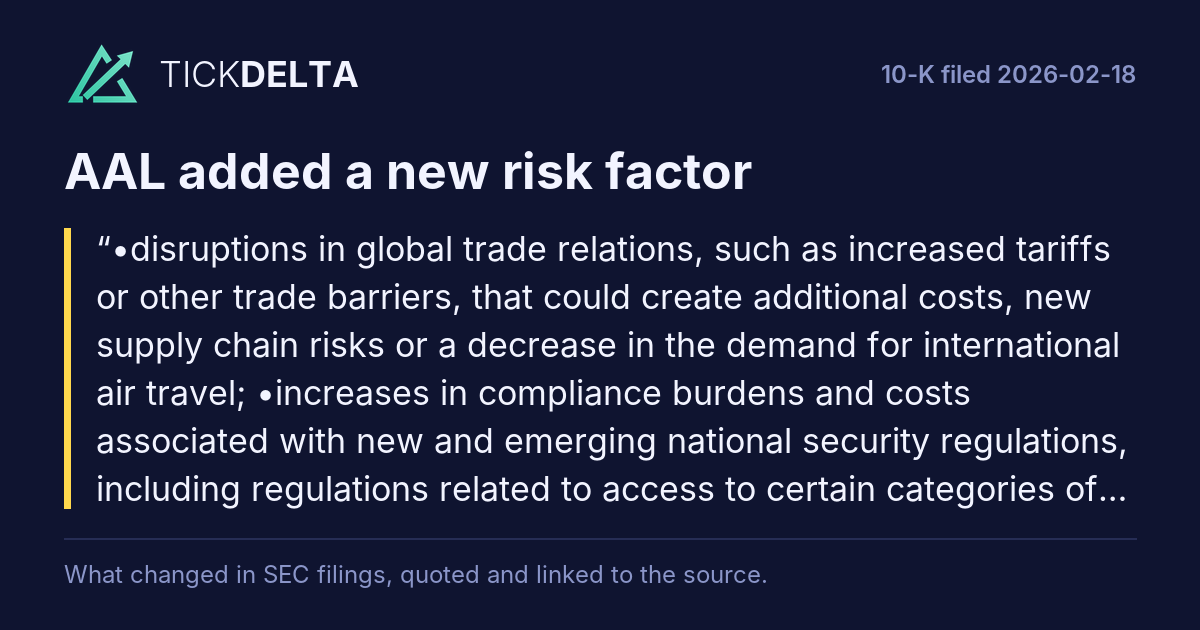
•disruptions in global trade relations, such as increased tariffs or other trade barriers, that could create additional costs, new supply chain risks or a decrease in the demand for international air travel;
•increases in compliance burdens and costs associated with new and emerging national security regulations, including regulations related to access to certain categories of personal information;
travel to specific regions as a result of health emergencies, geopolitical instability or other factors, and the speed with which demand for travel to these regions returns.
our services could adversely affect our business and financial results, as well as require additional resources to rebuild our reputation.
Additionally, new technologies, such as the use of AI and machine learning, present evolving and significant legal and operational risks for us and our third-party vendors. We use AI and machine learning technologies, including those licensed from third parties, in our technologies and our ability to continue to use such technologies at the scale may depend on access to specific third-party software and infrastructure. We cannot control the availability or pricing of such third-party AI and machine learning technologies, especially in a highly competitive environment, and we may be unable to negotiate favorable economic terms with the applicable providers. If any such third-party AI and machine learning technologies become incompatible with our solutions or are unavailable for use, or if the providers of such models unfavorably change the terms on which their AI technologies are offered or terminate their relationship with us, our solutions may become less appealing to our customers, and our business will be harmed. In addition, to the extent any third party AI and machine learning technologies are used as a hosted service, any disruption, outage, or loss of information through such hosted services could disrupt our operations or solutions, damage our reputation, cause a loss of confidence in our solutions, or result in legal claims or proceedings, for which we may be unable to recover damages from the affected provider.
We expect that increased investment will be required in the future to continuously improve our use of AI (including generative AI) and machine learning technologies. As with many technological innovations, there are significant risks involved in developing, maintaining and deploying these technologies and there can be no assurance that the usage of our investments in such technologies will always enhance our products or services or be beneficial to our business, including our efficiency or profitability. Additionally, the development of generative AI technologies is complex, with practical and competitive challenges in achieving desired accuracy, efficiency and reliability. Generative AI training
Additionally, in 2024, the National Security Division of the Department of Justice (DOJ) issued a new rule, referred to as the “Data Security Program” (DSP), to implement Executive Order 14117 aimed at preventing access to “bulk U.S. sensitive personal data” and “government-related data” by “countries of concern” (including China, Russia, Iran, North Korea, Cuba, and Venezuela) and so-called “covered persons.” The DSP imposes stringent obligations on companies that engage in transactions with persons and companies with a connection to countries of concern including by prohibiting or restricting certain data transfers and data transactions. The DSP is new, complex and has yet to be enforced, and as such, there is a risk that our interpretation of its applicability, scope, and requirements is incorrect, incomplete, or misapplied. Compliance with the DSP may require us to invest heavily in data security and compliance measures, such as implementing and complying with certain security requirements and guidelines and other burdensome recordkeeping, reporting, and auditing requirements. It may also require us to implement new processes, stop or restrict certain data transfers, alter the geographic scope of our operations, cease doing business with certain third parties or using certain tools or vendors, or change how data flows throughout our business, any of which could materially impact our business operations or hinder our ability to grow our business. Finally, non-compliance with the DSP could result in significant civil or criminal penalties, which could materially adversely affect our business, results of operations, and financial condition.
Even though we believe we and our third-party service providers are generally in compliance with applicable laws, rules and regulations relating to AI, data privacy and security, the regulatory environment is increasingly challenging as AI, data privacy and cybersecurity laws, rules, regulations, industry standards and other requirements are continually developing. These changing requirements, along with their evolving application, interpretation, and amendment, may present material obligations and risks to our business, including significantly expanded compliance burdens, costs and enforcement risks.
Show the other 3
costs or adversely impact our operation. The OBBBA included $12.5 billion in additional funding for ATC infrastructure and modernization. While this recent law and new funding should lead to ATC improvements, there is uncertainty on how and when the funding will be spent and if there will be any operational impacts as certain systems and infrastructure are modernized.
A prolonged disruption in U.S. federal government operations, including lapses in appropriations or extended continuing resolutions, has in the past and could in the future materially and adversely affect our business, financial condition and results of operations. When government agencies reduce or suspend operations, aviation system regulators—including the FAA and the TSA—may experience staffing constraints, furloughs, curtailed activities, and related operational limitations. In the fourth quarter of 2025, conditions led to mandated schedule reductions, strained air traffic control and security screening resources, reduced air traffic capacity at key U.S. airports, and increased delays and cancellations.
Shutdown-related uncertainty can also dampen both business and leisure travel demand and slow booking trends, causing short-term business challenges. In addition, curtailed FAA activities during shutdowns can delay regulatory
approvals and certifications necessary for airline operations, including those related to placing new aircraft into service, which can disrupt execution of fleet and growth plans.
Because the timing, duration, scope and operational effects of shutdowns and related capacity reduction mandates are uncertain—and can vary across airports and regions—future events of this nature could result in lower load factors and yields, higher unit costs, and reduced operational reliability. The cumulative impact of these factors could be material to our operations and financial performance.
Our ability to utilize our net operating losses (NOLs) and other carryforwards may be limited.
Paragraphs in the 10-Q filed Oct 22, 2026 that were not in the one before
New in the latest 10-Q
9 paragraphs in the 10-Q filed Oct 22, 2026 with nothing like them in the 10-Q filed Jul 23, 2026 (at least half the words must differ; new numbers alone do not count). Quoted exactly, grouped by the item heading above them. This is text that changed, not a judgement of how serious it is.
10-Q
(3) In the third quarter of 2026, we recorded an impairment charge related to our equity investment in Republic Airways Holdings Inc. (Republic Holdings). See Note 8 for further information on our equity investments.
Read in the 10-Q
(1) In the third quarter of 2026, we determined that the decline in the fair value of our equity method investment in Republic Holdings was other-than-temporary. Accordingly, we recorded a $ 78 million nonoperating special charge for the impairment of our equity investment in Republic Holdings and reduced the carrying value to the estimated fair value using quoted market prices.
Read in the 10-Q
(3) In the third quarter of 2026, American recorded an impairment charge related to its equity investment in Republic Airways Holdings Inc. (Republic Holdings). See Note 7 for further information on American’s equity investments.
Read in the 10-Q
(1) In the third quarter of 2026, American determined that the decline in the fair value of its equity method investment in Republic Holdings was other-than-temporary. Accordingly, American recorded a $ 78 million nonoperating special charge for the impairment of its equity investment in Republic Holdings and reduced the carrying value to the estimated fair value using quoted market prices.
Read in the 10-Q
Three Months Ended September 30, 2026 Compared to Three Months Ended September 30, 2025
Read in the 10-Q
Show the other 4
Nine Months Ended September 30, 2026 Compared to Nine Months Ended September 30, 2025
Read in the 10-Q
Three Months Ended September 30, 2026 Compared to Three Months Ended September 30, 2025
Read in the 10-Q
Nine Months Ended September 30, 2026 Compared to Nine Months Ended September 30, 2025
Read in the 10-Q
Item 6
10.1 Supplemental Agreement No. 38, dated as of August 7, 2026, to Purchase Agreement No. 03735 dated as of February 1, 2013, by and between American Airlines, Inc. and The Boeing Company.*
Read in the 10-Q
The 10-Q's risk factors against the 10-K
Item 1A of the 10-Q filed Oct 22, 2026 against Item 1A of the 10-K filed Feb 18, 2026.
A 10-Q repeats only the risks that changed, so a 10-K paragraph that is missing from it is not counted as removed.
Added is a paragraph with nothing like it in the 10-K, Reworded a sentence that is in both with several words changed,
Quiet changes a sentence in both where one to four words changed and one is a hedge or a modal
(cut words struck through, new words highlighted).
Text on the page, not a score; each links to the filing at sec.gov.
What the 10-Q itself says about its risk factors:There have been no material changes in our risk factors as previously disclosed in Part I, Item 1A in our 2025 Form 10-K. The risks in our 2025 Form 10-K are not the only risks facing AAG and American. Additional risks and uncertainties not currently known to us, or that we currently deem to be immaterial, could also materially adversely affect our business, financial condition or future results.
Read in the 10-Q
1 paragraph in the 10-Q's Item 1A, and none of them adds, rewords or quietly edits a paragraph of the 10-K's.
Phrases used for the first time
Two-word phrases in Risk Factors of the 10-K filed Feb 18, 2026 that are in none of the 1 earlier 10-Ks stored, back to Feb 19, 2025
Where each one is used
- new regulations: We are subject to taxation at the federal, state and local levels in the United States, as well as taxation in international jurisdictions in which we operate. New taxes, rates and charges may be imposed from time to time that significantly increase our costs, reduce revenues or otherwise negatively impact our...
- chain risks: •disruptions in global trade relations, such as increased tariffs or other trade barriers, that could create additional costs, new supply chain risks or a decrease in the demand for international air travel;
- national security: •increases in compliance burdens and costs associated with new and emerging national security regulations, including regulations related to access to certain categories of personal information;
- costs disrupt: Our international service exposes us to foreign economies and the potential for reduced demand when any foreign country we serve suffers adverse local economic conditions or if governments restrict commercial air services to or from any of these markets. In addition, “open skies” agreements, which are now in place...
- flexibility reduce: Our international service exposes us to foreign economies and the potential for reduced demand when any foreign country we serve suffers adverse local economic conditions or if governments restrict commercial air services to or from any of these markets. In addition, “open skies” agreements, which are now in place...
- create competitive: Our international service exposes us to foreign economies and the potential for reduced demand when any foreign country we serve suffers adverse local economic conditions or if governments restrict commercial air services to or from any of these markets. In addition, “open skies” agreements, which are now in place...
- card partner: We may also be impacted by regulations affecting certain of our major commercial partners, including our co-branded credit card partner, or our loyalty program. For example, there has been bipartisan legislation proposed in Congress called the Credit Card Competition Act designed to increase credit card transaction...
- executive branch: We may also be impacted by regulations affecting certain of our major commercial partners, including our co-branded credit card partner, or our loyalty program. For example, there has been bipartisan legislation proposed in Congress called the Credit Card Competition Act designed to increase credit card transaction...
Used at least twice, small words left out. Counted, not picked: a phrase can be new because the company renamed something.
What was taken out
20 paragraphs of last year's Risk Factors with nothing like them now. The longest are quoted.
Sources
Item 1A of each 10-K and 10-Q on EDGAR, quoted exactly. Each paragraph links to the filing at sec.gov.
Also
10-K change: what was reworded or cut, section by section.
Work with it
Excel workbook · CSV. Google Sheet that stays up to date: paste =IMPORTDATA("https://tickdelta.com/company/AAL/export.csv") into a cell.