Added10-Q Nov 9, 2026 vs 10-K Mar 2, 2026
Risks Related to Material Weakness In Internal Controls Over Financial Reporting
Each branch is a paragraph in Risk Factors with nothing like it in the 10-K filed Feb 27, 2025. A box jumps to the paragraph as filed, below.
7 paragraphs in Risk Factors of the 10-K filed Mar 2, 2026 with nothing like them in the 10-K filed Feb 27, 2025. Quoted exactly. Paragraphs that were only edited are under 10-K change.
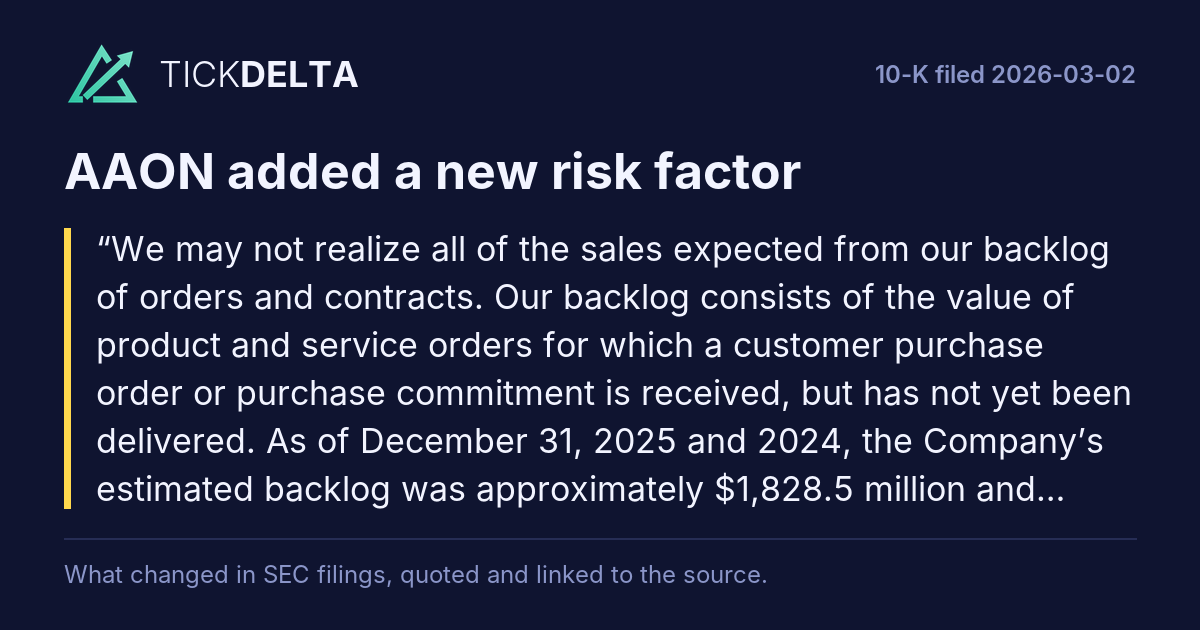
We may not realize all of the sales expected from our backlog of orders and contracts.
Our backlog consists of the value of product and service orders for which a customer purchase order or purchase commitment is received, but has not yet been delivered. As of December 31, 2025 and 2024, the Company’s estimated backlog was approximately $1,828.5 million and $867.1 million, respectively. The majority of our combined backlog is considered firm and expected to be delivered within 12 to 18 months. Our customers have the right in some circumstances, usually with penalties or other termination consequences, to reduce or defer firm orders in backlog. If customers terminate, reduce or defer firm orders, the revenue we expect to generate from our backlog may not be fully realized. Also, due to our large backlog, pricing changes may take longer to be reflected in our financial results.
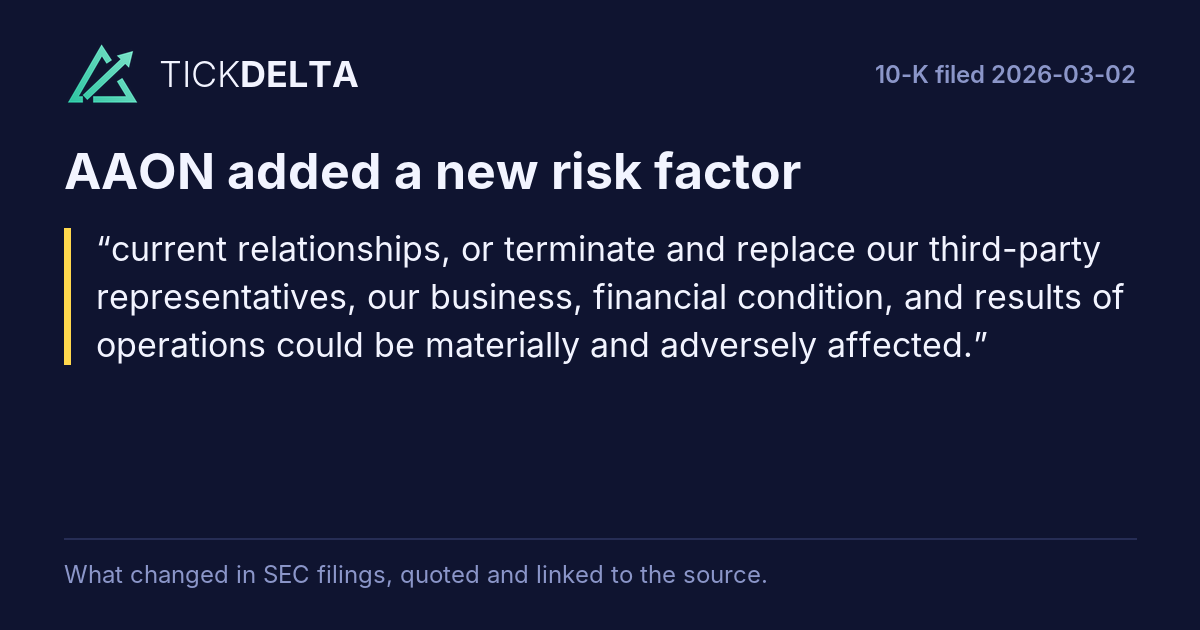
current relationships, or terminate and replace our third-party representatives, our business, financial condition, and results of operations could be materially and adversely affected.
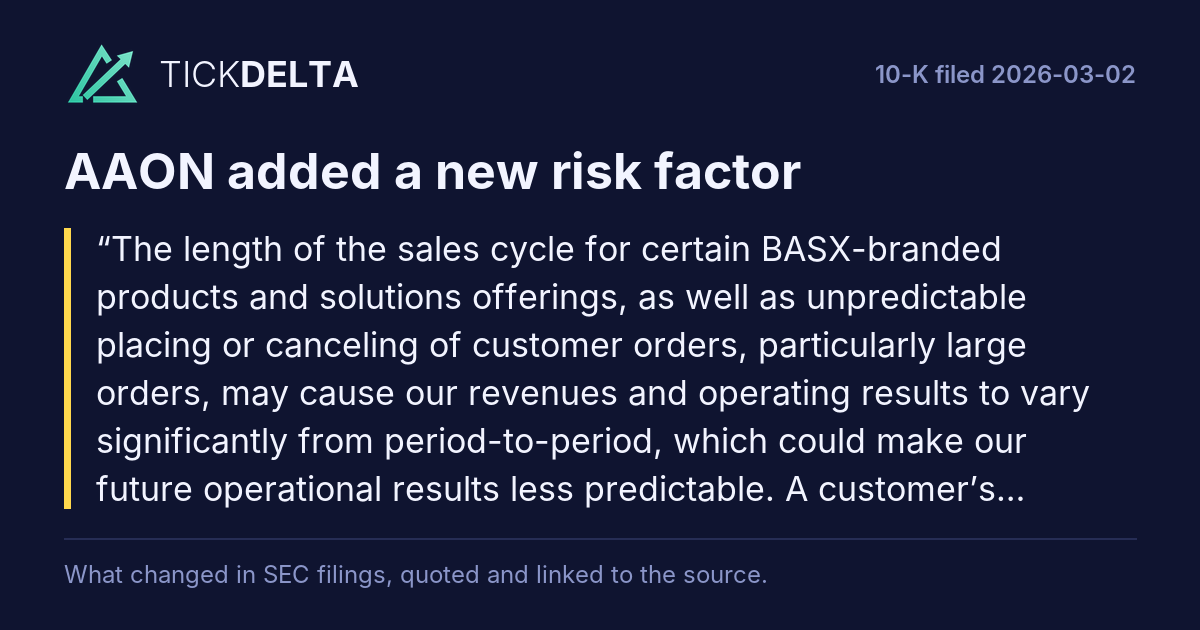
The length of the sales cycle for certain BASX-branded products and solutions offerings, as well as unpredictable placing or canceling of customer orders, particularly large orders, may cause our revenues and operating results to vary significantly from period-to-period, which could make our future operational results less predictable.
A customer’s decision to purchase certain of our products or solutions, particularly products new to the market or long-term end-to-end solutions, may involve a lengthy contracting, design and qualification process. In particular, customers deciding on the design and implementation of large deployments may have lengthy and unpredictable procurement processes that may delay or impact expected future orders, including customers canceling orders based on unforeseen changes to their businesses. As a result, the order booking and sales recognition process is often uncertain and unpredictable, with some customers placing large orders with short lead times on little advance notice and others requiring lengthy, open-ended processes that may change depending on global or regional economic conditions. This unpredictability may cause our revenues and operating results to vary unexpectedly from quarter-to-quarter and year-to-year, making our future operational results less predictable.
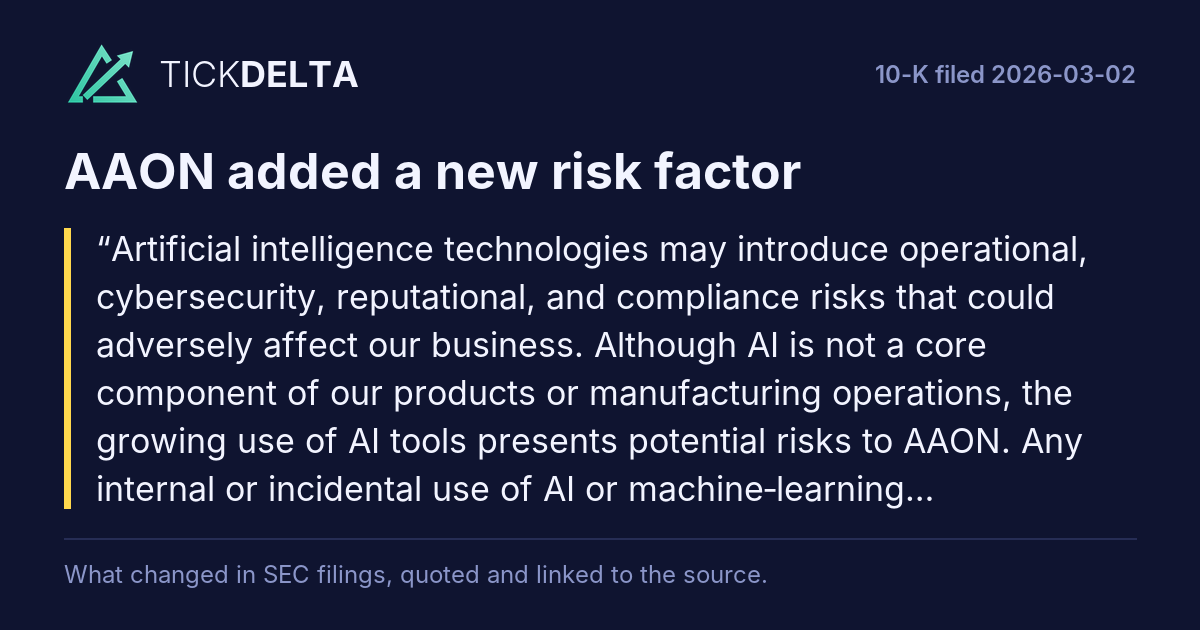
Artificial intelligence technologies may introduce operational, cybersecurity, reputational, and compliance risks that could adversely affect our business.
Although AI is not a core component of our products or manufacturing operations, the growing use of AI tools presents potential risks to AAON. Any internal or incidental use of AI or machine‑learning technologies—such as in engineering, data analysis, customer support, or administrative processes—may expose the Company to risks involving data privacy, cybersecurity, protection of proprietary information, intellectual property rights, and regulatory compliance. As AI capabilities rapidly evolve, our ability to evaluate, monitor, and govern their use may not keep pace. Employees, contractors, or third‑party partners could unintentionally or improperly use AI tools, which may lead to unauthorized disclosure of sensitive information, inaccurate or biased outputs, or other unintended consequences. These risks could negatively impact operational performance, decision‑making, and interactions with customers or suppliers. AI technologies are also subject to increasing regulatory scrutiny. New or evolving laws, standards, or reporting requirements applicable to AI could impose additional compliance obligations on AAON. If we do not implement appropriate controls and oversight mechanisms governing the use of AI, we could experience operational disruptions, reputational harm, litigation risk, or competitive disadvantage if other companies adopt AI more effectively to improve efficiency or reduce costs.
New in the latest 10-Q
23 paragraphs in the 10-Q filed Nov 9, 2026 with nothing like them in the 10-Q filed Aug 10, 2026 (at least half the words must differ; new numbers alone do not count). Quoted exactly, grouped by the item heading above them. This is text that changed, not a judgement of how serious it is.
On October 27, 2026, following the completion of the applicable seven-year compliance period, the Company completed the unwind of its 2019 NMTC transaction. As a result of the unwind, the related NMTC financing structure was terminated. The Company is expected to have a noncash gain of approximately $7.0 million related to the unwind in the fourth quarter.
Read in the 10-Q
On August 21, 2026, AAON, Inc., a Nevada corporation (the "Company") announced that it would operate under the trade name The Aaon Group. This new enterprise identity reflects the Company's evolution into a multi-brand organization with a clear distinction between the enterprise and the Company's operating brands, AAON and BASX.
Read in the 10-Q
The planned replacement and retrofit market continues to be an important source of demand for AAON-branded products and has historically been less sensitive to economic cycles than new construction. Sales in the replacement markets are sustained by an aging domestic equipment base, tightening environmental and efficiency regulations, and customers' growing preference for high-quality, premium efficiency, configurable equipment that lowers long-term operating cost. During periods of softer new construction activity, we are increasingly engaged in these opportunities as the market opportunity shifts.
Read in the 10-Q
Demand for our BASX-branded products is driven primarily by the data center market and, to a lesser extent, the advanced cleanroom market. Data center construction activity in the U.S. has continued to grow in 2026, and our customers' published capital spending plans indicate continued investment. The continued adoption of artificial intelligence and high-performance computing is increasing computing density and, in turn, the cooling requirements of data centers, which has supported strong demand for our liquid cooling and custom air-handling solutions. Because data center projects are large and planned well in advance, demand in this market has generally been driven more by customers' long-term capacity plans than by near-term economic conditions.
Read in the 10-Q
To meet this demand, we have made substantial investments to expand our manufacturing capacity and capabilities. Production volumes have increased as this capacity comes online, although the pace is dependent on customer project schedules. However, a significant portion of our data center sales comes from a limited number of customers, and the timing of their orders and deliveries can vary. As a result, changes in their capital spending plans or project schedules could cause our results to fluctuate from period to period.
Read in the 10-Q
Beginning in January 2025, the current United States (“U.S.”) Administration began enacting a series of tariffs affecting nearly all goods imported into the U.S. In February 2026, the U.S. Supreme Court held that tariffs imposed under the International Emergency Economic Powers Act were not authorized, and refunds of those duties are being processed by U.S. Customs and Border Protection. Tariffs imposed under other authorities, including Section 232 tariffs on steel, aluminum and copper, were not affected by the ruling and were expanded during 2026. Ongoing changes in trade policy can affect the cost and availability of materials, parts and components throughout our supply chain.
Read in the 10-Q
identify favorable procurement opportunities or potential supply disruptions, and we work closely with our vendors to manage supply chain challenges as well as expanding our list of available vendors.
Read in the 10-Q
volume coming from our Memphis facility, partially offset by higher costs related to outsourcing of materials to support robust growth.
Read in the 10-Q
Working Capital - Our unrestricted cash and cash equivalents remained stable as we apply available cash against our revolver. Restricted cash increased $2.4 million from December 31, 2025 to September 30, 2026 due to the net proceeds from the 2026 NMTC transaction. During the second quarter of 2026, we received net proceeds of $12.9 million from the 2026 NMTC transaction, which were restricted for use on our Memphis, Tennessee facility. During the third quarter of 2026, these funds were released to reimburse us for qualifying Memphis capital expenditures previously funded with borrowings under our Revolver, and we used the proceeds to reduce our Revolver balance.
Read in the 10-Q
On October 27, 2026, following the completion of the applicable seven-year compliance period, the Company completed the unwind of its 2019 NMTC transaction. As a result of the unwind, the related NMTC financing structure was terminated. The Company is expected to have a noncash gain of approximately $7.0 million related to the unwind in the fourth quarter.
Read in the 10-Q
• the material weakness in the effectiveness of our internal controls over financials reporting identified in this Quarterly Report on Form 10-Q, and the impact of our ability to adequately remediate the material weakness in a timely manner;
Read in the 10-Q
Notwithstanding such material weakness in our internal control over financial reporting, Company management, including our Chief Executive Officer and Chief Financial Officer, concluded that our consolidated financial statements in this quarterly report present fairly, in all material respects, our financial position, results of operations and cash flows for the periods presented, in conformity with US GAAP.
Read in the 10-Q
A material weakness is a deficiency, or combination of deficiencies, in internal control over financial reporting, such
Read in the 10-Q
that there is a reasonable possibility that a material misstatement of our annual or interim financial statements will
Read in the 10-Q
We did not maintain an effective control environment based on the criteria established in the Committee of Sponsoring Organizations of the Treadway Commissions (“COSO”) in the 2013 Internal Control-Integrated Framework (“2013 Framework”) and identified deficiencies in the principles associated with the Control Activities and Communication component of the 2013 Framework that constitute a material weakness, either individually or in the aggregate. The Company had previously identified control deficiencies that did not rise to the level of a material weakness related to processes associated with our ERP implementation in 2025 and driven by the increased growth and volume of the business. As part of our efforts to strengthen our internal control and remediate prior deficiencies, we identified certain errors, which have been corrected. As a result, we have restated our Q1 and Q2 Form 10Qs and identified the following material weakness, which exists as of September 30, 2026:
Read in the 10-Q
• We did not design and maintain adequate controls within the BASX-branded revenue process that resulted in a material weakness, either individually or in the aggregate. Primarily, the identified deficiencies included controls over the assignment of costs to the appropriate projects to ensure proper revenue recognition. We did not design and maintain adequate controls over certain aspects of the financial statement close process related to BASX-branded revenue. Specifically, controls related to account reconciliation, analysis and review related to key financial statement accounts did not operate timely and with complete and accurate information.
Read in the 10-Q
Over the past few years, our business has been in transition as we are expanding our internal infrastructure to support future growth and more complex business operations. This overall growth and increase in complexity of our business and its operations has strained our control structure that supports the effective operation of internal controls over accounting and financial reporting processes. We are committed to maintaining strong internal control over financial reporting. Management, with the oversight of the Audit Committee of the Board of Directors is taking comprehensive actions to remediate the material weakness described above. Our remediation plan includes the following:
Read in the 10-Q
• We are enhancing the design of existing controls and implementing new controls related to revenue, the financial close and reporting process. These include improvements to the tracking of costs and to the timely review of estimated costs to complete projects, including assessing our information technology systems for opportunities to reduce the reliance on manual controls over financial reporting.
Read in the 10-Q
• We are updating documentation, expanding education and training, and ensuring that controls are executed and reviewed for accurate reporting.
Read in the 10-Q
The material weakness will not be considered remediated until the new and redesigned controls operate for a sufficient period of time and management has concluded, through testing, that these controls are operating effectively. We believe the above measures, along with enhanced senior leadership’s oversight and monitoring of the internal control environment, will remediate the control deficiencies identified and strengthen our internal control over financial reporting. As we continue to evaluate and work to remediate the control deficiencies that gave rise to the material weakness, we may determine that additional measures are required to address the control deficiencies or that we need to modify or otherwise adjust the remediation measures described above. We will continue to assess the effectiveness of our remediation efforts in connection with our evaluation of our internal control over financial reporting.
Read in the 10-Q
Risks Related to Material Weakness In Internal Controls Over Financial Reporting
Read in the 10-Q
We have identified a material weakness in our internal controls over financial reporting which has resulted in the restatement of our previously issued financial statements. If our remedial measures are insufficient to timely and adequately address the material weakness, or if additional material weaknesses or significant deficiencies in our internal controls over financial reporting are discovered or occur in the future, our consolidated financial statements may contain material misstatements and we could be required to further restate our financial results, which could adversely affect our stock price.
Read in the 10-Q
Although we plan to complete the remediation process in a timely and prudent manner, we cannot at this time estimate how long it will take, and our measures may not prove to be successful in remediating the material weakness. If our remedial measures are insufficient to address the material weakness, or if an additional material weakness or significant deficiencies in our internal control over financial reporting are discovered or occur in the future, our consolidated financial statements may contain material misstatements and we could be required to further restate our financial results. In addition, if we are unable to successfully remediate the material weakness in our internal controls over financial reporting or if we are unable to produce accurate and timely financial statements, our stock price may be adversely affected.
Read in the 10-Q
Item 1A of the 10-Q filed Nov 9, 2026 against Item 1A of the 10-K filed Mar 2, 2026.
A 10-Q repeats only the risks that changed, so a 10-K paragraph that is missing from it is not counted as removed.
Added is a paragraph with nothing like it in the 10-K, Reworded a sentence that is in both with several words changed,
Quiet changes a sentence in both where one to four words changed and one is a hedge or a modal
(cut words struck through, new words highlighted).
Text on the page, not a score; each links to the filing at sec.gov.
What the 10-Q itself says about its risk factors:In addition to the other information set forth in this report, you should carefully consider the factors discussed in Part I, “Item 1A. Risk Factors” in our Annual Report on Form 10-K for the year ended December 31, 2025. The risk factors described in our Annual Report could materially adversely affect our business, financial condition or future results. There have been no material changes to the risk factors included in our 2025 Annual Report.
Read in the 10-Q
Two-word phrases in Risk Factors of the 10-K filed Mar 2, 2026 that are in none of the 1 earlier 10-Ks stored, back to Feb 27, 2025
Used at least twice, small words left out. Counted, not picked: a phrase can be new because the company renamed something.
Item 1A of each 10-K and 10-Q on EDGAR, quoted exactly. Each paragraph links to the filing at sec.gov.
10-K change: what was reworded or cut, section by section.
Excel workbook · CSV. Google Sheet that stays up to date: paste =IMPORTDATA("https://tickdelta.com/company/AAON/export.csv") into a cell.