tickdelta
Sign in

Tickdelta is free for now. Sign up and get Pro free

← Screener

AAPLApple Inc.

Technology · Computer Hardware · Nasdaq
Compare with peers → Embed
The 10-K against last year's

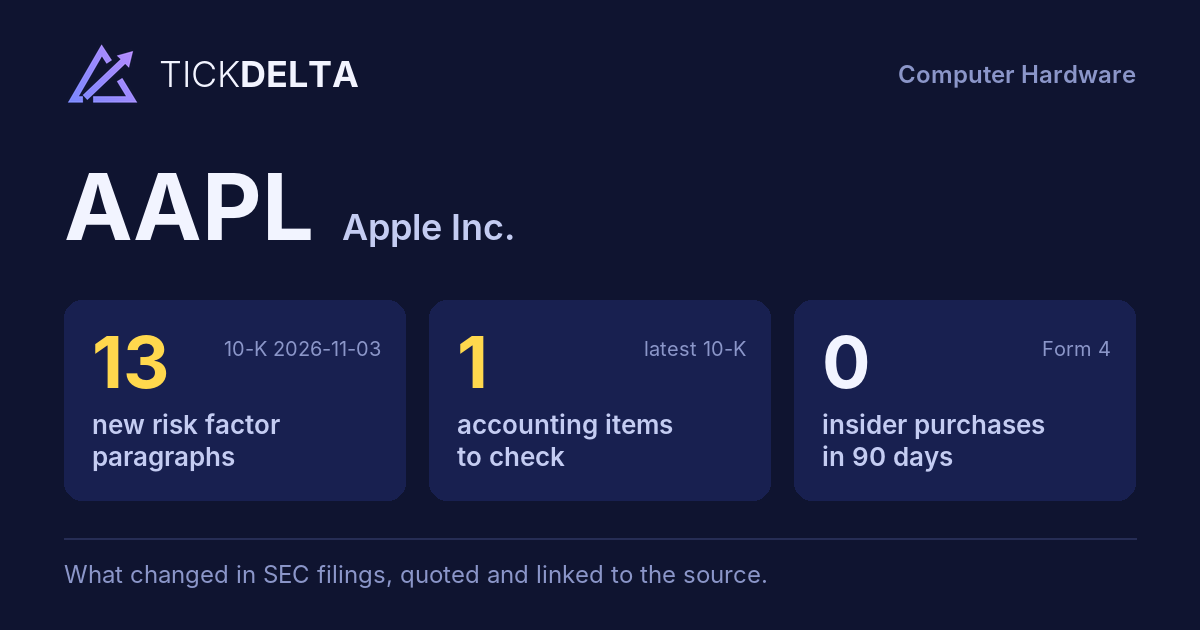
145 changes: 14 added, 4 removed, 124 reworded, 3 quiet changes

10-K Nov 3, 2026 vs Oct 31, 2025
Risk FactorsRedline ↓
26.4%
of the text changed · 12,172 words now
20.7%
of the text changed · 2,221 words now
Legal ProceedingsRedline ↓
18.8%
of the text changed · 779 words now
Accounting PoliciesRedline ↓
15.3%
of the text changed · 385 words now

10-K 0000320193-26-000026 (2026-11-03) vs 10-K 0000320193-25-000079 (2025-10-31)

The redline

The paragraph that changed most in each section

Marked against last year's 10-K: cut words struck through, new words highlighted and underlined.

Risk Factors 401 words changed in this paragraph; it is 55% similar to last year's version.
The Company has a large, global business with sales outside the U.S. representing a majority of the Company’s total net sales, and the Company believes that it generally benefits from growth in international trade. A significant majority of the Company’s manufacturing is performed in whole or in part by outsourcing partners located primarily in China mainland, India, Japan, South Korea, Taiwan and Vietnam, in addition to sourcing from partners and facilities located in the U.S. Global supply chains can be highly concentrated, and an escalation of geopolitical tensions, conflict or instability, particularly in regions where the Company relies on single or limited sources for critical components, such as advanced semiconductors, memory and storage, or that are significant to global commodity markets such as oil, gas, rare earths, and other raw materials, could result in significant disruptions. Restrictions on international trade, such as tariffs and other controls on imports or exports of goods, technology technologies, including artificial intelligence and super intelligence technologies, or data, can materially adversely affect the Company’s business and supply chain. The impact can be chain, particularly significant if these restrictive such measures apply to countries and regions where the Company derives a generates significant portion of its revenues and/or revenue or has significant supply chain operations. Restrictive These measures can increase the cost or limit the availability of the Company’s products and the components and components, rare earths and other raw materials that go into them. Restrictive measures can also them; require the Company to change suppliers, suppliers or restructure business relationships and operations, operations; require the Company to refrain from offering and or cease offering, distributing or cease to offer and distribute incorporating affected products, services and services, third-party applications or technologies, including artificial intelligence technologies; and cause the Company to its customers, and increase the prices of its products and services. Changing the Company’s business and supply chain in accordance with response to new or changed restrictions on international trade can be expensive, time-consuming and disruptive to the Company’s business and results of operations. disruptive. Trade and other international disputes can also have an adverse adversely impact on the overall macroeconomic environment and result environment, resulting in shifts and reductions in reduced consumer spending and negative consumer sentiment for the Company’s products and services, all of which can further adversely affect the Company’s business and results of operations. services. Such restrictions can be announced with little or no advance notice, which can create creating uncertainty, and the Company may not be able to effectively mitigate any or all adverse impacts from such measures. Global supply chains can be highly concentrated, and an escalation of geopolitical tensions or conflict could result in significant disruptions. Beginning in the second quarter of 2025, new tariffs were announced on imports to the U.S. (“U.S. Tariffs”), including additional tariffs on imports from China, India, Japan, South Korea, Taiwan, Vietnam and the European Union (“EU”), among others. In response, several countries have imposed, or threatened to impose, reciprocal tariffs on imports from the U.S. and other retaliatory measures. Various modifications to the U.S. Tariffs have been announced and further changes could be made in the future, which may include additional sector-based tariffs or other measures. For example, the U.S. Department of Commerce has initiated an investigation under Section 232 of the Trade Expansion Act of 1962, as amended, into, among other things, imports of semiconductors, semiconductor manufacturing equipment, and their derivative products, including downstream products that contain semiconductors. The ultimate impact remains uncertain and will depend on several factors, including whether additional or incremental U.S. Tariffs or other measures are announced or imposed, to what extent other countries implement tariffs or other retaliatory measures in response, and the overall magnitude and duration of these measures. If disputes and conflicts further escalate, actions by governments in response could be significantly more severe and restrictive.

Source: Item 1A, 10-K 0000320193-26-000026 vs Item 1A, 10-K 0000320193-25-000079

Legal Proceedings 284 words changed in this paragraph; it is 56% similar to last year's version.
Epic Games, Inc. filed a lawsuit in the U.S. California District Court for the Northern District of California (“California District Court”) against the Company alleging violations of federal and state antitrust laws and California’s unfair competition law based upon the Company’s operation of its App Store. The California District Court found that certain provisions of the Company’s App Review Guidelines violate California’s unfair competition law and issued an injunction (the “2021 Injunction”) enjoining the Company from prohibiting developers from including in their apps buttons, external links, or other calls to action that direct customers to purchasing mechanisms other than the Company’s in-app purchase system. The 2021 Injunction applies to apps on the U.S. storefronts of the iOS and iPadOS App Stores. On January 16, 2024, the Company implemented a plan to comply with the 2021 Injunction and filed a statement of compliance with the California District Court. On September 30, 2024, the Company filed a motion with the California District Court to narrow or vacate the 2021 Injunction. On April 30, 2025, the California District Court found the Company to be in violation of the 2021 Injunction and enjoined the Company from imposing any commission or any fee on purchases that consumers make outside an app; restricting, conditioning, limiting, or prohibiting how developers guide consumers to purchases outside an app; or otherwise interfering with a consumer’s choice to proceed in or out of an app. The California District Court also denied the Company’s motion to narrow or vacate the 2021 Injunction and referred the Company to the U.S. Attorney for the Northern District of California for a determination whether criminal contempt proceedings are appropriate. app (the “2025 Injunction”). The Company will continue to vigorously defend its actions and employees, and has appealed the California District Court’s most recent April 2025 decision to the U.S. Court of Appeals for the Ninth Circuit (“Ninth Circuit Court”). Although the Company’s request to stay the decision pending appeal was denied, Court. On December 11, 2025, the Ninth Circuit Court has agreed issued an order upholding the 2025 Injunction in part and modifying certain aspects to consider allow the Company to require parity in size, form and placement between the Company’s appeal in-app purchase and any links for consumers to make purchases outside an app. The Ninth Circuit Court also held that the Company can charge some commission on an expedited basis, link-out purchases, and remanded to the California District Court to further amend or modify the 2025 Injunction, consistent with oral arguments heard in October 2025. the Ninth Circuit Court’s order. On May 21, 2026, the Company filed a petition seeking Supreme Court review of the Ninth Circuit Court’s opinion. On June 30, 2026, the Supreme Court granted the Company’s petition to review the applicable legal standard for civil contempt.

Source: Item 3, 10-K 0000320193-26-000026 vs Item 3, 10-K 0000320193-25-000079

MD&A 199 words changed in this paragraph; it is 69% similar to last year's version.
Beginning in the second quarter of 2025, new U.S. Tariffs tariffs were announced, announced on imports to the U.S., including additional tariffs on imports from China, China mainland, India, Japan, South Korea, Taiwan, Vietnam and the EU, among others. In response, several countries have imposed, or threatened to impose, reciprocal tariffs on imports from the U.S. and other retaliatory measures. Various modifications to On January 14, 2026, initial results were published of the U.S. Tariffs have been previously announced and further changes could be made in the future, which may include additional sector-based tariffs or other measures. For example, the U.S. Department of Commerce has initiated an investigation under Section 232 of the Trade Expansion Act of 1962, as amended, into, among other things, into imports of semiconductors, semiconductor manufacturing equipment, and their derivative products, including downstream products that contain semiconductors. The announcement of the initial results of the investigation did not impose any additional tariffs affecting the Company’s products. Separately, on February 20, 2026, the Supreme Court issued a ruling striking down certain tariffs previously imposed under the International Emergency Economic Powers Act of 1977. The Company has applied for a refund of tariffs paid, following the processes established by U.S. Customs and Border Protection, and has recognized any refunds received as a reduction of products cost of sales. Various modifications to U.S. tariffs have been announced, including the recent imposition of tariffs under Section 301 of the Trade Act of 1974, and further changes could be made in the future, which may include additional measures under the Section 232 semiconductor sector investigation, additional sector-based tariffs, further actions under Section 301, or other measures. Tariffs and other measures that are applied to the Company’s products or their components can have a material adverse impact on the Company’s business, results of operations and financial condition, including impacting the Company’s supply chain, the availability of rare earths and other raw materials and components, pricing and gross margin. The ultimate impact remains uncertain and will depend on several factors, including whether additional or incremental U.S. Tariffs tariffs or other measures are announced or imposed, to what extent other countries implement tariffs or other retaliatory measures in response, and the overall magnitude and duration of these measures. Trade and other international disputes can have an adverse impact on the overall macroeconomic environment and result in shifts and reductions in consumer spending and negative consumer sentiment for the Company’s products and services, all of which can further adversely affect the Company’s business and business, results of operations. operations and financial condition.

Source: Item 7, 10-K 0000320193-26-000026 vs Item 7, 10-K 0000320193-25-000079

Accounting Policies 94 words changed in this paragraph; it is 50% similar to last year's version.
Beginning with the 2025 2026 annual reporting period, the Company adopted the FASB’s ASU No. 2023-07, Segment Reporting 2023-09, Income Taxes (Topic 280): 740): Improvements to Reportable Segment Income Tax Disclosures (“ASU 2023-07”), 2023-09”), which requires the Company to disclose segment expenses specified additional information in its income tax rate reconciliation and provide additional information for reconciling items that are significant and regularly provided to the Company’s chief operating decision maker (“CODM”). In addition, meet a quantitative threshold. ASU 2023-07 2023-09 also requires the Company to disclose the title disaggregate its income taxes paid disclosure by federal, state and position of its CODM local, and how the CODM uses segment profit or loss information in assessing segment performance and deciding how to allocate resources. foreign taxes, with further disaggregation required for significant individual jurisdictions. The Company adopted ASU 2023-07 2023-09 using a retrospective prospective transition method.

Source: Item 8, Note 1 – Summary of Significant Accounting Policies, 10-K 0000320193-26-000026 vs Item 8, Note 1 – Summary of Significant Accounting Policies, 10-K 0000320193-25-000079
Every change, by type

Sentences and paragraphs added, removed or reworded

Sentences and paragraphs of AAPL's Risk Factors and MD&A, 10-K 2026-11-03 against 10-K 2025-10-31. Each links to the text at sec.gov.

AddedRisk Factors
The Company competes with a number of companies in the development and deployment of artificial intelligence and has made significant investments in building artificial intelligence features and related infrastructure across its products and services. Failure to successfully develop, deploy or differentiate artificial intelligence capabilities, or to do so as quickly or cost-effectively as competitors, could result in loss of market share, erosion of competitive positioning, and inability to attract or retain customers and talent.

Read it in 10-K 2026-11-03 at sec.gov ↗

AddedRisk Factors
The Company’s business, including its artificial intelligence and machine learning offerings, also depends on access to sufficient compute capacity and storage resources. Demand for cloud compute and storage services and other artificial intelligence infrastructure has increased substantially across the technology industry, resulting in constrained supply, extended lead times, and increasing costs. In addition to its own data center infrastructure, the Company relies on third-party cloud service providers to meet these compute and storage needs. There are limited third-party providers that can reliably meet such demand, and the Company may be unable to secure sufficient capacity on commercially reasonable terms, or at all, to meet customer demand. Investment in data center capacity involves significant expenditures and long-term commitments, including for components and equipment, which increase the Company’s capital expenditures, liabilities and obligations. The ability of the Company and its third-party providers to timely build, expand and operate data centers is subject to operational challenges and other external factors, including restrictions on international trade, supply chain constraints, access to financing, construction delays, the availability of power, water and land, labor shortages, public sentiment, as well as existing and evolving laws governing the permitting, zoning, operation and taxation of data centers. In addition, new or expanding environmental regulations could increase the costs associated with operating and expanding the Company’s or its third-party providers’ data center infrastructure or limit the ability to expand in certain jurisdictions. Data center operations are also subject to risks related to power transmission and other utility outages, telecommunications and network failures, cybersecurity attacks, and other interruptions outside the Company’s control. If the Company is unable to obtain and maintain adequate compute capacity and storage resources in a timely manner or at commercially reasonable rates, this can limit the functionality and availability of the Company’s products, services and features, delay the deployment of new features or offerings, or cause the Company to incur significantly higher costs. In addition, the Company may overestimate or underestimate requirements, which could result in higher-than-expected costs for the Company or an inability to fully satisfy customer demand or expectations.

Read it in 10-K 2026-11-03 at sec.gov ↗

AddedRisk Factors
The Company distributes third-party applications through the App Store. Where applicable, the Company may retain a commission from sales of applications and sales of digital services or goods initiated within an application. If third-party developers use alternative methods of distribution and payment for their applications and digital content, including direct-to-consumer distribution models, the Company may earn a lower commission on such sales, or may not earn a commission at all.

Read it in 10-K 2026-11-03 at sec.gov ↗

AddedRisk Factors
Third-party developers may also engage in fraudulent, deceptive or illegal conduct that could harm the Company’s business, customers and reputation. Despite the Company’s significant investment in review processes, security measures and other controls designed to prevent abuse of its platforms, some third-party developers have engaged, and may in the future engage, in fraudulent activity or other illegal or improper behavior and the Company may not be able to timely or effectively prevent, detect or remediate such conduct. These risks may be exacerbated by the use of artificial intelligence by bad actors seeking to circumvent the Company’s review processes, security measures and other controls. Any such conduct, or the perception that the Company has failed to adequately prevent, detect or respond to such risks, could damage customer trust and the Company’s brand and reputation, result in a decline in customer use of the Company’s products and services, and subject the Company to litigation, regulatory investigations, fines or other legal liability.

Read it in 10-K 2026-11-03 at sec.gov ↗

AddedRisk Factors
The rapid advancement and widespread dissemination of artificial intelligence technologies significantly increases the risks associated with cybersecurity attacks. For example, artificial intelligence technologies are producing highly targeted phishing campaigns, automating the discovery or exploitation of vulnerabilities, generating deepfake content designed to bypass authentication protocols, and identifying and exploiting vulnerabilities at a greater scale and at a highly accelerated pace. As increasingly sophisticated and capable artificial intelligence models continue to become available, these risks are intensifying. Sophisticated and widespread cybersecurity attacks pose substantial systemic risks, such as cascading failures across interconnected systems, and potential disruptions to critical infrastructure and market stability. In addition, artificial intelligence technologies are themselves susceptible to security threats, and the development, deployment and use of artificial intelligence by the Company, its employees and its suppliers exposes the Company to additional vulnerabilities and attacks.

Read it in 10-K 2026-11-03 at sec.gov ↗

AddedRisk Factors
Issues related to artificial intelligence may result in reputational, competitive and financial harm to the Company, regulatory action, legal liability, and other adverse effects to the Company’s business.

Read it in 10-K 2026-11-03 at sec.gov ↗

AddedRisk Factors
Artificial intelligence technologies are increasingly integrated into the Company’s products and services and its business and operations. These technologies present emerging legal, regulatory, ethical and operational risks.

Read it in 10-K 2026-11-03 at sec.gov ↗

AddedRisk Factors
For example, the Company’s artificial intelligence efforts may give rise to risks related to, among other things: competition and strategy; recouping costs and returns on investments; product liability; intellectual property infringement; data privacy; cybersecurity; sanctions and export controls; unauthorized access to or inadvertent releases of confidential information or other unexpected access to or use of user information; exposing users to harmful, inaccurate or other negative content or experiences; unintended or unauthorized actions by autonomous or agentic systems; misuse of artificial intelligence by employees and other personnel; changing public sentiment; bias and discrimination; and online safety and protection of minors. While the Company is committed to developing and deploying artificial intelligence responsibly, the Company may be unsuccessful in identifying or resolving all potential issues and failures before they arise. As a result, the Company could be exposed to reputational and competitive harm, regulatory action, legal liability, and other adverse effects to its business.

Read it in 10-K 2026-11-03 at sec.gov ↗

Show the other 5
AddedRisk Factors
In particular, artificial intelligence agents and other technologies can take actions autonomously, including interacting with internal or external systems that in some cases they may not be authorized to access, executing or altering code, sending communications, and completing transactions. Such technologies, whether developed or deployed by the Company or by third parties, may behave in unintended or unpredictable ways, including by taking actions that were not directed, instructed or authorized, exceeding permissions, defying directions or resisting instructions, circumventing the Company’s or third parties’ security measures and other controls, or being manipulated or compromised through malicious inputs or by bad actors. In addition, such technologies may conceal actions, hide, withhold or manipulate information, or generate inaccurate or deceptive outputs. Because many of these technologies are nondeterministic, their behavior can be difficult to anticipate, control, test and audit, and errors can compound across multistep workflows. Some consequences, such as deleting data or completing transactions, may be difficult or impossible to reverse. Moreover, the Company’s ability to oversee and control third-party artificial intelligence agents and other technologies may be limited. Artificial intelligence tools may be used in ways that violate the Company’s policies, contractual obligations or applicable laws, produce unintended consequences, or intentionally misuse authorized access, and the Company’s policies and controls may not keep pace with rapidly advancing technologies or prevent or timely detect such misuse.

Read it in 10-K 2026-11-03 at sec.gov ↗

AddedRisk Factors
The divergent and rapidly evolving nature of legal and regulatory frameworks around artificial intelligence and super intelligence and increased scrutiny from lawmakers and regulators create significant uncertainty. The Company may not always be able to anticipate how courts and regulators will apply existing laws and regulations to artificial intelligence, predict how new legal and regulatory frameworks will develop to address artificial intelligence, or otherwise respond to these frameworks as they are still rapidly evolving. The Company may also have to incur significant expenditures to adapt to new legal frameworks and adjust its offerings in certain jurisdictions if the legal frameworks on artificial intelligence are not consistent across jurisdictions. The Company also cannot predict how various laws and regulations related to online services, intermediary liability, and other issues will apply to content generated by artificial intelligence. In addition, the Company is subject to the risks posed by ethical concerns and negative consumer perceptions related to automation, artificial intelligence and super intelligence, including perceived threats to safety or other societal harms or complications.

Read it in 10-K 2026-11-03 at sec.gov ↗

AddedRisk Factors
The Company is involved in lawsuits, many of which claim statutory damages or seek significant changes to its business operations, and the Company anticipates that it will continue to be a target for such lawsuits in the future. Because of the scale of the Company’s user, advertiser, investor and developer bases, the plaintiffs in class action cases filed against the Company typically claim monetary damages even if the alleged per-user or per-entity harm is small or nonexistent. In addition, the Company has faced, and will continue to face, additional class-action and other lawsuits based on various legal theories, including claims related to advertising, antitrust, privacy, security, biometrics, content, algorithms, copyright, user well-being, minors, employment, activities on the Company’s platforms, consumer protection, unfair and deceptive trade practices, or product performance or other claims related to the use of consumer hardware and software, including artificial intelligence products, that are new and unproven. The results of any such lawsuits and claims cannot be predicted with certainty, and any negative outcome could expose the Company to substantial penalties, including monetary damages, fines, injunctive relief, or requirements to change its products, services, or business policies and practices.

Read it in 10-K 2026-11-03 at sec.gov ↗

AddedMD&A
The Company is experiencing supply constraints and rising costs driven by industry-wide supply-demand imbalances for key components, including advanced semiconductors, memory and storage. The Company expects these trends to intensify for memory and storage components. Actions, such as price increases, that have been and may in the future be taken by the Company may not effectively mitigate these negative impacts, and may also reduce demand for the Company’s products.

Read it in 10-K 2026-11-03 at sec.gov ↗

Next Related parties →