tickdelta
Sign in

Tickdelta is free for now. Sign up and get Pro free

← Screener

Health care · Pharmaceuticals · NYSE

ABTAbbott Laboratories

Compare with peers → Embed
The 10-K against last year's

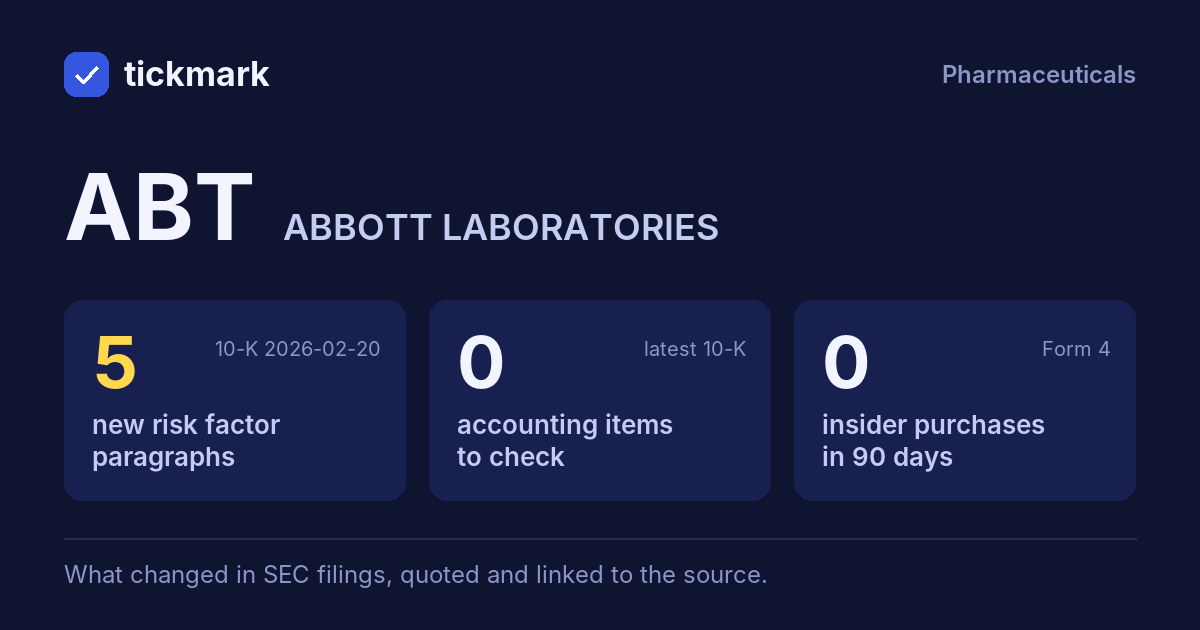
152 changes: 17 added, 26 removed, 105 reworded, 4 quiet changes

10-K Feb 20, 2026 vs Feb 21, 2025
Risk FactorsRedline ↓
11.8%
of the text changed · 4,486 words now
22.6%
of the text changed · 9,789 words now
Legal ProceedingsRedline ↓
20.8%
of the text changed · 844 words now
Accounting PoliciesRedline ↓
2.5%
of the text changed · 1,668 words now

10-K 0001628280-26-010185 (2026-02-20) vs 10-K 0001628280-25-007110 (2025-02-21)

The redline

The paragraph that changed most in each section

Marked against last year's 10-K: cut words struck through, new words highlighted and underlined.

Risk Factors 188 words changed in this paragraph; it is 36% similar to last year's version.
Many of these factors may manifest individually or collectively, For example, the global economy has been impacted by geopolitical tensions focused on trade, which has increased uncertainty for global businesses such as Russia’s invasion of Ukraine Abbott. The U.S. government has imposed tariffs on imports into the U.S., and it may impose additional tariffs in the future. Some countries may retaliate with trade protection measures, including reciprocal tariffs. These tariffs or other trade protection measures could have a negative impact on macroeconomic conditions, including inflation rates, foreign currency exchange rates, and interest rates, as well as causing potential disruptions to Abbott’s global supply chain, which could adversely affect its business. Additionally, the ongoing Russia-Ukraine conflict has resulted in political instability, sanctions, economic and currency volatility, inflation higher inflation, heightened cybersecurity risks, and other operational and supply chain disruptions. To date, Abbott has been able to manage these disruptions without material impact to its results of operations. However, it is difficult to predict the future implications and consequences of the situation conflict on local, regional regional, or global economies and Abbott’s operations. There could be additional sanctions, economic volatility, cybersecurity threats, political instability, transportation and other supply disruptions, as well as collection default or liquidity risks or limited availability of resources to conduct essential business processes that could have a material adverse impact to Abbott’s operations and financial condition. The resolution and long-term impact of this matter are uncertain and difficult to predict.

Source: Item 1A, 10-K 0001628280-26-010185 vs Item 1A, 10-K 0001628280-25-007110

MD&A 165 words changed in this paragraph; it is 63% similar to last year's version.
Pension and Post-Employment Benefits — Abbott offers pension benefits and post-employment health care healthcare to many of its employees. Abbott engages outside actuaries to assist in the determination of the obligations and costs under these programs. Abbott must develop long-term assumptions, the most significant of which are the health care healthcare cost trend rates, discount rates rates, and the expected return on plan assets. The discount rates used to measure liabilities were determined based on high-quality fixed income securities that match the duration of the expected retiree benefits. The health care healthcare cost trend rates represent Abbott’s expected annual rates of change in the cost of health care healthcare benefits and are a forward projection of health care healthcare costs as of the measurement date. A difference between the assumed rates and the actual rates, which will not be known for years, can be significant in relation to the obligations and the annual cost recorded for these programs. The net actuarial gains for Abbott's defined benefit plans in 2025 reflect the impact of actual asset returns during the year in excess of expected returns and the impact of higher discount rates on the measurement of plan liabilities. The net actuarial losses for Abbott's medical and dental plans primarily reflect an increase in claims. At December 31, 2025, pretax net actuarial gains (losses) and prior service costs and credits recognized in Accumulated other comprehensive income (loss) were net gains of $152 million for Abbott’s defined benefit plans and net losses of $189 million for Abbott’s medical and dental plans. Actuarial losses and gains are amortized over the remaining service attribution periods of the employees under the corridor method, in accordance with the rules for accounting for post-employment benefits. Differences between the expected long-term return on plan assets and the actual annual return are amortized over a five-year period.

Source: Item 7, 10-K 0001628280-26-010185 vs Item 7, 10-K 0001628280-25-007110

Legal Proceedings 145 words changed in this paragraph; it is 81% similar to last year's version.
In November 2022, Abbott learned that the United States Department of Justice, Justice (DOJ), through the United States Attorney’s Office for the Western District of Michigan, is conducting a criminal investigation related to Abbott’s manufacturing of powdered infant formula. In December 2022, Abbott received a subpoena from the Enforcement Division of the Commission requesting information relating to Abbott’s powder infant formula business and related public disclosures. In January 2023, Abbott received a civil investigative demand from the United States Federal Trade Commission seeking information in connection with its investigation of companies who participate in bids for WIC infant formula contracts. In addition, multiple civil lawsuits have been filed against Abbott relating to Abbott’s manufacturing of certain powder powdered infant formula products. Six shareholder derivative lawsuits against certain of Abbott’s current and former directors and officers are pending in a consolidated proceeding, In re Abbott Laboratories Infant Formula Shareholder Derivative Litigation, in the U.S. District Court for the Northern District of Illinois. The consolidated lawsuit seeks monetary damages from the defendants to Abbott. In re Abbott Laboratories Infant Formula Shareholder Derivative Litigation includes: Thomas P. DiNapoli, Controller of the State of New York, as Administrative Head of the New York State and Local Retirement System, and as Trustee of the New York State Common Retirement Fund, and International Brotherhood of Teamsters Local No. 710 Pension Fund and Southeastern Pennsylvania Transportation Authority, both filed in June 2023; David Hamilton filed in April 2023; Matthew Steele filed in February 2023; Ilene Lippman filed in January 2023; and Leon Martin filed in October 2022. In August 2024, the court granted in part and denied in part the defendants’ motion to dismiss, allowing the securities and breach of fiduciary duty claims to move forward. In September 2024, Abbott’s board Board of directors Directors established an independent and disinterested special litigation committee to investigate and evaluate the asserted claims. In November 2024, the special litigation committee filed a motion to stay the case in order to conduct its investigation. In February 2025, the court granted in part and denied in part the committee's motion, allowing written discovery to proceed. In November 2025, the DOJ intervened, in part, in a civil qui tam lawsuit previously filed under seal against Abbott by three private individuals in the U.S. District Court for the Western District of Michigan. The DOJ’s intervention is related to Abbott’s manufacturing of powdered infant formula products at its facility in Sturgis, Michigan. The DOJ alleges certain violations of the Federal False Claims Act and unjust enrichment, and it seeks various damages, including statutory penalties and disgorgement of profits. In December 2025, the Attorneys General of several states filed a consolidated complaint-in-intervention in the same lawsuit alleging violations of certain state laws, including false claims acts, and seeking damages and penalties.

Source: Item 3, 10-K 0001628280-26-010185 vs Item 3, 10-K 0001628280-25-007110

Accounting Policies 48 words changed in this paragraph; it is 40% similar to last year's version.
BASIS OF CONSOLIDATION — The consolidated financial statements include the accounts of the parent company company, subsidiaries, and subsidiaries, after elimination any variable interest entities for which Abbott is the primary beneficiary. Intercompany transactions are eliminated in consolidation. Investments in affiliates over which Abbott has a significant influence, but not a controlling interest, are accounted for using the equity method of intercompany transactions. accounting.

Source: Item 8, Note 1 – Summary of Significant Accounting Policies, 10-K 0001628280-26-010185 vs Item 8, Note 1 – Summary of Significant Accounting Policies, 10-K 0001628280-25-007110

Every change, by type

Sentences and paragraphs added, removed or reworded

Sentences and paragraphs of ABT's Risk Factors and MD&A, 10-K 2026-02-20 against 10-K 2025-02-21. Each links to the text at sec.gov.

RemovedRisk Factors
and economic conditions, and reducing funds available for working capital, capital expenditures, acquisitions, and other general corporate purposes.

Read it in 10-K 2025-02-21 at sec.gov ↗

RemovedRisk Factors
Abbott is subject to risks related to public health crises, such as widespread outbreaks of infectious diseases, which could have a material effect on Abbott’s business, financial condition and results of operations.

Read it in 10-K 2025-02-21 at sec.gov ↗

RemovedRisk Factors
As a global healthcare company, public health crises, such as the widespread outbreaks of infectious diseases, may negatively impact certain Abbott's operations. Health concerns and significant changes in political or economic conditions caused by such outbreaks can cause, and during the COVID-19 pandemic caused, significant reductions in demand for certain products, increased difficulty in serving customers, disruptions to manufacturing and supply chains, and negative effects on certain of Abbott’s operations as well as the operations of its suppliers, distributors and other third-party partners. Furthermore, such widespread outbreaks may impact, and during the COVID-19 pandemic impacted, the broader

Read it in 10-K 2025-02-21 at sec.gov ↗

RemovedRisk Factors
economies of affected countries, including negatively impacting economic growth, the proper functioning of financial and capital markets, inflation rates, foreign currency exchange rates, and interest rates.

Read it in 10-K 2025-02-21 at sec.gov ↗

RemovedRisk Factors
The international nature of Abbott’s business subjects it to additional business risks that may cause its revenue and profitability to decline.

Read it in 10-K 2025-02-21 at sec.gov ↗

RemovedRisk Factors
Abbott’s business is subject to risks associated with managing a global supply chain and doing business internationally. Sales outside of the United States in 2024 made up approximately 61 percent of Abbott’s net sales. Additional risks associated with Abbott’s international operations include:

Read it in 10-K 2025-02-21 at sec.gov ↗

RemovedRisk Factors
•trade protection measures, including tariffs, import or export licensing requirements, other governmental restrictions such as trade sanctions, and changes to international trade agreements;

Read it in 10-K 2025-02-21 at sec.gov ↗

Show the other 16
RemovedRisk Factors
•potential penalties or other adverse consequences for violations of anti-corruption, anti-bribery, anti-competition, and other similar laws and regulations, including the Foreign Corrupt Practices Act and the U.K. Bribery Act.

Read it in 10-K 2025-02-21 at sec.gov ↗

RemovedRisk Factors
Events contemplated by these risks may, individually or in the aggregate, have a material adverse effect on Abbott’s revenues and profitability.

Read it in 10-K 2025-02-21 at sec.gov ↗

RemovedRisk Factors
•changes in business, economic, and geopolitical conditions, including: war, political instability, terrorist attacks, the threat of future terrorist activity and related military action; global climate change, extreme weather and natural disasters; the cost and availability of insurance due to any of the foregoing events; labor disputes, strikes, slow-downs, or other forms of labor or union activity; and pressure from third-party interest groups;

Read it in 10-K 2025-02-21 at sec.gov ↗

RemovedMD&A
•U.S. Food and Drug Administration (FDA) clearance for two new over-the-counter CGM systems, Lingo® and Libre Rio™, which are based on Abbott's FreeStyle Libre® CGM technology,

Read it in 10-K 2025-02-21 at sec.gov ↗

RemovedMD&A
•FDA approval of the Esprit™ below-the-knee (BTK) system, which is designed to keep arteries open in people living with peripheral artery disease and deliver a drug to support vessel healing prior to completely dissolving,

Read it in 10-K 2025-02-21 at sec.gov ↗

RemovedMD&A
•CE Mark for the Aveir® dual chamber (DR) leadless pacemaker system, which is the world's first dual chamber leadless pacemaker system that treats people with abnormal or slow heart rhythms, and

Read it in 10-K 2025-02-21 at sec.gov ↗

RemovedMD&A
•FDA clearance for Advisor® HD Grid X Mapping Catheter, Sensor Enabled™, which will further support mapping of both pulsed field ablation (PFA) and radiofrequency (RF) ablation cases.

Read it in 10-K 2025-02-21 at sec.gov ↗

RemovedMD&A
In February 2022, Abbott’s U.S. Pediatric Nutrition business was impacted by a voluntary recall of certain infant powder formula products manufactured at its facility in Sturgis, Michigan, at which time the company temporarily stopped operations at that facility. Abbott took various actions to mitigate the impact of the recall on the supply of formula in the U.S. Abbott resumed operations later in 2022 and made significant progress through 2023 to increase production of infant formula in the U.S and recover market share. Beginning in the fourth quarter of 2023 and through 2024, Abbott has regained and maintained its market-leading position in the U.S., as measured on a volume basis.

Read it in 10-K 2025-02-21 at sec.gov ↗

RemovedMD&A
Management analyzes the adequacy of ending rebate accrual balances each quarter. In the domestic nutritional business, management uses both internal and external data available to estimate the accruals. In the WIC business, estimates are required for the amount of WIC sales within each state where Abbott holds the WIC contract. The state where the sale is made, which is the determining factor for the applicable rebated price, is reliably determinable. Rebated prices are based on contractually obligated agreements generally lasting a period of two to four years. Except for a change in contract price or a transition period before or after a change in the supplier for the WIC business in a state, accruals are based on historical redemption rates and data from the U.S. Department of Agriculture (USDA) and the states submitting rebate claims. The USDA, which administers the WIC program, has been making its data available for many years. Management also estimates the states' processing lag time based on sales and claims data. Management has access to several large customers' inventory management data, which allows management to make reliable estimates of inventory in the retail distribution channel. At December 31, 2024, Abbott had WIC business in 42 states.

Read it in 10-K 2025-02-21 at sec.gov ↗

RemovedMD&A
Notes: The Acelis Connected Health business was internally transferred from Diagnostic Products to Medical Devices on January 1, 2023. As a result, $115 million of sales in 2022 were moved from Diagnostic Products to Medical Devices.

Read it in 10-K 2025-02-21 at sec.gov ↗

RemovedMD&A
Rapid Diagnostics sales, excluding COVID-19 testing-related sales, increased 4.8 percent in 2024 and remained unchanged in 2023. In 2024, Rapid Diagnostics sales increased 6.0 percent, excluding the impact of foreign exchange and COVID-19 testing-related sales, due to strong demand for respiratory disease tests used to diagnose influenza, strep throat and RSV. In 2023, Rapid Diagnostics sales increased 1.3 percent, excluding the impact of foreign exchange and COVID-19 testing-related sales. Growth in various Rapid Diagnostics products in 2023 was partially offset by the unfavorable effects of an early 2022 flu season and a later start of the 2023 flu season.

Read it in 10-K 2025-02-21 at sec.gov ↗

RemovedMD&A
Procedure volumes continued to increase across the cardiovascular and neuromodulation businesses in 2024. In Structural Heart, excluding the effect of foreign exchange, the 17.0 percent and 14.3 percent sales increases in 2024 and 2023, respectively, reflect continued growth of the Navitor® and TriClip® products, as well as growth in surgical valves, structural interventions and other transcatheter repair sales.

Read it in 10-K 2025-02-21 at sec.gov ↗

RemovedMD&A
In Heart Failure, the 10.3 percent increase in sales in 2024, excluding the effect of foreign exchange, primarily reflects growth in heart assist devices, which offer treatment for chronic and temporary conditions. In 2023, Heart Failure sales increased 12.0 percent, excluding the effect of foreign exchange, as procedure volumes and staffing challenges, which occurred during the COVID-19 pandemic, began to recover.

Read it in 10-K 2025-02-21 at sec.gov ↗

RemovedMD&A
In Vascular, the 6.7 percent increase in 2024, excluding the impact of foreign exchange, was primarily due to higher vessel closure sales. In 2023, the 9.3 percent increase, excluding the impact of foreign exchange, was primarily due to the acquisition of CSI in April 2023.

Read it in 10-K 2025-02-21 at sec.gov ↗

RemovedMD&A
Established Pharmaceuticals — Abbott focuses on building country-specific portfolios made up of high-quality medicines that meet the needs of people in emerging markets. Over the next several years, Abbott plans to expand its

Read it in 10-K 2025-02-21 at sec.gov ↗

Next Related parties →