Form 10-K for the Fiscal Year Ended December 31, 2020
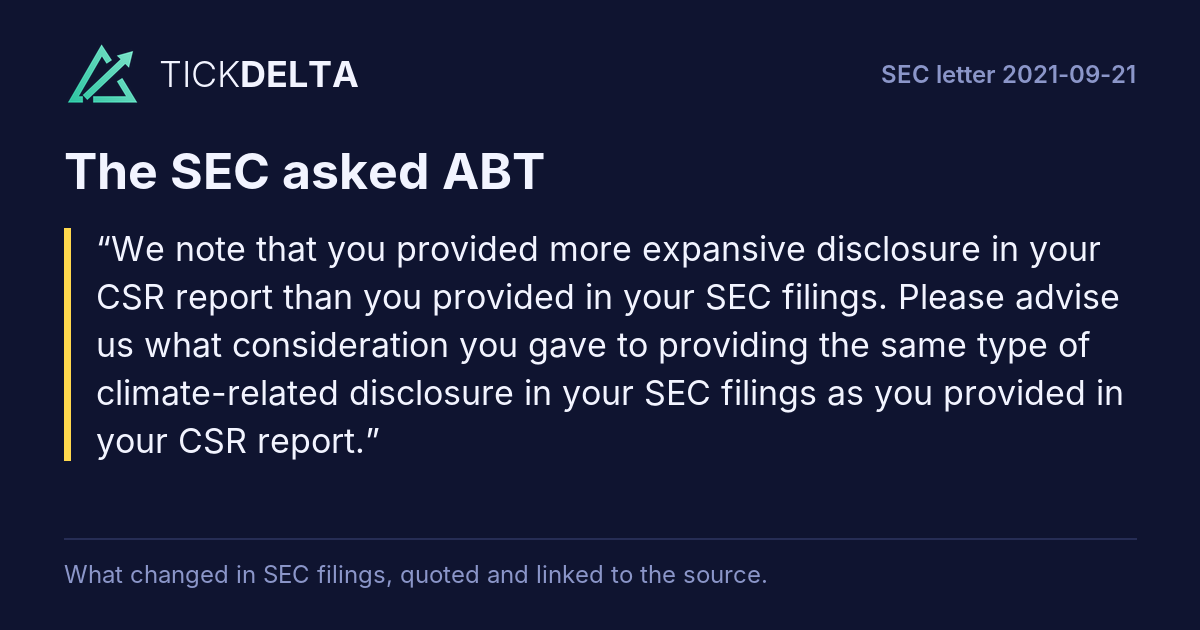
We note that you provided more expansive disclosure in your CSR report than you provided in your SEC filings. Please advise us what consideration you gave to providing the same type of climate-related disclosure in your SEC filings as you provided in your CSR report.
Abbott’s Global Sustainability Report (GSR) addresses sustainability reporting practices, speaks to a wide range of stakeholder interests, and provides disclosures beyond those considered material for investors in the context of disclosures required in a Form 10-K. Abbott considers whether it should provide the same type of climate-related disclosure in its SEC filings as it provides in its GSR.Read in the reply ↗Rest of the answer
The appropriate Abbott subject matter experts and responsible parties are involved in the preparation and review of Abbott’s SEC filings to confirm compliance with SEC disclosure requirements and disclosure of information that is material to investors in the context of SEC periodic reports. For its Form 10-K for the year ended
December 31, 2020 (2020 10-K), Abbott concluded that such disclosures were not required under applicable SEC disclosure rules and not material information necessary in order to make the required statements in the 2020 10-K, in light of the circumstances under which they are made, not misleading.
As discussed in its GSR, Abbott has determined through its risk management processes that Abbott is not exposed to material climate related risks or opportunities. Through Abbott’s diversified geographical distribution and the various initiatives that it has implemented to reduce its carbon emissions and improve operational efficiency, the potential impact for climate change-related physical and regulatory risks is significantly lessened. Accordingly, at the time of filing the 2020 10-K, Abbott concluded that there were no climate change-related material risks or known trends or uncertainties that had or that Abbott reasonably expected to have a material impact on its liquidity, capital resources, net sales, or income from continuing operations.
You generally refer to federal and state environmental protection laws and regulations concerning emissions and discharges to the environment from various manufacturing operations. Please tailor the general disclosure about pending or existing climate changerelated legislation, regulations, and international accords to describe the impact to your business, financial condition, and results of operations.
Abbott regularly monitors pending and existing climate change-related legislation, regulations and policies, such as carbon tax regulations, the EU Emissions Trading System, and the UK 2050 net zero target.
Abbott has designed policies and standards to consider applicable climate change-related regulations at local, state, national, and international levels.Read in the reply ↗Rest of the answer
Abbott regularly updates these policies and standards to reflect current and future anticipated best practices and trends.
Due to the nature of Abbott’s business and continuing efforts to manage Abbott’s energy usage and reduce its carbon footprint, Abbott does not significantly contribute to climate-related impacts. As a result, in preparation of its 2020 10-K, Abbott determined that it did not believe any specific pending or existing climate change-related legislation, regulations, or international accords would have a material impact on Abbott’s business, financial condition, liquidity or results of operations.
In its future SEC filings, Abbott will provide tailored disclosure as appropriate if any pending or existing climate change-related legislation, regulations, and international accords would have a material impact on Abbott’s business, financial condition, liquidity or results of operations.
To the extent applicable and material, discuss the indirect consequences of climate-related regulation or business trends, such as the following: • decreased demand for goods or services that produce significant greenhouse gas emissions or are related to carbon-based energy sources; • increased demand for goods that result in lower emissions than competing products; • increased competition to develop innovative newRest of the question
products that result in lower emissions; and • any anticipated reputational risks resulting from operations or products that produce material greenhouse gas emissions.
To date, Abbott has not identified material indirect consequences of climate-related regulation or business trends that would have a material impact on Abbott’s business, financial condition, liquidity or results of operations. Due to the nature of Abbott’s business, Abbott does not significantly contribute to climate-related impacts.
In addition, Abbott has implemented various initiatives to reduce carbon emissions and improve operational efficiency, including purchasing electricity from utility providers that included above-average renewable generation in their energy mix, investing inRead in the reply ↗Rest of the answer
cogeneration and renewable energy generation at our facilities, and implementing energy efficiency and air emissions projects. The cost to implement such initiatives was not material to Abbott. Such initiatives, together with the diversified nature of Abbott’s global businesses, currently lessen the potential for climate change-related regulation and business trends to have a material impact on its business.
Abbott will continue to monitor the material indirect consequences of climate-related regulation or business trends, and if they are considered reasonably likely to have a material effect on its business, financial condition or results of operations, Abbott will disclose such consequences in future SEC filings as appropriate.
If material, discuss the significant physical effects of climate change on your operations and results. This disclosure may include the following: • severity of weather, such as floods, hurricanes, extreme fires, and water availability and quality; • quantification of any material weather-related damages to your property or operations; and • potential for indirect weather-related impacts that have affected or mayRest of the question
affect your major customers or suppliers.
To date, there have not been significant physical effects of climate change that have had a material impact on Abbott’s operations and results. As a global organization, Abbott’s diverse geographical supply chain and distribution network, along with its well-developed business continuity planning processes, significantly lessen the potential for a substantive business impact from climate-related physical risks.
Abbott operates an integrated multi-disciplinary company-wide risk management process which assesses and manages climate-related risks at various levels of the organization to ensureRead in the reply ↗Rest of the answer
that its businesses and operations are resilient. Abbott proactively monitors weather conditions that may become severe and impact its facilities, employees, or supply chain. The diversification of Abbott’s business operations, along with the actions that it has already taken to ensure the efficiency of its operations reduces Abbott’s exposure to physical risks. As noted in the 2020 10-K, Abbott purchases raw materials and supplies from numerous suppliers around the world and Abbott has no single customer that, if the customer were lost, would have a material adverse effect on Abbott.
Abbott will continue to monitor the physical effects of climate change, and if such effects are considered reasonably likely to have a material effect on Abbott’s operations, financial conditions, or results, Abbott will disclose such effects in future SEC filings as appropriate.
Disclose the material effects of transition risks related to climate change that may affect your business, financial condition, and results of operations, such as policy and regulatory changes that could impose operational and compliance burdens, market trends that may alter business opportunities, credit risks, or technological changes.
The effects of transition risks related to climate change were not expected to have a material impact on Abbott’s business, financial condition, or results of operations as of the filing date of Abbott’s 2020 10-K. Abbott’s business strategies include reducing the energy and carbon footprint of its operations.
Abbott’s progress in meeting its 2020 carbon reduction targets means that it has fewer opportunities to realize significant additional operating efficiencies and cost savings in the future.
Abbott will continue to monitor the potential effects of transition risks related to climateRead in the reply ↗Rest of the answer
change and if such risks are considered reasonably likely to have a material effect on its business, financial condition or results of operations, Abbott will disclose such risks in future SEC filings as appropriate.
Disclose any material litigation risks related to climate change and the potential impact to the company.
Abbott does not have any material climate change-related litigation and given the nature of Abbott’s business activities, Abbott does not expect such litigation to be a significant risk.
In compliance with Item 103 of Regulation S-K, Abbott discloses any material legal proceedings in its Forms 10-K and Forms 10-Q. No climate change-related litigation has been reported in at least the last 10 years.Read in the reply ↗Rest of the answer
In addition, in Abbott’s 2020 10-K, Abbott estimated the range of possible loss for its legal proceedings and environmental exposures to be from approximately $90 million to $120 million, none of which pertained to climate change-related litigation.
We note your response to our prior comment number 2. As it relates to providing tailored disclosure, please explain in greater detail how the nature of your business supports your conclusion that pending or existing climate change related legislation, regulations, and international accords will not have a material impact.Rest of the question
In addition, tell us how you considered addressing difficulties in assessing the timing and effect of pending legislation or regulation.
Abbott is a diversified healthcare company, with multiple businesses that operate over 90 manufacturing facilities in more than 25 countries and maintain a diverse geographical supply chain and distribution network. This diversification across businesses and geographies mitigates the potential impact of pending or existing climate change related legislation and regulations on Abbott’s business, financial condition, or results of operations.
The most significant areas of climate change impact from
Abbott’s operations are its electricity use, fuel consumption by its manufacturing operations,Read in the reply ↗Rest of the answer
and its global sales vehicle fleet.
In 2020, Abbott’s estimated energy and fuel spend for its global operations was immaterial compared to its total operating expenses.
Abbott has an established process for identifying and monitoring developments in pending and existing climate change-related legislation, regulations, and international accords, such as carbon tax regulations, the EU Emissions Trading System, and the UK 2050 net zero target. This process includes assessing the potential impacts on its business, including whether such matters could have significant operational or cost implications, understanding its risk exposures, and developing appropriate management strategies. This process takes into consideration the difficulties in assessing the timing and effect of such pending legislation, regulations, or international accords.
Given the above, in preparation of its 2020 10-K, Abbott did not believe any specific pending or existing climate change-related legislation, regulations, or international accords had or were reasonably expected to have a material impact on Abbott’s business, financial condition, or results of operations.
In its future SEC filings, Abbott will include relevant disclosure if it believes that any pending or existing climate change-related legislation, regulations, or international accords would reasonably likely have a material impact on Abbott’s business, financial condition, or results of operations.
We note your response to our prior comment number 4. In order for us to evaluate your claim that the physical effects of climate change have not had a material impact on your operations and results, please describe for us the physical effects of climate change, such as effects of the severity of weather, on your operations and results in greater detail.Rest of the question
Your response should address the potential for indirect weather-related impacts that have affected or may affect your customers or suppliers and should include information quantifying weather-related damages to your property or operations.
Abbott is a global organization with over 90 manufacturing facilities in more than 25 countries, a diverse geographical supply chain and distribution network, and well-developed business continuity planning processes. These factors significantly lessen the potential for a material business impact from climate-related physical risks, such as effects of severity of weather, and Abbott believes that climate-related physical risks have not had a material effect on Abbott’s operations, financial conditions, or results.
Abbott assesses and manages climate-related risks through its integrated,Read in the reply ↗Rest of the answer
companywide risk management process. Abbott’s business continuity and crisis management functions monitor weather in real time to identify how Abbott may be impacted by weather-related events, such as potentially severe storms and hurricanes. Abbott conducts preparedness planning and implements measures designed to maintain business continuity and mitigate the financial impacts of physical climate-related risks. Accordingly, Abbott is well-positioned to quickly assess the impact of identified events and implement business continuity plans. Additionally, Abbott’s ongoing risk management processes work to identify and mitigate longer-term risks posed by climate change, such as shifts in climate patterns, drought and heat waves, and sea level rise.
As noted in Abbott’s prior response and 2020 10-K,
Abbott purchases raw materials and supplies from numerous suppliers around the world and Abbott has no single customer that, if the customer were lost, would have a material adverse effect on Abbott. While indirect weather-related impacts may have the potential to affect individual customers or suppliers on a localized basis, such impacts are not currently expected to materially affect Abbott’s operations or results due to Abbott’s diverse geographical supply chain and business continuity planning processes. From time to time, Abbott has experienced isolated weather-related damages to some of its property or operations, however, the impact of such damages has not been material.
Abbott will continue to monitor the physical effects of climate change, and if such effects are considered reasonably likely to have a material effect on its operations, financial condition or results, Abbott will disclose such effects in future SEC filings as appropriate.
Please tell us about the transition risks evaluated in preparing your response to prior comment number 5, including the items noted in our prior comment. Please also provide support for why you believe the effects of transition risks will not be material.Rest of the question
Include information in your response explaining how your efforts to reduce the energy and carbon footprint of your operations address specific transition risks related to climate change that may affect you.
Abbott evaluates transition risks including policy and regulatory changes that could impose operations and compliance burdens, market trends that may alter business opportunities, credit risks, and technological changes. Abbott has established procedures to monitor potential policy and regulatory changes related to climate change across the countries and regions in which it operates.Read in the reply ↗Rest of the answer
As part of its ongoing monitoring of such potential policy and regulatory changes, Abbott evaluates the potential impact of such changes on Abbott’s businesses, including whether such policy or regulation could have significant operational or cost implications. Through this process, Abbott did not identify effects of any transition risks that it believed would be material.
Further, an element of Abbott’s business strategy is reducing its overall energy and carbon footprint. Abbott has implemented several initiatives that have successfully achieved carbon reductions, including purchasing electricity from utility providers that include above-average renewable generation in their energy mix, investing in cogeneration and renewable energy generation at its facilities, and reducing energy use across its operations. Abbott’s successful implementation of such initiatives further lessens the transition risks related to climate change that may affect Abbott.
Considering Abbott’s globally diversified healthcare businesses and its continuing efforts to manage its energy usage, Abbott did not identify any effects of market trend, credit or technological change risks that it believed would reasonably likely be material to Abbott’s business, financial condition, or results of operations as of the filing date of Abbott’s 2020 10-K.
Abbott will continue to monitor the potential effects of transition risks related to climate change, and if such risks are considered reasonably likely to have a material effect on its business, financial condition or results of operations, Abbott will disclose such risks in future SEC filings as appropriate.
Also in this review: company letter, 2022-02-04, closing letter, 2022-02-11