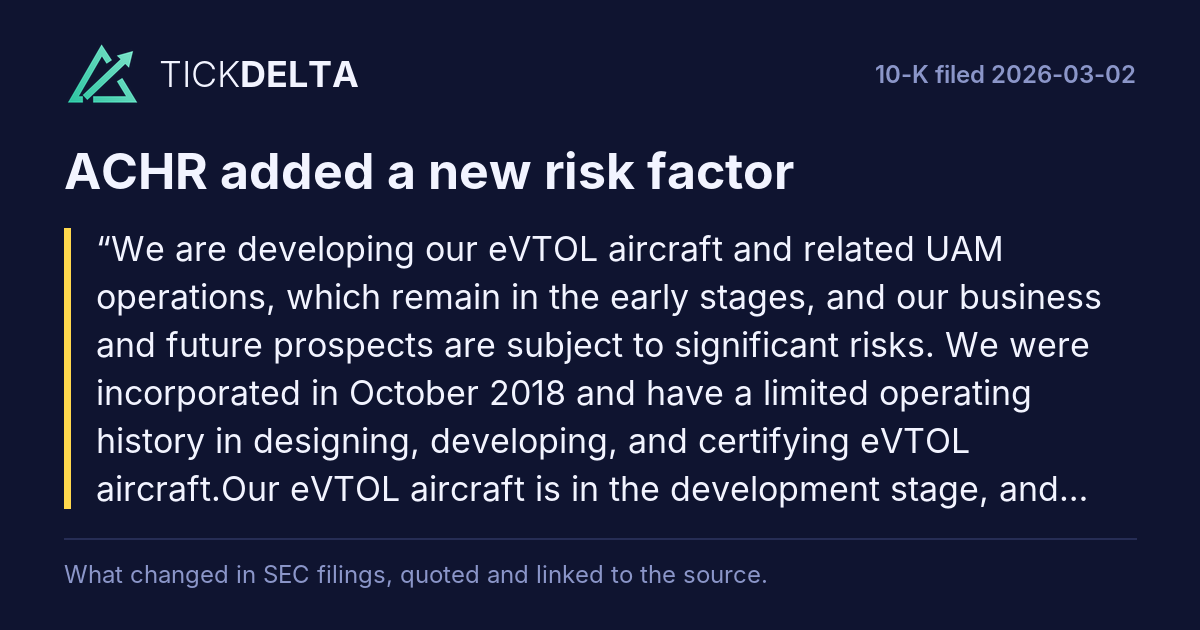
eVTOL aircraft involve a complex set of technologies and infrastructure, including charging, which we must continue to further develop and rely on our commercial and defense program customers to adopt. Before our eVTOL aircraft can fly passengers, we must obtain extensive government certifications and approvals from the FAA, DOT and other regulatory authorities in the U.S. and other countries. There are currently no FAA-certified eVTOL aircraft for commercial operations in the United States and regulatory standards and certification pathways for eVTOL aircraft continue to evolve globally. We may not achieve timely or successful certification in the United States or internationally, or at all, which could delay or prevent commercialization of our aircraft. The FAA and the DOT have primary regulatory authority over air transportation operations in the United States. As we build out our UAM operations, additional federal, state, and local requirements may apply, including approvals for take-off and landing locations, zoning, and land use.
aircraft to be certified under the current FAA regulatory framework and substantial regulatory changes could delay certification or require changes to our aircraft design or certification strategy, resulting in additional costs and delays. We are seeking certification of our aircraft in other countries, and evolving or uncertain foreign regulatory frameworks could delay these efforts.
Safety and reliability are critical for attracting and retaining customers. Failure to maintain satisfactory standards of safety and reliability could adversely impact our ability to attract and retain customers and expose us to negative publicity. Such incidents could involve employees, contractors, partners or third-party operators. Accidents, incidents, regulatory actions, or investigations involving our aircraft or those operated by others could result in reputational harm, legal liability, financial losses, or operational disruptions, which may not be fully covered by insurance. Events occurring in or near take-off and landing sites, such as vertiports, could also disrupt operations until the accident has been cleared and repairs or investigations are completed.
From time to time, we and our manufacturing partners store battery cells (including lithium-ion cells), which if mishandled, could disrupt operation of our facilities or our manufacturers, cause manufacturing delays, create adverse publicity or trigger recalls. Safety incidents involving competitors, partners, or customers may also indirectly affect public confidence in our aircraft and the eVTOL industry generally.
We depend on a limited number of suppliers and service providers, including single-source and custom manufacturers, for the parts, components and materials used in our aircraft. If any supplier or service partner is unable to meet demand due to supply chain disruptions, changes in their tax and government incentives, quality issues, natural or man-made disasters, climate
events, trade restrictions, tariffs, sanctions, financial distress, or other causes, this could result in production delays, increased costs, delays to our certification timeline, product redesign, revenue loss, reduced competitive advantage, and reputational harm. Further, if we are unable to successfully manage our relationship with our suppliers or service providers, the quality and availability of our aircraft may be harmed. Replacing suppliers or qualifying alternative manufacturing capacity would be costly and time-consuming, and prolonged disruptions at the operations or manufacturing facilities of any supplier or service provider could adversely affect our operations and prospects.
We have entered into, and may continue to pursue, strategic relationships, joint ventures, minority investments, acquisitions, and licensing arrangements, including our previously announced partnership with Anduril to jointly develop a next generation aircraft for military applications, our acquisitions of certain intellectual property, manufacturing and other assets and our proposed manufacturing relationship with Stellantis. These arrangements expose us to risks including intellectual property leakage, counterparty non-performance, operational disruptions, cost overruns, reputational harm, and integration challenges.
Onboarding new strategic partners involves various inherent risks that could adversely affect our production capacity, product quality, and negatively impact revenue, margins and costs. Additionally, where our strategic relationships involve milestone-based payments or performance criteria, our operating results may vary significantly from quarter to quarter, and there can be no assurance that we or our partners will complete certain technical milestones or that partners will fulfill their payment obligations. Any reduction, delay or termination of expected funding from strategic partners could disrupt our development timelines, or materially impact our business and financial results.
Further, we are subject to counterparty risk with respect to our existing purchase agreements and may become further subject to such risk if and when we enter into additional purchase agreements, which could adversely impact our business, results of operations, financial condition and prospects. Our business is, and may in the future be, subject to the risks of non-payment and non-performance by our counterparties. Additionally, the availability of financing for the purchase of our aircrafts is based in part on our counterparties’ creditworthiness, and there can be no assurance that they will be able to secure financing from third parties.
Our defense program is in its early stages and its success depends on a number of factors including, anticipating and addressing defense industry requirements, timely and successful research and development; effective pricing; demand forecasting, inventory management, controlling manufacturing and supply costs and quality and reliability of our aircraft. Our defense strategy may require us to work with prime contractors, joint venture partners, and other third parties, and our ability to achieve our objectives will depend in part on our ability to establish, manage, and maintain these relationships on commercially reasonable terms.
•governments routinely audit contractors, and any unfavorable audit could result in reduced or cancelled purchases, fines, or, if improper or illegal activities are identified, civil or criminal liability;
Our outstanding credit agreements contain restrictive financial and operational covenants including covenants relating to our liquidity. As of December 31, 2025, we were in compliance with the applicable covenants under our credit facilities.
A covenant breach could accelerate repayment obligations, restrict additional borrowing, and adversely affect liquidity and operations, as well as our ability to pursue other business opportunities that we would otherwise consider in our best interests. In addition, our creditors could proceed against any loan collateral, which could adversely affect our operations,
Our initial air taxi operations will be concentrated in a limited number of metropolitan areas.
Our ability to compete effectively depends on many factors, including: speed to market of our initial aircraft and UAM and other services, effective strategy and execution of aircraft and service offerings, product safety and performance, pricing, and quality of customer support. Competitors with greater scale, more established customer relationships, and resources could limit our market penetration.
•our inability to operate our air taxi operations in the Los Angeles area and for use during the LA28 Olympic Games due to any potential delays in certification;
In addition, changes we make to improve offerings or balance stakeholder interests may be viewed positively by some and negatively by others, or by none. Failure to balance stakeholder interests or meet customer expectations could reduce adoption and materially harm our business.
Our customer purchase agreements may include price escalation clauses, which could lead to losses if our costs rise faster than the agreed escalation rates.
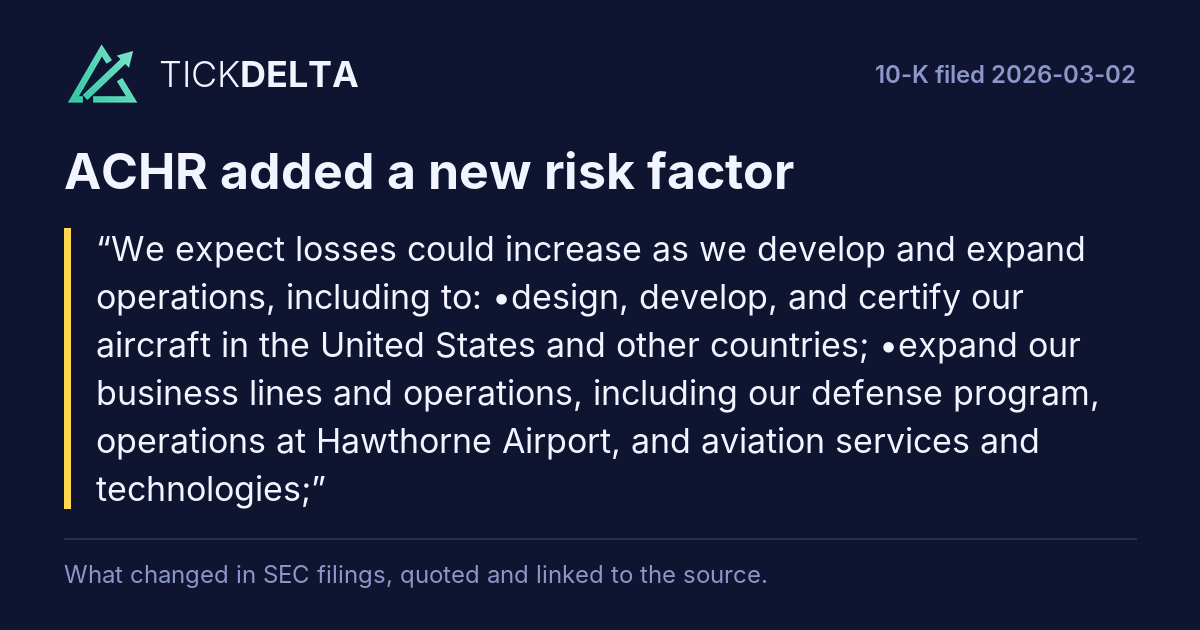
We may fail to realize the anticipated benefits from our planned operations at Hawthorne Airport.
We believe that there are significant benefits that may be realized through our planned operations at Hawthorne Airport. However, the efforts to realize these benefits will be a complex process and may disrupt our existing operations if not implemented in a timely manner.
Failure to achieve the anticipated benefits from our planned operations at Hawthorne Airport could adversely affect our business, results of operations, or financial condition, decrease or delay any accretive effect of our acquisition of the Hawthorne Airport, divert the attention of certain personnel and management, adversely affect the price of our Class A common stock and cause our business to not perform as expected. In addition, while we expect key management that has, since 2005, operated the facilities we acquired at Hawthorne Airport to continue operating these facilities following the transaction, there can be no assurance that such individuals will continue to remain employed by us for any period of time. Our management has limited experience operating the properties and the aviation business that we have acquired. If we fail to effectively manage such businesses and the risks and challenges inherent therewith, we may not realize the anticipated benefits of our planned operations at Hawthorne Airport and our operating results and financial condition will be materially and adversely affected. Our ability to generate revenue from these assets will depend, in part, on our abilities to attract and maintain customers to use the airport and hangar facilities and integrate the property into our planned infrastructure for our anticipated air taxi operations.
We are also planning on completing certain capital projects at Hawthorne Airport, including preparing the site for planned air tax operations in the Los Angeles area and for use during the LA28 Olympic Games. The estimated costs of, and the projected schedule for, our planned capital projects are subject to a number of uncertainties. Our ability to complete these
projects within budgets and on expected schedules may be adversely affected by various factors including, but not limited to: errors in our estimated costs and projected schedule; design and engineering errors; cost increases because of demand for labor and materials; cost increases due to instituted or proposed changes in trade policies; contractors’ difficulty in predicting costs over a lengthy construction period; changes to the scope of the projects; material and/or labor shortages; adverse weather conditions; contractor defaults and bankruptcy; labor disputes; unanticipated levels of inflation; litigation; certification, licensing, or permitting denials or delays; other regulatory impediments; and environmental issues. We expect to complete the redevelopment of up to 200,000 square feet of hangar space and to build a planned advanced air mobility center of excellence. Eventually, we aim to develop Hawthorne Airport into an AI-powered operations platform with such features as AI-powered air traffic coordination, AI-coordinated ground operations for managing aircraft, crews and turns, VR-based flight simulation with adaptive AI feedback, operational forecasting driven by AI models, machine learning to detect maintenance needs and biometric and AI-enabled screening for more seamless and secure boarding. These efforts to build the airport of the future, including our plans to use Hawthorne Airport as a innovation hub for the next generation of AI-based aviation technologies, will require significant additional capital and other resources for implementation and may require additional authorization from federal, state, or local regulators. If we are unable to access such capital, obtain the necessary regulatory approval, or develop the proper AI models to support this AI-powered operations platform, we may not be able to realize our long term plan for Hawthorne Airport.
Our operations at Hawthorne Airport subject us to additional federal and state regulations that may result in additional costs.
Our operations at Hawthorne Airport subject us to additional regulatory requirements and compliance with those requirements could result in additional costs. For example, the FAA, from time to time, issues directives and other regulations relating to the management, maintenance, operation, and use of airport facilities. Compliance with those requirements may cause us to incur significant expenditures.
In addition, the City of Hawthorne is subject to its own regulatory and contractual obligations as the owner and operator of Hawthorne Airport. The City of Hawthorne has entered into agreements with the FAA or its predecessor agencies that govern, among other things, how the city may operate and manage Hawthorne Airport and use airport revenue. If the FAA were to determine that the City of Hawthorne is noncompliant with any of those agreements, the FAA could order the city to remedy such noncompliance, including in ways that could materially limit our business operations at Hawthorne Airport or the value of our investment in the airport’s facilities or services. Additionally, if the FAA found the City of Hawthorne noncompliant with any of those agreements, the FAA could withhold future federal airport grants from the city until the FAA determines that the city has achieved compliance. Such withholding could reduce the funds available for maintenance or improvement of Hawthorne Airport infrastructure, including runways and taxiways, on which we or our tenants at the airport may rely for our respective operations.
Caltrans separately regulates aspects of Hawthorne Airport’s maintenance and operations, primarily to ensure airport safety, and Caltrans regularly inspects the airport for compliance with federal and state requirements. If Caltrans were to find the airport noncompliant with those requirements, it could direct the City of Hawthorne to remedy such noncompliance. Those remedies could limit our use or development of facilities at Hawthorne Airport or require the airport’s tenants, including us or our subtenants, to pay higher or additional fees to subsidize any required remedial measures.
The aviation business is subject to numerous, often-stringent federal, state, local, and foreign laws, regulations, and ordinances relating to the protection of the environment and noise, including those relating to emissions to the air, discharges, and the use, management, disposal, and release of, and exposure to, hazardous substances and waste materials. There is increasing litigation and regulatory focus in the U.S. concerning the potential health hazards of per- and polyfluoroalkyl substances (“PFAS”), a group of chemical compounds that have been used in various applications, including in firefighting foam at some airports. We have no knowledge of PFAS use or contamination at Hawthorne Airport, but we have no basis to determine whether any airport users have dispensed PFAS-containing firefighting foam or other products at Hawthorne Airport in the past. If PFAS contamination were found at Hawthorne Airport, we could be subject to liability or be required to undertake environmental remediation that could prove costly and materially impact our operations at the airport. In addition, Hawthorne Airport may be required to comply with Title III of the ADA to the extent that it is considered a “public accommodation” as defined under the ADA.
Our master ground lease with the City of Hawthorne for the property on which Hawthorne Airport is located may not be renewed or may be amended on unfavorable terms, potentially limiting our operations and increasing costs.
We do not own the property on which Hawthorne Airport is located. Instead, we have assumed an existing master ground lease with the City of Hawthorne that gives us the right to manage and sublease most of the airport’s commercial and hangar facilities consistent with city approvals and subject to FAA requirements. The remaining term of that master ground lease runs through 2055. The master ground lease contains provisions for a fixed rate increase over the life of the lease on the rent to be paid to the City of Hawthorne. The city authorities may choose not to renew a lease at all or to only renew the lease on terms
that are unfavorable to us. At the conclusion of a lease, we may be required to participate in a bidding process to renew the master ground lease, which could require unanticipated capital spending and could divert management’s attention during the pendency of the process.
In addition, our master ground lease at Hawthorne Airport is subject to the City of Hawthorne’s airport grant agreements with the FAA. If the FAA were to find the master ground lease in conflict with any such grant agreement, the FAA could require the City of Hawthorne to amend the master ground lease to resolve the conflict. Such an outcome could materially limit our use of the master ground lease or otherwise materially limit the value of the master ground lease to us.
Ineffective controls could lead to inaccurate financial reporting, regulatory noncompliance, restatements, fraud, or loss of investor confidence, which could negatively affect our reputation and the market price of our Class A common stock. Our controls may become inadequate due to changes in our business, and control weaknesses have been identified in the past and may be identified in the future, including through adverse findings by our independent registered public accounting firm. Our independent registered public accounting firm has in the past or may in the future issue a report that is adverse in the event it is not satisfied with the level at which our internal control over financial reporting is documented, designed or operating. Compliance with public company reporting requirements, including Section 404 of the Sarbanes-Oxley Act of 2002 (“Sarbanes-Oxley Act”), requires significant management time, resources, and expense, and may divert attention from our core business and increase operating costs.
Public health threats, including epidemics and pandemics, could materially harm our business, prospects, financial condition, and operating results.
A major health or safety incident could adversely affect our reputation, business and results of operations.
Manufacturing lines, airports, and aviation infrastructure are inherently dangerous, and operating in this industry involves certain inherent health and safety risks. Given the regulatory requirements governing health and safety, as well as our operations at Hawthorne Airport and other sites, maintaining strong health and safety performance is critical to the success of all aspects of our business.
Any failure in health and safety performance, whether at our own facilities or those of our contract manufacturers and suppliers, may result in penalties for non-compliance with applicable laws or regulations, regulatory investigations, or litigation. A major or significant health and safety incident could also result in substantial costs, generate negative publicity, and materially harm our reputation and relationships with regulators, governmental authorities, and local communities. Such impacts could have a material adverse effect on our business, and results of operations.
Compliance is costly and time-consuming, and regulatory changes could delay certification, limit operations, postpone or restrict operations and increase costs. If we fail to obtain or maintain required certifications or operating approvals, or if laws change in ways that make compliance impractical or prohibitively expensive, our business and prospects could be adversely affected. As we expand internationally, we will face additional complex regulatory requirements, which could further restrict our operations and increase costs.
Our business and reputation are impacted by information technology system failures and network disruptions.
We and our global supply chain rely on complex information technology systems and are exposed to information technology system failures or network disruptions caused by natural disasters, accidents, power disruptions, telecommunications failures, acts of terrorism or war, computer viruses, physical or electronic break-ins, ransomware or other cybersecurity incidents, or other events or disruptions. These incidents could disrupt our operations; result in the loss, theft or misuse of intellectual property; compromise sensitive, personal or confidential information; jeopardize facility or aircraft security; or impair the performance of aircraft systems and software.
We collect, store, transmit and otherwise process data from our aircraft, customers, employees and others, including personal information or confidential or proprietary information. We also work with partners and third-party service providers or vendors that collect, store and process such data on our behalf and in connection with our aircraft Although we have implemented security controls, there can be no assurance that our security controls or those of our partners and vendors will prevent all security breaches. A data breach or cybersecurity incident could result in contractual liability, regulatory penalties, remediation costs, loss of customer trust, and reputational damage.
Cybersecurity threats are evolving rapidly, including phishing, social engineering, and sophisticated attacks by nation-state or state-sponsored actors, particularly during geopolitical conflicts. Laws, regulations, and industry standards governing cybersecurity, data protection, and software security continue to evolve globally, which may increase compliance obligations and costs. Breaches may require disclosure to affected individuals, regulators, or other stakeholders, which could harm our reputation, erode customer trust, and result in substantial remediation expenses. While we maintain cybersecurity insurance, coverage may be insufficient or unavailable for certain claims, and large claims could exceed coverage, increase premiums, or reduce insurance availability, adversely affecting our business and financial condition.
We are subject to numerous U.S. and foreign laws, regulations, contractual obligations and industry standards relating to privacy, data protection, and consumer protection, including the California Consumer Privacy Act and the European Union and U.K. General Data Protection Regulations. These laws govern the collection, storage, retention, protection, use, processing,
transmission, sharing and disclosure of personal information and impose obligations such as security safeguards, breach notifications, and rights for individuals to access or control their data. Compliance can be resource-intensive and we may need to implement additional policies, systems, and controls. Non-compliance by us or our third-party vendors, can result in civil or criminal liability, regulatory investigations, fines or penalties, private litigation, and reputational harm.
The regulatory landscape is rapidly evolving. In the U.S., many states have enacted or are considering comprehensive consumer privacy laws, and federal regulatory authorities such as the Federal Trade Commission and state attorneys general continue to interpret and enforce consumer protection and data privacy requirements. Internationally, new cross-border data transfer frameworks, local storage requirements, and differing regulatory interpretations may increase operational complexity, compliance costs, and risk of enforcement. The scope and interpretation of the laws are often uncertain and may be inconsistent across jurisdictions.
Our investment in AI initiatives and use of AI exposes us to risk, which could adversely affect our reputation, business, operating results, and financial condition.
We are making investments in AI initiatives, including with respect to our services and technologies at Hawthorne Airport. AI technologies are complex and rapidly evolving, and we are subject to an evolving regulatory landscape. Our efforts to incorporate AI may result in new or enhanced governmental or regulatory scrutiny, litigation, ethical concerns, or other complications that could adversely affect our business, operating results and financial condition. For example, AI models, training data, outputs, or applications may be inaccurate, biased, harmful, or non-compliant with current or future laws and regulations, including those relating to aviation safety, consumer protection, intellectual property, and privacy, and may expose us to litigation or regulatory liability. Moreover, our use of third-party AI models relies on safeguards implemented by their developers, including with respect to data quality, accuracy, and bias, and these safeguards may be insufficient.
If our AI initiatives result in unintended or controversial outcomes because of their impact on human rights, privacy, employment, or other social, economic, or political issues, or if we fail to maintain effective governance, policies, and controls over AI development and use, we may suffer reputational harm, loss of customer trust, competitive disadvantage, or legal liability. Moreover, our competitors may introduce AI-enabled products or services that achieve greater market acceptance than ours. In our industry, failures, errors, or vulnerabilities in AI systems used in safety, security, or mission-critical workflows (including adversarial attacks, model drift, hallucinations, or data leakage) could result in safety incidents, operational disruptions, service delays, or grounding, and may delay or prevent regulatory approvals or certifications, trigger investigations or enforcement by aviation authorities, increase compliance costs, or expose us to product liability and contractual claims. We may also become subject to new or expanded regulatory and industry requirements, which could require changes to our systems, increase compliance costs, or limit certain uses of AI.
We may also face requirements under emerging AI and safety regulations and sector standards that could necessitate changes to our systems and processes or limit certain uses of AI. Our insurance coverage may not extend to all AI-related risks or losses. Any of these factors could adversely affect our business, operating results, and financial condition.
Our business is also subject to stringent U.S. import and export control laws and sanctions, which may include the Export Administration Regulations (“EAR”), the International Traffic in Arms Regulations, and economic sanctions administered by the Treasury Department’s Office of Foreign Assets Control. Compliance requires licenses and controls on technology transfers, and changes in laws, classifications, or policies could restrict operations, delay commercialization, impact our ability
to compete successfully, or lead to penalties, debarment, or reputational harm. Changes in U.S. trade control laws and regulations, or reclassifications of our products or technologies, may restrict our operations.
Recent and potential changes in U.S. and foreign trade policies, including tariffs, trade restrictions, and renegotiation or termination of trade agreements, have increased uncertainty and affected the pricing and availability of our products and components. Retaliatory tariffs, further increases in U.S. tariffs, and ongoing trade uncertainties may adversely affect demand for our aircraft and services. Certain aircraft components are difficult or impossible to source domestically. As a result, changes in trade conditions could increase our costs, disrupt supply chains, require significant management attention, and harm our business and operating results if not effectively managed.
Our aircraft operations and infrastructure may be affected by adverse weather and other factors.
Adverse weather conditions,, such as storms, floods, fires, high winds, extreme heat,and other climate-related events, could impact our aircraft operations, infrastructure, and financial results. These risks may include damage to facilities or assets, flight cancellations or delays, reduced aircraft availability, increased regulatory or reporting requirements, reputational effects, and costs to enhance climate resiliency. In addition, adverse weather and operational constraints, including airspace congestion, vertiport availability, and local limits, could reduce aircraft utilization and adversely affect our efficiency and ability to scale. We cannot predict the materiality of any potential losses or costs associated with these factors.
Protecting our patents, trade secrets, trademarks, copyrights, and other intellectual property is critical to maintaining competitive advantage. Our success depends, at least in part, on our ability to protect our key technology and intellectual property and to maintain access to intellectual property licensed or acquired from third parties. We will rely on a combination of patents, trade secrets (including know-how), employee and third-party non-disclosure agreements, copyrights, trademarks, intellectual property licenses and other contractual rights to establish and protect our rights in our technology. However, the measures we take may not be effective for various reasons, including: patent applications may not be granted and issued patents may be challenged, invalidated or found too narrow to fully protect our proprietary rights; employees or business partners may breach their confidentiality, non-disclosure and non-use obligations to us; third parties may independently develop similar technologies or design around our patents; and costs associated with enforcing patents, confidentiality and invention agreements or other intellectual property rights may make enforcement impracticable. We also depend on intellectual property that we license or otherwise acquire from third parties. These arrangements may limit our rights to use, modify, sublicense, or commercialize such intellectual property, may contain obligations that increase our operating costs, and may be subject to termination under certain conditions. If these licenses or other agreements are terminated, restricted, or not renewed on favorable terms, or if we are unable to obtain or maintain necessary licenses on commercially reasonable terms, we may be required to redesign our products, delay development or commercialization, or incur substantial additional costs, any of which could materially adversely affect our business.
Our amended and restated certificate of incorporation requires, unless we agree otherwise in writing, that certain lawsuits brought by stockholders be filed only in the Delaware Court of Chancery or, for claims under the Securities Act, in federal district courts. This applies to derivative actions, fiduciary duty claims, claims under Delaware law or our governing documents, and other matters related to our internal affairs. Anyone who owns or acquires our stock is deemed to consent to this provision.
Evolving expectations from investors, regulators, customers, employees, and other stakeholders regarding ESG practices could affect our business and reputation. If our ESG practices, disclosures, or goals do not meet expectations or comply with regulations, we may face litigation, regulatory enforcement, or criticism. Failures—or perceived failures—could harm our brand, employee retention, and willingness of customers and third parties to work with us. Changes in ESG reporting frameworks, negative public perception, or increased compliance costs could divert management attention and negatively impact our business.
New accounting standards or changes in interpretation could adversely affect our financial results.
Changes in accounting standards or varying interpretations of existing or new accounting pronouncements could adversely affect our financial results. Significant costs may be required to comply with these changes, and misalignment of systems or processes could delay reporting or affect internal controls. Management judgments and assumptions based on these standards may differ from actual outcomes, potentially causing operating results to fall below guidance or analyst expectations, which could lower our stock price.
result, even if we attain profitability, we may be unable to use all or a material portion of our net operating losses and other tax attributes, which could have an adverse impact on our business, financial condition and results of operations.
New or revised tax laws could materially affect our business, cash flows, or financial results.
The price of our Class A common stock and warrants may fluctuate due to various factors, including changes in macroeconomic, geopolitical, market, and industry conditions; volatility in interest rates, inflation, and currency exchange rates; supply chain disruptions; political events, regulatory developments, and acts of war or terrorism; our financial performance and guidance relative to expectations; actions by us or our competitors; strategic transactions and capital commitments; changes in management; declines in equity markets generally; future issuances or sales of our securities; investor sentiment; litigation or regulatory investigations; accounting changes; actions by significant stockholders; and other events beyond our control.
Our Class A common stock and public warrants are listed on the NYSE under the symbols “ACHR” and “ACHR WS.” If delisted and we cannot list on another national exchange, our securities may trade over-the-counter, which could result in: limited market quotations for our securities, reduced liquidity, classification of our Class A common stock as a “penny stock” triggering stricter broker rules and potentially lower trading activity, reduced news and analyst coverage, and decreased ability to issue additional securities or raise financing.
Our Class A common stock price and trading volume may be affected by industry and financial analysts’ reports.
We do not expect to pay cash dividends on our Class A common stock in the foreseeable future. We intend to retain any earnings to fund the growth and development of our business, and as a result, investors may not receive a return on their investment unless they sell their shares, and the value of our common stock may not appreciate.
We have and may issue our securities as consideration for services and in connection with investments or acquisitions. Such issuances could significantly dilute existing stockholders and increase the number of shares available in the public market.
These provisions provide for, among other things: the board of directors’ ability to issue one or more series of preferred stock, a classified board, advance notice requirements for director nominations and stockholder proposals at annual meetings, limits on calling special stockholder meetings, limits on stockholder action by written consent; and our board of directors has the authority to adopt, amend or repeal our amended and restated bylaws.