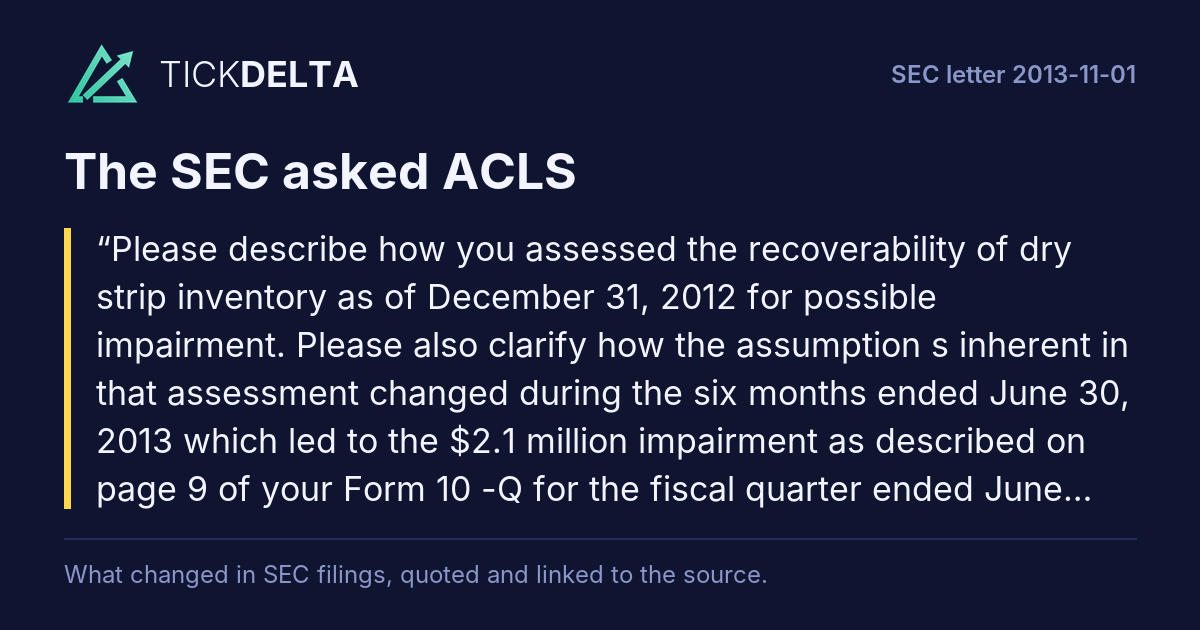
In response to the Staff’s comment, the Company advises the Staff that the Company’s assessment of the recoverability of dry strip
changed significantly based on new information obtained after the filing on March 1, 2013 of the Form
for the fiscal year ended December 31, 2012 (the “Form 10-K”).
requires the Company to estimate the future demand for its products.
Rest of the answer
During the fourth quarter of 2012, the Company performed a comprehensive review and analysis of its worldwide inventory levels based on historic and projected inventory requirements for all of its products, components and parts. This analysis which was primarily driven by the Company’s internal projections and the factors discussed below was supported by industry outlook indicating that the semiconductor industry downturn would continue into 2013. As a result, the Company recorded a $13.4 million increase to inventory reserves in the fourth quarter of 2012. This is disclosed in Note 6 of the 2012 financial statements included in the Form 10-K.
The Company’s inventory excess and obsolescence analysis as of December 31, 2012 took into account the December 2012 sale of certain intellectual property and other assets related to the Company’s dry strip product line to Lam Research Corporation which was also disclosed in the footnotes in the Form 10-K. The contractual arrangement associated with the Lam sale provided for a 270 day transition period that extended into September 2013, during which the Company had the ability to accept purchase orders for the sale of 300 mm dry strip tools for a period of 180 days and these tools were required to ship within a further 90 days. In addition, the contract allowed the Company to sell certain 200 mm dry strip tools until December 2015 and to provide aftermarket support (spares, services, etc.) for the current installed base of both 300 mm and 200 mm systems in perpetuity. The Company considered the impact of the Lam sale in its inventory excess and obsolescence analysis as of December 31, 2012. At December 31, 2012, the recovery of $5.0 million of dry strip inventory was supported by forecasts to support aftermarket needs and an annual plan for 2013 that assumed the sale of 300 mm units during the transition period to key customers. Accordingly, the Company concluded that there was no reserve required for the 300 mm dry strip inventory as of December 31, 2012.
The charge recorded in the period ended December 31, 2012, as well as the Company’s expectations regarding the recoverability of the remaining dry strip inventory, were based on system bookings at the time of the filing of the Form 10-K on March 1, 2013 as well as the Company’s annual plan for 2013 and a three year strategic plan, which were developed using historical customer purchasing patterns, feedback from key customers, and industry data supporting projected capital spending.
After the filing of the Form 10-K and prior to the filing of the Company’s Form 10-Q for the three months ended March 31, 2013 (filed on May 6, 2013), the Company received new information from key 300 mm dry strip customers that indicated that certain 300 mm product sales that had been included in the annual plan would not occur within the contractual transition period. This new information prompted the Company to review its 2013 annual plan inputs and, therefore, the salability of the 300 mm dry strip inventory. The Company concluded that there was not a high probability of new orders within the transition period and, accordingly, reconsidered the need for a reserve against the 300 mm dry strip inventory. As a result, the Company recorded a $2.1 million charge, specific to the 300 mm product line, which represented the value of inventory no longer expected to be recoverable as of March 31, 2013. The remaining dry strip inventory of $2.9 million was projected to be recoverable through aftermarket support needs for the existing installed base of dry strip customers, and consists primarily of spare parts inventory to support these needs. The Company included the following disclosure on page 9 of its Form 10-Q for the fiscal quarter ended March 31, 2013, “During the three months ended March 31, 2013, the Company recorded a charge to cost of sales of $2.1 million for 300mm dry strip components. Under the terms of the agreement with Lam, the Company was permitted to manufacture and sell dry strip products through September 2013. Due to changes in the forecasted sales of the Company’s dry strip products that become known in the current period, a portion of the dry strip inventory components were determined to be non-recoverable”. A similar disclosure was included on page 9 of Form 10-Q for the fiscal quarter ended June 30, 2013.
The conclusion that a reserve for 300 mm dry strip inventory was not needed at December 31, 2012 was based on information available to the Company at that date through the filing date of the Form 10K. The Company’s conclusion that a reserve was required for a portion of the 300 mm dry strip inventory at March 31, 2013, was based on new information available subsequent to the filing of the Form 10-K on March 1, 2013 and prior to the filing of Form 10-Q for the period ended March 31, 2013 on May 6, 2013 and, therefore, the charge was recorded in the period ended March 31, 2013.