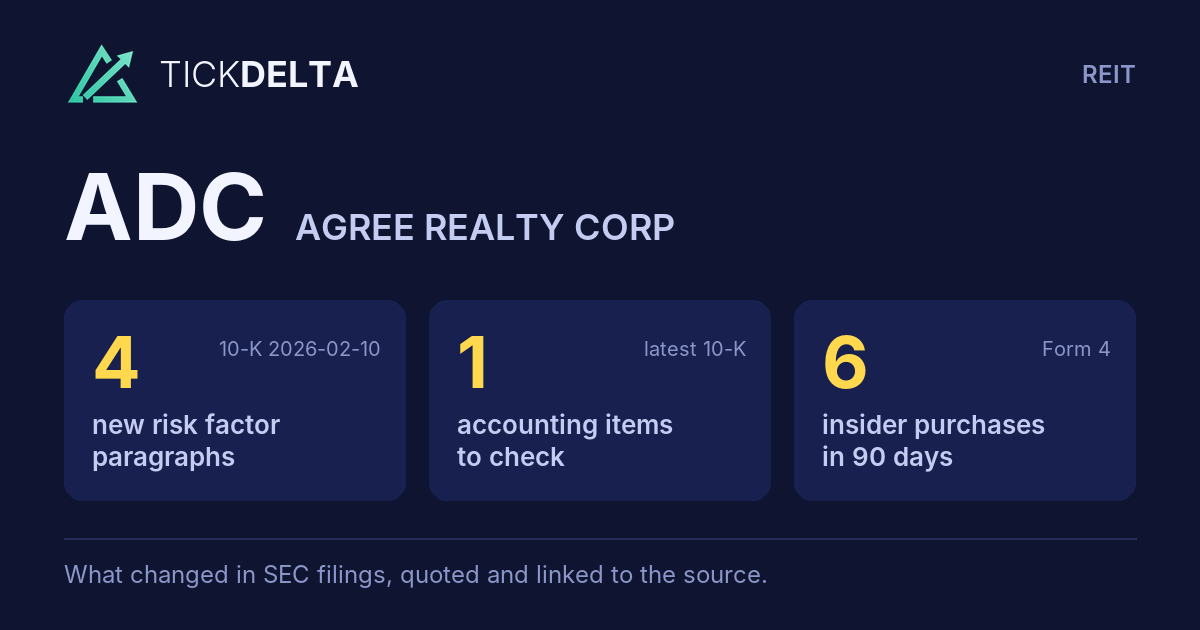
Paragraph 4 · 31% changed
Every version of it
Screener
/
SEC EDGAR
/CIK 0000917251
/10-K filed Feb 10, 2026, compared with Feb 11, 2025
/Numbers from the XBRL of the 10-Ks
NYSE
Real estate · REIT
Agree Realty Corp ADC
The 10-K against last year's
99 changes: 20 added, 6 removed, 72 reworded, 1 quiet changes
10-K Feb 10, 2026 vs Feb 11, 2025
Risk Factors
7.6%
of the text changed · 10,788 words now · 4 new paragraphs, 1 gone
MD&A
24.1%
of the text changed · 7,485 words now · 16 new paragraphs, 5 gone
Accounting Policies
52.1%
of the text changed · 4,329 words now
10-K 0000917251-26-000013 (Feb 10, 2026) vs 10-K 0001558370-25-000803 (Feb 11, 2025) Not compared: Legal Proceedings.
Every paragraph, and how much of it changed
One bar per paragraph, in the order of the 10-K. Height and colour show the share of its words not in the closest paragraph a year earlier; the tallest bars are new paragraphs.
Risk Factors
137 paragraphs · 4 new · 51 reworded · 1 gone · 10-K Feb 10, 2026 against Feb 11, 2025
New paragraph
Reworded (5% of its words or more)
Same or nearly
Paragraph 3 · 27% changed
Every version of it
Changes in global or national economic conditions, such as the global economic and financial market downturn, rising tensions between China and Taiwan and the conflicts in Ukraine and in the Middle East, may cause or continue to cause, among other things, tightening in the credit markets, lower levels of liquidity, increases in the rate of default and bankruptcy and lower consumer spending and business spending, which could adversely affect our business and operations. For example, the current and continued macro-economic conditions of high inflation and increased interest rates have increased the costs associated with acquiring new properties and decreased the availability of financing on terms that we find acceptable, which has reduced our ability to acquire properties at our historical rate with attractive terms. Potential consequences of changes in economic and financial conditions include:
Paragraph 104 · 20% changed
Every version of it
Paragraph 83 · 16% changed
Every version of it
Paragraph 119 · 15% changed
Every version of it
We are required to establish and maintain internal control over financial reporting and disclosure controls and procedures. Internal control over financial reporting is a process designed to provide reasonable assurance regarding the reliability of financial reporting and the preparation of financial statements in accordance with generally accepted accounting principles. Disclosure controls and procedures are processes designed to ensure that information required to be disclosed is communicated to management and reported in a timely manner. We cannot be certain that we will be successful in continuing to maintain adequate control over our financial reporting and disclosure controls and procedures. Deficiencies, including any material weakness, in our internal control over financial reporting that may occur could result in misstatements or restatements of our financial statements or a decline in the price of our securities. In addition, as our business continues to grow, and as we continue to make significant acquisitions, our internal controls will become more complex and may require significantly more resources to ensure that our disclosure controls and procedures remain effective. Moreover, the existence of any material weakness or significant deficiency in our internal controls and procedures may require management to devote significant time and incur significant expense to remediate any such material weaknesses or significant deficiencies and management may not be able to remediate any such material weaknesses or significant deficiencies in a timely manner. If we cannot provide reliable financial reports, our reputation and operating results could be materially adversely affected, which could also cause investors to lose confidence in our reported financial information, which in turn could result in a reduction in the trading price of our common stock.
Paragraph 58 · 14% changed
Every version of it
Our leases generally require tenants to carry comprehensive liability and extended coverage insurance on our properties. However, there are certain losses, including losses from environmental liabilities, terrorist acts or catastrophic acts of nature, that are not generally insured against or that are not generally fully insured against because it is not deemed economically feasible or prudent to do so. If there is an uninsured loss or a loss in excess of insurance limits, we could lose both the revenues generated by the affected property and the capital we have invested in the property. Inflation, changes in building codes and ordinances, environmental considerations and other factors might also keep us from using insurance proceeds to replace or renovate an affected property after it has been damaged or destroyed. Under those circumstances, the insurance proceeds we receive might be inadequate to restore our economic position on the damaged or destroyed property. In the event of a substantial unreimbursed loss, we would remain obligated to repay any mortgage indebtedness or other obligations related to the property.
Paragraph 100 · 14% changed
Every version of it
Changes to the federal income tax laws are proposed regularly. Additionally, the REIT rules are constantly under review by persons involved in the legislative process and by the IRS and the U.S. Department of the Treasury, which may result in revisions to regulations and interpretations in addition to statutory changes. If enacted, certain such changes could have an adverse impact on our business and financial results. In particular, H.R. 1, which took effect for taxable years that began on or after January 1, 2018 (subject to certain exceptions), as amended by the Coronavirus Aid, Relief, and Economic Security Act made many significant changes to the federal income tax laws that profoundly impacted the taxation of individuals, corporations (both regular C corporations as well as corporations that have elected to be taxed as REITs), and the taxation of taxpayers with overseas assets and operations. A Effective July 4, 2025, the One Big Beautiful Bill Act (“OBBBA”) was signed into law and is a complex revision to the U.S. federal income tax laws with potentially far-reaching consequences. The OBBBA will require subsequent rulemaking in a number of changes that affect non-corporate taxpayers will expire at areas. The long-term impact of the end of 2025 unless Congress acts to extend them. These OBBBA along with H.R. 1 on us, our investors, our tenants and the real estate industry cannot be reliably predicted and these changes impact us and our stockholders in various ways, some of which are adverse or potentially adverse compared to prior law. While the IRS has issued some guidance with respect to certain of the new provisions, there are numerous interpretive issues that will require further guidance, and technical corrections legislation may be needed to clarify certain aspects of the new law and give proper effect to Congressional intent. There can be no assurance, however, that technical clarifications to these laws or further changes needed to prevent unintended or unforeseen tax consequences will be enacted by Congress. In addition, while certain elements of tax reform legislation do not impact us directly as a REIT, they could impact the geographic markets in which we operate, the tenants that populate our properties and the customers who frequent our properties in ways, both positive and negative, that are difficult to anticipate. Other legislative proposals could be enacted in the future that could affect REITs and their stockholders. Prospective investors are urged to consult their tax advisors regarding the effect of these tax law changes and any other potential tax law changes on an investment in our common stock.
Paragraph 14 · 10% changed
Every version of it
If a tenant becomes bankrupt or insolvent, that could diminish the income we receive from that tenant’s leases. We may not be able to evict a tenant solely because of its bankruptcy. On the other hand, a bankruptcy court might authorize the tenant to terminate its leasehold with us. If that happens, our claim against the bankrupt tenant for unpaid future rent would be an unsecured claim subject to statutory limitations, and therefore any amounts received in bankruptcy are likely to be substantially less valuable than the remaining rent we otherwise were owed under the leases. We may be forced to “take back” a property as a result of default or rejection of a lease by a tenant in a bankruptcy proceeding. In addition, a tenant in bankruptcy may attempt to renegotiate their lease or request significant rent concessions, and any payment on a claim we have for unpaid past rent could be substantially less than the amount owed.
Paragraph 4 · 31% changed
Every version of it
10-K Feb 11, 2025Changes in global or national economic conditions, such as the global economic and financial market downturn, rising tensions between China and Taiwan and the conflicts in Ukraine and in the Middle East, may cause or continue to cause, among other things, tightening in the credit markets, lower levels of liquidity, increases in the rate of default and bankruptcy and lower consumer spending and business spending, which could adversely affect our business and operations. For example, the current and continued macro-economic conditions of high inflation and increased interest rates have increased the costs associated with acquiring new properties and decreased the availability of financing on terms that we find acceptable, which has reduced our ability to acquire properties at our historical rate with attractive terms. Potential consequences of changes in economic and financial conditions include:
10-K Feb 10, 2026
For example, the current and continued macro-economic conditions of elevated inflation and increased interest rates have increased the costs associated with acquiring new properties and decreased the availability of financing on terms that we find acceptable, which has reduced our ability to acquire properties at our historical rate with attractive terms. Potential consequences of changes in economic and financial conditions include:
Paragraph 3 · 27% changed
Every version of it
10-K Feb 11, 2025
Changes in global or national economic conditions, such as the global economic and financial market downturn, rising tensions between China and Taiwan and the conflicts in Ukraine and in the Middle East, may cause or continue to cause, among other things, tightening in the credit markets, lower levels of liquidity, increases in the rate of default and bankruptcy and lower consumer spending and business spending, which could adversely affect our business and operations. For example, the current and continued macro-economic conditions of high inflation and increased interest rates have increased the costs associated with acquiring new properties and decreased the availability of financing on terms that we find acceptable, which has reduced our ability to acquire properties at our historical rate with attractive terms. Potential consequences of changes in economic and financial conditions include:
10-K Feb 10, 2026
Changes in global or national economic conditions, such as the global economic and financial market downturn, rising tensions between China and Taiwan and the conflicts in Ukraine and in the Middle East, may cause or continue to cause, among other things, tightening in the credit markets, lower levels of liquidity, increases in the rate of default and bankruptcy and lower consumer spending and business spending, which could adversely affect our business and operations.
Paragraph 104 · 20% changed
Every version of it
10-K Feb 11, 202520% of the total value of our assets can be represented by one or more TRSs. If we fail to comply with these requirements at the end of any calendar quarter, we must correct the failure within 30 days after the end of the calendar quarter or qualify for certain statutory relief provisions to avoid losing our REIT qualification and suffering adverse tax consequences. As a result, we may be required to liquidate otherwise attractive investments.
10-K Feb 10, 2026
In order to qualify as a REIT, at least 75% of the value of our assets must consist of cash, cash items, government securities and qualified real estate assets. The remainder of our investments in securities (other than government securities, securities of TRSs and qualified real estate assets) cannot include more than 10% of the voting securities or 10% of the value of all securities, of any one issuer. In addition, in general, no more than 5% of the total value of our assets (other than government securities, securities of TRSs and qualified real estate assets) can consist of securities of any one issuer, and no more than 25% of the total value of our assets can be represented by one or more TRSs. If we fail to comply with these requirements at the end of any calendar quarter, we must correct the failure within 30 days after the end of the calendar quarter or qualify for certain statutory relief provisions to avoid losing our REIT qualification and suffering adverse tax consequences. As a result, we may be required to liquidate otherwise attractive investments.
Paragraph 83 · 16% changed
Every version of it
10-K Feb 11, 2025“Business combination” provisions that, subject to limitations, prohibit certain business combinations between us and an “interested stockholder” (defined generally as any person who beneficially owns 10% or more of the voting power of our shares or an affiliate thereof) for five years after the most recent date on which the stockholder
10-K Feb 10, 2026
•“Business combination” provisions that, subject to limitations, prohibit certain business combinations between us and an “interested stockholder” (defined generally as any person who beneficially owns 10% or more of the voting power of our shares or an affiliate thereof) for five years after the most recent date on which the stockholder becomes an interested stockholder and thereafter would require the recommendation of our board of directors and impose special appraisal rights and special stockholder voting requirements on these combinations; and
Paragraph 119 · 15% changed
Every version of it
10-K Feb 11, 2025
We are required to establish and maintain internal control over financial reporting and disclosure controls and procedures. Internal control over financial reporting is a process designed to provide reasonable assurance regarding the reliability of financial reporting and the preparation of financial statements in accordance with generally accepted accounting principles. Disclosure controls and procedures are processes designed to ensure that information required to be disclosed is communicated to management and reported in a timely manner. We cannot be certain that we will be successful in continuing to maintain adequate control over our financial reporting and disclosure controls and procedures. Deficiencies, including any material weakness, in our internal control over financial reporting that may occur could result in misstatements or restatements of our financial statements or a decline in the price of our securities. In addition, as our business continues to grow, and as we continue to make significant acquisitions, our internal controls will become more complex and may require significantly more resources to ensure that our disclosure controls and procedures remain effective. Moreover, the existence of any material weakness or significant deficiency in our internal controls and
10-K Feb 10, 2026
We are required to establish and maintain internal control over financial reporting and disclosure controls and procedures. Internal control over financial reporting is a process designed to provide reasonable assurance regarding the reliability of financial reporting and the preparation of financial statements in accordance with generally accepted accounting principles. Disclosure controls and procedures are processes designed to ensure that information required to be disclosed is communicated to management and reported in a timely manner. We cannot be certain that we will be successful in continuing to maintain adequate control over our financial reporting and disclosure controls and procedures. Deficiencies, including any material weakness, in our internal control over financial reporting that may occur could result in misstatements or restatements of our financial statements or a decline in the price of our securities. In addition, as our business continues to grow, and as we continue to make significant acquisitions, our internal controls will become more complex and may require significantly more resources to ensure that our disclosure controls and procedures remain effective. Moreover, the existence of any material weakness or significant deficiency in our internal controls and procedures may require management to devote significant time and incur significant expense to remediate any such material weaknesses or significant deficiencies and management may not be able to remediate any such material weaknesses or significant deficiencies in a timely manner. If we cannot provide reliable financial reports, our reputation and operating results could be materially adversely affected, which could also cause investors to lose confidence in our reported financial information, which in turn could result in a reduction in the trading price of our common stock.
Paragraph 58 · 14% changed
Every version of it
10-K Feb 11, 2025
economically feasible or prudent to do so. If there is an uninsured loss or a loss in excess of insurance limits, we could lose both the revenues generated by the affected property and the capital we have invested in the property. Inflation, changes in building codes and ordinances, environmental considerations and other factors might also keep us from using insurance proceeds to replace or renovate an affected property after it has been damaged or destroyed. Under those circumstances, the insurance proceeds we receive might be inadequate to restore our economic position on the damaged or destroyed property. In the event of a substantial unreimbursed loss, we would remain obligated to repay any mortgage indebtedness or other obligations related to the property.
10-K Feb 10, 2026
Our leases generally require tenants to carry comprehensive liability and extended coverage insurance on our properties. However, there are certain losses, including losses from environmental liabilities, terrorist acts or catastrophic acts of nature, that are not generally insured against or that are not generally fully insured against because it is not deemed economically feasible or prudent to do so. If there is an uninsured loss or a loss in excess of insurance limits, we could lose both the revenues generated by the affected property and the capital we have invested in the property. Inflation, changes in building codes and ordinances, environmental considerations and other factors might also keep us from using insurance proceeds to replace or renovate an affected property after it has been damaged or destroyed. Under those circumstances, the insurance proceeds we receive might be inadequate to restore our economic position on the damaged or destroyed property. In the event of a substantial unreimbursed loss, we would remain obligated to repay any mortgage indebtedness or other obligations related to the property.
Paragraph 100 · 14% changed
Every version of it
10-K Feb 11, 2025
Changes to the federal income tax laws are proposed regularly. Additionally, the REIT rules are constantly under review by persons involved in the legislative process and by the IRS and the U.S. Department of the Treasury, which may result in revisions to regulations and interpretations in addition to statutory changes. If enacted, certain such changes could have an adverse impact on our business and financial results. In particular, H.R. 1, which took effect for taxable years that began on or after January 1, 2018 (subject to certain exceptions), as amended by the Coronavirus Aid, Relief, and Economic Security Act made many significant changes to the federal income tax laws that profoundly impacted the taxation of individuals, corporations (both regular C corporations as well as corporations that have elected to be taxed as REITs), and the taxation of taxpayers with overseas assets and operations. A number of changes that affect non-corporate taxpayers will expire at the end of 2025 unless Congress acts to extend them. These changes impact us and our stockholders in various ways, some of which are adverse or potentially adverse compared to prior law. While the IRS has issued some guidance with respect to certain of the new provisions, there are numerous interpretive issues that will require further guidance, and technical corrections legislation may be needed to clarify certain aspects of the new law and give proper effect to Congressional intent. There can be no assurance, however, that technical clarifications or further changes needed to prevent unintended or unforeseen tax consequences will be enacted by Congress. In addition, while certain elements of tax reform legislation do not impact us directly as a REIT, they could impact the geographic markets in which we operate, the tenants that populate our properties and the customers who frequent our properties in ways, both positive and negative, that are difficult to anticipate. Other legislative proposals could be enacted in the future that could affect REITs and their stockholders. Prospective investors are urged to consult their tax advisors regarding the effect of these tax law changes and any other potential tax law changes on an investment in our common stock.
10-K Feb 10, 2026
Changes to the federal income tax laws are proposed regularly. Additionally, the REIT rules are constantly under review by persons involved in the legislative process and by the IRS and the U.S. Department of the Treasury, which may result in revisions to regulations and interpretations in addition to statutory changes. If enacted, certain such changes could have an adverse impact on our business and financial results. In particular, H.R. 1, which took effect for taxable years that began on or after January 1, 2018 (subject to certain exceptions), as amended by the Coronavirus Aid, Relief, and Economic Security Act made many significant changes to the federal income tax laws that profoundly impacted the taxation of individuals, corporations (both regular C corporations as well as corporations that have elected to be taxed as REITs), and the taxation of taxpayers with overseas assets and operations. Effective July 4, 2025, the One Big Beautiful Bill Act (“OBBBA”) was signed into law and is a complex revision to the U.S. federal income tax laws with potentially far-reaching consequences. The OBBBA will require subsequent rulemaking in a number of areas. The long-term impact of the OBBBA along with H.R. 1 on us, our investors, our tenants and the real estate industry cannot be reliably predicted and these changes impact us and our stockholders in various ways, some of which are adverse or potentially adverse compared to prior law. There can be no assurance, however, that technical clarifications to these laws or further changes needed to prevent unintended or unforeseen tax consequences will be enacted by Congress. In addition, while certain elements of tax reform legislation do not impact us directly as a REIT, they could impact the geographic markets in which we operate, the tenants that populate our properties and the customers who frequent our properties in ways, both positive and negative, that are difficult to anticipate. Other legislative proposals could be enacted in the future that could affect REITs and their stockholders. Prospective investors are urged to consult their tax advisors regarding the effect of these tax law changes and any other potential tax law changes on an investment in our common stock.
Paragraph 14 · 10% changed
Every version of it
10-K Feb 11, 2025
If a tenant becomes bankrupt or insolvent, that could diminish the income we receive from that tenant’s leases. We may not be able to evict a tenant solely because of its bankruptcy. On the other hand, a bankruptcy court might authorize the tenant to terminate its leasehold with us. If that happens, our claim against the bankrupt tenant for unpaid future rent would be an unsecured claim subject to statutory limitations, and therefore any amounts received in bankruptcy are likely to be substantially less valuable than the remaining rent we otherwise were owed under the leases. In addition, any payment on a claim we have for unpaid past rent could be substantially less than the amount owed.
10-K Feb 10, 2026
If a tenant becomes bankrupt or insolvent, that could diminish the income we receive from that tenant’s leases. We may not be able to evict a tenant solely because of its bankruptcy. On the other hand, a bankruptcy court might authorize the tenant to terminate its leasehold with us. If that happens, our claim against the bankrupt tenant for unpaid future rent would be an unsecured claim subject to statutory limitations, and therefore any amounts received in bankruptcy are likely to be substantially less valuable than the remaining rent we otherwise were owed under the leases. We may be forced to “take back” a property as a result of default or rejection of a lease by a tenant in a bankruptcy proceeding. In addition, a tenant in bankruptcy may attempt to renegotiate their lease or request significant rent concessions, and any payment on a claim we have for unpaid past rent could be substantially less than the amount owed.
MD&A
110 paragraphs · 16 new · 58 reworded · 5 gone · 10-K Feb 10, 2026 against Feb 11, 2025
New paragraph
Reworded (5% of its words or more)
Same or nearly
Paragraph 59 · 46% changed
Paragraph 58 · 46% changed
Paragraph 11 · 45% changed
Paragraph 65 · 44% changed
On August 8, 2024, November 17, 2025, the Company entered into the First Second Amendment to Term Loan Agreement (the “First “Second Amendment”) with PNC Bank, National Association, as Administrative Agent, and a syndicate of lenders named therein, and with certain indirect subsidiaries of the Operating Partnership as guarantors. The First Second Amendment amends implements various changes to conform to the 2031 Unsecured Term Loan (defined below). In addition, the Second Amendment reduced the SOFR adjustment to zero basis points, resulting in the borrowings under the 2029 Unsecured Term Loan implementing various covenant and technical amendments to make be priced at SOFR plus a spread of 80 to 160 basis points over SOFR, depending on the Company’s credit ratings. Based on the Company’s credit ratings as of December 31, 2025, pricing on the 2029 Unsecured Term Loan’s provisions consistent with corresponding provisions in the Revolving Credit Facility (see “Senior Unsecured Revolving Credit Facility” above). The First Amendment does not change the maturity or the pricing terms of the 2029 Unsecured Term Loan. Loan was 80 basis points over SOFR.
Paragraph 27 · 43% changed
Paragraph 28 · 42% changed
On August 8, 2024, November 17, 2025, the Company entered into the First Second Amendment to Term Loan Agreement (the “First “Second Amendment”) with PNC Bank, National Association, as Administrative Agent, and a syndicate of lenders named therein, and with certain indirect subsidiaries of the Operating Partnership as guarantors. The First Second Amendment amends implements various changes to conform to the 2031 Unsecured Term Loan (defined below). In addition, the Second Amendment reduced the SOFR adjustment to zero basis points, resulting in the borrowings under the 2029 Unsecured Term Loan implementing various covenant and technical amendments to make be priced at SOFR plus a spread of 80 to 160 basis points over SOFR, depending on the 2029 Unsecured Term Loan’s provisions consistent with corresponding provisions in the Revolving Credit Facility (see “Senior Unsecured Revolving Credit Facility” above). The First Amendment does not change the maturity or the pricing terms of the 2029 Unsecured Term Loan. Company’s credit ratings.
Paragraph 49 · 42% changed
The following table summarizes the ATM activity completed during for the years ended December 31, 2024, 2023 and 2022: periods presented:
Paragraph 84 · 39% changed
Paragraph 59 · 46% changed
10-K Feb 11, 2025In August 2024, the Company entered into the Fourth Amended and Restated Revolving Credit Agreement which provides for a $1.25 billion senior unsecured revolving credit facility. The Revolving Credit Facility's interest rate is based on a pricing grid with a range of 72.5 to 140 basis points over SOFR, determined by the Company's credit ratings and leverage ratio, plus a SOFR adjustment of 10 basis points. The margins for the Revolving Credit Facility are subject to adjustment based on changes in the Company's leverage ratio and credit ratings.
10-K Feb 10, 2026
On November 17, 2025, the Company entered into the First Amendment to the Revolving Credit Facility with PNC Bank, as administrative agent, and a syndicate of lenders named therein, and with certain indirect subsidiaries of the Borrower as guarantors. The First Amendment to the Revolving Credit Facility amends the Revolving Credit Facility by and among the Company, the Borrower, PNC Bank, as administrative agent, and a syndicate of lenders named therein. The First Amendment to the Revolving Credit Facility includes certain technical and administrative amendments, including an amendment to the interest rate for borrowings under the Revolving Credit Facility by reducing the SOFR adjustment to zero basis points. As a result, the Revolving Credit Facility's interest rate is based on a pricing grid with a range of 72.5 to 140 basis points over SOFR, determined by the Company's credit ratings and leverage ratio. At December 31, 2025, borrowings under the Revolving Credit Facility, as amended, would have incurred interest at a rate of SOFR plus a pricing grid spread of 72.5 basis points.
Paragraph 58 · 46% changed
10-K Feb 11, 2025In August 2024, the Company entered into the Fourth Amended and Restated Revolving Credit Agreement which provides for a $1.25 billion senior unsecured revolving credit facility. The Revolving Credit Facility's interest rate is based on a pricing grid with a range of 72.5 to 140 basis points over SOFR, determined by the Company's credit ratings and leverage ratio, plus a SOFR adjustment of 10 basis points. The margins for the Revolving Credit Facility are subject to adjustment based on changes in the Company's leverage ratio and credit ratings.
10-K Feb 10, 2026
On August 8, 2024, the Company entered into the Fourth Amended and Restated Revolving Credit Agreement which provides a $1.25 billion senior unsecured revolving credit facility (the “Revolving Credit Facility”).
Paragraph 11 · 45% changed
10-K Feb 11, 2025During the year ended December 31, 2024, the Company commenced 25 development and DFP projects. At December 31, 2024, the Company had 20 development or DFP projects under construction.
10-K Feb 10, 2026
Year Ended December 31, 2025 Projects completed 21 Projects commenced 14 Projects under construction at period-end 13
Paragraph 65 · 44% changed
10-K Feb 11, 2025
On August 8, 2024, the Company entered into the First Amendment to Term Loan Agreement (the “First Amendment”) with PNC Bank, National Association, as Administrative Agent, and a syndicate of lenders named therein, and with certain indirect subsidiaries of the Operating Partnership as guarantors. The First Amendment amends the 2029 Unsecured Term Loan implementing various covenant and technical amendments to make the 2029 Unsecured Term Loan’s provisions consistent with corresponding provisions in the Revolving Credit Facility (see “Senior Unsecured Revolving Credit Facility” above). The First Amendment does not change the maturity or the pricing terms of the 2029 Unsecured Term Loan.
10-K Feb 10, 2026
On November 17, 2025, the Company entered into the Second Amendment to Term Loan Agreement (the “Second Amendment”) with PNC Bank, National Association, as Administrative Agent, and a syndicate of lenders named therein, and with certain indirect subsidiaries of the Operating Partnership as guarantors. The Second Amendment implements various changes to conform to the 2031 Unsecured Term Loan (defined below). In addition, the Second Amendment reduced the SOFR adjustment to zero basis points, resulting in the borrowings under the 2029 Unsecured Term Loan to be priced at SOFR plus a spread of 80 to 160 basis points over SOFR, depending on the Company’s credit ratings. Based on the Company’s credit ratings as of December 31, 2025, pricing on the 2029 Unsecured Term Loan was 80 basis points over SOFR.
Paragraph 27 · 43% changed
10-K Feb 11, 2025In August 2024, the Company entered into the Fourth Amended and Restated Revolving Credit Agreement which provides for a $1.25 billion senior unsecured revolving credit facility. The Revolving Credit Facility's interest rate is based on a pricing grid with a range of 72.5 to 140 basis points over SOFR, determined by the Company's credit ratings and leverage ratio, plus a SOFR adjustment of 10 basis points. The margins for the Revolving Credit Facility are subject to adjustment based on changes in the Company's leverage ratio and credit ratings.
10-K Feb 10, 2026
On November 17, 2025, the Company entered into the First Amendment to the Fourth Amended and Restated Revolving Credit Agreement (the “First Amendment to the Revolving Credit Facility”) with PNC Bank, as administrative agent, and a syndicate of lenders named therein, and with certain indirect subsidiaries of the Borrower as guarantors. The First Amendment to the Revolving Credit Facility amends the Revolving Credit Facility by and among the Company, the Borrower, PNC Bank, as administrative agent, and a syndicate of lenders named therein. The First Amendment to the Revolving Credit Facility includes certain technical and administrative amendments, including an amendment to the interest rate for borrowings under the Revolving Credit Facility by reducing the SOFR adjustment to zero basis points. As a result, the Revolving Credit Facility's interest rate is based on a pricing grid with a range of 72.5 to 140 basis points over SOFR, determined by the Company's credit ratings and leverage ratio. At December 31, 2025, borrowings under the Revolving Credit Facility, as amended, would have incurred interest at a rate of SOFR plus a pricing grid spread of 72.5 basis points.
Paragraph 28 · 42% changed
10-K Feb 11, 2025
On August 8, 2024, the Company entered into the First Amendment to Term Loan Agreement (the “First Amendment”) with PNC Bank, National Association, as Administrative Agent, and a syndicate of lenders named therein, and with certain indirect subsidiaries of the Operating Partnership as guarantors. The First Amendment amends the 2029 Unsecured Term Loan implementing various covenant and technical amendments to make the 2029 Unsecured Term Loan’s provisions consistent with corresponding provisions in the Revolving Credit Facility (see “Senior Unsecured Revolving Credit Facility” above). The First Amendment does not change the maturity or the pricing terms of the 2029 Unsecured Term Loan.
10-K Feb 10, 2026
On November 17, 2025, the Company entered into the Second Amendment to Term Loan Agreement (the “Second Amendment”) with PNC Bank, National Association, as Administrative Agent, and a syndicate of lenders named therein, and with certain indirect subsidiaries of the Operating Partnership as guarantors. The Second Amendment implements various changes to conform to the 2031 Unsecured Term Loan (defined below). In addition, the Second Amendment reduced the SOFR adjustment to zero basis points, resulting in the borrowings under the 2029 Unsecured Term Loan to be priced at SOFR plus a spread of 80 to 160 basis points over SOFR, depending on the Company’s credit ratings.
Paragraph 49 · 42% changed
10-K Feb 11, 2025
The following table summarizes the ATM activity completed during the years ended December 31, 2024, 2023 and 2022:
10-K Feb 10, 2026
The following table summarizes the ATM activity completed for the periods presented:
Paragraph 84 · 39% changed
10-K Feb 11, 2025$6.1 million increase in payments as a result of the acquisition of the fee interest in land that was previously under a finance lease; and
10-K Feb 10, 2026
•$6.1 million decrease in payments of financing lease liabilities as an acquisition of the fee interest in land previously under a finance lease was completed during the year ended December 31, 2024;
A paragraph is matched with the one last year that shares the most of its words; under half in common makes it new. The paragraphs shown are the 8 reworded the most in each section.
The paragraph that changed most in each section
The redline
Marked against last year's 10-K: cut words struck through, new words highlighted.
Accounting Policies513 words changed in this paragraph; it is 32% similar to last year's version.
Source: 10-K text, Note 2 – Summary of Significant Accounting Policies, 10-K 0000917251-26-000013 vs 10-K text, Note 1 – Organization, 10-K 0001558370-25-000803
MD&A201 words changed in this paragraph; it is 32% similar to last year's version.
Source: Item 7, 10-K 0000917251-26-000013 vs Item 7, 10-K 0001558370-25-000803
Risk Factors127 words changed in this paragraph; it is 82% similar to last year's version.
Changes to the federal income tax laws are proposed regularly. Additionally, the REIT rules are constantly under review by persons involved in the legislative process and by the IRS and the U.S. Department of the Treasury, which may result in revisions to regulations and interpretations in addition to statutory changes. If enacted, certain such changes could have an adverse impact on our business and financial results. In particular, H.R. 1, which took effect for taxable years that began on or after January 1, 2018 (subject to certain exceptions), as amended by the Coronavirus Aid, Relief, and Economic Security Act made many significant changes to the federal income tax laws that profoundly impacted the taxation of individuals, corporations (both regular C corporations as well as corporations that have elected to be taxed as REITs), and the taxation of taxpayers with overseas assets and operations. A Effective July 4, 2025, the One Big Beautiful Bill Act (“OBBBA”) was signed into law and is a complex revision to the U.S. federal income tax laws with potentially far-reaching consequences. The OBBBA will require subsequent rulemaking in a number of changes that affect non-corporate taxpayers will expire at areas. The long-term impact of the end of 2025 unless Congress acts to extend them. These OBBBA along with H.R. 1 on us, our investors, our tenants and the real estate industry cannot be reliably predicted and these changes impact us and our stockholders in various ways, some of which are adverse or potentially adverse compared to prior law. While the IRS has issued some guidance with respect to certain of the new provisions, there are numerous interpretive issues that will require further guidance, and technical corrections legislation may be needed to clarify certain aspects of the new law and give proper effect to Congressional intent. There can be no assurance, however, that technical clarifications to these laws or further changes needed to prevent unintended or unforeseen tax consequences will be enacted by Congress. In addition, while certain elements of tax reform legislation do not impact us directly as a REIT, they could impact the geographic markets in which we operate, the tenants that populate our properties and the customers who frequent our properties in ways, both positive and negative, that are difficult to anticipate. Other legislative proposals could be enacted in the future that could affect REITs and their stockholders. Prospective investors are urged to consult their tax advisors regarding the effect of these tax law changes and any other potential tax law changes on an investment in our common stock.
Source: Item 1A, 10-K 0000917251-26-000013 vs Item 1A, 10-K 0001558370-25-000803
Sentences and paragraphs added, removed or reworded
Every change, by type
Sentences and paragraphs of ADC's Risk Factors and MD&A, 10-K Feb 10, 2026 against 10-K Feb 11, 2025. Each links to the text at sec.gov.
Quiet changes are sentences kept from last year with one to four words changed, at least one of them a hedge, a modal or a qualifier (may, could, will, not, significant, material…). A year or date rolling forward is not counted.
The full word list
adverse, adversely, all, although, anticipate, anticipates, any, approximately, believe, believes, can, cannot, certain, could, expect, expects, generally, however, if, intend, intends, largely, likely, many, material, materially, may, might, most, must, never, no, not, possible, primarily, probable, should, significant, significantly, some, substantial, substantially, unlikely, will, would
AddedRisk Factors
We face risks associated with climate change, which could materially and adversely impact us.
Read it in 10-K Feb 10, 2026 at sec.gov
AddedRisk Factors
As a result of climate change, our properties in certain markets could experience increases in storm intensity, flooding, drought, wildfires, rising sea levels, and extreme temperatures. The potential physical impacts of climate change on our properties are uncertain and would be particular to the geographic circumstances in areas in which we own property. Over time, these conditions could result in volatile or decreased demand for certain of our properties or, in extreme cases, the inability of our tenants to operate the properties at all. Climate change may also have indirect effects on our business by increasing the cost of insurance (or making insurance unavailable), increasing the cost of energy at our properties, or requiring us to spend funds to repair and protect our properties against such risks. Compliance with new federal and state-level laws or regulations related to climate change, including climate change disclosures, compliance with “green” building codes or other laws or regulations relating to reduction of carbon footprints and/or greenhouse gas emissions, may require us to make significant cash expenditures both at the property and corporate level. Furthermore, our tenants’ increased costs associated with compliance with such laws or regulations could negatively impact our tenants’ operating results and ability to pay rent. Any of these occurrences could materially and adversely impact us.
Read it in 10-K Feb 10, 2026 at sec.gov
AddedRisk Factors
Compliance with the ADA, fire and safety regulations, and other regulations may require us to make unanticipated expenditures.
Read it in 10-K Feb 10, 2026 at sec.gov
AddedRisk Factors
Our properties are subject to the ADA, fire and safety regulations, building codes and other regulations. Failure to comply with these laws and regulations could result in imposition of fines by the government or an award of damages to private litigants, or both. While our tenants are obligated by law to comply with the ADA and typically obligated under our leases to cover costs associated with compliance with the ADA and other property regulations, if required changes involve greater expenditures than anticipated or if the changes must be made on a more accelerated basis than anticipated, the ability of our tenants to cover costs could be adversely affected, and we could be required to expend our own funds to comply with applicable law and regulation.
Read it in 10-K Feb 10, 2026 at sec.gov
RemovedRisk Factors
RewordedRisk Factors
Our properties are located in all 50 states throughout the United States and in particular, the state of Texas (where 151 169 properties out of 2,370 2,674 properties are located, or 6.8% 6.9% of our annualized base rent was derived as of December 31, 2024), 2025), Illinois (140 (166 properties, or 5.5% 6.1% of our annualized base rent), Ohio (164 properties, or 5.3% of our annualized base rent), Michigan (142 properties, or 5.5% of our annualized base rent), North Carolina (133 (149 properties, or 5.2% of our annualized base rent), and Florida (129 New York (103 properties, or 5.2% 5.0% of our annualized base rent).
Read it in 10-K Feb 10, 2026 at sec.gov
RewordedRisk Factors
RewordedRisk Factors
In addition, a tenant in bankruptcy may attempt to renegotiate their lease or request significant rent concessions, and any payment on a claim we have for unpaid past rent could be substantially less than the amount owed.
Read it in 10-K Feb 10, 2026 at sec.gov
Show the other 39
RewordedRisk Factors
As of December 31, 2024, 9.2%, 9.2% 2025, 10.3%, 9.0% and 8.1% 7.7% of our annualized base rents were derived from tenants operating in the grocery store, stores, home improvement, and tire and auto service convenience store sectors, respectively.
Read it in 10-K Feb 10, 2026 at sec.gov
RewordedRisk Factors
Taking into account H.R. 1’s this 20% reduction in the maximum individual federal income tax rate from 39.6% to 37%, (which is otherwise 37%), this results in a maximum effective rate of regular income tax on ordinary REIT dividends of 29.6% through 2025 (as compared to the 20% maximum federal income tax rate applicable to qualified dividend income received from a non-REIT corporation).
Read it in 10-K Feb 10, 2026 at sec.gov
RewordedRisk Factors
Therefore, the financial failure of, or other default in payment by, a single tenant under its lease or our decision not to renew a tenant's lease and the potential resulting vacancy is likely to may cause a significant reduction in our operating cash flows from that property and a significant reduction in the value of the property and could cause a significant impairment loss.
Read it in 10-K Feb 10, 2026 at sec.gov
RewordedRisk Factors
A REIT that annually distributes at least 90% of its taxable income to its stockholders generally is not taxed at the corporate level on such distributed income.
Read it in 10-K Feb 10, 2026 at sec.gov
RewordedRisk Factors
Similarly, we have concentrations in other sectors such as convenience stores, dollar stores tire and auto parts. service, auto parts and dollar stores.
Read it in 10-K Feb 10, 2026 at sec.gov
RewordedRisk Factors
An epidemic or pandemic (such as the outbreak and worldwide spread of COVID-19), pandemic, and the measures that international, federal, state and local governments, agencies, law enforcement and/or health authorities implement to address it, may precipitate or materially exacerbate one or more of the other risks, and may significantly disrupt our tenants’ ability to operate their businesses and/or pay rent to us or prevent us from operating our business in the ordinary course for an extended period.
Read it in 10-K Feb 10, 2026 at sec.gov
RewordedRisk Factors
Such tenants operate in sectors including grocery stores, home improvement, convenience stores, tire and automotive services auto services, auto parts and convenience dollar stores.
Read it in 10-K Feb 10, 2026 at sec.gov
RewordedRisk Factors
Commencing with taxable years that began on or after January 1, 2018 and continuing through 2025, H.R. 1 temporarily reduced the effective tax rate on ordinary REIT dividends (i.e., dividends other than capital gain dividends and dividends attributable to certain qualified dividend income received by us) was reduced for U.S. holders of our common stock that are individuals, estates or trusts by permitting such holders to claim a deduction in determining their taxable income equal to 20% of any such dividends they receive.
Read it in 10-K Feb 10, 2026 at sec.gov
RewordedRisk Factors
In addition, new project development is subject to a number of risks, including risks of construction delays delays, supply chain disruptions, price fluctuations of materials or cost overruns that may increase anticipated project costs.
Read it in 10-K Feb 10, 2026 at sec.gov
AddedMD&A
The following summarizes the acquisitions completed by the Company during the periods presented (dollars in thousands):
Read it in 10-K Feb 10, 2026 at sec.gov
AddedMD&A
Year Ended December 31, 2025 Number of properties acquired 305 Location (by state) 41 Tenant retail sectors 29 Weighted-average lease term (years) 11.5 Underwritten weighted-average capitalization rate(1) 7.2 % Total purchase price, including acquisition and closing costs $ 1,448,066
Read it in 10-K Feb 10, 2026 at sec.gov
AddedMD&A
The following summarizes the Company’s development and Developer Funding Platform (“DFP”) activity during the periods presented:
Read it in 10-K Feb 10, 2026 at sec.gov
AddedMD&A
The following summarizes the Company’s disposition activity during the periods presented (dollars in thousands):
Read it in 10-K Feb 10, 2026 at sec.gov
AddedMD&A
Year Ended December 31, 2025 Number of properties sold 22 Net proceeds $ 42,067 Gain on sale of assets, net $ 5,416
Read it in 10-K Feb 10, 2026 at sec.gov
AddedMD&A
Comparison of Year Ended December 31, 2025 to Year Ended December 31, 2024 (dollars in thousands)
Read it in 10-K Feb 10, 2026 at sec.gov
AddedMD&A
Income and other tax expense decreased $2.6 million to $1.7 million for the year ended December 31, 2025 compared to $4.3 million during the year ended December 31, 2024. The decrease is driven by refunds received as a result of amendments to previous years' tax returns for various state filings as well as a reduction in recurring expense levels following these amendments.
Read it in 10-K Feb 10, 2026 at sec.gov
AddedMD&A
In March 2025, the Operating Partnership established a commercial paper program (the “Commercial Paper Program”), pursuant to which it may issue short-term, fixed rate, unsecured commercial paper notes (the “Commercial Paper Notes”) under the exemption from registration contained in Section 4(a)(2) of the Securities Act. Amounts available under the Commercial Paper Program may be borrowed, repaid and re-borrowed from time to time, with the aggregate principal amount of the Commercial Paper Notes outstanding under the Commercial Paper Program at any time not to exceed $625.0 million. The Commercial Paper Notes can have maturities of up to 397 days from the date of issue and are guaranteed by the Company and certain wholly owned subsidiaries of the Operating Partnership.
Read it in 10-K Feb 10, 2026 at sec.gov
AddedMD&A
In addition, in May 2025, the Operating Partnership repaid the $50.0 million 2025 Senior Unsecured Notes at maturity.
Read it in 10-K Feb 10, 2026 at sec.gov
AddedMD&A
Program Program Size Total Forward Total Forward Total Forward Total Net Proceeds Anticipated or Received from Forward Shares Sold Shares Sold Shares Settled Shares Outstanding as of December 31, 2025 September 2022 (1) $750.0 10,217,973 10,217,973 — $670.3 February 2024 (1) $1,000.0 10,409,017 10,409,017 — $705.3 October 2024 $1,250.0 4,444,245 (2) — 4,444,245 (3) $330.3
Read it in 10-K Feb 10, 2026 at sec.gov
AddedMD&A
Upon settlement of the relevant forward sale agreement, subject to certain exceptions, we may elect, in our sole discretion, to physically settle in common shares, cash settle, or net share settle all or any portion of our obligations under any forward sale agreement.
Read it in 10-K Feb 10, 2026 at sec.gov
AddedMD&A
Year Ended December 31, 2025 2024 2023 Shares of common stock sold under the ATM programs 4,275,968 10,598,037 5,846,998 Shares of common stock settled under the ATM programs 7,633,519 6,630,112 6,117,768 Net proceeds received (in millions) $538.3 $403.8 $415.4
Read it in 10-K Feb 10, 2026 at sec.gov
RemovedMD&A
RemovedMD&A
RemovedMD&A
RemovedMD&A
RemovedMD&A
RewordedMD&A
The Company’s real estate investment portfolio grew from approximately $6.74 billion in net investment amount representing 2,135 properties with 44.2 million square feet of GLA as of December 31, 2023 to approximately $7.42 billion in net investment amount representing 2,370 properties with 48.8 million square feet of GLA as of December 31, 2024 to approximately $8.57 billion in net investment amount representing 2,674 properties with 55.5 million square feet of GLA at December 31, 2024. 2025.
Read it in 10-K Feb 10, 2026 at sec.gov
RewordedMD&A
During the year ended December 31, 2024, 2025, the Company received gross proceeds of $397.2 million from the issuance of the 2035 Senior Unsecured Public Notes in May 2025, compared to gross proceeds of $444.7 million from the issuance of the 2034 Senior Unsecured Public Notes in May 2024 while $350.0 million of proceeds were received in connection with the 2029 Unsecured Term Loan that closed in July 2023. 2024.
Read it in 10-K Feb 10, 2026 at sec.gov
RewordedMD&A
RewordedMD&A
Interest expense expense, net increased $27.8 $25.7 million, or 34%, 24%, to $134.6 million for the year ended December 31, 2025, compared to $108.9 million for the year ended December 31, 2024, compared to $81.1 million for the year ended December 31, 2023. 2024.
Read it in 10-K Feb 10, 2026 at sec.gov
RewordedMD&A
RewordedMD&A
RewordedMD&A
General and administrative expenses increased $2.4 $6.9 million, or 7%, 18%, to $44.1 million for the year ended December 31, 2025, compared to $37.2 million for the year ended December 31, 2024, compared to $34.8 million for the year ended December 31, 2023. 2024.
Read it in 10-K Feb 10, 2026 at sec.gov
RewordedMD&A
The following table provides a reconciliation of net income to FFO, Core FFO, FFO and AFFO for the years ended December 31, 2024, 2023 periods presented (dollars in thousands, except for per common share and 2022 (presented in thousands): partnership unit data):
Read it in 10-K Feb 10, 2026 at sec.gov
RewordedMD&A
RewordedMD&A
RewordedMD&A
General and administrative expenses as a percentage of total revenue decreased increased to 6.1% for the year ended December 31, 2025 from 6.0% for the year ended December 31, 2024 from 6.5% for the year ended December 31, 2023. 2024.
Read it in 10-K Feb 10, 2026 at sec.gov
RewordedMD&A
Quiet changesMD&A
Agree has agreed to reimburse the Company for his proportionate share of loss incurred under the Revolving Credit Facility and/or certain other indebtedness in an amount to be determined by facts and circumstances at the time of loss.
Read it in 10-K Feb 10, 2026 at sec.gov
Sources
The two latest 10-Ks on EDGAR, section by section. Each change links to the text at sec.gov.
Also
New risk factors: paragraphs with nothing like them last year, quoted in full.
Work with it
Excel workbook · CSV. Google Sheet that stays up to date: paste =IMPORTDATA("https://tickdelta.com/company/ADC/export.csv") into a cell.