ADMArcher Daniels Midland
Archer-Daniels-Midland Company and its subsidiaries (the "Company" or "ADM") unlocks the power of nature to enrich the quality of life. 10-K, Item 1
- Headquarters
- Chicago, IL
- CEO
- Juan Luciano
- Next results
- around Feb 2, 2027
22 new paragraphs in the 10-K, 23 new in the latest 10-Q
Paragraphs with nothing like them in last year's 10-K
22 paragraphs in Risk Factors of the 10-K filed Feb 17, 2026 with nothing like them in the 10-K filed Feb 20, 2025. Quoted exactly. Paragraphs that were only edited are under 10-K change.
Compared with the Risk Factors in the latest 10-K of the other 31 Consumer staples companies: a paragraph with at least half its words the same at another company is called similar, and the companies are listed under it. A paragraph most of them have is marked boilerplate. No line means no other company has one like it. This counts text; it does not say how serious a risk is.
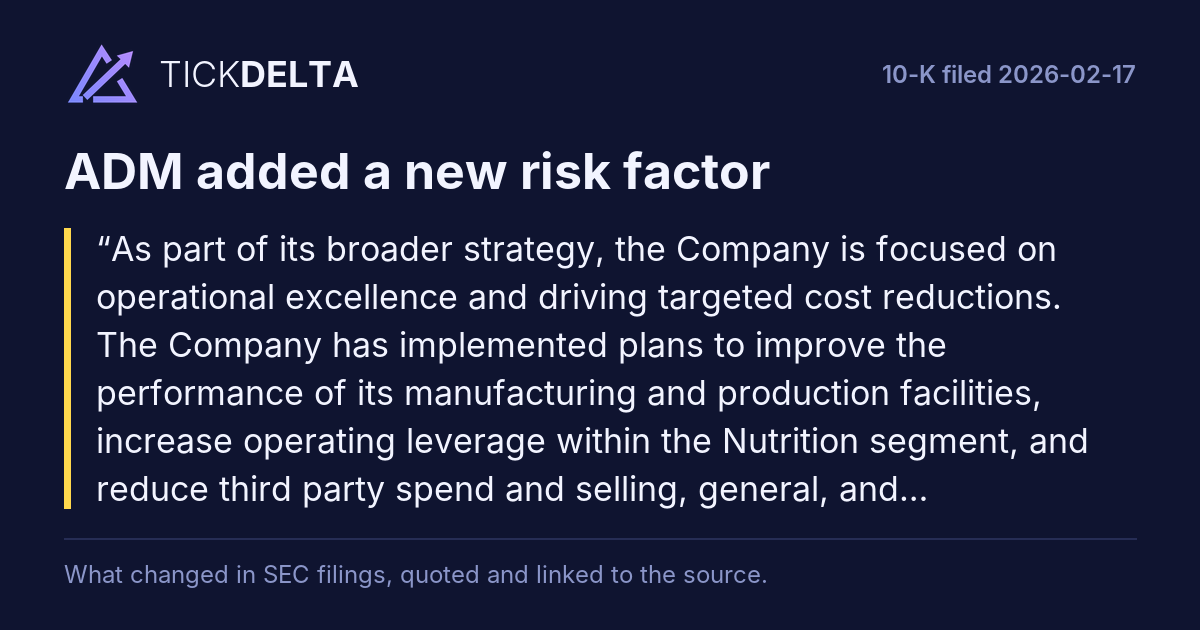
As part of its broader strategy, the Company is focused on operational excellence and driving targeted cost reductions. The Company has implemented plans to improve the performance of its manufacturing and production facilities, increase operating leverage within the Nutrition segment, and reduce third party spend and selling, general, and administrative expenses. The success of these plans, and any future related plans, depend on a broad range of factors. The Company’s ability to improve its cost structure depends on reducing its manufacturing, delivery and administrative costs, as well as having cost-effective purchasing programs for raw materials, energy and related manufacturing requirements, all of which are subject to risks and uncertainties and may not be successful. The Company’s working capital requirements are directly affected by the price of global commodities, which may fluctuate significantly and change quickly. The implementation of these plans may be more difficult, costly, or time-consuming than expected, and may not result in any or all of the anticipated benefits, which could adversely affect the Company’s business, results of operations and financial condition.
In addition, ADM proactively reviews its portfolio of businesses to identify opportunities to simplify and optimize its portfolio and enhance shareholder value. As a result, from time to time, the Company seeks to divest certain of its assets or businesses by selling them or entering into joint ventures. The Company’s ability to successfully complete a divestiture or joint venture transaction will depend on, among other things, its ability to identify buyers or joint venture partners that are prepared to acquire and successfully operate such assets or businesses on acceptable terms, and on the Company's ability to adjust and optimize its retained businesses following the divestiture. These transactions may involve unanticipated delays, costs, and other problems, and senior management may be required to divert attention away from other aspects of ADM’s businesses to address these problems.
Similar paragraph at 1 of 31 other Consumer staples companies: BGRead in the 10-K ↗
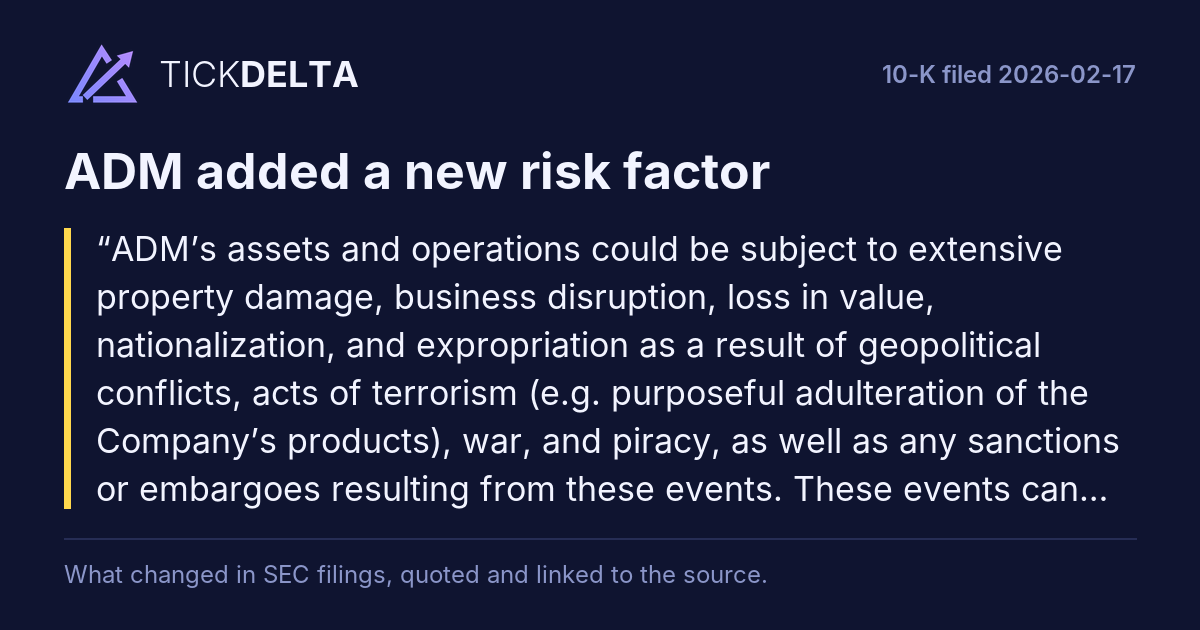
ADM’s assets and operations could be subject to extensive property damage, business disruption, loss in value, nationalization, and expropriation as a result of geopolitical conflicts, acts of terrorism (e.g. purposeful adulteration of the Company’s products), war, and piracy, as well as any sanctions or embargoes resulting from these events. These events can disrupt trade flows, damage infrastructure, limit access to raw materials, reduce customer demand, or impede the Company’s ability to operate facilities or move product. They also may trigger macroeconomic volatility, including fluctuations in commodity prices, interest rates, and foreign exchange rates, which can negatively affect margins, inventory values, and hedging positions. Further, compliance with rapidly evolving sanction regimes may require operational adjustments and could increase the risk of inadvertent violations.
Read in the 10-K ↗
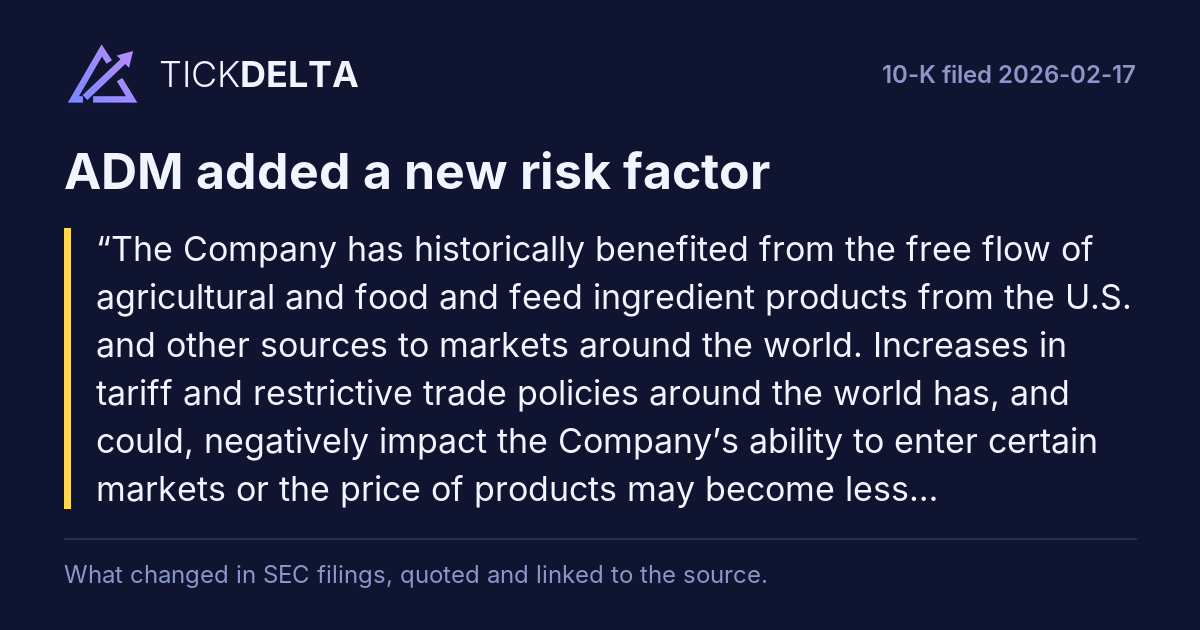
The Company has historically benefited from the free flow of agricultural and food and feed ingredient products from the U.S. and other sources to markets around the world. Increases in tariff and restrictive trade policies around the world has, and could, negatively impact the Company’s ability to enter certain markets or the price of products may become less competitive in those markets. For example, the Company’s results of operations were impacted by changes in and uncertainty relating to global trade and tariffs in 2025, and the resulting trade flow disruptions, such as U.S. soybean trade with China, as well as the deferral of U.S. biofuel policy with respect to renewable volume obligations (RVO), and the resulting uncertainty which impacted demand for soybean oil and other feedstocks.
Read in the 10-K ↗
The Company’s business depends on the quality and safety of the agricultural commodities, ingredients, food, feed, nutritional products, and other products it sources, manufactures, processes, stores, transports, and sells. As a result, the Company is exposed to a wide range of food quality and safety risks. ADM must comply with U.S. and non-U.S. federal, state, and local regulations on food safety, quality, manufacturing and labeling. Certain of the Company’s products may require regulatory approvals, pre‑market notifications, or ongoing compliance with evolving or uncertain regulatory frameworks in multiple jurisdictions. Further, regulatory scrutiny and standards in the food, feed, and nutrition sectors continue to evolve, such as the ongoing review by regulatory authorities in the EU and other jurisdictions of the safety and permitted uses of specified chemicals. Any failure to comply with applicable laws and regulations or changes in regulatory interpretations, standards, or enforcement priorities could restrict the Company’s ability to manufacture, market, or sell certain products, increase compliance costs, or require product reformulation or withdrawal from certain markets, and could subject ADM to substantial fines, administrative sanctions, criminal penalties, litigation, and other liabilities, as well as damage to its reputation. The Company’s liability which could result from noncompliance and other risks may not be covered by, or could exceed liability insurance related to product liability and food safety matters.
The Company also is subject to extensive U.S. and non-U.S. federal, state, and local occupational health and safety, environmental and other regulatory requirements. Any failure to comply with applicable laws and regulations may subject ADM to substantial fines, administrative sanctions, criminal penalties, revocations of operating permits and/or shutdowns of its facilities, litigation, and other liabilities, as well as damage to its reputation. Further, ADM may be subject to environmental liabilities for past operations at current facilities and in some cases to liabilities for past operations at facilities that it no longer owns, operates or uses. The Company may also be subject to liabilities for operations of acquired companies. The Company’s operational activities can also result in serious accidents that could result in personal injuries, facility shutdowns, reputational harm to our business and/or require the expenditure of significant amounts to remediate safety issues or repair damaged facilities.
Similar paragraph at 1 of 31 other Consumer staples companies: BGRead in the 10-K ↗
The Company is subject to various evolving, and sometimes inconsistent, United States federal, state, local and non-U.S. regulations related to ESG matters, including regulations related to the production of greenhouse gas (GHG) emissions. Some of these regulations establish specific metrics, targets, and disclosure frameworks for a variety of ESG issues, including environmental sustainability, supply chain labor practices, deforestation, workforce health and safety, proper handling of chemicals or materials, among others. Compliance with these changing and sometimes divergent ESG laws in a timely manner could, among other things, increase raw material, administrative, compliance or other costs, require the Company to make changes to its business operations or strategies, or require the Company to make additional investments in its facilities or equipment. Further, it is difficult to predict the potential impact and timing of any new or additional legislation, regulations or agreements related to climate change or other ESG matters.
The Company has programs and policies in place that are aimed at expanding responsible practices while reducing its environmental footprint. The Company has also established ESG related goals and objectives. The Company may be required to make investments and incur costs to implement these programs and policies that are significant or higher than anticipated,
ADM may not be able to achieve the goals and objectives, and ADM may not realize, on a timely basis or at all, the anticipated benefits of these investments and actions, any of which could adversely impact the Company’s reputation and business.
Read in the 10-K ↗
Show the other 6
The Company’s goals and stakeholder expectations relating to ESG-related matters and sustainable practices may expose the Company to increased costs, reputational harm and other risks.
The Company has established and publicly announced certain goals and strategies related to sustainable practices and other ESG-related issues, which may be refined in the future. The execution of the Company’s strategy to achieve these goals is subject to risks and uncertainties, many of which may be outside of ADM’s control and may prove to be more costly than anticipated. Any failure, or perceived failure, to achieve these goals or the setting or publication of certain goals or objectives could damage the Company’s reputation or may expose the Company to regulatory risks. Additionally, recent changes to governmental and investor perspectives on ESG matters could affect the Company's ability to pursue its sustainability and ESG-related goals and the Company may face criticism as a result of ‘anti-ESG’ sentiment among certain stakeholders, which may adversely impact the Company’s reputation, business, cash flows, and results of operations.
Read in the 10-K ↗
In addition, the competitive dynamics of the Company’s markets are subject to geopolitical and related risks, including the governments of countries and regions working with ADM's competitors to address trade flow restrictions or develop their own local or regional capacity.
Read in the 10-K ↗
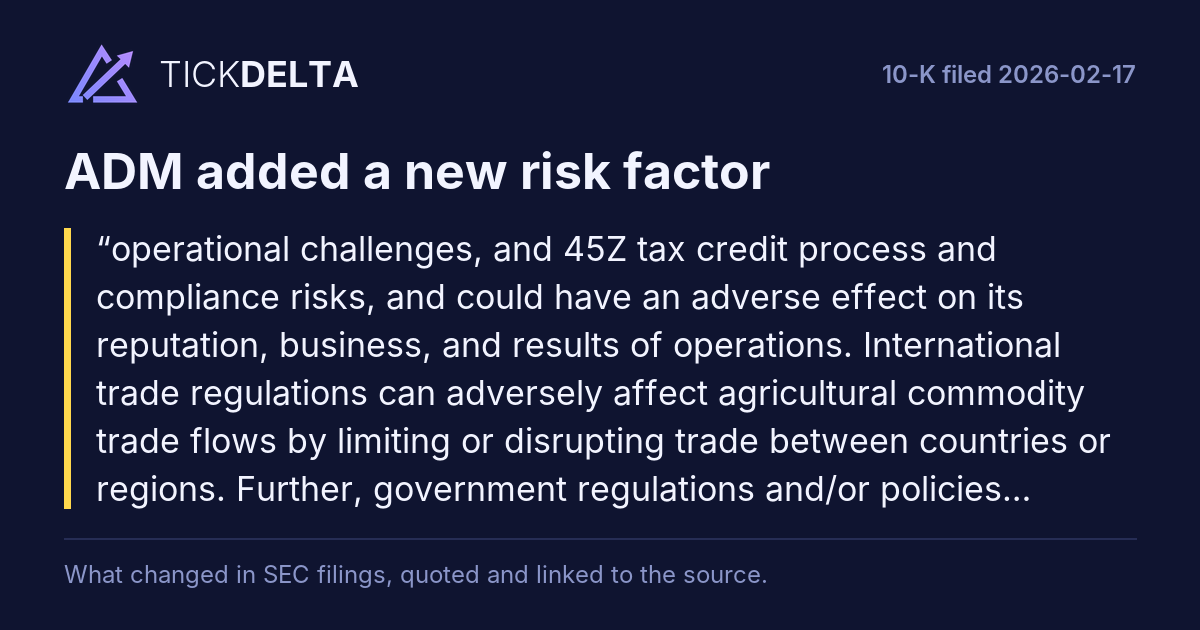
operational challenges, and 45Z tax credit process and compliance risks, and could have an adverse effect on its reputation, business, and results of operations. International trade regulations can adversely affect agricultural commodity trade flows by limiting or disrupting trade between countries or regions. Further, government regulations and/or policies relating to the type of fats, sugars, and grains consumed, as well as changes in customer preferences, can also negatively impact demand for the Company’s ingredients and/or products.
The Company is also subject to certain additional financial and commodities market and insurance-related regulations due to its futures commission merchant business, agricultural commodity risk management practices, and captive insurance provider. These regulations include customer protection, capital and financial responsibility requirements, transaction reporting, risk-management practices, margin and collateral standards, anti-money-laundering and sanctions compliance, and other requirements, such as those imposed by Commodity Futures Trading Commission regulations, the Dodd-Frank Act, Consumer Protection Act, and the European Market Infrastructure Regulation. These requirements are complex, evolving and differ in respects from the regulatory requirements to which the Company's other businesses are subject. Any failure of the Company to comply with these laws and regulations could impact the Company's reputation, and adversely affect the Company’s futures commission merchant business and its agricultural commodity risk management practices, or captive insurance provider. Future government policies may adversely affect the supply of, demand for, and prices of the Company’s products; adversely affect the Company’s ability to deploy adequate hedging programs; restrict the Company’s ability to do business in its existing and target markets; and adversely affect the Company’s revenues and operating results.
Read in the 10-K ↗
The Company is subject to income taxes as well as non-income taxes in various jurisdictions throughout the world. ADM’s effective tax rates could be adversely affected by changes in the mix of earnings by jurisdiction, changes in tax laws, tax rate changes in the valuation of deferred tax assets and liabilities and material adjustments from tax audits. The Company frequently faces challenges from U.S. and foreign tax authorities regarding the amount of taxes due including questions regarding the timing, amount of deductions, the allocation of income among various tax jurisdictions. The outcomes of these challenges could have a material impact on the Company’s results of operations and financial condition in the periods in which they are recognized.
Further, legislatures and taxing authorities in many jurisdictions in which ADM operates may enact changes to their tax rules. The U.S. One Big Beautiful Bill Act ("OBBBA"), which includes significant changes to corporate tax rules, deductions, expensing, and international tax provisions, may affect the Company’s tax position, the timing and amount of deductible expenditures, and the application of credits and incentives. The Organization for Economic Cooperation and Development (the “OECD”), the European Union, and other countries (including countries in which the Company operates) have enacted substantial changes to numerous long-standing tax principles impacting how large multinational enterprises are taxed. In particular, the OECD’s Pillar Two initiative introduced a 15% global minimum tax applied on a country-by-country basis. The U.S., under the current Administration, has opposed the adoption of Pillar Two and other OECD initiatives. While the OECD has reached an agreement with the G7 to exempt U.S. multinationals from certain impacts and it introduced certain related safe harbors, the ultimate impact on the Company remains uncertain due to whether all countries immediately adopt the safe harbors and whether certain Pillar Two reporting obligations remain applicable. Each country must enact the changes to their local laws in order for the rules to go in effect. The implementation of Pillar Two will result in additional mandatory disclosures, which will likely cause additional scrutiny of the Company's tax positions and potentially increased tax assessments.
Read in the 10-K ↗
The Company is subject to various technical, legal, and opportunistic-related risks relating to use of artificial intelligence and other emerging digital technologies.
The Company continues to focus on leveraging digital technologies, including artificial intelligence (“AI”) and advanced analytics across its operations. The effective design, deployment, governance and oversight of these technologies involve risks and uncertainties that could adversely affect the Company’s business, reputation, financial condition and results of operations. The Company’s ability to realize the anticipated benefits of AI initiatives depends on a number of factors, many of which are outside of its control.
Read in the 10-K ↗
Further, the Company’s investments in AI may not achieve expected returns, may take longer than anticipated to generate value, if at all, or may become obsolete due to rapid technological change. In addition, ADM may be adversely affected if it fails to keep pace with the adoption and effective use of AI technologies by its competitors and other industry participants.
The Company is involved in a number of legal proceedings that may result in adverse outcomes.
The Company is involved in a number of legal proceedings that arise from time to time. The outcome of these proceedings is subject to inherent uncertainties. The actual costs to be incurred depend upon many unknown factors and the outcome of some of these proceedings and other contingencies could adversely affect the Company’s operations or could result in excessive adverse verdicts, fines, or results. Additionally, as the Company has seen in the past, involvement in such lawsuits, investigations and inquiries, and other proceedings, as well as compliance with any settlements or consent decrees that result from those proceedings, could divert management’s attention and resources from other matters, impact the reputation of the Company, and may have a material adverse effect on the Company’s business, financial position or operating results.
For more information regarding pending legal proceedings, please see Part I, Item 3, Legal Proceedings and Part II, Item 8, Note 20, Legal Proceedings.
Read in the 10-K ↗
Paragraphs in the 10-Q filed Nov 3, 2026 that were not in the one before
23 paragraphs in the 10-Q filed Nov 3, 2026 with nothing like them in the 10-Q filed Aug 4, 2026 (at least half the words must differ; new numbers alone do not count). Quoted exactly, grouped by the item heading above them. This is text that changed, not a judgement of how serious it is.
Financial statements and notes
Estimated fair values for inventories and inventory-related payables stated at market are based on exchange-quoted prices, adjusted for differences in local markets, referred to as basis, and quality, as described above.
Read in the 10-Q ↗
Fair value for commodity purchase and sale contracts is estimated based on exchange-quoted prices adjusted for differences in local markets, referred to as basis, as described above.
Read in the 10-Q ↗
Cash receipts and payments related to derivative instruments are classified within operating activities in the Consolidated Statements of Cash Flows.
Read in the 10-Q ↗
In the three months ended September 30, 2026, the Company issued $ 1.0 billion of senior unsecured notes, consisting of $ 500 million 4.83 % Notes due September 1, 2031 and $ 500 million 5.27 % Notes due September 1, 2036.
Read in the 10-Q ↗
In the three months ended September 30, 2026, the Company redeemed the entire $ 1.0 billion aggregate principal amount outstanding of its 2.50 % Notes, previously included in Current maturities of long-term debt, which matured in August 2026.
Read in the 10-Q ↗
Show the other 18
As of September 30, 2026, short-term debt includes $ 690 million of commercial paper outstanding and $ 466 million of other short-term debt. As of December 31, 2025, short term debt includes $ 715 million of commercial paper outstanding and $ 83 million of other short term debt.
Read in the 10-Q ↗
(2) Includes a $ 173 million impairment charge related to previously capitalized internal-use software, presented as a specified item.
Read in the 10-Q ↗
(3) Represents a charge recorded by the Company related to its share of a penalty imposed on Wilmar during the three months ended September 30, 2025.
Read in the 10-Q ↗
(2) Includes a $ 173 million impairment charge related to previously capitalized internal-use software, presented as a specified item.
Read in the 10-Q ↗
(3) Represents a charge recorded by the Company related to its share of a penalty imposed on Wilmar during the nine months ended September 30, 2025.
Read in the 10-Q ↗
(2) During the three and nine months ended September 30, 2025, the Company recognized an impairment charge of $ 173 million, related to previously capitalized internal-use software, within Corporate.
Read in the 10-Q ↗
• Generating strong cash flow - Driving strong cash flow to fund our capital allocation and growth priorities, including investing in organic growth projects and selective bolt-on acquisitions, and funding dividend growth and opportunistic share repurchases.
Read in the 10-Q ↗
• The execution, in October 2026, of a definitive agreement with a subsidiary of CJ CheilJedang (“CJ”), a South Korea based global food and biotech company, to launch a joint venture in North and South America that will be majority owned by CJ. The proposed joint venture would develop, manufacture and market fermentation-derived amino acids by bringing together CJ’s fermentation production facilities in Fort Dodge, Iowa and Piracicaba, Brazil and an ADM amino acid facility in Decatur, Illinois, as well as CJ’s sales offices in Mexico, Brazil and the U.S., and, via license, CJ’s intellectual property related to feed-grade amino acids for use by the joint venture in North and South America. The launch date for the proposed joint venture is subject to customary closing activities as well as regulatory approvals.
Read in the 10-Q ↗
Three Months Ended September 30, 2026 Compared to Three Months Ended September 30, 2025
Read in the 10-Q ↗
Nine Months Ended September 30, 2026 Compared to Nine Months Ended September 30, 2025
Read in the 10-Q ↗
Interest expense decreased $8 million to $462 million, which was largely consistent with the prior year period.
Read in the 10-Q ↗
In the nine months ended September 30, 2026, the Company received proceeds from short term debt of $705 million and repaid short-term debt of $399 million.
Read in the 10-Q ↗
In the nine months ended September 30, 2026, the Company issued $1.0 billion aggregate principal amount of senior unsecured notes, consisting of $500 million 4.83% Notes due September 1, 2031 and $500 million 5.27% Notes due September 1, 2036.
Read in the 10-Q ↗
In the nine months ended September 30, 2026, the Company redeemed the entire $1 billion aggregate principal amount of 2.50% Notes which matured in August 2026.
Read in the 10-Q ↗
Other information
On August 28, 2026, Regina B. Jones, the Company’s Senior Vice President and Chief Legal Officer and Secretary, entered into a pre-arranged trading plan that is intended to satisfy the affirmative defense of Rule 10b5-1(c) of the Exchange Act. This plan provides for the sale of up to 17,148 shares of the Company’s common stock in the aggregate, and terminates on the earlier of the close of market on October 29, 2027 or the date all shares are sold thereunder.
Read in the 10-Q ↗
On September 10, 2026, Juan R. Luciano, the Company’s Chair of the Board, President and Chief Executive Officer, entered into a pre-arranged trading plan that is intended to satisfy the affirmative defense of Rule 10b5-1(c) of the Exchange Act. This plan provides for the sale of up to 60,000 shares of the Company’s common stock in the aggregate by the Juan R. Luciano Trust, and terminates on the earlier of the close of market on March 15, 2027 or the date all shares are sold thereunder.
Read in the 10-Q ↗
On September 14, 2026, Jennifer L. Weber, the Company’s Senior Vice President and Chief People Officer, entered into a pre-arranged trading plan that is intended to satisfy the affirmative defense of Rule 10b5-1(c) of the Exchange Act. This plan provides for the sale of up to 25,000 shares of the Company’s common stock in the aggregate, and terminates on the earlier of the close of market on September 14, 2027 or the date all shares are sold thereunder
Read in the 10-Q ↗
There were no other Rule 10b5-1 trading arrangements or non-Rule 10b5-1 trading arrangements adopted, modified or terminated by the Company’s directors and executive officers during the three months ended September 30, 2026.
Read in the 10-Q ↗
The 10-Q's risk factors against the 10-K
Item 1A of the 10-Q filed Nov 3, 2026 against Item 1A of the 10-K filed Feb 17, 2026.
A 10-Q repeats only the risks that changed, so a 10-K paragraph that is missing from it is not counted as removed.
Added is a paragraph with nothing like it in the 10-K, Reworded a sentence that is in both with several words changed,
Quiet changes a sentence in both where one to four words changed and one is a hedge or a modal
(cut words struck through, new words highlighted and underlined).
Text on the page, not a score; each links to the filing at sec.gov.
What the 10-Q itself says about its risk factors:
Read in the 10-Q ↗
In addition to the other information set forth in this report, you should carefully consider the risk factors discussed in “Item 1A. Risk Factors” in the Company’s Annual Report on Form 10-K for the year ended December 31, 2025.
1 paragraph in the 10-Q's Item 1A, and none of them adds, rewords or quietly edits a paragraph of the 10-K's.
Work on ADM in a spreadsheet:
Excel workbook (a sheet per section, ten years by column, charts, links to the filings) ·
CSV.
For a Google Sheet that stays up to date, paste =IMPORTDATA("https://tickdelta.com/company/ADM/export.csv") into a cell.