Paragraph 207 · 39% changed
Every version of it
Screener
/
SEC EDGAR
/CIK 0001368514
/10-K filed Feb 25, 2026, compared with Mar 18, 2025
/Numbers from the XBRL of the 10-Ks
Nasdaq
Health care · Biotechnology
Adma Biologics, Inc. ADMA
The 10-K against last year's
143 changes: 27 added, 14 removed, 98 reworded, 4 quiet changes
10-K Feb 25, 2026 vs Mar 18, 2025
Risk Factors
7.5%
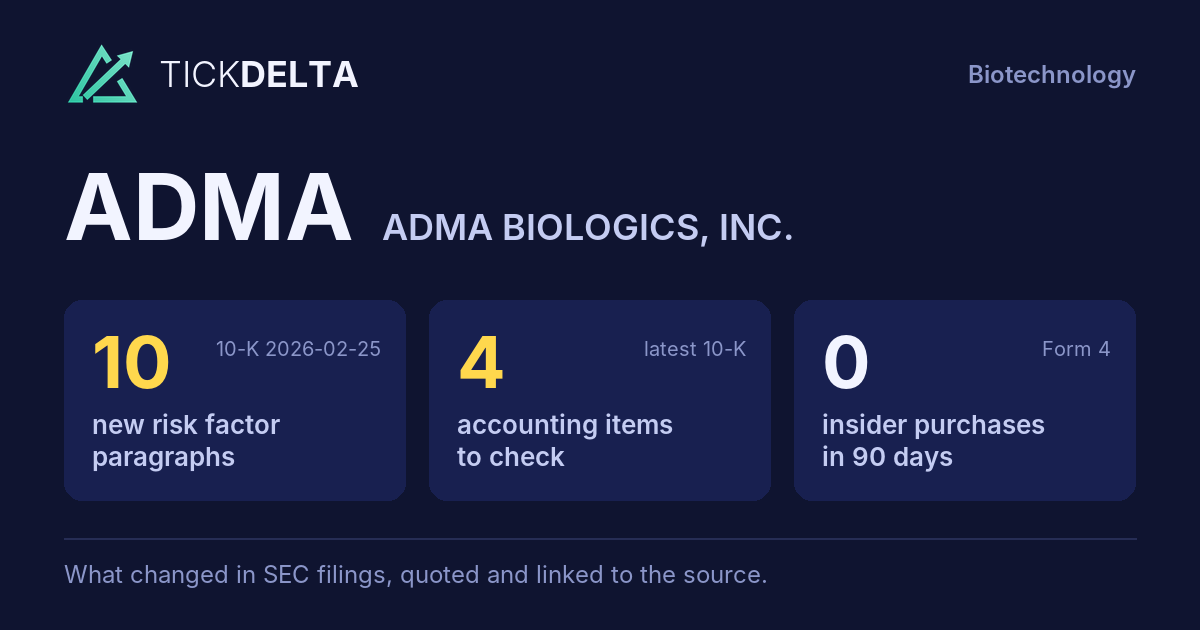
of the text changed · 22,304 words now · 10 new paragraphs, 1 gone
MD&A
41.0%
of the text changed · 8,491 words now · 17 new paragraphs, 13 gone
10-K 0001140361-26-006815 (Feb 25, 2026) vs 10-K 0001140361-25-009257 (Mar 18, 2025) Not compared: Legal Proceedings, Accounting Policies.
Every paragraph, and how much of it changed
One bar per paragraph, in the order of the 10-K. Height and colour show the share of its words not in the closest paragraph a year earlier; the tallest bars are new paragraphs.
Risk Factors
230 paragraphs · 10 new · 57 reworded · 1 gone · 10-K Feb 25, 2026 against Mar 18, 2025
New paragraph
Reworded (5% of its words or more)
Same or nearly
Paragraph 47 · 38% changed
Every version of it
Market opportunity estimates and growth forecasts are subject to significant uncertainty and are based on assumptions and estimates that may not prove to be accurate. In particular, the size and growth of the overall U.S. IVIG and source plasma markets and the potential market opportunity for an S. pneumoniae hyperimmune globulin are subject to significant variables that can be difficult to measure, estimate or quantify. Additionally, we anticipate receiving FDA approval by mid-2025 for the PAS for our innovative yield enhancement production process, which has demonstrated an ability to increase production yields by approximately 20% from the same starting plasma volume, potentially driving significant increases to financial targets beginning in the second half of 2025, if approved. Although our financial targets for 2025 and 2026 described in Part 1, Item 1. Business- Overview do not account for the potential FDA approval of our innovative yield enhancement production process, in the event that the FDA does not approve the PAS, or in the event that such approval occurs after mid-2025, our growth rate may be materially impacted.
Paragraph 187 · 38% changed
Every version of it
The Healthcare Reform Law Inflation Reduction Act also created new rebate amended certain discount obligations for our products originally implemented under Medicare Part D, a partial, voluntary prescription drug benefit created by the U.S. federal government primarily for persons 65 years old and over. The Part D drug program is administered through private insurers that contract with CMS. Beginning in 2011, the Healthcare Reform Law generally Law. In January 2025, the Inflation Reduction Act implemented a new manufacturer discount program that requires that participating manufacturers to provide discounts on applicable drugs in order for a drug manufacturer’s products to be reimbursed under Medicare Part D, both the manufacturer must enter into a Medicare Initial Coverage Gap Discount Program agreement with the Secretary and Catastrophic Coverage phases of HHS, and reimburse each Medicare Part D plan sponsor an amount now equal to 70% savings for the manufacturer’s brand name drugs and biologics which the Part D plan sponsor has provided to its Medicare Part D beneficiaries who are in the “donut hole” (or a gap in Medicare Part D coverage for beneficiaries who have expended certain amounts for drugs). benefit. The Part D plan sponsor is responsible for calculating and providing the discount directly to its beneficiaries and for reporting these amounts paid to CMS’s contractor, which notifies drug manufacturers of the rebate amounts it must pay to each Part D plan sponsor. The rebate requirement could adversely affect our future financial performance, particularly if contracts with Part D plans cannot be favorably renegotiated or the Part D plan sponsors fail creating continued pressure to accurately calculate payments due in a manner that overstates our rebate obligation. lower prices related to units sold to Medicare beneficiaries. Regarding access to our products, the Healthcare Reform Law established and provided significant funding for a Patient-Centered Outcomes Research Institute to coordinate and fund Comparative Effectiveness Research (“CER”). While the stated intent of CER is to develop information to guide providers to the most efficacious therapies, outcomes of CER could influence the reimbursement or coverage for therapies that are determined to be less cost-effective than others. Should any of our products be determined to be less cost effective than alternative therapies, the levels of reimbursement for these products, or the willingness to reimburse at all, could be impacted, which could materially impact our future financial prospects and results.
Paragraph 182 · 38% changed
Every version of it
The ACA and the companion Healthcare and Education Reconciliation Act (which together are referred to as the “Healthcare Reform Law”) introduced an abbreviated licensure pathway for biological products that are demonstrated to be biosimilar to an FDA-licensed biological product. A biological product may be demonstrated to be “biosimilar” if data shows that, among other things, the product is “highly similar” to an already-approved biological product, known as a reference product, and has no clinically meaningful differences in terms of safety and effectiveness from the reference product. The law provides that a biosimilar application may be submitted as soon as four years after the reference product is first licensed, and that the FDA may not make approval of an application effective until 12 years after the reference product was first licensed. Since the enactment of the law, the FDA has issued several guidance documents This exclusivity period, however, is subject to assist sponsors of biosimilar products in preparing their approval applications. Moreover, in an effort to increase competition in the biologic product marketplace, Congress, the executive branch, and the FDA have taken certain legislative and regulatory steps. limitations. For example, the exclusivity only applies to the first licensure of a product, as defined in 2020 the statute and FDA finalized a guidance guidance, and, thus, not all BLAs will have exclusivity protection. There may also be future legislative efforts to facilitate biologic product importation. The 2020 Further Consolidated Appropriations Act included provisions requiring that sponsors decrease this period of approved biologic products provide samples of the approved products to persons developing biosimilar products within specified timeframes, in sufficient quantities, and on commercially reasonable market-based terms. exclusivity. The FDA approved the first biosimilar also may not consider a particular biologic to be a reference product in 2015 and has since approved a number of biosimilars. As a result of or competitors may pursue full traditional BLAs, rather than the biosimilar pathway in pathway, which full BLAs would not be blocked by the United States, regulatory exclusivity. Moreover, following the submission of a biosimilar application, we expect in the future may need to face greater competition from biosimilar products, including a possible increase in institute patent challenges. infringement actions or may be subject to actions for declaratory judgment, which may be time consuming and costly.
Paragraph 183 · 30% changed
Every version of it
Paragraph 95 · 26% changed
Every version of it
We currently anticipate expanding the may expand our manufacturing capacity and product output capability of our the Boca Facility. Following the expansion of any of our manufacturing processes or the addition of new equipment, such as our fill-finish machine, we will need be required to validate the expanded facility facility, process changes if any and equipment, make the necessary submissions to FDA, obtain any FDA-required approvals and have it inspected by the FDA. Any other changes to the manufacturing process will also potentially require validation, FDA submissions, and approvals and inspections. Changes may also require that further studies are conducted before the change is approved by regulatory authorities or product marketing approval is obtained. Given the significant delays that may result during the validation and approval process, we may not receive the necessary manufacturing or product approvals, experience a supply shortage of our products or our production capabilities may be limited until completion of and validation of our facility expansion and new manufacturing equipment. equipment and until the necessary approvals are obtained.
Paragraph 131 · 26% changed
Every version of it
Paragraph 18 · 25% changed
Every version of it
Our senior secured credit facility with Ares Capital Corporation JPMorgan Chase Bank, N.A. and certain of its affiliates (“Ares”) other lenders party thereto (collectively “JPMorgan”) is subject to acceleration in specified circumstances, which may result in Ares JPMorgan taking possession and disposing of any collateral.
Paragraph 207 · 39% changed
Every version of it
10-K Mar 18, 2025expected timing and amount of the release of any valuation allowance on our deferred tax assets; or
10-K Feb 25, 2026
changes in our assessment of the lack of a need for a valuation allowance on our deferred tax assets; or
Paragraph 47 · 38% changed
Every version of it
10-K Mar 18, 2025
Market opportunity estimates and growth forecasts are subject to significant uncertainty and are based on assumptions and estimates that may not prove to be accurate. In particular, the size and growth of the overall U.S. IVIG and source plasma markets and the potential market opportunity for an S. pneumoniae hyperimmune globulin are subject to significant variables that can be difficult to measure, estimate or quantify. Additionally, we anticipate receiving FDA approval by mid-2025 for the PAS for our innovative yield enhancement production process, which has demonstrated an ability to increase production yields by approximately 20% from the same starting plasma volume, potentially driving significant increases to financial targets beginning in the second half of 2025, if approved. Although our financial targets for 2025 and 2026 described in Part 1, Item 1. Business- Overview do not account for the potential FDA approval of our innovative yield enhancement production process, in the event that the FDA does not approve the PAS, or in the event that such approval occurs after mid-2025, our growth rate may be materially impacted.
10-K Feb 25, 2026
Market opportunity estimates and growth forecasts are subject to significant uncertainty and are based on assumptions and estimates that may not prove to be accurate. In particular, the size and growth of the overall U.S. IVIG and source plasma markets and the potential market opportunity for an S. pneumoniae hyperimmune globulin are subject to significant variables that can be difficult to measure, estimate or quantify.
Paragraph 187 · 38% changed
Every version of it
10-K Mar 18, 2025
The Healthcare Reform Law also created new rebate obligations for our products under Medicare Part D, a partial, voluntary prescription drug benefit created by the U.S. federal government primarily for persons 65 years old and over. The Part D drug program is administered through private insurers that contract with CMS. Beginning in 2011, the Healthcare Reform Law generally requires that in order for a drug manufacturer’s products to be reimbursed under Medicare Part D, the manufacturer must enter into a Medicare Coverage Gap Discount Program agreement with the Secretary of HHS, and reimburse each Medicare Part D plan sponsor an amount now equal to 70% savings for the manufacturer’s brand name drugs and biologics which the Part D plan sponsor has provided to its Medicare Part D beneficiaries who are in the “donut hole” (or a gap in Medicare Part D coverage for beneficiaries who have expended certain amounts for drugs). The Part D plan sponsor is responsible for calculating and providing the discount directly to its beneficiaries and for reporting these amounts paid to CMS’s contractor, which notifies drug manufacturers of the rebate amounts it must pay to each Part D plan sponsor. The rebate requirement could adversely affect our future financial performance, particularly if contracts with Part D plans cannot be favorably renegotiated or the Part D plan sponsors fail to accurately calculate payments due in a manner that overstates our rebate obligation. Regarding access to our products, the Healthcare Reform Law established and provided significant funding for a Patient-Centered Outcomes Research Institute to coordinate and fund Comparative Effectiveness Research (“CER”). While the stated intent of CER is to develop information to guide providers to the most efficacious therapies, outcomes of CER could influence the reimbursement or coverage for therapies that are determined to be less cost-effective than others. Should any of our products be determined to be less cost effective than alternative therapies, the levels of reimbursement for these products, or the willingness to reimburse at all, could be impacted, which could materially impact our future financial prospects and results.
10-K Feb 25, 2026
The Inflation Reduction Act also amended certain discount obligations originally implemented under the Healthcare Reform Law. In January 2025, the Inflation Reduction Act implemented a new manufacturer discount program that requires participating manufacturers to provide discounts on applicable drugs in both the Initial Coverage and Catastrophic Coverage phases of the Part D benefit. The discount requirement could adversely affect our future financial performance, creating continued pressure to lower prices related to units sold to Medicare beneficiaries. Regarding access to our products, the Healthcare Reform Law established and provided significant funding for a Patient-Centered Outcomes Research Institute to coordinate and fund Comparative Effectiveness Research (“CER”). While the stated intent of CER is to develop information to guide providers to the most efficacious therapies, outcomes of CER could influence the reimbursement or coverage for therapies that are determined to be less cost-effective than others. Should any of our products be determined to be less cost effective than alternative therapies, the levels of reimbursement for these products, or the willingness to reimburse at all, could be impacted, which could materially impact our future financial prospects and results.
Paragraph 182 · 38% changed
Every version of it
10-K Mar 18, 2025
The ACA and the companion Healthcare and Education Reconciliation Act (which together are referred to as the “Healthcare Reform Law”) introduced an abbreviated licensure pathway for biological products that are demonstrated to be biosimilar to an FDA-licensed biological product. A biological product may be demonstrated to be “biosimilar” if data shows that, among other things, the product is “highly similar” to an already-approved biological product, known as a reference product, and has no clinically meaningful differences in terms of safety and effectiveness from the reference product. The law provides that a biosimilar application may be submitted as soon as four years after the reference product is first licensed, and that the FDA may not make approval of an application effective until 12 years after the reference product was first licensed. Since the enactment of the law, the FDA has issued several guidance documents to assist sponsors of biosimilar products in preparing their approval applications. Moreover, in an effort to increase competition in the biologic product marketplace, Congress, the executive branch, and the FDA have taken certain legislative and regulatory steps. For example, in 2020 the FDA finalized a guidance to facilitate biologic product importation. The 2020 Further Consolidated Appropriations Act included provisions requiring that sponsors of approved biologic products provide samples of the approved products to persons developing biosimilar products within specified timeframes, in sufficient quantities, and on commercially reasonable market-based terms. The FDA approved the first biosimilar product in 2015 and has since approved a number of biosimilars. As a result of the biosimilar pathway in the United States, we expect in the future to face greater competition from biosimilar products, including a possible increase in patent challenges.
10-K Feb 25, 2026
The ACA and the companion Healthcare and Education Reconciliation Act (which together are referred to as the “Healthcare Reform Law”) introduced an abbreviated licensure pathway for biological products that are demonstrated to be biosimilar to an FDA-licensed biological product. A biological product may be demonstrated to be “biosimilar” if data shows that, among other things, the product is “highly similar” to an already-approved biological product, known as a reference product, and has no clinically meaningful differences in terms of safety and effectiveness from the reference product. The law provides that a biosimilar application may be submitted as soon as four years after the reference product is first licensed, and that the FDA may not make approval of an application effective until 12 years after the reference product was first licensed. This exclusivity period, however, is subject to certain limitations. For example, the exclusivity only applies to the first licensure of a product, as defined in statute and FDA guidance, and, thus, not all BLAs will have exclusivity protection. There may also be future legislative efforts to decrease this period of exclusivity. The FDA also may not consider a particular biologic to be a reference product or competitors may pursue full traditional BLAs, rather than the biosimilar pathway, which full BLAs would not be blocked by the regulatory exclusivity. Moreover, following the submission of a biosimilar application, we may need to institute patent infringement actions or may be subject to actions for declaratory judgment, which may be time consuming and costly.
Paragraph 183 · 30% changed
Every version of it
10-K Mar 18, 2025The ACA and the companion Healthcare and Education Reconciliation Act (which together are referred to as the “Healthcare Reform Law”) introduced an abbreviated licensure pathway for biological products that are demonstrated to be biosimilar to an FDA-licensed biological product. A biological product may be demonstrated to be “biosimilar” if data shows that, among other things, the product is “highly similar” to an already-approved biological product, known as a reference product, and has no clinically meaningful differences in terms of safety and effectiveness from the reference product. The law provides that a biosimilar application may be submitted as soon as four years after the reference product is first licensed, and that the FDA may not make approval of an application effective until 12 years after the reference product was first licensed. Since the enactment of the law, the FDA has issued several guidance documents to assist sponsors of biosimilar products in preparing their approval applications. Moreover, in an effort to increase competition in the biologic product marketplace, Congress, the executive branch, and the FDA have taken certain legislative and regulatory steps. For example, in 2020 the FDA finalized a guidance to facilitate biologic product importation. The 2020 Further Consolidated Appropriations Act included provisions requiring that sponsors of approved biologic products provide samples of the approved products to persons developing biosimilar products within specified timeframes, in sufficient quantities, and on commercially reasonable market-based terms. The FDA approved the first biosimilar product in 2015 and has since approved a number of biosimilars. As a result of the biosimilar pathway in the United States, we expect in the future to face greater competition from biosimilar products, including a possible increase in patent challenges.
10-K Feb 25, 2026
Since the enactment of the law, the FDA has issued several guidance documents to assist sponsors of biosimilar products in preparing their approval applications. Moreover, in an effort to increase competition in the biologic product marketplace, Congress, the executive branch, and the FDA have taken certain legislative and regulatory steps. For example, in 2020 the FDA finalized guidance to facilitate biologic product importation. The 2020 Further Consolidated Appropriations Act included provisions requiring that sponsors of approved biologic products provide samples of the approved products to persons developing biosimilar products within specified timeframes, in sufficient quantities, and on commercially reasonable market-based terms. In 2025, the FDA also potentially made it easier for sponsors of biosimilar or interchangeable products to obtain approval, easing requirements for biosimilar comparative efficacy clinical studies and interchangeable product switching studies. The FDA approved the first biosimilar product in 2015 and has since approved a number of biosimilars. As a result of the biosimilar pathway in the United States, we expect in the future to face greater competition from biosimilar products, including a possible increase in patent challenges.
Paragraph 95 · 26% changed
Every version of it
10-K Mar 18, 2025
We currently anticipate expanding the manufacturing capacity and product output capability of our Boca Facility. Following the expansion of any of our manufacturing processes or the addition of new equipment, such as our fill-finish machine, we will need to validate the expanded facility and equipment, make the necessary submissions to FDA, obtain any FDA-required approvals and have it inspected by the FDA. Given the significant delays that may result during the validation process, we may experience a supply shortage of our products or our production capabilities may be limited until completion of and validation of our facility expansion and new manufacturing equipment.
10-K Feb 25, 2026
We may expand our manufacturing capacity and product output capability of the Boca Facility. Following the expansion of any of our manufacturing processes or the addition of new equipment, we will be required to validate the expanded facility, process changes if any and equipment, make the necessary submissions to FDA, obtain any FDA-required approvals and have it inspected by the FDA. Any other changes to the manufacturing process will also potentially require validation, FDA submissions, and approvals and inspections. Changes may also require that further studies are conducted before the change is approved by regulatory authorities or product marketing approval is obtained. Given the significant delays that may result during the validation and approval process, we may not receive the necessary manufacturing or product approvals, experience a supply shortage of our products or our production capabilities may be limited until completion of and validation of our facility expansion and new manufacturing equipment and until the necessary approvals are obtained.
Paragraph 131 · 26% changed
Every version of it
10-K Mar 18, 2025On December 18, 2023 (the “Ares Closing Date”), we entered into a credit agreement with Ares (the “Ares Credit Agreement”) (see “Liquidity and Capital Resources”). The Ares Credit Agreement provided for a total of $135 million in senior secured credit facilities (the “Ares Credit Facility”) consisting of (i) a term loan in the aggregate principal amount of $62.5 million and (ii) a revolving credit facility in the aggregate principal amount of $72.5 million (collectively, the “Ares Loans”), both of which were fully drawn on the Ares Closing Date. The Ares Credit Facility has a maturity date of December 20, 2027 (the “Ares Maturity Date”). On August 14, 2024, we repaid $30.0 million against the revolving credit facility and on December 19, 2024 we repaid $30.0 million against the term loan. As of December 31, 2024, we had $42.5 million and $32.5 million of borrowings outstanding under the revolving credit facility and the term loan, respectively. The Ares Loans are secured by substantially all of our assets, including our intellectual property. Events of default include, among others, non-payment of principal, interest or fees, violation of covenants, inaccuracy of representations and warranties, bankruptcy and insolvency events, material judgments, cross-defaults to material contracts and events constituting a change of control. If there is an event of default, we would incur an increase in the rate of interest on the Ares Loans of 2% per annum. The occurrence of an event of default could result in, among other things, the termination of commitments under the Ares Credit Facility, the declaration that all outstanding loans are immediately due and payable in whole or in part, and Ares taking immediate possession of, and selling, any collateral securing the Ares Loans.
10-K Feb 25, 2026
The JPM Loans are secured by substantially all of our assets, including our intellectual property. Events of default include, among others, non-payment of principal, interest or fees, violation of covenants, inaccuracy of representations and warranties, bankruptcy and insolvency events, material judgments, cross-defaults to material contracts and events constituting a change of control. If there is an event of default, we would incur an increase in the rate of interest on the JPM Loans of 2% per annum. The occurrence of an event of default could result in, among other things, the termination of commitments under the JPM Credit Facilities, the declaration that all outstanding loans are immediately due and payable in whole or in part, and JPMorgan taking immediate possession of, and selling, any collateral securing the JPM Loans.
Paragraph 18 · 25% changed
Every version of it
10-K Mar 18, 2025
Our senior secured credit facility with Ares Capital Corporation and certain of its affiliates (“Ares”) is subject to acceleration in specified circumstances, which may result in Ares taking possession and disposing of any collateral.
10-K Feb 25, 2026
Our senior secured credit facility with JPMorgan Chase Bank, N.A. and certain other lenders party thereto (collectively “JPMorgan”) is subject to acceleration in specified circumstances, which may result in JPMorgan taking possession and disposing of any collateral.
MD&A
89 paragraphs · 17 new · 56 reworded · 13 gone · 10-K Feb 25, 2026 against Mar 18, 2025
New paragraph
Reworded (5% of its words or more)
Same or nearly
Paragraph 34 · 50% changed
Selling, general and administrative (“SG&A”) expenses were $59.0 $91.6 million for the year ended December 31, 2023, 2025, an increase of $6.6 $17.5 million from the year ended December 31, 2022. 2024, or approximately 24%. The increase reflects is primarily driven by higher compensation costs due to increased headcount to support the growth of our business and manufacturing operations. In addition, higher insurance premiums, professional fees and software expenses for employee-related costs including salaries, benefits, stock-based compensation, travel, relocation and recruiting of $2.4 million, data services and market intelligence fees in support of the continued ASCENIV and BIVIGAM commercialization efforts in the amount of $1.8 million, marketing and advertising expenses of $1.0 million, insurance expense of $0.6 million, software maintenance expense of $0.6 million and state and local taxes of $0.2 million. contributed to this increase.
Paragraph 86 · 50% changed
Paragraph 76 · 50% changed
Paragraph 72 · 49% changed
On August 14, 2024, we repaid $30.0 million against the Ares revolving credit facility and the outstanding balance on the Ares revolving credit facility as of December 31, 2024 was $42.5 million. On December 19, 2024 we repaid million, with an additional $30.0 million against of availability through the term loan and the outstanding balance on the term loan as Ares Maturity Date. We were required to pay an unused commitment fee of December 31, 2024 was $32.5 million. In connection with the repayment against the term loan, we recognized a loss on extinguishment of debt in the approximate amount of $1.2 million, which is comprised of a prepayment penalty in the amount of $0.45 million and a partial write-off of unamortized discount attributable to the term loan in the amount of $0.8 million. 0.5% per annum for this availability.
Paragraph 62 · 49% changed
Paragraph 35 · 46% changed
Paragraph 26 · 46% changed
Paragraph 41 · 46% changed
Paragraph 34 · 50% changed
10-K Mar 18, 2025
Selling, general and administrative (“SG&A”) expenses were $59.0 million for the year ended December 31, 2023, an increase of $6.6 million from the year ended December 31, 2022. The increase reflects higher expenses for employee-related costs including salaries, benefits, stock-based compensation, travel, relocation and recruiting of $2.4 million, data services and market intelligence fees in support of the continued ASCENIV and BIVIGAM commercialization efforts in the amount of $1.8 million, marketing and advertising expenses of $1.0 million, insurance expense of $0.6 million, software maintenance expense of $0.6 million and state and local taxes of $0.2 million.
10-K Feb 25, 2026
Selling, general and administrative (“SG&A”) expenses were $91.6 million for the year ended December 31, 2025, an increase of $17.5 million from the year ended December 31, 2024, or approximately 24%. The increase is primarily driven by higher compensation costs due to increased headcount to support the growth of our business and manufacturing operations. In addition, higher insurance premiums, professional fees and software expenses contributed to this increase.
Paragraph 86 · 50% changed
10-K Mar 18, 2025Research and development (“R&D”) expenses totaled $1.8 million for the year ended December 31, 2024, as compared to $3.3 million for the year ended December 31, 2023. The decrease is primarily due to the absence of expenditures in 2024 related to the BIVIGAM post-marketing commitments, for which we incurred $1.7 million of expenses in 2023, partially offset by an increase in expenses associated with our ASCENIV pediatric study in the amount of $0.3 million.
10-K Feb 25, 2026
Cash used in investing activities for the year ended December 31, 2025, was $21.9 million as compared to cash used in investing activities for the year ended December 31, 2024 of $8.6 million. The increase is primarily related to the capital expenditures associated with the Yield Enhancement project of $1.8 million and the acquisition of the real estate in Boca Raton, FL in the amount of $12.6 million, partially offset by the $1.0 million deposit received in December 2025 related to the sale of three of our plasma centers (refer to Note 5 to our financial statements included in Item 8 of this Annual Report on Form 10-K for further information).
Paragraph 76 · 50% changed
10-K Mar 18, 2025On August 14, 2024, we repaid $30.0 million against the revolving credit facility and the outstanding balance on the revolving credit facility as of December 31, 2024 was $42.5 million. On December 19, 2024 we repaid $30.0 million against the term loan and the outstanding balance on the term loan as of December 31, 2024 was $32.5 million. In connection with the repayment against the term loan, we recognized a loss on extinguishment of debt in the approximate amount of $1.2 million, which is comprised of a prepayment penalty in the amount of $0.45 million and a partial write-off of unamortized discount attributable to the term loan in the amount of $0.8 million.
10-K Feb 25, 2026
In May 2025, we repaid $30.0 million against the Ares term loan using a draw of $30.0 million against the Ares revolving credit facility made in May 2025. In August 2025, we repaid all obligations outstanding under the Ares Credit Agreement using the proceeds from the JPM Credit Agreement, defined below. As a result of the aforementioned transactions, during the year ended December 31, 2025, we recognized debt extinguishment losses of $3.3 million.
Paragraph 72 · 49% changed
10-K Mar 18, 2025
On August 14, 2024, we repaid $30.0 million against the revolving credit facility and the outstanding balance on the revolving credit facility as of December 31, 2024 was $42.5 million. On December 19, 2024 we repaid $30.0 million against the term loan and the outstanding balance on the term loan as of December 31, 2024 was $32.5 million. In connection with the repayment against the term loan, we recognized a loss on extinguishment of debt in the approximate amount of $1.2 million, which is comprised of a prepayment penalty in the amount of $0.45 million and a partial write-off of unamortized discount attributable to the term loan in the amount of $0.8 million.
10-K Feb 25, 2026
On August 14, 2024, we repaid $30.0 million against the Ares revolving credit facility and the outstanding balance on the Ares revolving credit facility as of December 31, 2024 was $42.5 million, with an additional $30.0 million of availability through the Ares Maturity Date. We were required to pay an unused commitment fee of 0.5% per annum for this availability.
Paragraph 62 · 49% changed
10-K Mar 18, 2025Amortization expense mainly pertains to the amortization of intangible assets acquired in a 2017 acquisition transaction and was $0.7 million for the years ended December 31, 2023 and 2022.
10-K Feb 25, 2026
Excludes estimated tax effect of the add-backs of $2.7 million $0.6 million for the years ended December 31, 2025 and 2024, respectively.
Paragraph 35 · 46% changed
10-K Mar 18, 2025Our net loss was $28.2 million for the year ended December 31, 2023, as compared to $65.9 million for the year ended December 31, 2022. The $37.7 million decrease in net loss was mainly due to the improvement in operating income/loss of $61.0 million and the $1.9 million increase in other income/expense, partially offset by a higher loss on extinguishment of debt of $19.5 million and higher interest expense of $5.7 million.
10-K Feb 25, 2026
Interest expense for the year ended December 31, 2025, was $7.1 million, as compared to $13.9 million for the year ended December 31, 2024, primarily driven by the decrease in debt balances due to principal repayments made in 2024 and the lower JPM Term Loan Facility (as defined below) interest rate.
Paragraph 26 · 46% changed
10-K Mar 18, 2025Other income, net, for the year ended December 31, 2024 was $1.9 million, as compared to $1.3 million for the year ended December 31, 2023. The increase is mainly due to an increase in interest income of $0.5 million in 2024 resulting from higher average cash balances in 2024.
10-K Feb 25, 2026
We recorded total revenues of $510.2 million for the year ended December 31, 2025, as compared to $426.5 million for the year ended December 31, 2024, an increase of $83.7 million, or 20%. Revenue by product for the years ended December 31, 2025 and 2024 was as follows:
Paragraph 41 · 46% changed
10-K Mar 18, 2025Other income, net, for the year ended December 31, 2024 was $1.9 million, as compared to $1.3 million for the year ended December 31, 2023. The increase is mainly due to an increase in interest income of $0.5 million in 2024 resulting from higher average cash balances in 2024.
10-K Feb 25, 2026
We recorded total revenues of $426.5 million for the year ended December 31, 2024, as compared to $258.2 million for the year ended December 31, 2023, an increase of $168.2 million, or 65%. Revenue by product for the years ended December 31, 2024 and 2023 was as follows:
A paragraph is matched with the one last year that shares the most of its words; under half in common makes it new. The paragraphs shown are the 8 reworded the most in each section.
The paragraph that changed most in each section
The redline
Marked against last year's 10-K: cut words struck through, new words highlighted.
Risk Factors271 words changed in this paragraph; it is 49% similar to last year's version.
The Healthcare Reform Law Inflation Reduction Act also created new rebate amended certain discount obligations for our products originally implemented under Medicare Part D, a partial, voluntary prescription drug benefit created by the U.S. federal government primarily for persons 65 years old and over. The Part D drug program is administered through private insurers that contract with CMS. Beginning in 2011, the Healthcare Reform Law generally Law. In January 2025, the Inflation Reduction Act implemented a new manufacturer discount program that requires that participating manufacturers to provide discounts on applicable drugs in order for a drug manufacturer’s products to be reimbursed under Medicare Part D, both the manufacturer must enter into a Medicare Initial Coverage Gap Discount Program agreement with the Secretary and Catastrophic Coverage phases of HHS, and reimburse each Medicare Part D plan sponsor an amount now equal to 70% savings for the manufacturer’s brand name drugs and biologics which the Part D plan sponsor has provided to its Medicare Part D beneficiaries who are in the “donut hole” (or a gap in Medicare Part D coverage for beneficiaries who have expended certain amounts for drugs). benefit. The Part D plan sponsor is responsible for calculating and providing the discount directly to its beneficiaries and for reporting these amounts paid to CMS’s contractor, which notifies drug manufacturers of the rebate amounts it must pay to each Part D plan sponsor. The rebate requirement could adversely affect our future financial performance, particularly if contracts with Part D plans cannot be favorably renegotiated or the Part D plan sponsors fail creating continued pressure to accurately calculate payments due in a manner that overstates our rebate obligation. lower prices related to units sold to Medicare beneficiaries. Regarding access to our products, the Healthcare Reform Law established and provided significant funding for a Patient-Centered Outcomes Research Institute to coordinate and fund Comparative Effectiveness Research (“CER”). While the stated intent of CER is to develop information to guide providers to the most efficacious therapies, outcomes of CER could influence the reimbursement or coverage for therapies that are determined to be less cost-effective than others. Should any of our products be determined to be less cost effective than alternative therapies, the levels of reimbursement for these products, or the willingness to reimburse at all, could be impacted, which could materially impact our future financial prospects and results.
Source: Item 1A, 10-K 0001140361-26-006815 vs Item 1A, 10-K 0001140361-25-009257
MD&A245 words changed in this paragraph; it is 30% similar to last year's version.
Source: Item 7, 10-K 0001140361-26-006815 vs Item 7, 10-K 0001140361-25-009257
Sentences and paragraphs added, removed or reworded
Every change, by type
Sentences and paragraphs of ADMA's Risk Factors and MD&A, 10-K Feb 25, 2026 against 10-K Mar 18, 2025. Each links to the text at sec.gov.
Quiet changes are sentences kept from last year with one to four words changed, at least one of them a hedge, a modal or a qualifier (may, could, will, not, significant, material…). A year or date rolling forward is not counted.
The full word list
adverse, adversely, all, although, anticipate, anticipates, any, approximately, believe, believes, can, cannot, certain, could, expect, expects, generally, however, if, intend, intends, largely, likely, many, material, materially, may, might, most, must, never, no, not, possible, primarily, probable, should, significant, significantly, some, substantial, substantially, unlikely, will, would
AddedRisk Factors
Issues in the development and use of AI may result in reputational harm and increased liability exposure.
Read it in 10-K Feb 25, 2026 at sec.gov
AddedRisk Factors
Our business may be adversely affected by a pandemic, epidemic, or outbreak of an unknown or emerging infections disease.
Read it in 10-K Feb 25, 2026 at sec.gov
AddedRisk Factors
Regulatory authorities may not accept data from foreign clinical studies or sites or may find that such data is not sufficiently representative of the population of the approving jurisdiction;
Read it in 10-K Feb 25, 2026 at sec.gov
AddedRisk Factors
our customers’ inability to comply with the terms of our distribution agreements; and
Read it in 10-K Feb 25, 2026 at sec.gov
AddedRisk Factors
On August 5, 2025 (the “JPM Closing Date”), we entered into a credit agreement with JPMorgan and certain other lenders party thereto (the “JPM Credit Agreement”) (see “Liquidity and Capital Resources”). The JPM Credit Agreement provides for a total of $300 million in senior secured credit facilities (the “JPM Credit Facilities”) consisting of (i) a term loan in the aggregate principal amount of $75 million, which was drawn in full on the JPM Closing Date, and (ii) a revolving credit facility in the aggregate principal amount of up to $225 million (collectively, the “JPM Loans”), none of which was drawn on the JPM Closing Date. The JPM Credit Facility has a maturity date of August 5, 2028.
Read it in 10-K Feb 25, 2026 at sec.gov
AddedRisk Factors
There is no assurance that ASCENIV, or any other of our products for which we are issued a patent, will enjoy market exclusivity for the full time period of the respective patent.
Read it in 10-K Feb 25, 2026 at sec.gov
AddedRisk Factors
Issues in the development and use of AI may result in reputational harm and increased liability exposure.
Read it in 10-K Feb 25, 2026 at sec.gov
AddedRisk Factors
We have engaged a third-party firm to assist the Company with the development and deployment of an AI tool, ADMAlytics, to improve efficiencies across our supply chain, production, and commercial operations. This tool has been used to assist with activities including plasma pool composition and identifying other manufacturing efficiencies to streamline certain operational processes. While we have successfully implemented ADMAlytics in certain aspects of our commercial manufacturing and expanded its use throughout fiscal year 2025, the development, implementation, and ongoing use of AI technologies involve inherent risks. While ADMA has not experienced any issues to date, these risks include potential data inaccuracies, flawed assumptions, system errors, cybersecurity vulnerabilities, unintended outcomes, and difficulties in integrating AI-driven insights into complex and highly regulated manufacturing and operational environments. If ADMAlytics fails to perform as intended or produces unreliable or biased outputs, our reputation could be harmed and we could be subject to legal exposure, which could adversely affect our business, results of operations, and financial condition.
Read it in 10-K Feb 25, 2026 at sec.gov
Show the other 55
AddedRisk Factors
There may be and have been changes in legal and regulatory requirements that may materially impact our results of operation.
Read it in 10-K Feb 25, 2026 at sec.gov
AddedRisk Factors
We may face new risks as a result of changes in legal and regulatory requirements that may impact our operations and future prospects. For example, the 2025 change in the U.S. federal administration, as well as changes in legal standards, including the reduced level of judicial deference due to administrative agencies following a 2024 Supreme Court decision, may and does introduce regulatory and legal uncertainties that impact our operations. New federal or state laws and regulations may be, and have been, passed or enforced differently than they were before, requiring that we adapt, which we may not be able to do, and expend additional resources to ensure that we are able to comply. New laws and regulations, or the enforcement of the same, may also adversely restrict how we conduct our business. There could also be changes in the FDA’s approval standards that could impact our ability to obtain and maintain product approvals and market our product candidates or that otherwise could impact the competitive market for our products. Legal and regulatory changes may additionally impact how we may market and sell our products and how they are reimbursed. We cannot predict the exact nature of any changes that may take place or whether and how they may impact our business and results of operation.
Read it in 10-K Feb 25, 2026 at sec.gov
RemovedRisk Factors
RewordedRisk Factors
In addition, our effective tax rate in a given financial statement period may be materially impacted by a variety of other factors including, but not limited to, changes in the mix and level of earnings, deductible expenses and availability of NOLs changes in the different states and other jurisdictions in which we operate, fluctuations in and deductible expenses and limitations on the valuation allowance on our deferred tax assets, or by changes to existing accounting rules or regulations. use of NOLs resulting from ownership changes.
Read it in 10-K Feb 25, 2026 at sec.gov
RewordedRisk Factors
Violations of laws such as the FDCA, the Social Security Act (including the Anti-Kickback Statute), the Public Health Service Act, the civil and criminal federal False Claims Act, the civil monetary penalty statute, requirements regarding the reporting and repayment of overpayments, other fraud and abuse laws and any regulations promulgated under the authority of the preceding, may result in significant criminal and/or civil sanctions, including jail sentences, fines or criminal fines, imprisonment, civil monetary penalties and damages, exclusion from participation in or federal healthcare programs (including Medicare and Medicaid), suspension and debarment from federal government contracts, and state healthcare or refusal of orders under existing government procurement programs, contracts, pursuant to enforcement actions by DOJ, Medicare, Medicaid, CMS, OIG and other regulatory authorities.
Read it in 10-K Feb 25, 2026 at sec.gov
RewordedRisk Factors
In addition, any such litigation may divert our management's attention from our core business and reduce the resources available for our clinical development, manufacturing and marketing activities, and consequently have a material and adverse effect on our business and prospects, regardless of the outcome.There is no assurance that ASCENIV, or any other of our products for which we are issued a patent, will enjoy market exclusivity for the full time period of the respective patent. outcome.
Read it in 10-K Feb 25, 2026 at sec.gov
RewordedRisk Factors
Although we achieved net income of $197.7 million and $146.9 million for the years ended December 31, 2024 and 2025, respectively, for the year ended December 31, 2024, for the years ended December 31, 2023 and 2022, we incurred a net losses loss of $28.2 million and $65.9 million, respectively. million.
Read it in 10-K Feb 25, 2026 at sec.gov
RewordedRisk Factors
Depending on the seriousness of any findings, we or our suppliers may be subject to additional significant enforcement or other actions and events, may need to undertake product recalls, may have a disruption in the supply of commercial or clinical product, or may need to modify or repeat studies, which could have a material impact on our business.
Read it in 10-K Feb 25, 2026 at sec.gov
RewordedRisk Factors
Further, there can be no assurance that we will be able to generate the revenue that we believe our products and plasma collection facilities are capable of generating. generating, including but not limited to our current expectations with respect to our yield enhancement production process, which received FDA approval in April 2025.
Read it in 10-K Feb 25, 2026 at sec.gov
RewordedRisk Factors
As of December 31, 2024, 2025, there were 36,093,118 38,703,218 shares of common stock remaining available for issuance, after giving effect to 11,854,060 9,827,286 shares of our common stock that were subject to outstanding stock options, options and RSUs and warrants as of December 31, 2024 that may be issued by us without stockholder approval, as well as an additional 15,432,277 13,595,000 shares of our common stock reserved for the future issuance of awards under our equity compensation plans.
Read it in 10-K Feb 25, 2026 at sec.gov
RewordedRisk Factors
We have employment agreements with each of our executive officers; however, the existence of an employment agreement does not guarantee retention of members of our management team and we may not be able to retain those individuals for the duration of or beyond the end of their respective terms. team.
Read it in 10-K Feb 25, 2026 at sec.gov
RewordedRisk Factors
Our operations, including our headquarters located in Ramsey, NJ, the Boca Facility Facility, our new real estate in Boca Raton, FL and our plasma collection facilities, are vulnerable to natural disasters (including as a result of climate change), such as interruption by fire, fires, weather related events such as hurricanes, wind and rain, other acts of God or force majeure events, electric power loss, telecommunications failure, equipment failure and breakdown, cyberattacks on our operations and information technology systems as well as the systems of our customers, suppliers and related entities, human error, employee issues, global health occurrences such as a pandemic, global and economic uncertainty, war, terrorism, geopolitical conditions and emergencies, product liability claims and events beyond our control.
Read it in 10-K Feb 25, 2026 at sec.gov
RewordedRisk Factors
As of March 10, 2025, February 20, 2026, most of our 237,615,100 238,159,176 outstanding shares of common stock, as well as a substantial number of shares of our common stock underlying outstanding warrants, were available for sale in the public market, subject to certain restrictions with respect to sales of our common stock by our affiliates, either pursuant to Rule 144 under the Securities Act, or under effective registration statements.
Read it in 10-K Feb 25, 2026 at sec.gov
RewordedRisk Factors
In addition, our contract fill/finishers and our other third-party vendors may source their materials and supplies globally and are therefore subject to potential tariffs, which could be passed along to us in whole or in part and adversely impact our results of operations, and supply disruptions in the event of fire, weather related events such as hurricanes, wind and rain, international conflicts, strikes, embargoes, trade and sanction requirements and limits, other acts of God or force majeure events or global health occurrences and emergencies.
Read it in 10-K Feb 25, 2026 at sec.gov
RewordedRisk Factors
Our senior secured credit facility with Ares Capital Corporation JPMorgan Chase Bank, N.A. and certain of its affiliates (“Ares”) other lenders party thereto (collectively “JPMorgan”) is subject to acceleration in specified circumstances, which may result in Ares JPMorgan taking possession and disposing of any collateral.
Read it in 10-K Feb 25, 2026 at sec.gov
Quiet changesRisk Factors
Quiet changesRisk Factors
Under the Healthcare Reform Law, payments and transfers of value by pharmaceutical manufacturers of drugs, devices, biologics and medical supplies for which payment is available under Medicare, Medicaid or the Children’s Health Insurance Program (with certain exceptions) to or at the request of covered recipients, such as, but not limited to, U.S.-licensed physicians, physician assistants, nurse practitioners, clinical nurse specialists and certified registered nurse anesthetists and U.S. teaching hospitals, must be tracked and reported to CMS, and are publicly disclosed.
Read it in 10-K Feb 25, 2026 at sec.gov
AddedMD&A
In April 2025, the FDA approved our Prior Approval Supplement (the “PAS”) for our innovative yield enhancement production process (the “Yield Enhancement”) benefiting both ASCENIV and BIVIGAM. This PAS approval amends the Biologics License Application (“BLA”) approvals for ASCENIV and BIVIGAM and will continue to be the process by which we will manufacture these products on a go-forward basis. The production methods approved in this PAS have started to result in additional bulk drug yield from the same starting raw material source plasma volumes and the Company believes it should experience meaningful revenue and earnings accretion accelerating further into 2026 and beyond. This innovative process has demonstrated an ability to increase ASCENIV and BIVIGAM production yields by 20% or more from the same starting source plasma volume. Fiscal year 2026 will be our first full year of yield-enhanced production, supporting anticipated sustained margin expansion.
Read it in 10-K Feb 25, 2026 at sec.gov
AddedMD&A
In July 2025, the One Big Beautiful Bill Act ("OBBBA") was enacted, which includes numerous changes to existing tax law including extending or making permanent certain business provisions initially established under the 2017 Tax Cuts and Jobs Act, which were set to expire. The OBBBA permanently eliminates the requirement to capitalize and amortize U.S.-based research and experimental expenditures, making these expenditures fully deductible in the period incurred. The OBBBA also permanently extends recognition of the accelerated bonus depreciation on qualifying assets in the period acquired. In 2025, these provisions resulted in a reduction of current income tax liabilities and a corresponding reduction to income tax expense.
Read it in 10-K Feb 25, 2026 at sec.gov
AddedMD&A
In July 2025, we completed the acquisition of real estate in Boca Raton, FL for a total purchase price of $12.6 million. This real estate purchase is intended to allow us to expand our production operations and related activities as well as provide for certain redundancies for ambient and cold-chain storage of raw materials, work in process and finished goods inventory.
Read it in 10-K Feb 25, 2026 at sec.gov
AddedMD&A
In December 2025, we entered into an agreement for the divestiture of three of our plasma collection centers for an aggregate purchase price of $12.0 million. As of the date of this Annual Report on Form 10-K, two of the plasma collection centers have been sold to the purchaser. The closing of the third center is anticipated to occur in the first quarter of 2026. After the divestiture of all three centers, we will continue to own and operate seven plasma collection centers. In conjunction with the divestiture agreement, we entered into long-term plasma supply agreements with the purchaser of the three plasma collection centers, further diversifying our third-party high-titer plasma supply base. Collectively, these actions reflect a deliberate shift toward a more flexible, capital-efficient supply model and are expected to deliver accretive cost savings beginning in fiscal year 2026, improve capital efficiency, support increased ASCENIV production capacity, and provide durable plasma supply confidence through the late 2030s.
Read it in 10-K Feb 25, 2026 at sec.gov
AddedMD&A
Our provision for income taxes and the determination of our effective tax rate are subject to significant judgment and complexity. We estimate our income tax expense based on enacted tax laws and statutory tax rates in the jurisdictions in which we operate, as well as our interpretation of relevant tax regulations. The effective tax rate includes the impact of various estimates and judgments. Changes in these estimates or in tax laws could significantly affect our effective tax rate and results of operations. Due to the complexity of tax regulations and the potential for differing interpretations, it is reasonably possible that the ultimate resolution of these matters could result in material adjustments to our effective tax rate in future periods.
Read it in 10-K Feb 25, 2026 at sec.gov
AddedMD&A
(1) Due to Nabi-HB historically representing less than 10% of the Company’s revenue within the ADMA BioManufacturing segment, it has been included under intermediates and other products. The $12.6 million U.S. Medicaid rebate adjustment recorded in 2024 is also included under intermediates and other products.
Read it in 10-K Feb 25, 2026 at sec.gov
AddedMD&A
Income tax expense of $35.7 million for the year ended December 31, 2025 represented an effective tax rate of 19.6%, which differed from the federal statutory rate of 21% primarily due to the excess tax benefits on stock-based compensation and R&D tax credits.
Read it in 10-K Feb 25, 2026 at sec.gov
AddedMD&A
(1) Due to Nabi-HB historically representing less than 10% of the Company’s revenue within the ADMA BioManufacturing segment, it has been included under intermediates and other products. The $12.6 million U.S. Medicaid rebate adjustment recorded in 2024 is also included under intermediates and other products.
Read it in 10-K Feb 25, 2026 at sec.gov
AddedMD&A
Non-recurring professional fees represent incremental costs associated with a vendor change that we do not expect to incur in future periods and other one-time professional fees.
Read it in 10-K Feb 25, 2026 at sec.gov
AddedMD&A
Non-recurring professional fees represent incremental costs associated with a vendor change that we do not expect to incur in future periods and other one-time professional fees.
Read it in 10-K Feb 25, 2026 at sec.gov
AddedMD&A
Research and development, including studies and development activities relating to SG-001;
Read it in 10-K Feb 25, 2026 at sec.gov
AddedMD&A
We currently anticipate, based upon our projected revenue and expenditures, that our current cash, cash equivalents and accounts receivable, along with our projected future operating cash flow, will be sufficient to fund our operations, as currently conducted, through the first quarter of 2027 and beyond. Based on current operations and assuming continued market acceptance and utilization of our finished drug products, we do not anticipate the need to raise additional capital at this time. However, should the market for our products or political, economic or inflationary conditions change, we may need to seek additional capital which may not be available due to a variety of potential factors beyond our control (see “Risk Factors” appearing elsewhere in this report).
Read it in 10-K Feb 25, 2026 at sec.gov
RemovedMD&A
RemovedMD&A
RemovedMD&A
RemovedMD&A
RemovedMD&A
RemovedMD&A
RemovedMD&A
RemovedMD&A
RemovedMD&A
RemovedMD&A
RemovedMD&A
RemovedMD&A
RewordedMD&A
The negative covenants include certain financial covenants, including maximum total leverage ratios and a $15.0 million liquidity covenant, and also restrict or limit our ability and the ability of our subsidiaries to, among other things and subject to certain exceptions contained in the Ares JPM Credit Agreement, incur new indebtedness; create liens on assets; engage in certain fundamental corporate changes, such as mergers or acquisitions, or changes to our or our subsidiaries’ business activities; changes; make certain Investments investments; dispose of certain assets; engage in sale and leaseback transactions or swap agreements; make certain Restricted Payments (each as (as defined in the Ares JPM Credit Agreement); engage in certain affiliate transactions; or enter into, amend or terminate into any other agreements that have the impact of restricting our ability to make loan repayments under the Ares JPM Credit Agreement. Agreement; or amend certain material documents.
Read it in 10-K Feb 25, 2026 at sec.gov
RewordedMD&A
RewordedMD&A
RewordedMD&A
RewordedMD&A
Plasma center operating expenses, which primarily consists consist of compensation, benefits and travel for plasma center management and administrative staff, along with certain initial opening, marketing and start-up costs, were essentially unchanged at staff increased to $4.8 million for the year ended December 31, 2025 as compared to approximately $4.2 million for the year ended December 31, 2024 as compared to approximately $4.3 million for the year ended December 31, 2023. 2024.
Read it in 10-K Feb 25, 2026 at sec.gov
RewordedMD&A
As a result of this transaction, we recorded a loss on the extinguishment of the Hayfin Credit Facility in the amount of $26.2 million in during the year ended December 31, 2023, which is mainly comprised we recorded a total loss on the extinguishment in the amount of the write-off of unamortized debt discount and the prepayment penalty. $26.2 million.
Read it in 10-K Feb 25, 2026 at sec.gov
RewordedMD&A
However, in the event that we pay paid down an aggregate amount under the revolving facility that is was greater than 50% of revolving facility the $72.5 million commitment of $72.5 million, amount, or $36,250,000, we will were still be required to pay an amount of interest on 50% of this amount, or $36.3 million, the revolving facility that would have been payable had $36,250,000 been outstanding, through the term of Ares Credit Facility. Maturity Date.
Read it in 10-K Feb 25, 2026 at sec.gov
RewordedMD&A
RewordedMD&A
RewordedMD&A
RewordedMD&A
Cost of product revenue was $217.4 million for the year ended December 31, 2025, as compared to $206.9 million for the year ended December 31, 2024, as compared to $169.3 million for the year ended December 31, 2023. an increase of $10.5 million, or 5%.
Read it in 10-K Feb 25, 2026 at sec.gov
RewordedMD&A
Year Ended December 31, 2025 2024 2023 (in thousands) 2024 2023 2022 Net cash provided by (used in) operating activities $ 50,396 $ 118,672 $ 8,800 $ (59,508) Net cash used in investing activities (21,891) (8,575) (4,981) (13,911) Net cash (used in) provided by used in financing activities (44,022) (58,302) (38,989) 108,852 Net change in cash and cash equivalents (15,517) 51,795 (35,170) 35,433 Cash and cash equivalents - beginning of year 103,147 51,352 86,522 51,089 Cash and cash equivalents - end of year $ 87,630 $ 103,147 $ 51,352 $ 86,522
Read it in 10-K Feb 25, 2026 at sec.gov
Quiet changesMD&A
In the future however, future, we may elect to work with the FDA and the immunology and infectious disease community to design an appropriate clinical trial to evaluate the use of ASCENIV in this patient population.
Read it in 10-K Feb 25, 2026 at sec.gov
Quiet changesMD&A
Medicaid rebates, our gross profit for the year ended December 31, 2024 was approximately $207.0 million, representing a gross margin of approximately 50.0%.
Read it in 10-K Feb 25, 2026 at sec.gov
Sources
The two latest 10-Ks on EDGAR, section by section. Each change links to the text at sec.gov.
Also
New risk factors: paragraphs with nothing like them last year, quoted in full.
Work with it
Excel workbook · CSV. Google Sheet that stays up to date: paste =IMPORTDATA("https://tickdelta.com/company/ADMA/export.csv") into a cell.