Added10-Q Nov 3, 2026 vs 10-K Mar 2, 2026
The Merger may not be completed on the terms or timeline currently contemplated or at all, which could adversely affect our stock price, business, financial condition and results of operations.
Each branch is a paragraph in Risk Factors with nothing like it in the 10-K filed Feb 27, 2025. A box jumps to the paragraph as filed, below.
13 paragraphs in Risk Factors of the 10-K filed Mar 2, 2026 with nothing like them in the 10-K filed Feb 27, 2025. Quoted exactly. Paragraphs that were only edited are under 10-K change.
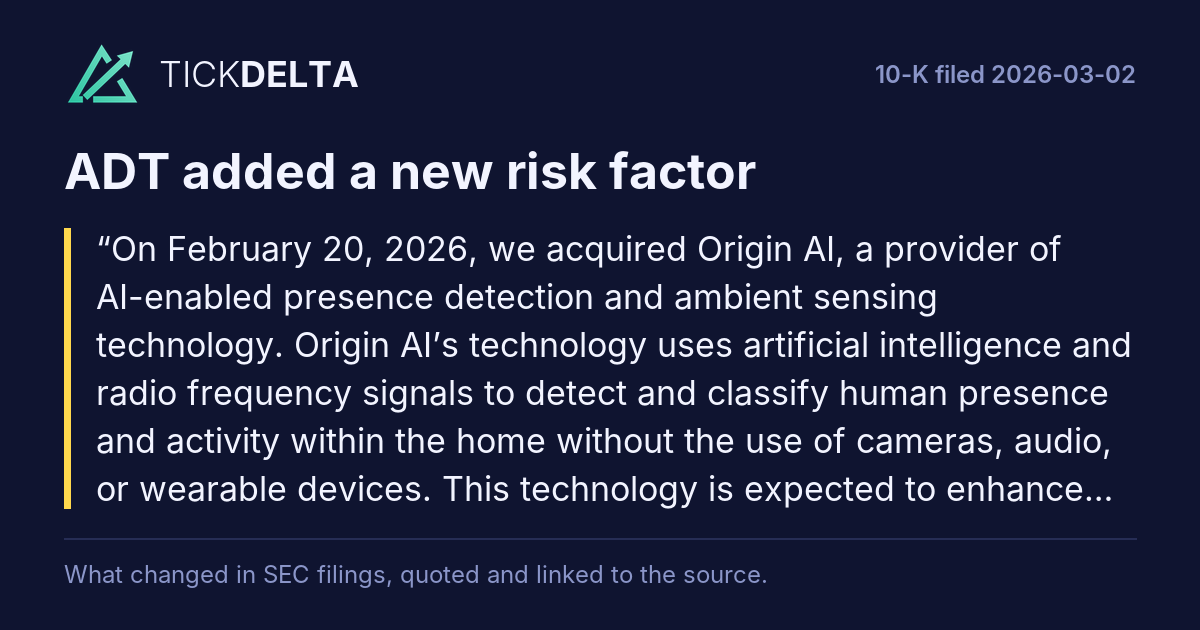
On February 20, 2026, we acquired Origin AI, a provider of AI-enabled presence detection and ambient sensing technology. Origin AI’s technology uses artificial intelligence and radio frequency signals to detect and classify human presence and activity within the home without the use of cameras, audio, or wearable devices. This technology is expected to enhance our ability to deliver improved alarm verification, reduce false alarms, and support new intelligent security and smart home use cases over time. In connection with our acquisition of Origin AI, we face risks related to the integration, development, and commercialization of Origin AI’s technology. Origin AI’s AI‑enabled presence detection and ambient sensing technology is relatively new and may require additional development, testing, and integration with our existing platforms and offerings. We may experience challenges integrating Origin AI’s technology, personnel, and operations into our business, or may be unable to achieve the anticipated benefits of the acquisition within the expected timeframes or at all. In addition, the successful commercialization of Origin AI’s technology depends on customer adoption, evolving regulatory and industry standards applicable to artificial intelligence and wireless technologies, and our ability to effectively incorporate these capabilities into our products and services. Failure to successfully integrate or commercialize Origin AI’s technology could adversely affect our business, results of operations, and financial condition.
As we continue to develop our ADT+ platform and integrate our ambient sensing technologies, we face inherent risks associated with a “software-as-a-product” model. Unforeseen software bugs, technical glitches, or latency in our cloud infrastructure could disrupt primary security and life-safety functions. Such failures could lead to significant reputational harm, customer dissatisfaction, and potential liability if a system fails to perform as intended.
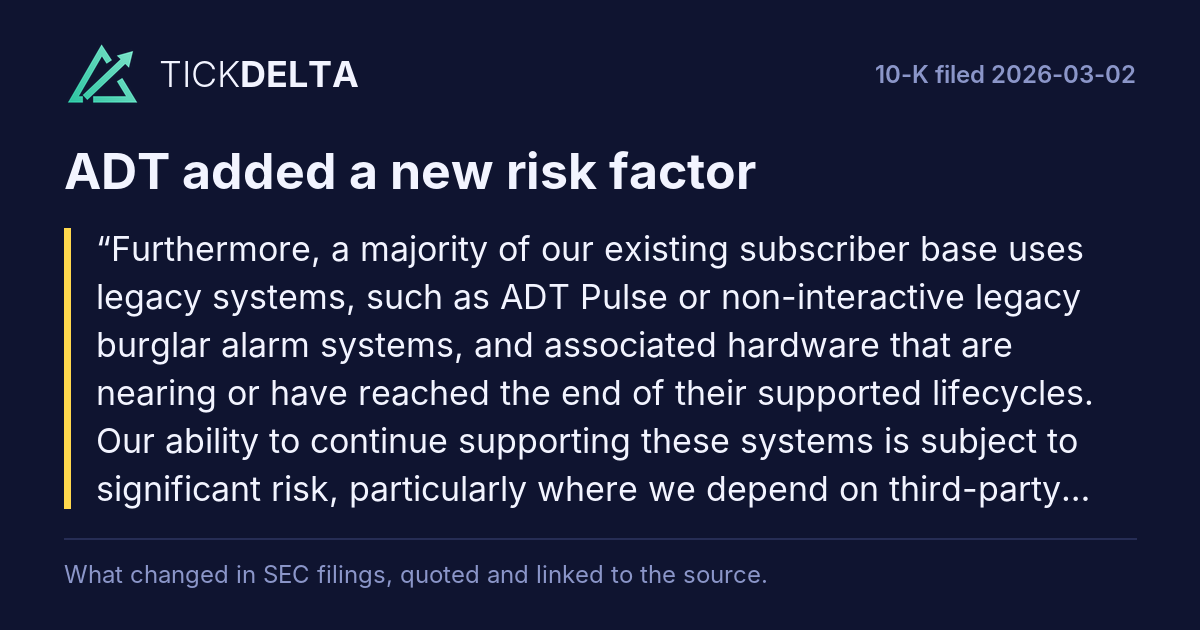
Furthermore, a majority of our existing subscriber base uses legacy systems, such as ADT Pulse or non-interactive legacy burglar alarm systems, and associated hardware that are nearing or have reached the end of their supported lifecycles. Our ability to continue supporting these systems is subject to significant risk, particularly where we depend on third-party providers for software or hardware support, system updates, and bug fixes. Should these third parties designate systems as “end-of-life” or otherwise cease support, we could be forced to assume substantial costs to maintain these systems independently or accelerate their retirement. Additionally, as legacy hardware becomes obsolete, it may become susceptible to unpatchable security vulnerabilities or suffer from a lack of available replacement parts. These legacy systems are also incompatible with our ADT+ platform and features, including our planned ambient intelligence development through our acquisition of Origin AI. Migrating these subscribers to the ADT+ platform would require significant capital investment or customer-funded hardware upgrades. These customers may be at higher risk of attrition as they become more susceptible to competitors offering additional features and newer hardware at lower entry prices. If we are unable to adapt in a timely and cost-effective manner to technological obsolescence and changing technologies or customer preferences, our business, financial condition, results of operations, and cash flows could be materially adversely affected.
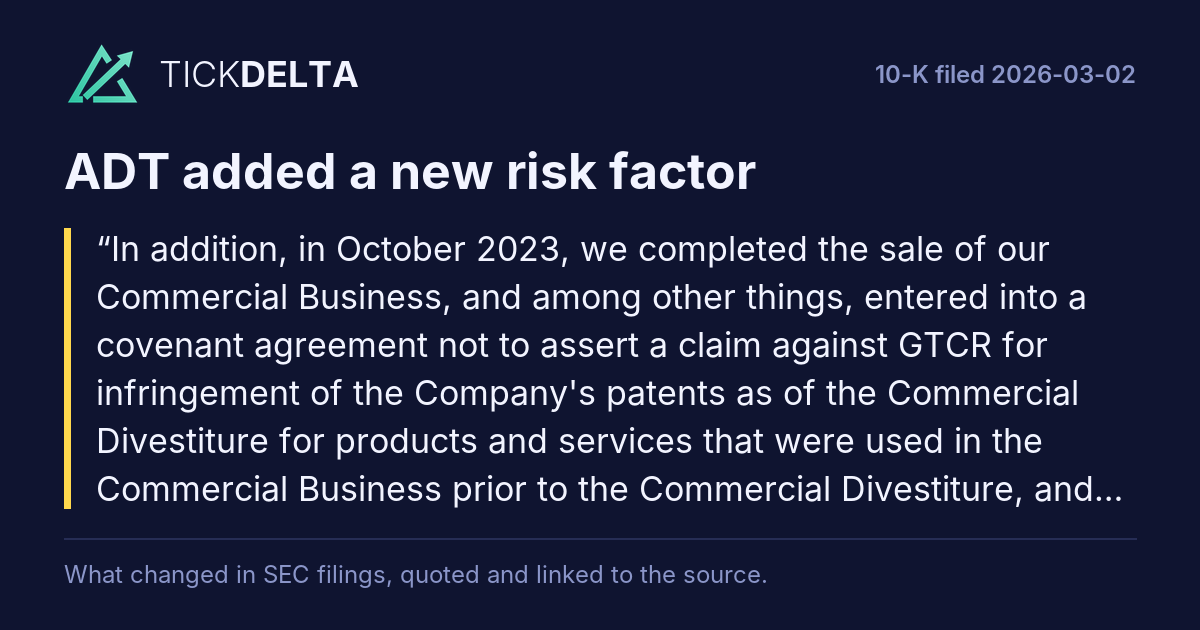
In addition, in October 2023, we completed the sale of our Commercial Business, and among other things, entered into a covenant agreement not to assert a claim against GTCR for infringement of the Company's patents as of the Commercial Divestiture for products and services that were used in the Commercial Business prior to the Commercial Divestiture, and provided GTCR with a paid-up, irrevocable, non-assignable (with limited exceptions) license to continue to use certain software and other Company intellectual property in the same manner.
experience, we are also integrating systems from our various bulk account acquisitions, making changes to legacy systems, replacing legacy systems with successor systems with new functionality, and implementing new systems.
We increasingly use AI‑enabled tools and systems to support customer interactions, product functionality, monitoring capabilities, and internal operations, and to drive efficiencies within our workforce. AI technologies are complex and rapidly evolving, and their use may involve risks relating to, among other things, accuracy, reliability, bias, cybersecurity vulnerabilities, data privacy, intellectual property, and regulatory compliance. AI systems may produce unintended or incorrect outputs, fail to perform as expected, or be misused by employees, customers, or third parties. In addition, any latency, disruption, or failure in our AI systems or data infrastructure could result in data loss, delays, or errors in our offerings or operational activities. Developing, testing, and deploying resource-intensive AI solutions may require significant investment and could increase our costs. We can provide no assurance that our development or use of, or our investments in, AI-enabled or AI-integrated systems and tools will enhance these systems and tools or be beneficial to our business.
In addition, evolving legal and regulatory frameworks governing AI, as well as heightened public and investor scrutiny of AI use, may require us to modify our practices, incur additional compliance costs, or limit certain applications of AI. Any failure or perceived failure to responsibly develop, deploy, or govern AI‑enabled solutions could result in, among other things, legal liability, regulatory action, reputational harm, or reduced customer trust, any of which could materially adversely affect our business.
Furthermore, certain components of our security and smart home offerings, including certain sensors and connected devices, rely on wireless communication protocols and radio-frequency spectrum set aside by the FCC for unlicenced use (including protocols such as Z-Wave and other sub‑1 GHz technologies that operate in unlicensed bands). This lower 900MHz band of spectrum is shared with many other devices and is subject to interference, congestion, and changes in technical rules or usage rights. Regulatory proceedings could alter spectrum allocations, power limits, or other operating conditions in ways that increase the risk of harmful interference to low-power devices. If wireless interference, spectrum reconfiguration, or related regulatory changes reduce signal reliability or device performance, customers may experience degraded functionality, missed or delayed signals, or service interruptions. Any such issues could require us to redesign or re-certify products, modify device firmware or network configurations, accelerate replacement of installed equipment, increase service and support costs, and/or incur material capital expenditures. These events could also increase customer dissatisfaction and attrition, expose us to contractual disputes, or litigation, which could materially adversely affect our business, financial condition, results of operations, and cash flows.
We have and will continue to pursue and invest in new business opportunities that may diverge from our current business model and practices, including expanding our products or service offerings, investing in new and unproven technologies, adding customer acquisition channels, and forming new alliances with companies to market our services. We can provide no assurance that any such business opportunities or investments will perform as expected. Among other negative effects, our pursuit of such
The Origin AI Acquisition significantly expanded our patent portfolio, which may increase our exposure to intellectual property‑related risks. As our patent portfolio grows, we may face increased costs to maintain and enforce our intellectual property rights and may be subject to claims of infringement or other disputes, which could be costly and divert management resources.
In February 2026, the U.S. Supreme Court ruled that the President lacks authority under the International Emergency Economic Powers Act to impose tariffs, invalidating certain tariffs that had been imposed pursuant to that statute. As a result, certain tariffs imposed during fiscal year 2025 are no longer being collected. However, the ruling does not limit the ability of the U.S. government to impose tariffs under other statutory authorities. In response to the ruling, President Trump has announced new tariffs, including a global tariff of 10% imposed pursuant to a separate executive order and trade authority. In addition, Congress or the executive branch may impose additional tariffs, modify existing tariffs, or adopt other trade restrictions, and foreign governments may implement retaliatory measures. These developments have increased uncertainty regarding the scope, duration, and impact of U.S. trade policy, and any such actions could materially adversely affect our business, financial condition, results of operations, and cash flows.
•providing for a transition from a classified board to a declassified board, such that, until the annual shareholders meeting in 2028, not all members of our Board of Directors are elected at one time;
affect our share trading prices, increase their volatility, reduce our cash reserves and may be suspended or terminated at any time, which may result in a decrease in the trading price of our stock.
New in the latest 10-Q
37 paragraphs in the 10-Q filed Nov 3, 2026 with nothing like them in the 10-Q filed Jul 30, 2026 (at least half the words must differ; new numbers alone do not count). Quoted exactly, grouped by the item heading above them. This is text that changed, not a judgement of how serious it is.
On October 29, 2026, the Company entered into an Agreement and Plan of Merger (the “Merger Agreement”) with Abode Parent, LLC, a Delaware limited liability company (“Parent”), and Abode Merger Sub, Inc., a Delaware corporation and wholly owned subsidiary of Parent (“Merger Sub”), pursuant to which, subject to the terms and conditions thereof, Merger Sub will merge with and into ADT with ADT continuing as the surviving corporation and a wholly owned subsidiary of Parent (the “Merger”). Consummation of the Merger is subject to the approval of the Company’s stockholders and other customary closing conditions.
Read in the 10-Q
Subject to the terms and conditions set forth in the Merger Agreement, which has been unanimously approved by the Board of Directors, at the effective time of the Merger (the “Effective Time”), each share of the Company’s Common Stock and Class B Common Stock (together, the “Company Common Stock”) issued and outstanding immediately prior to the Effective Time (other than shares owned directly by Parent or Merger Sub, owned by ADT as treasury shares or held by any person who properly exercises appraisal rights under Delaware law) will be converted automatically into the right to receive an amount in cash equal to $ 10.00 per share, without interest (the “Merger Consideration”).
Read in the 10-Q
At the Effective Time, each unvested option to purchase shares of Common Stock (each, a “Company Stock Option”) and each unvested restricted stock unit with respect to Common Stock (each, a “Company RSU”) outstanding immediately prior to the Effective Time will be canceled and converted into the contingent right to receive an amount in cash, without interest, equal to the Merger Consideration (less the per share exercise price in the case of Company Stock Options) multiplied by the number of shares of Common Stock subject to such Company Stock Option or Company RSU, as applicable, assuming, solely for purposes of calculating such amount, that any applicable performance-based vesting conditions are achieved, with the same terms and conditions (including service- and/or performance-based vesting conditions) that applied to the corresponding Company Stock Option or Company RSU, as applicable, immediately prior to the Effective Time (unless the per share exercise price of such Company Stock Option is equal to or greater than the Merger Consideration, in which case such Company Stock Option will be canceled for no consideration). In the case of any vested Company Stock Option and Company RSUs, the foregoing amounts (if any) will be immediately payable at the Effective Time.
Read in the 10-Q
The consummation of the Merger is subject to certain closing conditions, including, among other things: (i) the approval of the Company’s stockholders, (ii) the expiration or early termination of the applicable waiting period under the Hart-Scott-Rodino Antitrust Improvements Act of 1976, (iii) the absence of legal restraints in the U.S. prohibiting the Merger and (iv) other customary conditions specified in the Merger Agreement. Upon termination of the Merger Agreement under specified circumstances, the Company will be required to pay Parent a termination fee. If the termination fee becomes payable as a result of the Company terminating the Merger Agreement in order to enter into a definitive acquisition agreement providing for a Superior Proposal (as defined in the Merger Agreement) and under certain other circumstances, the amount of the termination fee will be $ 227 million, except that, in the event that the Company terminates the Merger Agreement to enter into a definitive acquisition agreement providing for a Superior Proposal prior to midnight, New York City time, on November 29, 2026 (i.e., one minute after 11:59 p.m., New York City time, on November 28, 2026) or, with respect to any Excluded Party (as defined in the Merger Agreement), prior to and including December 8, 2026, the termination fee will be $ 114 million. The Company will be entitled to receive from Parent a termination fee of $ 473 million under certain circumstances, including if the Company terminates the Merger Agreement because Parent fails to consummate the Merger when required by the Merger Agreement. The foregoing description of the Merger Agreement does not purport to be complete and is subject to, and qualified in its entirety by, the full text of the Merger Agreement, a copy of which is attached as Exhibit 2.1 to the Current Report on Form 8-K filed by the Company on October 29, 2026.
Read in the 10-Q
Unless otherwise defined herein, capitalized terms related to the Merger used in this Management’s Discussion and Analysis of Financial Condition and Results of Operations have the meanings ascribed to them in Note 15 “Subsequent Event” to our condensed consolidated financial statements included in Part I, Item 1 of this Quarterly Report on Form 10-Q.
Read in the 10-Q
On October 29, 2026, we entered into the Merger Agreement with Parent, pursuant to which, subject to certain terms and conditions therein, Parent will acquire ADT for $10.00 per share in cash, representing a premium of 45.6% to ADT’s unaffected closing share price on October 27, 2026, and 52.1% to ADT’s 30-day volume-weighted average share price ending on October 27, 2026. The Merger is expected to close in the first quarter of 2027 and is conditioned on the approval by our stockholders of a proposal to adopt the Merger Agreement, as well as the satisfaction or waiver of other customary closing conditions, including the expiration or early termination of the applicable waiting period under the Hart-Scott-Rodino Antitrust Improvements Act of 1976. If the Merger is consummated, we will become a privately held company, and our Common Stock will be delisted from the New York Stock Exchange. See additional information in Note 15 “Subsequent Event” to our condensed consolidated financial statements included in Part I, Item 1 of this Quarterly Report on Form 10-Q.
Read in the 10-Q
Our results are impacted by the mix, price, offerings, sales and distribution channel, and equipment ownership of our transactions.
Read in the 10-Q
• goodwill impairment of $12 million recognized in the prior year associated with the Multifamily Divestiture.
Read in the 10-Q
• goodwill impairment of $12 million recognized in the prior year associated with the Multifamily Divestiture, and
Read in the 10-Q
(2) Represents a goodwill impairment charge associated with the Multifamily Divestiture.
Read in the 10-Q
(2) Represents a goodwill impairment charge associated with the Multifamily Divestiture.
Read in the 10-Q
(4) During 2025, primarily includes one-time costs associated with debt transactions.
Read in the 10-Q
• the risk that the proposed Merger described above may not be completed in a timely manner or at all;
Read in the 10-Q
• the failure to receive, on a timely basis or otherwise, the required approval of the Merger by our stockholders;
Read in the 10-Q
• the possibility that any or all of the various other conditions to the consummation of the Merger may not be satisfied or waived, including the failure to receive any required regulatory approvals from any applicable governmental entities (or any conditions, limitations or restrictions placed on such approvals);
Read in the 10-Q
• the possibility that competing offers or acquisition proposals for the Company will be made;
Read in the 10-Q
• the occurrence of any event, change or other circumstance that could give rise to the termination of the Merger Agreement relating to the Merger, including in circumstances which would require us to pay a termination fee;
Read in the 10-Q
• the risk that our stock price may decline significantly if the Merger is not consummated;
Read in the 10-Q
• the risk of stockholder litigation in connection with the Merger, including resulting expense or delay;
Read in the 10-Q
A larger portion of our debt is subject to variable interest rates as of September 30, 2026 as compared to December 31, 2025. As of September 30, 2026, the principle balance of our debt, excluding finance leases, that was subject to a variable-rate was approximately 9% (including the impact of interest rate swaps) and approximately 52% (excluding the impact of interest rate swaps) of the total carrying amount of our debt.
Read in the 10-Q
The Merger may not be completed on the terms or timeline currently contemplated or at all, which could adversely affect our stock price, business, financial condition and results of operations.
Read in the 10-Q
On October 29, 2026, we entered into the Merger Agreement, which provides that the consummation of the Merger is subject to certain conditions, many of which are not within our full control, including, among other things: (i) the approval of our stockholders, (ii) the expiration or early termination of the applicable waiting period under the Hart-Scott-Rodino Antitrust Improvements Act of 1976, (iii) the absence of legal restraints in the U.S. prohibiting the Merger and (iv) other customary conditions specified in the Merger Agreement. While we currently expect that the Merger will be consummated in the first quarter of 2027, there can be no assurance that the foregoing conditions will be satisfied in a timely manner or at all, or that an effect, event, development, or change will not transpire that could delay or prevent these conditions from being satisfied. In addition, both we and Parent may terminate the Merger Agreement in certain circumstances as set forth in the Merger Agreement.
Read in the 10-Q
If the Merger is not consummated on the expected timeline or at all, the trading price of our common stock may decline. We may also be subject to additional risks if the Merger is not completed, including:
Read in the 10-Q
• we could be required to pay Parent a termination fee of $227 million or $114 million, as applicable, in cash if the Merger Agreement is terminated in certain circumstances;
Read in the 10-Q
• we have incurred and will incur further substantial expenses in connection with the Merger, including financial advisory, legal, accounting and other professional services fees, and other costs relating to the Merger regardless of whether the Merger is consummated;
Read in the 10-Q
• we may experience disruptions to our business resulting from the announcement and pendency of the Merger, including adverse changes in our relationships with, or loss of, our customers, business partners and employees, including key personnel, which may not be reversible and may continue or intensify in the event the Merger is delayed or not consummated;
Read in the 10-Q
• if the Merger is not consummated, we may suffer from negative publicity and a negative impression of us in the investment community, and a failure to close the Merger may have a negative impact on the market price of our Common Stock;
Read in the 10-Q
• matters relating to the Merger will require substantial commitments of time and resources by our management, which would otherwise have been devoted to day-to-day operations and other opportunities that may have been beneficial to us, in each case without realizing any of the benefits of having the Merger completed;
Read in the 10-Q
• we may be subject to legal proceedings related to the potential delay of, or failure to consummate, the Merger; and
Read in the 10-Q
• under the Merger Agreement, we are subject to certain restrictions on the conduct of our business prior to completing the Merger, which restrictions could adversely affect our ability to conduct our business as we otherwise would have done if we were not subject to these restrictions.
Read in the 10-Q
The pendency of the Merger could negatively impact our business, financial conditions, and results of operations.
Read in the 10-Q
The pendency of the Merger could adversely affect our business, financial condition and results of operations and may result in our inability to hire, or the departure of, key personnel. In connection with the Merger, some of our customers, suppliers and business partners may delay or defer decisions or may end their relationships with us, which could negatively affect our revenues, earnings and cash flows, regardless of whether the Merger is completed. Similarly, our current and prospective employees may experience uncertainty about their future roles with us following the Merger, which may materially adversely affect our ability to attract and retain key personnel during the pendency of the Merger.
Read in the 10-Q
Until the completion of the Merger or the termination of the Merger Agreement in accordance with its terms, we are prohibited from entering into certain transactions and taking certain actions that might otherwise be beneficial to us and our stockholders.
Read in the 10-Q
From and after the date of the Merger Agreement and prior to completion of the Merger, the Merger Agreement restricts us from taking specified actions without the consent of Parent and requires ADT to use reasonable best efforts to conduct its business in the ordinary course of business. These restrictions may prevent us from making changes to our business or organizational structure or from pursuing business opportunities that may arise prior to the completion of the Merger. Adverse effects arising from these restrictions during the pendency of the Merger could be exacerbated by any delays in the consummation of the Merger or the termination of the Merger Agreement.
Read in the 10-Q
Litigation challenging the Merger Agreement may prevent the Merger from being consummated within the expected timeframe or at all.
Read in the 10-Q
Lawsuits may be filed in the future, against us, the Board of Directors or other parties to the Merger Agreement, challenging the adequacy of the proxy disclosures or making other claims in connection with the Merger. Such lawsuits may be brought by purported stockholders or other interested parties, seeking, among other things, to enjoin consummation of the Merger. One of the conditions to the consummation of the Merger is that the consummation of the Merger is not restrained, made illegal, enjoined or prohibited by any order or legal or regulatory restraint or prohibition of a court of competent jurisdiction or any governmental entity. As such, if the plaintiffs in such potential lawsuits are successful in obtaining an injunction prohibiting the defendants from completing the Merger on the agreed upon terms, then such injunction may prevent the Merger from becoming effective within the expected timeframe or at all. Moreover, any such litigation could be time-consuming and expensive and could divert our management’s attention away from our ongoing business operations. Any lawsuit adversely resolved against us or members of the Board of Directors could have a material adverse effect on our business, financial condition and results of operations.
Read in the 10-Q
schedules and exhibits to the U.S. Securities and Exchange Commission upon request.
Read in the 10-Q
Item 1A of the 10-Q filed Nov 3, 2026 against Item 1A of the 10-K filed Mar 2, 2026.
A 10-Q repeats only the risks that changed, so a 10-K paragraph that is missing from it is not counted as removed.
Added is a paragraph with nothing like it in the 10-K, Reworded a sentence that is in both with several words changed,
Quiet changes a sentence in both where one to four words changed and one is a hedge or a modal
(cut words struck through, new words highlighted).
Text on the page, not a score; each links to the filing at sec.gov.
What the 10-Q itself says about its risk factors:Our significant business risks are described in Part I, Item 1A “Risk Factors” in our 2025 Annual Report and in our other filings with the SEC. The risk factors described in our filings with the SEC and other information may not describe every risk facing the Company. Except as set forth below, there have been no material changes in our risk factors from those disclosed in our 2025 Annual Report.
Read in the 10-Q
The first 12 of 16 are shown (at most 12 of each type).
Two-word phrases in Risk Factors of the 10-K filed Mar 2, 2026 that are in none of the 1 earlier 10-Ks stored, back to Feb 27, 2025
Used at least twice, small words left out. Counted, not picked: a phrase can be new because the company renamed something.
16 paragraphs of last year's Risk Factors with nothing like them now. The longest are quoted.
Item 1A of each 10-K and 10-Q on EDGAR, quoted exactly. Each paragraph links to the filing at sec.gov.
10-K change: what was reworded or cut, section by section.
Excel workbook · CSV. Google Sheet that stays up to date: paste =IMPORTDATA("https://tickdelta.com/company/ADT/export.csv") into a cell.