Marked against last year's 10-K:
cut words struck through, new words highlighted and underlined.
MD&A 415 words changed in this paragraph; it is 36% similar to last year's version.
Net income attributable to Ameren common shareholders was $1,456 million, or $5.35 per diluted share, for 2025, and $1,182 million, or $4.42 per diluted share, for 2024, and $1,152 million, or $4.38 per diluted share, for 2023. 2024. Net income was favorably affected in 2024, 2025, compared with 2023, by increased infrastructure investments at Ameren Transmission and Ameren Missouri. Net income was also favorably affected in 2024, compared with 2023, by increased base rate revenues at Ameren Missouri effective June 1, 2025, pursuant to the MoPSC's June 2023 April 2025 MoPSC electric rate order as well as higher base rate revenues pursuant to the ICC's November 2023 natural gas rate order, which increased earnings and decreased tax expense at Ameren Transmission, Ameren Illinois Electric Distribution and Ameren Illinois Natural Gas. Additionally, earnings in 2024, compared with 2023, Gas due to the revaluation of excess deferred income tax regulatory liabilities. Earnings were also favorably affected by increased retail electric sales volumes at Ameren Missouri, primarily due to warmer July temperatures and colder winter temperatures in 2025, and by decreased other operations and maintenance expenses not subject to formula rates, riders, or trackers, largely because of lower energy center maintenance costs, lower storm costs, disciplined cost management including lower labor costs from decreased headcount and decreased use of contractors, and lower amortization of refueling costs for the Callaway Energy Center, partially offset by the absence in 2025 of the regulatory deferrals associated with the June 2023 MoPSC rate order. Net income in 2024, compared with 2023, was also favorably affected by increased retail electric sales volumes at an Ameren Missouri, primarily due to higher sales excluding customer energy-efficiency programs. Net income was unfavorably affected in 2024, compared with 2023, by two charges Missouri charge related to matters that originated over a decade ago. The first the resolution of these charges was recorded by Ameren Missouri related to an order from the United States District Court for the Eastern District of Missouri, which resolved all outstanding claims in the NSR and Clean Air Act litigation related to associated with the Rush Island Energy Center. The second charge was recognized Additionally, earnings were favorably affected by the increased deferral of financing costs related to rate base investments at Ameren Missouri and by increased infrastructure investments at Ameren Transmission and Ameren Illinois and ATXI for the decrease in the allowed base ROE under the MISO tariff resulting from the October 2024 FERC order, which included customer refunds for certain historical periods. Electric Distribution. Net income was unfavorably affected in 2024, 2025 compared with 2023, was also unfavorably affected 2024 by increased financing costs due to costs, primarily resulting from higher long-term interest rates on higher debt balances and interest rates at Ameren Missouri and Ameren (parent), (parent) and by increased other operations and maintenance expenses not subject to formula rates, riders, or trackers, excluding a lower recognized ROE under charge related to the MYRP, NSR and Clean Air Act litigation, primarily due to higher vegetation management costs, higher storm costs, and higher energy center maintenance expenses. Additionally, earnings were unfavorably affected by an increase in the weighted-average basic common shares outstanding, which reduced earnings per diluted share.
Source: Item 7, 10-K 0001002910-26-000009 vs Item 7, 10-K 0001002910-25-000055
Legal Proceedings 347 words changed in this paragraph; it is 35% similar to last year's version.
Federal and state laws, including the CSAPR, regulate emissions of SO2 and NOx through the reduction of emissions at their source and the use and retirement of emission allowances. allowances available for state budgets. In April 2022, the EPA proposed the Good Neighbor Rule of the Clean Air Act, which includes additional NOx emission reductions from power plants in Missouri, Illinois, and other states through revisions to the CSAPR. In January 2023, the EPA issued its final disapproval of Missouri’s proposed state implementation plan for addressing reduce the transport of ozone under from power plants by reducing the amount of CSAPR NOx allowances available for compliance. The EPA subsequently rejected state implementation plans proposed by Missouri and other states to comply with the Good Neighbor Rule of the Clean Air Act. The disapproval of the state plan allowed the EPA to implement revisions to the CSAPR through and issued a federal implementation plan that reduced the amount of NOx allowances available plan. The disapprovals for state budgets and imposed NOx emission limits on electric generating units for Missouri, Illinois, and other states under the Good Neighbor Rule of the Clean Air Act. In April 2023, the Missouri Attorney General and Ameren Missouri separately filed lawsuits in the United States Court of Appeals for the Eighth Circuit challenging the EPA’s disapproval of the Missouri state plan. Ameren expected a decision on Missouri’s proposed state implementation plan under the Good Neighbor Rule by the United States Court of Appeals for the Eighth Circuit in 2025, but, in February 2025, the EPA requested that the appellate court suspend the case indefinitely and indicated it was reviewing the basis for the disapproval of the some state implementation plans, including Missouri’s. Missouri’s, were stayed by multiple appellate courts, and in 2024, the United States Supreme Court issued a stay of the federal implementation plan. In January 2026, the EPA issued a proposed rule to reconsider the Good Neighbor Rule. Ameren Missouri complies with the current CSAPR requirements by minimizing emissions through the use of with low-sulfur coal, operation of two scrubbers at its Sioux Energy Center, and optimization of existing NOx air pollution control equipment. Reducing If a final rule is issued similar to the amount of state budget proposed rule, Ameren Missouri would not expect additional NOx allowances for compliance with NOx emission limits under the Good Neighbor Rule could result in additional controls being required on Ameren Missouri’s generating units and/or the reduction of operations. Any costs for compliance are expected at its coal-fired energy centers to be recovered from customers, subject to MoPSC prudence review, through the FAC or higher base rates. necessary.
Source: Item 3, via Note 14 – COMMITMENTS AND CONTINGENCIES, 10-K 0001002910-26-000009 vs Item 3, via Note 14 – COMMITMENTS AND CONTINGENCIES, 10-K 0001002910-25-000055
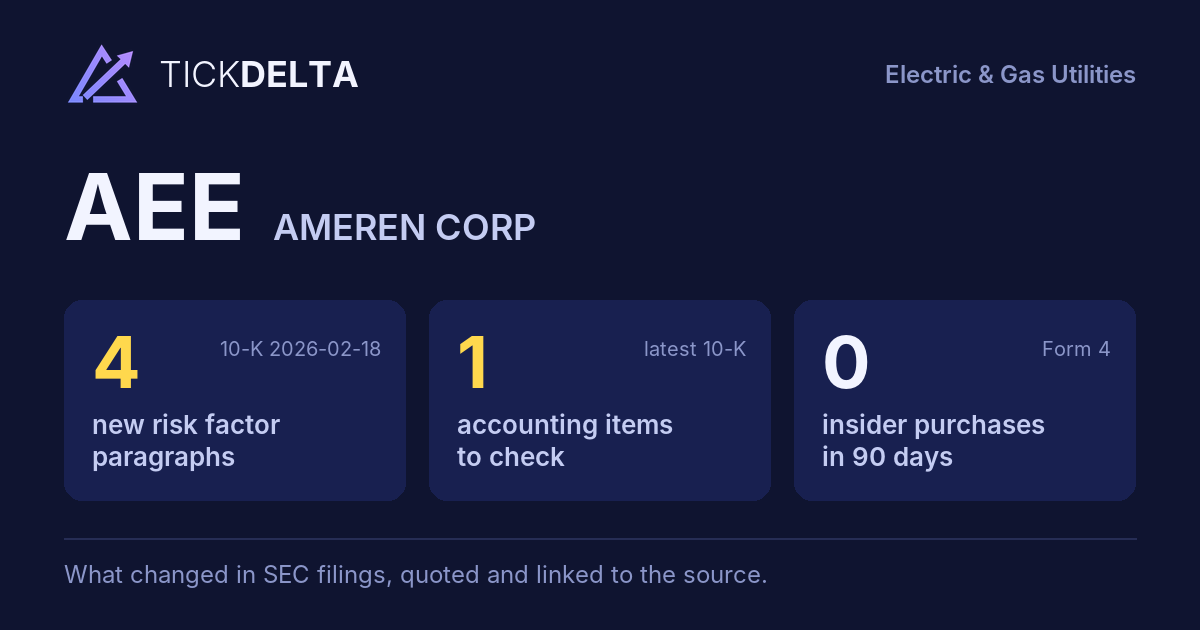
Risk Factors 263 words changed in this paragraph; it is 42% similar to last year's version.
The Ameren Companies have historically experienced minimal growth in energy demand for the past two decades. Recent However, current industry projections reflect the potential for significant growth in energy demand over the next decade, primarily arising from data centers to support artificial intelligence and further augmented by onshoring and electrification of manufacturing and an increase in transportation electrification. In addition, in February 2026, Ameren Missouri executed electric service agreements with large load customers under its large load customer rate plan, representing 2.2 gigawatts of demand. The Ameren Companies may or may not experience the energy demand growth currently being forecasted depending on the decisions of potential new customers about whether to locate their operations within our service territories. If new territories or whether customers elect to locate that have signed electric service agreements begin operations within our service territories, the Ameren Companies may not be able to provide the necessary electric service within the time periods required by those customers. The Ameren Companies may need to accelerate new generation build within current plans, and construct or obtain new generation sources and expand transmission and distribution facilities that are not currently within their plans. The Ameren Companies may not be able to plan, receive regulatory approvals, and execute those plans in a timely manner. Future expected timeframes. Also, demand from these customers growth may not be realized at the current projected pace as a result rate, or in the amount, expected if construction of customer facilities is not completed within expected timeframes, which is dependent on the ability of suppliers, contractors, and developers to meet contractual commitments and timely complete projects. In addition, expected demand growth may not be realized if emerging technologies are not broadly adopted at the rate expected, increased efficiency efficiencies in computing, and computing or other advances in these new customers may be transitory and exit our service territory. Significant uncertainty exists regarding future increases in technologies reduce energy demand within the Ameren Companies’ service territory, and whether and how the Ameren Companies will construct for data centers, or obtain the assets necessary to timely serve that additional demand. large load customers, such as data centers,
Source: Item 1A, 10-K 0001002910-26-000009 vs Item 1A, 10-K 0001002910-25-000055
Accounting Policies 127 words changed in this paragraph; it is 40% similar to last year's version.
We expect that regulators will reduce future revenues for deferred tax liabilities that were initially recorded at rates in excess of the current statutory rate. Therefore, reductions in certain excess deferred tax liabilities that were recorded because of decreases in the statutory rate have been credited to a regulatory liability. A regulatory asset has been established to recognize the probable recovery through future customer rates of tax benefits related to the equity component of allowance for funds used during construction, as well as the effects of tax rate increases. To the extent deferred tax balances are included in rate base, the revaluation of deferred taxes caused by a change in the statutory rate is recorded as a regulatory asset or liability on the balance sheet and will be collected from, or refunded to, customers. For deferred tax balances not included in rate base, the revaluation of deferred taxes caused by a change in the statutory rate is recorded as an adjustment to income tax expense on the income statement.
Source: Item 8, Note 1 – SUMMARY OF SIGNIFICANT ACCOUNTING POLICIES, 10-K 0001002910-26-000009 vs Item 8, Note 1 – SUMMARY OF SIGNIFICANT ACCOUNTING POLICIES, 10-K 0001002910-25-000055