tickdelta
Sign in

Tickdelta is free for now. Sign up and get Pro free

← Screener

AEEAmeren

Utilities · Electric & Gas Utilities · NYSE

Ameren, formed in 1997 and headquartered in St. 10-K, Item 1

Headquarters
St Louis, MO
Next results
around Feb 10, 2027
Compare with peers → Embed

When the SEC's staff reviews a filing, it writes to the company with numbered questions, and the company answers each one in a letter. SEC publishes the exchange once the review is over, at least 20 business days later. Below: what the staff asked AEE, and the company's answer to each question, quoted from the letters. A question is not an accusation; most reviews end with the company adding detail to its next filing.

Form 10-K for the Fiscal Year ended December 31, 2023

2024-03-27 to 2024-04-18 · 2 questions · 1 letter from the SEC, 1 from the company
Review closed 2024-04-18
RevenueNon-GAAP measuresResults discussion (MD&A)
Management's Discussion and Analysis of Financial Condition and Results of Operations · Margins, page 46
SEC asked (1)
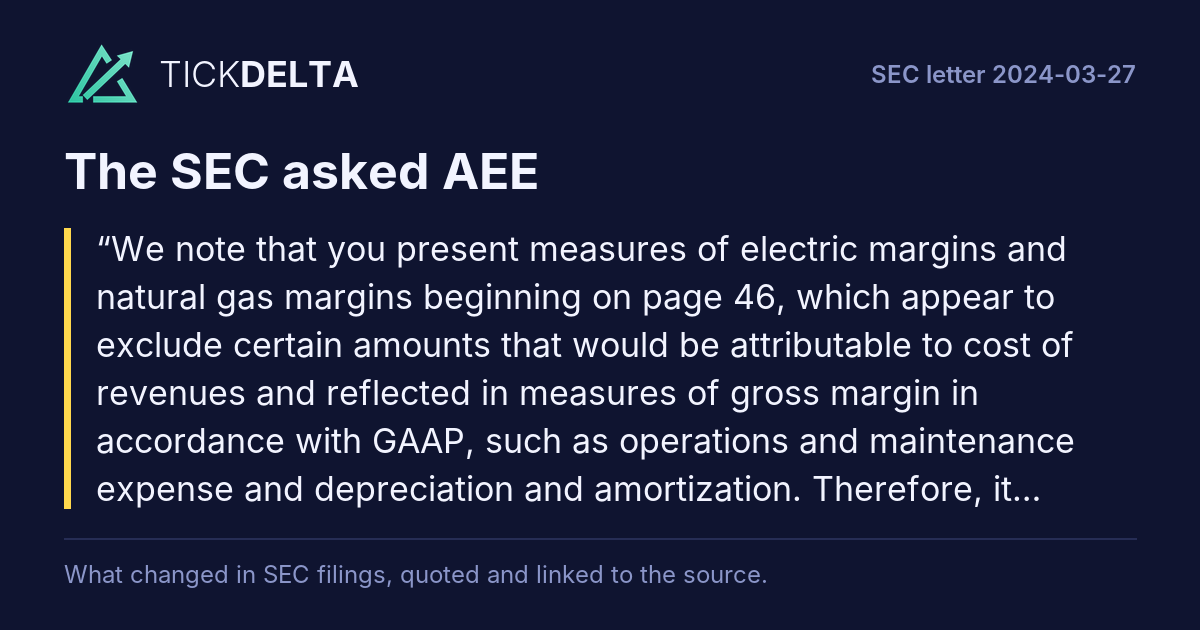
We note that you present measures of electric margins and natural gas margins beginning on page 46, which appear to exclude certain amounts that would be attributable to cost of revenues and reflected in measures of gross margin in accordance with GAAP, such as operations and maintenance expense and depreciation and amortization.
Rest of the question

Therefore, it appears that your measures of electric margins and natural gas margins should be identified as non-GAAP measures and that you should adhere to the requirements in Item 10(e) of Regulation S-K. For example, it appears that electric gross margin and natural gas gross margin, each reflecting all costs and expenses applicable to revenues, would be identified as the most directly comparable GAAP measures in providing the disclosures required by Item 10(e)(1)(i)(A) and (B) of Regulation S-K. You should include analyses of the changes in these most directly comparable GAAP measures, similar to those provided for changes in your non-GAAP measures of the electric margins and natural gas margins. Please refer to the answers to Questions 100.05 and 102.10(a) and (b) of our C&DI's pertaining to Non-GAAP measures if you require further clarification. You may view this guidance at the following website address: https://www.sec.gov/corpfin/non-gaap-financial-measures.htm Please submit the revisions that you propose to address these concerns.

AEE answered
We respectfully acknowledge the Staff’s comment. We will exclude electric margins and natural gas margins as non-GAAP measures in future combined Form 10-Q and Form 10-K filings for Ameren, Union Electric Company, and Ameren Illinois Company, beginning with the Form 10-Q for the quarter ended March 31, 2024. Read in the reply ↗
In its next report

First report after the company's reply of 2024-04-10: 10-Q filed 2024-05-06 ↗, against the 10-Q filed 2023-11-09 ↗.

Tickdelta does not hold the text of both reports, so they are not compared here.
Financial Statements and Supplementary Data · Note 11 - Stock-Based Compensation, page 142
SEC asked (2)
We understand from your disclosures on pages 143 and 144 that you have dividend equivalents related to the performance share and restricted stock units, and that employees are entitled to receive common shares based on accumulated dividends upon vesting.
Rest of the question

Please explain to us how you considered and applied the guidance for participating securities in FASB ASC 260-10-45-59A through 70, in computing earnings per share and formulating the disclosures made pursuant to FASB ASC 260-10-50-1. Please include any numerical details and analyses of the terms that are necessary to support the conclusions that you have made relative to this guidance. In closing, we remind you that the company and its management are responsible for the accuracy and adequacy of their disclosures, notwithstanding any review, comments, action or absence of action by the staff.

AEE answered
Per ASC 260-10-45-61A, "Unvested share-based payment awards that contain nonforfeitable rights to dividends or dividend equivalents (whether paid or unpaid) are participating securities and shall be included in the computation of EPS pursuant to the two-class method under the requirements of paragraph 260-10-45-60A." (emphasis added).

As disclosed in the Form 10-K, participants in Ameren's long-term incentive plan that have been granted performance share units ("PSUs") and restricted stock units ("RSUs") are entitled to receive dividend equivalents, which represent the right to receive
Rest of the answer

shares measured by the dividend payable with respect to the corresponding number of unvested PSUs or RSUs. Subject to the participant's continued employment, the dividend equivalents will vest and be settled at the same time and in the same proportion as the PSUs or RSUs to which they relate. Participants are not entitled to any dividend equivalent amount on PSUs or RSUs which do not ultimately vest.

In most cases, the right to dividend equivalents in our PSU and RSU arrangements are forfeitable and, therefore, these awards are not participating securities. An exception exists for RSUs granted to participants who are retirement eligible (or become retirement eligible during the vesting period). A participant is retirement eligible when the participant completes both at least five years of service and is at least 55 years of age. As RSU awards for participants who are retirement eligible vest on a pro rata basis depending on the number of days the participant was employed during the vesting period, dividend equivalents earned in relation to these awards are nonforfeitable and these awards are participating securities.

Ameren calculated earnings per share, including participating securities in accordance with ASC 260-10-45-61A, and concluded that the subset of RSUs which qualified as participating securities was immaterial for all periods presented in the Form 10-K. The impact to earnings per share was less than $0.01 per share for all periods presented and not considered material to disclose.

* * *

In connection with this letter in response to the Staff’s comments, Ameren acknowledges:

● Ameren is responsible for the adequacy and accuracy of the disclosure in its filings;

● Staff comments or changes to disclosure in response to Staff comments do not foreclose the Commission from taking any action with respect to our filings; and

● Ameren may not assert Staff comments as a defense in any proceeding initiated by the Commission or any person under the federal securities laws of the United States.

Read in the reply ↗
In its next report

First report after the company's reply of 2024-04-10: 10-Q filed 2024-05-06 ↗, against the 10-Q filed 2023-11-09 ↗.

Tickdelta does not hold the text of both reports, so they are not compared here.

Also in this review: closing letter, 2024-04-18
Form 10-K for the Fiscal Year Ended December 31, 2015

2016-06-08 to 2016-06-20 · 3 questions · 1 letter from the SEC, 1 from the company
Review closed 2016-06-20
Income taxesNon-GAAP measures
Note 1 – Summary of Significant Accounting Policies · Improvements to Employee Share-Based Payment Accounting, page 13
SEC asked (1)
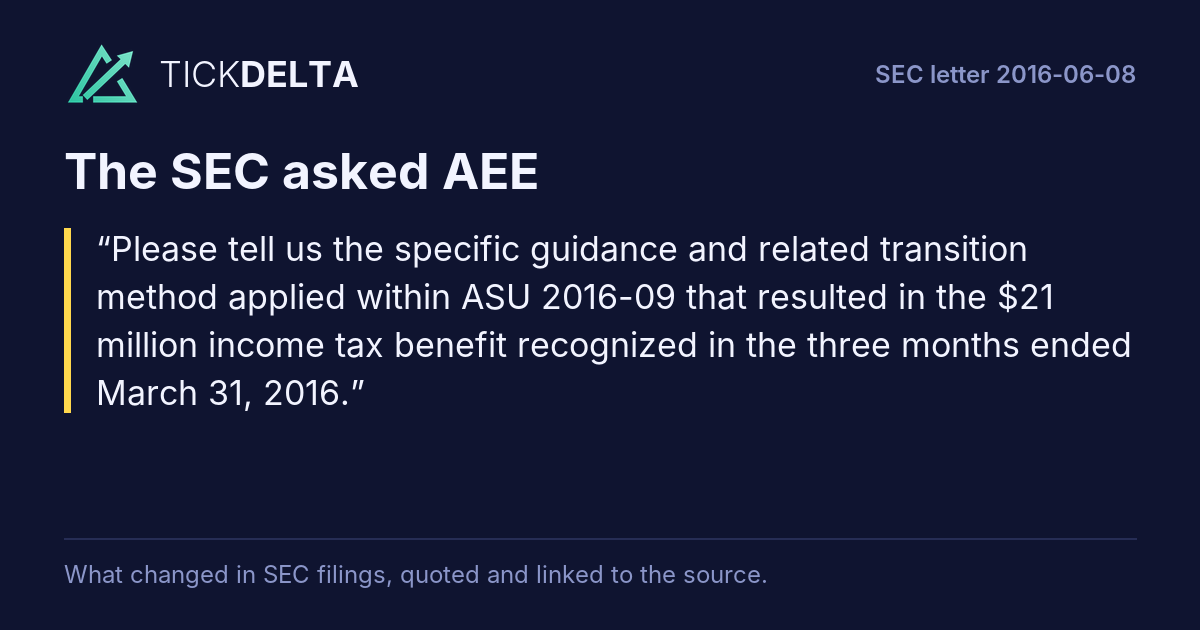
Please tell us the specific guidance and related transition method applied within ASU 2016-09 that resulted in the $21 million income tax benefit recognized in the three months ended March 31, 2016.
AEE answered
Ameren has granted performance share units (“share units”) to certain employees under either its 2006 Omnibus Incentive Compensation Plan or 2014

Omnibus Incentive Compensation Plan. Under these plans, a share unit vests and entitles an employee to receive shares of Ameren common stock (plus accumulated dividends) if, at the end of a three-year performance period, certain specified performance or market conditions have been met, and the individual remains employed by Ameren through the required vesting period.
Rest of the answer

The number of shares issued for each share unit varies from 0% to 200% of the target award, depending on actual company performance relative to the performance goals. The fair value of each share unit, which is recorded as the compensation cost for financial reporting purposes, is determined on the grant date based on the expected share payout, consistent with Accounting Standards Codification (“ASC”) 718 for equity-classified awards.

In March 2016, the Financial Accounting Standards Board (the

“FASB”) issued ASU 2016-09 Compensation – Stock Compensation (Topic 718): Improvements to Employee Share-Based Payment Accounting (“ASU 2016-09”), which simplified the accounting for share-based payment transactions, including the income tax consequences, the calculation of diluted earnings per share, the treatment of forfeitures, the classification of awards as either equity or liabilities, and the classification on the statement of cash flows by amending sections of the Accounting Standards Codification.

Ameren elected to adopt ASU 2016-09 in the first quarter of 2016 and, in accordance with the guidance, reflected all adjustments as of January 1, 2016. Ameren’s adoption of “Issue 1: Accounting for Income Taxes,” described on page 5 of ASU 2016-09, resulted in a $21 million income tax benefit recognized in the three months ended

March 31, 2016.

Prior to the adoption of ASU 2016-09, GAAP required tax effects of deductions for share-based payments in excess of compensation cost (“windfalls”) to be recorded in equity, and tax deficiencies (“shortfalls”) to be recorded in equity to the extent of previously recognized windfalls, with the remainder recorded in income tax expense. Ameren’s existing windfall pool on January 1, 2016, was $2 million. ASU 2016-09 amended ASC 718-740-35-2, such that the tax effect of any difference between the compensation cost of an award recognized for financial reporting purposes and the deduction for an award for tax purposes is recognized as an income tax expense or benefit in the income statement in the period in which the tax deduction arises.

As a result of Ameren’s total shareholder return relative to the designated peer group for the three-year performance period ended December 31, 2015, the number of shares issued for each share unit granted in 2013 was 200% of the target award, which was the maximum payout for the awards. The 200% payout, which was approved by the Board of Directors and distributed to employees in the first quarter of 2016, resulted in the $21 million income tax benefit. The benefit represents the tax effect of the excess of (i) the tax deduction for the actual compensation cost over (ii) the compensation cost for financial reporting purposes as calculated based on the grant date fair value of the share units in accordance with ASC 718.

Under the amended ASC 718-740-35-2, the tax effects of awards are treated as discrete items in the reporting period in which they occur. Therefore, the tax effect of awards is not spread over the entire year through the use of the annual effective tax rate, but instead is recorded entirely in the period in which the tax deduction arose. Accordingly, Ameren recorded the $21 million income tax benefit as a discrete item in income from continuing operations for the first quarter of 2016, resulting in a first quarter effective tax rate of 22%, as disclosed in Ameren’s Form 10-Q for the quarterly period ended March 31, 2016, Item 2. Management’s Discussion and Analysis of Financial Condition and Results of

Operations (page 43).

The transition guidance for “Issue 1: Accounting for Income Taxes,” as set forth in ASC 718-10-65-4e, requires prospective application of the amendment related to the tax effects of differences recognized on or after the effective date between the deduction for an award for tax purposes and the compensation costs of that award recognized for financial reporting purposes. In addition, the transition guidance requires a modified retrospective application through a cumulative-effect adjustment to retained earnings as of the beginning of the period for all tax benefits that were not previously recognized because the related tax deduction had not reduced taxes payable.

Ameren applied the amendment requiring recognition of excess tax benefits and tax deficiencies in the income statement prospectively from the date of adoption, January 1, 2016. Accordingly, Ameren recognized the $21 million income tax benefit in the period in which the distribution and related tax deduction occurred

(i.e., the three months ended March 31, 2016). Since the amendment requiring recognition in the income statement was applied prospectively, the adoption of ASU 2016-09, as of January 1, 2016, did not result in an adjustment to the financial statements for the outstanding windfall pool of $2 million on January 1, 2016. Further, there were no tax benefits that were not previously recognized because the related tax deduction had not reduced taxes payable, and therefore no cumulative-effect adjustment to Ameren’s beginning retained earnings was required.

Read in the reply ↗
In its next report

First report after the company's reply of 2016-06-16: 10-Q filed 2016-08-05 ↗, against the 10-Q filed 2016-05-10 ↗.

Tickdelta does not hold the text of both reports, so they are not compared here.

Note 1 – Summary of Significant Accounting Policies · Improvements to Employee Share-Based Payment Accounting, page 13
SEC asked (2)
In future filings please disclose the method of applying the change in accounting and the effect of the change on income from continuing operations, net income and related per share amounts, and the cumulative effect of the change on retained earnings as of the beginning of the year.
Rest of the question

Please also disclose whether you elected to estimate the number of awards that are expected to vest or to account for forfeitures when they occur. Please show us what your revised disclosures would look like.

AEE answered
In future filings, Ameren will disclose the method of applying the change in accounting and the effect of the change on income from continuing operations, net income and related per share amounts, and the cumulative effect of the change on retained earnings as of the beginning of the year. Ameren applied the amendment requiring recognition of excess tax benefits and tax deficiencies in the income statement prospectively, which resulted in recognition of the $21 million increase to income from continuing operations and net income for the three months ended March 31, 2016.
Rest of the answer

None of the amendments in ASU 2016-09 that are required to be applied using a modified retrospective transition method by means of a cumulative-effect adjustment to equity as of the beginning of the period in which the guidance is adopted impacted Ameren. Therefore, there was no cumulative-effect adjustment to retained earnings recognized as of January 1, 2016. As discussed in Ameren’s Form 10-Q for the quarterly period ended March 31,

2016, Item 2. Management’s Discussion and Analysis of Financial Condition and Results of Operations (page 38), first quarter 2016 earnings per diluted share from continuing operations were favorably affected by “a decrease in the effective tax rate primarily due to an income tax benefit recorded at Ameren (parent) pursuant to the adoption of new accounting guidance related to share-based compensation (8 cents per share)” (emphasis added). As noted below, Ameren will enhance its disclosure in Note 1 – Summary of Significant Accounting Policies in future filings to disclose that the adoption of ASU 2016-09 resulted in an income tax benefit of 9 cents per diluted share.

As discussed on page 56 of ASU 2016-09, the FASB’s amendments to ASC 718-10-35-3 permit an entity to “make an entity-wide accounting policy election either to estimate the number of forfeitures expected to occur or to account for forfeitures in the compensation cost when they occur.” Ameren has elected to continue to estimate forfeitures and record compensation expense net of the estimated forfeitures with a true-up to actual forfeitures, as needed.

Ameren will enhance its disclosure of the adoption of ASU

2016-09 in future filings, as follows (the new language is underlined below):

Improvements to Employee Share-Based Payment

Accounting

In March 2016, the FASB issued authoritative accounting guidance that simplifies the accounting for share-based payment transactions, including the income tax consequences, the calculation of diluted earnings per share, the treatment of forfeitures, the classification of awards as either equity or liabilities, and the classification on the statement of cash flows. Ameren determines for each performance share unit award whether the difference between the deduction for tax purposes and the compensation cost recognized for financial reporting purposes results in either an excess tax benefit or an excess tax deficit. Previously, excess tax benefits were recognized in “Other paid-in capital” on Ameren’s consolidated balance sheet, and in certain cases, excess tax deficits were recognized in “Income taxes” on Ameren’s consolidated income statement. The new guidance increases income statement volatility by requiring all excess tax benefits and deficits to be recognized in “Income taxes,” and treated as discrete items in the period in which they occur. Ameren adopted this guidance in the first quarter of 2016 and prospectively applied the amendment in this guidance requiring recognition of excess tax benefits and deficits in the income statement, which resulted in recognition of a $21 million income tax benefit and a corresponding $21 million increase in income from continuing operations and net income (9 cents per diluted share) during the period. Also as a result of the adoption of this guidance,

Ameren made an accounting policy election to continue to estimate the number of forfeitures expected to occur. The amendments in the guidance that require application using a modified retrospective transition method did not impact Ameren. Therefore, there was no cumulative-effect adjustment to retained earnings recognized as of January 1, 2016. Ameren applied the amendments in this guidance relating to classification on the statement of cash flows retrospectively. As a result, for the three months ended March 31, 2015, Ameren reclassified, for comparison purposes, $2 million of excess tax benefits on the statement of cash flows from financing to operating activities, and $12 million of employee payroll taxes related to share-based payments from operating to financing activities.

Read in the reply ↗
In its next report

First report after the company's reply of 2016-06-16: 10-Q filed 2016-08-05 ↗, against the 10-Q filed 2016-05-10 ↗.

Tickdelta does not hold the text of both reports, so they are not compared here.

Form 8-K filed February 19, 2016
SEC asked (3)
We note that Core (Non-GAAP) Diluted Earnings per Share precedes the most directly comparable GAAP measure in the headlines to the earnings release filed as Exhibit 99.1. In addition, we note that the adjustments to GAAP EPS to reconcile to Core EPS are presented net of tax. These presentations are inconsistent with the updated Compliance and Disclosure Interpretations issued on May 17, 2016.
Rest of the question

Please review this guidance when preparing your next earnings release.

AEE answered
Ameren will review and reflect the updated Compliance and Disclosure Interpretations issued on May 17, 2016, in future earnings releases and other applicable disclosures.

* * *

In connection with this letter in response to the Staff’s comments, Ameren acknowledges:

•

Ameren is responsible for the adequacy and accuracy of the disclosure in its filings;

Staff comments or changes to disclosure in response to Staff comments do not foreclose the Commission from taking any action with respect to its filings; and

Ameren may not assert Staff comments as a defense in any proceeding initiated by
Rest of the answer

the Commission or any person under the federal securities laws of the United States.

Read in the reply ↗

Also in this review: closing letter, 2016-06-20

From the SEC's correspondence on EDGAR: staff letters (form UPLOAD) and company letters (form CORRESP), 6 letters filed since 2016-06-08. Questions and answers are matched by their numbers; topics come from words in each question. The reports are compared word for word (same form, before the first SEC letter against the first report after the company's reply). No AI.

Work on AEE in a spreadsheet: Excel workbook (a sheet per section, ten years by column, charts, links to the filings) · CSV. For a Google Sheet that stays up to date, paste =IMPORTDATA("https://tickdelta.com/company/AEE/export.csv") into a cell.