Paragraph 13 · 40% changed
Every version of it
Screener
/
SEC EDGAR
/CIK 0000927003
/10-K filed Feb 13, 2026, compared with Feb 18, 2025
/Numbers from the XBRL of the 10-Ks
Nasdaq
Technology · Electronic Components
Advanced Energy Industries Inc AEIS
The 10-K against last year's
125 changes: 29 added, 20 removed, 73 reworded, 3 quiet changes
10-K Feb 13, 2026 vs Feb 18, 2025
Risk Factors
11.3%
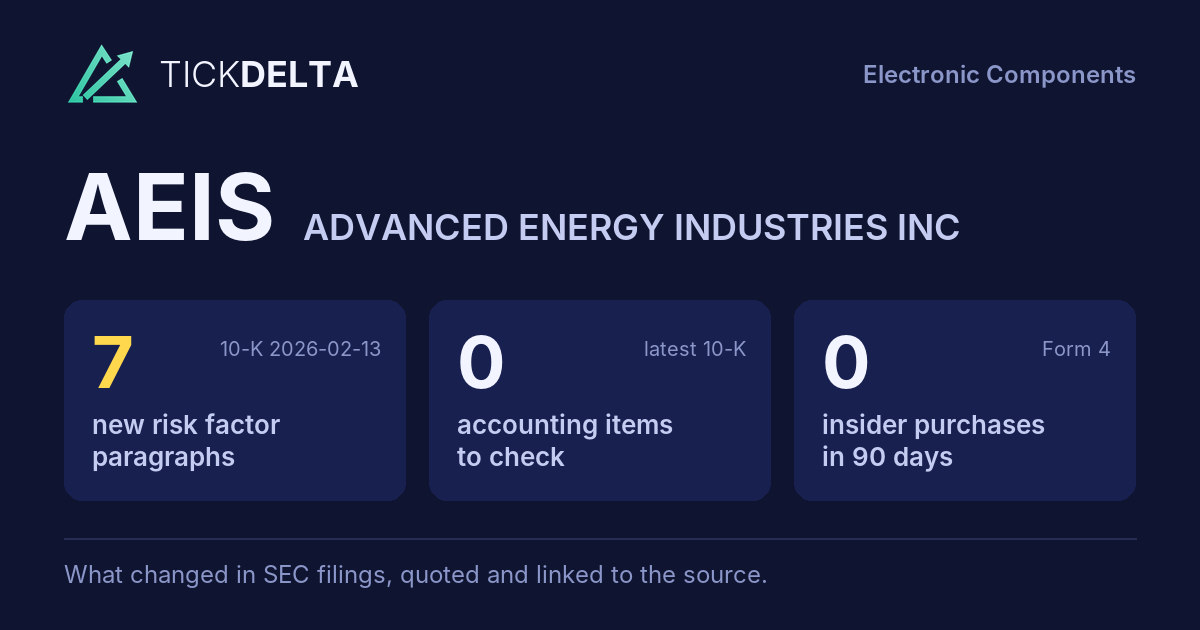
of the text changed · 9,894 words now · 7 new paragraphs, 3 gone
MD&A
38.2%
of the text changed · 5,400 words now · 22 new paragraphs, 17 gone
Legal Proceedings
23.5%
of the text changed · 168 words now
Accounting Policies
7.0%
of the text changed · 3,966 words now
10-K 0001104659-26-014731 (Feb 13, 2026) vs 10-K 0001558370-25-001038 (Feb 18, 2025)
Every paragraph, and how much of it changed
One bar per paragraph, in the order of the 10-K. Height and colour show the share of its words not in the closest paragraph a year earlier; the tallest bars are new paragraphs.
Risk Factors
123 paragraphs · 7 new · 45 reworded · 3 gone · 10-K Feb 13, 2026 against Feb 18, 2025
New paragraph
Reworded (5% of its words or more)
Same or nearly
Paragraph 100 · 32% changed
Every version of it
Our Credit Agreement, including the associated revolving line of credit, imposes financial covenants on us and our subsidiaries that require us to maintain a certain leverage ratio. The financial covenants place certain restrictions on our business that may affect our ability to execute our business strategy successfully or take other actions that we believe would be in the best interests of our Company. These include limitations or restrictions, among other things, on our ability and the ability of our subsidiaries to:
Paragraph 21 · 30% changed
Every version of it
Consistent with prior years, a limited number of customers accounted for a significant portion of our business, revenue and accounts receivable. receivable in 2025. A significant decline in revenue from these or our other large customers, the loss of these or other large customers, or any inability to collect from large customers could materially and adversely impact our business, results of operations, and financial condition. The mix of products sold to our customers, particularly our large customers, may also impact our financial performance. For example, our Data Center Computing market generally has lower margins than our other markets. As Data Center Computing grows to comprise a larger proportion of our revenue, gross margin has been and could continue to be negatively impacted.
Paragraph 92 · 27% changed
Every version of it
Paragraph 24 · 23% changed
Every version of it
As part of our day-to-day business, we process, transmit and store our own confidential data and certain data about our customers and employees in our global information technology system. We are subject to ongoing data security threats, including phishing attempts, denial of service attacks, ransomware, viruses, and other malware, employee error or malfeasance, theft, natural disasters, and hardware or software malfunctions, any one of which could compromise our data security, cause the loss of critical data, or disrupt operations, which could materially adversely affect our business and results of operations. Additionally, third parties may attempt to fraudulently induce employees or customers into disclosing sensitive information such as usernames, passwords, or other information to gain access to our customers’ data or our data or our information technology systems. We and our third party providers have experienced, and expect to continue to experience, cybersecurity events or from external actors and confidential information theft incidents, from internal actors, some of which could be devastating. We continue to devote significant resources to cybersecurity, IP protection, data encryption, and other measures to protect our systems and data from unauthorized external access or internal misuse, and we may be required to expend greater resources in the future for cybersecurity protection, compliance, and remediation, especially in the face of continuously evolving and increasingly sophisticated cybersecurity threats and privacy and data protection laws.
Paragraph 101 · 22% changed
Every version of it
Paragraph 51 · 20% changed
Every version of it
our ability to effectively manage hire, manage, and retain our employees at remote locations who are operating in different business environments from the United States;
Paragraph 71 · 20% changed
Every version of it
Since October 2022, we have been particularly affected by U.S. government-imposed export regulations on U.S. semiconductor and supercomputing technology and related parts and services sold in China. Over the past few years, the U.S. government has introduced several additional regulatory changes that impose extensive restrictions and compliance obligations, and As a result, Chinese customers may replace replaced us at least in part with competitors who are not subject to operate outside the scope of U.S. export rules. Additionally, our ability to maintain business in China may be dependent at least in part on obtaining export licenses. Obtaining export licenses may be difficult, costly, and time-consuming, and there is no assurance we will be issued licenses in time to meet customer requirements or at all.
Paragraph 13 · 40% changed
Every version of it
10-K Feb 18, 2025In recent years, there was a shortage of critical components caused by a variety of factors, including increased demand for electronic components used in a wide variety of industries, the pandemic-driven rise in consumer demand for technology goods, logistics-related disruptions in shipping, capacity limitations at some suppliers, and labor shortages. These supply constraints led to longer lead times in procuring materials and subcomponents and, in some cases, meaningfully higher costs for the subcomponents. Our revenues, earnings, and cash flow may be adversely impacted if these conditions reoccur.
10-K Feb 13, 2026
Finally, if shortages of critical components or supply constraints were to reoccur, we could again experience the longer lead times in procuring materials and subcomponents and, in some cases, meaningfully higher costs for the subcomponents that we faced in the wake of the pandemic. Our revenues, earnings, and cash flow may be adversely impacted if these conditions reoccur.
Paragraph 100 · 32% changed
Every version of it
10-K Feb 18, 2025
Our Credit Agreement, including the associated revolving line of credit, imposes financial covenants on us and our subsidiaries that require us to maintain a certain leverage ratio. The financial covenants place certain restrictions on our business that may affect our ability to execute our business strategy successfully or take other actions that we believe would be in the best interests of our Company. These include limitations or restrictions, among other things, on our ability and the ability of our subsidiaries to:
10-K Feb 13, 2026
Our Credit Agreement, including the associated revolving line of credit, imposes financial covenants on us and our subsidiaries that require us to maintain a certain leverage ratio. The financial covenants place certain restrictions on
Paragraph 21 · 30% changed
Every version of it
10-K Feb 18, 2025
Consistent with prior years, a limited number of customers accounted for a significant portion of our business, revenue and accounts receivable. A significant decline in revenue from these or our other large customers, the loss of these or other large customers, or any inability to collect from large customers could materially and adversely impact our business, results of operations, and financial condition.
10-K Feb 13, 2026
Consistent with prior years, a limited number of customers accounted for a significant portion of our business, revenue and accounts receivable in 2025. A significant decline in revenue from these or our other large customers, the loss of these or other large customers, or any inability to collect from large customers could materially and adversely impact our business, results of operations, and financial condition. The mix of products sold to our customers, particularly our large customers, may also impact our financial performance. For example, our Data Center Computing market generally has lower margins than our other markets. As Data Center Computing grows to comprise a larger proportion of our revenue, gross margin has been and could continue to be negatively impacted.
Paragraph 92 · 27% changed
Every version of it
10-K Feb 18, 2025increased costs to maintain compliance with the quality systems and other regulations and requirements that apply to the acquired business. Compliance with future regulations, directives, and standards could require us to modify or redesign some products, make capital expenditures, or incur substantial costs. Also, we may incur significant costs in complying with the numerous imports, exports, and customs regulations as we seek to sell our products internationally. If we do not comply with current or future regulations, directives, and standards:
10-K Feb 13, 2026
acquired business. Compliance with future regulations, directives, and standards could require us to modify or redesign some products, make capital expenditures, or incur substantial costs. Also, we may incur significant costs in complying with the numerous imports, exports, and customs regulations as we seek to sell our products internationally. If we do not comply with current or future regulations, directives, and standards, we could be subject to fines and penalties, our production or shipments could be suspended, and we could be prohibited from offering particular products in specified markets. If we were unable to comply with current or future regulations, directives and standards, our business, financial condition, and results of operations could be materially and adversely affected.
Paragraph 24 · 23% changed
Every version of it
10-K Feb 18, 2025
affect our business and results of operations. Additionally, third parties may attempt to fraudulently induce employees or customers into disclosing sensitive information such as usernames, passwords, or other information to gain access to our customers’ data or our data or our information technology systems. We and our third party providers have experienced, and expect to continue to experience, cybersecurity events or confidential information theft incidents, some of which could be devastating. We continue to devote significant resources to cybersecurity, IP protection, data encryption, and other measures to protect our systems and data from unauthorized external access or internal misuse, and we may be required to expend greater resources in the future for cybersecurity protection, compliance, and remediation, especially in the face of continuously evolving and increasingly sophisticated cybersecurity threats and privacy and data protection laws.
10-K Feb 13, 2026
As part of our day-to-day business, we process, transmit and store our own confidential data and certain data about our customers and employees in our global information technology system. We are subject to ongoing data security threats, including phishing attempts, denial of service attacks, ransomware, viruses, and other malware, employee error or malfeasance, theft, natural disasters, and hardware or software malfunctions, any one of which could compromise our data security, cause the loss of critical data, or disrupt operations, which could materially adversely affect our business and results of operations. Additionally, third parties may attempt to fraudulently induce employees or customers into disclosing sensitive information such as usernames, passwords, or other information to gain access to our customers’ data or our data or our information technology systems. We and our third party providers have experienced, and expect to continue to experience, cybersecurity events from external actors and confidential information theft from internal actors, some of which could be devastating. We continue to devote significant resources to cybersecurity, IP protection, data encryption, and other measures to protect our systems and data from unauthorized external access or internal misuse, and we may be required to expend greater resources in the future for cybersecurity protection, compliance, and remediation, especially in the face of continuously evolving and increasingly sophisticated cybersecurity threats and privacy and data protection laws.
Paragraph 101 · 22% changed
Every version of it
10-K Feb 18, 2025Our Credit Agreement, including the associated revolving line of credit, imposes financial covenants on us and our subsidiaries that require us to maintain a certain leverage ratio. The financial covenants place certain restrictions on our business that may affect our ability to execute our business strategy successfully or take other actions that we believe would be in the best interests of our Company. These include limitations or restrictions, among other things, on our ability and the ability of our subsidiaries to:
10-K Feb 13, 2026
our business that may affect our ability to execute our business strategy successfully or take other actions that we believe would be in the best interests of our Company. These include limitations or restrictions, among other things, on our ability and the ability of our subsidiaries to:
Paragraph 51 · 20% changed
Every version of it
10-K Feb 18, 2025
our ability to effectively manage our employees at remote locations who are operating in different business environments from the United States;
10-K Feb 13, 2026
our ability to effectively hire, manage, and retain our employees at locations operating in different business environments from the United States;
Paragraph 71 · 20% changed
Every version of it
10-K Feb 18, 2025
Since October 2022, we have been particularly affected by U.S. government-imposed export regulations on U.S. semiconductor and supercomputing technology and related parts and services sold in China. Over the past few years, the U.S. government has introduced several additional regulatory changes that impose extensive restrictions and compliance obligations, and Chinese customers may replace us with competitors who are not subject to U.S. export rules. Additionally, our ability to maintain business in China may be dependent at least in part on obtaining export licenses. Obtaining export licenses may be difficult, costly, and time-consuming, and there is no assurance we will be issued licenses in time to meet customer requirements or at all.
10-K Feb 13, 2026
Since October 2022, we have been particularly affected by U.S. government-imposed export regulations on U.S. semiconductor and supercomputing technology and related parts and services sold in China. As a result, Chinese customers replaced us at least in part with competitors operate outside the scope of U.S. export rules. Additionally, our ability to maintain business in China may be dependent at least in part on obtaining export licenses. Obtaining export licenses may be difficult, costly, and time-consuming, and there is no assurance we will be issued licenses in time to meet customer requirements or at all.
MD&A
77 paragraphs · 22 new · 31 reworded · 17 gone · 10-K Feb 13, 2026 against Feb 18, 2025
New paragraph
Reworded (5% of its words or more)
Same or nearly
Paragraph 64 · 48% changed
Net cash from operating activities from continuing operations was $132.9 $234.7 million, a decrease an increase of $80.0 $101.7 million, compared to $212.9 $133.0 million in the prior year. The decrease increase was primarily due to lower higher net income from continuing operations, primarily due to a decline operations driven by growth in revenue. the Data Center Computing and Semiconductor Equipment markets. Additionally, during the current year, we had a significant use of cash for inventories due to a strategic inventory buildup. In addition, we had net cash usage related to unfavorable changes in working capital from accounts payable, accrued expenses, restructuring payments, receivable, inventories, and other liabilities. assets which was partially offset by timing of payments.
Paragraph 44 · 44% changed
As of January 1, 2024, December 31, 2025, certain countries in which the Company operates have implemented or are in the process of implementing the Pillar II minimum global effective tax rate of 15% enacted regime as put forth by the Organization for Economic Cooperation and Development (“OECD”) was effectuated. More than 140 (“OECD”). Specifically, the OECD released prospective “Side-by-Side” guidance in early 2026 which is generally beneficial to U.S. parented organizations, but will require adoption by member countries agreed to enact the Pillar II global minimum tax. However, the timing of the implementation for each country varies. For the year ended December 31, 2024, we included an estimate of global minimum tax liability as a result of those countries where we conduct business that have adopted Pillar II. implement. As countries continue to make revisions to their legislation and release additional guidance with respect to the global minimum tax, we continue to determine any potential cash tax expense and tax rate impact in the countries in which we operate. The impact of these changes may have a material impact on our cash tax expense and tax rate.
Paragraph 10 · 43% changed
Paragraph 32 · 41% changed
The decrease increase in gross profit was largely due to the decline increase in revenue, partially offset by reduction in revenue and manufacturing expenses. cost improvements. Gross margin declined improved mainly due to the impact of lower higher volume, largely offset by lower manufacturing, material, and other costs of 170 approximately 140 basis points and favorable mix of 150 basis points. resulting from manufacturing cost reduction programs.
Paragraph 7 · 40% changed
In 2024, 2025, we increased gross margin and gross profit largely as a result of executing our manufacturing cost improvement program and higher revenue. We reported higher operating expenses of $492.7 $509.4 million, an increase of $14.0 $16.7 million from 2024 primarily attributable to higher stock-based compensation expense, higher research and development (“R&D”) program costs, higher restructuring charges from initiatives focused on optimizing manufacturing compensation costs related to stock-based compensation and support operations, annual merit increases, partially offset by a general workforce reduction to align to lower restructuring charges driven by the timing of our revenue levels. The restructuring actions should largely be completed in 2026 and are expected to enable a more efficient and cost-effective operating structure. plan decisions.
Paragraph 28 · 37% changed
Sales in the Semiconductor Equipment market increased $48.8 $47.4 million, or 6.6%, 6.0%, to $792.6 $839.9 million, as compared to $743.8 $792.5 million in the prior year. The increase was primarily due to improved increased demand as we emerge for platforms used in leading-edge process tools and incremental revenue generated from the cyclical trough new products in 2023. this market, partially offset by lower trailing-edge logic demand.
Paragraph 51 · 36% changed
Reconciliation of non-GAAP measure Year Ended December 31, Non-GAAP provision for income taxes 2025 2024 (in millions) Provision (benefit) for income taxes, as reported $ 19.4 $ (3.9) Adjustment: Non-GAAP items and other discrete tax items excluding stock-based compensation 14.0 19.6 Tax effect of stock-based compensation 11.7 9.6 Non-GAAP provision for income taxes $ 45.1 $ 25.3 Reconciliation of non-GAAP measure Years Year Ended December 31, Non-GAAP income before income taxes 2025 2024 (in millions) Income from continuing operations, excluding certain items 2024 2023 (in thousands) Income from continuing operations, less non-controlling interest, net of before income tax $ 56,306 168.7 $ 130,749 52.4 Adjustments: Amortization of intangible assets 26,046 28,254 22.1 26.0 Stock-based compensation 55.7 45.9 Acquisition-related costs 5,952 4,264 Facility expansion, relocation costs, 5.8 6.0 Facility, infrastructure, and other 5,643 2,523 transition costs 19.9 5.7 Restructuring, asset impairments, and other charges 30,318 26,977 12.5 30.3 Unrealized foreign currency gain loss (gain) (3,512) (89) 5.2 (3.4) Other costs included in other income (expense), expense, net 2,812 0.2 (1,516) Tax effect of non-GAAP adjustments, including certain discrete 2.8 Non-GAAP income before income taxes $ 290.1 $ 165.7 Effective tax benefits (19,563) (31,303) Non-GAAP income, net of income tax, excluding stock-based compensation 104,002 159,859 Stock-based compensation, net of tax 36,292 24,181 Non-GAAP income, net of income tax $ 140,294 $ 184,040 rate, as reported 11.5% (7.4)% Non-GAAP effective tax rate 15.5% Years Ended December 31, Weighted-average common shares 2024 2023 (in thousands) Diluted weighted-average common shares outstanding 37,839 37,750 15.3%
Paragraph 40 · 35% changed
Other expense, net was $2.0 $9.2 million in 2024, 2025, as compared to $1.8 $2.0 million of expense in the prior year. Other expense, net consists primarily of foreign exchange gains and losses and other miscellaneous items. We had During 2025, we recorded a $9.7 million increase in unrealized foreign exchange losses during the year 2024 compared to unrealized gains in losses, while the prior year. Additionally, in 2024, we incurred costs associated with year included $3.0 million of expense related to nonrecurring foreign currency translation adjustments. These prior-year adjustments related to liquidated the liquidation of certain foreign operations and as well as the write-off of debt discount and fees associated with the early repayment of our Term Loan Facility prepayment. There were no such costs during the same periods prior senior unsecured term loan facility. See Note 7. Long-Term Debt in the prior year. Part II, Item 8 “Financial Statements and Supplementary Data” for information regarding our debt.
Paragraph 64 · 48% changed
10-K Feb 18, 2025
Net cash from operating activities from continuing operations was $132.9 million, a decrease of $80.0 million, compared to $212.9 million in the prior year. The decrease was primarily due to lower net income from continuing operations, primarily due to a decline in revenue. Additionally, during the current year, we had a significant use of cash for inventories due to a strategic inventory buildup. In addition, we had net cash usage related to accounts payable, accrued expenses, restructuring payments, and other liabilities.
10-K Feb 13, 2026
Net cash from operating activities from continuing operations was $234.7 million, an increase of $101.7 million, compared to $133.0 million in the prior year. The increase was primarily due to higher net income from continuing operations driven by growth in the Data Center Computing and Semiconductor Equipment markets. Additionally, we had unfavorable changes in working capital from accounts receivable, inventories, and other assets which was partially offset by timing of payments.
Paragraph 44 · 44% changed
10-K Feb 18, 2025
As of January 1, 2024, the Pillar II minimum global effective tax rate of 15% enacted by the Organization for Economic Cooperation and Development (“OECD”) was effectuated. More than 140 countries agreed to enact the Pillar II global minimum tax. However, the timing of the implementation for each country varies. For the year ended December 31, 2024, we included an estimate of global minimum tax liability as a result of those countries where we conduct business that have adopted Pillar II. As countries continue to make revisions to their legislation and release additional guidance with respect to the global minimum tax, we continue to determine any potential impact in the countries in which we operate. The impact of these changes may have a material impact on our cash tax expense and tax rate.
10-K Feb 13, 2026
As of December 31, 2025, certain countries in which the Company operates have implemented or are in the process of implementing the Pillar II minimum global effective tax rate regime as put forth by the Organization for Economic Cooperation and Development (“OECD”). Specifically, the OECD released prospective “Side-by-Side” guidance in early 2026 which is generally beneficial to U.S. parented organizations, but will require adoption by member countries to implement. As countries continue to make revisions to their legislation and release additional guidance with respect to the global minimum tax, we continue to determine any potential cash tax expense and tax rate impact in the countries in which we operate.
Paragraph 10 · 43% changed
10-K Feb 18, 2025In the third quarter of 2024, we entered into an amendment to the Credit Agreement to increase the capacity on the Revolving Facility from $200.0 million to $600.0 million. This amendment was in connection with the concurrent prepayment, using existing cash on hand, of the full $345.0 million outstanding principal balance under our Term Loan Facility. See Note 18. Long-Term Debt in Part II, Item 8 “Financial Statements and Supplementary Data” and Liquidity and Capital Resources below.
10-K Feb 13, 2026
During the second quarter of 2025, we terminated our prior credit agreement, dated as of September 10, 2019 (and subsequently amended) and entered into a new credit agreement consisting of a senior unsecured term loan and a senior unsecured revolving facility, both maturing on May 8, 2030. See Note 7. Long-Term Debt in Part II, Item 8 “Financial Statements and Supplementary Data” and Liquidity and Capital Resources below.
Paragraph 32 · 41% changed
10-K Feb 18, 2025
The decrease in gross profit was largely due to the decline in revenue, partially offset by reduction in manufacturing expenses. Gross margin declined mainly due to the impact of lower volume, largely offset by lower manufacturing, material, and other costs of 170 basis points and favorable mix of 150 basis points.
10-K Feb 13, 2026
The increase in gross profit was largely due to increase in revenue and manufacturing cost improvements. Gross margin improved mainly due to the impact of higher volume, and approximately 140 basis points resulting from manufacturing cost reduction programs.
Paragraph 7 · 40% changed
10-K Feb 18, 2025
In 2024, we reported higher operating expenses of $492.7 million, an increase of $14.0 million primarily attributable to higher stock-based compensation expense, higher research and development (“R&D”) program costs, higher restructuring charges from initiatives focused on optimizing manufacturing and support operations, partially offset by a general workforce reduction to align to our revenue levels. The restructuring actions should largely be completed in 2026 and are expected to enable a more efficient and cost-effective operating structure.
10-K Feb 13, 2026
In 2025, we increased gross margin and gross profit largely as a result of executing our manufacturing cost improvement program and higher revenue. We reported higher operating expenses of $509.4 million, an increase of $16.7 million from 2024 primarily attributable to higher research and development program costs, higher compensation costs related to stock-based compensation and annual merit increases, partially offset by lower restructuring charges driven by the timing of our restructuring plan decisions.
Paragraph 28 · 37% changed
10-K Feb 18, 2025
Sales in the Semiconductor Equipment market increased $48.8 million, or 6.6%, to $792.6 million, as compared to $743.8 million in the prior year. The increase was primarily due to improved demand as we emerge from the cyclical trough in 2023.
10-K Feb 13, 2026
Sales in the Semiconductor Equipment market increased $47.4 million, or 6.0%, to $839.9 million, as compared to $792.5 million in the prior year. The increase was primarily due to increased demand for platforms used in leading-edge process tools and incremental revenue generated from new products in this market, partially offset by lower trailing-edge logic demand.
Paragraph 51 · 36% changed
10-K Feb 18, 2025
Reconciliation of non-GAAP measure Years Ended December 31, Income from continuing operations, excluding certain items 2024 2023 (in thousands) Income from continuing operations, less non-controlling interest, net of income tax $ 56,306 $ 130,749 Adjustments: Amortization of intangible assets 26,046 28,254 Acquisition-related costs 5,952 4,264 Facility expansion, relocation costs, and other 5,643 2,523 Restructuring, asset impairments, and other charges 30,318 26,977 Unrealized foreign currency gain (3,512) (89) Other costs included in other income (expense), net 2,812 (1,516) Tax effect of non-GAAP adjustments, including certain discrete tax benefits (19,563) (31,303) Non-GAAP income, net of income tax, excluding stock-based compensation 104,002 159,859 Stock-based compensation, net of tax 36,292 24,181 Non-GAAP income, net of income tax $ 140,294 $ 184,040 Years Ended December 31, Weighted-average common shares 2024 2023 (in thousands) Diluted weighted-average common shares outstanding 37,839 37,750
10-K Feb 13, 2026
Reconciliation of non-GAAP measure Year Ended December 31, Non-GAAP provision for income taxes 2025 2024 (in millions) Provision (benefit) for income taxes, as reported $ 19.4 $ (3.9) Adjustment: Non-GAAP items and other discrete tax items excluding stock-based compensation 14.0 19.6 Tax effect of stock-based compensation 11.7 9.6 Non-GAAP provision for income taxes $ 45.1 $ 25.3 Reconciliation of non-GAAP measure Year Ended December 31, Non-GAAP income before income taxes 2025 2024 (in millions) Income from continuing operations, before income tax $ 168.7 $ 52.4 Adjustments: Amortization of intangible assets 22.1 26.0 Stock-based compensation 55.7 45.9 Acquisition-related costs 5.8 6.0 Facility, infrastructure, and other transition costs 19.9 5.7 Restructuring, asset impairments, and other charges 12.5 30.3 Unrealized foreign currency loss (gain) 5.2 (3.4) Other costs included in other expense, net 0.2 2.8 Non-GAAP income before income taxes $ 290.1 $ 165.7 Effective tax rate, as reported 11.5% (7.4)% Non-GAAP effective tax rate 15.5% 15.3%
Paragraph 40 · 35% changed
10-K Feb 18, 2025
Other expense, net was $2.0 million in 2024, as compared to $1.8 million of expense in the prior year. Other expense, net consists primarily of foreign exchange gains and losses and other miscellaneous items. We had unrealized foreign exchange losses during the year 2024 compared to unrealized gains in the prior year. Additionally, in 2024, we incurred costs associated with foreign currency translation adjustments related to liquidated foreign operations and debt discount and fees associated with our Term Loan Facility prepayment. There were no such costs during the same periods in the prior year.
10-K Feb 13, 2026
Other expense, net was $9.2 million in 2025, as compared to $2.0 million of expense in the prior year. Other expense, net consists primarily of foreign exchange gains and losses and other miscellaneous items. During 2025, we recorded a $9.7 million increase in unrealized foreign exchange losses, while the prior year included $3.0 million of expense related to nonrecurring foreign currency translation adjustments. These prior-year adjustments related to the liquidation of certain foreign operations as well as the write-off of debt discount fees associated with the early repayment of our prior senior unsecured term loan facility. See Note 7. Long-Term Debt in Part II, Item 8 “Financial Statements and Supplementary Data” for information regarding our debt.
A paragraph is matched with the one last year that shares the most of its words; under half in common makes it new. The paragraphs shown are the 8 reworded the most in each section.
The paragraph that changed most in each section
The redline
Marked against last year's 10-K: cut words struck through, new words highlighted.
MD&A182 words changed in this paragraph; it is 57% similar to last year's version.
Reconciliation of non-GAAP measure measures Operating expenses and Non-GAAP gross profit, gross margin, operating income from continuing expenses, Years Ended December 31, operations, excluding certain items operating income, and operating margin 2025 2024 2023 (in thousands) millions) Gross profit from continuing operations, as reported $ 529,343 677.4 $ 592,398 529.3 Adjustments to gross profit: Stock-based compensation 3,994 2,059 Facility expansion, relocation costs 4.9 4.0 Facility, infrastructure, and other 4,421 2,334 Acquisition-related transition costs (13) 14.7 238 4.5 Non-GAAP gross profit 537,745 597,029 697.0 537.8 GAAP gross margin 37.7% 35.7% Non-GAAP gross margin 38.7% 36.3% 36.1% Operating expenses from continuing operations, as reported 492,736 478,704 509.4 492.7 Adjustments: Amortization of intangible assets (26,046) (28,254) (22.1) (26.0) Stock-based compensation (41,946) (28,942) (50.8) (41.9) Acquisition-related costs (5,965) (4,026) Facility expansion, relocation costs (5.8) (6.0) Facility, infrastructure, and other (1,222) (189) transition costs (5.2) (1.2) Restructuring, asset impairments, and other charges (30,318) (26,977) (12.5) (30.3) Non-GAAP operating expenses 387,239 390,316 413.0 387.3 Non-GAAP operating income $ 150,506 284.0 $ 206,713 150.5 Operating income, as reported $ 168.0 $ 36.6 Adjustments to gross profit 19.6 8.5 Adjustments to operating expenses 96.4 105.4 Non-GAAP operating income $ 284.0 $ 150.5 Income from continuing operations, as reported GAAP operating margin 9.3% 2.5% Non-GAAP operating margin 15.8% 10.2% 12.5%
Source: Item 7, 10-K 0001104659-26-014731 vs Item 7, 10-K 0001558370-25-001038
Risk Factors104 words changed in this paragraph; it is 37% similar to last year's version.
Source: Item 1A, 10-K 0001104659-26-014731 vs Item 1A, 10-K 0001558370-25-001038
Accounting Policies103 words changed in this paragraph; it is 31% similar to last year's version.
In November 2023, July 2025, the FASB issued ASU 2023-07 “Segment Reporting 2025-05 “Financial Instruments - Credit Losses (Topic 280) Improvements 326): Measurement of Credit Losses for Accounts Receivable and Contract Assets.” ASU 2025-05 permits the use of certain estimates and assumptions in developing forecasts used for determining expected credit losses on accounts receivable. This guidance will be effective for us on January 1, 2026. We do not expect the above guidance to Reportable Segment Disclosures.” The amendments in ASU 2023-07 expand disclosure requirements. In addition, the ASU enhances interim disclosures, clarifies circumstances in which an entity can disclose multiple segment measures of profit or loss, and provides new disclosures requirements for entities with a single reportable segment. We adopted this guidance on December 31, 2024, and it was not material to materially impact our consolidated financial statements.
Source: Item 8, Note 1 – SUMMARY OF OPERATIONS AND SIGNIFICANT ACCOUNTING POLICIES AND ESTIMATES, 10-K 0001104659-26-014731 vs Item 8, Note 1 – SUMMARY OF OPERATIONS AND SIGNIFICANT ACCOUNTING POLICIES AND ESTIMATES, 10-K 0001558370-25-001038
Sentences and paragraphs added, removed or reworded
Every change, by type
Sentences and paragraphs of AEIS's Risk Factors and MD&A, 10-K Feb 13, 2026 against 10-K Feb 18, 2025. Each links to the text at sec.gov.
Quiet changes are sentences kept from last year with one to four words changed, at least one of them a hedge, a modal or a qualifier (may, could, will, not, significant, material…). A year or date rolling forward is not counted.
The full word list
adverse, adversely, all, although, anticipate, anticipates, any, approximately, believe, believes, can, cannot, certain, could, expect, expects, generally, however, if, intend, intends, largely, likely, many, material, materially, may, might, most, must, never, no, not, possible, primarily, probable, should, significant, significantly, some, substantial, substantially, unlikely, will, would
AddedRisk Factors
For example, infrastructure investments in artificial intelligence (“AI”) have increased substantially, which is driving significant demand increases in the Data Center Computing market. We accelerated investments to increase capacity and make upgrades to support higher demand and new product requirements in the market, but if we are unable to timely or efficiently scale to meet growing demand or if we have not accurately assessed the magnitude or sustainability of such demand, our results of operations could be adversely impacted.
Read it in 10-K Feb 13, 2026 at sec.gov
AddedRisk Factors
We must scale our manufacturing capacity and secure sufficient critical components to meet customer demand.
Read it in 10-K Feb 13, 2026 at sec.gov
AddedRisk Factors
In 2025, the U.S. government imposed significant tariffs on imports from a wide range of countries, with further tariffs threatened. The tariffs were imposed under various rules including Section 301 (punitive duties imposed
Read it in 10-K Feb 13, 2026 at sec.gov
AddedRisk Factors
by on imported goods, primarily from China, to counter unfair trade practices like intellectual property theft and forced technology transfer), Section 232 (tariffs that aim to protect U.S. national security), and the International Emergency Economic Powers Act. We are also subject to anti-dumping and countervailing duty rates. In 2025, higher costs from tariffs partially offset benefits from cost optimization across our operations, and we expect this negative dynamic to continue. If we are unable to mitigate the impact of these and any additional tariffs or other import restrictions in future periods, we can expect our results of operations to be adversely affected.
Read it in 10-K Feb 13, 2026 at sec.gov
AddedRisk Factors
ESG compliance and reporting is costly, and we could be at a disadvantage compared to companies that do not have similar regulatory requirements, customer pressures, or that have more resources to devote to ESG efforts.
Read it in 10-K Feb 13, 2026 at sec.gov
AddedRisk Factors
One of the conditional conversion features of the Convertible Notes was triggered as of December 31, 2025 due to the trading price of our common stock exceeding 130% of the Convertible Notes conversion price on at least 20 out of the 30 consecutive trading days prior to such date. As a result, the Convertible Notes are currently convertible at the option of the holders, in whole or in part, until March 31, 2026, and may in the future continue to be convertible at the option of the holders during specified periods in the event the current conversion features or any additional conditional conversion features of the Convertible Notes are triggered. If one or more holders elect to convert, we would be required
Read it in 10-K Feb 13, 2026 at sec.gov
AddedRisk Factors
We are subject to counterparty default risk with respect to the Convertible Note Hedges.
Read it in 10-K Feb 13, 2026 at sec.gov
RemovedRisk Factors
Show the other 53
RemovedRisk Factors
RemovedRisk Factors
RewordedRisk Factors
RewordedRisk Factors
RewordedRisk Factors
Additionally, we are currently executing a restructuring plan to optimize and consolidate our manufacturing operations and improve operating efficiencies, and which we continue expect to evaluate our manufacturing facilities and may decide to conduct additional optimization and consolidation initiatives. be substantially complete during 2027.
Read it in 10-K Feb 13, 2026 at sec.gov
RewordedRisk Factors
RewordedRisk Factors
We continue to execute our pricing strategies and practices; however, we have in the past had to implement price increases and surcharges to reflect higher supply chain costs and any future price increases outside of our normal pricing strategy could make our products less competitive in the market over time and could have an adverse effect on our results of operations.
Read it in 10-K Feb 13, 2026 at sec.gov
RewordedRisk Factors
As governments impose greenhouse gas emission reporting requirements and climate risk assessment requirements, along with other ESG-related laws, or customers make ESG-related demands, we are subject to at least some of these rules and concomitant regulatory risk exposure. exposure, and the potential for regulatory scrutiny, enforcement actions, and reputational harm.
Read it in 10-K Feb 13, 2026 at sec.gov
RewordedRisk Factors
If we do not were unable to comply with current or future regulations, directives, directives and standards: standards, our business, financial condition, and results of operations could be materially and adversely affected.
Read it in 10-K Feb 13, 2026 at sec.gov
RewordedRisk Factors
RewordedRisk Factors
RewordedRisk Factors
Additionally, the Chinese government exercises substantial control over the Chinese economy, and our operations and supply chain in China may be subject to various government and regulatory interference. exercise preferential treatment of local companies.
Read it in 10-K Feb 13, 2026 at sec.gov
RewordedRisk Factors
RewordedRisk Factors
Policy changes, preferential treatment of local companies, changes or the imposition of new, stricter regulations or interpretations of existing regulations could require changes to our operating activities, increase our costs, costs or limit our ability to sell products in China. the Asia Pacific region.
Read it in 10-K Feb 13, 2026 at sec.gov
Quiet changesRisk Factors
These plans and any future initiatives initiatives, however, may or may not be ultimately successful in achieving our intended results.
Read it in 10-K Feb 13, 2026 at sec.gov
Quiet changesRisk Factors
The conditional conversion features of the Convertible Notes, if triggered, Notes may adversely affect our financial condition and operating results.
Read it in 10-K Feb 13, 2026 at sec.gov
AddedMD&A
Throughout 2025 we managed tariffs affecting AE announced by the U.S. government and continue to evaluate the impact of any additional tariffs or other trade policy measures on our supply chain or on our customers. While the tariff impact was not material to our results in 2025, the effects could be material in future periods as any further tariff, export control, trade restrictions, policy measures, and retaliatory responses to the U.S. trade policy announcements, or any related macroeconomic effects could adversely impact our product demand, production costs, or ability to sell our products and provide services.
Read it in 10-K Feb 13, 2026 at sec.gov
AddedMD&A
During 2025, we continued to execute the 2024 Plan. Manufacturing operations in Zhongshan ceased during the second quarter of 2025. Final site closure activities are in progress and are expected to conclude in 2026. During the second quarter of 2025, we also approved actions related to consolidating our research and development, sales, and administrative functions in connection with our manufacturing and footprint consolidation. We expect these actions to be substantially complete during 2027 and do not expect to incur significant additional charges. See Note 11. Restructuring, Asset Impairments, and Other Charges in Part II, Item 8 “Financial Statements and Supplementary Data.” We also continued progress on a new factory in Thailand.
Read it in 10-K Feb 13, 2026 at sec.gov
AddedMD&A
Advanced Energy generates revenue from the sale of a broad range of advanced and system power products and services to global original equipment manufacturers (“OEMs”), distributors, and end customers. Our customers select our products based on various performance metrics such as high power conversion efficiency, high power density, and low noise emission, and lower power consumption, as well as our ability to tailor our solutions to meet the unique requirements of their critical applications. The future growth and demand for our products is driven by a combination of factors within each of the end markets we serve, as follows:
Read it in 10-K Feb 13, 2026 at sec.gov
AddedMD&A
The Semiconductor Equipment market supports and enables the long-term need for production capacity and new process technologies to meet demand for semiconductor devices across many applications driven by megatrends such as artificial intelligence (“AI”), energy efficiency, automobile electrification, and Internet of things.
Read it in 10-K Feb 13, 2026 at sec.gov
AddedMD&A
Our portfolio of power conversion and related products sold into this market includes plasma power, high-voltage power, system power, and adjacent sensing solutions. Our plasma power solutions are used to create plasma-based etch and deposition processes. Our semiconductor market products are incorporated into a wide range of applications, including dry etch and strip, deposition, ion implant, inspection and metrology, thermal, epitaxy, and back-end test and packaging.
Read it in 10-K Feb 13, 2026 at sec.gov
AddedMD&A
In 2025, the Semiconductor Equipment market continued to be driven by demand for leading-edge devices in logic and memory used in AI applications, partially offset by lower trailing-edge logic demand due to capacity underutilization, particularly in China, U.S. export restrictions to China, and the impact of tariffs. However, end market conditions started to improve in the fourth quarter of 2025. We expect these improving conditions to continue into 2026 and to accelerate demand for our products in the second half of the year.
Read it in 10-K Feb 13, 2026 at sec.gov
AddedMD&A
The Data Center Computing market is being driven by the rapid growth of AI and related investments. The accelerated power rating of next-generation AI processors and increased density of AI processors in each IT rack have significantly increased the power requirements for AI-based servers and racks which, in turn, increased the importance of high power efficiency, density, and reliability for server rack power solutions.
Read it in 10-K Feb 13, 2026 at sec.gov
AddedMD&A
Our products are designed into data center server and storage systems and are also used by cloud service providers and their partners in their custom designed server racks and power shelves.
Read it in 10-K Feb 13, 2026 at sec.gov
AddedMD&A
Due to increased investments in AI applications by leading hyperscale customers, along with adoption of our next- generation high-power solutions, our revenue in the Data Center Computing market more than doubled in 2025.
Read it in 10-K Feb 13, 2026 at sec.gov
AddedMD&A
We expect continued investments and adoption of newer, higher power solutions for AI-related applications will continue to support robust demand in 2026.
Read it in 10-K Feb 13, 2026 at sec.gov
AddedMD&A
The Industrial and Medical market is fueled by continued investment in complex manufacturing processes, increased adoption of new industrial technologies such as automation and clean energy, and increased breadth and precision requirements of medical devices and life science equipment.
Read it in 10-K Feb 13, 2026 at sec.gov
AddedMD&A
We supply this market with critical, precision power conversion products that deliver precise and highly reliable, low noise and/or differentiated power. In addition, our sensing, control, and instrumentation products complement our power solutions. Our products are used in a wide variety of applications, such as advanced material fabrication, medical devices, life science, test and measurement equipment, robotics, industrial production, defense, aerospace, and large-scale lighting applications.
Read it in 10-K Feb 13, 2026 at sec.gov
RemovedMD&A
RemovedMD&A
RemovedMD&A
RemovedMD&A
RemovedMD&A
RemovedMD&A
RemovedMD&A
RemovedMD&A
RemovedMD&A
RemovedMD&A
RemovedMD&A
RemovedMD&A
RewordedMD&A
RewordedMD&A
As of January 1, 2024, December 31, 2025, certain countries in which the Company operates have implemented or are in the process of implementing the Pillar II minimum global effective tax rate of 15% enacted regime as put forth by the Organization for Economic Cooperation and Development (“OECD”) was effectuated. (“OECD”).
Read it in 10-K Feb 13, 2026 at sec.gov
RewordedMD&A
Our effective tax rates differ from the U.S. federal statutory rate of 21% for the years ended December 31, 2024 2025 and 2023, 2024, primarily due to valuation allowance releases partially offset by the impact of non-US tax law changes in 2025, and the intercompany transfer of intellectual property among certain of our subsidiaries in 2024 and a valuation allowance release in 2023. 2024.
Read it in 10-K Feb 13, 2026 at sec.gov
RewordedMD&A
The decrease increase was primarily due to lower higher net income from continuing operations, primarily due to a decline operations driven by growth in revenue. the Data Center Computing and Semiconductor Equipment markets.
Read it in 10-K Feb 13, 2026 at sec.gov
RewordedMD&A
The increase is related to higher compensation costs, related to stock-based compensation expense as well as and annual merit increases, and higher engineering program and materials costs compared to the prior year. costs.
Read it in 10-K Feb 13, 2026 at sec.gov
RewordedMD&A
The decrease increase in gross profit was largely due to the decline increase in revenue, partially offset by reduction in revenue and manufacturing expenses. cost improvements.
Read it in 10-K Feb 13, 2026 at sec.gov
RewordedMD&A
RewordedMD&A
Additionally, both 2025 and 2024 and 2023 included the benefit of earnings in foreign jurisdictions which are subject to lower tax rates, as well as tax credits, partially offset by net U.S. tax on foreign operations. operations and the net effect of Pillar II top-up taxes.
Read it in 10-K Feb 13, 2026 at sec.gov
RewordedMD&A
For the year ended December 31, 2024, 2025, our revenue was $1,482.0 $1,798.8 million, representing a decline an increase of 10.5% 21.4% as compared to 2023. 2024.
Read it in 10-K Feb 13, 2026 at sec.gov
RewordedMD&A
We believe our sources of liquidity will be adequate to meet operational needs, including capital expenditures, as well as anticipated debt service, share repurchase programs, dividends, and dividends. strategic investments.
Read it in 10-K Feb 13, 2026 at sec.gov
RewordedMD&A
Net cash from operating activities from continuing operations was $132.9 $234.7 million, a decrease an increase of $80.0 $101.7 million, compared to $212.9 $133.0 million in the prior year.
Read it in 10-K Feb 13, 2026 at sec.gov
RewordedMD&A
In 2024, we used existing cash on hand to make payments towards our Term Loan Facility prior senior unsecured term loan facility for $355.0 million, including $10.0 million in principal payment made in the first half of the year and the September prepayment of the remaining $345.0 million outstanding principal balance, and repurchased common stock for $1.8 million.
Read it in 10-K Feb 13, 2026 at sec.gov
Quiet changesMD&A
In addition, management’s incentive plans include certain of these non-GAAP measures as criteria for achievements.
Read it in 10-K Feb 13, 2026 at sec.gov
Sources
The two latest 10-Ks on EDGAR, section by section. Each change links to the text at sec.gov.
Also
New risk factors: paragraphs with nothing like them last year, quoted in full.
Work with it
Excel workbook · CSV. Google Sheet that stays up to date: paste =IMPORTDATA("https://tickdelta.com/company/AEIS/export.csv") into a cell.