Form 10-K
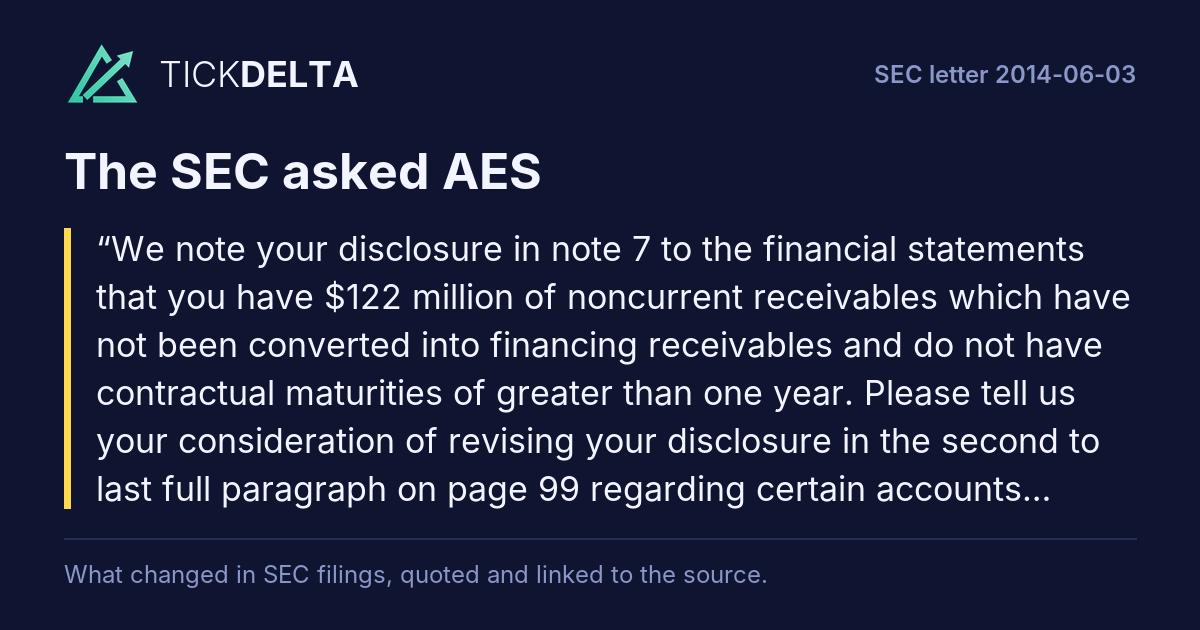
We note your disclosure in note 7 to the financial statements that you have $122 million of noncurrent receivables which have not been converted into financing receivables and do not have contractual maturities of greater than one year.Rest of the question
Please tell us your consideration of revising your disclosure in the second to last full paragraph on page 99 regarding certain accounts receivable classified as noncurrent to address the nature and terms of this $122 million in noncurrent receivables, including your assessment of any risk associated with collection of these receivables.
In response to the Staff’s Comment, the Company agrees that to the extent applicable, it will provide more specific disclosure regarding the noncurrent receivables which have not been converted into financing receivables and do not have contractual maturities greater than one year.
In the case of the $122 million of non-current receivables noted in the Staff’s comment, the Company notes that approximately $101 million of the receivables was expected to be contributed to finance construction of facilities in Argentina pursuant to the FONINVEMEM program in Argentina, while the remaining $21Read in the reply ↗Rest of the answer
million relates to the receivables to be contributed into new trusts to be set up by the Argentine government under Resolution 95. The Company has included disclosure regarding the FONINVEMEM program and Resolution 95 in the Form 10-K, including at Note 7—Long-Term Financing Receivables (incorporated by referenced in the second to last paragraph on page 99 that was noted in the Staff’s comment), Item 8- Financial Statements and Supplementary Data, and Item 1. – Business – Regulatory matters – Argentina.
As noted above, in future filings and to the extent applicable, the Company agrees that it will provide disclosure that will expand its current disclosure in Note 7 in a manner similar to the following:
“Excludes noncurrent receivables of $122 million and $120 million, respectively, as of December 31, 2013 and 2012, which have not been converted into financing receivables and do not have contractual maturities of greater than one year. Of the $122 million, approximately $101 million is expected to be contributed to a FONINVEMEM Agreement and approximately $21 million is expected to be contributed to a trust to be set up by the Argentine government as required by Resolution 95. Also, excludes the foreign currency-related embedded derivative assets associated with the financing receivables which had a fair value of $97 million and $69 million, respectively, as of December 31, 2013 and 2012.”
First report after the company's reply of 2014-06-17: 10-Q filed 2014-08-07 ↗, against the 10-Q filed 2014-05-08 ↗.
Tickdelta does not hold the text of both reports, so they are not compared here.
Please tell us your consideration of disclosing how you computed the proportional adjustment factor applied in arriving at proportional operating cash flow, proportional maintenance capital expenditures, net of reinsurance proceeds and proportional nonrecoverable environmental capital expenditures each period.Rest of the question
We believe this information is necessary to make the reconciliation to operating cash flows clearly understandable, as contemplated in Item 10(e)(1)(i)(b) of Regulation S-K. Please also tell us your consideration of disclosing this same information where you disclose proportional free cash flow in earnings releases furnished on Form 8-K.
As further described below, the Company agrees that it will provide additional disclosure explaining the computation of the proportional adjustment factor.
As background, the proportional adjustment factor is used to calculate AES’ ownership interest in the metric in question (e.g., proportional operating cash flow, proportional maintenance capital expenditures and proportional non-recoverable environmental capital expenditures).Read in the reply ↗Rest of the answer
In calculating the proportional adjustment factor, the Company simply takes the consolidated number and multiplies by the non-controlling interest for each consolidated subsidiary that is not wholly-owned. For example, the Company owns approximately 70% of AES Gener, its subsidiary in Chile. Assuming a consolidated net cash flow from operating activities of $100 from AES Gener, the proportional adjustment factor for AES Gener would equal approximately $30. The Company calculates the proportional adjustment factor for each consolidated business and adds these amounts together to calculate the total proportional adjustment factor used in the reconciliation. The proportional adjustment factor is then subtracted from consolidated net cash flow from operating activities to arrive at proportional operating cash flow, as presented in the Company’s reconciliation of this metric.
The Company notes that it currently includes the following disclosure in its description of the computation: “We define Proportional Free Cash Flow as cash flows from operating activities less maintenance capital expenditures (including non-recoverable environmental capital expenditures), adjusted for the estimated impact of non-controlling interests.” In future filings, the Company will add the following sentence after this disclosure: “The proportionate share of cash flows and related adjustments attributable to noncontrolling interests in our subsidiaries comprise the proportional adjustment factor presented in the reconciliation below.”
First report after the company's reply of 2014-06-17: 10-Q filed 2014-08-07 ↗, against the 10-Q filed 2014-05-08 ↗.
Tickdelta does not hold the text of both reports, so they are not compared here.
We note you include a schedule of capital expenditures with your presentations of non- GAAP financial measures in earnings releases furnished on Form 8-K. Please explain to us why the total capital expenditures per the tabular 8-K disclosure is higher than total capital expenditures in your Form 10-K and your consideration of providing a similar schedule here of capital expenditures reconciled to capitalRest of the question
expenditures disclosed in your statements of cash flows.
The Company reports capital expenditures in the following two lines in its statements of cash flows as required by ASC 230-10-45-13.c.: “Capital expenditures” and “Payments for financed capital expenditures.” The sum of these two lines equals the capital expenditures included in the Company’s earnings releases, as per the below table.
Consolidated Statements of Cash Flows:
2013
2012
Capital expenditures
$
1,988
2,108
Payments for financed capital expenditures
591
162
Total Capital Expenditures (per Earnings Release)
2,579
2,270
In response to the Staff’s comment, the CompanyRead in the reply ↗Rest of the answer
agrees that in future periodic filings, in the Proportional Free Cash Flow section of Management’s Discussion and Analysis of Financial Condition and Results of Operations, it will include a schedule similar to the one provided in the Company’s earnings press release.
First report after the company's reply of 2014-06-17: 10-Q filed 2014-08-07 ↗, against the 10-Q filed 2014-05-08 ↗.
Tickdelta does not hold the text of both reports, so they are not compared here.
Please refer to the last paragraph under this heading. You indicate that one or more of the subsidiaries currently in default could at some point in time fall within the definition of a “material subsidiary” and trigger an event of default and possible acceleration of the Parent Company’s outstanding debt securities.Rest of the question
Please tell us your consideration of describing what would constitute a “material subsidiary” to enable investors to better understand the risk of cross-default. Item 8. Financial Statements and Supplementary Data, page 114 Notes to Consolidated Financial Statements, page 120 8. Investments in and Advances to Affiliates, page 141
As noted in the Company’s Form 10-K, at this time there are no subsidiaries which meet the definition of “material subsidiary.” Nevertheless, in response to the Staff’s Comment, the Company agrees that in future filings, it will note that “material subsidiary” is defined in its senior secured revolving credit facility as any business that contributed 20% or more of the Parent Company’s total cash distributions from businesses for the four most recently completed fiscal quarters. Read in the reply ↗
First report after the company's reply of 2014-06-17: 10-Q filed 2014-08-07 ↗, against the 10-Q filed 2014-05-08 ↗.
Tickdelta does not hold the text of both reports, so they are not compared here.
We note your disclosure that the aggregate carrying amount of investments in equity affiliates exceeds the underlying equity in their net assets by $214 million at December 31, 2013. Please refer to ASC 323-10-50-3 and tell us your consideration of disclosing your accounting treatment for this difference.Rest of the question
In addition, we note that the carrying amount of investments in equity affiliates exceeded the underlying equity in their net assets by only $37 million at December 31, 2012. Please help us understand the cause of the increased difference between the carrying amount and underlying equity in net assets of equity affiliates during 2013. In this regard, we note that undistributed earnings of equity affiliates only increased $18 million in this same period, and there do not appear to be any significant new equity affiliates in 2013. 12. Debt, page 149
As contemplated by ASC 323-10-35, AES frequently has carrying amounts of investments in equity affiliates that exceed the underlying equity in their net assets because the Company acquires the investments after the inception of the affiliate and the fair value implied by the cost of investment is higher than the carrying amount of that proportion of the equity in net assets.
In responding to the Staff’s comment, the Company determined that the disclosure in its 2013 Form 10-K of the difference between the carrying amount of investments in equity affiliates and underlying equity in net assetsRead in the reply ↗Rest of the answer
of equity affiliates is correct. However, the comparable disclosure in the 2012 Form 10-K should have been $109 million instead of $37 million. The disclosure difference in the 2012 Form 10-K had no impact to amounts reported on AES’ consolidated balance sheets, consolidated statements of operations, consolidated statements of comprehensive income, consolidated statements of changes in equity or consolidated statements of cash flows as of and for the years ended December 31, 2013 and 2012. The Company determined this disclosure difference to be both quantitatively and qualitatively immaterial as it is not probable that the judgment of a reasonable person relying upon our financial statements would have been changed or influenced by the correction of the disclosure difference.
The 2013 to 2012 change in the difference between the carrying amount of investments in equity affiliates and underlying equity in net assets of equity affiliates is explained in the table below and related notes thereto:
(in millions)
Carrying
Amount of
Underlying
Equity
Investments in
Equity in
Change in
Affiliate
Equity Affiliates
Net Assets
Difference
Trinidad
-
(51
)
Entek
165
167
(2
234
286
(52
Guacolda
245
164
196
193
Others
600
465
135
742
605
137
1,010
796
214
1,196
1,159
177 a)
At December 31, 2012, the underlying equity in net assets of Trinidad was greater than the carrying amount of the investment in equity affiliate because the 90% majority partner in Trinidad Generation Unlimited contributed additional capital into Trinidad Generation Unlimited. The Company did not make a proportional contribution, which resulted in a $51 million difference between the Company’s carrying amount and the underlying equity in net assets of Trinidad Generation Unlimited. The Company sold its interest in Trinidad Generation Unlimited during the third quarter of 2013.
b)
A $37 million loan made by the Company to Entek (Turkey) to acquire a project was appropriately classified as a liability by Entek as of December 31, 2012. During 2013, this loan was converted into equity.
c)
For Guacolda and Entek, the underlying equity in net assets should have been $135 million and $272 million instead of $193 million and $286 million, respectively.
First report after the company's reply of 2014-06-17: 10-Q filed 2014-08-07 ↗, against the 10-Q filed 2014-05-08 ↗.
Tickdelta does not hold the text of both reports, so they are not compared here.
Please refer to Rule 4-08(e)(1) of Regulation S-X and tell us your consideration of disclosing the amount of retained earnings or net income restricted as to the payment of dividends. In this regard, we note your disclosure on page 152 that the senior secured credit facilities include limitations on restricted payments such as shareholder dividends. 14. Contingencies, page 153
There are no restrictions on the payment of dividends based on income or retained earnings tests in the Company’s outstanding debt covenants. However, in response to the Staff’s comment, the Company agrees that in future filings, it will include a statement clarifying that when not in compliance with the financial covenants of its senior secured revolving credit facility, restricted payments will be limited to regular quarterly shareholder dividends at the then prevailing rate.Read in the reply ↗Rest of the answer
The Company will also disclose that payment defaults and bankruptcy defaults also preclude the making of any restricted payments.
First report after the company's reply of 2014-06-17: 10-Q filed 2014-08-07 ↗, against the 10-Q filed 2014-05-08 ↗.
Tickdelta does not hold the text of both reports, so they are not compared here.
Please refer to ASC 450-20-50-1 and tell us your consideration of revising disclosures under the Environmental and Litigation subheadings to replace the term “reserves” with other terminology that is descriptive of the nature of the accrual, such as estimated liability.Rest of the question
Use of the term “reserves” may create confusion since accrual of a loss related to a contingency does not create or set aside funds to lessen the possible financial impact of a loss. Additionally, please tell us your consideration of discussing in the footnotes or Management’s Discussion and Analysis of Financial Condition and Results of Operations any significant changes in your contingency accrual, such as the $81 million reduction of the accrual during 2013. 17. Segments and Geographic Information, page 162
In response to the Staff’s comment, the Company agrees that beginning with the 2nd Quarter 2014 Form 10-Q, under the Environmental and Litigation subheadings, the Company will replace the terms “reserves” and “reserved” with descriptions contained in ASC 450-20, such as “estimated liability” or “accrual.”
The reduction in the contingency accrual during 2013 is principally due to foreign currency rate changes in Brazil of $27 million, the settlement and payment of liabilities that were less than the amount of the related contingency accrual of $30 million, and the reduction of accruedRead in the reply ↗Rest of the answer
liabilities when the likelihood of an unfavorable outcome was no longer probable of $10 million. In future filings, we will provide the detail of similar changes in the contingency accrual in the footnote on Contingencies to the extent material.
First report after the company's reply of 2014-06-17: 10-Q filed 2014-08-07 ↗, against the 10-Q filed 2014-05-08 ↗.
Tickdelta does not hold the text of both reports, so they are not compared here.
We note that you decreased from nine to six reportable segments in 2013 and as a result, the regulated utility operations are now aggregated with the non-regulated generation operations within each geographic region.Rest of the question
If you have determined that the regulated utility operations do not represent an operating segment or segments separate and distinct from unregulated generation activities within each region, and particularly in the US and Brazil, please tell us how you applied the guidance in ASC 280-10-50-1 through 9 in determining your operating segments. Alternatively, if operating segments have been aggregated in arriving at the revised reportable segments, please disclose this information pursuant to ASC 280-10-50-21.a. and tell us the basis for such aggregation considering all of the aggregation criteria in ASC 280-10-50-11. 18. Share-Based Compensation, page 165
During the fourth quarter of 2013 and in connection with the finalization of its revised internal reporting structure, the Company revised its internal reporting to align more closely with its operations. The Company’s management reporting structure is organized along six strategic business units (“SBUs”) — led by our Chief Executive Officer (“CEO”) who is also the Company’s Chief Operating Decision Maker (“CODM”).Read in the reply ↗Rest of the answer
Using the accounting guidance on segment reporting under ASC 280, the Company has determined that it has six operating segments corresponding to its six SBUs.
During the fourth quarter of 2012, under the direction of our new CEO, the Company initiated the process of redefining its operational management structure, which was reorganized along six geographic SBUs. During 2013, the CEO initiated changes to the way in which the company managed the business and the company continued to transition the SBUs under the new management regime. The changes took several months to implement and were completed in the fourth quarter of 2013 culminating with alignment of the internal reporting information provided to the CEO with the SBU management structure. At this time, the company also determined that the CODM consists solely of the CEO as opposed to the Executive Leadership Team (ELT) as the CEO has the ability to override the decisions made by the ELT.
In conjunction with the Company’s change in operating segments, the segment manager for the US SBU manages all of the businesses in the US SBU geographical area and the CEO/CODM now receives only financial information at the SBU level rather than by type of operation. The Company determined that the regulated utility operations do not represent an operating segment separate and distinct from unregulated generation activities within each region because, in accordance with ASC 280-10-50-1, the separate operating results of the regulated utility operations are no longer regularly reviewed by the CODM to make decisions about resources to be allocated to the utility operations and assess their performance.
The Company has elected to not aggregate any operating segments for the purposes of presenting its reportable segments.
Finally, it should be noted that the change in operating segments did not result in any changes to the Company’s reporting units under ASC 350.
First report after the company's reply of 2014-06-17: 10-Q filed 2014-08-07 ↗, against the 10-Q filed 2014-05-08 ↗.
Tickdelta does not hold the text of both reports, so they are not compared here.
We note you use the simplified method in determining the expected term for stock options granted. Please refer to SAB 110 and explain to us why your historical share option exercise experience does not provide a reasonable basis upon which to estimate expected term. 24. Acquisitions and Dispositions, page 177
The Company had used the simplified method for estimating the expected term of employee stock options as we had previously determined that we were unable to rely on historical data due to the significant changes in recent years in the types of employees eligible for stock option awards and therefore historical exercise data may no longer have provided a reasonable basis upon which to estimated expected term. Furthermore, alternative information, such as exercise data for employees of other companies, was not easily obtainable.Read in the reply ↗Rest of the answer
Notwithstanding these points, the Company performed a sensitivity analysis related to 2013 and determined that the stock option expense of approximately $1 million recognized in the year ended December 31, 2013 would not have been materially different had the simplified method not been used for estimating the expected term of employee stock options when measuring the related stock compensation expense. Nevertheless, in response to the Staff’s comment, the Company will use historical data when it can be relied upon as contemplated under SAB 110.
First report after the company's reply of 2014-06-17: 10-Q filed 2014-08-07 ↗, against the 10-Q filed 2014-05-08 ↗.
Tickdelta does not hold the text of both reports, so they are not compared here.
Please tell us in detail how you concluded that Cartagena should not be classified as discontinued operations upon the sale of your majority interest in this entity in 2012. In this regard, we note your disclosure that the results of Cartagena were not classified as discontinued operations due to the Company’s continued ownership interest, yet we note you only retained a 14% interest in Cartagena after the 2012Rest of the question
disposal. Additionally, please tell us whether you expected the counterparty to the sale transaction to exercise its option to purchase your remaining 14% interest when the option became exercisable one year and one month after the sale of your majority interest in Cartagena and how this provision of the sale agreement impacted your analysis as to whether classification as discontinued operation was required. Refer to ASC 205-20.
As disclosed in Note 24 to our 2012 consolidated financial statements, the Company sold 80% of its interest in the wholly-owned holding company that controls and consolidates Cartagena to GDF Suez in February 2012. Under the terms of the sale agreement, the Company maintained “significant influence” over the holding company as defined by ASC 323 through its representation on its board of directors and by having additional rights that limited the ability of GDF Suez to make unilateral changes to Cartagena.Read in the reply ↗Rest of the answer
The option granting GDF Suez the right to acquire the last 20% of the holding company could not be exercised until March 2013, which was longer than one year after the sale in February 2012. From the time of the sale until the exercise of the option in April of 2013 (14 months after the original sale), the Board structure and additional rights referenced above remained in place. As such, the Company continued to have significant continuing involvement in Cartagena for at least one year after it had disposed of its controlling financial interest, so the criterion necessary for discontinued operations treatment under ASC 205-20-45-1.b. (as interpreted by ASC 205-20-55-20) was not met (and there were no changes to prompt a reassessment under ASC 205-20-55-22).
We note your disclosure regarding your investments in Bulgaria and the numerous events, any of which could have a material impact on the Company. Please discuss and quantify, to the extent practical, the reasonably likely impact on your results of operations and financial condition of the February 2014 restructuring of NEK as well as Standard and Poor’s lowering of NEK’s credit rating.Rest of the question
Please also expand your disclosure to discuss if any impairment testing has been conducted, and if so, the results of the testing indicating the factors considered in concluding no adjustments to the assets were necessary.
The Company reviewed the guidance in ASC 360-10-35 and determined that there was no indicator of impairment as of March 31, 2014 as there was no reason to believe the carrying amount of the asset group was not recoverable from undiscounted cash flows. The Company determined that there may not be an impact on Maritza, as the power purchase agreement remained in place (as did the Government Support Letter issued in 2005), and Maritza had honored its obligations thereunder and believed that NEK would as well.Read in the reply ↗Rest of the answer
In addition, NEK remained current under the revised payment schedule noted in the disclosure. In accordance with the guidance in ASC 450-20, the Company concluded that the accounts receivables outstanding from NEK were probable of being fully collected as of March 31, 2014.
Although there was no financial statement impact resulting from events at Maritza, the Company nevertheless provided disclosure in accordance with Instruction 3 to Item 303(a) of Regulation S-K, which seeks disclosure on uncertainties which could cause reported financial information to differ from future operating results. With regard to quantification, the Company notes that neither the downgrade of NEK nor its restructuring by themselves result in economic harm to Maritza under its agreements (e.g., there is no increase in interest rate, penalties or costs that are quantifiable resulting from these events). Furthermore, the Company determined that future impacts could range from zero (as noted in the preceding paragraph) to total loss of the business (if NEK did not honor any obligations under the contract). Therefore, consistent with the Staff’s comment, the Company quantified the $185 million of receivables outstanding (including $19 million current, $45 million not yet due, and $121 million overdue by less than 90 days), the $1.7 billion of long-lived assets held at Maritza, the Company’s $749 million net equity at Maritza, the $820 million of debt in default at Maritza and the $330 million of damages sought by the contractor in the arbitration referenced in the disclosure. These amounts were included so that investors could understand the potential maximum exposure faced by the Company at Maritza.
In future filings, if events occur at Maritza that allow the Company to estimate the reasonably likely impact on AES’ results of operations or financial condition, the Company will update its disclosure accordingly and provide any disclosures that are warranted in the financial statements based on the guidance on ASC 275-10-50
* * *
The Company acknowledges that: (i) the Company is responsible for the adequacy and accuracy of the disclosure in its filings; (ii) Staff comments or changes to disclosure in response to Staff comments do not foreclose the Commission from taking any action with respect to the filings; and (iii) the Company may not assert Staff comments as a defense in any proceeding initiated by the Commission or any person under the federal securities laws of the United States.
First report after the company's reply of 2014-06-17: 10-Q filed 2014-08-07 ↗, against the 10-Q filed 2014-05-08 ↗.
Tickdelta does not hold the text of both reports, so they are not compared here.
We reviewed your response to comment 2 in our letter dated June 3, 2014 and we reissue the comment. In this regard, we don’t believe the additional disclosure you intend to provide in future filings clarifies sufficiently how you computed the proportional adjustment factor applied in arriving at proportional operating cash flow, proportional maintenance capital expenditures, net of reinsurance proceeds andRest of the question
proportional nonrecoverable environmental capital expenditures. Moreover, we note you have not addressed the last part of our comment regarding disclosures on Form 8-K. In responding to the comment, please help us understand why AES’ proportional interest in each metric in question is so much more significant than AES’ proportional interest in net income (loss) of the consolidated entity each period. For example, we note in the computation of fiscal 2013 proportional operating cash flow, the proportion of cash flow attributed to non-controlling interests appears to be 30%, whereas the proportion of consolidated net income attributed to non-controlling interests in fiscal 2013 was 79%.
As further described below, the Company agrees that it will provide additional disclosure explaining the computation of the proportional adjustment factor.
The Company notes that the difference between AES’ proportional interest in cash flow and AES’ proportional interest in consolidated net income (loss) has historically resulted principally from: (a) the impact of non-cash items (such as impairments) that have a significant impact on net income but no impact on cash flows, and (b) the Company’s ownership interest in the subsidiary where such non-cash items occur.Read in the reply ↗Rest of the answer
For example, in 2013 the Company reported $372 million of goodwill impairments, of which 100% is attributable to AES. These non-cash impairments have a significant impact on consolidated net income, but little to no impact on either net income attributable to non-controlling interests or the amount of operating cash flow attributable to non-controlling interests. Therefore, the proportion of consolidated net income attributable to non-controlling interests is higher than the proportion of cash flow attributable to non-controlling interests.
As shown in the following table, the principal difference between the 79% proportion of consolidated net income attributable to non-controlling interests and the 30% proportion of cash flow attributable to non-controlling interests results from non-cash items recognized in earnings principally at wholly-owned subsidiaries:
Income Statement Line Items
After-tax Amounts
(in millions)
2013 Net Income
$551
Add: Goodwill impairment
$372
Add: Loss on extinguishment of debt
$165
Add: Asset impairment expense
$66
2013 Adjusted Net Income
$1,154
Net Income attributable to non-controlling interests
$437
Proportional Interest in Adjusted Net Income (above)
38%
The remaining difference relates to other less significant non-cash items and the effects of insignificant non-controlling interests.
In response to the Staff’s comment, the Company agrees that in future filings where proportional metrics are used, the Company will expand its disclosure to further explain the proportional adjustment factor. In the case of proportional cash flow, the Company proposes the following disclosure: “The proportional adjustment factor is calculated by multiplying the percentage owned by non-controlling interests for each entity by its corresponding consolidated cash flow metric and adding up the resulting figures. For example, the Company owns approximately 70% of AES Gener, its subsidiary in Chile. Assuming a consolidated net cash flow from operating activities of $100 from AES Gener, the proportional adjustment factor for AES Gener would equal approximately $30 (or $100 x 30%). The Company calculates the proportional adjustment factor for each consolidated business in this manner and then adds these amounts together to determine the total proportional adjustment factor used in the reconciliation. The proportional adjustment factor may differ from the proportion of income attributable to non-controlling interests as a result of (a) non-cash items which impact income but not cash and (b) AES’ ownership interest in the subsidiary where such items occur.”
In the case of the other metrics noted in the Staff’s comment, similar disclosures will be included which are tailored to the metric in question. Furthermore, the above-referenced disclosures will be included in both the Company’s periodic filings and in earnings releases furnished on Form 8-K. In each case, the disclosures will be included where the Company provides its reconciliation as required by Item 10(e)(1)(i)(b) of Regulation S-K.
First report after the company's reply of 2014-07-18: 10-Q filed 2014-08-07 ↗, against the 10-Q filed 2014-05-08 ↗.
Tickdelta does not hold the text of both reports, so they are not compared here.
We note your response to comment 4 in our letter dated June 3, 2014 and the additional disclosure you intend to provide in future filings. Please tell us your consideration of disclosing further whether any subsidiary currently in default or all subsidiaries currently in default on an aggregate basis are presently at risk of triggering cross-default due to the proportion of the Parent Company’s total cashRest of the question
distributions contributed by these subsidiaries approaching the 20% materiality threshold in the credit agreement.
The Company agrees that in future filings, it will disclose whether any subsidiary currently in default or all subsidiaries currently in default on an aggregate basis are presently at risk of triggering cross-default due to the proportion of the Parent Company’s total cash distributions contributed by these subsidiaries approaching the 20% materiality threshold in the credit agreement. Read in the reply ↗
First report after the company's reply of 2014-07-18: 10-Q filed 2014-08-07 ↗, against the 10-Q filed 2014-05-08 ↗.
Tickdelta does not hold the text of both reports, so they are not compared here.
We reviewed your response to comment 11 in our letter dated June 3, 2014. Please expand your disclosure in future filings to disclose that you determined there was no indicator of asset impairment and there was no reason to believe the carrying amount of the asset group was not recoverable.
In future filings, the Company will include in its disclosure whether or not there were any indicators of asset impairment and whether or not there is any reason to believe the carrying amount of the asset group is not recoverable from undiscounted cash flows.
* * *
The Company acknowledges that: (i) the Company is responsible for the adequacy and accuracy of the disclosure in its filings; (ii) Staff comments or changes to disclosure in response to Staff comments do not foreclose the Commission from taking any action with respect to the filings; and (iii) the Company may not assert StaffRead in the reply ↗Rest of the answer
comments as a defense in any proceeding initiated by the Commission or any person under the federal securities laws of the United States.
First report after the company's reply of 2014-07-18: 10-Q filed 2014-08-07 ↗, against the 10-Q filed 2014-05-08 ↗.
Tickdelta does not hold the text of both reports, so they are not compared here.
Also in this review: closing letter, 2014-07-28