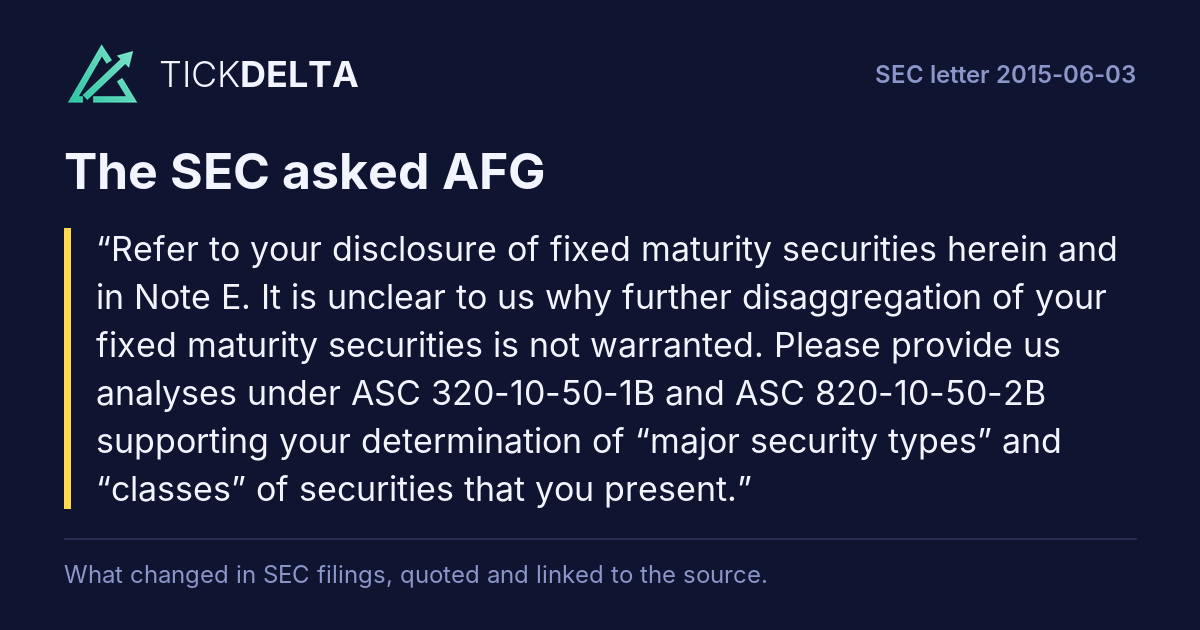
The majority of the investment-related disclosures mandated by ASC 320 are required to be presented separately for each “type” of security. In accordance with ASC 320-10-50-1B, we determined major security types based on the nature and risks of the securities. In determining whether disclosure for a particular security type is necessary and whether it is necessary to further separate a particular security type into greater detail, management considered all of the following: shared activity or business sector, vintage, geographic concentration, credit quality and other economic
Rest of the answer
characteristics. ASC 942-320-50-2 requires all of the following major security types to be included in AFG’s ASC 320 disclosures regarding fixed maturity securities (to the extent applicable):
•
Debt securities issued by the U.S. Treasury and other U.S. government corporations and agencies
Debt securities issued by states of the United States and political subdivisions of the states
Debt securities issued by foreign governments
Corporate debt securities
Residential mortgage-backed securities
Commercial mortgage-backed securities
Collateralized debt obligations
Other debt obligations
Similar to the ASC 320 investment disclosures, the fair value disclosures required under ASC 820 must be presented separately for each “class” of assets and liabilities measured at fair value subsequent to initial recognition. In accordance with ASC 820-10-50-2B, a reporting entity determines the appropriate classes (level of disaggregation) of its assets and liabilities based on (a) the nature, characteristics, and risks of the asset or liability and (b) the level of the fair value hierarchy within which the fair value measurement is categorized.
The disclosures required by ASC 320 and ASC 820 are included in audited financial statement Note E, “Investments” and Note D, “Fair Value Measurements” to AFG’s Form 10-K for the year-ended December 31, 2014. In concluding that the level of disaggregation prescribed by ASC 942-320-50-2 provides sufficient and meaningful information for a user of AFG’s financial statements to understand the nature, characteristics and risks inherent in the Company’s fixed maturity portfolio, management considered the following:
As highlighted by the disclosure on page 32 of AFG’s Form 10-K for the year-ended December 31, 2014, under Item 7 — Management’s Discussion and Analysis of Financial Condition and Results of Operations — Investments, AFG’s portfolio of debt securities issued by U.S. states, municipalities and political subdivisions is very highly rated (98% investment grade at December 31, 2014) and its general obligation bonds are not concentrated geographically. Since the risk is widely distributed with no significant concentrations, management believes that additional disaggregation of the state, municipalities and political subdivisions portion of AFG’s fixed maturity portfolio within the audited financial statements would not be material to users of the financial statements.
As highlighted by the disclosure on page 92 of AFG’s Form 10-K for the year-ended December 31, 2014, under Item 7A — Quantitative and Qualitative Disclosures of Market Risk, AFG does not have a material exposure to European debt and did not own any sovereign debt issued by Greece, Portugal, Ireland, Italy or Spain at December 31, 2014. Due to the small overall size of AFG’s portfolio of foreign government debt securities and lack of exposure to higher risk jurisdictions, management believes that additional disaggregation of the foreign government portion of AFG’s fixed maturity portfolio within the audited financial statements would not be material to users of the financial statements.
As highlighted by the disclosure on page 31 of AFG’s Form 10-K for the year-ended December 31, 2014, under Item 7 — Management’s Discussion and Analysis of Financial Condition and Results of Operations — Investments, over 99% of AFG’s commercial mortgage-backed securities were rated investment grade at December 31, 2014. In addition, the fair value of AFG’s portfolio of residential mortgage-backed securities significantly exceeded the amortized cost of those investments across all collateral types at December 31, 2014, which is indicative of the similar level of risk across the collateral types. Because investment ratings are based primarily on the probability of loss without regard to the severity of loss, management does not believe that investment ratings are a meaningful way to analyze AFG’s portfolio of non-agency residential mortgage-backed securities, particularly considering the significant discount to face value at which many of these securities were purchased. Noting the unrealized gain position across collateral types and the fact that no individual collateral type represented more than 7% of the fair value of AFG’s overall portfolio of fixed maturity securities, management believes that additional disaggregation of the residential or commercial mortgage-backed securities portions of AFG’s fixed maturity portfolio within the audited financial statements would not be material to users of the financial statements.
Over 90% of AFG’s securities included in the “corporate and other” portion of its fixed maturity portfolio were rated investment grade at December 31, 2014. Accordingly, management believes that the securities in this class are sufficiently similar and that additional disaggregation of the “corporate and other” portion of AFG’s fixed maturity portfolio by credit quality within the audited financial statements would not be material to users of the financial statements.
Management believes that disaggregating its fixed maturity portfolio into seven types/classes provides sufficient information to users of its financial statements to adequately understand the composition of AFG’s portfolio. Given the judgment inherent in applying this accounting guidance, management believes adding additional types/classes to multiple disclosures would not provide material information to financial statement users and might impair the effectiveness of the disclosure.
Based on the periodic review of peer company filings, management believes that the disaggregation of securities in AFG’s current ASC 320 and ASC 820 disclosures is consistent with standard industry practice and therefore provides sufficient comparability for users of AFG’s financial statements when evaluated against our peers.
ASC 820 acknowledges that determining the appropriate level of disaggregation requires judgment and provides that if another ASC Topic (e.g. ASC 942-320-50-2) specifies the class for an asset (or a liability) that meets the requirements of ASC 820-10-50-2B, a reporting entity may use that class in providing the required ASC 820 disclosures. Management believes that using consistent disaggregation between the ASC 320 and ASC 820 disclosures improves transparency and benefits the users of AFG’s financial statements.
Based on the analysis above, management believes that the Company has met the disaggregation requirements of ASC 320-10-50-1B and ASC 820-10-50-2B. While management believes that the level of disaggregation in the audited financial statements is sufficient to allow those statements to stand on their own, the supplemental disclosures included under Item 7 — Management’s Discussion and Analysis of Financial Condition and Results of Operations — Investments and Item 7A — Quantitative and Qualitative Disclosures of Market Risk are available to users of the financial statements who desire more insight regarding management’s view of the Company’s investment portfolio. In addition, investors who desire an even more granular view of AFG’s fixed maturity portfolio should be aware that individual security level information is publicly available in each of our insurance companies’ Statutory Annual Statements, which are available in searchable datasets.
AFG continuously monitors the overall make-up and characteristics of its investment portfolio. Management confirms its understanding that changes in the portfolio over time may require further disaggregation in the Company’s ASC 320 and ASC 820 disclosures.