Paragraph 196 · 48% changed
Every version of it
Screener
/
SEC EDGAR
/CIK 0001439222
/10-K filed Feb 12, 2026, compared with Feb 13, 2025
/Numbers from the XBRL of the 10-Ks
Nasdaq
Health care · Pharmaceuticals
Agios Pharmaceuticals, Inc. AGIO
The 10-K against last year's
213 changes: 43 added, 42 removed, 126 reworded, 2 quiet changes
10-K Feb 12, 2026 vs Feb 13, 2025
Risk Factors
23.1%
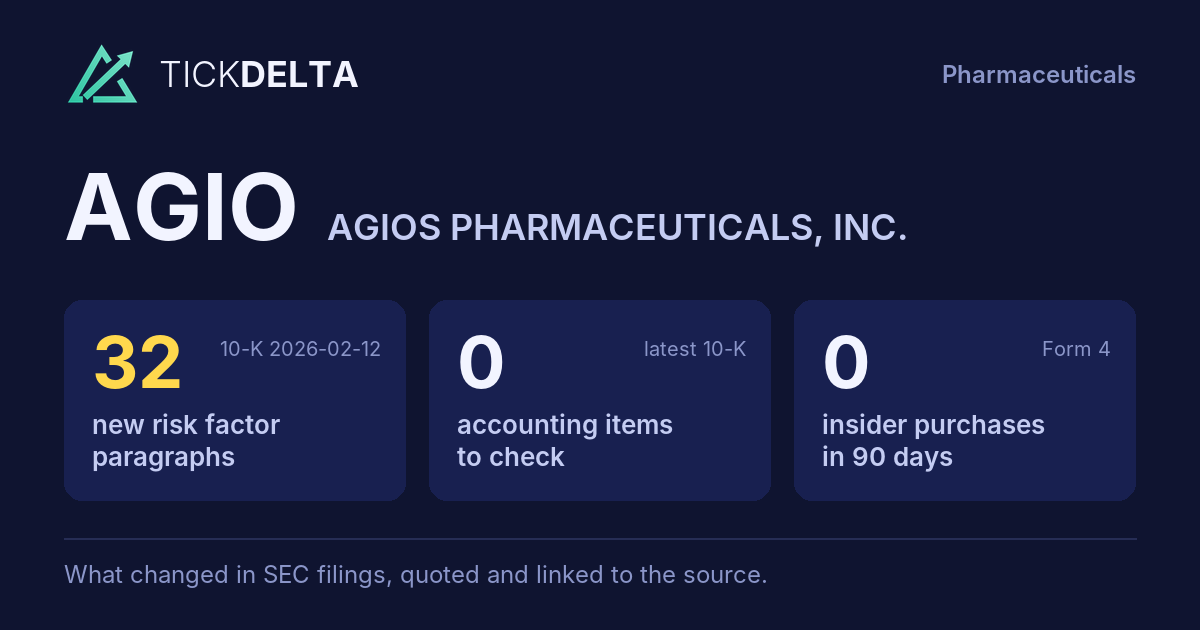
of the text changed · 23,190 words now · 32 new paragraphs, 34 gone
MD&A
33.8%
of the text changed · 10,430 words now · 11 new paragraphs, 8 gone
Accounting Policies
11.3%
of the text changed · 4,060 words now
10-K 0001439222-26-000025 (Feb 12, 2026) vs 10-K 0001439222-25-000009 (Feb 13, 2025) Not compared: Legal Proceedings.
Every paragraph, and how much of it changed
One bar per paragraph, in the order of the 10-K. Height and colour show the share of its words not in the closest paragraph a year earlier; the tallest bars are new paragraphs.
Risk Factors
303 paragraphs · 32 new · 124 reworded · 34 gone · 10-K Feb 12, 2026 against Feb 13, 2025
New paragraph
Reworded (5% of its words or more)
Same or nearly
Paragraph 172 · 47% changed
Every version of it
We have licensed patent rights, and in the future may license additional patent rights, from third parties. Such licenses may be accompanied by milestone and/or royalty payment obligations. These licensed patent rights may be valuable to our business, and we may not have the right to control the preparation, filing and prosecution of patent applications, or to maintain the patents, covering technology or medicines underlying such licenses. We cannot be certain that these patents and applications will be prosecuted and enforced in a manner consistent with the best interests of our business. If any such licensors fail to maintain such patents, or lose rights to those patents, the rights we have licensed may be reduced or eliminated and our right to develop and commercialize any of our products that are the subject of such licensed rights could be adversely affected. In addition to the foregoing, the risks associated with patent rights that we license from third parties also apply to patent rights we own.
Paragraph 254 · 45% changed
Every version of it
Paragraph 255 · 44% changed
Every version of it
Paragraph 115 · 44% changed
Every version of it
Paragraph 27 · 42% changed
Every version of it
•if our product candidates have undesirable side effects, it could result in a more restrictive label or the addition of safety warnings, or it could result in the delay or denial of marketing approval by the FDA or comparable foreign regulatory authorities. For example, in January 2025, the U.S. Prescribing Information, or USPI, for PYRUKYND® includes a warning regarding the risk of potential hepatocellular injury, and the USPI for PYRUKYND® AQVESME™ contains a boxed warning regarding the potential for hepatocellular injury. In addition, the treatment FDA has required and might in the future require the development and submission of hemolytic anemia in adults with PK deficiency was updated REMS for our products. For example, to include information regarding mitigate the risk of hepatocellular injury observed in clinical trials in patients with thalassemia treated with PYRUKYND® at a higher dose than recommended for patients with PK deficiency; injury, AQVESME™ is available only through the REMS approved by the FDA;
Paragraph 165 · 42% changed
Every version of it
Paragraph 116 · 41% changed
Every version of it
Paragraph 196 · 48% changed
Every version of it
10-K Feb 13, 2025The FDA, EMA and other foreign regulatory authorities have substantial discretion in the approval process. Accordingly, it is possible that the FDA or EMA may refuse to accept for substantive review any NDA, supplemental NDA or MAA that we submit for our product candidates, or may conclude after review of our data that our marketing application is insufficient to obtain marketing approval of our product candidates. If the FDA or EMA does not accept or approve our applications for any of our product candidates, the applicable regulator may require that we conduct additional clinical trials, preclinical studies or manufacturing validation studies and submit that data before reconsidering our applications. Depending on the extent of these or any other FDA- or EMA-required trials or studies, approval of any marketing applications that we submit may be delayed by several years, or may require us to expend more resources than we planned. It is also possible that additional trials or studies, if performed and completed, may not be considered sufficient by the FDA or EMA to approve any marketing applications. We may not be successful in obtaining FDA or EMA approval of our product candidates on a timely basis, or ever. We have limited experience in filing and supporting the applications necessary to gain marketing approvals and expect to rely on third-party CROs to assist us in this process, and failure to obtain marketing approval for our product candidates will prevent us from commercializing the product candidate in the applicable jurisdictions.
10-K Feb 12, 2026
We may not be successful in obtaining FDA or EMA approval of our product candidates on a timely basis, or ever. We have limited experience in filing and supporting the applications necessary to gain marketing approvals and expect to rely on third-party CROs to assist us in this process.
Paragraph 172 · 47% changed
Every version of it
10-K Feb 13, 2025
We have licensed patent rights, and in the future may license additional patent rights, from third parties. Such licenses may be accompanied by milestone and/or royalty payment obligations. These licensed patent rights may be valuable to our business, and we may not have the right to control the preparation, filing and prosecution of patent applications, or to maintain the patents, covering technology or medicines underlying such licenses. We cannot be certain that these patents and applications will be prosecuted and enforced in a manner consistent with the best interests of our business. If any such licensors fail to maintain such patents, or lose rights to those patents, the rights we have licensed may be reduced or eliminated and our right to develop and commercialize any of our products that are the subject of such licensed rights could be adversely affected. In addition to the foregoing, the risks associated with patent rights that we license from third parties also apply to patent rights we own.
10-K Feb 12, 2026
We have licensed patent rights, and in the future may license additional patent rights, from third parties. Such licenses may be accompanied by milestone and/or royalty payment obligations. These licensed patent rights may be valuable to our business,
Paragraph 254 · 45% changed
Every version of it
10-K Feb 13, 2025Under the Creating and Restoring Equal Access to Equivalent Samples Act of 2019, or the CREATES Act, authorizes sponsors of ANDAs and 505(b)(2) applications to file lawsuits against companies holding NDAs that decline to provide sufficient quantities of an approved reference drug on commercially reasonable, market-based terms. Drug products on FDA’s drug shortage list are exempt from these new provisions unless the product has been on the list for more than six continuous months or the FDA determines that the supply of the product will help alleviate or prevent a shortage. For the purposes of the statute, the term “commercially reasonable, market-based terms” is defined as (1) the nondiscriminatory price at or below the most recent wholesale acquisition cost for the product, (2) a delivery schedule that meets the statutorily defined timetable, and (3) no additional conditions on the sale.
10-K Feb 12, 2026
The Creating and Restoring Equal Access to Equivalent Samples Act of 2019, or the CREATES Act, authorizes sponsors of ANDAs and 505(b)(2) applications to file lawsuits against companies holding NDAs that decline to provide sufficient quantities of an approved reference drug on commercially reasonable, market-based terms, subject to certain exemptions.
Paragraph 255 · 44% changed
Every version of it
10-K Feb 13, 2025To bring an action under the statute, an ANDA or 505(b)(2) sponsor must take certain steps to request the reference product, which, in the case of products covered by a REMS with elements to assure safe use, include obtaining authorization from the FDA for the acquisition of the reference product. If the sponsor does bring an action for failure to provide a reference product, there are certain affirmative defenses available to the NDA holder, which must be shown by a preponderance of evidence. If the sponsor prevails in litigation, it is entitled to a court order directing the NDA holder to provide, without delay, sufficient quantities of the applicable product on commercially reasonable, market-based terms, plus reasonable attorney fees and costs.
10-K Feb 12, 2026
If a sponsor were to bring an action under the statute and prevail in litigation, it is entitled to a court order directing the NDA holder to provide, without delay, sufficient quantities of the applicable product on commercially reasonable, market-based terms, plus reasonable attorney fees and costs. Additionally, the statutory provisions authorize a federal court to award the sponsor an amount “sufficient to deter” the NDA holder from refusing to provide sufficient product quantities on commercially reasonable, market-based terms if the court finds, by a preponderance of the evidence, that the NDA holder did not have a legitimate business justification to delay providing the product or failed to comply with the court’s order.
Paragraph 115 · 44% changed
Every version of it
10-K Feb 13, 2025Similar to the laws in the United States, there are significant privacy and data security laws that apply in Europe and other countries. The collection, use, disclosure, transfer, or other processing of personal data, including personal health data, regarding individuals who are located in the European Economic Area, or EEA, and the processing of personal data that takes place in the EEA, is regulated by the GDPR, which went into effect in May 2018 and which imposes obligations on companies that operate in our industry with respect to the processing of personal data and the cross-border transfer of such data. The GDPR imposes onerous accountability obligations requiring data controllers and processors to maintain a record of their data processing and policies. If our or our partners’ or service providers’ privacy or data security measures fail to comply with the GDPR requirements, we may be subject to litigation, regulatory investigations, enforcement notices requiring us to change the way we use personal data and/or fines of up to 20 million Euros or up to 4% of the total worldwide annual turnover of the preceding financial year, whichever is higher, as well as compensation claims by affected individuals, negative publicity, reputational harm and a potential loss of business and goodwill.
10-K Feb 12, 2026
There are also significant privacy and data security laws that apply in Europe and other countries. The collection, use, disclosure, transfer, or other processing of personal data, including personal health data, regarding individuals who are located in the European Economic Area, or EEA, and the processing of personal data that takes place in the EEA, is regulated by the GDPR. The GDPR imposes onerous accountability obligations requiring data controllers and processors to maintain a record of their data processing and policies. While many other countries outside of the EEA loosely follow GDPR as a model, other laws contain different or conflicting provisions.
Paragraph 27 · 42% changed
Every version of it
10-K Feb 13, 2025
•if our product candidates have undesirable side effects, it could result in a more restrictive label or the addition of safety warnings, or it could result in the delay or denial of marketing approval by the FDA or comparable foreign regulatory authorities. For example, in January 2025, the USPI for PYRUKYND® for the treatment of hemolytic anemia in adults with PK deficiency was updated to include information regarding hepatocellular injury observed in clinical trials in patients with thalassemia treated with PYRUKYND® at a higher dose than recommended for patients with PK deficiency;
10-K Feb 12, 2026
•if our product candidates have undesirable side effects, it could result in a more restrictive label or the addition of safety warnings, or it could result in the delay or denial of marketing approval by the FDA or comparable foreign regulatory authorities. For example, the U.S. Prescribing Information, or USPI, for PYRUKYND® includes a warning regarding the risk of potential hepatocellular injury, and the USPI for AQVESME™ contains a boxed warning regarding the potential for hepatocellular injury. In addition, the FDA has required and might in the future require the development and submission of REMS for our products. For example, to mitigate the risk of hepatocellular injury, AQVESME™ is available only through the REMS approved by the FDA;
Paragraph 165 · 42% changed
Every version of it
10-K Feb 13, 2025We may seek collaborations for the development and commercialization of our product candidates, such as the NewBridge Agreement, with large and mid-size pharmaceutical companies and biotechnology companies. We face significant competition in seeking appropriate collaborators. Collaborations are complex and time-consuming to negotiate and document. Whether we reach a definitive agreement for a collaboration will depend, among other things, upon our assessment of the collaborator’s resources and expertise, the terms and conditions of the proposed collaboration and the proposed collaborator’s evaluation of a number of factors. We may not be able to negotiate collaborations on a timely basis, on acceptable terms, or at all. Collaborators may have rights that restrict us from entering into future agreements on certain terms with potential collaborators.
10-K Feb 12, 2026
factors. We may not be able to negotiate collaborations on a timely basis, on acceptable terms, or at all. Collaborators may have rights that restrict us from entering into future agreements on certain terms with potential collaborators.
Paragraph 116 · 41% changed
Every version of it
10-K Feb 13, 2025We are subject to data privacy and protection laws and regulations that apply to the collection, transmission, storage and use of personally-identifying information, which among other things, impose certain requirements relating to the privacy, security and transmission of personal information, including comprehensive regulatory systems in the United States and the EU. The legislative and regulatory landscape for privacy and data protection continues to evolve in jurisdictions worldwide, and there has been an increasing focus on privacy and data protection issues with the potential to affect our business. Failure to comply with any of these laws and regulations could result in enforcement action against us, including fines, imprisonment of company officials and public censure, claims for damages by affected individuals, damage to our reputation and loss of goodwill, any of which could have a material adverse effect on our business, financial condition, results of operations or prospects.
10-K Feb 12, 2026
Failure to comply with any of these laws and regulations could result in litigation, regulatory investigations or enforcement actions against us, orders to changes our practices, systems or policies, breaches of our contracts, fines, imprisonment of company officials and public censure, civil or criminal penalties, claims for damages by affected individuals, damage to our reputation and loss of goodwill, any of which could have a material adverse effect on our business, financial condition, results of operations or prospects. Even if we are not determined to have violated these laws, litigation or government investigations into these issues typically require the expenditure of significant resources and generate negative publicity.
MD&A
132 paragraphs · 11 new · 62 reworded · 8 gone · 10-K Feb 12, 2026 against Feb 13, 2025
New paragraph
Reworded (5% of its words or more)
Same or nearly
Paragraph 40 · 49% changed
Paragraph 5 · 47% changed
Paragraph 11 · 47% changed
On March 31, 2021, we completed the sale of our oncology business to Servier Pharmaceuticals, LLC, or Servier, which represented a discontinued operation. Servier. The transaction included the sale of our entire oncology business, including TIBSOVO®, our clinical-stage product candidates candidate vorasidenib, AG-270 and AG-636, and our oncology research programs for a payment of approximately $1.8 billion in cash at the closing, subject to certain adjustments, and a payment of $200.0 million in cash, if, prior to January 1, 2027, vorasidenib is granted new drug application, or NDA, approval from the FDA with an approved label that permits vorasidenib’s use as a single agent for the adjuvant treatment of patients with Grade 2 glioma that have an isocitrate dehydrogenase, or IDH, 1 or 2 mutation (and, to the extent required by such approval, the vorasidenib companion diagnostic test is granted an FDA premarket approval), or the Vorasidenib Milestone Payment, as well as a royalty of 5% of U.S. net sales
Paragraph 65 · 46% changed
Paragraph 35 · 44% changed
Paragraph 38 · 44% changed
Paragraph 45 · 42% changed
•An extension study evaluating the long-term safety, tolerability and efficacy of treatment with PYRUKYND® mitapivat in SCD patients who are 16 years of age or older from DRIVE PK, RISE UP, our completed global double-blind phase 2, first-in-patient, open-label 3 study evaluating the efficacy and safety and efficacy clinical trial of PYRUKYND® in adult, not regularly transfused patients with PK deficiency. mitapivat as a potential treatment for SCD.
Paragraph 18 · 40% changed
Paragraph 40 · 49% changed
10-K Feb 13, 2025We have worldwide development and commercial rights to PYRUKYND®. In July 2024, we entered into a distribution agreement with NewBridge Pharmaceuticals FZ-LLC, or the NewBridge Agreement, pursuant to which we granted NewBridge the right to commercialize PYRUKYND® in the GCC region. We expect to fund the future development and commercialization costs related to this program. PYRUKYND® has been granted orphan drug designation for the treatment of PK deficiency by the FDA and the EMA. Additionally, PYRUKYND® has received orphan drug designation from the FDA for the treatment of thalassemia and SCD, orphan medicinal product designation from the EMA for the treatment of SCD, and breakthrough medicine designation from the Saudi Food and Drug Authority for the treatment of thalassemia.
10-K Feb 12, 2026
In addition, we are evaluating mitapivat for the treatment of pediatric patients with PK deficiency. Additionally, mitapivat has received orphan drug designation from the FDA for the treatment of thalassemia and SCD, and orphan medicinal product designation from the EMA for the treatment of SCD. Mitapivat was granted orphan drug designation for the treatment of PK deficiency by the FDA and EMA.
Paragraph 5 · 47% changed
10-K Feb 13, 2025PYRUKYND® is approved for use by the FDA for the treatment of hemolytic anemia in adults with PK deficiency in the United States and by the European Commission for the treatment of PK deficiency in adult patients in the EU. Additionally, we received marketing authorization in Great Britain for PYRUKYND® for the treatment of PK deficiency in adult patients under the European Commission Decision Reliance Procedure. In December 2024, we announced that we submitted an sNDA to the FDA for PYRUKYND® for the treatment of adult patients with non-transfusion dependent and transfusion-dependent alpha- or beta-thalassemia, which was accepted with standard review by the FDA and granted a PDUFA goal date of September 7, 2025. Also in December 2024, we announced that we submitted an MAA to the EMA and regulatory applications to the Kingdom of Saudi Arabia and United Arab Emirates health authorities for PYRUKYND® for the treatment of adult patients with non-transfusion dependent and transfusion-dependent alpha- or beta-thalassemia. In addition, we are currently evaluating PYRUKYND® in clinical trials for the treatment of SCD and in pediatric patients with PK deficiency.
10-K Feb 12, 2026
In December 2024, we announced that we submitted a marketing authorization application, or MAA, to the European Medicines Agency, or EMA, and a regulatory application to the United Arab Emirates health authorities for PYRUKYND® for the treatment of adult patients with non-transfusion dependent and transfusion-dependent alpha- or beta-thalassemia. In October 2025, we announced that the Committee for Medicinal Products for Human Use, or the CHMP, of the EMA adopted a positive opinion for the new indication for PYRUKYND® in adults for the treatment of anemia associated with transfusion-dependent and non-transfusion-dependent alpha- or beta-thalassemia. The European Commission is reviewing the CHMP’s opinion, with the final decision expected in early 2026.
Paragraph 11 · 47% changed
10-K Feb 13, 2025
On March 31, 2021, we completed the sale of our oncology business to Servier Pharmaceuticals, LLC, or Servier, which represented a discontinued operation. The transaction included the sale of our oncology business, including TIBSOVO®, our clinical-stage product candidates vorasidenib, AG-270 and AG-636, and our oncology research programs for a payment of approximately $1.8 billion in cash at the closing, subject to certain adjustments, and a payment of $200.0 million in cash, if, prior to January 1, 2027, vorasidenib is granted new drug application, or NDA, approval from the FDA with an approved label that permits vorasidenib’s use as a single agent for the adjuvant treatment of patients with Grade 2 glioma that have an isocitrate dehydrogenase, or IDH, 1 or 2 mutation (and, to the extent required by such approval, the vorasidenib companion diagnostic test is granted an FDA premarket approval), or the Vorasidenib Milestone Payment, as well as a royalty of 5% of U.S. net sales
10-K Feb 12, 2026
On March 31, 2021, we completed the sale of our oncology business to Servier Pharmaceuticals, LLC, or Servier. The transaction included the sale of our entire oncology business, including our clinical-stage product candidate vorasidenib, for a payment of approximately $1.8 billion in cash at the closing, subject to certain adjustments, and a payment of $200.0 million in
Paragraph 65 · 46% changed
10-K Feb 13, 2025statements, as well as the reported amounts of revenue and expenses during the reporting periods. On an ongoing basis, we evaluate our estimates and judgments. We base our estimates on historical experience and various other factors that we believe are reasonable under the circumstances, the results of which form the basis for making judgments about the carrying value of assets and liabilities that are not readily apparent from other sources. Actual results may differ from these estimates under different assumptions or conditions.
10-K Feb 12, 2026
assets and liabilities that are not readily apparent from other sources. Actual results may differ from these estimates under different assumptions or conditions.
Paragraph 35 · 44% changed
10-K Feb 13, 2025PYRUKYND® is approved for use by the FDA for the treatment of hemolytic anemia in adults with PK deficiency in the United States and by the European Commission for the treatment of PK deficiency in adult patients in the EU. Additionally, we received marketing authorization in Great Britain for PYRUKYND® for the treatment of PK deficiency in adult patients under the European Commission Decision Reliance Procedure. In December 2024, we announced that we submitted an sNDA to the FDA for PYRUKYND® for the treatment of adult patients with non-transfusion dependent and transfusion-dependent alpha- or beta-thalassemia, which was accepted with standard review by the FDA and granted a PDUFA goal date of September 7, 2025. Also in December 2024, we announced that we submitted an MAA to the EMA and regulatory applications to the Kingdom of Saudi Arabia and United Arab Emirates health authorities for PYRUKYND® for the treatment of adult patients with non-transfusion dependent and transfusion-dependent alpha- or beta-thalassemia. In addition, we are currently evaluating PYRUKYND® in clinical trials for the treatment of SCD and in pediatric patients with PK deficiency.
10-K Feb 12, 2026
The FDA approved mitapivat, under the brand name PYRUKYND®, for the treatment of hemolytic anemia in adults with PK deficiency in the United States and by the European Commission for the treatment of PK deficiency in adult patients in the EU. Additionally, we received marketing authorization in Great Britain for PYRUKYND® for the treatment of PK deficiency in adult patients under the European Commission Decision Reliance Procedure.
Paragraph 38 · 44% changed
10-K Feb 13, 2025PYRUKYND® is approved for use by the FDA for the treatment of hemolytic anemia in adults with PK deficiency in the United States and by the European Commission for the treatment of PK deficiency in adult patients in the EU. Additionally, we received marketing authorization in Great Britain for PYRUKYND® for the treatment of PK deficiency in adult patients under the European Commission Decision Reliance Procedure. In December 2024, we announced that we submitted an sNDA to the FDA for PYRUKYND® for the treatment of adult patients with non-transfusion dependent and transfusion-dependent alpha- or beta-thalassemia, which was accepted with standard review by the FDA and granted a PDUFA goal date of September 7, 2025. Also in December 2024, we announced that we submitted an MAA to the EMA and regulatory applications to the Kingdom of Saudi Arabia and United Arab Emirates health authorities for PYRUKYND® for the treatment of adult patients with non-transfusion dependent and transfusion-dependent alpha- or beta-thalassemia. In addition, we are currently evaluating PYRUKYND® in clinical trials for the treatment of SCD and in pediatric patients with PK deficiency.
10-K Feb 12, 2026
In December 2024, we announced that we submitted an MAA to the EMA and a regulatory application to the United Arab Emirates health authorities for PYRUKYND® for the treatment of adult patients with non-transfusion dependent and transfusion-dependent alpha- or beta-thalassemia. In October 2025, we announced that the CHMP of the EMA adopted a positive opinion for the new indication for PYRUKYND® in adults for the treatment of anemia associated with transfusion-dependent and non-transfusion-dependent alpha- or beta-thalassemia. The European Commission is reviewing the CHMP’s opinion, with the final decision expected in early 2026.
Paragraph 45 · 42% changed
10-K Feb 13, 2025
•An extension study evaluating the long-term safety, tolerability and efficacy of treatment with PYRUKYND® in patients from DRIVE PK, our completed global phase 2, first-in-patient, open-label safety and efficacy clinical trial of PYRUKYND® in adult, not regularly transfused patients with PK deficiency.
10-K Feb 12, 2026
•An extension study evaluating the long-term safety, tolerability and efficacy of treatment with mitapivat in SCD patients who are 16 years of age or older from RISE UP, our completed double-blind phase 3 study evaluating the efficacy and safety of mitapivat as a potential treatment for SCD.
Paragraph 18 · 40% changed
10-K Feb 13, 2025Our wholly owned product, PYRUKYND®, received approval from the FDA on February 17, 2022, for the treatment of hemolytic anemia in adults with PK deficiency in the United States. Upon FDA approval of PYRUKYND® in the United States, we began generating product revenue from sales of PYRUKYND®. We sell PYRUKYND® to a limited number of specialty distributors and specialty pharmacy providers, or collectively, the Customers. These Customers subsequently resell PYRUKYND® to pharmacies or dispense PYRUKYND® directly to patients. In addition to distribution agreements with Customers, we enter into arrangements with healthcare providers and payors that provide for government-mandated and/or privately-negotiated rebates, chargebacks and discounts with respect to the purchase of PYRUKYND®. In July 2024, we entered into a distribution agreement, or the NewBridge Agreement, with NewBridge Pharmaceuticals FZ-LLC, or NewBridge, pursuant to which we granted NewBridge the right to commercialize PYRUKYND® in Bahrain, Kuwait, Oman, Qatar, Saudi Arabia, and the United Arab Emirates, or the GCC region. For further discussion of our revenue recognition policy, see Note 2, Summary of Significant Accounting Polices and Note 8, Product Revenue, to the consolidated financial statements in this Annual Report on Form 10-K.
10-K Feb 12, 2026
In July 2024, we entered into a distribution agreement, or the NewBridge Agreement, with NewBridge Pharmaceuticals FZ-LLC, or NewBridge, pursuant to which we granted NewBridge the right to commercialize PYRUKYND® in Bahrain, Kuwait, Oman, Qatar, Saudi Arabia, and the United Arab Emirates, also known as the Gulf Council Countries, or GCC. In June 2025, we entered into a distribution agreement, or the Avanzanite Agreement, with Avanzanite Bioscience B.V., or Avanzanite, pursuant to which we granted Avanzanite the right to commercialize PYRUKYND® in the European Economic Area, Switzerland, and the U.K. For further discussion of our revenue recognition policy, see Note 2, Summary of Significant Accounting Polices and Note 8, Product Revenue, to the consolidated financial statements in this Annual Report on Form 10-K.
A paragraph is matched with the one last year that shares the most of its words; under half in common makes it new. The paragraphs shown are the 8 reworded the most in each section.
The paragraph that changed most in each section
The redline
Marked against last year's 10-K: cut words struck through, new words highlighted.
MD&A229 words changed in this paragraph; it is 34% similar to last year's version.
The lead product candidate in our portfolio, PYRUKYND® (mitapivat), mitapivat, is an activator of both wild-type and mutant pyruvate kinase, or PK, enzymes for the potential treatment of hemolytic anemias. PYRUKYND® Mitapivat is approved for use in the United States by the U.S. Food and Drug Administration, or FDA, under the brand name AQVESME™ for the treatment of anemia in adults with non-transfusion dependent and transfusion-dependent alpha- or beta-thalassemia and in Saudi Arabia under the brand name PYRUKYND® for the treatment of adult patients with non-transfusion-dependent and transfusion-dependent alpha- or beta-thalassemia. Mitapivat is also approved under the brand name PYRUKYND® in the United States by the FDA for the treatment of hemolytic anemia in adults with PK deficiency and in the United States European Union, or EU, and by the European Commission Great Britain for the treatment of PK deficiency in adult patients in the European Union, or EU. Additionally, we received marketing authorization in Great Britain for PYRUKYND® for the treatment of PK deficiency in adult patients under the European Commission Decision Reliance Procedure. In December 2024, we announced that we submitted a supplemental new drug application, or sNDA, to the FDA for PYRUKYND® for the treatment of adult patients with non-transfusion dependent and transfusion-dependent alpha- or beta-thalassemia, which was accepted with standard review by the FDA and granted a Prescription Drug User Fee Act, or PDUFA, goal date of September 7, 2025. Also in December 2024, we announced that we submitted a marketing authorization application, or MAA, to the European Medicines Agency, or EMA, and regulatory applications to the Kingdom of Saudi Arabia and United Arab Emirates health authorities for PYRUKYND® for the treatment of adult patients with non-transfusion dependent and transfusion-dependent alpha- or beta-thalassemia. adults.
Source: Item 7, 10-K 0001439222-26-000025 vs Item 7, 10-K 0001439222-25-000009
Risk Factors217 words changed in this paragraph; it is 31% similar to last year's version.
Source: Item 1A, 10-K 0001439222-26-000025 vs Item 1A, 10-K 0001439222-25-000009
Accounting Policies86 words changed in this paragraph; it is 46% similar to last year's version.
We review marketable securities for impairment whenever the fair value of a marketable security is less than the amortized cost and evidence indicates that a marketable security’s carrying amount is not recoverable. Unrealized losses are evaluated for impairment under ASC 326, Financial Instruments - Credit Losses, to determine if the impairment is credit-related or noncredit-related. Credit-related impairment is recognized as an allowance on the balance sheet with a corresponding adjustment to earnings, and noncredit-related impairment is recognized in other comprehensive (loss) income, net of taxes. Evidence considered in this assessment includes reasons for the impairment, compliance with our investment policy, the severity of the impairment, collectability of the security, and any adverse conditions specifically related to the security, an industry, or geographic area.
Source: 10-K text, Note 2 – Summary of Significant Accounting Policies, 10-K 0001439222-26-000025 vs 10-K text, Note 2 – Summary of Significant Accounting Policies, 10-K 0001439222-25-000009
Sentences and paragraphs added, removed or reworded
Every change, by type
Sentences and paragraphs of AGIO's Risk Factors and MD&A, 10-K Feb 12, 2026 against 10-K Feb 13, 2025. Each links to the text at sec.gov.
Quiet changes are sentences kept from last year with one to four words changed, at least one of them a hedge, a modal or a qualifier (may, could, will, not, significant, material…). A year or date rolling forward is not counted.
The full word list
adverse, adversely, all, although, anticipate, anticipates, any, approximately, believe, believes, can, cannot, certain, could, expect, expects, generally, however, if, intend, intends, largely, likely, many, material, materially, may, might, most, must, never, no, not, possible, primarily, probable, should, significant, significantly, some, substantial, substantially, unlikely, will, would
AddedRisk Factors
The development and commercialization of PYRUKYND® or AQVESME™ could be unsuccessful if:
Read it in 10-K Feb 12, 2026 at sec.gov
AddedRisk Factors
•competing drug products are approved for the same indications or in the same jurisdictions as PYRUKYND® or AQVESME™;
Read it in 10-K Feb 12, 2026 at sec.gov
AddedRisk Factors
•the requirements of the AQVESME™ REMS make it more difficult and/or time-consuming for physicians to prescribe AQVESME™ and for patients to subsequently use AQVESME™.
Read it in 10-K Feb 12, 2026 at sec.gov
AddedRisk Factors
•the strength of sales, marketing and distribution support, including under any distribution agreement with third parties;
Read it in 10-K Feb 12, 2026 at sec.gov
AddedRisk Factors
•a requirement to implement a REMS, such as the REMS required for AQVESME™. Failure of physicians, prescribers, pharmacies or patients to enroll in our REMS program or to successfully complete and comply with its requirements may result in regulatory action from the FDA or decreased sales of AQVESME™.
Read it in 10-K Feb 12, 2026 at sec.gov
AddedRisk Factors
Ongoing or unanticipated geopolitical events in countries where we may to have clinical trial sites could also negatively impact our ability to initiate, enroll and retain patients in, and conduct clinical trials.
Read it in 10-K Feb 12, 2026 at sec.gov
AddedRisk Factors
Conducting clinical trials outside the United States also exposes us to additional risks, including risks associated with foreign exchange fluctuations, compliance with foreign manufacturing, customs, shipment and storage requirements, cultural differences in medical practice and clinical research, diminished protection of intellectual property in some countries, and interruptions or delays in our trials resulting from geopolitical events, such as war or terrorism.
Read it in 10-K Feb 12, 2026 at sec.gov
AddedRisk Factors
For example, the USPI for PYRUKYND® includes a warning regarding the risk of potential hepatoceullar injury, and the USPI for AQVESME™ contains a boxed warning regarding the potential for hepatocellular injury. In addition, to mitigate the risk of hepatocellular injury, AQVESME™ is available only through the REMS program approved by the FDA. If we are unable to comply with any REMS imposed on any of our products, we may face additional restrictions, limitations or substantial penalties, any of which may materially adversely affect our business and results of operations. We cannot predict whether the FDA will request, seek to require or ultimately require modifications to, or impose additional requirements on, the AQVESME™ REMS.
Read it in 10-K Feb 12, 2026 at sec.gov
Show the other 61
AddedRisk Factors
dependent beta-thalassemia; DISC Medicine, Inc., or DISC, is conducting a clinical trial for a potential treatment for SCD; Fulcrum Therapeutics Inc. is conducting clinical trials for a potential treatment for SCD; BMS is conducting clinical trials for a potential treatment for SCD; Otsuka Pharmaceutical Co., Ltd., NGGT Inc., and Maze Therapeutics, Inc. are conducting clinical trials for potential treatments for PKU; PharmaEssentia Corp and Incyte Corporation are marketing therapies to treat PV, and Protagonist Therapeutics in collaboration with Takeda, Ionis in collaboration with Ono/Deciphera, Italfarmaco S.p.A., DISC, Merck, and Silence Therapeutics are developing therapies to treat PV; and a number of other biotechnology companies have product candidates in clinical development in similar indications as ours.
Read it in 10-K Feb 12, 2026 at sec.gov
AddedRisk Factors
The FDA may not approve an ANDA or 505(b)(2) NDA until any applicable period of regulatory exclusivity for the reference-listed drug has expired, subject to certain exceptions.
Read it in 10-K Feb 12, 2026 at sec.gov
AddedRisk Factors
eliminated entirely. We cannot guarantee that the measures we have taken to date, and actions we may take in the future, will be sufficient to prevent any cyber-attacks or security breaches.
Read it in 10-K Feb 12, 2026 at sec.gov
AddedRisk Factors
product candidates, and unanticipated changes in applicable laws and regulations that may adversely affect the rare disease business.
Read it in 10-K Feb 12, 2026 at sec.gov
RemovedRisk Factors
RemovedRisk Factors
RemovedRisk Factors
RemovedRisk Factors
RemovedRisk Factors
RemovedRisk Factors
RemovedRisk Factors
RemovedRisk Factors
RemovedRisk Factors
RemovedRisk Factors
RemovedRisk Factors
RemovedRisk Factors
RewordedRisk Factors
RewordedRisk Factors
Our failure to successfully begin and complete clinical trials of our product candidates, candidates and to demonstrate the efficacy and safety necessary to obtain regulatory approval to market any of our product candidates, candidates could result in additional costs to us, or any collaborators, and would impair our ability to generate revenue from product sales, regulatory and commercialization milestones and royalties, and would significantly harm our business.
Read it in 10-K Feb 12, 2026 at sec.gov
RewordedRisk Factors
The collection, use, disclosure, transfer, or other processing of personal data, including personal health data, regarding individuals who are located in the European Economic Area, or EEA, and the processing of personal data that takes place in the EEA, is regulated by the GDPR, which went into effect in May 2018 and which imposes obligations on companies that operate in our industry with respect to the processing of personal data and the cross-border transfer of such data. GDPR.
Read it in 10-K Feb 12, 2026 at sec.gov
RewordedRisk Factors
In particular, regulations promulgated pursuant to the federal Health Insurance Portability and Accountability Act of 1996, or HIPAA, establish privacy and security standards that limit the use and disclosure of individually identifiable health information, or protected health information, and require the implementation of administrative, physical and technological safeguards to protect the privacy of protected health information and ensure the confidentiality, integrity and availability of electronic protected health information.
Read it in 10-K Feb 12, 2026 at sec.gov
RewordedRisk Factors
Although we enter into non-disclosure and confidentiality agreements with parties who may have access to patentable aspects of our research and development output, such as our employees, corporate collaborators, outside scientific collaborators, CROs, contract manufacturers, consultants, advisors and other third parties, any of these parties may breach the agreements and disclose such output before a patent application is filed, thereby jeopardizing our ability to seek patent protection.
Read it in 10-K Feb 12, 2026 at sec.gov
RewordedRisk Factors
We have established sales and marketing capabilities to support our commercialization of PYRUKYND® for the treatment of hemolytic anemia in adults with PK deficiency in the United States and have expanded these capabilities to support the commercial launch of AQVESME™ for the treatment of anemia in adults with non-transfusion dependent and transfusion-dependent alpha- or beta-thalassemia in the United States.
Read it in 10-K Feb 12, 2026 at sec.gov
RewordedRisk Factors
The legislative and regulatory landscape for privacy and data protection continues to evolve in jurisdictions worldwide, and there has been an increasing focus on privacy we must devote significant resources and data protection issues funds to understanding and complying with the potential to affect our business. this changing landscape.
Read it in 10-K Feb 12, 2026 at sec.gov
RewordedRisk Factors
Fast track designation and/or designation, priority review designation by the FDA or designation, PRIME designation in the EU or other expedited review designations or vouchers may not actually lead to a faster development or regulatory review or approval process, nor does it assure ensure approval of the product candidate by the FDA or the EMA. candidate.
Read it in 10-K Feb 12, 2026 at sec.gov
RewordedRisk Factors
In connection with our regulatory approval approvals in the EU EU, Great Britain and Great Britain, Saudi Arabia, we are currently providing access to PYRUKYND® through the Avanzanite Agreement and the NewBridge Agreement, as applicable, and on a for charge and free of charge basis for eligible patients in those jurisdictions and other jurisdictions through a global managed access program.
Read it in 10-K Feb 12, 2026 at sec.gov
RewordedRisk Factors
We cannot be certain that we will obtain marketing approval of PYRUKYND® mitapivat in thalassemia in such jurisdictions, jurisdictions with pending or potential future marketing applications for thalassemia, nor can we be certain that we will obtain marketing approval of PYRUKYND® mitapivat for SCD or for any other indication or in other jurisdictions. indication.
Read it in 10-K Feb 12, 2026 at sec.gov
RewordedRisk Factors
In addition, because our Board of Directors is responsible for appointing the members of our management team, these provisions may frustrate or prevent any attempts by our stockholders to replace or remove our current management by making it more difficult for stockholders to replace members of our Board of Directors.
Read it in 10-K Feb 12, 2026 at sec.gov
RewordedRisk Factors
We have limited experience in filing and supporting the applications necessary to gain marketing approvals and expect to rely on third-party CROs to assist us in this process, and failure to obtain marketing approval for our product candidates will prevent us from commercializing the product candidate in the applicable jurisdictions. process.
Read it in 10-K Feb 12, 2026 at sec.gov
Quiet changesRisk Factors
If the prices for our products, if any, products decrease or if governmental and other third-party payors do not provide coverage or adequate reimbursement, our prospects for revenue and profitability will suffer.
Read it in 10-K Feb 12, 2026 at sec.gov
Quiet changesRisk Factors
The price of our common stock is likely to be volatile, which could result in substantial losses for purchasers of our common stock.
Read it in 10-K Feb 12, 2026 at sec.gov
AddedMD&A
We are a commercial-stage biopharmaceutical company dedicated to redefining the future of rare disease treatment. Fueled by connections, we build trusted partnerships with communities, collaborating to develop and deliver innovative medicines with the potential to transform lives. With a foundation in hematology, we combine biological expertise with real-world insights to advance a growing pipeline of rare disease medicines that reflect the priorities of the people we serve.
Read it in 10-K Feb 12, 2026 at sec.gov
AddedMD&A
We will have a pre-supplemental New Drug Application, or sNDA, meeting with the FDA in the first quarter of 2026 and intend to submit a U.S. marketing application for mitapivat in sickle cell disease, or SCD, following that engagement.
Read it in 10-K Feb 12, 2026 at sec.gov
AddedMD&A
On July 28, 2023, we entered into a license agreement with Alnylam under which we acquired the rights to develop and commercialize Alnylam’s novel preclinical siRNA targeting the TMPRSS6 gene, which we refer to as AG-236, as a potential disease-modifying treatment for patients with PV.
Read it in 10-K Feb 12, 2026 at sec.gov
AddedMD&A
•maintaining an acceptable safety profile of the products following approval; and
Read it in 10-K Feb 12, 2026 at sec.gov
AddedMD&A
In December 2025, the FDA approved mitapivat under the brand name AQVESME™ for the treatment of anemia in adults with non-transfusion dependent and transfusion-dependent alpha- or beta-thalassemia in the United States. AQVESME™ is the only FDA-approved medicine for anemia in both non-transfusion-dependent and transfusion-dependent alpha- or beta-thalassemia. We commercially launched AQVESME™ in the United States in late January 2026 following our implementation of a Risk Evaluation and Mitigation Strategy, or REMS, to mitigate the risk of hepatocellular injury. Mitapivat will continue to be marketed as PYRUKYND® in the United States for the PK deficiency indication, which does not require a REMS. The AQVESME™ REMS requires liver tests prior to the first AQVESME™ dose, every four weeks thereafter for 24 weeks, and then as clinically indicated. It also includes education and certification requirements for patients, prescribing physicians, and pharmacists, which are common components of REMS.
Read it in 10-K Feb 12, 2026 at sec.gov
AddedMD&A
In August 2025, we announced that the Saudi Food and Drug Authority approved PYRUKYND® for the treatment of adults with non-transfusion dependent and transfusion-dependent alpha- or beta-thalassemia.
Read it in 10-K Feb 12, 2026 at sec.gov
AddedMD&A
We will have a pre-sNDA meeting with the FDA in the first quarter of 2026 and intend to submit a U.S. marketing application for mitapivat in SCD following that engagement.
Read it in 10-K Feb 12, 2026 at sec.gov
AddedMD&A
agreement, or the Avanzanite Agreement, with Avanzanite Bioscience B.V., or Avanzanite, pursuant to which we granted Avanzanite the right to commercialize PYRUKYND® in the European Economic Area, Switzerland, and the United Kingdom. Under the NewBridge Agreement and the Avanzanite Agreement, we rely on NewBridge and Avanzanite, respectively, to assist with regulatory filings, prepare applications for pricing and reimbursement approval, negotiate with payors, conduct medical affairs activities and import, distribute, promote and commercialize our products in accordance with applicable law in the applicable jurisdictions.
Read it in 10-K Feb 12, 2026 at sec.gov
AddedMD&A
RISE UP, a phase 2/3 study evaluating the efficacy and safety of mitapivat in SCD patients who are 16 years of age or older, have had between two and 10 sickle cell pain crises, or SCPCs, in the past 12 months, and have hemoglobin within the range of 5.5 to 10.5 g/dL during screening. We enrolled 207 patients in the phase 3 portion of the trial, which included a 52-week double blind, randomized, placebo-controlled period in which participants were randomized in a 2:1 ratio to receive the recommended (100 mg twice daily) mitapivat dose level or the placebo. The 52-week double-blind treatment period was completed by 87.0% (n=120/138) of patients in the mitapivat arm and 81.2% (n=56/69) of patients in the placebo arm. All but two of these patients (174/176) opted to enter the ongoing 216-week open-label extension period of the study. The primary endpoints of the phase 3 portion of the trial were (i) hemoglobin response, defined as ≥1 g/dL increase in average hemoglobin from week 24 through week 52 compared to baseline, and (ii) annualized rate of SCPCs. The secondary endpoints included change from baseline in hemoglobin concentration, change from baseline in indirect bilirubin, change from baseline in Patient Reported Outcome Measurement Information System Fatigue 13a, or PROMIS Fatigue, Short Form scores, annualized frequency of hospitalizations for SCPCs, and change from baseline in percent reticulocyte levels. In November 2025, we announced that the phase 3 portion of the trial had achieved the primary endpoint of hemoglobin response in the mitapivat arm, with 40.6% of patients in the mitapivat arm having achieved a hemoglobin response, compared to 2.9% of patients in the placebo arm, a statistically significant improvement (2-sided p<0.0001). In patients who achieved a hemoglobin response in the mitapivat arm, mean change from baseline in average hemoglobin concentration from Week 24 through Week 52 was 1.6 g/dL. The annualized rate of SCPCs, defined as acute pain needing medical contact, acute chest syndrome, priapism, hepatic, or splenic sequestration, was 2.62 in the mitapivat arm and 3.05 in the placebo arm (2-sided p=0.1213), with such reduction of SCPCs not achieving statistical significance for that primary endpoint. Treatment with mitapivat also showed statistically significant improvements in two secondary endpoints: (a) the average change from baseline in hemoglobin concentration from Week 24 through Week 52 was 7.69 g/L in the mitapivat arm and 0.26 g/L in the placebo arm, a statistically significant improvement (2-sided p<0.0001), and (b) the average change from baseline in indirect bilirubin from Week 24 through Week 52 was -16.03 µmol/L in the mitapivat arm and 0.88 µmol/L in the placebo arm, a statistically significant improvement (2-sided p<0.0001). The average change from baseline in PROMIS Fatigue score from Week 24 through Week 52 was -2.72 in the mitapivat arm and -2.25 in the placebo arm (2-sided p=0.7112), indicating improvements in fatigue, but the PROMIS Fatigue secondary endpoint was not met. No conclusions could be drawn regarding the statistical significance of the following additional key secondary endpoints: (a) the annualized frequency of hospitalizations for SCPCs, with 1.56 in the mitapivat arm and 1.81 in the placebo arm (2-sided nominal p=0.2498), and (b) the average change from baseline in percent reticulocyte levels from Week 24 through Week 52, with -0.0236 (fraction of 1) in the mitapivat arm and -0.0013 (fraction of 1) in the placebo arm (2-sided nominal p=0.0001). We also announced that in the subset of patients in the mitapivat arm achieving the primary endpoint of hemoglobin response, the following was observed: (i) the annualized rate of SCPCs was 2.20 for hemoglobin responders and 2.98 for non-hemoglobin responders (rate ratio [RR]=0.74, 95% confidence interval [CI]=0.58 to 0.94); (ii) the annualized frequency of hospitalizations for SCPCs was 1.16 for hemoglobin responders and 1.76 for non-hemoglobin responders (RR=0.66, 95% CI=0.48 to 0.91); and (iii) the average change in PROMIS Fatigue score between Week 24 and Week 52 was -5.19 for hemoglobin responders and -2.55 for non-hemoglobin responders (95% CI=-5.59 to 0.32). The results for hemoglobin responders in the mitapivat arm exceeded -4.1, the threshold for a clinically meaningful change from baseline for PROMIS Fatigue score. The safety profile for mitapivat observed in the phase 3 portion of the trial was generally consistent with that observed in prior mitapivat SCD trials. We observed as follows: (i) a similar proportion of
Read it in 10-K Feb 12, 2026 at sec.gov
AddedMD&A
patients on mitapivat (n=134, 97.1%) and placebo (n=68, 98.6%) had adverse events; (ii) serious TEAEs were reported in 20.3% (n=28) and 29.0% (n=20) of patients on mitapivat and placebo, respectively; 0.7% (n=1) and 0.0% (n=0), respectively, were considered treatment-related; (iii) liver abnormalities observed across the mitapivat and placebo arms were not suggestive of drug-induced hepatocellular injury, unlike what was observed in the mitapivat ENERGIZE and ENERGIZE-T phase 3 trials; (iv) TEAEs led to treatment discontinuation in 4.3% (n=6) of patients on mitapivat and 2.9% (n=2) on placebo; and (v) three deaths (2.2%) occurred in patients on mitapivat, and two (2.9%) on placebo, none of which were deemed related to study treatment by the trial investigator.
Read it in 10-K Feb 12, 2026 at sec.gov
AddedMD&A
treatment with mitapivat. We updated our mitapivat clinical trial protocols across all indications to incorporate monthly monitoring of liver tests for the first six months of treatment.
Read it in 10-K Feb 12, 2026 at sec.gov
RemovedMD&A
RemovedMD&A
RemovedMD&A
RemovedMD&A
RemovedMD&A
RemovedMD&A
RemovedMD&A
RemovedMD&A
RewordedMD&A
We expect that we will continue to incur significant expenses as we continue to advance and expand clinical development and our commercialization activities for PYRUKYND®, including with respect to the review by the FDA and other regulatory authorities of PYRUKYND®; continue our regulatory submissions made, which we announced in December 2024, commercialization activities for the treatment of thalassemia; continue to advance and expand clinical development of tebapivat, our novel PK activator; AQVESME™; continue to advance clinical development of AG-181, our PAH stabilizer; continue preclinical development of AG-236, a licensed siRNA development candidate pursuant to our license agreement with Alnylam; and regulatory activities for mitapivat, tebapivat, AG-181 and AG-236; expand and protect our intellectual property portfolio, including by in-licensing or acquiring assets for pipeline growth; and hire additional commercial and development personnel.
Read it in 10-K Feb 12, 2026 at sec.gov
RewordedMD&A
Total Operating Expenses – 2025 vs. 2024 vs. 2023 – The increase in total operating expenses of $43.9 $63.9 million in 2024 2025 compared to 2023 2024 was primarily due to an increase of $36.9 $38.2 million in research and development expenses, which is described below under Research and Development Expenses, and an increase of $23.5 million in selling, general and administrative expenses, driven by an increase in commercial-related activities as we prepare prepared for the potential approval of PYRUKYND® AQVESME™ in thalassemia, and an increase of $5.8 million in research and development expenses, which is described below under Research and Development Expenses. was approved by the FDA on December 23, 2025.
Read it in 10-K Feb 12, 2026 at sec.gov
RewordedMD&A
(In thousands) 2025 2024 2023 2022 PK activator (PYRUKYND®) (PYRUKYND®/AQVESME™) $ 108,087 $ 112,720 $ 101,322 $ 83,271 Novel PK activator (tebapivat) 31,639 14,544 18,267 15,747 PAH stabilizer (AG-181) 5,992 2,912 740 siRNA targeting TMPRSS6 (AG-236) 12,490 11,985 2,664 In-process research and development 10,000 — 17,500 — Other research and platform programs 20,730 11,492 26,837 7,820 5,833 8,088 Total direct research and development expenses 176,028 147,994 148,581 125,855 Compensation and related expenses 121,645 114,618 108,484 109,248 Facilities and IT related expenses & other 41,862 38,674 38,461 43,290 Other expenses - transition services — — 1,517 Total indirect research and development expenses 163,507 153,292 146,945 154,055 Total research and development expense $ 339,535 $ 301,286 $ 295,526 $ 279,910
Read it in 10-K Feb 12, 2026 at sec.gov
RewordedMD&A
RewordedMD&A
Food and Drug Administration, or FDA, under the brand name AQVESME™ for the treatment of hemolytic anemia in adults with PK deficiency non-transfusion dependent and transfusion-dependent alpha- or beta-thalassemia and in Saudi Arabia under the United States and by the European Commission brand name PYRUKYND® for the treatment of PK deficiency in adult patients in the European Union, with non-transfusion-dependent and transfusion-dependent alpha- or EU. beta-thalassemia.
Read it in 10-K Feb 12, 2026 at sec.gov
RewordedMD&A
In accordance with the license agreement with Alnylam, in the year ended December 31, 2023, agreement, we made an up-front payment to Alnylam and recognized in-process research and development of $17.5 million which was recorded in research and development expense within our consolidated statements of operations and classified as investing activities within our consolidated statements of cash flows. the year ended December 31, 2023.
Read it in 10-K Feb 12, 2026 at sec.gov
RewordedMD&A
The transaction included the sale of our entire oncology business, including TIBSOVO®, our clinical-stage product candidates candidate vorasidenib, AG-270 and AG-636, and our oncology research programs for a payment of approximately $1.8 billion in cash at the closing, subject to certain adjustments, and the right to the Vorasidenib Milestone Payment, as well as a royalty of 5% of U.S. net sales of TIBSOVO® from the close of the transaction through loss of exclusivity, Payment and the Vorasidenib Royalty Rights.
Read it in 10-K Feb 12, 2026 at sec.gov
RewordedMD&A
Total Revenue – 2025 vs. 2024 vs. 2023 – The increase in total revenue of $9.7 $17.5 million in 2024 2025 compared to 2023 2024 was due to increased volume associated with PYRUKYND®. an increase of $12.8 million in U.S. product revenue and an increase of $4.7 million in rest of world product revenue.
Read it in 10-K Feb 12, 2026 at sec.gov
RewordedMD&A
In July 2024, June 2025, we entered into a distribution agreement, or the NewBridge Avanzanite Agreement, with NewBridge Pharmaceuticals FZ-LLC, Avanzanite Bioscience B.V., or NewBridge, Avanzanite, pursuant to which we granted NewBridge Avanzanite the right to commercialize PYRUKYND® in Bahrain, Kuwait, Oman, Qatar, Saudi Arabia, the European Economic Area, Switzerland, and the United Arab Emirates, or the GCC region. U.K.
Read it in 10-K Feb 12, 2026 at sec.gov
RewordedMD&A
In connection with our regulatory approvals in the EU EU, Great Britain and Great Britain, Saudi Arabia, we are currently providing provide access to PYRUKYND® to eligible patients through the Avanzanite Agreement and the NewBridge Agreement, as applicable, and on either a free of charge or for charge basis for eligible patients in those jurisdictions and other jurisdictions through a global managed access program.
Read it in 10-K Feb 12, 2026 at sec.gov
RewordedMD&A
Total Research and Development Expenses – 2025 vs. 2024 vs. 2023 – The increase in research and development expenses of $5.8 $38.2 million in 2024 2025 compared to 2023 2024 was due to a $6.3 $28.0 million increase in our direct expenses and a $10.2 million increase in our indirect expenses, partially offset by a $0.6 million decrease in our direct expenses.
Read it in 10-K Feb 12, 2026 at sec.gov
RewordedMD&A
Our net loss for the year ended December 31, 2025 was $412.8 million, our net income for the year ended December 31, 2024 was $673.7 million, million and our net loss for the year ended December 31, 2023 was $352.1 million and our net loss for the year ended December 31, 2022 was $231.8 million.
Read it in 10-K Feb 12, 2026 at sec.gov
Sources
The two latest 10-Ks on EDGAR, section by section. Each change links to the text at sec.gov.
Also
New risk factors: paragraphs with nothing like them last year, quoted in full.
Work with it
Excel workbook · CSV. Google Sheet that stays up to date: paste =IMPORTDATA("https://tickdelta.com/company/AGIO/export.csv") into a cell.