Assured Guaranty Ltd AGO
New risk paragraphs, branching off last year
Each branch is a paragraph in Risk Factors with nothing like it in the 10-K filed Feb 28, 2025. A box jumps to the paragraph as filed, below.
Paragraphs with nothing like them in last year's 10-K
31 paragraphs in Risk Factors of the 10-K filed Feb 27, 2026 with nothing like them in the 10-K filed Feb 28, 2025. Quoted exactly. Paragraphs that were only edited are under 10-K change.
•Experience making pricing assumptions for life and annuity reinsurance products relating to longevity, mortality, policy lapses, withdrawals, surrenders, investment returns and expenses.
•Strategic transactions not resulting in the benefits anticipated or subjecting the Company to negative consequences.
•The Assured Life Re Acquisition may negatively impact the Company, including how it is perceived by its investors, regulators, rating agencies or obligors, as well as Assured Life Re’s business relationships.
•Risks related to entering the life and annuity reinsurance business, including integration with the Company’s core competencies.
•Losses arising from asset/liability mismatch in the Company’s annuity reinsurance business.
The financial guaranties issued by the Company’s insurance subsidiaries insure the credit performance of the guaranteed obligations over an extended period of time, in some cases over 30 years, and, in most circumstances, the Company
The Company makes assumptions when pricing its life and annuity reinsurance products relating to longevity, mortality, policy lapses, withdrawals, surrenders, investment returns and expenses, and significant deviations in experience could negatively affect the Company’s financial condition and results of operations.
The Company’s life and annuity reinsurance contracts expose it to longevity risk, which is the risk that the period the Company pays annuity or pension benefits exceeds that which it assumed in pricing its reinsurance contracts. Some of the
Company’s life and annuity reinsurance contracts are exposed to mortality risk, which is the risk that the level of death claims may differ from that which was assumed in pricing the reinsurance contracts. In addition, the Company’s reinsurance contracts are exposed to lapse risk (i.e., risk that a policyholder stops paying premium and allows a policy to terminate before maturity) and withdrawal and/or surrender risk (i.e., where a policyholder withdraws part or all of the cash value of a life insurance policy). An adverse deviation of longevity, mortality, lapse and/or surrender rates from the Company’s expectations could have a negative impact on its financial performance.
The Company’s life and annuity reinsurance risk analysis and underwriting processes are designed with the objective of controlling the quality of this business and establishing appropriate pricing for the risks it assumes. Among other things, these processes rely heavily on the Company’s underwriting, its analysis of longevity and mortality trends, lapse rates, withdrawal and surrender rates, expenses and the Company’s understanding of medical advances or impairments and their effect on longevity or mortality.
The Company expects longevity, mortality, lapse, withdrawal and surrender experience to fluctuate somewhat from period to period, but believes they should remain reasonably predictable over a period of many years. Longevity, mortality, lapse, withdrawal or surrender experience that is less favorable than the rates that the Company used in pricing a reinsurance agreement may cause its net income to be less than otherwise expected because the premiums it receives for the risks it assumes may not be sufficient to cover the claims and profit margin.
The Company regularly reviews its reserves and associated assumptions as part of its ongoing assessment of its business performance. If the Company concludes that its reserves are insufficient to cover actual or expected reinsurance contract liabilities as a result of changes in experience, assumptions or otherwise, the Company would be required to increase its reserves and incur charges in the period in which it makes the determination. The amounts of such increases may be significant, and this could materially adversely affect the Company’s financial condition and results of operations and may require it to fund additional capital in its life and annuity reinsurance business.
The Company’s financial condition and results of operations may also be adversely affected if its actual investment returns and expenses differ from its pricing and reserve assumptions. Changes in economic conditions may lead to changes in market interest rates, credit spreads, availability of liquidity, foreign exchange rates, or changes in the Company’s investment strategies, any of which could cause the Company’s actual investment returns and expenses to differ from its pricing and reserve assumptions.
Show the other 7
The life and annuity reinsurance market is extremely competitive and expansion of the Company’s life and annuity reinsurance business may be slower than anticipated. While the Company believes that its annuity reinsurance platform provides a compelling market proposition, it may experience difficulties executing its business strategies, including market acceptance of the Assured Life Re platform and obtaining acceptable market rates of return for business opportunities.
The Assured Life Re Acquisition may negatively impact the Company, including how it is perceived by its investors, regulators, rating agencies or obligors it insures, as well as Assured Life Re’s business relationships.
The Assured Life Re Acquisition represents the Company’s platform dedicated solely to the life and annuity reinsurance business and may involve significant investments by the Company. The Company has engaged in preliminary discussions regarding the Assured Life Re Acquisition with its relevant regulators and with the rating agencies, and, on that basis, does not believe that the Assured Life Re Acquisition will have a negative impact on its regulators’ or rating agencies’ views of Assured Guaranty or cause those regulators or rating agencies to take any actions that would impede the Company's continued pursuit of its current businesses. There can be no assurance, however, that the Assured Life Re Acquisition will not negatively impact the Company or the perception of the Company by its investors, regulators, rating agencies or obligors it insures and/or its business or results of operations.
The Company and Assured Life Re are dependent on the experience and industry knowledge of their respective management personnel and other key employees, including, in the case of Assured Life Re, key life and annuity reinsurance professionals, to execute their business plans. The Company’s success in the life and annuity reinsurance business will depend in part upon the ability of the Company and Assured Life Re to attract, motivate and retain key management personnel and other key employees, including asset-liability management financial professionals and other key life and annuity reinsurance professionals. Uncertainties associated with the Assured Life Re Acquisition may result in the departure of management personnel and other key employees at Assured Life Re or the Company, and Assured Life Re and the Company may have difficulty attracting and motivating management personnel and other key employees
Entering the life and annuity reinsurance business may present integration risks and other risks specific to the life and annuity reinsurance business that could have a negative effect on the Company’s business, results of operations or financial condition.
While the Assured Life Re Acquisition is intended to diversify Assured Guaranty’s earnings, entering this business line, which the Company believes is in line with its risk profile and benefits from its core competencies, may present integration risks as well as new risks that could have a negative effect on the Company's business, results of operations or financial condition.
The Company’s focus on the growth of the life and annuity reinsurance business may divert management’s attention from the Company’s core operations and other priorities resulting in strategic misalignment. Moreover, the use of the Company’s financial resources for the Assured Life Re Acquisition and growth of the life and annuity reinsurance business may limit the Company’s ability to invest in other strategic initiatives or deploy capital for other purposes.
Successfully integrating Assured Life Re into the Company’s existing operations involves challenges such as integrating or implementing new complex systems, preparing Assured Life Re’s financial statements in accordance with GAAP and in compliance with the SEC’s accounting regulations, consolidating financial statements, aligning organizational cultures, and retaining key personnel. Failure to effectively manage any of the integration processes could disrupt the Company’s operations and negatively impact its financial performance.
The Company’s due diligence process may not have identified all potential liabilities and risks associated with the Assured Life Re Acquisition. This could result in unexpected financial and operational challenges post-acquisition, including regulatory non-compliance, undisclosed liabilities, or operational inefficiencies.
Assured Life Re’s life and annuity reinsurance business is also subject to legal, regulatory and compliance risks that differ from those involved in the Company’s current business of providing credit protection products. Failure to comply with applicable laws or regulations can result in legal penalties, regulatory actions, or reputational damage, which could have a material adverse effect on the Company’s business. In addition, in recent years, annuity and reinsurance products have come under increased regulatory scrutiny reflecting concerns over financial stability, consumer protection, and the evolving complexity of insurance-linked financial products, potentially leading to increased compliance costs, limitations on forms of product offerings, and higher capital and solvency requirements, which could negatively impact the business and financial performance of Assured Life Re.
Each of AGL, AGUS and AGMH requires liquidity, either in the form of cash or in the ability to easily sell investments for cash, in order to meet its payment obligations, including, without limitation, its operating expenses, interest and
The Company’s annuity reinsurance business is subject to the risk of asset/liability mismatch, which arises when the characteristics of the assets held do not align with the expected timing, amount, or nature of the liabilities assumed under reinsurance contracts. This mismatch may occur for several reasons, including due to differences in interest rate sensitivity, liquidity profiles, credit quality, or duration between assets and liabilities. In particular, the liabilities associated with annuity reinsurance contracts often involve complex cash flow patterns, and changes in market conditions can influence policyholder behavior, including in respect of surrenders, transfers, benefit elections, and retirement timing, while the underlying investment portfolio may be subject to market volatility, changing interest rates, and evolving credit conditions.
If the Company’s investment strategy fails to adequately match the cash flows, durations, or risk profiles of its assets and liabilities, it could be exposed to increased volatility in earnings, difficulties in meeting contractual obligations, or the need to liquidate assets under unfavorable market conditions. Additionally, sudden shifts in interest rates or adverse market movements may exacerbate mismatches, potentially requiring the Company to raise additional capital, adjust its investment portfolio and realize losses, or experience reduced profitability. Asset and liability mismatches may also affect collateral arrangements, obliging the Company to fund any shortfalls that arise under such agreements. If the Company is unable to post collateral due to liquidity constraints or other reasons, its annuity reinsurance business may be subject to termination and recapture.
The Company actively manages this risk through prudent asset/liability management practices, including by maintaining a well-diversified investment portfolio with a duration closely aligned to that of its liabilities, holding prudent short-term liquidity buffers, and hedging interest rate, inflation, and currency risks; however, there can be no assurance that such efforts will be successful in all market environments. Failure to effectively manage asset/liability mismatch risk could have an adverse effect on the Company’s financial condition, results of operations, and ability to meet its obligations under annuity reinsurance contracts.
were on arm's length terms. Any transfer pricing adjustment could adversely affect Assured Guaranty’s results of operations. Further, following consultation in Spring 2025, on December 4, 2025, the U.K. government published the draft Finance Bill which repeals the law relating to diverted profits tax and incorporates analogous anti-avoidance measures within the U.K.'s transfer pricing regime. Pursuant to the new charging provisions, if a company within the charge to U.K. corporation tax has "unassessed transfer pricing profits" (UTPP) such profits may be subject to corporation tax at the higher “UTPP rate” (currently 31%). If any U.K. resident company in the Assured Guaranty group is liable to corporation tax at the UTPP rate, this could adversely affect the Company's results of operations.
The Company’s businesses are subject to detailed insurance, asset management and other financial services laws and government regulations in the jurisdictions in which they operate. In the U.S., financial guaranty insurers are subject to specific regulatory requirements and limitations applicable to their portfolios of outstanding insured obligations, consisting of single risk limits, aggregate risk limits, exposure limits to municipal (and related) obligations that lack an underlying investment grade NRSRO or SVO designation, and exposure limits to non-U.S. dollar insured obligations. Such insurers also must comply with specific regulatory requirements and limitations applicable to their investment portfolios, including limits on the portion of such portfolio rated BIG or non-rated. While the Company’s U.S. financial guaranty insurer, AG, manages these requirements, it is possible for the limitations to be exceeded for several reasons, including a strategic acquisition of a financial guaranty insurance company (or reinsurance of a company’s insured portfolio) by AG increasing concentrations of AG’s insurance exposures, decline of AG’s statutory capital (against which single risk and aggregate risk limits are measured), deterioration of AG’s insurance portfolio, foreign exchange fluctuations, downgrades of AG’s investment grade investments or positive returns in AG’s non-rated alternative investments (thereby increasing the valuation of such investments on its balance sheet). In addition to the insurance, asset management and other regulations and laws specific to the industries in which the Company operates or
invests, regulatory agencies in jurisdictions in which the Company’s businesses operate have broad administrative power over many aspects of the Company’s business, which may include ethical issues, money laundering, cybersecurity, privacy, recordkeeping and marketing and sales practices.
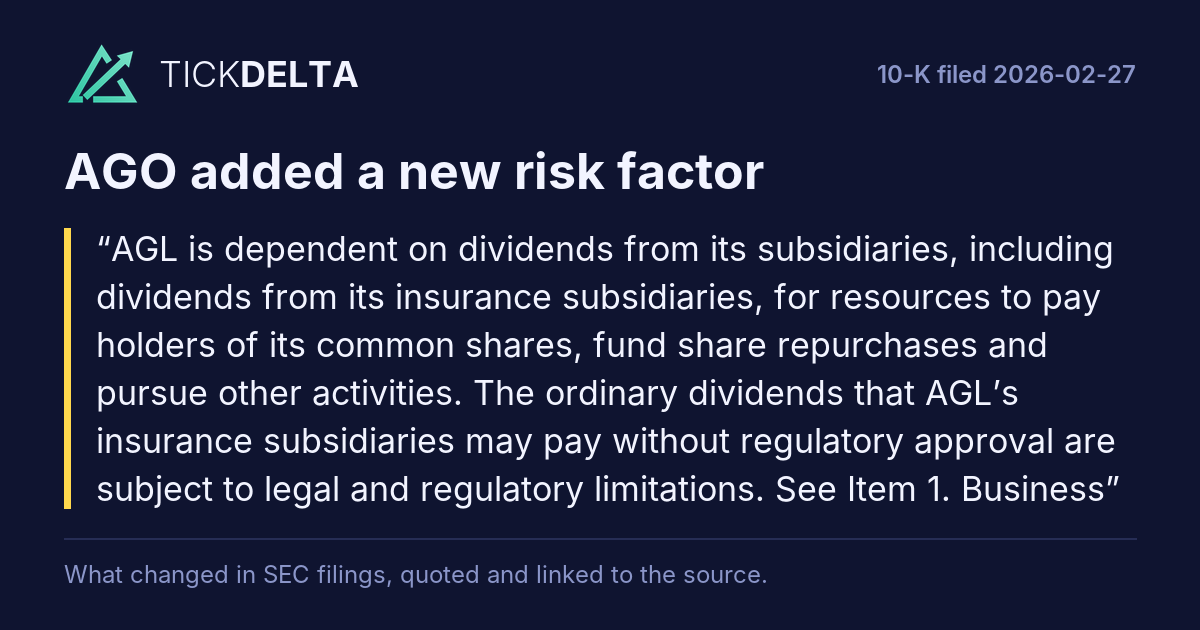
AGL is dependent on dividends from its subsidiaries, including dividends from its insurance subsidiaries, for resources to pay holders of its common shares, fund share repurchases and pursue other activities. The ordinary dividends that AGL’s insurance subsidiaries may pay without regulatory approval are subject to legal and regulatory limitations. See Item 1. Business
Paragraphs in the 10-Q filed Nov 6, 2026 that were not in the one before
New in the latest 10-Q
23 paragraphs in the 10-Q filed Nov 6, 2026 with nothing like them in the 10-Q filed Aug 7, 2026 (at least half the words must differ; new numbers alone do not count). Quoted exactly, grouped by the item heading above them. This is text that changed, not a judgement of how serious it is.
Financial statements and notes
(1) Asset Management segment revenues consist of incentive fees, which are performance fees earned by the consolidated general partner of a fund managed by Sound Point.
Read in the 10-Q
depleted following the July 1, 2026 interest payment. The Company’s exposure benefits from a continuing senior lien on the assets of Brightline.
Read in the 10-Q
On September 24, 2026, certain of Brightline’s affiliates filed for protection under Chapter 11 of the U.S. Bankruptcy Code. Brightline is not a debtor in the Chapter 11 proceedings, and the filings do not alter its payment obligations on the insured senior bonds. Under a restructuring support agreement (RSA) that is subject to certain conditions, Brightline is to receive $ 490 million of new capital upon its affiliates' exit from Chapter 11. That amount consists of $ 350 million of new junior debt and $ 140 million of additional senior debt. The $ 140 million of additional senior debt, of which the Company has committed to provide $ 70 million, ranks pari passu with the insured senior bonds. The RSA also provides for $ 258 million of post-petition funding to Brightline during the pendency of the Chapter 11 proceedings, ranking pari passu with Brightline’s existing senior debt, of which the Company has agreed to provide up to $ 122 million, and is to be repaid upon exit of the debtors from Chapter 11. The Company understands that Brightline intends to offer holders of its senior bonds the option of a limited deferral of scheduled interest payments in exchange for a fee and certain holders have committed to provide such a deferral. For insured holders electing the deferral, the Company will guarantee payment of the deferred interest when due; for insured holders not electing the deferral, the Company will continue to guarantee timely payment of interest as originally scheduled. As of November 5, 2026, the Company had not paid any claims in respect of its Brightline exposure.
Read in the 10-Q
Net Expected Loss to be Paid (Recovered) Economic Loss Development (Benefit) September 30, December 31, Third Quarter Nine Months 2026 2025 2026 2025 2026 2025 (dollars in millions) First lien U.S. RMBS $ 89 $ 90 $ (3) $ (2) $ (3) $ (4) Second lien U.S. RMBS (125) (144) (1) (29) (4) (36) Total U.S. RMBS $ (36) $ (54) $ (4) $ (31) $ (7) $ (40) Impact of changes in discount rates $ (3) $ 1 $ (3) $ — Range of discount rates 3.90 % 5.74% 3.45 % 4.97% Weighted average discount rate 4.94% 3.84% First lien U.S. RMBS weighted average future recovery for deferred principal balances 50.0% 50.0% Second lien U.S. RMBS weighted average future recoveries on charged-off loans 60.0% 60.0%
Read in the 10-Q
projected future interest rates were to fall below the weighted average coupon of the underlying mortgages, excess spread projections may increase.
Read in the 10-Q
Show the other 18
(1) The net amount at risk is the sum of any contract level shortfalls of account value below surrender value.
Read in the 10-Q
During third quarter 2026, the Company purchased a portion of the subordinated note of a CLO for $ 5 million that was accounted for as a purchased credit-deteriorated security (PCD security). At acquisition, this security had outstanding principal of $ 8 million, an allowance for credit losses of $ 2 million, and a non-credit related discount of $ 1 million. During nine months 2026, the Company purchased two securities with credit deterioration for $ 7 million. At acquisition, the securities had an outstanding principal of $ 11 million, an allowance for credit losses of $ 2 million, and a non-credit related discount of $ 2 million. The majority of securities with credit losses relate to RMBS, CLOs, obligations of state and political subdivisions and corporates.
Read in the 10-Q
The change in the ISCR of the FG VIEs’ assets for which the Company elected the FVO held as of September 30, 2026 that was reported in the condensed consolidated statements of operations for third quarter 2026 and nine months 2026 was a gain of $ 1 million and $ 3 million, respectively. The change in the ISCR of the FG VIEs’ assets at FVO held as of September 30, 2025 that was reported in the condensed consolidated statements of operations for third quarter 2025 and nine months 2025 was a gain of $ 3 million and $ 6 million, respectively. The ISCR amount is determined by using expected cash flows at the
Read in the 10-Q
original date of consolidation, discounted at the effective yield, less current expected cash flows discounted at that same original effective yield.
Read in the 10-Q
(4) $ 53 million of funds withheld is backed by Level 3 assets for which the discounted cash flows are used as the primary valuation technique.
Read in the 10-Q
interest rate environment, before narrowing again in 2022. The Company believes that wider credit spreads may improve demand for bond insurance.
Read in the 10-Q
analysis and underwriting. The Assured Life Re Acquisition represents the Company’s first platform dedicated solely to the annuity reinsurance business.
Read in the 10-Q
The Company also seeks to manage its capital efficiently through reinsurance and other risk transfer arrangements. The amount of excess capital the Company has under the capital adequacy models of the rating agencies depends in part on the credit performance of its insured portfolio, and any deterioration in insured obligations, including obligations supported by revenue streams, requires the Company to hold additional capital under those models, which reduces the Company’s excess capital. Therefore, from time to time, the Company pursues initiatives to cede portions of its insured portfolio to third-party reinsurers or to transfer risk through other arrangements. The Company expects these initiatives to reduce the capital required for the ceded exposures under the rating agency models, and thereby increase its excess capital under those models. Additional excess capital would support the Company’s ability to write new business, return capital to shareholders and pursue other strategic initiatives. The availability, terms and capital benefit of such arrangements are subject to market conditions and to their treatment under those models. See Part I, Item 1A, Risk Factors in the Company’s Annual Report on Form 10-K for the year ended December 31, 2025 for further discussion of factors affecting the Company’s capital requirements.
Read in the 10-Q
Non-U.S. public finance GWP and PVP in third quarter 2026 increased compared with third quarter 2025, by $34 million and $15 million, respectively, and were primarily attributable to an infrastructure finance transaction in France and a regulated energy transaction in Spain. GWP for non-U.S. public finance in third quarter 2025 was negative due to the early repayment of several U.K. sub-sovereign credits, which had no impact on third quarter 2025 PVP.
Read in the 10-Q
U.S. and non-U.S. structured finance GWP and PVP in third quarter 2026 increased compared with third quarter 2025, and results were primarily attributable to fund finance transactions, a commercial real estate balloon note guaranty transaction and a non-U.S. consumer receivables auto lending facility transaction.
Read in the 10-Q
The Company’s primary par written represented 49% of the total U.S. municipal market insured par sold in nine months 2026, as reported by LSEG; however, the LSEG number excludes $2.0 billion in par insured on military housing transactions and a university healthcare transaction. Including those transactions increases the Company’s par written to 52% of insured par sold. The 49% reported by LSEG compares with 63% in nine months 2025. The Company’s penetration of all municipal issuance was 2.9% in nine months 2026 compared with 5.0% in nine months 2025. While the Company’s U.S. primary par written will vary from period to period, the Company's U.S. public finance portfolio has been growing in recent years. After reaching a year-end low of $171.6 billion as of December 31, 2020, U.S. public finance insured net par outstanding has increased 28% to $219.7 billion as of September 30, 2026.
Read in the 10-Q
(1) Effective October 1, 2026, AGUS and AG amended this loan to extend the final maturity date to October 1, 2034, increase the annual interest rate to 4.8%, and provide for annual principal repayments of $25 million commencing October 1, 2027.
Read in the 10-Q
On October 14, 2026, AG Global, as borrower, and AGL, as guarantor, entered into a five-year $160 million unsecured revolving credit facility with KeyBank National Association, as administrative agent and lender. The facility may be used for loans and letters of credit for working capital, general corporate purposes and growth initiatives, and matures in October 2031. Subject to certain conditions, AG Global may increase the commitments by up to $90 million. As of November 5, 2026, no amounts were outstanding under the facility.
Read in the 10-Q
Other information
In connection with the previously announced retirement of Stephen Donnarumma from his role as the Chief Credit Officer of the Company, which was effective September 30, 2026, the Company entered into a separation agreement with Mr. Donnarumma on November 3, 2026 (the Separation Agreement). Pursuant to the Separation Agreement, Mr. Donnarumma will serve as senior advisor to the Chief Executive Officer during the period from October 1, 2026 through October 1, 2027 (the Transition Period and such end date, the Retirement Date), which Transition Period has been extended from his previously announced advisory period ending April 2, 2027.
Read in the 10-Q
The Separation Agreement provides that Mr. Donnarumma’s base salary during the Transition Period will be the same as his current base salary. In addition, Mr. Donnarumma will be eligible for certain cash and equity incentive opportunities. For the 2026 fiscal year, the Compensation Committee of AGL’s Board of Directors will determine the exact amount of Mr. Donnarumma’s incentive awards after the 2026 financial results are available. Mr. Donnarumma’s cash incentive will be determined based on his actual performance through September 30, 2026 as well as the 2026 financial performance of the Company, prorated for the nine months in which he served as Chief Credit Officer and an executive officer and will be subject to Mr. Donnarumma’s continued employment through the payment date. If the Compensation Committee grants Mr. Donnarumma equity awards relating to his 2026 performance through September 30, 2026, such awards will be subject to Mr. Donnarumma’s continued employment through the date of grant and will be granted as restricted share units pursuant to a grant agreement substantially in the form attached as an exhibit to the Separation Agreement, with one-third of such units generally settling on the one-year anniversary of the date of grant, one-third of such units settling on the two-year anniversary of the date of grant, and the remaining units settling on the three-year anniversary of the date of grant. In addition, for Mr. Donnarumma’s work through the Transition Period but subject to his continued employment through the Retirement Date, the Compensation Committee will grant him a cash incentive award for the 2027 fiscal year with a target amount of $345,865 (representing one-fourth of his 2025 cash incentive payment), payable within sixty days of the Retirement Date.
Read in the 10-Q
Mr. Donnarumma’s outstanding restricted share unit and performance share unit awards granted under the Assured Guaranty Ltd. 2024 Long-Term Incentive Plan or its predecessor plan (as applicable, the LTIP) will continue to vest in accordance with their terms through the Retirement Date. Upon his retirement, subject to the conditions described in the Separation Agreement, Mr. Donnarumma’s termination will be treated as a Retirement under the LTIP, entitling him to continued vesting and distribution of shares and dividend equivalents in accordance with the applicable grant agreements.
Read in the 10-Q
The Separation Agreement contains restrictive covenants including a two-year non-competition restriction prohibiting Mr. Donnarumma from engaging in activities competitive with the Company’s financial guaranty insurance, annuity reinsurance or asset management businesses, a two-year non-solicitation restriction with respect to the Company’s clients, customers, and employees, confidentiality obligations, and a non-disparagement provision.
Read in the 10-Q
The foregoing description of the Separation Agreement does not purport to be complete and is qualified in its entirety by reference to the full text of the Separation Agreement, a copy of which is filed as Exhibit 10.1 to this Quarterly Report on Form 10-Q.
Read in the 10-Q
The 10-Q's risk factors against the 10-K
Item 1A of the 10-Q filed Nov 6, 2026 against Item 1A of the 10-K filed Feb 27, 2026.
A 10-Q repeats only the risks that changed, so a 10-K paragraph that is missing from it is not counted as removed.
Added is a paragraph with nothing like it in the 10-K, Reworded a sentence that is in both with several words changed,
Quiet changes a sentence in both where one to four words changed and one is a hedge or a modal
(cut words struck through, new words highlighted).
Text on the page, not a score; each links to the filing at sec.gov.
What the 10-Q itself says about its risk factors:See the risk factors set forth in Part I, “Item 1A. Risk Factors” of the Company’s Annual Report on Form 10-K for the year ended December 31, 2025. There have been no material changes to the risk factors disclosed in such Annual Report on Form 10-K.
Read in the 10-Q
1 paragraph in the 10-Q's Item 1A, and none of them adds, rewords or quietly edits a paragraph of the 10-K's.
Phrases used for the first time
Two-word phrases in Risk Factors of the 10-K filed Feb 27, 2026 that are in none of the 1 earlier 10-Ks stored, back to Feb 28, 2025
Where each one is used
- annuity reinsurance: •The impact of narrow credit spreads on the demand for financial guaranty insurance and annuity reinsurance.
- assured life: •The Assured Life Re Acquisition may negatively impact the Company, including how it is perceived by its investors, regulators, rating agencies or obligors, as well as Assured Life Re’s business relationships.
- reinsurance contracts: The Company’s life and annuity reinsurance contracts expose it to longevity risk, which is the risk that the period the Company pays annuity or pension benefits exceeds that which it assumed in pricing its reinsurance contracts. Some of the
- longevity mortality: •Experience making pricing assumptions for life and annuity reinsurance products relating to longevity, mortality, policy lapses, withdrawals, surrenders, investment returns and expenses.
- asset liability: •Losses arising from asset/liability mismatch in the Company’s annuity reinsurance business.
- reinsurance products: •Experience making pricing assumptions for life and annuity reinsurance products relating to longevity, mortality, policy lapses, withdrawals, surrenders, investment returns and expenses.
- investment returns: •Experience making pricing assumptions for life and annuity reinsurance products relating to longevity, mortality, policy lapses, withdrawals, surrenders, investment returns and expenses.
- life re’s: •The Assured Life Re Acquisition may negatively impact the Company, including how it is perceived by its investors, regulators, rating agencies or obligors, as well as Assured Life Re’s business relationships.
Used at least twice, small words left out. Counted, not picked: a phrase can be new because the company renamed something.
What was taken out
6 paragraphs of last year's Risk Factors with nothing like them now. The longest are quoted.
Sources
Item 1A of each 10-K and 10-Q on EDGAR, quoted exactly. Each paragraph links to the filing at sec.gov.
Also
10-K change: what was reworded or cut, section by section.
Work with it
Excel workbook · CSV. Google Sheet that stays up to date: paste =IMPORTDATA("https://tickdelta.com/company/AGO/export.csv") into a cell.