Paragraph 61 · 50% changed
Every version of it
Screener
/
SEC EDGAR
/CIK 0000100591
/10-K filed Mar 26, 2026, compared with Mar 27, 2025
/Numbers from the XBRL of the 10-Ks
NYSE
Industrials · Construction - Special Trade Contractors
Argan Inc AGX
The 10-K against last year's
270 changes: 59 added, 92 removed, 113 reworded, 6 quiet changes
10-K Mar 26, 2026 vs Mar 27, 2025
Risk Factors
56.9%
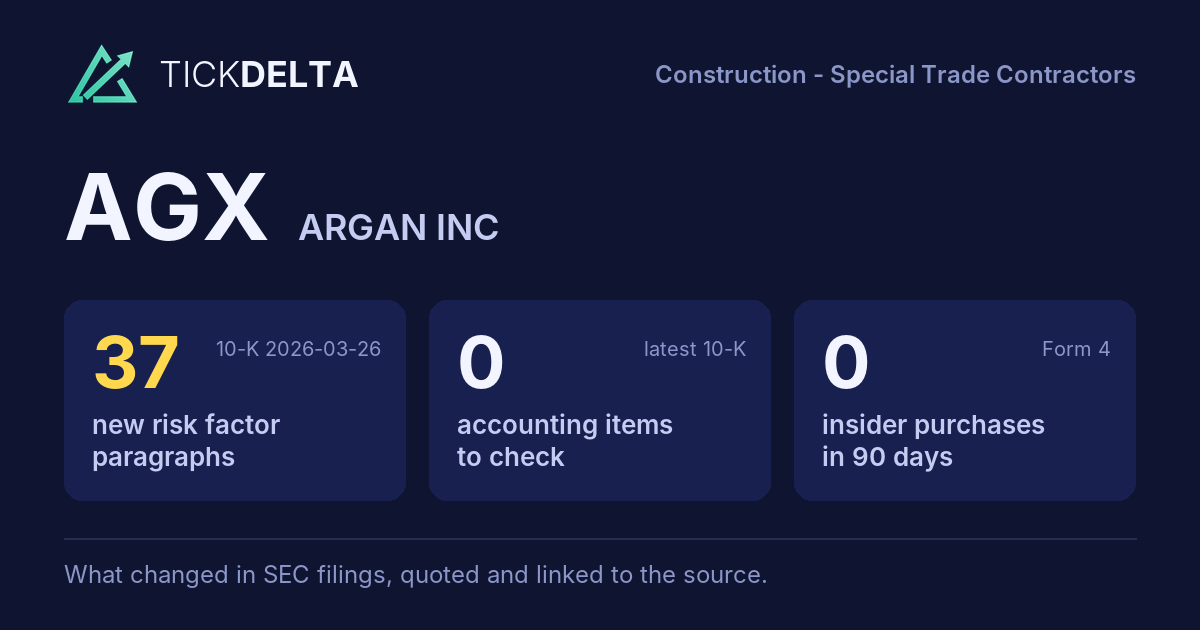
of the text changed · 6,657 words now · 37 new paragraphs, 51 gone
MD&A
51.7%
of the text changed · 7,321 words now · 22 new paragraphs, 41 gone
Legal Proceedings
39.1%
of the text changed · 328 words now
Accounting Policies
26.0%
of the text changed · 409 words now
10-K 0001104659-26-035216 (Mar 26, 2026) vs 10-K 0001558370-25-003819 (Mar 27, 2025)
Every paragraph, and how much of it changed
One bar per paragraph, in the order of the 10-K. Height and colour show the share of its words not in the closest paragraph a year earlier; the tallest bars are new paragraphs.
Risk Factors
111 paragraphs · 37 new · 51 reworded · 51 gone · 10-K Mar 26, 2026 against Mar 27, 2025
New paragraph
Reworded (5% of its words or more)
Same or nearly
Paragraph 12 · 50% changed
Every version of it
For each of our fixed-price customer contracts, we recognize revenues over the life of the contract as performance obligations are completed by us time based on the proportion of costs incurred to date compared with the relative to total costs estimated to be incurred for the entire project, and by using the resulting percentage to update the recorded amounts of project-to-date revenues. costs. We review and make necessary revisions to the amounts of update estimated future costs on a monthly basis. In addition, contract monthly. Contract results may also be impacted affected by our estimates of the amounts of related to change orders that we expect and the resolution of contract disputes. Changes in contract values or estimated costs may result in cumulative catch-up adjustments to receive revenue and our assessment of any contract disputes that may arise. The effects on revenues of changes to the amounts of profit, which could be material. Actual contract values and estimated costs are recorded as catch-up adjustments when the amounts are known and can be reasonably estimated. These revisions can occur at any time and may differ from estimates, which could be material. Given the uncertainties associated with the types of customer contracts that we are awarded, it is possible for contract values and actual costs to vary from estimates reduce or reverse previously made, which may result in reductions or reversals of previously recorded recognized revenues and profits. Our disclosures of Critical Accounting Policies and Estimates (see Item 7. Management’s Discussion and Analysis of Financial Condition and Results of Operations) include an expanded discussion of the estimates, judgments and assumptions that our revenue recognition accounting may require.
Paragraph 45 · 49% changed
Every version of it
Paragraph 27 · 47% changed
Every version of it
Paragraph 75 · 45% changed
Every version of it
Our dependence upon third parties to complete many perform portions of our contracts may work and supply materials and equipment could adversely affect our project performance under current and future construction contracts. profitability.
Paragraph 89 · 44% changed
Every version of it
Paragraph 23 · 44% changed
Every version of it
Paragraph 101 · 44% changed
Every version of it
The U.S. Foreign Corrupt Practices Act, the U.K. Bribery Act of 2010 and similar anti-bribery laws in other jurisdictions generally prohibit companies and their intermediaries from making improper payments to officials or others for the purpose of obtaining or retaining business. While we believe that our policies We maintain policies, procedures and oversight in this area are comprehensive and effective, internal controls designed to promote compliance with these laws. However, we cannot provide assurances assurance that our internal controls and procedures always will protect us from the possible reckless or criminal acts committed prevent violations by our employees or others. If we are found to be liable for anti-bribery law violations (either due to by third parties acting on our own acts or our inadvertence, or due to the acts or inadvertence of others behalf, including our partners, subcontractors or suppliers), we could suffer from criminal or civil penalties or other sanctions, including contract cancellations or debarment, and damage to our reputation, any of which could have a material adverse effect on our business. Litigation or investigations relating to alleged or suspected violations of anti-bribery laws, even if such litigation or investigations demonstrate ultimately that we did not violate anti-bribery laws, could be costly and could divert management’s attention away from other aspects of our business. suppliers.
Paragraph 61 · 50% changed
Every version of it
10-K Mar 27, 2025unforeseen increases in the costs of labor, warranties, raw materials, components or equipment, or our failure or inability to obtain resources when needed;
10-K Mar 26, 2026
inflation, specifically increases in the cost of labor, materials, components, equipment, warranties, or subcontractor services;
Paragraph 12 · 50% changed
Every version of it
10-K Mar 27, 2025
For each of our fixed-price customer contracts, we recognize revenues over the life of the contract as performance obligations are completed by us based on the proportion of costs incurred to date compared with the total costs estimated to be incurred for the entire project, and by using the resulting percentage to update the recorded amounts of project-to-date revenues. We review and make necessary revisions to the amounts of estimated future costs on a monthly basis. In addition, contract results may be impacted by our estimates of the amounts of change orders that we expect to receive and our assessment of any contract disputes that may arise. The effects on revenues of changes to the amounts of contract values and estimated costs are recorded as catch-up adjustments when the amounts are known and can be reasonably estimated. These revisions can occur at any time and could be material. Given the uncertainties associated with the types of customer contracts that we are awarded, it is possible for contract values and actual costs to vary from estimates previously made, which may result in reductions or reversals of previously recorded revenues and profits. Our disclosures of Critical Accounting Policies and Estimates (see Item 7. Management’s Discussion and Analysis of Financial Condition and Results of Operations) include an expanded discussion of the estimates, judgments and assumptions that our revenue recognition accounting may require.
10-K Mar 26, 2026
For fixed-price customer contracts, we recognize revenues over time based on the proportion of costs incurred to date relative to total estimated costs. We review and update estimated costs monthly. Contract results may also be affected by estimates related to change orders and the resolution of contract disputes. Changes in contract values or estimated costs may result in cumulative catch-up adjustments to revenue and profit, which could be material. Actual contract values and costs may differ from estimates, which could reduce or reverse previously recognized revenues and profits.
Paragraph 45 · 49% changed
Every version of it
10-K Mar 27, 2025Our business is subject to overseas economic and political conditions that change for reasons which are beyond our control. Such changes may have unfavorable consequences for us. Operating in the European marketplace, which for us exists primarily in Ireland and the U.K., may expose us to a number of risks including:
10-K Mar 26, 2026
A portion of our business is conducted outside the United States, primarily in Ireland and the U.K. Our international operations are subject to economic, political, regulatory, and social conditions that may change rapidly and are outside our control. These risks include:
Paragraph 27 · 47% changed
Every version of it
10-K Mar 27, 2025We have protections in our contracts with major customers that provide certain relief that helps to mitigate certain financial risks. However, the effectiveness of these protections may be limited by factors including the financial strength of the customer. The extent to which natural disasters, human-made disasters or other catastrophic events could harm us depends on the impact on our customers, supply chains, labor forces and numerous other evolving factors.
10-K Mar 26, 2026
Although our contracts with certain customers include provisions intended to provide limited relief from some of these risks, the effectiveness of such protection may depend on factors outside our control, including the financial condition of our customers. The ultimate impact of natural disasters, human-made disasters, or other catastrophic events depends on the severity, duration, and geographic scope of the event, as well as its effects on customers, supply chains, labor availability, and broader economic conditions. Any of these factors could adversely affect our business, financial condition, and results of operations.
Paragraph 75 · 45% changed
Every version of it
10-K Mar 27, 2025
Our dependence upon third parties to complete many of our contracts may adversely affect our performance under current and future construction contracts.
10-K Mar 26, 2026
Our dependence upon third parties to perform portions of our work and supply materials and equipment could adversely affect our project performance and profitability.
Paragraph 89 · 44% changed
Every version of it
10-K Mar 27, 2025Artificial intelligence poses risks that could adversely affect our business, results of operations, and financial condition.
10-K Mar 26, 2026
Failure to successfully execute acquisitions, integrations, or divestitures could adversely affect our business, financial condition, results of operations, and reputation.
Paragraph 23 · 44% changed
Every version of it
10-K Mar 27, 2025Market conditions, changes in our performance or financial position, changes in our surety’s assessment of its own operating and financial risk, or larger future projects could cause our surety company to decline to issue, or substantially reduce, the amount of bonding available for our work and/or could increase our bonding costs. These actions can be taken on short notice. If our surety company were to limit or eliminate our access to new bonds, our alternatives would include seeking bonding capacity from other surety companies, joint venturing with other construction firms, increasing business with clients that do not require bonds or posting other forms of collateral for project performance, such as letters of credit or cash. We may be unable to make alternative arrangements in a timely manner, on acceptable terms, or at all. Accordingly, if we were to experience an interruption, reduction or other alteration in the availability of bonding capacity, we may be unable to compete for or work on certain projects.
10-K Mar 26, 2026
Our construction contracts frequently require payment and/or performance bonds from surety companies as a condition of contract award. Although we have historically maintained sufficient bonding capacity, sureties typically issue bonds on a project-by-project basis and may require additional collateral or adjust bonding terms. Changes in market conditions, our financial position, project size, or a surety’s assessment of risk could affect the availability or cost of bonding. If bonding capacity were to become more limited, we could seek bonding from other surety providers, pursue joint ventures, increase work with clients that do not require bonds, or provide other forms of project security, such as letters of credit or cash. However, if adequate bonding or alternative arrangements were not available, our ability to compete for certain projects could be affected.
Paragraph 101 · 44% changed
Every version of it
10-K Mar 27, 2025
The U.S. Foreign Corrupt Practices Act, the U.K. Bribery Act of 2010 and similar anti-bribery laws in other jurisdictions generally prohibit companies and their intermediaries from making improper payments to officials or others for the purpose of obtaining or retaining business. While we believe that our policies and oversight in this area are comprehensive and effective, we cannot provide assurances that our internal controls and procedures always will protect us from the possible reckless or criminal acts committed by our employees or others. If we are found to be liable for anti-bribery law violations (either due to our own acts or our inadvertence, or due to the acts or inadvertence of others including our partners, subcontractors or suppliers), we could suffer from criminal or civil penalties or other sanctions, including contract cancellations or debarment, and damage to our reputation, any of which could have a material adverse effect on our business. Litigation or investigations relating to alleged or suspected violations of anti-bribery laws, even if such litigation or investigations demonstrate ultimately that we did not violate anti-bribery laws, could be costly and could divert management’s attention away from other aspects of our business.
10-K Mar 26, 2026
The U.S. Foreign Corrupt Practices Act, the U.K. Bribery Act of 2010 and similar anti-bribery laws in other jurisdictions generally prohibit companies and their intermediaries from making improper payments to officials or others for the purpose of obtaining or retaining business. We maintain policies, procedures and internal controls designed to promote compliance with these laws. However, we cannot provide assurance that our controls and procedures will prevent violations by our employees or by third parties acting on our behalf, including partners, subcontractors or suppliers.
MD&A
99 paragraphs · 22 new · 63 reworded · 41 gone · 10-K Mar 26, 2026 against Mar 27, 2025
New paragraph
Reworded (5% of its words or more)
Same or nearly
Paragraph 19 · 50% changed
In April August 2024, GPS executed we received FNTP on an LNTP with a customer EPC services contract to construct a utility-scale solar field in Illinois with the capacity to provide 405 MW of electrical power (the “405 MW Midwest Solar Project”). In August 2024, GPS received a full release for the activities on the EPC contract. The unique, multi-phased project includes solar-tracking panels that can be stowed by remote command for expected adverse weather events and will use pre-existing transmission and utility infrastructure from a nearby retired coal power plant. power. Project completion is scheduled for the first half of the fiscal year ending January 31, 2027 (“Fiscal 2027”). Fiscal 2027.
Paragraph 70 · 48% changed
We have entered into similar agreed to support arrangements with other independent parties in the past that resulted in the successful project developers, primarily by providing development and our construction of three separate financing to special purpose entities formed to advance natural gas-fired power plant projects. We were paid Several of these arrangements have resulted in our successful construction of gas-fired power plants. In each case, we received project development fees for each project fees, and our loans to the development entities were repaid in full plus interest. In each of these cases, interest and fees. Not all such business development endeavors are successful, and we deconsolidated have recorded impairment losses as a result in the corresponding VIE when we were no longer the primary beneficiary. past.
Paragraph 7 · 47% changed
Industrial: Our Industrial Construction Services: Through TRC, we provide primarily segment provides field services that support supporting new plant construction and additions, maintenance turnarounds, shutdowns and emergency mobilizations plant additions for industrial plants facilities primarily located in the Southeast region of the U.S. The segment also fabricates, delivers, and that may include the fabrication, delivery and installation of steel components such as installs metal components, including piping systems and pressure vessels. vessels, and performs maintenance turnarounds, shutdowns, and emergency mobilizations.
Paragraph 45 · 47% changed
For Fiscal 2025, we reported a 2026, consolidated gross profit of approximately $141.0 was $193.7 million, which represented representing a gross profit percentage of approximately 20.5% of consolidated revenues, compared with $141.0 million, or approximately 16.1% of corresponding consolidated revenues. For revenues, for Fiscal 2024, we reported a consolidated 2025. The increase in gross profit of approximately $80.8 million, which represented a gross profit percentage of approximately 14.1% of corresponding consolidated revenues. The gross profit percentage increased margin between periods was primarily due attributable to the changing mix of projects and contract types. Additionally, during Fiscal 2025 Our international operations experienced a significant improvement in profitability, reflecting strong execution and Fiscal 2024, strategic discipline. In addition, disciplined execution on the Trumbull Energy Center reduced project costs and enabled us to achieve substantial completion ahead of schedule. The gross profit was negatively impacted by losses recorded on percentages of corresponding revenues for the Kilroot Project, which reduced margins by approximately $3.4 million Power, Industrial and $10.0 million, Teledata segments for Fiscal 2026 were 22.4%, 12.1% and 19.5%, respectively. The gross profit percentages of corresponding revenues for the power industry services, industrial construction services Power, Industrial and telecommunications infrastructure services Teledata segments for Fiscal 2025 were 16.7%, 13.3% and 23.8%, respectively.
Paragraph 71 · 47% changed
In Fiscal 2025, we funded a loan to a special purpose entity in the amount of $5.0 million to support the development phase of a natural gas-fired power plant (see Note 18 to plant. During Fiscal 2026, the accompanying consolidated financial statements). We may enter into other support arrangements loan was repaid in the future in connection with power plant development opportunities when they arise and when we are confident that providing early financial support for the projects will lead to the award of the corresponding EPC contracts to us. full.
Paragraph 15 · 46% changed
In December 2024, GPS entered into April 2025, we received a notice to proceed on an EPC services contract and received the corresponding FNTP with to build a customer for an approximately 700 MW 1.2 GW combined-cycle natural gas-fired power plant located in the United States. Lee County, Texas. Project activity commenced in the fourth second quarter of Fiscal 2025. 2026. The project has an expected completion date in calendar year 2028.
Paragraph 3 · 46% changed
Paragraph 14 · 43% changed
In December 2024, GPS July 2025, we entered into an EPC services contract and received for the corresponding FNTP construction of a power plant with a customer for an planned electricity generation capacity of approximately 700 170 MW combined-cycle natural gas-fired power plant located in the United States. County Meath, Ireland. Project activity commenced in the fourth third quarter of Fiscal 2025. 2026. The project has an expected project completion date in calendar year 2028.
Paragraph 19 · 50% changed
10-K Mar 27, 2025
In April 2024, GPS executed an LNTP with a customer to construct a utility-scale solar field in Illinois with the capacity to provide 405 MW of electrical power (the “405 MW Midwest Solar Project”). In August 2024, GPS received a full release for the activities on the EPC contract. The unique, multi-phased project includes solar-tracking panels that can be stowed by remote command for expected adverse weather events and will use pre-existing transmission and utility infrastructure from a nearby retired coal power plant. Project completion is scheduled for the first half of the fiscal year ending January 31, 2027 (“Fiscal 2027”).
10-K Mar 26, 2026
In August 2024, we received FNTP on an EPC services contract to construct a utility-scale solar field in Illinois with the capacity to provide 405 MW of electrical power. Project completion is scheduled for Fiscal 2027.
Paragraph 70 · 48% changed
10-K Mar 27, 2025
We have entered into similar support arrangements with other independent parties in the past that resulted in the successful development and our construction of three separate gas-fired power plant projects. We were paid project development fees for each project and our loans to the development entities were repaid in full plus interest. In each of these cases, we deconsolidated the corresponding VIE when we were no longer the primary beneficiary.
10-K Mar 26, 2026
We have agreed to support arrangements with independent project developers, primarily by providing development financing to special purpose entities formed to advance natural gas-fired power plant projects. Several of these arrangements have resulted in our successful construction of gas-fired power plants. In each case, we received project development fees, and our loans were repaid in full plus interest and fees. Not all such business development endeavors are successful, and we have recorded impairment losses as a result in the past.
Paragraph 7 · 47% changed
10-K Mar 27, 2025
Industrial Construction Services: Through TRC, we provide primarily field services that support new plant construction and additions, maintenance turnarounds, shutdowns and emergency mobilizations for industrial plants primarily located in the Southeast region of the U.S. and that may include the fabrication, delivery and installation of steel components such as piping systems and pressure vessels.
10-K Mar 26, 2026
Industrial: Our Industrial segment provides field services supporting new plant construction and plant additions for industrial facilities primarily located in the Southeast region of the U.S. The segment also fabricates, delivers, and installs metal components, including piping systems and pressure vessels, and performs maintenance turnarounds, shutdowns, and emergency mobilizations.
Paragraph 45 · 47% changed
10-K Mar 27, 2025
For Fiscal 2025, we reported a consolidated gross profit of approximately $141.0 million, which represented a gross profit percentage of approximately 16.1% of corresponding consolidated revenues. For Fiscal 2024, we reported a consolidated gross profit of approximately $80.8 million, which represented a gross profit percentage of approximately 14.1% of corresponding consolidated revenues. The gross profit percentage increased between periods primarily due to the changing mix of projects and contract types. Additionally, during Fiscal 2025 and Fiscal 2024, gross profit was negatively impacted by losses recorded on the Kilroot Project, which reduced margins by approximately $3.4 million and $10.0 million, respectively. The gross profit percentages of corresponding revenues for the power industry services, industrial construction services and telecommunications infrastructure services segments for Fiscal 2025 were 16.7%, 13.3% and 23.8%, respectively.
10-K Mar 26, 2026
For Fiscal 2026, consolidated gross profit was $193.7 million, representing a gross profit percentage of approximately 20.5% of consolidated revenues, compared with $141.0 million, or approximately 16.1% of consolidated revenues, for Fiscal 2025. The increase in gross profit margin between periods was primarily attributable to the changing mix of projects and contract types. Our international operations experienced a significant improvement in profitability, reflecting strong execution and strategic discipline. In addition, disciplined execution on the Trumbull Energy Center reduced project costs and enabled us to achieve substantial completion ahead of schedule. The gross profit percentages of corresponding revenues for the Power, Industrial and Teledata segments for Fiscal 2026 were 22.4%, 12.1% and 19.5%, respectively. The gross profit percentages of corresponding revenues for the Power, Industrial and Teledata segments for Fiscal 2025 were 16.7%, 13.3% and 23.8%, respectively.
Paragraph 71 · 47% changed
10-K Mar 27, 2025
In Fiscal 2025, we funded a loan to a special purpose entity in the amount of $5.0 million to support the development phase of a natural gas-fired power plant (see Note 18 to the accompanying consolidated financial statements). We may enter into other support arrangements in the future in connection with power plant development opportunities when they arise and when we are confident that providing early financial support for the projects will lead to the award of the corresponding EPC contracts to us.
10-K Mar 26, 2026
In Fiscal 2025, we funded a loan to a special purpose entity in the amount of $5.0 million to support the development phase of a natural gas-fired power plant. During Fiscal 2026, the loan was repaid in full.
Paragraph 15 · 46% changed
10-K Mar 27, 2025
In December 2024, GPS entered into an EPC services contract and received the corresponding FNTP with a customer for an approximately 700 MW combined-cycle natural gas-fired power plant located in the United States. Project activity commenced in the fourth quarter of Fiscal 2025.
10-K Mar 26, 2026
In April 2025, we received a notice to proceed on an EPC services contract to build a 1.2 GW combined-cycle natural gas-fired power plant in Lee County, Texas. Project activity commenced in the second quarter of Fiscal 2026. The project has an expected completion date in calendar year 2028.
Paragraph 3 · 46% changed
10-K Mar 27, 2025This section of our 2025 Annual Report may include projections, assumptions and beliefs that are intended to be “forward-looking statements.” They should be read in light of our cautionary statement regarding “forward-looking statements” presented at the beginning of this 2025 Annual Report. The following discussion summarizes the financial position of Argan, Inc. and its subsidiaries as of January 31, 2025, and the results of their operations for Fiscal 2025 and Fiscal 2024, and should be read in conjunction with the consolidated financial statements and notes thereto included elsewhere in Item 8 of this 2025 Annual Report.
10-K Mar 26, 2026
Fiscal 2025, and should be read in conjunction with the consolidated financial statements and notes thereto included elsewhere in Item 8 of this 2026 Annual Report.
Paragraph 14 · 43% changed
10-K Mar 27, 2025
In December 2024, GPS entered into an EPC services contract and received the corresponding FNTP with a customer for an approximately 700 MW combined-cycle natural gas-fired power plant located in the United States. Project activity commenced in the fourth quarter of Fiscal 2025.
10-K Mar 26, 2026
In July 2025, we entered an EPC services contract for the construction of a power plant with a planned electricity generation capacity of approximately 170 MW in County Meath, Ireland. Project activity commenced in the third quarter of Fiscal 2026. The project has an expected project completion date in calendar year 2028.
A paragraph is matched with the one last year that shares the most of its words; under half in common makes it new. The paragraphs shown are the 8 reworded the most in each section.
The paragraph that changed most in each section
The redline
Marked against last year's 10-K: cut words struck through, new words highlighted.
Risk Factors235 words changed in this paragraph; it is 31% similar to last year's version.
Source: Item 1A, 10-K 0001104659-26-035216 vs Item 1A, 10-K 0001558370-25-003819
MD&A190 words changed in this paragraph; it is 46% similar to last year's version.
Source: Item 7, 10-K 0001104659-26-035216 vs Item 7, 10-K 0001558370-25-003819
Legal Proceedings153 words changed in this paragraph; it is 66% similar to last year's version.
In March 2025, APC’s our U.K. subsidiary in the U.K., Atlantic Projects Company (UK) Limited (“APC UK”), sued EP NI Energy Limited and EP UK Investment Limited (together referred to as “EP”) in the High Court of Justice, Business and Property Courts of England and Wales for EP’s breach of contract and failure to remedy various events which negatively impacted the schedule and costs of a project to construct a 2 x 330 MW natural gas-fired power plant in Carrickfergus (the “Kilroot Project”), an overseas project, resulting in EP receiving the benefits of the construction efforts of APC UK our U.K. subsidiary and the corresponding progress on the project without making payments for to which our U.K. subsidiary was contractually entitled. Our U.K. subsidiary provided the value received. As previously disclosed, APC UK provided 14 days’ project owner notice to terminate as a result because of project owner breaches of the contract. Those breaches were not resolved during that 14-day period, resolved, as a result of which the contract terminated on May 3, 2024. APC UK Subsequently, the project owner made a draw for the full amount of a $10.0 million irrevocable letter of credit, or on-demand performance bond, issued by our bank. We believe the project owner improperly initiated the draw on the bond and, therefore, the amount should be refunded. This amount is included in accounts receivable as of January 31, 2026. Our U.K. subsidiary has significant billable receivables, unresolved contract variations and claims for extensions of time, among other issues, related to the Kilroot Project. an overseas project. The project owner has asserted counterclaims that APC UK our U.K. subsidiary disputes. APC UK Our U.K. subsidiary will vigorously assert its rights and claims in order to recover its lost value and collect any remaining monies owed.
Source: Item 3, 10-K 0001104659-26-035216 vs Item 3, 10-K 0001558370-25-003819
Accounting Policies115 words changed in this paragraph; it is 66% similar to last year's version.
Through GPS and APC, the Power segment, the Company provides a full range of engineering, procurement, construction, commissioning, maintenance, project development development, and technical consulting services to the power generation market. The customers include primarily independent power producers, public utilities, power plant equipment suppliers and other commercial firms with significant power requirements. Customer projects are located in the United States (the “U.S.”), the Republic of Ireland (“Ireland”) and the United Kingdom (the “U.K.”). GPS and APC represent the The Company’s power industry services reportable segment. Through TRC, the industrial construction services reportable Industrial segment provides on-site services that support new plant construction and additions, maintenance turnarounds, shutdowns and emergency mobilizations additions for industrial operations facilities primarily located in the Southeast region of the U.S. The segment also fabricates, delivers, and that may include the fabrication, delivery and installation of steel components such as installs metal components, including piping systems and pressure vessels. Through SMC, which conducts business as SMC Infrastructure Solutions, the telecommunications infrastructure services vessels, and performs maintenance turnarounds, shutdowns, and emergency mobilizations. The Company’s Teledata segment provides project management, construction, installation installation, maintenance, repair, and maintenance emergency response services to commercial, local government for power distribution and information, communication, and data networks. The segment’s customers include commercial and industrial organizations, as well as state and federal government customers agencies, primarily in throughout the Mid-Atlantic region of the U.S.
Source: 10-K text, Note 1 – DESCRIPTION OF THE BUSINESS AND BASIS OF PRESENTATION, 10-K 0001104659-26-035216 vs 10-K text, Note 1 – DESCRIPTION OF THE BUSINESS AND BASIS OF PRESENTATION, 10-K 0001558370-25-003819
Sentences and paragraphs added, removed or reworded
Every change, by type
Sentences and paragraphs of AGX's Risk Factors and MD&A, 10-K Mar 26, 2026 against 10-K Mar 27, 2025. Each links to the text at sec.gov.
Quiet changes are sentences kept from last year with one to four words changed, at least one of them a hedge, a modal or a qualifier (may, could, will, not, significant, material…). A year or date rolling forward is not counted.
The full word list
adverse, adversely, all, although, anticipate, anticipates, any, approximately, believe, believes, can, cannot, certain, could, expect, expects, generally, however, if, intend, intends, largely, likely, many, material, materially, may, might, most, must, never, no, not, possible, primarily, probable, should, significant, significantly, some, substantial, substantially, unlikely, will, would
AddedRisk Factors
During periods of reduced economic activity, customers may delay, reduce, or cancel projects, including new construction, maintenance, repairs, and outage work. In addition, adverse industry conditions may reduce our customers’ ability or willingness to fund capital expenditures. These conditions could result in delays, reductions, or cancellations of projects that are important to our business and future results.
Read it in 10-K Mar 26, 2026 at sec.gov
AddedRisk Factors
Contracts may be delayed or canceled after award, and project commencement is often subject to receipt of a notice to proceed. Failure to secure future EPC project awards, obtain notices to proceed, or successfully complete awarded projects could adversely affect our future revenues, profitability, and cash flows.
Read it in 10-K Mar 26, 2026 at sec.gov
AddedRisk Factors
Our financial results may fluctuate due to the timing of large construction projects.
Read it in 10-K Mar 26, 2026 at sec.gov
AddedRisk Factors
Geopolitical conflicts and related global disruptions may also adversely affect energy markets and supply chains. For example, the war in Ukraine and other international conflicts have contributed to volatility in global energy supply and pricing, increased transportation costs, shipping disruptions, and delays in the delivery of materials and equipment. In addition, escalation of military conflict involving Iran could disrupt global oil and liquefied natural gas (“LNG”) markets, including potential impacts to shipping through key transit routes. These conditions may increase project costs, delay schedules, or reduce demand for certain projects.
Read it in 10-K Mar 26, 2026 at sec.gov
AddedRisk Factors
Disruptions or unfavorable changes in power market economics, including reductions in spark spreads or changes in capacity market pricing, could reduce demand for new power generation projects in certain regions.
Read it in 10-K Mar 26, 2026 at sec.gov
AddedRisk Factors
Historically, a portion of our EPC business has been driven by the development of utility-scale power generation projects. In many regions, the economic viability of new generation projects depends on the expected margin between wholesale electricity prices and the cost of fuel and operations, commonly referred to as the spark spread. In certain wholesale markets, project economics may depend in part on revenues from capacity markets that compensate power generators for maintaining available capacity to support grid reliability. Declines in spark spreads resulting from lower power prices, higher fuel costs, or other market conditions, as well as decreases in capacity market prices or changes to capacity market rules that reduce expected revenues, could reduce the expected returns on new power generation projects and discourage or delay project development. If fewer projects are developed in regions important to our business, our revenues, profitability, and cash flows could be adversely affected.
Read it in 10-K Mar 26, 2026 at sec.gov
AddedRisk Factors
We may use artificial intelligence, machine learning, and similar technologies (“AI”), including AI-enabled features in third-party products, to support our business processes. Although our current use of AI is limited, we may expand our use of these technologies over time.
Read it in 10-K Mar 26, 2026 at sec.gov
AddedRisk Factors
AI creates data security, confidentiality, and privacy risks. Unauthorized or improper use of AI tools by employees, vendors, or third parties could result in the disclosure of sensitive or proprietary information, including customer information, pricing, contract terms, and other confidential business data. In addition, we may have limited control over how third-party AI tools process, store, or protect data, even where contractual protections are in place. AI-related laws, regulations, and contractual requirements are evolving and may impose additional compliance costs, restrict our use of AI, or expose us to regulatory investigations, litigation, or liability. Any of these risks could adversely affect our business, financial condition, and results of operations.
Read it in 10-K Mar 26, 2026 at sec.gov
Show the other 70
AddedRisk Factors
A significant portion of our power construction business has historically been supported by the development of combined-cycle natural gas-fired power plants. The economics of these projects, and the willingness of developers and lenders to finance them, are sensitive to natural gas prices and related market expectations. If natural gas prices increase or become more volatile, developers may delay, reduce, or cancel new natural gas-fired generation projects or may be unable to obtain construction or permanent financing on acceptable terms.
Read it in 10-K Mar 26, 2026 at sec.gov
AddedRisk Factors
Natural gas prices may be affected by a variety of factors, including changes in domestic supply and demand dynamics, increased U.S. LNG exports, and regulatory developments affecting natural gas production. A significant portion of U.S. natural gas supply is produced using hydraulic fracturing and horizontal drilling, which remain subject to evolving federal, state, and local regulation and public opposition. If these or other factors limit natural gas production or increase price volatility, the economic attractiveness of natural gas-fired power plants could decline. Any reduction in the development of new natural gas-fired power plants could reduce demand for our EPC services and adversely affect our revenues, profitability, and cash flows.
Read it in 10-K Mar 26, 2026 at sec.gov
AddedRisk Factors
The EPC market for utility-scale power generation projects is highly competitive and subject to changes in participant strategies over time. While certain competitors have reduced their participation in this market or limited their willingness to enter fixed-price contracts, other competitors remain well-capitalized and have significant personnel, equipment, and operating scale. In addition, as utilities and developers pursue new generation capacity, additional firms may re-enter or expand their participation in the market.
Read it in 10-K Mar 26, 2026 at sec.gov
AddedRisk Factors
Our ability to compete effectively depends on factors including financial strength, access to skilled labor and equipment, execution performance, and the effective use of technology. Competitive pressures may require us to accept lower margins, assume greater contractual risk, or offer more favorable terms to customers. If we are unable to compete successfully and win new projects on acceptable terms, we could lose market share, experience reduced revenues and profitability, or incur losses on individual projects.
Read it in 10-K Mar 26, 2026 at sec.gov
RemovedRisk Factors
RemovedRisk Factors
RemovedRisk Factors
RemovedRisk Factors
RemovedRisk Factors
RemovedRisk Factors
RemovedRisk Factors
RemovedRisk Factors
RemovedRisk Factors
RemovedRisk Factors
RemovedRisk Factors
RemovedRisk Factors
RewordedRisk Factors
If our surety company bonding capacity were to limit or eliminate our access to new bonds, our alternatives would include seeking become more limited, we could seek bonding capacity from other surety companies, providers, pursue joint venturing with other construction firms, increasing business ventures, increase work with clients that do not require bonds bonds, or posting provide other forms of collateral for project performance, security, such as letters of credit or cash.
Read it in 10-K Mar 26, 2026 at sec.gov
RewordedRisk Factors
We have been, and may be in the future, future be, named as a defendant in legal proceedings where parties may allege breach proceedings, including matters arising in the ordinary course of contract and seek recovery for damages or other remedies with respect to our projects or other matters business (see Item 3, Legal Proceedings).
Read it in 10-K Mar 26, 2026 at sec.gov
RewordedRisk Factors
RewordedRisk Factors
The extent to which ultimate impact of natural disasters, human-made disasters disasters, or other catastrophic events could harm us depends on the impact severity, duration, and geographic scope of the event, as well as its effects on our customers, supply chains, labor forces availability, and numerous other evolving factors. broader economic conditions.
Read it in 10-K Mar 26, 2026 at sec.gov
RewordedRisk Factors
The engineering and construction industry is prone subject to cyclical fluctuations influenced by factors such as due to economic recessions, downturns in conditions, project owners’ business cycles, material shortages, labor and materials constraints, subcontractor price hikes, pricing, interest rate changes, and regulatory and or political change, and other external economic factors. developments.
Read it in 10-K Mar 26, 2026 at sec.gov
RewordedRisk Factors
RewordedRisk Factors
RewordedRisk Factors
The results examination of current or future our income tax return examinations returns by tax authorities, or the resolution of any related appeals, could result in unfavorable adjustments to the amounts of income taxes previously recorded and/or or paid.
Read it in 10-K Mar 26, 2026 at sec.gov
RewordedRisk Factors
RewordedRisk Factors
RewordedRisk Factors
We began to repurchase shares of our common stock in November 2021, and we have repurchased shares of our common stock during each fiscal year since then (see Item 5 in Part II of this 2025 Annual Report and Note 14 to the accompanying consolidated financial statements). then.
Read it in 10-K Mar 26, 2026 at sec.gov
RewordedRisk Factors
Our business is international operations are subject to overseas economic economic, political, regulatory, and political social conditions that may change for reasons which rapidly and are beyond outside our control.
Read it in 10-K Mar 26, 2026 at sec.gov
Quiet changesRisk Factors
Demand for our services may decrease during economic downturns or unpredictable economic cycles, which would most likely could affect our businesses adversely.
Read it in 10-K Mar 26, 2026 at sec.gov
Quiet changesRisk Factors
Unexpected and adverse changes in the foreign countries in which we operate could result in project disruptions, increased costs and potential losses.
Read it in 10-K Mar 26, 2026 at sec.gov
Quiet changesRisk Factors
If we are required to pay such costs, the total costs of the project would likely could exceed our original estimate, and we could experience reduced profits or a loss related to the applicable project.
Read it in 10-K Mar 26, 2026 at sec.gov
AddedMD&A
Teledata: Our Teledata segment provides project management, construction, installation, maintenance, repair, and emergency response services across power distribution and information, communications, and data networks. The segment’s customers include commercial and industrial organizations, as well as state and federal government agencies, primarily throughout the Mid-Atlantic region of the U.S.
Read it in 10-K Mar 26, 2026 at sec.gov
AddedMD&A
As of January 31, 2026, our Industrial segment’s project backlog was approximately $253.0 million as compared to $53.2 million on January 31, 2025. During Fiscal 2026, the Industrial segment added contracts to its project backlog related to
Read it in 10-K Mar 26, 2026 at sec.gov
AddedMD&A
an automotive plant, data centers, an aluminum rolling and recycling facility, a water treatment plant, and facilities related to certain other industries.
Read it in 10-K Mar 26, 2026 at sec.gov
AddedMD&A
Electricity demand in the United States has increased to its highest levels in approximately two decades, driven by continued growth in data centers, increased electrification across transportation and industrial sectors, and ongoing onshoring of manufacturing activities. At the same time, a significant portion of the existing power generation fleet is aging or being retired, creating challenges for grid reliability as capacity additions struggle to keep pace with rising demand.
Read it in 10-K Mar 26, 2026 at sec.gov
AddedMD&A
Grid operators have emphasized the need for additional dispatchable, reliable power sources to support system stability, particularly during periods of peak demand or reduced renewable output. These dynamics continue to influence investment decisions across the power generation sector. The timing and economics of power generation projects may also be influenced by evolving federal, state, and local regulatory requirements, permitting processes, and energy-related incentive programs, which can affect development schedules, financing, and project viability.
Read it in 10-K Mar 26, 2026 at sec.gov
AddedMD&A
Natural gas remains the primary source of utility-scale electricity generation in the United States and continues to play a central role in maintaining grid reliability. The retirement of coal-fired facilities, combined with the efficiency, flexibility, and lower emissions profile of modern combined-cycle and simple-cycle gas plants, has supported sustained demand for natural gas-fired generation.
Read it in 10-K Mar 26, 2026 at sec.gov
AddedMD&A
The pace of new gas-fired power plant development faces certain challenges, including equipment supply constraints, the limited number of EPC contractors, interconnection delays, evolving regulatory requirements, and financing considerations. In addition, long-term clean energy and decarbonization goals adopted by various jurisdictions may influence development timelines. However, recent actions by grid operators and state governments highlight a growing recognition of the importance of dispatchable generation in supporting reliability. Programs designed to incentivize new power capacity, including gas-fired facilities, reflect this focus. We believe that the operating efficiency, fuel availability, and operational flexibility of natural gas-fired power plants position them to remain a critical component of the U.S. generation mix, particularly as a complement to renewable energy resources.
Read it in 10-K Mar 26, 2026 at sec.gov
AddedMD&A
Utility-scale solar generation and battery storage capacity continue to grow in the United States, supported by declining technology costs, advancements in energy storage, and available incentives. Battery storage, in particular, has become increasingly important in addressing the intermittency of renewable generation and enhancing grid flexibility. While renewable capacity additions are expected to continue, these resources typically require firm, dispatchable generation to ensure reliability. As a result, renewable energy development often requires natural gas-fired generation and energy storage solutions to support system balance and performance.
Read it in 10-K Mar 26, 2026 at sec.gov
AddedMD&A
Behind-the-meter ("BTM") generation is becoming more prevalent among commercial and industrial customers, particularly data center developers facing tight timelines and interconnection constraints. As BTM resources expand alongside renewables, grid operators may require additional flexible dispatchable generation to maintain reliability, which could support continued demand for natural gas-fired power plants.
Read it in 10-K Mar 26, 2026 at sec.gov
AddedMD&A
Nuclear energy may influence future generation capacity additions, with industry focus increasingly shifting toward small modular reactors ("SMRs") given the extended timelines, regulatory complexity, and high capital costs associated with
Read it in 10-K Mar 26, 2026 at sec.gov
AddedMD&A
conventional nuclear development. While interest in nuclear has grown due to its minimal carbon footprint, meaningful new capacity is generally not expected at scale for several years.
Read it in 10-K Mar 26, 2026 at sec.gov
AddedMD&A
Our domestic operations of our Power segment historically has represented the predominant portion of our power-related revenues. However, overseas power markets may continue to provide important new power construction opportunities, particularly in Ireland and the United Kingdom. Both markets are pursuing ambitious renewable energy objectives while also emphasizing the need for flexible, dispatchable generation and grid-supporting technologies to maintain reliability as renewable penetration increases. In Ireland, energy policy continues to support the development of additional generation and grid support resources, including natural gas-fired generation, battery storage, and other technologies intended to enhance security of supply. In the U.K., energy policy continues to evolve, with ongoing efforts to expand renewable generation while recognizing the role of flexible conventional generation and grid infrastructure in supporting system reliability. We continue to pursue selective construction opportunities in these markets consistent with our experience in power generation and related infrastructure.
Read it in 10-K Mar 26, 2026 at sec.gov
RemovedMD&A
RemovedMD&A
RemovedMD&A
RemovedMD&A
RemovedMD&A
RemovedMD&A
RemovedMD&A
RemovedMD&A
RemovedMD&A
RemovedMD&A
RemovedMD&A
RemovedMD&A
RewordedMD&A
The revenues of industrial construction services increased by $24.8 million, or 17.4%, the Industrial segment were essentially flat at $167.6 million for Fiscal 2026 compared to $167.6 million for Fiscal 2025 compared with revenues of $142.8 million for Fiscal 2024 2025, as the amounts of increased field services construction activities increased meaningfully between periods, partially were largely offset by decreased supporting vessel fabrication work between periods.
Read it in 10-K Mar 26, 2026 at sec.gov
RewordedMD&A
Our net liquidity increased by $56.5 $119.6 million to $421.0 million as of January 31, 2026 from $301.4 million as of January 31, 2025 from $244.9 million as of January 31, 2024, 2025, due primarily to our net income for the fiscal year, income, partially offset by the payment of cash dividends, common stock repurchases, and settlements of share-based awards, net cash paid for of withholding taxes due to stock-based award net settlements. paid.
Read it in 10-K Mar 26, 2026 at sec.gov
RewordedMD&A
The New Credit Agreement supersedes the Expired Credit Agreement, reduces the which was amended on October 23, 2025, has a base lending commitment amount from $50.0 of $35.0 million to $35.0 million, increases the letter of credit fees to be consistent with current market conditions, and establishes the interest rate for revolving loans at SOFR plus 1.85%.
Read it in 10-K Mar 26, 2026 at sec.gov
RewordedMD&A
RewordedMD&A
The following discussion summarizes the financial position of Argan, Inc. and its subsidiaries as of January 31, 2025, 2026, and the results of their operations for Fiscal 2025 2026 and Fiscal 2024, and should be read in conjunction with the consolidated financial statements and notes thereto included elsewhere in Item 8 of this 2025 Annual Report.
Read it in 10-K Mar 26, 2026 at sec.gov
RewordedMD&A
The increase in revenues between years was partially offset by decreased construction activities associated with the Guernsey Power Station project, Trumbull Energy Center, the Midwest Solar and Battery Projects, the Louisiana LNG Facility, the ESB FlexGen Peaker Plants, and the Shannonbridge Power Project and the Kilroot Project, as those projects are in their later stages or have fully concluded.
Read it in 10-K Mar 26, 2026 at sec.gov
RewordedMD&A
For Fiscal 2025, we reported a 2026, consolidated gross profit of approximately $141.0 was $193.7 million, which represented representing a gross profit percentage of approximately 20.5% of consolidated revenues, compared with $141.0 million, or approximately 16.1% of corresponding consolidated revenues. revenues, for Fiscal 2025.
Read it in 10-K Mar 26, 2026 at sec.gov
RewordedMD&A
In general, making these assessments, we consider potential liquidated damages, the costs of other related items costs, and potential any mitigating factors in determining the estimates of estimating forecasted revenues and the adequacy of our estimates of the cost costs to complete contracts. complete.
Read it in 10-K Mar 26, 2026 at sec.gov
RewordedMD&A
RewordedMD&A
In December 2024, GPS October 2025, we entered into an EPC services contract and received the corresponding FNTP with a customer full notice to proceed (“FNTP”) for the construction of an approximately 700 860 MW combined-cycle natural gas-fired power plant located in the United States. ERCOT market.
Read it in 10-K Mar 26, 2026 at sec.gov
RewordedMD&A
We recorded income tax expense for Fiscal 2025 2026 in the net amount of approximately $25.7 million primarily due to our reporting pre-tax income for financial reporting purposes in the amount of $111.2 million for the year. $22.7 million.
Read it in 10-K Mar 26, 2026 at sec.gov
RewordedMD&A
This tax rate differed from the statutory federal tax rate of 21% due to the unfavorable effect favorable effects of state income taxes the windfall benefit from stock-based compensation and the unfavorable effects of certain nondeductible expense amounts. change in valuation allowance for NOLs.
Read it in 10-K Mar 26, 2026 at sec.gov
Quiet changesMD&A
We have pledged the majority most of the Company’s assets to secure its financing arrangements.
Read it in 10-K Mar 26, 2026 at sec.gov
Quiet changesMD&A
The Bank’s consent is not required for acquisitions, divestitures, cash dividends or significant investments as long as if certain conditions are met.
Read it in 10-K Mar 26, 2026 at sec.gov
Quiet changesMD&A
The accuracy of our revenues and profit recognition in a given any period depends on the accuracy of our estimates of the forecasted contract value, or transaction price, and the cost to complete the work for each project.
Read it in 10-K Mar 26, 2026 at sec.gov
Sources
The two latest 10-Ks on EDGAR, section by section. Each change links to the text at sec.gov.
Also
New risk factors: paragraphs with nothing like them last year, quoted in full.
Work with it
Excel workbook · CSV. Google Sheet that stays up to date: paste =IMPORTDATA("https://tickdelta.com/company/AGX/export.csv") into a cell.