Screener / SEC EDGAR /CIK 0001632970 /10-K filed Feb 27, 2026, compared with Feb 28, 2025 /Numbers from the XBRL of the 10-Ks
NYSE Real estate · REIT

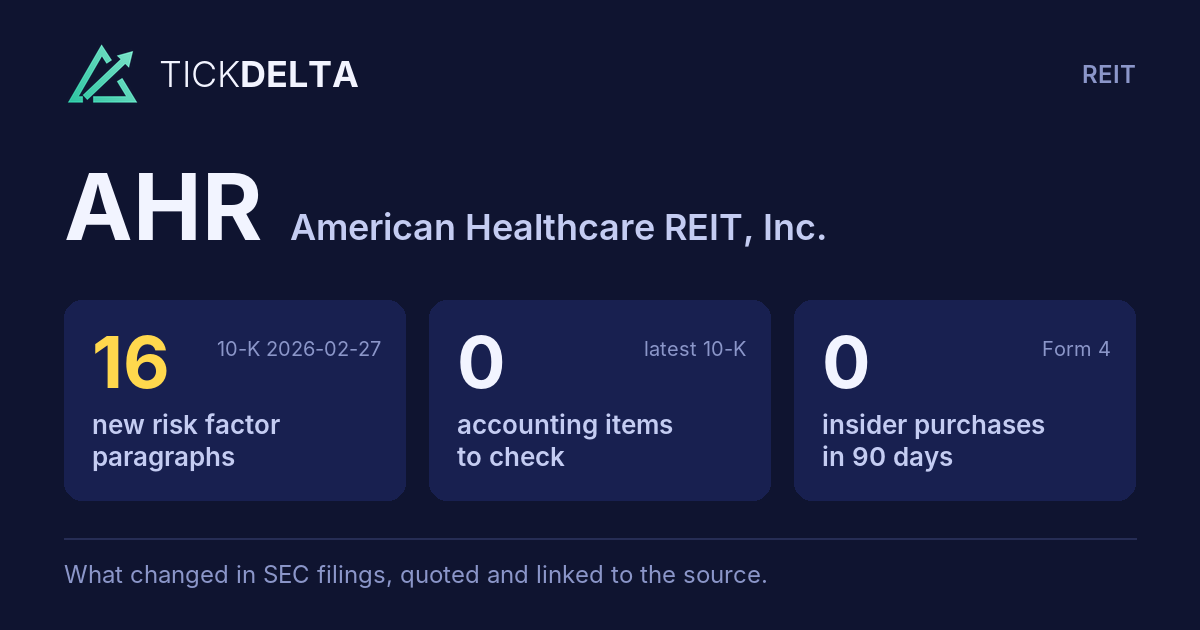
American Healthcare REIT, Inc. AHR

Compare with peers Embed
SEC comment letters, last 20 years

4 reviews of AHR's filings by SEC staff

UPLOAD and CORRESP
Reviews 4 latest letter Jun 24, 2024
Questions asked 41 each answered in the company's own letter
No closing letter 3 reviews without a letter saying the staff completed it

When the SEC's staff reviews a filing, it writes to the company with numbered questions, and the company answers each one in a letter. SEC publishes the exchange once the review is over, at least 20 business days later. A question is not an accusation; most reviews end with the company adding detail to its next filing.

How the reviews went

Every review on EDGAR, from the first staff letter to the letter that closes it

  1. 1. Staff letters 8 UPLOAD
  2. 2. Questions in them 41 numbered comments
  3. 3. Company replies 8 CORRESP
  4. 4. Reviews closed 1 of 4 closing letter

Half the closed reviews took 15 days or less from the first letter to the closing letter.

Form 10-K for the fiscal year ended December 31, 2023

2024-06-24 to 2024-07-09 · 2 questions · 1 letter from the SEC, 1 from the company
Review closed 2024-07-09
Non-GAAP measuresResults discussion (MD&A)
After reviewing your response to this letter, we may have additional comments. Exhibit 99.1, page 9
SEC asked (1)
We note your calculation of EBITDA contains adjustments for items other than interest, taxes, depreciation and amortization. Please revise in future filings to ensure that measures calculated differently from EBITDA are not characterized as EBITDA and have titles that are distinguished from "EBITDA", such as "Adjusted EBITDA".
Rest of the question

Reference is made to Question 103.01 of the Compliance & Disclosure Interpretations for Non-GAAP Financial Measures.

AHR answered
The Company acknowledges the Staff’s comment and will revise its disclosure in future filings to ensure that measures calculated differently from EBITDA are not characterized as EBITDA and have titles that are distinguished from “EBITDA,” such as “Adjusted EBITDA.”
Read in the reply
In its next report

First report after the company's reply of Jul 2, 2024: 10-Q filed Aug 9, 2024 ↗, against the 10-Q filed May 14, 2024 ↗.

Tickdelta does not hold the text of both reports, so they are not compared here.
After reviewing your response to this letter, we may have additional comments. Exhibit 99.1, page 9
SEC asked (2)
Please tell us and disclose in future filings the reasons why management believes that the presentation of certain non-GAAP financial measures (e.g. Cash NOI, Pro-Rata Cash NOI, Same-Store NOI, EBITDA and Adjusted EBITDA) provides useful information to investors regarding the registrant's financial condition and results of operations. Refer to Item 10(e)(1)(i)(C) of Regulation S-K.
AHR answered
The Company acknowledges the Staff’s comment and hereby confirms that it will revise its disclosure in future filings to disclose why the Company’s management believes that the presentation of non-GAAP financial measures provides useful information to investors regarding the Company’s financial condition and results of operations.
Rest of the answer

The proposed disclosure will be in a substantially similar format as the following:

EBITDA and Adjusted EBITDA

Management uses earnings before interest, taxes, depreciation and amortization (“EBITDA”) and Adjusted EBITDA to facilitate internal and external comparisons to our historical operating results and in making operating decisions. EBITDA and Adjusted EBITDA are widely used by investors, lenders, credit and equity analysts in the valuation, comparison, investment recommendations of companies. Additionally, EBITDA and Adjusted EBITDA are utilized by our Board of Directors to evaluate management. Neither EBITDA nor Adjusted EBITDA represents net income or cash flow provided from operating activities as determined in accordance with GAAP and should not be considered as alternative measures of profitability or liquidity. Finally, the EBITDA and Adjusted EBITDA may not be comparable to similarly entitled items reported by other REITs or other companies.

Net Operating Income, Cash NOI, Pro-Rata Cash NOI and Same-Store NOI

We believe that net operating income (“NOI”), Cash NOI, Pro-Rata Cash NOI and Same-Store NOI are appropriate supplemental performance measures to reflect the performance of our operating assets because NOI, Cash NOI, Pro-Rata Cash NOI and Same-Store NOI exclude certain items that are not associated with the operations of the properties. We believe that NOI, Cash NOI, Pro-Rata Cash NOI and Same-Store NOI are widely accepted measures of comparative operating performance in the real estate community. However, our use of the terms NOI, Cash NOI, Pro-Rata Cash NOI and Same-Store NOI may not be comparable to that of other real estate companies as they may have different methodologies for computing these amounts.

NOI, Cash NOI, Pro-Rata Cash NOI and Same-Store NOI are not equivalent to our net income (loss) as determined under GAAP and may not be a useful measure in measuring operational income or cash flows. Furthermore, NOI, Cash NOI, Pro-Rata Cash NOI and Same-Store NOI should not be considered as alternatives to net income (loss) as an indication of our operating performance or as an alternative to cash flows from operations as an indication of our liquidity. NOI, Cash NOI, Pro-Rata Cash NOI and Same-Store NOI should not be construed to be more relevant or accurate than the GAAP methodology in calculating net income (loss). NOI, Cash NOI, Pro-Rata Cash NOI and Same-Store NOI should be reviewed in conjunction with other measurements as an indication of our performance.

In connection with these responses, the Company acknowledges that the Company is responsible for the accuracy and adequacy of its disclosures, notwithstanding any review, comments, action or absence of action by the Staff.

Should the Staff have any additional questions, please contact me at (949) 270-9204.

Read in the reply
In its next report

First report after the company's reply of Jul 2, 2024: 10-Q filed Aug 9, 2024 ↗, against the 10-Q filed May 14, 2024 ↗.

Tickdelta does not hold the text of both reports, so they are not compared here.

Also in this review: closing letter, 2024-07-09
Form S-11

2024-01-31 to 2024-02-05 · 7 questions · 2 letters from the SEC, 2 from the company
No closing letter
DebtRisk factorsAcquisitions
Distribution Policy, page 87
SEC asked (1)
We note the adjustment line item Adjustments related to acquisition and disposition activity appears to include the impact of acquisitions or dispositions of properties that are expected to close in the future. Please tell us how you determined it was appropriate to make adjustments for acquisitions and/or dispositions not yet consummated.
AHR answered
In calculating the estimated cash available for distribution (“CAD”) for the 12 months ending September 30, 2024 as disclosed in the Prospectus, the Company adopted an approach it believes to be consistent with the Staff’s historical views on such matters and also opted for adjustments that would provide a more conservative and lower CAD.
Rest of the answer

With respect to any dispositions not yet consummated, the Company concluded that it had a reasonable basis to include adjustments for this activity, because it has entered into definitive agreements for the disposition of certain properties and has no reason to believe that such dispositions will not occur during the 12 months ending September 30, 2024. The Company believes that deducting the cash that it no longer expects to have available as a result of these planned dispositions (for which the Company has definitive agreements) provides investors with a more accurate estimate of CAD. The pending dispositions reflect an approximately $111,000 deduction to CAD, which is included in the $3.9 million line item. If the Company were to exclude the impact of these pending dispositions, this would increase its CAD by such amount. Please note no pending acquisitions are reflected in this line item.

Read in the reply
Distribution Policy, page 87
SEC asked (2)
We note your adjustment for estimated capital expenditures is based on capital expenditures for the 12 months ended September 30, 2023. Please tell us how you determined it was appropriate to utilize this timeframe, rather than a three-year historical average, or your estimated capital expenditures for the 12 months ended September 30, 2024, to the extent that is greater.
AHR answered
We acknowledge that the Staff has historically taken the view that adjustments for estimated capital expenditures and tenant improvements and leasing commissions should, in some cases, be the greater of a three-year historical average or estimated capital expenditures and tenant improvements and leasing commissions for the relevant 12 month period.
Rest of the answer

However, the Company opted to base these adjustments on its experience for the 12 months ended September 30, 2023, as this number is greater than a three-year historical average and greater than estimated capital expenditures and tenant improvements and leasing commissions for the 12 months ending September 30, 2024. The Company believes this methodology for capital expenditures and tenant improvements and leasing commissions adjustments is more appropriate, as it results in an overall more representative and more conservative outcome (i.e., less CAD).

In addition, this methodology is more appropriate for a number of reasons. First, capital expenditures and tenant improvements and leasing commissions in 2021 and 2022 are not representative of the capital expenditures and tenant improvements and leasing commissions the Company generally expects to incur in the future. The Company underwent a merger at the end of 2021, and, as a result, the capital expenditures and tenant improvements and leasing commissions for 2021 are not comparable due to the Company’s significantly increased size post-merger. For the 12 months ended September 30, 2022, capital expenditures and tenant improvements and leasing commissions were significantly lower, in large part due to the

COVID-19 pandemic and the postponement or cancellation of many expenditures, than the Company’s current expectations for capital expenditures going forward. Therefore, using a three-year historical average in this instance would not provide an appropriate adjustment to arrive at CAD.

Second, the Company currently estimates that the aggregate of the capital expenditures and tenant improvements and leasing commissions for the 12 months ending September 30, 2024 will be slightly lower than the capital expenditures and tenant improvements and leasing commissions for the 12 months ended September 30, 2023, as certain previously deferred expenditures were made during the 12 months ended September 30, 2023. Accordingly, rather than using a forward-looking estimate that is inherently uncertain, the Company believes that a methodology based on historical results for both capital expenditures and tenant improvements and leasing commissions results in an overall more conservative outcome (i.e., less CAD).

Read in the reply
Distribution Policy, page 87
SEC asked (3)
We note your adjustment for estimated tenant improvements and leasing commissions is based on tenant improvements and leasing commissions for the 12 months ended September 30, 2023. Please tell us how you determined it was appropriate to utilize this timeframe, rather than a three-year historical average, or your committed and estimated tenant improvements and leasing commissions for the 12 months ended September 30,
AHR answered
#2 above.
Read in the reply
Distribution Policy, page 87
SEC asked (4)
We note your adjustment for interest expense savings significantly exceeds your adjustments to your pro forma financial statements for the reduction in interest expense due to the use of proceeds from the offering to pay down existing debt.
Rest of the question

Please provide us with a quantitative reconciliation of this adjustment, highlighting the material differences between this adjustment and the adjustments made to your pro forma financial statements.

AHR answered
As requested, we have included below a quantitative reconciliation of the interest expense savings adjustment appearing under the caption “Distribution Policy” in the Prospectus (“Distribution Policy Interest Expense Savings”) to the interest expense savings adjustment appearing in the Unaudited Pro Forma Condensed Consolidated Statement of Operations for the Nine Months Ended September 30, 2023 (“Pro Forma Interest Expense Savings”).
Rest of the answer

The differences between the two adjustments are due to the following:

•

Pro Forma Interest Expense Savings reflects nine months of interest expense savings whereas Distribution Policy

Interest Expense Savings reflects 12 months of interest expense savings. Please note that the annualized Pro Forma Interest Expense Savings of approximately $46.1 million is only approximately $2.4 million less than the Distribution Policy

Interest Expense Savings of approximately $48.5 million (with such $2.4 million difference consisting of the differences noted in the following two bullets).

Due to the requirements for preparing pro forma financial statements, Pro Forma Interest Expense Savings is calculated using a historical weighted-average interest rate on the Company’s Credit Facility for the nine months ended September 30, 2023 of 6.60%. Conversely, in order to provide more representative disclosure of interest expense for the

12 months ending September 30, 2024, Distribution Policy Interest Expense Savings is calculated using the weighted-average interest rate on the Company’s Credit Facility for the most recent quarter (quarter ended December 31, 2023) of

7.12%. Such more recent (and representative) interest rate is significantly higher than the rate used for the Pro Forma Interest Expense Savings, which increases interest expense savings by approximately $3.9 million.

Due to the requirements for preparing pro forma financial statements, Pro Forma Interest Expense Savings relates solely to the repayment of a portion of the Company’s Credit Facility. Conversely, in order to provide more representative disclosure of interest expense for the 12 months ending September 30, 2024, Distribution Policy Interest Expense

Savings relates to the repayment of a portion of the Company’s Credit Facility plus adjustments for the net change to interest expense associated with indebtedness incurred or eliminated after September 30, 2023 and indebtedness contractually scheduled to mature or contractually set to be incurred during the 12 months ending September 30, 2024. The adjustments in this bullet provide a more conservative approach than if such adjustments were not made as these adjustments decrease interest expense savings by approximately $1.6 million.

Reconciliation of Pro Forma

Interest Expense Savings to Distribution Policy Interest Expense Savings (amounts in thousands)

Pro Forma Interest Expense Savings (i.e., amount from the Company’s Unaudited Pro Forma

Condensed Consolidated Statement of Operations for the Nine Months Ended September 30, 2023)

$

34,621

Annualized Pro Forma Interest Expense Savings

46,161

Difference in Interest Rate (i.e., Pro Forma Interest Expense Savings is calculated using a historical weighted-average interest rate on the Company’s Credit Facility for the nine months ended September 30, 2023 of 6.60% and Distribution Policy Interest Expense Savings is calculated using the weighted-average interest rate on the

Company’s Credit Facility for the most recent quarter (quarter ended December 31, 2023) of 7.12%)

3,933

Adjustments for indebtedness incurred or eliminated after September 30, 2023 and indebtedness contractually scheduled to mature or contractually set to be incurred during the 12 months ending September 30, 2024

(1,624

Read in the reply
Distribution Policy, page 87
SEC asked (5)
We note that your estimated initial annual distribution is substantially more than the estimated cash available for distribution for the 12 months ending September 30, 2024. Please revise and expand your disclosure in your footnotes or elsewhere to specify the expected source of funds for this shortfall. Please note that the source of funds for the shortfall may not be future offerings.
Rest of the question

Also, revise your risk factor disclosure to address this shortfall.

AHR answered
We respectfully note that the Company added disclosure to the Prospectus in Amendment No. 4 that its estimated initial annual distribution is substantially more than its estimated CAD for the 12 months ending September 30, 2024 and specifying the potential sources of funds for this shortfall. This disclosure is included in the Prospectus in the second paragraph under the caption “Distribution Policy” (see page 87 of the Prospectus) as well as in the table that appears in such section (see page 89 of the Prospectus).
Rest of the answer

It also added a risk factor in the Prospectus in “Risk Factors—We may be unable to make distributions at expected levels, which could result in a decrease in the market price of our common stock” (see page 78 of the Prospectus). The added risk factor includes the following disclosure: “To the extent our actual cash available for distribution to our stockholders is not sufficient to pay our estimated initial annual distribution to our stockholders or if our operating cash flow does not increase, we may have to fund distributions from borrowings, sales of certain assets or use a portion of the net proceeds from this offering or reduce such distributions.”

Similar cautionary language is also included in footnote (19) to the table appearing under the caption “Distribution Policy” (see page 91 of the Prospectus). The Company acknowledges that the source of funds to cover any shortfall may not be future equity offerings.

Read in the reply
Distribution Policy, page 87
SEC asked (1)
We have reviewed your response to comment 4, and note that you have used a higher interest rate than was actually experienced in the trailing 12 month period to calculate the impact of the proposed paydown of your credit lines on your forward 12 month interest expense.
Rest of the question

Calculating the reduction in interest expense due to the increase in interest rates in this manner, rather than applying the current interest rate to the debt that remains for the forward 12 month period, has the impact of overstating the forward 12 month interest expense savings, and means that the effective interest rate on the remaining debt for the forward 12 month period must be something less than what was actually incurred in the trailing 12 month period, while you have stated that the assumed interest rate for the forward 12 month period should actually be higher than the trailing 12 month rate. Stated another way, an increase in interest rates should have the impact of increasing the interest expense on the remaining debt when compared to the interest expense on that portion of the debt in the prior period, and the $3.9M portion of the adjustment due to the increase in interest rates noted in your response has the opposite impact. Please tell us how you have determined you have a reasonable basis for this adjustment or revise.

AHR answered
The Company notes the Staff’s comment and has revised the disclosure on pages 89 and 90 of the Prospectus to reflect (a) that the interest expense savings due to the expected repayment of the Company’s Credit Facility with the net proceeds from the offering is calculated by removing all interest expense attributable to such indebtedness for the 12 months ended September 30, 2023 and (b) an increase to interest expense associated with indebtedness outstanding as of September 30, 2023 bearing interest at variable rates that is not repaid with the net proceeds from this offering (calculated
Rest of the answer

assuming that the interest expense for such indebtedness reflects the increase in (i) the annual interest rate on each component of such debt as of January 19, 2024 from (ii) the annual interest rate on each such component for the 12 months ended

September 30, 2023).

Read in the reply
Distribution Policy, page 87
SEC asked (2)
We reissue our prior comment 5. We note that your estimated initial annual distribution is substantially more than the estimated cash available for distribution for the 12 months ending September 30, 2024. Please revise and expand your disclosure in your footnotes or elsewhere to specify the expected source of funds for this shortfall.
Rest of the question

Please note that the source of funds for the shortfall may not be future offerings. Also, revise your risk factor disclosure to address this shortfall.

AHR answered
The Company notes the Staff’s comment and has revised the disclosure on pages 78, 87 and 91 of the Prospectus to specify the expected source of funds for the shortfall.
Read in the reply

Form S-11

2022-10-11 to 2023-07-14 · 1 question · 1 letter from the SEC, 1 from the company
No closing letter
Form S-11 Filed September 16, 2022 · Distribution Policy, page 79
SEC asked
We note your calculation of cash available for distribution includes several adjustments related to non-controlling interest. Given it appears your table is designed to calculate cash available for the consolidated entity, and reflects distributions to non-controlling interest holders below the calculation of CAD, explain to us why these adjustments for non-controlling interest are necessary.
AHR answered
The Company notes the Staff’s comment and has revised the disclosure on pages 84 and 85 of the Prospectus to clarify that, in the adjustments used in calculating estimated cash available for distribution (“CAD”), the references to “noncontrolling interest” relate to noncontrolling interest “in consolidated joint ventures” (i.e., such references do not relate to noncontrolling interest in the Operating Partnership).
Rest of the answer

Similarly, the Company has revised the disclosure to clarify that the table calculates CAD attributable to “our stockholders and holders of OP units” and then allocates such CAD between “our stockholders” and “holders of OP units.”

Read in the reply

Form S-11

2015-03-12 to 2016-06-16 · 31 questions · 4 letters from the SEC, 4 from the company
No closing letter
AcquisitionsRisk factorsResults discussion (MD&A)LeasesLiquidity and cashLegal and contingenciesExecutive pay
SEC letter of Mar 12, 2015 ↗ no reply letter on EDGAR (the company may have answered in an amended filing)
General
SEC asked (1)
We note your analysis beginning on page 20, on page 37 in the risk factors section and again beginning on page 94, regarding why you believe your planned investment activities will permit you and your subsidiaries to maintain an exemption from registration under the Investment Company Act of 1940.
Rest of the question

Please provide us with a detailed analysis of the exemption that you and your subsidiaries intend to rely on and how your investment strategy will support that exemption. Please note that we will refer your response to the Division of Investment Management for further review.

AHR answered

No reply letter found.

General
SEC asked (2)
Please provide us with copies of any graphics, maps, photographs, and related captions or other artwork including logos that you intend to use in the prospectus. Such graphics and pictorial representations should not be included in any preliminary prospectus distributed to prospective investors prior to our review.
AHR answered

No reply letter found.

General
SEC asked (3)
Please supplementally provide us with copies of all written communications, as defined in Rule 405 under the Securities Act, that you, or anyone authorized to do so on your behalf, present to potential investors in reliance on Section 5(d) of the Securities Act, whether or not they retain copies of the communications.
AHR answered

No reply letter found.

General
SEC asked (4)
Please be advised that you are responsible for analyzing the applicability of the tender offer rules, including Rule 13e-4 and Regulation 14E, to your share repurchase program. We urge you to consider all the elements of your share repurchase program in determining whether the program is consistent with relief granted by the Division of Corporation Finance in prior no action letters. See, for example, T REIT Inc.
Rest of the question

(Letter dated June 4, 2001) and Wells Real Estate Investment Trust II, Inc. (Letter dated December 3, 2003). To the extent you have questions as to whether the program is entirely consistent with the relief previously granted by the Division of Corporation Finance, you may contact the Division’s Office of Mergers and Acquisitions.

AHR answered

No reply letter found.

General
SEC asked (5)
We note that you may conduct the share repurchase program during the offering period of the shares being registered under this registration statement. Please be advised that you are responsible for analyzing the applicability of Regulation M to your share repurchase program.
Rest of the question

We urge you to consider all the elements of your share repurchase program in determining whether the program is consistent with the class relief granted by the Division of Trading & Markets in the class exemptive letter granted Alston & Bird LLP dated October 22, 2007. To the extent you have questions as to whether the program is entirely consistent with that class exemption you may contact the Division of Trading & Markets.

AHR answered

No reply letter found.

General
SEC asked (6)
Please confirm that you will submit to us any sales literature that is to be used in connection with this offering prior to use, including sales literature intended for brokerdealer use only. Please be aware that we will need time to review these materials.
Rest of the question

In addition, note that sales materials must set forth a balanced presentation of the risks and rewards to investors and should not contain any information or disclosure that is inconsistent with or not also provided in the prospectus. For guidance, refer to Item 19.D of Industry Guide 5.

AHR answered

No reply letter found.

Prospectus Summary · Distribution Policy, page 18
SEC asked (7)
We note that you plan to pay distributions on a monthly basis. Please revise to explain when you expect to initiate such distributions.
AHR answered

No reply letter found.

Estimated Use of Proceeds, page 57
SEC asked (8)
We note your discussion in footnote 4 to the tabular disclosure regarding the variance in the acquisition fee. As such, please include the maximum fee in the use of proceeds table or explain the basis for the estimated figure in reliance on the 2% figure. We may have further comment.
AHR answered

No reply letter found.

Compensation of Directors and Officers · Executive Compensation, page 65
SEC asked (9)
We note that you do not intend to pay any compensation “directly” to your executive officers or other key officer; however, we note your earlier discussion of reimbursement for services relating to “the investment and management of [y]our assets.” In addition, in future filings that require Item 402 or Item 404 of Regulation S-K disclosure, please disclose the amount of fees paid to the advisor, break out the
Rest of the question

amounts paid pursuant to the base management fee, relevant construction/property management fees and the reimbursement provision.

AHR answered

No reply letter found.

Investment Objectives, Strategy and Criteria, page 77 · Real Estate Investments, page 78
SEC asked (10)
We note your discussion in the risk factors section regarding plans to acquire properties outside of the United States. Please supplement your disclosure to more fully describe the geographical areas in which you plan to operate.
AHR answered

No reply letter found.

Ownership Interests, page 75
SEC asked (11)
We note your disclosure in this section and elsewhere in the prospectus regarding your outstanding shares of common stock. It appears that the outstanding common stock was purchased at less than the offering price of the common stock in the registration statement. In light of this disclosure, please advise us why Item 506 of Regulation S-K dilution disclosure is not required. We may have further comment.
AHR answered

No reply letter found.

Conflicts of Interest · Interests in Other Real Estate Programs, page 106
SEC asked (12)
Please revise your disclosure to clarify, if true, that the programs and entities described in this section directly compete with you.
AHR answered

No reply letter found.

Prior Performance Summary · Program Co-Sponsored by American Healthcare Investors and Griffin Capital, page 110
SEC asked (13)
Please revise your disclosure to indicate the total number of investors in each of the referenced programs or advise.
AHR answered

No reply letter found.

Management’s Discussion and Analysis of Financial Condition and Results of Operations · Property Acquisitions, page 127
SEC asked (14)
We note that you record the above or below market component of acquired in-place leases when the difference between the lease payment and estimate of market rents is greater than 10%, and in the case of renewals, only assume renewals for below market rents when the rent option is greater than 5% below market rent.
Rest of the question

Please tell us the accounting literature relied upon in determining the thresholds for recording above and below market rents, as well as assuming option renewals. Further, please tell us what analysis was performed supporting your representation that leases less than 5% below market at acquisition would not renew.

AHR answered

No reply letter found.

Liquidity and Capital Resources, page 129
SEC asked (15)
You indicate that a primary source of funds will be borrowings. To the extent any relevant terms are known prior to effectiveness although not finalized, please provide such material terms including amounts available, related interest rates, maturity dates, restrictions on future business activities, and any other material terms.
AHR answered

No reply letter found.

Prior Performance Tables – Griffin Capital Corporation · Table I – Experience in Raising and Investing Funds, page A-8
SEC asked (16)
Please tell us why you have excluded the information related to the follow-on offering which commenced in April 2013 for Griffin Capital Essential Asset REIT, Inc. We note the inclusion of such amounts within Table II.
AHR answered

No reply letter found.

Part II. Information Not Required in Prospectus · Item 36. Financial Statements and Exhibits, page II-3
SEC asked (17)
Please submit all exhibits as promptly as possible. If you are not in a position to file legal and tax opinions with the next amendment, please provide draft copies for us to review. The drafts should be filed as EDGAR correspondence.
AHR answered

No reply letter found.

General
SEC asked (1)
We note your response to comment 1 of our comment letter dated March 12, 2015. We have referred your analysis to the Division of Investment Management and they will contact you directly when they have completed their review. Please feel free to contact the Division of Investment Management staff member referenced below regarding their review.
AHR answered
The Company understands that the analysis provided in the Company’s letter dated April 30, 2015 will be reviewed by the Division of Investment Management.
Read in the reply
Investment Strategy · Real Estate Investments, page 83
SEC asked (2)
We note your response to comment 10 in our letter dated March 12, 2015. Please revise your disclosure in this section consistent with your stated expectations regarding international acquisitions as noted in the risk factor on page 48 or advise.
AHR answered
The Company respectfully submits that significant information regarding possible international acquisitions is already provided in the “Investment Objectives, Strategy and Criteria - Demographic Investing - Geographic Regions” section of the Prospectus, which immediately follows the “Investment Objectives, Strategy and Criteria - Real Estate Investments” section of the Prospectus.
Rest of the answer

The Company respectfully believes that the current location of such information, within a discussion of the demographics and geographic regions in which the Company intends to invest, is the proper location for disclosure regarding potential international acquisitions, and that additional duplicative information in a section of the Prospectus that is so close to the current disclosure would not provide any additional material information to potential investors. The Company therefore respectfully requests that the Staff clear this comment.

Read in the reply
Prior Performance Summary · Program Co-Sponsored by American Healthcare Investors and Griffin Capital, page 118
SEC asked (3)
Please indicate the approximate percentage of the overall data that represents activities of programs with similar investment objectives or advise. See Item 8.A.1. of Industry Guide 5.
AHR answered
The Company has revised the “Prior Performance Summary” section of the Prospectus contained in the revised Registration Statement to disclose that all of the information provided in such section of the Prospectus represents the performance of programs with investment objectives that are similar to the Company’s investment objectives.
Read in the reply
Management’s Discussion and Analysis of Financial Condition and Results of Operations · Property Acquisitions, page 131
SEC asked (4)
We note your response to prior comment 14. Please tell us how your policy of using thresholds for recording the above/below market components of acquired in-place leases, as well as the assumption of renewals for below market intangibles when rent option is greater than 5% below estimated market rent, complies with ASC 805-20-25-12.
Rest of the question

Additionally, please clarify if your case-by-case review of renewal options will include only leases that exceed the 5% threshold.

AHR answered
ASC 805-20-25-12 states that an “acquirer shall determine whether the terms of each of an acquiree’s operating leases are favorable or unfavorable compared with the market terms of leases of the same or similar items at the acquisition date.” The Company submits that ASC 805-20-25-12 does not dictate how to compare the numerous characteristics of different leases (including rent, term, concessions, rent steps, recoveries, etc.) when determining if the terms of a lease are favorable or unfavorable, all of which can vary among different leases.
Rest of the answer

Therefore, the Company submits that it will make a determination whether the terms of an operating lease are favorable or unfavorable on a case-by-case basis (with such case-by-case review applying to all leases) based on all facts and circumstances of the specific lease, which may include the length of the lease in place, the contractual ability of the tenant to sublease their space during the renewal term, the economic conditions of the area in which the property is located, performance of the property, performance of the individual tenant and any known facts or circumstances surrounding the tenant’s business operations. Accordingly, the Company has revised the “Management’s Discussion and Analysis of Financial Condition and Results of Operations” section of the Prospectus contained in the revised Registration Statement to remove references to particular thresholds and to confirm that the determination regarding whether the terms of an operating lease are favorable or unfavorable will be conducted on a case-by-case basis.

Read in the reply
General
SEC asked (1)
In the forepart of the prospectus, please include disclosure that affirmatively states that fees can be increased without shareholder consent.
AHR answered
The Company has revised the forepart of the Prospectus contained in the Amendment to affirmatively state that fees may be increased without the stockholders’ consent.
Read in the reply
General
SEC asked (2)
We note your disclosure on the cover page of the prospectus that the servicing fee will not exceed the 10% limitation on underwriting compensation imposed by FINRA. Please revise your disclosure throughout the prospectus, including the summary and use of proceeds sections, to disclose that total selling commissions and dealer manager fees (i.e., 6.0% selling commissions and dealer manager fees plus 4% stockholder
Rest of the question

servicing fee) would be 10% if the servicing fee was paid in full. Please see your related disclosure on page 189.

AHR answered
The Company has revised the “Prospectus Summary - Estimated Use of Proceeds,” “Estimated Use of Proceeds” and “Management of Our Company - Affiliated Companies - Dealer Manager” sections of the Prospectus contained in the Amendment to disclose that, if the maximum selling commissions, dealer manager fees and stockholder servicing fees are paid, the total of such underwriting compensation would be 10.0% of the gross offering proceeds in the primary offering.
Read in the reply
General
SEC asked (3)
We note your disclosure that you will pay to your adviser acquisition fees up to 4.50%. Please tell us whether the amount of these acquisition fees is higher than what is typically paid in the industry. If these acquisition fees are higher, please include disclosure in the prospectus, including the summary, that explains how these fees are higher than what is customarily paid.
AHR answered
The Company has reviewed the acquisition fees paid by other companies in the non-traded real estate investment trust industry and respectfully believes that, during the time that the Company would pay the contingent advisor payment, as described in the Prospectus contained in the Amendment, the aggregate acquisition fees the Company would pay would be higher than the prevailing market average for such fees, although the Company also believes that certain other fees it intends to pay are below the prevailing market average for such fees.
Rest of the answer

Nevertheless, the Company has revised the “Prospectus Summary - Compensation to Our Advisor, Our Dealer Manager and Their Affiliates,” “Estimated Use of Proceeds” and “Compensation Table” sections of the Prospectus contained in the Amendment to disclose that, while the Company is paying the contingent advisor payment, the aggregate acquisition fees that the Company would pay would be higher than the prevailing market average for such fees in the non-traded real estate investment trust industry.

Read in the reply
Questions and Answers About this Offering · Q: What will you do with the money raised in this offering? page 3
SEC asked (4)
When discussing the costs of the offering, please include the servicing fee.
AHR answered
The Company respectfully submits that the stockholder servicing fee is paid from the Company’s operations, not from the offering proceeds. Nevertheless, the Company has revised the “Questions and Answers About This Offering - What will you do with the money raised in this offering?” section of the Prospectus contained in the Amendment to include a reference to the stockholder servicing fee.
Read in the reply
Prospectus Summary · Estimated Use of Proceeds, page 7
SEC asked (5)
Please revise your table to include a footnote to provide additional information regarding your acquisition fees, including but not limited to the contingent acquisition fee.
AHR answered
The Company has revised the “Prospectus Summary - Estimated Use of Proceeds” section of the Prospectus contained in the Amendment to include a footnote that provides additional information regarding the acquisition fees, including the contingent advisor payment.
Read in the reply
Estimated Use of Proceeds, page 59
SEC asked (6)
We note that the amount of the acquisition fees in the table is 4.1% percent of the offering. Please reconcile this amount with the disclosure in footnote (5) that you will pay acquisition fees up to 4.5%. Notes to Consolidated Balance Sheets 3. Commitments and Contingencies
AHR answered
As noted in the “Prospectus Summary - Compensation to Our Advisor, Our Dealer Manager and Their Affiliates,” “Estimated Use of Proceeds” and “Compensation Table” sections of the Prospectus, the acquisition fees are based on the contract purchase price of an investment, not the gross offering proceeds.
Rest of the answer

Because such acquisition fees are calculated based on the contract purchase price and therefore reduce the amount that the Company may invest in assets, one must calculate the amount available to be invested in assets before calculating the maximum acquisition fees that must be paid (in other words, one must calculate the last row of the table in the “Prospectus Summary - Estimated Use of Proceeds” and “Estimated Use of Proceeds” sections of the Prospectus before calculating the maximum acquisition fees that may be paid). The result of that calculation, assuming maximum acquisition fees of 4.5% of the contract purchase price of investments, is shown in the “Prospectus Summary - Estimated Use of Proceeds” and “Estimated Use of Proceeds” sections of the Prospectus, and illustrates that the maximum acquisition fees of 4.5% of the contract purchase price (assuming the maximum offering amount is raised) would reflect acquisition fees that represent 4.1% of the gross offering proceeds. To provide further clarity regarding this calculation, the Company has added disclosure to footnote (4) to the table in the “Prospectus Summary - Estimated Use of Proceeds” section of the Prospectus and footnote (5) to the table in the “Estimated Use of Proceeds” section of the Prospectus contained in the Amendment.

Notes to Consolidated Balance Sheets

3. Commitments and Contingencies

Read in the reply
Other Organizational and Offering Expenses, page F-4
SEC asked (7)
Please amend to clarify for what portion of the amount disclosed you are liable, as you indicate you are no longer required to reimburse your advisor for certain other organizational and offering expenses.
AHR answered
The Company has revised Note 3 to the Consolidated Balance Sheet in the Prospectus contained in the Amendment to clarify the portion of the other organizational and offering expenses for which the Company may be liable.
Read in the reply
General
SEC asked (1)
We note your response to prior comment 3 and updated disclosures indicating that the base acquisition fee would be near the prevailing market average and that certain other fees would be below the prevailing market average. Please tell us how you are able to substantiate these representations. Additionally, specifically tell us which fees you believe are below prevailing market averages.
AHR answered
The Company receives proprietary information from an independent investment banking firm specializing in providing strategic planning, investment banking, asset valuation, securities valuation and other services to the non-traded real estate investment trust industry which indicates that the base acquisition fee is near the prevailing market average for such fee.
Rest of the answer

The information further indicates that while the contingent advisor payment will cause the aggregate acquisition fees paid by the Company to exceed the prevailing market average for such fees in the non-traded real estate investment trust industry until such time as the Company is no longer obligated to pay the contingent advisor payment, the aggregate of all fees and expenses the Company will pay to the advisor and its affiliates are near the prevailing market average for such aggregate fees and expenses. Accordingly, the Company has revised the “Prospectus Summary - Compensation to Our Advisor, Our Dealer Manager and Their Affiliates” and “Compensation Table” sections of the Prospectus contained in the Amendment to disclose this comparison of the Company’s acquisition fees and aggregate fees to market averages for such fees.

____________________________________________________________________________________________________________________________

Phone: 404.233.7000 | www.mmmlaw.com

1600 Atlanta Financial Center | 3343 Peachtree Road, NE | Atlanta, Georgia 30326

Atlanta • Washington, DC • Raleigh-Durham • Savannah

International Marketing Offices: Beijing • Taipei

MORRIS, MANNING & MARTIN, LLP

Mr. Tom Kluck

The proprietary information from the independent investment banking firm is being provided to the Staff under separate cover on a confidential and supplemental basis pursuant to Rule 418 under the Securities Act of 1933, as amended, and Rule 12b-4 under the Securities Exchange Act of 1934, as amended. In accordance with such Rules, the Company hereby requests that these materials be returned promptly following completion of the Staff’s review thereof.

Read in the reply
Q: What will you do with the money raised in this offering? page 3
SEC asked (2)
We note your response to prior comment 4 and your revised disclosure that you intend to pay the stockholder servicing fee from your operations, not offering proceeds. Please revise to disclose here and elsewhere as applicable, such as the use of proceeds table, to discuss how the stockholder servicing fee will be paid if you have negative cash flow from operations.
AHR answered
The Company has revised the “Questions and Answers About This Offering - What will you do with the money raised in this offering?,” “Prospectus Summary - Estimated Use of Proceeds,” “Estimated Use of Proceeds,” “Investment Objectives, Strategy and Criteria - Our Strategies and Policies With Respect to Borrowing” and “Plan of Distribution - Dealer Manager and Participating Broker-Dealer Compensation and Terms” sections of the Prospectus contained in the Amendment to disclosure that the stockholder servicing fee will be paid through borrowings in anticipation of future cash flows if the Company
Rest of the answer

does not have sufficient cash flows from operations from which to pay the stockholder servicing fee.

Read in the reply
Notes to Consolidated Balance Sheets
SEC asked (3)
Commitments and Contingencies Other Organizational and Offering Expenses, page F-4 3. We note your response to prior comment 7. It appears that you are liable for organization and offering expenses to the extent you pay the contingent advisor payment upon closing of acquisitions. If true, please update disclosures throughout your prospectus to this effect.
AHR answered
The Company has revised the “Prospectus Summary - Estimated Use of Proceeds,” “Prospectus Summary - Compensation to Our Advisor, Our Dealer Manager and Their Affiliates,” “Estimated Use of Proceeds,” “Management of Our Company - The Advisory Agreement,” “Compensation Table” and “Plan of Distribution - Dealer Manager and Participating Broker-Dealer Compensation and Terms” sections of the Prospectus contained in the Amendment, as well as Note 3 to the Consolidated Balance Sheets, to clarify the relationship between the contingent advisor payment and organizational and offering expenses.
Read in the reply

Also in this review: company letter, Jun 16, 2016

Letters without questions

Other letters

UPLOAD and CORRESP
8 other letters: notices that a filing will not be reviewed, requests to declare a registration effective, and the like

From the SEC's correspondence on EDGAR: staff letters (form UPLOAD) and company letters (form CORRESP), 25 letters filed since 2015-03-13. Questions and answers are matched by their numbers; topics come from words in each question. The reports are compared word for word (same form, before the first SEC letter against the first report after the company's reply). No AI.

Sources

The SEC's correspondence on EDGAR: staff letters (form UPLOAD) and company letters (form CORRESP), matched question by question. No AI.

Also

Filings: the letters in the filing list.

Work with it

Excel workbook · CSV. Google Sheet that stays up to date: paste =IMPORTDATA("https://tickdelta.com/company/AHR/export.csv") into a cell.

Next in Owners and insiders:Insider trades
Esc

Type a ticker such as AAPL, a name, an investor such as Buffett, or a topic such as tariffs. ↑ ↓ to move, Enter to open.