Screener / SEC EDGAR /CIK 0000001750 /10-K filed Jul 22, 2026, compared with Jul 22, 2025 /Numbers from the XBRL of the 10-Ks
NYSE Industrials · Aerospace

AAR Corp AIR

Compare with peers Embed
SEC comment letters, last 20 years

7 reviews of AIR's filings by SEC staff

UPLOAD and CORRESP
Reviews 7 latest letter Feb 6, 2023
Questions asked 20 each answered in the company's own letter
No closing letter 2 reviews without a letter saying the staff completed it

When the SEC's staff reviews a filing, it writes to the company with numbered questions, and the company answers each one in a letter. SEC publishes the exchange once the review is over, at least 20 business days later. A question is not an accusation; most reviews end with the company adding detail to its next filing.

How the reviews went

Every review on EDGAR, from the first staff letter to the letter that closes it

  1. 1. Staff letters 7 UPLOAD
  2. 2. Questions in them 20 numbered comments
  3. 3. Company replies 9 CORRESP
  4. 4. Reviews closed 5 of 7 closing letter

Half the closed reviews took 25 days or less from the first letter to the closing letter.

Form 8-K

2023-02-06 to 2023-02-15 · 1 question · 1 letter from the SEC, 1 from the company
No closing letter
Non-GAAP measures
Form 8-K furnished December 20, 2022 · Exhibit 99.1 , page 8
SEC asked
We note your response to our prior comment 1 that you began including this adjustment related to contract termination/restructuring costs and loss provisions in your non-GAAP financial measures in your disclosures for the third quarter ended February 29, 2020 following the onset of the COVID-19 pandemic.
Rest of the question

You indicate that due to the unprecedented impact of the COVID-19 pandemic on your operations and your commercial activities, multiple contracts with your airlines customer were terminated and/or restructured to address the challenging operating environment. We also note your response that you have continued to include gains and losses related to the original contract actions and gains from new, significant contractual events that were similar to the adjustments reflected in prior periods to ensure consistency in your presentation. For example, your long-term contract supporting certain U.K. military aircraft was terminated early by your customer resulting in the recognition of a gain of $1.7 million in the second quarter ended November 30, 2021, which you included in the adjustment to be consistent with your prior presentation. Please tell us if you expect to continue to adjust for contract termination gains/losses or minimum volume guarantees in future periods. In this regard, if they continue to occur, we would expect that cash charges/gains related to these may be considered normal operating costs of the business and would not be considered appropriate adjustments to a Non-GAAP performance measure under the guidance in Question 100.01 of the Non-GAAP C&DI. Please advise.

AIR answered
The Company acknowledges the Staff’s comment. With respect to future contract termination/restructuring gains/losses or minimum volume guarantees, we may continue to adjust for those items in future periods to the extent they relate to significant contractual events of the type referred to in the Staff’s comment.
Rest of the answer

That said, we would not include as adjustments cash charges/gains related to those events that are considered normal, recurring cash operating expenses.

******************

In connection with responding to the Staff’s comment, the Company acknowledges that:

• The Company is responsible for the adequacy and accuracy of the disclosure in its filings;

• Staff comments or changes to disclosure in response to Staff comments do not foreclose the Commission from taking any action with respect to the Company’s filings; and

• The Company may not assert Staff comments as a defense in any proceeding initiated by the Commission or any person under the federal securities laws of the United States.

Read in the reply

Form 10-K

2023-01-23 to 2023-02-17 · 2 questions · 1 letter from the SEC, 1 from the company
Review closed 2023-02-17
Non-GAAP measuresLiquidity and cash
Exhibit 99.1, page 8
SEC asked (1)
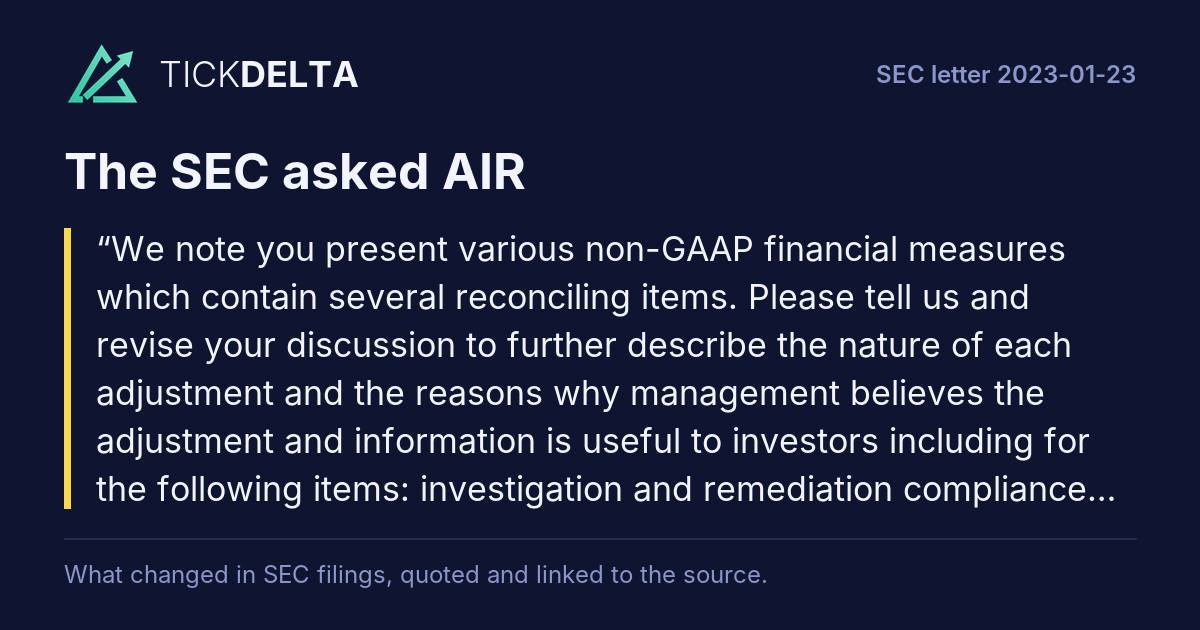
We note you present various non-GAAP financial measures which contain several reconciling items. Please tell us and revise your discussion to further describe the nature of each adjustment and the reasons why management believes the adjustment and information is useful to investors including for the following items: investigation and remediation compliance costs, contract termination/restructuring costs and loss
Rest of the question

provisions, net, customer bankruptcy and credit charges (recoveries), gain on legal settlement, and costs related to strategic projects. Specifically also address why each of these components is deemed appropriate when considering the SEC Staff's Compliance and Disclosure Interpretations on Non-GAAP Financial Measures.

AIR answered
The Company acknowledges the Staff’s comment. We are providing below a summary of the nature of the adjustments identified in the comment and the reasons management believes that the adjustments provide our shareholders and other interested parties with meaningful supplemental information. We also are providing a sample of additional disclosure that we intend to include in future filings relating to the adjustments identified in the comment.

We believe our non-GAAP financial measures are relevant and useful for management, shareholders, and other interested parties because they provide
Rest of the answer

supplemental information that management believes reflect our core operating performance and cash flows unaffected by the impact of certain items that management does not believe are indicative of our ongoing and core operating activities. When reviewed in conjunction with our GAAP results and our reconciliations, we believe our non-GAAP financial measures provide additional information that is useful to gain an understanding of the factors and trends affecting our business and provide additional means to compare our operating performance against that of other companies in the industries in which we compete.

Our adjustment for investigation and remediation costs is comprised solely of legal and professional fees related to addressing potential violations of the U.S. Foreign Corrupt

Practices Act (“FCPA”) which we self-reported to the U.S. Department of Justice and other agencies in fiscal 2019. In making this adjustment, we have considered the SEC Staff's Compliance and Disclosure Interpretations on Non-GAAP Financial Measures (the “C&DIs”), including Question 100.01, and we do not believe the adjustment is misleading. Specifically, the adjustment does not eliminate an item that is a normal, recurring cash operating expense necessary to operate our business. The investigation and remediation costs reflected in the adjustment are not related to our operations, revenue generating activities, business strategy, or our industry environment. In addition, the adjustment does not include any routine, normal or recurring legal and compliance costs. In this regard, upon the resolution of the self-reported, potential violations of the FCPA, we do not expect to incur any future costs related to the matter. We believe the adjustment for these non-operating costs provides our shareholders and other interested parties with meaningful supplemental financial information for use in assessing our underlying business performance and trends.

The COVID-19 pandemic had a dramatic and unprecedented impact on the larger global economy and the aviation industry in particular. The effects of the COVID-19 pandemic negatively impacted our operations, as we are directly affected by the number of commercial aircraft flying and resulting flight hours. In order to help mitigate the impact of the COVID-19 pandemic on our business, and in light of the significant uncertainties associated with the onset of the pandemic, we took many actions to address the radical shift in market conditions and stabilize our operations, including facility consolidations and restructurings, compensation reductions, and employee furloughs. We also reviewed our customer portfolio in light of those uncertainties and the developing credit and operating risks brought on by the onset of pandemic, while also executing significant modifications, terminations, and restructurings of certain customer contracts to address the rapidly changing markets in which we operate.

Our adjustment for contract termination/restructuring costs and loss provisions, net, is comprised of gains and losses that are recognized at the time of terminating or restructuring certain customer and vendor contracts, including forward loss provisions on long-term contracts. These contracts primarily include our long-term, power-by-the-hour arrangements under which we provide aircraft component repair services and a related vendor contract that includes a minimum volume guarantee that was not able to be met due to the historical decrease in flight hours resulting from the COVID-19 pandemic.

We began including this adjustment to our non-GAAP financial measures in our disclosures for the third quarter ended February 29, 2020 following the onset of the COVID-19 pandemic. Due to the unprecedented impact of the COVID-19 pandemic on our operations and our commercial activities, multiple contracts with our airlines customer were terminated and/or restructured to address the challenging operating environment.

The adjustment does not include any normal, recurring operating results from these contracts, but rather only includes the direct impact from the modification, termination, or restructuring of these contracts.

We do not believe the adjustment is misleading, and the adjustment does not eliminate an item that is a normal, recurring cash operating income or expense necessary to operate our business. We believe that we comply with Question 100.02 of the C&DIs because we have continued to include gains and losses related to the original contract actions and gains from new, significant contractual events that were similar to the adjustments reflected in prior periods to ensure consistency in our presentation. For example, our long-term contract supporting certain U.K. military aircraft was terminated early by our customer resulting in the recognition of a gain of $1.7 million in the second quarter ended November 30, 2021, which we included in the adjustment to be consistent with our prior presentation. We also believe we comply with Question 100.03 of the

C&DIs because we include both gains and losses in the adjustment for these types of significant contractual events to ensure consistency across similar significant contractual events, such as the gain from the early termination of our U.K. contract noted above. Further, we believe that we comply with Question 102.03 of the C&DIs because we do not describe the adjustment as non-recurring or infrequent.

In this regard, we believe that presenting the adjustment for these significant contractual events provides our shareholders and other interested parties with meaningful supplemental information for use in comparing quarterly financial results and in assessing our business performance and trends.

Our adjustment for customer bankruptcy and credit charges (recoveries) includes the impact of bankruptcies that primarily resulted from the significant impact of the COVID-19 pandemic on our commercial customers. In this regard, the adjustment is related to the economic effects of the

COVID-19 pandemic and is incremental to normal operations. We do not believe the adjustment is misleading, and the adjustment does not eliminate an item that is a normal and recurring item necessary to operate our business. We believe that we comply with Question

100.03 of the C&DIs because we include both credit charges and recoveries in the adjustment to ensure consistency across similar items. We also believe that we comply with Question 102.03 of the C&DIs because we do not describe the adjustment as non-recurring or infrequent. Further, we believe that presenting the impact of these COVID-related customer bankruptcies on our financial results provides our shareholders and other interested parties with meaningful supplemental information regarding the collectability of our accounts receivable.

In the third quarter ended February

28, 2021, we recognized a gain of $4.3 million for a legal settlement with our Michigan medical claims administrator related to access fees charged to us in violation of government regulations. We believe that the adjustment for this gain on legal settlement is not misleading and is properly categorized as non-recurring because we have not had other favorable legal settlements in the last few years. In this regard, the adjustment does not eliminate an item that is a normal and recurring item necessary to operate our business.

Our adjustment for costs related to strategic projects comprises third-party professional fees for potentially transformational projects related to strategic financings and acquisitions. The adjustment reflects external costs associated with only two projects undertaken over the last three years. The first project involved a detailed, non-ordinary course review and evaluation of various financing alternatives that was undertaken following the onset of the COVID-19 pandemic as part of our efforts to ensure our adequate liquidity and access to capital in light of the economic and market uncertainties and the significant impact the COVID-19 pandemic was having on the commercial aviation industry in particular.

The second project covered in the adjustment reflects acquisition due diligence costs for a major potential acquisition that was not ultimately consummated. The adjustment for these costs related to the strategic projects does not include any routine, normal or recurring financing costs or acquisition due diligence expenses. We do not believe the adjustment is misleading, and the adjustment does not eliminate an item that is a normal, recurring cash operating expense necessary to operate our business. Further, we believe the adjustment for these non-operating costs provides our shareholders and other interested parties with meaningful supplemental financial information for use in assessing our underlying business performance.

In addition, and in the interest of providing additional disclosure that may be useful to our shareholders and other interested parties, we will expand our disclosures in future filings to include additional information regarding adjustments reflected in our non-GAAP financial measures that would be based on the sample disclosure provided below.

Sample Disclosure for Future Filings:

Our non-GAAP financial measures reflect adjustments for certain items including, but not limited to, the following:

· Investigation and remediation compliance costs comprised of legal and professional fees related to addressing potential violations of the U.S. Foreign Corrupt Practices Act, which we self-reported to the U.S. Department of Justice and other agencies;

· Contract termination/restructuring costs comprised of gains and losses that are recognized at the time of modifying, terminating, or restructuring certain customer and vendor contracts, including adjustments for forward loss provisions on long-term contracts;

· Customer bankruptcy and credit charges (recoveries) reflecting the impact of bankruptcies and other credit charges primarily resulting from the significant impact of the COVID-19 pandemic on the commercial aviation industry; and

· Costs related to strategic projects consisting of professional fees for significant projects related to strategic financings and acquisitions, including due diligence costs.
Read in the reply
In its next report

First report after the company's reply of Feb 1, 2023: 10-Q filed Mar 21, 2023 ↗, against the 10-Q filed Dec 20, 2022 ↗.

Tickdelta does not hold the text of both reports, so they are not compared here.

Exhibit 99.1, page 8
SEC asked (2)
We note your adjusted cash provided by (used in) operating activities from continuing operations which adjusts for the change in amounts outstanding on your accounts receivable financing program. Please further explain why management believes this measure is useful to investors and address and why this measurement is deemed appropriate when considering the SEC Staff's Compliance and Disclosure Interpretations on
Rest of the question

Non-GAAP Financial Measures. Additionally, tell us where the adjusting items are included within the statement of cash flows.

AIR answered
We exclude the impact of our accounts receivable financing program from our adjusted cash provided by operating activities from continuing operations as management believes our shareholders and other interested parties view the program as a financing instrument. Nonetheless, the program meets the requirements for treatment as a sale of accounts receivable in accordance with Accounting Standards Codification 860, Transfers and Servicing, which requires classification of the program’s cash transactions as operating activities on our statement of cash flows.
Rest of the answer

The timing of our accounts receivable sales and servicing activities impact our cash flow from operations, and management has determined to exclude this impact to provide our shareholders and other interested parties with meaningful supplemental information for use in analyzing our business performance and cash flows. In this regard, we believe our reconciliation to adjusted cash flow from operations provides meaningful supplemental information regarding activities impacting our cash flows that are not directly related to our core sales of products and services.

Within the statement of cash flows, transactions under our accounts receivable financing program are included in the accounts receivable and accounts payable line items.

The amount reported on the statement of cash flows for changes in accounts receivable is impacted by the timing of our sales of accounts receivable to the Purchaser under the program (Citibank, N.A.). The amount reported on the statement of cash flows for changes in accounts payable is impacted by the timing of our payment to the Purchaser as part of our role as servicer of the sold receivables.

******************

In connection with responding to the Staff’s comments, the Company acknowledges that:

· The Company is responsible for the adequacy and accuracy of the disclosure in its filings;

· Staff comments or changes to disclosure in response to Staff comments do not foreclose the Commission from taking any action with respect to the Company’s filings; and

· The Company may not assert Staff comments as a defense in any proceeding initiated by the Commission or any person under the federal securities laws of the United States.

Read in the reply
In its next report

First report after the company's reply of Feb 1, 2023: 10-Q filed Mar 21, 2023 ↗, against the 10-Q filed Dec 20, 2022 ↗.

Tickdelta does not hold the text of both reports, so they are not compared here.

Also in this review: closing letter, 2023-02-17

Form 10-K for the Fiscal Year Ended May 31, 2017

2018-01-25 to 2018-02-08 · 2 questions · 1 letter from the SEC, 1 from the company
Review closed 2018-02-08
Results discussion (MD&A)RevenueLeases
Management’s Discussion and Analysis of Financial Condition and Results of Operations, page
SEC asked (1)
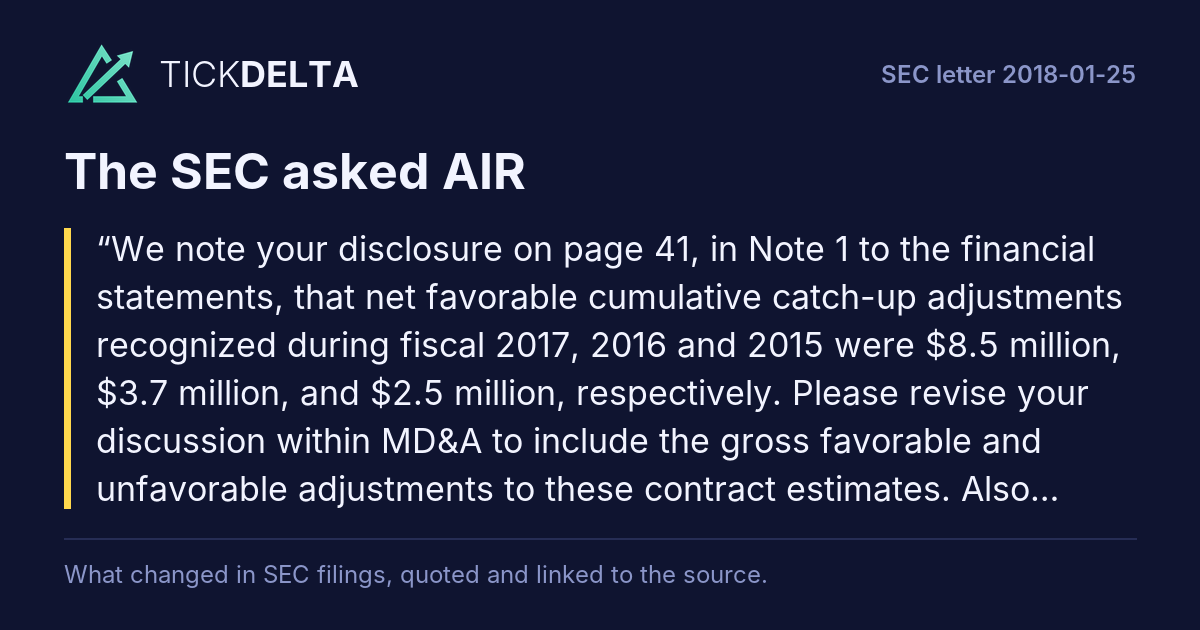
We note your disclosure on page 41, in Note 1 to the financial statements, that net favorable cumulative catch-up adjustments recognized during fiscal 2017, 2016 and 2015 were $8.5 million, $3.7 million, and $2.5 million, respectively. Please revise your discussion within MD&A to include the gross favorable and unfavorable adjustments to these contract estimates.
Rest of the question

Also, please discuss the nature of any contracts or programs that had a significant change in the estimate to complete.

AIR answered
Our net favorable cumulative catch-up adjustments as a percent of gross profit represented only 3.1%, 1.6%, and 1.9% for fiscal years 2017, 2016, and 2015, respectively. When our cumulative catch-up adjustments are material, we include discussion of the adjustments in our MD&A. For example, we included disclosure in our MD&A as recently as fiscal 2013 when we recognized a $29.8 million adjustment related to our KC-10 logistics program.

For fiscal years 2017, 2016, and 2015, we assessed the net favorable cumulative catch-up adjustments and determined they did not have a material impact on our
Rest of the answer

sales or gross profit which would warrant further specific disclosure in our MD&A.

Notwithstanding the above, the Company acknowledges the Staff’s comment and in the interest of providing additional disclosure that may prove helpful to investors, we will expand our MD&A disclosures in future filings with discussion similar to the below paragraph:

Changes in estimates and assumptions related to our programs accounted for using the percentage-of-completion method are recorded using the cumulative catch-up method of accounting. In fiscal 2017, 2016, and 2015, we recognized favorable cumulative catch-up adjustments of $9.2 million, $6.1 million, and $4.2 million, and unfavorable cumulative catch-up adjustments of $0.7 million, $2.4 million, and $1.7 million, respectively. When considering these adjustments on a net basis, we recognized favorable cumulative catch-up adjustments of $8.5 million, $3.7 million, and $2.5 million in fiscal 2017, 2016, and 2015, respectively. These adjustments primarily relate to our long-term, power-by-the-hour programs where we provide component inventory management and repair services.

Read in the reply
In its next report

First report after the company's reply of Feb 5, 2018: 10-Q filed Mar 21, 2018 ↗, against the 10-Q filed Dec 22, 2017 ↗.

Tickdelta does not hold the text of both reports, so they are not compared here.

Consolidated Statements of Income, page 35
SEC asked (2)
We note that your statements of income present sales and cost of sales for both products and services. However, we also note from your disclosures that you lease aircraft engines and other equipment and recognize lease income.
Rest of the question

In light of the fact that it appears from your disclosures that you have increased the amount of equipment on or available for long-term lease during fiscal 2017 and into fiscal 2018, please tell us if your revenue from these leases is over 10% of consolidated revenue. If so, please separately present the revenue and cost of revenue related to this leased equipment on the face of your statements of income. See Rule 5-03(b)(1) of Regulation S-X.

AIR answered
Our lease revenue as a percent of consolidated sales was 3.3% and 2.9% for the year ended May 31, 2017 and for the six month period ended November 30, 2017, respectively.

We evaluate the extent of our revenue and cost of revenue disclosures quarterly in accordance with Rule 5-03(b). We will expand our disclosures in future filings should our lease revenue reach the 10% threshold.

******************

In connection with responding to your comments, the Company acknowledges that:

· The Company is responsible for the adequacy and accuracy of the disclosure in the filing;

· Staff comments or
Rest of the answer

changes to disclosure in response to Staff comments do not foreclose the Commission from taking any action with respect to the filing; and

· The Company may not assert Staff comments as a defense in any proceeding initiated by the Commission or any person under the federal securities laws of the United States.

Read in the reply
In its next report

First report after the company's reply of Feb 5, 2018: 10-Q filed Mar 21, 2018 ↗, against the 10-Q filed Dec 22, 2017 ↗.

Tickdelta does not hold the text of both reports, so they are not compared here.

Also in this review: closing letter, 2018-02-08

AAR Corp. · 10-K for Fiscal Year Ended May 31, 2016 · Filed July 13, 2016 · File No. 1-06263

2017-04-07 to 2017-05-03 · 2 questions · 1 letter from the SEC, 1 from the company
Review closed 2017-05-03
Russia and UkraineRevenue
General
SEC asked (1)
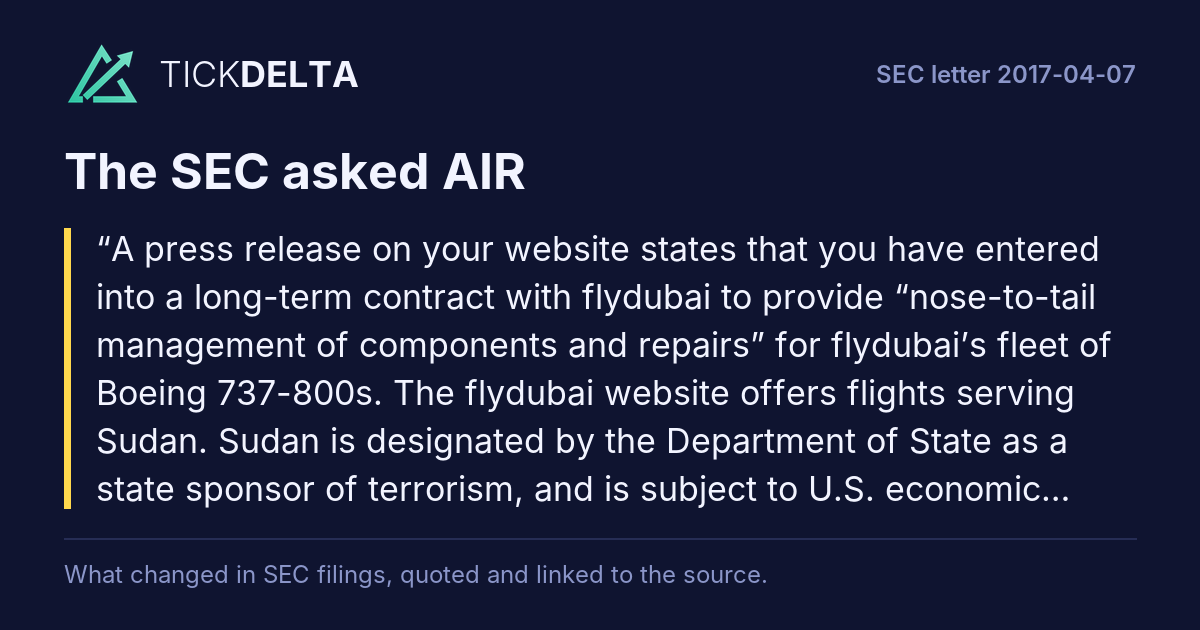
A press release on your website states that you have entered into a long-term contract with flydubai to provide “nose-to-tail management of components and repairs” for flydubai’s fleet of Boeing 737-800s. The flydubai website offers flights serving Sudan. Sudan is designated by the Department of State as a state sponsor of terrorism, and is subject to U.S. economic sanctions and export controls.
Rest of the question

Please describe to us the nature and extent of any past, current, and anticipated contacts with Sudan, whether through subsidiaries, partners, customers, joint venture partners or other direct or indirect arrangements. You should describe any services, products, information or technology you have provided to Sudan, directly or indirectly, and any agreements, commercial arrangements, or other contacts you have had with the governments of Sudan or entities it controls.

AIR answered
The Company does not have any past contacts (except as noted below)* or current contacts with Sudan, directly or indirectly through subsidiaries, partners, customers, joint venture partners or other arrangements, and does not anticipate any direct or indirect contacts with Sudan in the future. Further, the Company does not provide any services, products, information or technology to Sudan, directly or indirectly, nor does it have any agreements, commercial arrangements or other contacts with the government of Sudan or entities it controls.

As noted in the Staff’s comment, the Company does
Rest of the answer

have a relationship with flydubai (officially known as Dubai Aviation Corporation). Specifically, the Company’s wholly-owned subsidiary, AAR International, Inc. (“AAR International”) entered into a Component Support Agreement dated as of August 4, 2016 (the “Agreement”) with flydubai. Under the Agreement, AAR International provides aircraft component repair, supply and inventory management services for flydubai’s fleet of Boeing 737-800 aircraft. AAR International provides these services principally at flydubai’s headquarters in Dubai. The Agreement is the only currently effective agreement between the Company and flydubai.

The Company is aware that flydubai offers flights serving two destinations in Sudan (Khartoum and Port Sudan) and may operate the aircraft subject to the Agreement for these flights. The Agreement contains contractual provisions obligating the parties to comply with applicable U.S. export control and trade sanctions laws (as well as export control and trade sanctions laws of the Member States of the European Union). The Agreement further provides that AAR International has the right to not supply any component or service or engage in any activity if it believes in good faith that such supply or activity would be impermissible under the U.S. export control and trade sanctions laws.

The Company is not aware of any violation of U.S. export control and trade sanctions laws by flydubai under the Agreement. AAR International has not exercised its right under the Agreement to not supply any component or service or engage in any activity as it has no reason to believe that flydubai is violating any U.S. export control or trade sanctions law.

Read in the reply
General
SEC asked (2)
Please discuss the materiality of any contacts with Sudan you describe in response to the comment above, and whether those contacts constitute a material investment risk for your security holders. You should address materiality in quantitative terms, including the approximate dollar amounts of any associated revenues, assets, and liabilities for the last three fiscal years and the subsequent interim period.
Rest of the question

Also, address materiality in terms of qualitative factors that a reasonable investor would deem important in making an investment decision, including the potential impact of corporate activities upon a company's reputation and share value. Various state and municipal governments, universities, and other investors have proposed or adopted divestment or similar initiatives regarding investment in companies that do business with U.S.-designated state sponsors of terrorism. You should address the potential impact of the investor sentiment evidenced by such actions directed toward companies that have operations associated with Sudan.

AIR answered
As stated in the response to comment no. 1, the Company has not had any past contacts with Sudan (other than the two noted exceptions), does not have any current contacts with Sudan, and does not anticipate any future contacts with Sudan.

The Company does not believe that its relationship with its customer flydubai — consisting solely of activities under the Agreement — constitutes a contact with Sudan as explained in the response to comment no. 1.
Rest of the answer

If, however, the Company’s relationship with flydubai is viewed as a contact with Sudan, it is an indirect and minimal contact that does not constitute a material investment risk for the Company’s security holders for the following reasons:

· The Company’s revenues for the nine months ended February 28, 2017 under the Agreement with flydubai account for approximately 0.4% of the Company’s total revenues;

· The Company has not derived any other revenue from flydubai during fiscal 2017 and did not derive any revenue from flydubai in fiscal 2016 or fiscal 2015;

· The Company does not know the amount or percentage of revenues that flydubai derives from its flights to Sudan. However, the Company is aware that flydubai maintains flights to approximately 117 destinations across 47 countries, with only two of those destinations located in Sudan;

· The Company has contractual protections under the Agreement designed to ensure that flydubai complies with the U.S. export control and trade sanctions laws; and

· The Company has no reason to believe that flydubai is violating the Agreement or any U.S. export control and trade sanctions laws.

In short, the Company has a strong culture of compliance and is committed to strict adherence to U.S. export control and trade sanctions laws. Its relationship with flydubai — and indirectly with Sudan through flydubai — does not constitute a material investment risk for the Company’s security holders and is not quantitatively or qualitatively material to a reasonable investor in making an investment decision with respect to the Company’s securities.

************

The Company acknowledges that the Company and its management are responsible for the adequacy and accuracy of the disclosures in this filing, notwithstanding any review, comments, action or absence of action by the Staff.

Read in the reply

Also in this review: closing letter, 2017-05-03

Form 10-K for the Fiscal Year Ended May 31, 2015

2016-02-16 to 2016-03-10 · 3 questions · 1 letter from the SEC, 2 from the company
Review closed 2016-03-10
SegmentsResults discussion (MD&A)Legal and contingenciesRevenueInventory
Management’s Discussion and Analysis of Financial Condition and Results of Operations · Results of Operations – Fiscal 2015 Compared with Fiscal 2014, page 22
SEC asked (1)
We note that your discussion of your results of operations describes changes in your sales and gross profit by segment, but does not provide any discussion of the changes in cost of sales. Please revise your disclosure to separately quantify and discuss factors responsible for changes in the levels of your cost of products and cost of services during all periods presented as required by Item 303 of Regulation S-K.
Rest of the question

As part of your revised disclosure, please revise to quantify and discuss the impact of each significant component of costs comprising cost of sales that caused cost of sales to materially vary (or not vary when expected to). This disclosure should be presented in a manner so as to allow investors to discern the relative contribution of each of the components cited to the total change in cost of sales and resultant operating income. Financial Statements Notes to Consolidated Financial Statements 11. Commitments and Contingencies, page 69

AIR answered
Historically, the Company provided disclosure about significant changes in its cost of sales through a discussion of gross profit. When factors have materially impacted cost of sales, we have included discussion of these factors in our segment gross profit disclosures in Management’s Discussion and Analysis since gross profit is the focus of management’s review and the primary profitability measure of our segments. For example, in fiscal 2015 impairment charges related to rotable assets, inventory, and aircraft materially impacted our cost of sales.
Rest of the answer

In our Annual Report on Form 10-K for the year ended May 31, 2015, we discussed these impairment charges in our segment gross profit disclosures on page 23 (for Aviation Services) and page 24 (for Expeditionary Services)

Notwithstanding the above, the Company acknowledges the Staff’s comment and will include disclosures in future filings to more expressly discuss and quantify significant factors impacting cost of sales.

Financial Statements

Notes to Consolidated Financial Statements

11. Commitments and Contingencies, page 69

Read in the reply
In its next report

First report after the company's reply of Mar 7, 2016: 10-Q filed Mar 23, 2016 ↗, against the 10-Q filed Dec 18, 2015 ↗.

Tickdelta does not hold the text of both reports, so they are not compared here.

Management’s Discussion and Analysis of Financial Condition and Results of Operations · Results of Operations – Fiscal 2015 Compared with Fiscal 2014, page 22
SEC asked (2)
We note from page 70 that you entered into a sale-leaseback arrangement during fiscal 2015 that was not yet complete by year-end. We further note that in addition to the $40.3 million in proceeds received in the fourth quarter of fiscal 2015, you also received $19.2 million during the six months ended November 30, 2015.
Rest of the question

Please tell us, and revise to disclose why you received additional amounts upon completion of the sale of one of the aircraft and whether any gain or loss was recognized on the sale-leaseback transaction. To the extent you recognized a gain or loss, please describe your accounting in detail. 13. Business Segment Information, page 71

AIR answered
As disclosed in our Form 10-K, during the fourth quarter of fiscal 2015, we entered into a sale-leaseback transaction for our two S-92 rotary-wing aircraft which were classified as aircraft held for sale and received proceeds of $40.3 million in fiscal 2015. The proceeds were recorded as a sale-leaseback advance because the sale agreement included a provision permitting the buyer the right to return the S-92 aircraft.
Rest of the answer

This right to return remained effective until we executed and closed on sale-leaseback transactions for two AW-189 rotary-wing aircraft.

Since the proceeds received on the sale of the S-92 aircraft were less than the aircraft carrying value of $41.4 million, we recognized a loss of $1.1 million in the fourth quarter of fiscal 2015.

In fiscal 2016, we entered into sale-leaseback transactions with the same buyer for two AW-189 aircraft. We sold one of the AW-189 aircraft in the second quarter ended November 30, 2015 receiving $19.2 million of proceeds. Concurrently with the sale of this AW-189 aircraft, the right to return one of the S-92 aircraft was terminated, and as a result, we derecognized the S-92 and related sale-leaseback advance from our consolidated balance sheet with no impact on the income statement as the loss was previously recognized in the fourth quarter of fiscal 2015. We realized a gain on the sale of the AW-189 aircraft of $0.4 million which was recorded as a deferred gain on our consolidated balance sheet. The deferred gain on the AW-189 will be recognized on a straight-line basis over the ten year life of the lease.

During the third quarter ended February 29, 2016, we sold the second AW-189 aircraft realizing a gain of $1.2 million which will also be recognized on a straight-line basis over the ten year life of the lease. We also derecognized the remaining S-92 aircraft asset and sale-leaseback advance from our consolidated balance sheet as the right to return terminated on the second S-92 aircraft.

In our Form 10-Q for the third quarter ended February 29, 2016, the Company will include a note to our condensed consolidated financial statements comparable to the following:

Note x — Aircraft Sale-Leaseback Transactions

During the fourth quarter of fiscal 2015, we entered into a sale-leaseback transaction for our two S-92 rotary-wing aircraft resulting in the recognition of a loss of $1.1 million. We received proceeds of $40.3 million in fiscal 2015 which were deferred as a sale-leaseback advance pending completion of the sale transactions. Both of the S-92 aircraft sales were completed in fiscal 2016.

During the nine-month period ended February 29, 2016, we received proceeds of $38.5 million from sale-leaseback transactions for two AW-189 rotary-wing aircraft. The $1.7 million gain realized on the sale has been deferred and is being amortized over the lease term of ten years.

13. Business Segment Information, page 71

Read in the reply
In its next report

First report after the company's reply of Mar 7, 2016: 10-Q filed Mar 23, 2016 ↗, against the 10-Q filed Dec 18, 2015 ↗.

Tickdelta does not hold the text of both reports, so they are not compared here.

Management’s Discussion and Analysis of Financial Condition and Results of Operations · Results of Operations – Fiscal 2015 Compared with Fiscal 2014, page 22
SEC asked (3)
We note from your disclosure on pages 3 and 4 of your Business Section that the Aviation Services segment sells engine and airframe parts and components, provides inventory management and distribution services, MRO services, and engineering services. We also note that the Expeditionary Services segment provides airlift services, containers and shelters, and engineering, design, and system integration services.
Rest of the question

In light of the apparent different types of services and products provided, please revise to separately disclose revenues for each product and service or each group of similar products and services as required by ASC 280-10-50-40.

AIR answered
The Company believes its reporting of sales by segment meets the requirements of ASC 280-10-50-40 as our existing segments are organized around similar product and service offerings.

Our Aviation Services segment provides integrated aftermarket solutions to the global aviation industry. We deliver products and services that are commonly bundled together and offered to our customers as a comprehensive and integrated total support solution. This integrated solution routinely includes product and service deliverables crossing multiple product lines within our Aviation Services segment.
Rest of the answer

These product lines are frequently marketed and sold under one umbrella within the Aviation Services segment.

Our Expeditionary Services segment provides products and services that support the mobility and agility requirements of our government and defense customers. These products and services, also typically bundled as part of an integrated solution, include providing aircraft, equipment, and personnel in austere and remote locations throughout the world.

Notwithstanding our prior practices, the Company acknowledges the Staff’s comment and in the interest of providing additional disclosure that may prove helpful to investors, we will enhance our revenue disclosures in future Form 10-K filings by including a tabular presentation of revenues in a format comparable to the following:

For the Year Ended May 31,

2016

2015

2014

Net sales:

Aviation supply chain

$ xxx.x

847.6

755.7

Maintenance, repair and overhaul services

468.5

475.5

Expeditionary airlift services

173.3

328.8

Mobility products

104.9

149.1 x,xxx.x

1,594.3

1,709.1

************************************************************************************************************

In connection with responding to your comments, the Company acknowledges that:

· The Company is responsible for the adequacy and accuracy of the disclosure in the filing;

· Staff comments or changes to disclosure in response to Staff comments do not foreclose the Commission from taking any action with respect to the filing; and

· The Company may not assert Staff comments as a defense in any proceeding initiated by the Commission or any person under the federal securities laws of the United States.

Read in the reply
In its next report

First report after the company's reply of Mar 7, 2016: 10-Q filed Mar 23, 2016 ↗, against the 10-Q filed Dec 18, 2015 ↗.

Tickdelta does not hold the text of both reports, so they are not compared here.

Also in this review: company letter, Feb 17, 2016, closing letter, 2016-03-10

Schedule TO-I

2015-05-05 to 2015-05-07 · 3 questions · 1 letter from the SEC, 1 from the company
No closing letter
Offer to Purchase
SEC asked (1)
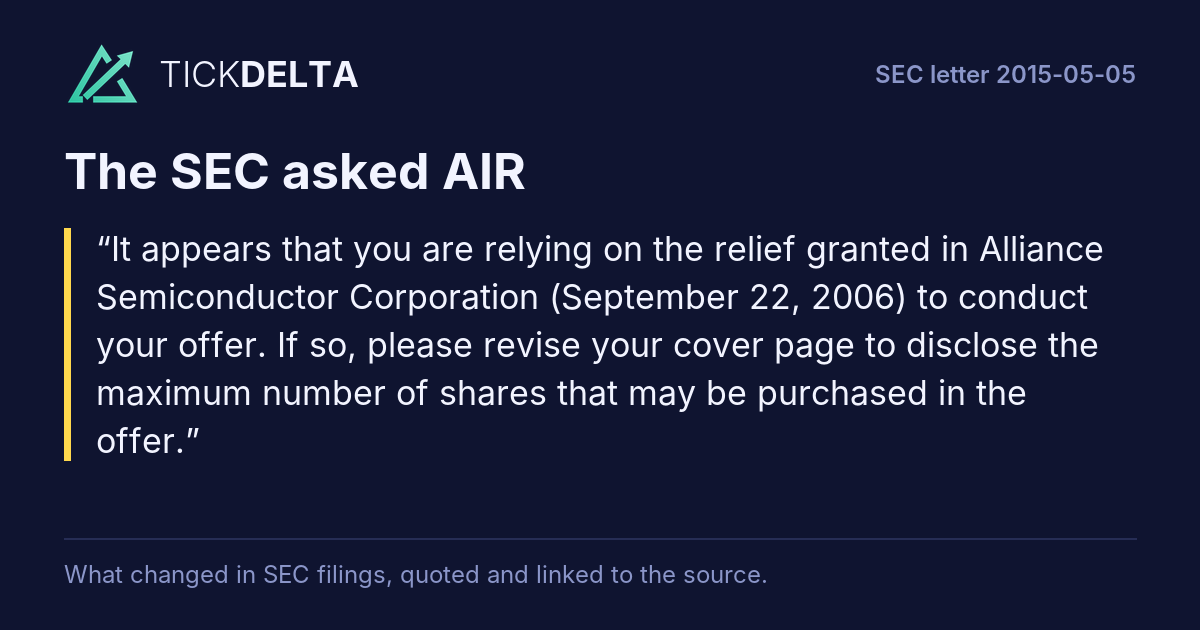
It appears that you are relying on the relief granted in Alliance Semiconductor Corporation (September 22, 2006) to conduct your offer. If so, please revise your cover page to disclose the maximum number of shares that may be purchased in the offer.
AIR answered
We have revised the third paragraph of the cover page of the Offer to Purchase to read as follows:

“Assuming that the Offer is fully subscribed, if the Purchase Price is determined to be $29.00 per share, the minimum price under the Offer, the maximum number of shares that will be purchased under the Offer is 4,655,172.
Rest of the answer

Assuming that the Offer is fully subscribed, if the Purchase Price is determined to be $32.00 per share, the maximum Purchase Price under the Offer, the minimum number of shares that will be purchased under the Offer is 4,218,750.”

This is consistent with the disclosure that appears elsewhere in the Offer to Purchase (e.g., pages vi, x, 3 and 21).

Read in the reply
Summary Term Sheet, page vi
SEC asked (2)
We note that the third q&a on page vii states that you may terminate the offer if “in [your] judgment” a condition is “unlikely to be satisfied.” Please remove this language. The ability of a bidder to determine, in its sole discretion, whether a condition has occurred may render the offer illusory.
AIR answered
We have deleted the language “or, in our judgment is unlikely to be satisfied,” in the third Q&A on page vii. We made the same change under Section 15, “Extension of the Offer; Termination; Amendment,” on page 31 of the Offer to Purchase, which is the only other place it appeared.
Read in the reply
Summary Term Sheet, page vi
SEC asked (3)
On a similar note, we note the condition in the first bullet point on page x of your summary term sheet can only be determined by you and is subject to your action and your sole discretion. Please delete or revise the condition in such a way that the offer is not rendered illusory.
AIR answered
We have revised the condition in the first bullet point on page x to clarify that our determination must be made “in our reasonable judgment.” This is consistent with the way the condition is expressed in Section 7, “Conditions of the Offer,” on page 18 of the Offer to Purchase.

The Company acknowledges that:

· the Company is responsible for the adequacy and accuracy of the disclosure in the filing;

· staff comments or changes to disclosure in response to Staff comments do not foreclose the Commission from taking any action with respect to the filing; and

· the Company may not assert
Rest of the answer

staff comments as a defense in any proceeding initiated by the Commission or any person under the federal securities laws of the United States.

Read in the reply

Form 10-K

2015-02-27 to 2015-03-26 · 7 questions · 1 letter from the SEC, 2 from the company
Review closed 2015-03-26
RevenueResults discussion (MD&A)SegmentsLiquidity and cashGoodwill and impairmentIncome taxesInventory
Results of Operations · Fiscal 2014 Compared to Fiscal 2013, page 20
SEC asked (1)
We note from your disclosure on page 21 that although your Aviation Services segment began the year with 40 aircraft in revenue service, at the end of 2014, 20 aircraft were no longer in active service and were available for future missio n deployment. We also note from your Form 10-Q for the quarter ended November 30, 2014 that only 17 of these aircraft were in revenue service at November 30, 2014.
Rest of the question

Please explain to us the nature of any impairment analysis performed on the non -revenue generating aircraft, major components in service, and associated rotable assets for your expeditionary airlift services at May 31, 2014 and November 30, 2014. If an impairment analysis was not performed during these periods, please explain to us why you do not believe such an analysis was appropriate under the guidance in ASC 360 -10-35.

AIR answered
We did not perform an impairment analysis of our non-revenue generating aircraft, major components in service, and associated rotable assets for our expeditionary airlift services business (the “Airlift business”) at May 31, 2014 and November 30, 2014 as there were no events or significant changes in circumstances which indicated that their carrying values may not be recoverable.
Rest of the answer

In reaching this conclusion, the Company considered the unique nature of the Airlift business and also specifically considered the guidance on the impairment indicators set forth in Accounting Standards Classification (“ASC”) 360-10-35, each as described below.

1100 N. Wood Dale Road Wood Dale Illinois 60191 USA Tel 1-630-227-2000

General Considerations. A description of the unique nature of the Airlift business is essential to an understanding of the Company’s conclusion that there were no events or significant changes in circumstances indicating that the carrying values of the Airlift business may not be recoverable. The Airlift business provides aircraft, crew and logistics support personnel in austere and remote locations throughout the world. It operates a fleet of specialized rotary-wing and fixed-wing aircraft currently in Afghanistan, Africa and the Western Pacific regions, with new business slated to commence in the Falkland Islands. The expeditionary airlift services include the transportation of personnel and cargo in support of mission-critical activities, often on short notice, on rigid timetables and in war zones and undeveloped areas.

The principal current customer of the Airlift business is the United States Department of Defense (“DoD”). The DoD requires expeditionary airlift services in support of the U.S. and allied military efforts in Afghanistan, Africa and other areas around the world undergoing war, conflict, terrorism, or humanitarian crisis. As such, the Airlift business operates in a fluid business environment that is subject to the uncertainties and vagaries of the U.S. Government efforts in areas subject to these conditions.

As noted in the Staff’s comment, the Airlift business experienced a decrease in the number of revenue-generating aircraft (also known as aircraft contract positions) over the periods ended May 31, 2014 and November 30, 2014. The decrease — from 40 to 20 to 17 — was entirely the result of the drawdown of the U.S. presence in Afghanistan. However, the decrease in aircraft contract positions did not mean that the carrying value of the Airlift business’s long-lived assets may not be recoverable, for two principal reasons:

1. In each case of a DoD contract termination, the Airlift business immediately and aggressively pursued new contract opportunities as a means of deploying the aircraft idled by the Afghanistan drawdown and generating new revenue sources. As a result of these business development efforts, the Airlift business has experienced over the past 18 months a sharp uptick in the number of opportunities across a broad range of customers (including the DoD, the United Nations, foreign militaries and other government agencies) and across multiple markets (including military service support in Afghanistan, Iraq and Africa, search and rescue missions and narcotics control). For example, one significant success for the Airlift business was an indefinite delivery, indefinite quantity award in December 2013 of up to 18 aircraft under an RFP sponsored by the U.S. Central Command Joint Theater Support Contracting Command to provide fixed-wing and rotary wing support for the Afghan National Security Forces under the NATO Training Mission (the “NATO Contract”). This contract alone, assuming expected task orders, likely would have consumed most of the Airlift idle aircraft at that time. See Exhibit A for further information about the NATO Contract and a description of other actual contract wins and potential contract opportunities for the Airlift business during the relevant period.

Read in the reply
In its next report

First report after the company's reply of Mar 19, 2015: 10-Q filed Mar 31, 2015 ↗, against the 10-Q filed Dec 19, 2014 ↗.

Tickdelta does not hold the text of both reports, so they are not compared here.

Liquidity, Capital Resources and Financial Position, page 25
SEC asked (2)
Please revise to expand your liquidity discussion to cover the three -year period covered by the financial statements, using year-to-year comparisons or any other format to enhance the reader’s understanding. Refer to Instruction 1 to paragraph 303(a) of Regulation S-K.
AIR answered
Under each of its contracts with the DoD, the Airlift business was legally committed to keeping its aircraft available to the DoD until it received a notice of contract termination from the DoD. Given the short notice periods in the DoD contracts, the Airlift business typically received back aircraft from the DoD with no more than 30 or 60 days’ notice.
Rest of the answer

Even under the best of circumstances, the Airlift’s business’s new placement of such idled aircraft required some additional lead time.

We did not believe an impairment analysis was necessary given the robust proposal pipeline and the Company’s favorable view of the long-term prospects of the Airlift business. As of February 28, 2015, the Airlift business has 19 aircraft in revenue service with at least three new contract positions expected by the end of March (although some of these aircraft will not yet have begun contract performance by that date). The Airlift business expects to win many of the opportunities described in Appendix A, which would result in the full utilization of all idle aircraft in revenue service or in support of revenue aircraft (i.e., spares, and trainers required for the fleets in service).

In addition to these general considerations relating to the unique nature of the Airlift business, the Company’s specific consideration of the guidance on the individual impairment indicators set forth in ASC 360-10-35 likewise supports the Company’s conclusion that an impairment analysis was not warranted at the Airlift business.

Specific Consideration of Impairment Indicators under ASC 360-10—35. As disclosed in our Form 10-K in our Critical Accounting Policies in the MD&A and Note 1 (Summary of Significant Accounting Policies) to the Consolidated Financial Statements, we regularly assess whether impairment indicators are present and address them in accordance with the requirements of ASC 360.

In the case of the non-revenue generating aircraft, major components in service and associated rotable assets for the Airlift business, we separately considered each of the impairment indicators set forth in ASC 360-10-35-21 which provides examples of events or circumstances that may indicate the carrying amount of a long-lived asset (or asset group) may not be recoverable. Set forth below is our analysis under each of these impairment indicators:

1. Significant decrease in the market price of a long-lived asset (asset group)

Volatility in market prices for aircraft, components, and related rotables does not impact our consideration of the recoverability of the carrying value of the assets. The fair value of our aircraft and related assets is influenced by the long-term demand for airlift services throughout the world and not from declines in the market price of aircraft. Our long-lived aircraft and rotable assets are either active on revenue-producing contracts, supporting revenue-producing contracts as spare or trainer aircraft, in long-term scheduled maintenance, or reserved for assignment to an outstanding proposal or development opportunity.

2. Significant adverse change in the extent or manner in which a long-lived asset (asset group) is being used or in its physical condition

We have not experienced any significant adverse changes in the manner in which our aircraft, components, and rotables are being used or in their physical condition.

Use of Aircraft. As the existing contract positions ran their course in Afghanistan (which was expected by the Company) during fiscal 2014, we expected to redeploy the majority of these aircraft on the NATO Contract awarded to the Airlift business which could have provided up to 18 new aircraft contract positions (see Appendix A for further details). As it became apparent that task orders for the NATO Contract were not imminent, the Airlift business development team actively pursued other opportunities for these aircraft. As further described in Appendix A, these efforts have proven successful to date, with new contract awards in Africa and Iraq and potential wins in outstanding proposals. These contracts represent new geographies, customers, and/or missions, for the Airlift business, but there has not been any change in the manner in which the Airlift business uses the assets.

We expect temporary idle aircraft downtime as aircraft are transitioned to new contracts and missions. Due to frequent contract award delays and unpredictable mission changes, it is difficult to forecast with certainty when Airlift services will no longer be necessary in a particular area or when new task orders will be received. This creates short to medium-term re-deployment gaps with respect to the aircraft. The number of potential contract award opportunities, the likelihood that the Airlift business would win some or all of these potential contract award opportunities and the growing global demands for airlift services did not indicate that a significant adverse change in the assets’ use was present.

Physical Condition of Aircraft. There has been no degradation in the physical condition of our aircraft. The aircraft are either airworthy and ready for immediate deployment, are in the process of being made airworthy as circumstances dictate, or are deployable with limited modification (typically to the customers’ specific mission demands).

Read in the reply
In its next report

First report after the company's reply of Mar 19, 2015: 10-Q filed Mar 31, 2015 ↗, against the 10-Q filed Dec 19, 2014 ↗.

Tickdelta does not hold the text of both reports, so they are not compared here.

Notes to the Financial Statements · Note 5. Income Taxes, page 52
SEC asked (3)
We note from your disclosure of the components of the provision for income taxes that a significant portion of the provision is attributable to foreign operations. Please provide us with, and revise to disclose, the components of income before income tax expense as either domestic or foreign. See Rule 4-08(h) of Regulation S-X.
AIR answered
Significant adverse change in legal factors or in the business climate that could affect the value of a long-lived asset (asset group), including an adverse action or assessment by a regulator

There have been no significant adverse changes in legal factors or in the overall business climate relating to our Airlift business. Our regulators primarily include the Federal Aviation Administration and other U.S. government agencies. We are subject to normal and customary inquiries from our regulators which is typical in our industry.
Rest of the answer

These inquiries are, in the Company’s view, standard and in the ordinary course of business.

We have experienced changes in the geographies where we operate with the drawdown of the U.S. presence in Afghanistan. A current shift in the geographies is occurring with Africa and Iraq representing expanding markets for the Airlift business. This has not had an adverse impact on the overall business climate. There remains strong global demand for airlift services demonstrated by our recent contract awards and the potential opportunities in the market.

Read in the reply
In its next report

First report after the company's reply of Mar 19, 2015: 10-Q filed Mar 31, 2015 ↗, against the 10-Q filed Dec 19, 2014 ↗.

Tickdelta does not hold the text of both reports, so they are not compared here.

Note 14. Selected Quarterly Data (Unaudited), page 73
SEC asked (4)
Please revise to discuss the nature of any unusual or infrequent items that impacted your quarterly results of operations for the various periods presented, such as the $29.8 million pre-tax charge recognized in the fourth quarter of 2013 due to reduced sale s and profit expectations on a contract as a result of lower expected flight hours of the KC10 aircraft.
Rest of the question

Refer to the requirement outlined in It em 302(a)(3) of Regulation S -K.

AIR answered
An accumulation of costs significantly in excess of the amount originally expected for the acquisition or construction of a long-lived asset (asset group)

This indicator does not apply to the aircraft and related components of our Airlift business.
Read in the reply
In its next report

First report after the company's reply of Mar 19, 2015: 10-Q filed Mar 31, 2015 ↗, against the 10-Q filed Dec 19, 2014 ↗.

Tickdelta does not hold the text of both reports, so they are not compared here.

Balance Sheet, page 3
SEC asked (5)
We note that in the six months ended November 30, 2014, your accounts receivable balance increased by 13% even though revenue during this period de creased by 9% from the comparable prior period in fiscal 2014. We also note that your allowance for doubtful accounts decreased slightly in the six months ended November 30, 2014.
Rest of the question

Please explain to us why your accounts receivable increased, why you belie ve your accounts receivable balance is recoverable as of November 30, 2014, and why you believe your allowance for doubtful accounts is appropriate at November 30, 2014.

AIR answered
Current-period operating or cash flow loss combined with a history of operating or cash flow losses or a projection or forecast that demonstrates continuing losses associated with the use of a long-lived asset (asset group)

The Airlift business has historically been profitable with strong cash flows from operations, including for the periods covered by the Form 10-K and 10-Q reviewed by the Staff.
Rest of the answer

Likewise, the Company believes the long-term financial prospects for the Airlift business are positive based on its contract wins to date, the volume and nature of opportunities, and the history of successful contract awards from customers. When the Company acquired the Airlift business in 2010, the business model expected a drawdown from Afghanistan in the future (e.g., 3-7 years) after which the operations would go through a period of transition as new contract positions were developed and secured. The transition process is ongoing and the new contract positions and opportunities in Niger, Central African Republic, Uganda, Democratic Republic of the Congo, Iraq, Afghanistan and aboard USNS ships demonstrate the progress of our transition.

Read in the reply
In its next report

First report after the company's reply of Mar 19, 2015: 10-Q filed Mar 31, 2015 ↗, against the 10-Q filed Dec 19, 2014 ↗.

Tickdelta does not hold the text of both reports, so they are not compared here.

Management’s Discussion and Analysis of Financial Condition and Results of Operations · Six Month Period Ended November 30, 2014, page 21
SEC asked (6)
We note that in your discussion of the results of operations in MD&A, you often attribute changes in your revenues and gross profit to a combination of several different factors. For example, you disclose that for the six month period ended November 30, 2014, sales in the Aviation Services segment decreased $77 million , or 9.4%, from the prior year period and the decrease was due to a $97.5 million , or 27.5%,
Rest of the question

decrease in sales to government and defense customers primarily attributable to lower demand for expeditionary airlift services in Afghanistan due to a reduced number of aircraft positions, and the delivery of three aircraft to government customers in fiscal 2014 with no deliveries in fiscal 2015, partially offset by higher supply chain volumes. When you list multiple factors that contributed to changes in revenue, in future filings please quantify, if possible, the impact of each material factor that you discuss to pro vide your readers with better insight into the underlying reasons behind the changes in your results. Refer to Item 303(a)(3) of Regulation S -K and Section III.D of Release No. 33 -6835.

AIR answered
The Company acknowledges the Staff’s comment and will include year-to-year comparisons for the three-year period covered by the financial statements in our Form 10-K filing for the fiscal year ending May 31, 2015.

Notes to the Financial Statements

Note 5. Income Taxes, page 52

3. We note from your disclosure of the components of the provision for income taxes that a significant portion of the provision is attributable to foreign operations. Please provide us with, and revise to disclose, the components of income before income tax expense as either domestic or foreign.
Rest of the answer

See Rule 4-08(h) of Regulation S-X.

Response:

For the year ended May 31, 2014, the components of income before income tax were as follows: Domestic of $66 million and Foreign of $39 million.

In February 2015, we agreed to sell our Telair Cargo Group which will be reported in our Form 10-Q as a discontinued operation effective in our third fiscal quarter ended February 28, 2015. The sale is expected to close by early April. The Telair Cargo Group comprised the majority of our foreign operations and as a result, the foreign component of our income from continuing operations before provision for income taxes will be less significant in future filings. Effective with the Form 10-Q for the third quarter of fiscal 2015, the majority of our foreign operations, pre-tax earnings and foreign tax provision will be presented as discontinued operations for all periods presented.

The Company acknowledges the Staff’s comment and will provide the components of our income from continuing operations before provision for income taxes in its future filings, if it remains material.

Note 14. Selected Quarterly Data (Unaudited), page 73

4. Please revise to discuss the nature of any unusual or infrequent items that impacted your quarterly results of operations for the various periods presented, such as the $29.8 million pre-tax charge recognized in the fourth quarter of 2013 due to reduced sales and profit expectations on a contract as a result of lower expected flight hours of the KC10 aircraft. Refer to the requirement outlined in Item 302(a)(3) of Regulation S-K.

Response:

We believe our disclosure of the $29.8 million pre-tax charge was adequate in our Annual Report on Form 10-K for the year ended May 31, 2014. The charge is described in detail in footnote 1 to the Selected Financial Data table on page 18 and in Note 1 to our Consolidated Financial Statements on page 38.

Notwithstanding the above, the Company acknowledges the Staff’s comment and in future filings will include an explanatory footnote to the Selected Quarterly Data Note where unusual or infrequent items have had a material impact on our quarterly results of operations in future filings.

Balance Sheet, page 3

5. We note that in the six months ended November 30, 2014, your accounts receivable balance increased by 13% even though revenue during this period decreased by 9% from the comparable prior period in fiscal 2014. We also note that your allowance for doubtful accounts decreased slightly in the six months ended November 30, 2014. Please explain to us why your accounts receivable increased, why you believe your accounts receivable balance is recoverable as of November 30, 2014, and why you believe your allowance for doubtful accounts is appropriate at November 30, 2014.

Response:

The 13% increase in accounts receivable at November 30, 2014 as compared to May 31, 2014 was primarily the result of a $25.7 million increase in accounts receivable at the Company’s aviation supply chain business units (which are reported in our Aviation Services segment) and a $7.9 million increase in accounts receivable at the Company’s U.S. cargo system manufacturing unit (which is reported in our Technology Product segment).

As disclosed in our last two Form 10-Qs, our aviation supply chain business units have been successful in winning new contracts across both the commercial and defense markets, resulting in a 15% increase in year-over-year sales for the three month period ended November 30, 2014. This increased sales activity is the primary reason for the $25.7 million increase in accounts receivable at the aviation supply chain business units.

The $7.9 million increase in accounts receivable at our U.S. cargo system manufacturing unit was attributable to deliveries of cargo loading system components for the Airbus A400M Military Transport Aircraft program, which experienced an increase in shipments in the three month period ended November 30, 2014 as compared to the prior year.

With respect to the Staff’s question on recoverability of accounts receivable, our principal commercial customers are domestic and foreign commercial airlines, domestic and foreign freight airlines, regional and commuter airlines, business and general aviation operators, large original equipment manufacturers, aircraft leasing companies, and aftermarket aviation support companies. The global airline industry, including airlines, original equipment manufacturers and other support companies are experiencing strong operating results. We have not had any significant collection issues with our commercial customer group.

Our largest defense customer is the U.S. DoD. We also sell to other U.S. government agencies, their contractors and to foreign military organizations. Sales to this customer group represented 35% of consolidated sales for the three month period ended November 30, 2014. We have not had any significant collection issues with our defense customer group.

Our increase in accounts receivable over the first six months of fiscal 2015 has generally been associated with these principal commercial and defense customers. We have a favorable collection history across both our commercial and defense customer bases and have experienced minimal deductions for accounts receivable write-offs as shown in Footnote 15 to our Consolidated Financial Statements in our Form 10-K for the year ended May 31, 2014. Our allowance for doubtful accounts is largely comprised of individually insignificant balances related to smaller customers with specific risks and exposures. An assessment of collectability is determined based on our prior history with the specific customer and general and industry specific conditions. The majority of our customers are recurring customers with an established payment history. New customers are required to undergo an extensive credit check prior to delivery. We actively monitor our accounts receivable aging across all our businesses and customers. We have not experienced any significant deterioration which would be an indicator of potential collectability concerns beyond our recorded allowance for doubtful accounts. Based upon the above discussion, we believe that our allowance for doubtful accounts is appropriate at November 30, 2014.

Six Month Period Ended November 30, 2014, page 21

6. We note that in your discussion of the results of operations in MD&A, you often attribute changes in your revenues and gross profit to a combination of several different factors. For example, you disclose that for the six month period ended November 30, 2014, sales in the Aviation Services segment decreased $77 million, or 9.4%, from the prior year period and the decrease was due to a $97.5 million, or 27.5%, decrease in sales to government and defense customers primarily attributable to lower demand for expeditionary airlift services in Afghanistan due to a reduced number of aircraft positions, and the delivery of three aircraft to government customers in fiscal 2014 with no deliveries in fiscal 2015, partially offset by higher supply chain volumes. When you list multiple factors that contributed to changes in revenue, in future filings please quantify, if possible, the impact of each material factor that you discuss to provide your readers with better insight into the underlying reasons behind the changes in your results. Refer to Item 303(a)(3) of Regulation S-K and Section III.D of Release No. 33-6835.

Response:

The Company acknowledges the Staff’s comment and when multiple factors that contributed to changes in revenue or gross profit are disclosed, we will quantify, when possible, the impact of each material factor in future filings.

Read in the reply
In its next report

First report after the company's reply of Mar 19, 2015: 10-Q filed Mar 31, 2015 ↗, against the 10-Q filed Dec 19, 2014 ↗.

Tickdelta does not hold the text of both reports, so they are not compared here.

Liquidity, Capital Resources and Financial Position, page 22
SEC asked (7)
Please expand your liquidity disclosure to also discuss the underlying reasons for changes that impacted cash flows, with specific discussions of working capital components such as accounts receivables, inventory, accounts payable, and accrued expenses.
Rest of the question

Your current disclosure only lists the increase or decrease in working capital components but does not provide any insight into the reasons for the changes in working capital components. In this regard, we note that during the six months ended November 30, 20 14, both accounts receivable and inventory increased significantly. Your disclosure should also discuss material changes in inventory levels and the impact of these changes on future sales. Please revise your disclosure for all periods presented. See Section IV.B of the SEC Interpretive Release No. 33 -8350.

AIR answered
The Company addressed the increase in accounts receivable and inventory as of November 30, 2014 in paragraph two of the cash flows from operating activities section where it discussed the reason for the reduction of cash from operations over the comparable period being attributable to the working capital required to support new contract wins.

Notwithstanding the above, the Company acknowledges the Staff’s comment and will expand the disclosure in future filings to include additional discussion of the underlying reasons for material changes in working capital
Rest of the answer

components.

******************

In connection with responding to your comments, the Company acknowledges that:

· The Company is responsible for the adequacy and accuracy of the disclosure in the filing;

· Staff comments or changes to disclosure in response to Staff comments do not foreclose the Commission from taking any action with respect to the filing; and

· The Company may not assert Staff comments as a defense in any proceeding initiated by the Commission or any person under the federal securities laws of the United States.

Read in the reply
In its next report

First report after the company's reply of Mar 19, 2015: 10-Q filed Mar 31, 2015 ↗, against the 10-Q filed Dec 19, 2014 ↗.

Tickdelta does not hold the text of both reports, so they are not compared here.

Also in this review: company letter, Mar 4, 2015, closing letter, 2015-03-26

SEC enforcement releases naming AIR

Litigation releases and accounting and auditing enforcement releases (AAER) · sec.gov

1

A release is listed only when SEC's list names AAR CORP (or a name it had before) among those the action is against. The page does not say what the release found: open it on sec.gov. A release against a person at the company, or one that names the company under another spelling, is not matched, so this list can be shorter than SEC's.

From the SEC's correspondence on EDGAR: staff letters (form UPLOAD) and company letters (form CORRESP), 21 letters filed since 2015-02-27. Questions and answers are matched by their numbers; topics come from words in each question. The reports are compared word for word (same form, before the first SEC letter against the first report after the company's reply). No AI.

Sources

The SEC's correspondence on EDGAR: staff letters (form UPLOAD) and company letters (form CORRESP), matched question by question. No AI.

Also

Filings: the letters in the filing list.

Work with it

Excel workbook · CSV. Google Sheet that stays up to date: paste =IMPORTDATA("https://tickdelta.com/company/AIR/export.csv") into a cell.

Next in Owners and insiders:Insider trades
Esc

Type a ticker such as AAPL, a name, an investor such as Buffett, or a topic such as tariffs. ↑ ↓ to move, Enter to open.