Screener / SEC EDGAR /CIK 0001736297 /10-K filed Feb 20, 2026, compared with Feb 14, 2025 /Numbers from the XBRL of the 10-Ks
Nasdaq Technology · Semiconductors

Astera Labs, Inc. ALAB

Compare with peers Embed
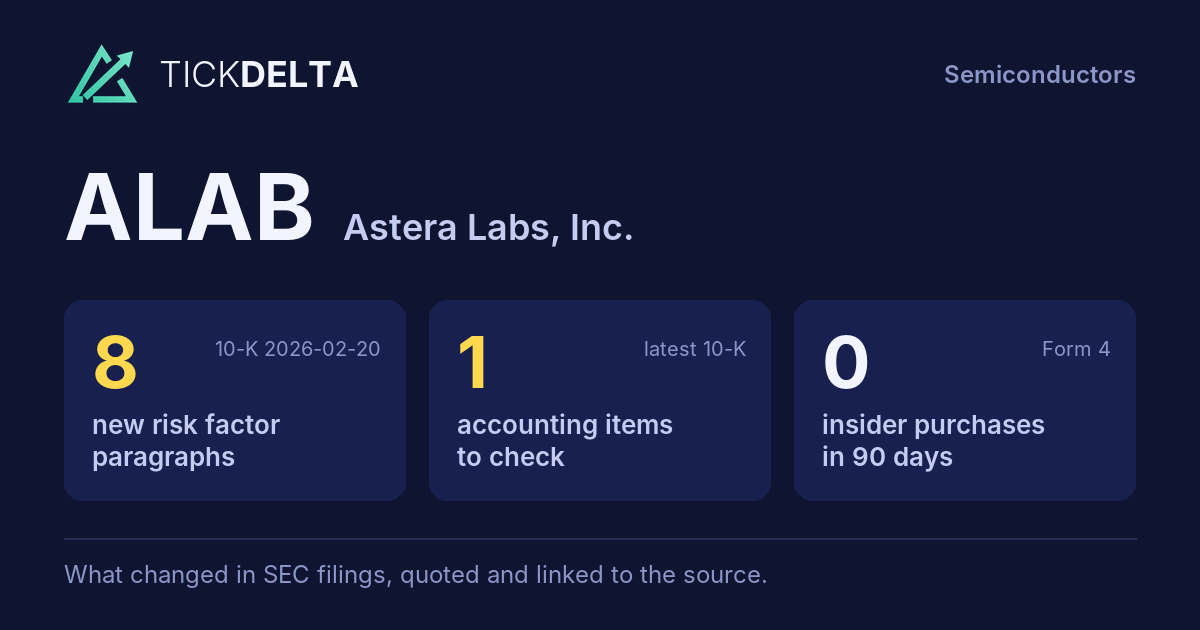
New in the 10-K 8 paragraphs with nothing like them in the 10-K filed Feb 14, 2025 New in the 10-Q 3 paragraphs not in the 10-Q filed Aug 5, 2026 10-Q against the 10-K 1 risk factor paragraphs and sentences added or reworded

New risk paragraphs, branching off last year

Each branch is a paragraph in Risk Factors with nothing like it in the 10-K filed Feb 14, 2025. A box jumps to the paragraph as filed, below.

8 new

Paragraphs with nothing like them in last year's 10-K

Quoted exactly

8 paragraphs in Risk Factors of the 10-K filed Feb 20, 2026 with nothing like them in the 10-K filed Feb 14, 2025. Quoted exactly. Paragraphs that were only edited are under 10-K change.

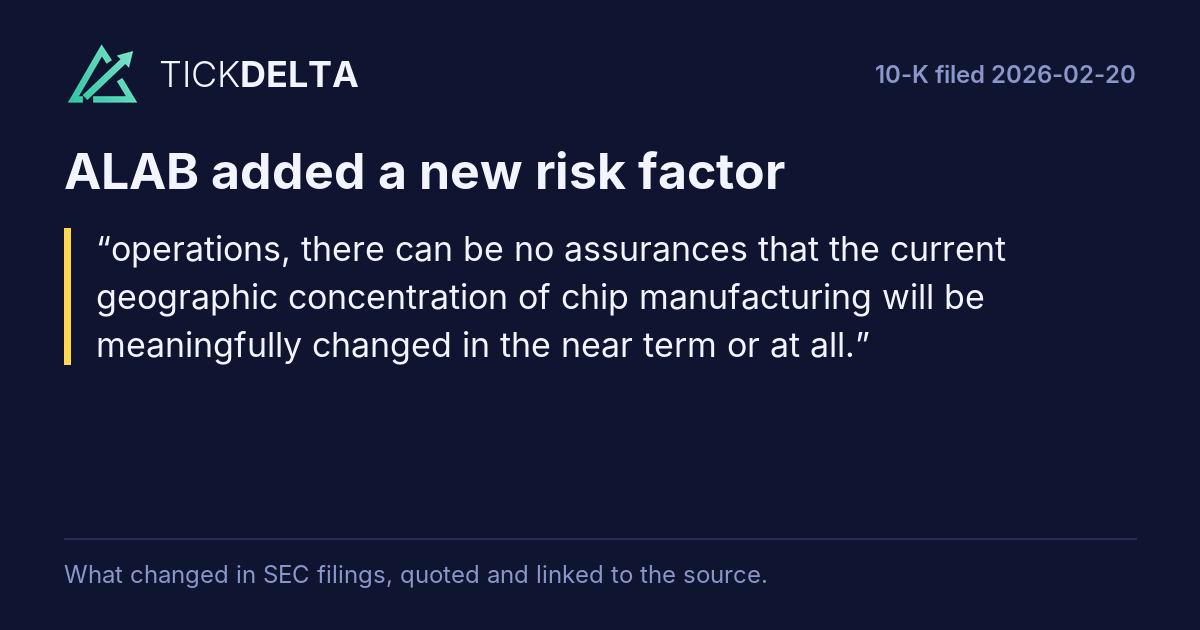
operations, there can be no assurances that the current geographic concentration of chip manufacturing will be meaningfully changed in the near term or at all.

Read in the 10-K

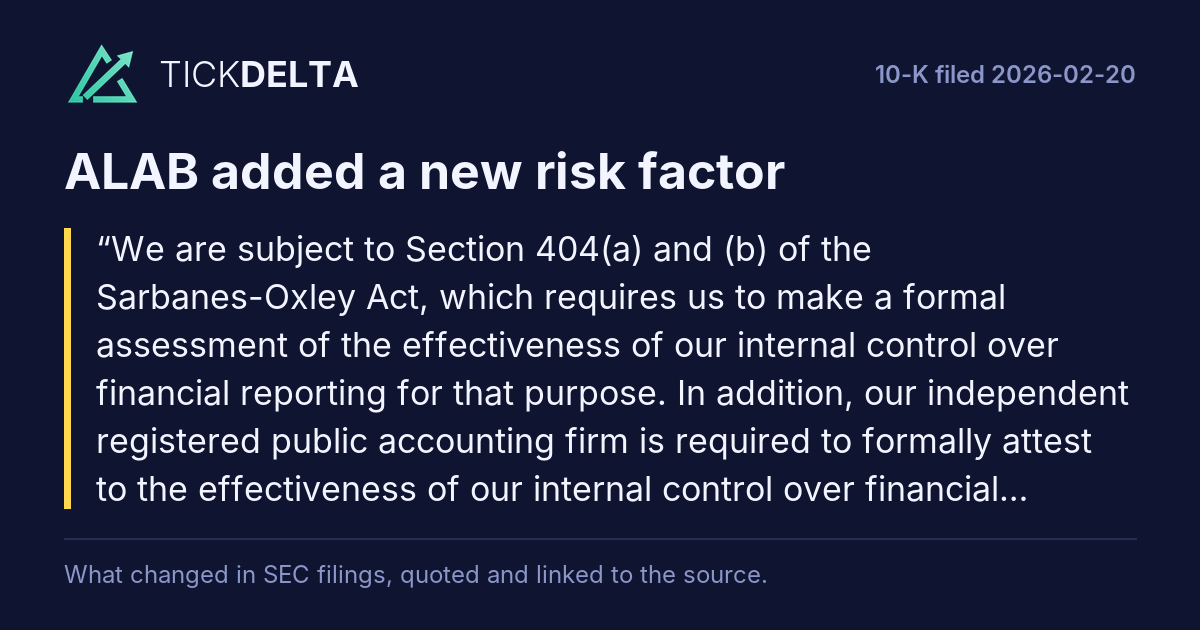
We are subject to Section 404(a) and (b) of the Sarbanes-Oxley Act, which requires us to make a formal assessment of the effectiveness of our internal control over financial reporting for that purpose. In addition, our independent registered public accounting firm is required to formally attest to the effectiveness of our internal control over financial reporting. Maintaining effective disclosure controls and procedures and effective internal controls over financial reporting are necessary for us to produce reliable financial statements and disclosure reports. While we have remediated previously identified material weaknesses, we cannot assure you that additional material weaknesses will not arise in the future, particularly as we continue to scale our operations, integrate new systems and processes such as a new enterprise resource planning system, and as certain of our foreign subsidiaries, which historically have not been subject to full SOX‑based testing due to their size and scope, grow or otherwise become material and require expanded internal control design, documentation, and testing. Any failure to maintain effective disclosure controls and internal control over financial reporting could harm our business and could cause a decline in the trading price of our common stock.

Read in the 10-K

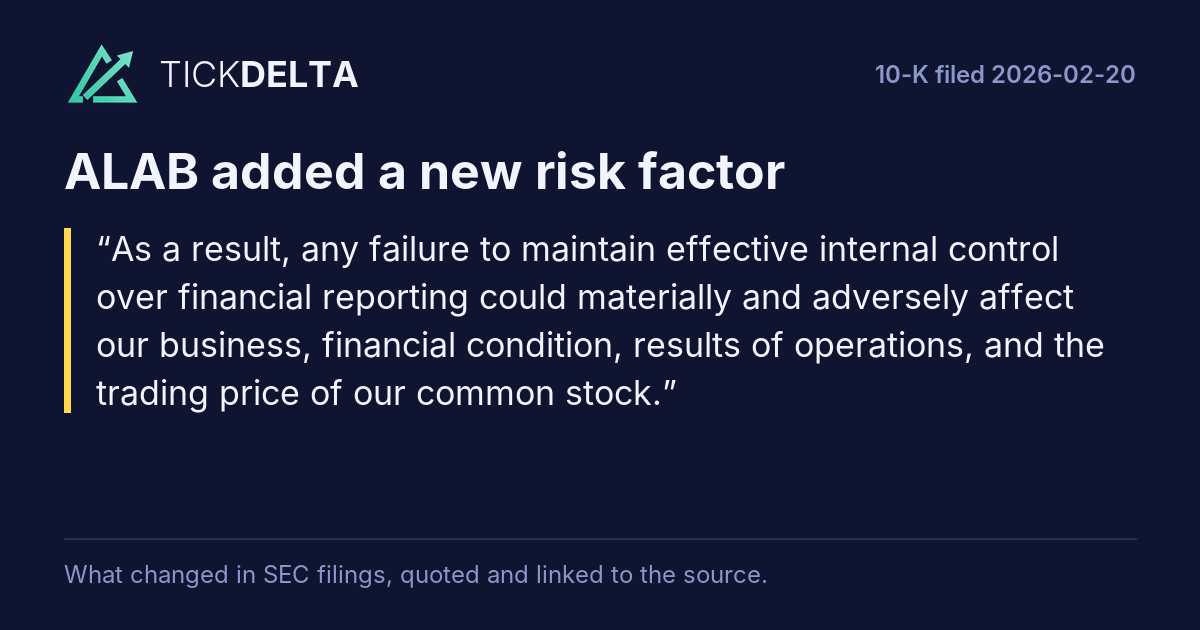
As a result, any failure to maintain effective internal control over financial reporting could materially and adversely affect our business, financial condition, results of operations, and the trading price of our common stock.

Read in the 10-K

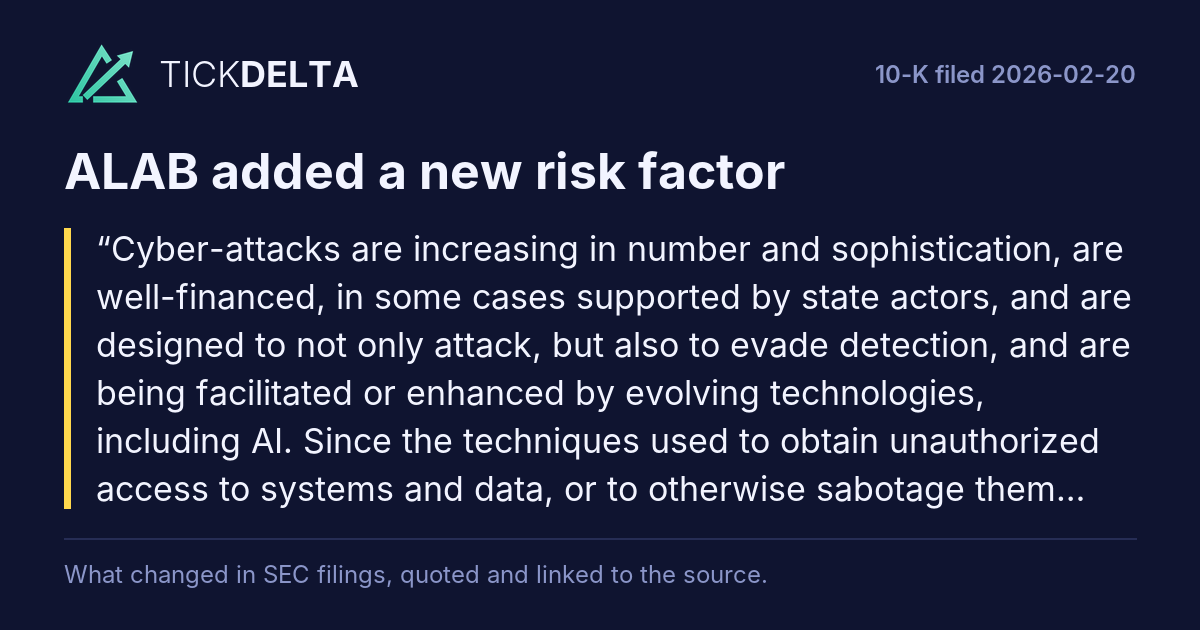
Cyber-attacks are increasing in number and sophistication, are well-financed, in some cases supported by state actors, and are designed to not only attack, but also to evade detection, and are being facilitated or enhanced by evolving technologies, including AI. Since the techniques used to obtain unauthorized access to systems and data, or to otherwise sabotage them, change frequently and are often not recognized until launched against a target, we may be unable to anticipate these techniques or to implement adequate preventative measures. Attempts to disrupt or gain unauthorized access to our and our third-party vendors’ information systems from malicious third parties or insider threats may incorporate widely varying and frequently changing tactics, which may be enhanced or facilitated by evolving technologies

Read in the 10-K

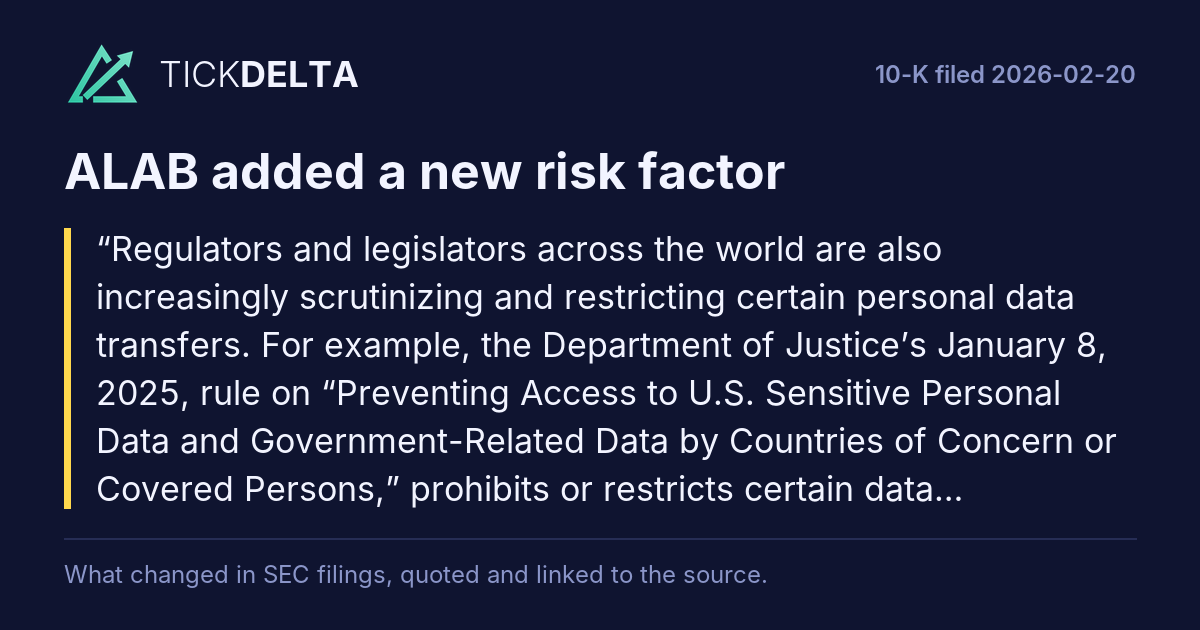
Regulators and legislators across the world are also increasingly scrutinizing and restricting certain personal data transfers. For example, the Department of Justice’s January 8, 2025, rule on “Preventing Access to U.S. Sensitive Personal Data and Government-Related Data by Countries of Concern or Covered Persons,” prohibits or restricts certain data transactions involving countries of concern, including China. Actual or alleged violations of these regulations may be punishable by criminal and/or civil sanctions and may result in exclusion from participation in federal and state programs.

Read in the 10-K
Show the other 3

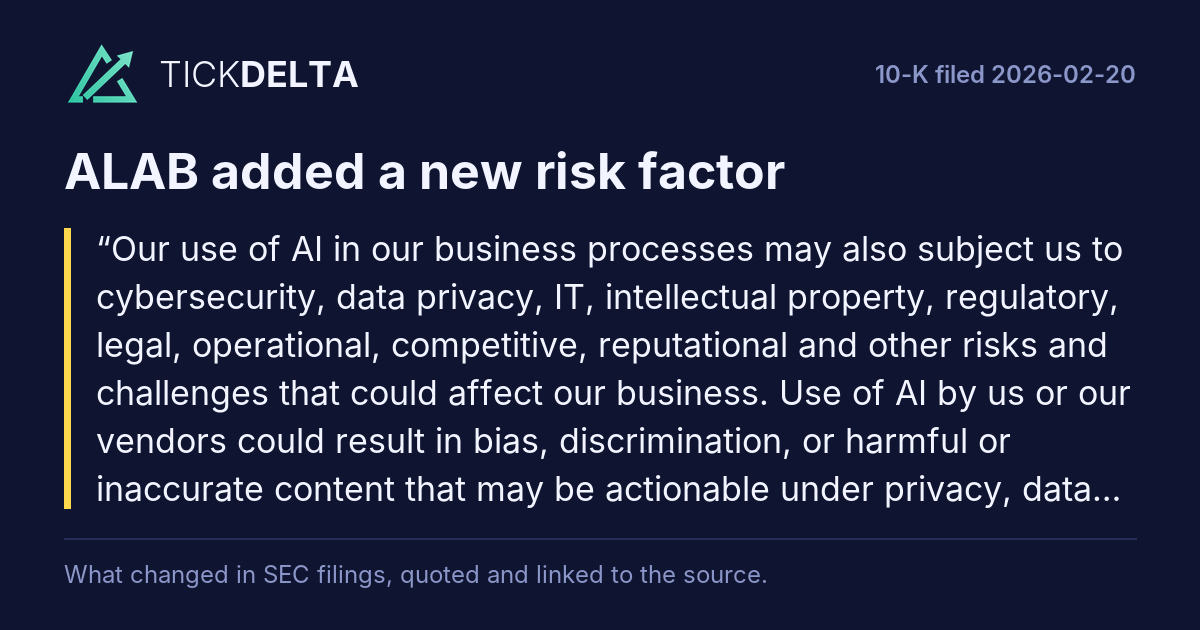
Our use of AI in our business processes may also subject us to cybersecurity, data privacy, IT, intellectual property, regulatory, legal, operational, competitive, reputational and other risks and challenges that could affect our business. Use of AI by us or our vendors could result in bias, discrimination, or harmful or inaccurate content that may be actionable under privacy, data protection, and emerging AI laws. The use of certain AI technology can also give rise to intellectual property risks, including by disclosing or otherwise compromising our confidential or proprietary intellectual property and intellectual property infringement, or by undermining our ability to assert or defend ownership rights in intellectual property created with the assistance of AI tools.

Read in the 10-K

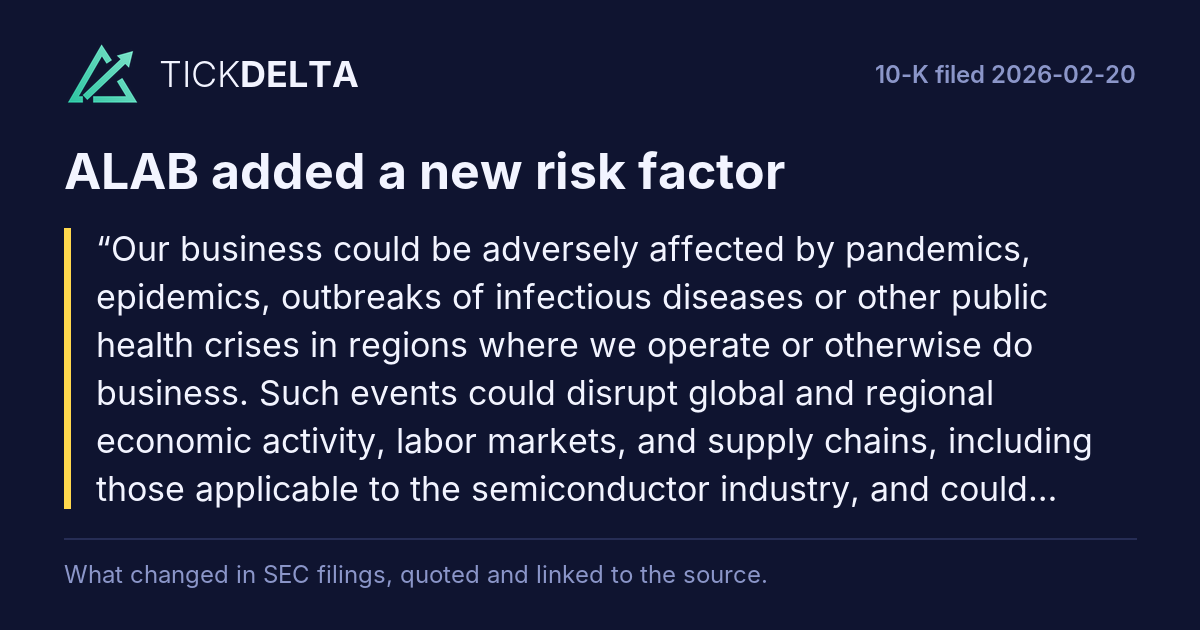
Our business could be adversely affected by pandemics, epidemics, outbreaks of infectious diseases or other public health crises in regions where we operate or otherwise do business. Such events could disrupt global and regional economic activity, labor markets, and supply chains, including those applicable to the semiconductor industry, and could adversely affect our employees, customers, suppliers and other business partners.

Read in the 10-K

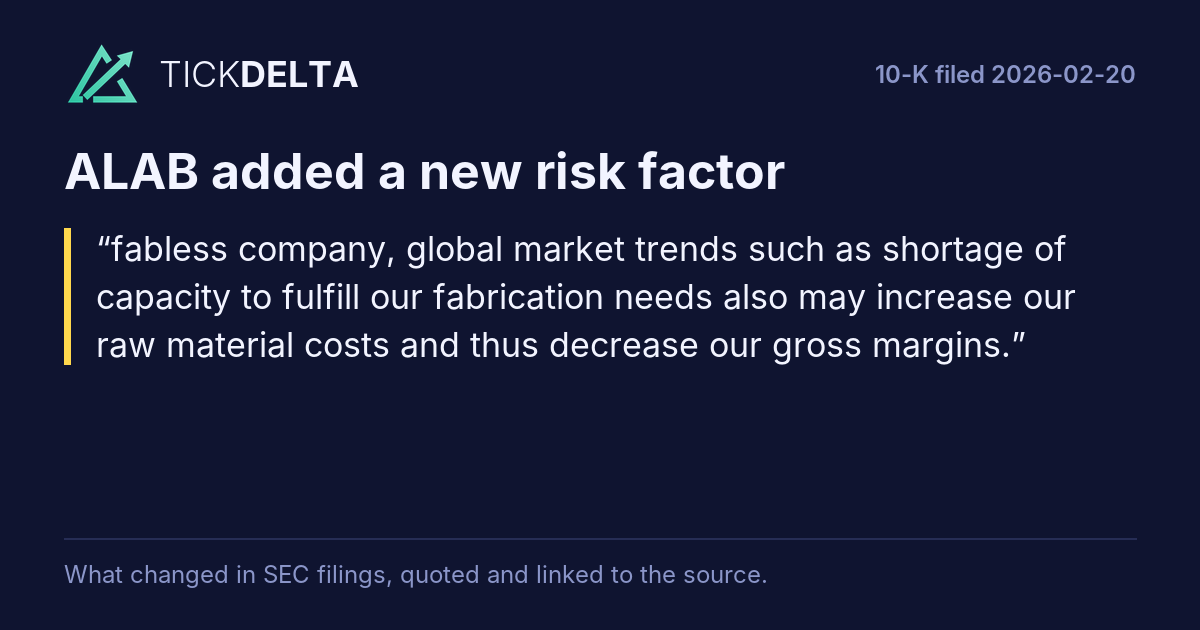
fabless company, global market trends such as shortage of capacity to fulfill our fabrication needs also may increase our raw material costs and thus decrease our gross margins.

Read in the 10-K

Paragraphs in the 10-Q filed Nov 4, 2026 that were not in the one before

New in the latest 10-Q

3 paragraphs in the 10-Q filed Nov 4, 2026 with nothing like them in the 10-Q filed Aug 5, 2026 (at least half the words must differ; new numbers alone do not count). Quoted exactly, grouped by the item heading above them. This is text that changed, not a judgement of how serious it is.

Financial statements and notes

As of September 30, 2026 December 31, 2025 Customer A 58% * Customer B 13% 14% Customer F * 28% Customer C * 27%

Read in the 10-Q

additional tool to eliminate the effects of items that may vary for different companies for reasons unrelated to core operating performance.

Read in the 10-Q

Controls and procedures

During the quarter ended September 30, 2026, we implemented a new enterprise resource planning (“ERP”) system to replace components of our operating and financial systems. This implementation resulted in changes to certain of our processes and internal controls that support financial reporting. We have updated our internal controls as appropriate in light of the new system and will continue to monitor the impact of the implementation on our processes, procedures, and internal controls over financial reporting. The newly implemented ERP system and the modified new processes and controls were used to prepare our condensed consolidated financial statements included in this filing.

Read in the 10-Q

The 10-Q's risk factors against the 10-K

Item 1A of the 10-Q filed Nov 4, 2026 against Item 1A of the 10-K filed Feb 20, 2026. A 10-Q repeats only the risks that changed, so a 10-K paragraph that is missing from it is not counted as removed. Added is a paragraph with nothing like it in the 10-K, Reworded a sentence that is in both with several words changed, Quiet changes a sentence in both where one to four words changed and one is a hedge or a modal (cut words struck through, new words highlighted). Text on the page, not a score; each links to the filing at sec.gov.

Added10-Q Nov 4, 2026 vs 10-K Feb 20, 2026
For a discussion of potential risks and uncertainties, see the information in the section titled “Risk Factors” in the Annual Report on Form 10-K for the year ended December 31, 2025. As of the date of this Quarterly Report on Form 10-Q, there have been no material changes from the risk factors disclosed in our Annual Report on Form 10-K for the year ended December 31, 2025. Any of these factors could result in a significant or material adverse effect on our results of operations or financial condition. Additional risk factors not presently known to us or that we currently deem immaterial may also impair our business or results of operations. We may disclose changes to such factors or disclose additional factors from time to time in our future filings with the SEC.

Read it in the 10-Q at sec.gov

Phrases used for the first time

Two-word phrases in Risk Factors of the 10-K filed Feb 20, 2026 that are in none of the 1 earlier 10-Ks stored, back to Feb 14, 2025

net income ×4incidents data ×4limited history ×3investments joint ×3input costs ×3previously identified ×3rapidly grown ×2evolving markets ×2cyber-attacks cybersecurity ×2accumulated deficits ×2reported gross ×2increase input ×2data regarding ×2evolving technologies ×2contractual requirements ×2government shutdowns ×2
Where each one is used
  • net income: •We have a limited history of generating net income, and if we are unable to achieve adequate revenue growth while our expenses increase, we may not maintain profitability in the future;
  • incidents data: •Cybersecurity risks, including cyber-attacks, cybersecurity incidents, data breaches, and system vulnerabilities could adversely affect our business and disrupt our operations;
  • limited history: •We have a limited history of generating net income, and if we are unable to achieve adequate revenue growth while our expenses increase, we may not maintain profitability in the future;
  • investments joint: •We may pursue acquisitions, investments, joint ventures, and dispositions, which could adversely affect our results of operations, and any acquisitions we do make could disrupt our business and harm our financial condition;
  • input costs: increase input costs. Moreover, concerns that U.S. companies may not be reliable suppliers as a result of these and other actions has caused, and may in the future cause, some of our customers in China to amass large inventories of our products well in advance of need or caused some of our customers to replace our...
  • previously identified: We previously identified material weaknesses in our internal control over financial reporting and may identify additional material weaknesses in the future or fail to maintain an effective system of internal control over financial reporting. Although these material weaknesses have been remediated, if we fail to...
  • rapidly grown: •We have rapidly grown as a business in dynamic and rapidly evolving markets, and we may have difficulty accurately predicting our future revenue for the purpose of appropriately budgeting and adjusting our expenses;
  • evolving markets: •We have rapidly grown as a business in dynamic and rapidly evolving markets, and we may have difficulty accurately predicting our future revenue for the purpose of appropriately budgeting and adjusting our expenses;

The 10-K at sec.gov

Used at least twice, small words left out. Counted, not picked: a phrase can be new because the company renamed something.

What was taken out

13 paragraphs of last year's Risk Factors with nothing like them now. The longest are quoted.

Across all companies
We began taking steps to remediate these material weaknesses through the implementation of business process and IT general controls in 2024. We have reviewed and are continuing to review business processes and IT processes and design and implement internal controls consistent with the principles of the Committee of Sponsoring Organizations of the Treadway Commission (“COSO”) framework to address the risks of material misstatement. Such activities include designing and implementing new business processes, enhancing information and communication processes, assessing risk, improvements to...
In the 10-K filed Feb 14, 2025
We are an “emerging growth company” within the meaning of the Securities Act, as modified by the JOBS Act, and we may take advantage of certain exemptions from various reporting requirements that are applicable to other public companies that are not emerging growth companies including, but not limited to, not being required to comply with the auditor attestation requirements of Section 404 of the Sarbanes-Oxley Act, reduced disclosure obligations regarding executive compensation in our periodic reports and proxy statements, and exemptions from the requirements of holding a nonbinding...
In the 10-K filed Feb 14, 2025
Further, Section 102(b)(1) of the JOBS Act exempts emerging growth companies from being required to comply with new or revised financial accounting standards until private companies (that is, those that have not had a Securities Act registration statement declared effective or do not have a class or series of securities registered under the Exchange Act) are required to comply with the new or revised financial accounting standards. The JOBS Act provides that a company can elect to opt out of the extended transition period and comply with the requirements that apply to non-emerging growth...
In the 10-K filed Feb 14, 2025
We are not currently required to comply with the SEC rules that implement Section 404 of the Sarbanes- Oxley Act and are therefore not required to make a formal assessment of the effectiveness of our internal control over financial reporting for that purpose. As a public company, we are required to provide an annual management report on the effectiveness of our internal control over financial reporting commencing with our second annual report on Form 10-K. Our independent registered public accounting firm is not required to formally attest to the effectiveness of our internal control over...
In the 10-K filed Feb 14, 2025

Sources

Item 1A of each 10-K and 10-Q on EDGAR, quoted exactly. Each paragraph links to the filing at sec.gov.

Also

10-K change: what was reworded or cut, section by section.

Work with it

Excel workbook · CSV. Google Sheet that stays up to date: paste =IMPORTDATA("https://tickdelta.com/company/ALAB/export.csv") into a cell.

Next:10-K change
Esc

Type a ticker such as AAPL, a name, an investor such as Buffett, or a topic such as tariffs. ↑ ↓ to move, Enter to open.