Paragraph 13 · 49% changed
Every version of it
Screener
/
SEC EDGAR
/CIK 0000866291
/10-K filed May 21, 2026, compared with May 22, 2025
/Numbers from the XBRL of the 10-Ks
Nasdaq
Technology · Semiconductors
Allegro Microsystems, Inc. ALGM
The 10-K against last year's
175 changes: 22 added, 19 removed, 131 reworded, 3 quiet changes
10-K May 21, 2026 vs May 22, 2025
Risk Factors
24.5%
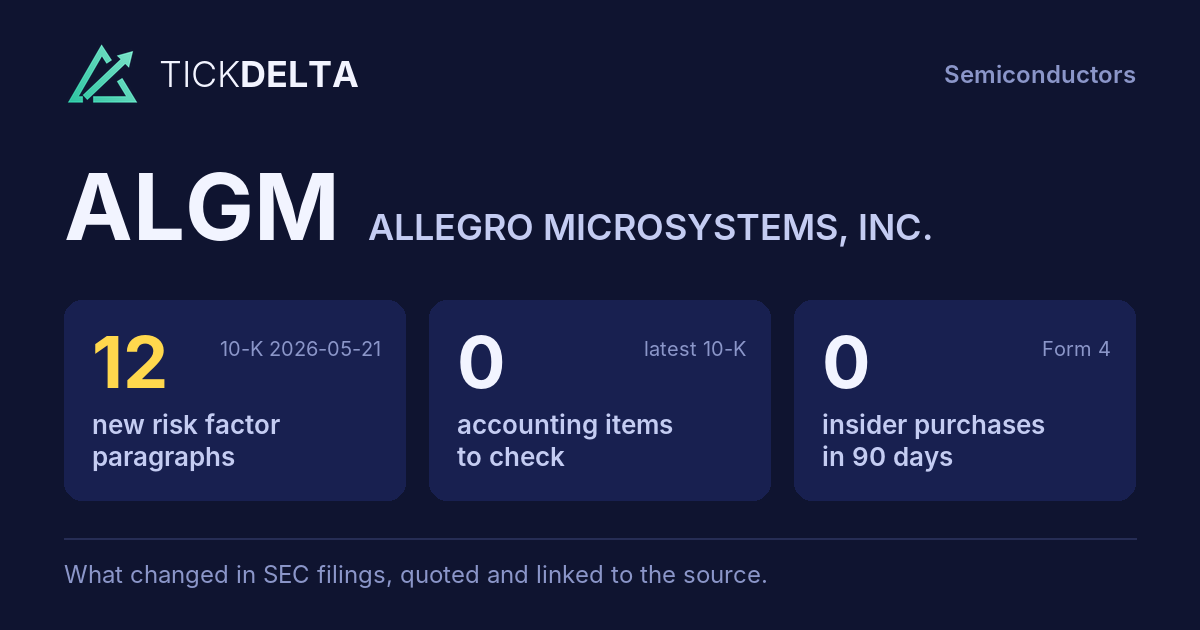
of the text changed · 15,829 words now · 12 new paragraphs, 8 gone
MD&A
20.5%
of the text changed · 8,770 words now · 10 new paragraphs, 11 gone
10-K 0001193125-26-233537 (May 21, 2026) vs 10-K 0000950170-25-076059 (May 22, 2025) Not compared: Legal Proceedings, Accounting Policies.
Every paragraph, and how much of it changed
One bar per paragraph, in the order of the 10-K. Height and colour show the share of its words not in the closest paragraph a year earlier; the tallest bars are new paragraphs.
Risk Factors
121 paragraphs · 12 new · 70 reworded · 8 gone · 10-K May 21, 2026 against May 22, 2025
New paragraph
Reworded (5% of its words or more)
Same or nearly
Paragraph 59 · 48% changed
Every version of it
We face an inherent business risk of exposure to warranty and product liability claims if products fail to perform as expected or any such failure is alleged to result in bodily injury, death, and/or property damage. In addition, Further, if any of our designed products are alleged to be defective, we may be required to participate in their recalls. Some In addition, our customers, particularly automotive and industrial OEMs expect suppliers to warrant and their products for longer periods tier-one suppliers, increasingly assert quality-related claims against us seeking recovery of time and are increasingly looking to them for contribution when faced with product liability claims costs incurred as a result of actual or recalls. For example, some alleged non-conformance of our products are used in automotive safety systems, the failure of which could lead products. Customers frequently seek to injury recover these claimed amounts through charge-backs, set-offs against amounts otherwise owed to us, or death. We carry various commercial liability policies, including umbrella/excess policies which provide some protection against product liability exposure. However, a successful warranty contractual indemnification, cost-sharing or product liability claim against us in excess of our available insurance coverage and established reserves, or a requirement that we participate in a product recall, could have adverse effects on our business results. Further, in the future, it is possible that we will not be able to obtain insurance coverage in the quality-incentive provisions. The amounts and for the risks we seek at policy costs and terms we desire. Additionally, if our products fail to perform as expected or such failure of our products results in a recall, our reputation may be damaged, which could make it more difficult for us to sell our products to existing and prospective customers and could materially and adversely affect our business, results of operations and financial condition.
Paragraph 74 · 46% changed
Every version of it
Exports to certain manufacturers of technology relating to our products are subject, or could be subject in the future, to export controls imposed by the U.S. government and administered by the U.S. Departments of State and Commerce. In certain instances, these regulations may require pre-shipment authorization from the administering department. For products subject to the Export Administration Regulations, administered by the Department of Commerce’s Bureau of Industry and Security, the requirement for a license is dependent on the type and end use of the product, the final destination, the identity of the end user and whether a license exception might apply. Products developed and manufactured in our foreign locations are subject to export controls of the applicable foreign nation. Obtaining export licenses can be difficult, costly and time-consuming, and we may not always be successful in obtaining necessary export licenses. Our failure to obtain required import or export approval for our products or limitations on our ability to manufacture or sell our products imposed by these laws may harm our international and domestic revenues. Noncompliance with these laws could have negative consequences, including government investigations, penalties and reputational harm. The absence of comparable restrictions on competitors in other countries may adversely affect our competitive position. Failure to obtain export licenses for technology relating to our products or having one or more of our customers be restricted from receiving exports from us could significantly reduce our net sales and materially and adversely affect our business, financial condition and results of operations.
Paragraph 45 · 45% changed
Every version of it
Our continued success will depend in large part on general economic growth and growth within our target markets in the automotive and industrial sectors. Factors affecting these markets, including reductions in sales of our customers’ products, deterioration of our customers’ financial condition, insufficient customer resources dedicated to promoting and commercializing their products, the inability of our customers to adapt to changing technological demands, design flaws in customer products, the effects of catastrophic and other disruptive events, and increased supply chain, manufacturing or production costs could seriously harm our customers and, as a result, harm us. Any slowdown Additionally, our products may be used in AI infrastructure, including data centers, robotics and factory automation, and our ability to capitalize on this trend is subject to significant risks and uncertainties. The market for AI applications is still developing, and demand for products that support AI Technologies may be unpredictable and vary significantly. If the growth of these end markets could adversely affect our financial results. For example, AI infrastructure is constrained by factors such as power availability, utility limitations, shifts in customer budgets or a significant element of our growth strategy depends on the increasing adoption of (i) HEVs and EVs, which are expected to have higher sensor and power product content, and (ii) our products collapse in the industrial market, which have applications in clean energy and EV charging, both of which we anticipate will benefit from a transition to lower emission vehicles and clean energy. If anticipated demand in the end market for these vehicles and products does not materialize or if widespread adoption takes longer than we project, it would adversely affect AI demand, demand for our products from offerings could be lower than we currently expect. Further, our failure to develop and offer the solutions that our AI-focused customers demand in a timely manner, commercialize new technologies used in AI data centers, or adapt to a shift in data center design could result in a loss of market share, unanticipated costs and impact our ability inventory obsolescence. Moreover, expectations and front-loaded investment related to execute our growth strategy. AI Technologies may increase the magnitude and volatility of semiconductor industry cycles, making downturns more abrupt, and if customer spending on AI Technologies moderates, is delayed, or declines more rapidly than anticipated, we could face a more pronounced downturn.
Paragraph 21 · 40% changed
Every version of it
Paragraph 50 · 38% changed
Every version of it
As part of our growth strategy, we seek to expand our addressable markets by identifying and entering both new geographic markets and increasing the number and types of applications our products can be used in. For example, we are increasing investment in and pursuing opportunities in applications such as AI, medical devices and robotics, and in geographic markets where we have not historically had a strong presence. Our future success depends in part on our ability to successfully identify these opportunities, make the necessary investments to pursue them, overcome marketing and technological challenges, and ultimately generate and expand revenue and achieve appropriate margins from these efforts. Our ability to generate significant revenue from new markets and product applications for our products will depend on various factors, including: the development and growth rate of these markets; the ability of our technologies and product solutions to address the specific needs, price and performance requirements of customers and end users in these markets; our ability to provide solutions that offer advantages in terms of performance, quality, reliability, and value-added features compared with alternative solutions and competitive offerings; the ability to adapt to market conditions, distribution channels, and customer relationships that may be unfamiliar to us; the timely and efficient completion of product development, manufacturing, assembly, and test processes suitable for these markets; and the effectiveness of our marketing, sales, and support efforts in these new areas. Many potential customers in these markets may have well-established relationships with competitive suppliers. Our ongoing success will require us to offer compelling alternatives at competitive costs. The markets for certain of these products may develop slower than anticipated, or not at all, or could utilize competing technologies. If we are unable to adapt rapidly to such conditions, or if we fail to timely introduce new products or penetrate these markets successfully, our investments may not generate expected returns, our sales growth could be impeded, and our business, financial condition, and results of operations could be adversely affected.
Paragraph 20 · 37% changed
Every version of it
Paragraph 72 · 35% changed
Every version of it
These factors, individually or in combination, could impair our ability to effectively operate one or more of our foreign facilities or deliver our products, result in unexpected and material expenses, or cause an unexpected decline in the demand for our products in certain countries or regions. Our failure to manage the risks and challenges associated with our international business and operations could have a material adverse effect on our business. For example, the military conflict between Israel and Hamas and the potential for regional expansion; any deterioration in the relations between Taiwan and China, and other factors affecting military, political or economic conditions in Taiwan or elsewhere in Asia; and the continuing military conflict between Ukraine and Russia, as well as the financial and trade-related restrictions associated with Russia and Belarus and economic sanctions on certain individuals and entities in Russia and Belarus, could adversely impact the global supply chain, disrupt our operations and/or our customers’ operations, negatively impact the demand for our products in our primary end markets or lead to an increase in cyberattacks and espionage.
Paragraph 13 · 49% changed
Every version of it
10-K May 22, 2025In addition, we base operating decisions, and enter into purchase commitments, on the basis of anticipated net sales trends, which are highly unpredictable. Changes in forecasts or the timing of orders from customers expose us to risks of inventory shortages or excess inventory. Some of our purchase commitments are not cancellable, and in some cases we are required to recognize a charge representing the amount of material or capital equipment purchased or ordered, which exceeds our actual requirements. For example, we have noncancellable purchase commitments with vendors and “take-or-pay” agreements with certain of our third-party wafer fabrication partners, under which we are required to purchase a minimum number of wafers per year or face financial penalties. These types of commitments and agreements have reduced and may continue to reduce, our ability to adjust our inventory to address declining market demands. Over the past several quarters, we and other semiconductor companies have experienced a downturn in market demand, which has caused us to record substantive charges for excess and obsolete inventories and be forced to incur other inventory-related charges. If net sales in future periods fall substantially below our expectations, or if we fail to accurately forecast changes in demand mix, we could again be required to record substantial charges for obsolete or excess inventories or noncancellable purchase commitments. Moreover, during a market upturn we may not be able to purchase sufficient supplies or components to meet increasing product demand, which could prevent us from taking advantage of opportunities and maximizing our net sales. Our failure to adjust our supply chain volume, secure sufficient supply from our third-party vendors, including our semiconductor wafer suppliers, or estimate our customers’ demand could have a material adverse effect on our net sales, business, financial condition and results of operations.
10-K May 21, 2026
market upturn we may not be able to purchase sufficient supplies or components to meet increasing product demand, which could prevent us from taking advantage of opportunities and maximizing our net sales. Any failure to adjust our supply chain volume, secure sufficient supply from third-party vendors, including semiconductor wafer suppliers, or estimate customer demand could have a material adverse effect on our net sales, business, financial condition and results of operations.
Paragraph 59 · 48% changed
Every version of it
10-K May 22, 2025
We face an inherent business risk of exposure to warranty and product liability claims if products fail to perform as expected or any such failure is alleged to result in bodily injury, death, and/or property damage. In addition, if any of our designed products are alleged to be defective, we may be required to participate in their recalls. Some OEMs expect suppliers to warrant their products for longer periods of time and are increasingly looking to them for contribution when faced with product liability claims or recalls. For example, some of our products are used in automotive safety systems, the failure of which could lead to injury or death. We carry various commercial liability policies, including umbrella/excess policies which provide some protection against product liability exposure. However, a successful warranty or product liability claim against us in excess of our available insurance coverage and established reserves, or a requirement that we participate in a product recall, could have adverse effects on our business results. Further, in the future, it is possible that we will not be able to obtain insurance coverage in the amounts and for the risks we seek at policy costs and terms we desire. Additionally, if our products fail to perform as expected or such failure of our products results in a recall, our reputation may be damaged, which could make it more difficult for us to sell our products to existing and prospective customers and could materially and adversely affect our business, results of operations and financial condition.
10-K May 21, 2026
We face an inherent business risk of exposure to warranty and product liability claims if products fail to perform as expected or any such failure is alleged to result in bodily injury, death, and/or property damage. Further, if any of our designed products are alleged to be defective, we may be required to participate in their recalls. In addition, our customers, particularly automotive and industrial OEMs and their tier-one suppliers, increasingly assert quality-related claims against us seeking recovery of costs incurred as a result of actual or alleged non-conformance of our products. Customers frequently seek to recover these claimed amounts through charge-backs, set-offs against amounts otherwise owed to us, or contractual indemnification, cost-sharing or quality-incentive provisions. The amounts
Paragraph 74 · 46% changed
Every version of it
10-K May 22, 2025
Exports to certain manufacturers of technology relating to our products are subject, or could be subject in the future, to export controls imposed by the U.S. government and administered by the U.S. Departments of State and Commerce. In certain instances, these regulations may require pre-shipment authorization from the administering department. For products subject to the Export Administration Regulations, administered by the Department of Commerce’s Bureau of Industry and Security, the requirement for a license is dependent on the type and end use of the product, the final destination, the identity of the end user and whether a license exception might apply. Products developed and manufactured in our foreign locations are subject to export controls of the applicable foreign nation. Obtaining export licenses can be difficult, costly and time-consuming, and we may not always be successful in obtaining necessary export licenses. Our failure to obtain required import or export approval for our products or limitations on our ability to manufacture or sell our products imposed by these laws may harm our international and domestic revenues. Noncompliance with these laws could have negative consequences, including government investigations, penalties and reputational harm. The absence of comparable restrictions on competitors in other countries may adversely affect our competitive position. Failure to obtain export licenses for technology relating to our products or having one or more of our customers be restricted from receiving exports from us could significantly reduce our net sales and materially and adversely affect our business, financial condition and results of operations.
10-K May 21, 2026
Exports to certain manufacturers of technology relating to our products are subject, or could be subject in the future, to export controls imposed by the U.S. government and administered by the U.S. Departments of State and Commerce. In certain instances, these regulations may require pre-shipment authorization from the administering department. For products subject to the Export Administration Regulations, administered by the Department of Commerce’s Bureau of Industry and Security, the requirement for a
Paragraph 45 · 45% changed
Every version of it
10-K May 22, 2025
Our continued success will depend in large part on general economic growth and growth within our target markets in the automotive and industrial sectors. Factors affecting these markets, including reductions in sales of our customers’ products, deterioration of our customers’ financial condition, insufficient customer resources dedicated to promoting and commercializing their products, the inability of our customers to adapt to changing technological demands, design flaws in customer products, the effects of catastrophic and other disruptive events, and increased supply chain, manufacturing or production costs could seriously harm our customers and, as a result, harm us. Any slowdown in the growth of these end markets could adversely affect our financial results. For example, a significant element of our growth strategy depends on the increasing adoption of (i) HEVs and EVs, which are expected to have higher sensor and power product content, and (ii) our products in the industrial market, which have applications in clean energy and EV charging, both of which we anticipate will benefit from a transition to lower emission vehicles and clean energy. If anticipated demand in the end market for these vehicles and products does not materialize or if widespread adoption takes longer than we project, it would adversely affect demand for our products from customers and impact our ability to execute our growth strategy.
10-K May 21, 2026
Our continued success will depend in large part on general economic growth and growth within our target markets in the automotive and industrial sectors. Factors affecting these markets, including reductions in sales of our customers’ products, deterioration of our customers’ financial condition, insufficient customer resources dedicated to promoting and commercializing their products, the inability of our customers to adapt to changing technological demands, design flaws in customer products, the effects of catastrophic and other disruptive events, and increased supply chain, manufacturing or production costs could seriously harm our customers and, as a result, harm us. Additionally, our products may be used in AI infrastructure, including data centers, robotics and factory automation, and our ability to capitalize on this trend is subject to significant risks and uncertainties. The market for AI applications is still developing, and demand for products that support AI Technologies may be unpredictable and vary significantly. If the growth of AI infrastructure is constrained by factors such as power availability, utility limitations, shifts in customer budgets or a collapse in AI demand, demand for our offerings could be lower than we currently expect. Further, our failure to develop and offer the solutions that our AI-focused customers demand in a timely manner, commercialize new technologies used in AI data centers, or adapt to a shift in data center design could result in a loss of market share, unanticipated costs and inventory obsolescence. Moreover, expectations and front-loaded investment related to AI Technologies may increase the magnitude and volatility of semiconductor industry cycles, making downturns more abrupt, and if customer spending on AI Technologies moderates, is delayed, or declines more rapidly than anticipated, we could face a more pronounced downturn.
Paragraph 21 · 40% changed
Every version of it
10-K May 22, 2025Gross margins on individual products typically fluctuate over the product’s life cycle. Our overall gross margins have fluctuated from period to period as a result of shifts in product mix, customer mix, channel mix, the introduction of new products, decreases in ASPs for older products and our ability to reduce product costs. In addition, in periods of high demand for some of our products, we may have to source a portion of materials from higher-cost providers, which may decrease overall gross margin. These fluctuations are expected to continue in the future.
10-K May 21, 2026
The market for our products is generally characterized by declining ASPs, resulting from factors such as increased competition, overcapacity, the amount of inventory held by our customers, the introduction of new products and increased unit volumes. Further, our overall gross margins have fluctuated period to period as a result of shifts in product mix, customer mix and channel mix, as gross margins on individual products typically fluctuate over the product’s life cycle. We have experienced, and in the future may experience, substantial period-to-period fluctuations in operating results due to these factors. ASPs may decrease in the future in response to
Paragraph 50 · 38% changed
Every version of it
10-K May 22, 2025
Our ability to generate significant revenue from new markets and applications for our products will depend on various factors, including: the development and growth rate of these markets; the ability of our technologies and product solutions to address the specific needs, price and performance requirements of customers and end users in these markets; our ability to provide solutions that offer advantages in terms of performance, quality, reliability, and value-added features compared with alternative solutions and competitive offerings; the ability to adapt to market conditions, distribution channels, and customer relationships that may be unfamiliar to us; the timely and efficient completion of product development, manufacturing, assembly, and test processes suitable for these markets; and the effectiveness of our marketing, sales, and support efforts in these new areas.
10-K May 21, 2026
As part of our growth strategy, we seek to expand our addressable markets by identifying and entering both new geographic markets and increasing the number and types of applications our products can be used in. For example, we are increasing investment in and pursuing opportunities in applications such as AI, medical devices and robotics, and in geographic markets where we have not historically had a strong presence. Our future success depends in part on our ability to successfully identify these opportunities, make the necessary investments to pursue them, overcome marketing and technological challenges, and ultimately generate and expand revenue and achieve appropriate margins from these efforts. Our ability to generate significant revenue from new markets and product applications will depend on various factors, including: the development and growth rate of these markets; the ability of our technologies and product solutions to address the specific needs, price and performance requirements of customers and end users in these markets; our ability to provide solutions that offer advantages in terms of performance, quality, reliability, and value-added features compared with alternative solutions and competitive offerings; the ability to adapt to market conditions, distribution channels, and customer relationships that may be unfamiliar to us; the timely and efficient completion of product development, manufacturing, assembly, and test processes suitable for these markets; and the effectiveness of our marketing, sales, and support efforts in these new areas. Many potential customers in these markets may have well-established relationships with competitive suppliers. Our ongoing success will require us to offer compelling alternatives at competitive costs. The markets for certain of these products may develop slower than anticipated, or not at all, or could utilize competing technologies. If we are unable to adapt rapidly to such conditions, or if we fail to timely introduce new products or penetrate these markets successfully, our investments may not generate expected returns, our sales growth could be impeded, and our business, financial condition, and results of operations could be adversely affected.
Paragraph 20 · 37% changed
Every version of it
10-K May 22, 2025Decreases in average selling prices of our products and increases in input costs may reduce our gross margins.
10-K May 21, 2026
Our gross margins may be adversely affected by decreases in average selling prices of our products, increases in input costs and shifts in product, customer or channel mix.
Paragraph 72 · 35% changed
Every version of it
10-K May 22, 2025
These factors, individually or in combination, could impair our ability to effectively operate one or more of our foreign facilities or deliver our products, result in unexpected and material expenses, or cause an unexpected decline in the demand for our products in certain countries or regions. Our failure to manage the risks and challenges associated with our international business and operations could have a material adverse effect on our business. For example, the military conflict between Israel and Hamas and the potential for regional expansion; any deterioration in the relations between Taiwan and China, and other factors affecting military, political or economic conditions in Taiwan or elsewhere in Asia; and the continuing military conflict between Ukraine and Russia, as well as the financial and trade-related restrictions associated with Russia and Belarus and economic sanctions on certain individuals and entities in Russia and Belarus, could adversely impact the global supply chain, disrupt our operations and/or our customers’ operations, negatively impact the demand for our products in our primary end markets or lead to an increase in cyberattacks and espionage.
10-K May 21, 2026
These factors, individually or in combination, could impair our ability to effectively operate one or more of our foreign facilities or deliver our products, result in unexpected and material expenses, or cause an unexpected decline in the demand for our products in certain countries or regions. Our failure to manage the risks and challenges associated with our international business and operations could have a material adverse effect on our business.
MD&A
94 paragraphs · 10 new · 39 reworded · 11 gone · 10-K May 21, 2026 against May 22, 2025
New paragraph
Reworded (5% of its words or more)
Same or nearly
Paragraph 74 · 46% changed
For the fiscal years ended March 28, 2025 27, 2026 and March 29, 2024, 28, 2025, our income tax (benefit) provision benefits and the effective income tax rate (“ETR”) ETR was $(0.2) million and 1.7%, and $(12.9) million and 15.1%, and $41.9 million and 21.5%, respectively. The ETR decrease primarily results from (i) lower pre-tax GAAP loss in our ETR was primarily due to the decrease in GAAP income before tax and the impact of the entity restructuring transactions completed during the fiscal year ended March 29, 2024. 27, 2026, which was driven in part, by the $34.8 million nondeductible loss on change in fair value of forward repurchase contract recorded in the fiscal year ended March 28, 2025 and (ii) the OBBB impacts described above in the “Components of Our Results of Operations.”
Paragraph 60 · 46% changed
Cost of goods sold decreased increased in the fiscal year ended March 28, 2025 27, 2026 compared to the fiscal year ended March 29, 2024. 28, 2025. The decrease increase in cost of goods sold was primarily due to a reduction higher production volume in shipped volume, as well as a change in support of higher product mix, partially offset by an sales and increase in amortization of intangible assets related to the acquisition of Crocus. materials and commodity costs.
Paragraph 56 · 39% changed
Industrial and other net sales decreased increased primarily due to an increase in demand for data center applications, industrial automation and robotics products, medical applications and clean energy applications, partially offset by a decrease in demand for our data center applications consumer products, broad-based industrial products and our broad-based personal and other industrial applications, in addition to distributor inventory reductions. transport products.
Paragraph 57 · 34% changed
The decrease increase in MS was primarily due to a decline an increase in fiscal year 2025 demand for our current and isolator products, as well as our magnetic speed sensors, TMR sensor solutions and magnetic position sensors, partially offset by an sensors. The increase in sales of our TMR solutions. The decline in PIC sales was primarily driven by a decrease in fiscal year 2025 demand for our motor products and high-performance high performance power products. For additional details on the factors driving the decrease in demand for fiscal year 2025, see discussion below under Net Sales by Geographic Location.
Paragraph 84 · 33% changed
Net cash used in financing activities was $112.1 $77.4 million in fiscal year 2025, 2026, primarily consisting of $853.9 million used to repurchase our common stock, $105.0 $345.0 million of payments on our indebtedness under the 2023 Revolving Credit Agreement and $16.2 term loan, $12.6 million of taxes related to the net settlement of equity awards, awards and $5.0 million of payments for intangible assets, partially offset by the issuance of common stock of $665.9 million, net proceeds of $193.1 $285.0 million from our financing activities under the 2023 Revolving Credit Agreement, proceeds received in connection with the issuance of common stock under our employee stock purchase plan and proceeds received related to the quarterly payment on the PSL Promissory Note (prior to being discharged). Agreement.
Paragraph 68 · 31% changed
Interest expense increased decreased in the fiscal year ended March 28, 2025 27, 2026 compared to the fiscal year ended March 29, 2024. 28, 2025. The increase decrease was primarily due to higher interest the voluntary payments on applied to the Refinanced 2023 outstanding balance of our Term Loan Facility, which increased our total outstanding debt balance. Facility.
Paragraph 63 · 30% changed
R&D expenses increased in the fiscal year ended March 28, 2025 27, 2026 compared to the fiscal year ended March 29, 2024. 28, 2025. This increase was primarily due to an increase in R&D supplies, partially offset by a reduction from personnel costs, depreciation and R&D tax credits. including the funding of the annual incentive program.
Paragraph 65 · 26% changed
SG&A expenses decreased increased in the fiscal year ended March 28, 2025 27, 2026 compared to the fiscal year ended March 29, 2024. 28, 2025. This decrease increase was primarily due to a decrease in funding of the Company’s annual incentive bonus program and outside service costs, partially offset by an increase in personnel costs, including the funding of the annual incentive program, outside services and severance expenses. legal fees.
Paragraph 74 · 46% changed
10-K May 22, 2025
For the fiscal years ended March 28, 2025 and March 29, 2024, our income tax (benefit) provision and the effective income tax rate (“ETR”) was $(12.9) million and 15.1%, and $41.9 million and 21.5%, respectively. The decrease in our ETR was primarily due to the decrease in GAAP income before tax and the impact of the entity restructuring transactions completed during the fiscal year ended March 29, 2024.
10-K May 21, 2026
For the fiscal years ended March 27, 2026 and March 28, 2025, our income tax benefits and the ETR was $(0.2) million and 1.7%, and $(12.9) million and 15.1%, respectively. The ETR decrease primarily results from (i) lower pre-tax GAAP loss in the fiscal year ended March 27, 2026, which was driven in part, by the $34.8 million nondeductible loss on change in fair value of forward repurchase contract recorded in the fiscal year ended March 28, 2025 and (ii) the OBBB impacts described above in the “Components of Our Results of Operations.”
Paragraph 60 · 46% changed
10-K May 22, 2025
Cost of goods sold decreased in the fiscal year ended March 28, 2025 compared to the fiscal year ended March 29, 2024. The decrease in cost of goods sold was primarily due to a reduction in shipped volume, as well as a change in product mix, partially offset by an increase in amortization of intangible assets related to the acquisition of Crocus.
10-K May 21, 2026
Cost of goods sold increased in the fiscal year ended March 27, 2026 compared to the fiscal year ended March 28, 2025. The increase in cost of goods sold was primarily due to higher production volume in support of higher product sales and increase in materials and commodity costs.
Paragraph 56 · 39% changed
10-K May 22, 2025
Industrial and other net sales decreased primarily due to a decrease in demand for our data center applications and our broad-based and other industrial applications, in addition to distributor inventory reductions.
10-K May 21, 2026
Industrial and other net sales increased primarily due to an increase in demand for data center applications, industrial automation and robotics products, medical applications and clean energy applications, partially offset by a decrease in consumer products, broad-based industrial products and personal and industrial transport products.
Paragraph 57 · 34% changed
10-K May 22, 2025
The decrease in MS was due to a decline in fiscal year 2025 demand for our current and isolator products, as well as our magnetic speed and position sensors, partially offset by an increase in sales of our TMR solutions. The decline in PIC sales was primarily driven by a decrease in fiscal year 2025 demand for our motor products and high-performance power products. For additional details on the factors driving the decrease in demand for fiscal year 2025, see discussion below under Net Sales by Geographic Location.
10-K May 21, 2026
The increase in MS was primarily due to an increase in demand for our current and isolator products, magnetic speed sensors, TMR sensor solutions and magnetic position sensors. The increase in PIC sales was primarily driven by a demand for our motor and high performance power products.
Paragraph 84 · 33% changed
10-K May 22, 2025
Net cash used in financing activities was $112.1 million in fiscal year 2025, consisting of $853.9 million used to repurchase our common stock, $105.0 million of payments on our indebtedness under the 2023 Revolving Credit Agreement and $16.2 million of taxes related to the net settlement of equity awards, partially offset by the issuance of common stock of $665.9 million, net proceeds of $193.1 million from our financing activities under the 2023 Revolving Credit Agreement, proceeds received in connection with the issuance of common stock under our employee stock purchase plan and proceeds received related to the quarterly payment on the PSL Promissory Note (prior to being discharged).
10-K May 21, 2026
Net cash used in financing activities was $77.4 million in fiscal year 2026, primarily consisting of $345.0 million of payments on our term loan, $12.6 million of taxes related to the net settlement of equity awards and $5.0 million of payments for intangible assets, partially offset by net proceeds of $285.0 million from our financing activities under the 2023 Revolving Credit Agreement.
Paragraph 68 · 31% changed
10-K May 22, 2025
Interest expense increased in the fiscal year ended March 28, 2025 compared to the fiscal year ended March 29, 2024. The increase was primarily due to higher interest payments on the Refinanced 2023 Term Loan Facility, which increased our total outstanding debt balance.
10-K May 21, 2026
Interest expense decreased in the fiscal year ended March 27, 2026 compared to the fiscal year ended March 28, 2025. The decrease was primarily due to the voluntary payments applied to the outstanding balance of our Term Loan Facility.
Paragraph 63 · 30% changed
10-K May 22, 2025
R&D expenses increased in the fiscal year ended March 28, 2025 compared to the fiscal year ended March 29, 2024. This increase was primarily due to an increase in R&D supplies, partially offset by a reduction from personnel costs, depreciation and R&D tax credits.
10-K May 21, 2026
R&D expenses increased in the fiscal year ended March 27, 2026 compared to the fiscal year ended March 28, 2025. This increase was primarily due to an increase in personnel costs, including the funding of the annual incentive program.
Paragraph 65 · 26% changed
10-K May 22, 2025
SG&A expenses decreased in the fiscal year ended March 28, 2025 compared to the fiscal year ended March 29, 2024. This decrease was primarily due to a decrease in funding of the Company’s annual incentive bonus program and outside service costs, partially offset by an increase in personnel and severance expenses.
10-K May 21, 2026
SG&A expenses increased in the fiscal year ended March 27, 2026 compared to the fiscal year ended March 28, 2025. This increase was primarily due to an increase in personnel costs, including the funding of the annual incentive program, outside services and legal fees.
A paragraph is matched with the one last year that shares the most of its words; under half in common makes it new. The paragraphs shown are the 8 reworded the most in each section.
The paragraph that changed most in each section
The redline
Marked against last year's 10-K: cut words struck through, new words highlighted.
MD&A299 words changed in this paragraph; it is 55% similar to last year's version.
Net cash provided by operating activities was $61.9 $163.1 million in the fiscal year 2025, 2026, resulting primarily from a net loss of $72.8 $14.7 million and non-cash charges of $143.5 $123.0 million, further adjusted by a net decrease increase in cash from an increase a decrease in net operating assets and liabilities of $8.9 $54.7 million. Noncash charges primarily include increases for $64.5 $67.6 million of for depreciation and amortization, $41.9 $47.9 million of stock-based compensation, $34.8 $10.0 million for loss on the change in fair value of a forward repurchase contract, $9.2 million provisions for inventory and expected credit losses and $7.0 $6.6 million for impairment of other non-cash reconciling items, assets held for sale, partially offset by $16.3 $12.0 million of deferred income taxes. The decrease in net increase in operating assets and liabilities consisted of a $30.2 million increase in inventories, $16.3 $49.4 million decrease in accrued expenses and other current and long-term liabilities and $4.8 increase in prepaid expenses and other assets, a $41.3 million decrease in other changes in operating assets and liabilities, net, and a $6.0 million increase in trade accounts payable, partially offset by a $33.1 $15.0 million decrease increase in payment to related party, a $9.8 million increase in accounts receivable - other, a $9.2 million increase in trade accounts receivable, net, a $4.0 $6.3 million increase in trade accounts payable inventories, and a $5.1 $1.7 million increase decrease in net amounts due to related party. The decrease in trade accounts receivable, prepaid expenses and other assets was primarily due to the receipt of a tax refund and the additional planning related to the OBBB. The decrease in other changes in operating assets and liabilities, net was primarily a the result of decreased sales year-over-year. accrued income taxes and accrued personnel costs, including $2.1 million of accrued capital expenditures. Trade accounts payable increased primarily due to the timing of payments to suppliers and vendors, including unpaid capital expenditures of $2.2 $1.9 million. The increase in payment to related party was primarily the result of advanced payment on products. The increase in accounts receivable - other was primarily related to the timing of tax receipts. The increase in trade accounts receivable, net was primarily a result of increased sales year-over-year and timing of collections. The increase in inventories was primarily the result of the increase in production to support the increase in net sales. The decrease in net amounts due to related party was primarily due to variations in the timing of such payments in the ordinary course of business. The increase in inventories was primarily the result of inventory builds of standard products to support anticipated sales growth. The decrease in prepaid expenses and other assets was mostly due to the timing of tax payments. The decrease in accrued expenses and other current and long-term liabilities was primarily the result of a reduction in accrued personnel costs due to the timing of payments pursuant to our annual incentive compensation plan.
Source: Item 7, 10-K 0001193125-26-233537 vs Item 7, 10-K 0000950170-25-076059
Risk Factors282 words changed in this paragraph; it is 43% similar to last year's version.
Our continued success will depend in large part on general economic growth and growth within our target markets in the automotive and industrial sectors. Factors affecting these markets, including reductions in sales of our customers’ products, deterioration of our customers’ financial condition, insufficient customer resources dedicated to promoting and commercializing their products, the inability of our customers to adapt to changing technological demands, design flaws in customer products, the effects of catastrophic and other disruptive events, and increased supply chain, manufacturing or production costs could seriously harm our customers and, as a result, harm us. Any slowdown Additionally, our products may be used in AI infrastructure, including data centers, robotics and factory automation, and our ability to capitalize on this trend is subject to significant risks and uncertainties. The market for AI applications is still developing, and demand for products that support AI Technologies may be unpredictable and vary significantly. If the growth of these end markets could adversely affect our financial results. For example, AI infrastructure is constrained by factors such as power availability, utility limitations, shifts in customer budgets or a significant element of our growth strategy depends on the increasing adoption of (i) HEVs and EVs, which are expected to have higher sensor and power product content, and (ii) our products collapse in the industrial market, which have applications in clean energy and EV charging, both of which we anticipate will benefit from a transition to lower emission vehicles and clean energy. If anticipated demand in the end market for these vehicles and products does not materialize or if widespread adoption takes longer than we project, it would adversely affect AI demand, demand for our products from offerings could be lower than we currently expect. Further, our failure to develop and offer the solutions that our AI-focused customers demand in a timely manner, commercialize new technologies used in AI data centers, or adapt to a shift in data center design could result in a loss of market share, unanticipated costs and impact our ability inventory obsolescence. Moreover, expectations and front-loaded investment related to execute our growth strategy. AI Technologies may increase the magnitude and volatility of semiconductor industry cycles, making downturns more abrupt, and if customer spending on AI Technologies moderates, is delayed, or declines more rapidly than anticipated, we could face a more pronounced downturn.
Source: Item 1A, 10-K 0001193125-26-233537 vs Item 1A, 10-K 0000950170-25-076059
Sentences and paragraphs added, removed or reworded
Every change, by type
Sentences and paragraphs of ALGM's Risk Factors and MD&A, 10-K May 21, 2026 against 10-K May 22, 2025. Each links to the text at sec.gov.
Quiet changes are sentences kept from last year with one to four words changed, at least one of them a hedge, a modal or a qualifier (may, could, will, not, significant, material…). A year or date rolling forward is not counted.
The full word list
adverse, adversely, all, although, anticipate, anticipates, any, approximately, believe, believes, can, cannot, certain, could, expect, expects, generally, however, if, intend, intends, largely, likely, many, material, materially, may, might, most, must, never, no, not, possible, primarily, probable, should, significant, significantly, some, substantial, substantially, unlikely, will, would
AddedRisk Factors
solely be relied upon as indications of future performance. Any shortfall in net sales or net income compared to a previous quarter or to levels expected by the investment community could cause a decline in the trading price of our stock.
Read it in 10-K May 21, 2026 at sec.gov
AddedRisk Factors
macroeconomic events, such as valuation concerns related to AI Technologies, continued inflation and labor market concerns, public health crises, geopolitical tensions or conflicts and risks, and uncertainties in global financial markets, could materially adversely impact our operations or those of our suppliers, third party distributors and sub-contractors.
Read it in 10-K May 21, 2026 at sec.gov
AddedRisk Factors
Because our products are components that are incorporated into our customers’ end products alongside semiconductors, electronic components, subassemblies, raw materials and other inputs supplied by numerous third parties over whom we have no control, our business is also exposed to disruptions affecting those other suppliers and the broader electronics supply chain, even when our own supply, manufacturing and distribution capabilities are unaffected. Many of the end products into which our sensor, power and motor driver ICs are designed, including automobiles, industrial equipment, data center infrastructure, consumer electronics and clean energy systems, cannot be completed, shipped or sold by our customers unless all required components are available in the necessary quantities and on the required schedule. As a result, a shortage, allocation, quality issue, recall, cyber incident, geopolitical disruption, trade restriction, labor action, insolvency or other disruption affecting any other critical component or input, such as memory or logic semiconductors, microcontrollers, power discretes, passive components, connectors, printed circuit boards, substrates, displays, batteries, wire harnesses, rare-earth elements, minerals or magnets subject to export restrictions, or other specialty raw materials, could cause our customers to delay, reduce, reschedule or cancel orders for our products, draw down inventory of our products in lieu of placing new orders, or suspend or curtail production of the end products into which our devices are incorporated. These dynamics may be magnified by our customers’ just-in-time manufacturing practices, lean inventory strategies, dual-sourcing requirements and contractual commitments to their own customers. We typically have limited visibility into our customers’ full bills of materials and into the supply chains of other component suppliers, which limits our ability to anticipate, plan for or mitigate the impact of such third-party disruptions. The effects of these disruptions on our business may lag the underlying event by one or more quarters as inventory is consumed and orders are rescheduled and may persist for an extended period after the underlying event resolves. For example, export restrictions on rare-earth magnets imposed by China in 2025 caused certain automotive manufacturers to pause or reduce vehicle production, and similar disruptions affecting the supply of critical inputs to our customers’ end products could reduce demand for our products even where our own deliveries continue uninterrupted.
Read it in 10-K May 21, 2026 at sec.gov
AddedRisk Factors
In particular, the escalation of armed conflict involving the United States, Israel and Iran beginning in early 2026 has heightened risks to our business. Disruption of key Middle East maritime shipping corridors, including the Strait of Hormuz, has increased freight costs and transit times and could delay or interrupt the supply of raw materials, components and packaging materials sourced from or routed through the affected region, including for our fabs, other suppliers and third-party suppliers of components incorporated into the same end products as our devices. Related surges in global energy prices have also affected energy costs in countries where we maintain significant manufacturing operations, including the Philippines, which has declared a state of energy emergency. Increased energy costs or supply constraints at our facilities could reduce production capacity or cause delays. The conflict may prompt expanded sanctions and export control measures that could restrict our ability to transact with counterparties or expose us to regulatory risk. Because our operations are downstream in the global supply chain, the effects of these disruptions, and any further escalation, may lag the underlying events and persist beyond any resolution or de-escalation of the conflict itself.
Read it in 10-K May 21, 2026 at sec.gov
AddedRisk Factors
In addition, end-user demand for certain HEVs, BEVs and green energy products often depends on the availability of rebates, tax credits and other financial incentives. The reduction, modification, expiration or elimination of such incentives across various global jurisdictions could reduce end-user demand and thus affect our customers’ demand for our products. For example, the adoption rate of xEVs is sensitive to the total cost of ownership relative to ICE vehicles, which can be significantly impacted by fluctuations in global fuel prices and the varying availability or sunsetting of government subsidies in key markets. If gas prices are low or if governmental financial incentives for new and used xEVs are reduced or eliminated more rapidly than anticipated, end-user demand for our products could slow, which could adversely affect our business, financial condition and results of operations. If anticipated demand in the end market for automobiles with higher sensor and power product content, industrial data center, robotics and the other growth markets in which we compete does not materialize or match our projections, it would adversely affect demand for our products from customers and impact our ability to execute our growth strategy.
Read it in 10-K May 21, 2026 at sec.gov
AddedRisk Factors
We focus on winning competitive bid selection processes, called “design wins,” to develop products for use in our customers’
Read it in 10-K May 21, 2026 at sec.gov
AddedRisk Factors
Future sales of our common stock by large stockholders, or the possibility of such sales, may cause the trading price of our common stock to decline.
Read it in 10-K May 21, 2026 at sec.gov
AddedRisk Factors
Future sales of substantial amounts of our common stock in the public market by our largest stockholders, or the perception that these sales could occur, could cause the market price of our common stock to decline and impair our ability to raise capital through the sale of additional shares.
Read it in 10-K May 21, 2026 at sec.gov
Show the other 60
AddedRisk Factors
our operating results and financial condition would be adversely affected as a result.
Read it in 10-K May 21, 2026 at sec.gov
AddedRisk Factors
We are increasingly incorporating AI tools and capabilities into our business operations, including our chip design lifecycle, manufacturing operations, and administrative functions, which subjects us to significant competitive, legal, regulatory, and other risks. Our competitors may be more successful in their development of AI Technologies, including by developing superior products or improving their operations. Our use of AI Technologies may also expose us to risks related to the loss of confidential information or IP rights, IP infringement or misappropriation, data privacy, cybersecurity, and the unauthorized use of Company data. In particular, if the models underlying the AI Technologies we use are poorly designed, trained on inadequate, biased or improperly licensed data, deployed without sufficient governance, or affected by defects or cybersecurity threats, the performance of our products and services and our reputation could suffer, and we could incur liability under applicable law or contract.
Read it in 10-K May 21, 2026 at sec.gov
AddedRisk Factors
We use third-party AI Technologies in our operations, and our ability to continue to use such technologies at the scale we need may depend on access to specific third-party software and infrastructure. If any such third-party AI Technologies become incompatible with the other technologies we use in our business or unavailable for use (including due to service disruptions or outages beyond our control), or if the providers of such models unfavorably change their terms or terminate their relationship with us, our operations could be materially adversely affected. Additionally, the jurisdictions in which we operate have adopted and may adopt laws and regulations related to AI, which could cause us to incur greater compliance costs, limit our use of AI Technologies, or subject us to legal liabilities. See “Risk Factors—Risks Related to Regulatory Compliance.”
Read it in 10-K May 21, 2026 at sec.gov
AddedRisk Factors
The legal and regulatory framework governing AI Technologies is rapidly evolving in the United States, the European Union and other jurisdictions in which we conduct business, with certain existing regimes (such as data privacy laws) already regulating aspects of AI and additional AI-specific laws and regulations enacted or under consideration. These laws and regulations, as well as related enforcement practices and judicial interpretations, may be amended, rescinded, enjoined or applied in ways we cannot predict, which could increase our compliance costs, limit our use of AI Technologies or expose us to legal liability.
Read it in 10-K May 21, 2026 at sec.gov
RemovedRisk Factors
RemovedRisk Factors
RemovedRisk Factors
RemovedRisk Factors
RemovedRisk Factors
RemovedRisk Factors
RemovedRisk Factors
RemovedRisk Factors
RewordedRisk Factors
To the extent expected favorable economic conditions do not materialize or take longer to materialize than expected, we have faced and may continue to face an oversupply of our products and have excess inventory, which could result in charges for excess and obsolete inventory, or in the case of excess inventory held by our customers, reduce the number of products purchased by our customers as they digest inventory, which we have experienced over the last several quarters. inventory.
Read it in 10-K May 21, 2026 at sec.gov
RewordedRisk Factors
RewordedRisk Factors
RewordedRisk Factors
A significant portion of our net sales are made to distributors, which were approximately 50.7%, 55.0%, 50.7% and 52.9% and 39.3% of our net sales in fiscal years 2025, 2024 2026, 2025 and 2023, respectively, excluding our former distribution relationship with Sanken in Japan, which represented approximately 16.5% of our net sales in fiscal year 2023. 2024.
Read it in 10-K May 21, 2026 at sec.gov
RewordedRisk Factors
RewordedRisk Factors
RewordedRisk Factors
For products subject to the Export Administration Regulations, administered by the Department of Commerce’s Bureau of Industry and Security, the requirement for a license is dependent on the type and end use of the product, the final destination, the identity of the end user and whether a license exception might apply.
Read it in 10-K May 21, 2026 at sec.gov
RewordedRisk Factors
To the extent we are unable to cannot reduce the our product prices of our products and remain competitive, competitive or are forced to discontinue development or sales of low margin products, our net sales will likely decline, resulting in further pressure on our gross margins, which could have a material adverse effect on our business, financial condition and condition, results of operations and our ability to grow our business.
Read it in 10-K May 21, 2026 at sec.gov
RewordedRisk Factors
We cannot assure you that our business will be able to generate sufficient levels of cash from operations or that future borrowings or other financings will be available to us in an amount sufficient to enable us to service our indebtedness and fund our other liquidity needs. borrowing
Read it in 10-K May 21, 2026 at sec.gov
RewordedRisk Factors
RewordedRisk Factors
RewordedRisk Factors
Our use of AI subjects us to a legal framework that is rapidly evolving and our failure to monitor and comply with the large body of laws and regulations to which we are or may become subject could have a material adverse effect on our business and operations.
Read it in 10-K May 21, 2026 at sec.gov
Quiet changesRisk Factors
If any of these risks occurs or increases in scope or severity, our business, financial condition and results of operations could be harmed materially. materially harmed.
Read it in 10-K May 21, 2026 at sec.gov
Quiet changesRisk Factors
Because we base our operating expenses on anticipated revenue trends and a high percentage of our expenses are fixed in the short term, any delay in generating or recognizing forecasted net sales or changes in levels of our customers’ forecasted demand could materially and adversely impact our business, financial condition and results of operations.
Read it in 10-K May 21, 2026 at sec.gov
AddedMD&A
Allegro MicroSystems, Inc. is a global leader in the design, development, and marketing of sensor ICs and application-specific power ICs, that enable the sensing, motion control, and power management functions of complex electromechanical or power conversion systems. We primarily serve automotive and industrial markets, including advanced industrial markets such as AI data centers, robotics, and energy infrastructure, where our solutions enable customers to sense, move, and manage power with efficiency, precision, and reliability.
Read it in 10-K May 21, 2026 at sec.gov
AddedMD&A
Our sensor ICs provide critical feedback for motion, position, speed, and electrical current sensing, while our power ICs control motors and manage power conversion and regulation across a wide range of applications. By embedding system-level intelligence directly into our products, we reduce the number of components required in a customer’s design while improving performance, energy efficiency, safety, and reliability. We believe our deep application knowledge, differentiated technology, and strong customer relationships enable us to deliver solutions that are more integrated, intelligent, and efficient than typical ICs.
Read it in 10-K May 21, 2026 at sec.gov
AddedMD&A
facilitation fee of $35.0 million, which was recorded within additional paid-in-capital with the consolidated statements of changes in equity.
Read it in 10-K May 21, 2026 at sec.gov
AddedMD&A
On August 6, 2024, we entered into Amendment No. 2 (the “Second Amendment”) to the revolving facility credit agreement dated June 21, 2023 by and among the Company, the Company’s wholly owned subsidiary Allegro MicroSystems, LLC (“AML”) Morgan Stanley Senior Funding, Inc., as administrative agent, collateral agent, a letter of credit issuer and a lender, and the other agents, lenders and letter of credit issuers parties thereto (as amended, restated, supplemented or otherwise modified, refinanced or replaced from time to time, the “2023 Revolving Credit Agreement”). The Second Amendment increased the total capacity of the revolving credit facility thereunder to $256.0 million.
Read it in 10-K May 21, 2026 at sec.gov
AddedMD&A
Impairment of assets held for sale consists primarily of charges recorded to reduce the carrying value of certain assets to their estimated fair value, less costs to sell.
Read it in 10-K May 21, 2026 at sec.gov
AddedMD&A
In 2017, the Tax Cuts and Jobs Act (“TCJA”) introduced significant U.S. corporate tax reform to the U.S. Internal Revenue Code (the “Code”), including a requirement to capitalize domestic and foreign research and development expenditures incurred in fiscal years 2023 through 2025 (“174 Capitalization”). The capitalized amounts were required to be amortized over five and 15 years, respectively. On July 4, 2025, the One Big Beautiful Bill Act (“OBBB”) was enacted into law, and it generally extended and modified many of the TCJA provisions of the Code. Specifically, the OBBB provided options to taxpayers such as (i) restoring the ability to immediately expense domestic R&D expenditures, (ii) providing a one-time election to accelerate the deduction of previously capitalized domestic R&D over a two-tax year period (“Accelerated R&D Amortization Election”), (iii) reinstating Section 59(e) of the Code to allow domestic R&D to be capitalized and amortized over 10 years, and (iv) updating Section 280(c) of the Code, which reduces the benefit of the Section 41 research and development tax credit (“R&D Credit”). The OBBB changes, especially the Accelerated R&D Amortization Election, result in a current year reduction of the U.S. cash taxes, FDII deduction, and R&D credit benefits. The Company continues to evaluate the tax impact of the various OBBB provisions, elections, and forthcoming guidance.
Read it in 10-K May 21, 2026 at sec.gov
AddedMD&A
Total net sales increased primarily driven by Focus Auto products, which include ADAS and xEV components, data center applications, industrial automation and robotics products, medical applications, internal combustion engine products, clean energy applications and safety, comfort and convenience applications, partially offset by a decrease in consumer products, broad-based industrial products and personal and industrial transport products.
Read it in 10-K May 21, 2026 at sec.gov
AddedMD&A
Automotive net sales increased primarily due to an increase in demand for Focus Auto products, which include ADAS and xEV components, as well as our internal combustion engine products and safety, comfort and convenience applications.
Read it in 10-K May 21, 2026 at sec.gov
AddedMD&A
Other Asia net sales increased in data center applications, medical applications and safety, comfort and convenience applications, partially offset by a decrease in consumer products. Greater China net sales increased primarily driven by ADAS and xEV components, industrial automation and robotics products, safety, comfort and convenience applications and data center applications, partially offset by a decrease in consumer products. Other Americas net sales increased in both Automotive and Industrial and Other applications, primarily in ADAS components and clean energy applications. Europe net sales increased primarily in Automotive markets, driven by ADAS and xEV components, as well as growth in industrial automation and robotics and internal combustion engine products, partially offset by decreases in consumer products, clean energy applications, and safety, comfort and convenience applications. South Korea net sales increased primarily in xEV components and safety, comfort and convenience applications, partially offset by a decrease in ADAS components. Japan net sales declined primarily in personal and industrial transport products, and safety, comfort and convenience applications, partially offset by an increase in data center applications and ADAS components.
Read it in 10-K May 21, 2026 at sec.gov
AddedMD&A
We recorded an impairment of assets held for sale in the fiscal year ended March 27, 2026. We determined that the carrying value of these assets exceeded their fair value, less costs to sell.
Read it in 10-K May 21, 2026 at sec.gov
RemovedMD&A
RemovedMD&A
RemovedMD&A
RemovedMD&A
RemovedMD&A
RemovedMD&A
RemovedMD&A
RemovedMD&A
RemovedMD&A
RemovedMD&A
RemovedMD&A
RewordedMD&A
Net cash used in financing activities was $112.1 $77.4 million in fiscal year 2025, 2026, primarily consisting of $853.9 million used to repurchase our common stock, $105.0 $345.0 million of payments on our indebtedness under the 2023 Revolving Credit Agreement and $16.2 term loan, $12.6 million of taxes related to the net settlement of equity awards, awards and $5.0 million of payments for intangible assets, partially offset by the issuance of common stock of $665.9 million, net proceeds of $193.1 $285.0 million from our financing activities under the 2023 Revolving Credit Agreement, proceeds received in connection with the issuance of common stock under our employee stock purchase plan and proceeds received related to the quarterly payment on the PSL Promissory Note (prior to being discharged). Agreement.
Read it in 10-K May 21, 2026 at sec.gov
RewordedMD&A
The decrease in net increase in operating assets and liabilities consisted of a $30.2 million increase in inventories, $16.3 $49.4 million decrease in accrued expenses and other current and long-term liabilities and $4.8 increase in prepaid expenses and other assets, a $41.3 million decrease in other changes in operating assets and liabilities, net, and a $6.0 million increase in trade accounts payable, partially offset by a $33.1 $15.0 million decrease increase in payment to related party, a $9.8 million increase in accounts receivable - other, a $9.2 million increase in trade accounts receivable, net, a $4.0 $6.3 million increase in trade accounts payable inventories, and a $5.1 $1.7 million increase decrease in net amounts due to related party.
Read it in 10-K May 21, 2026 at sec.gov
RewordedMD&A
RewordedMD&A
Noncash charges primarily include increases for $64.5 $67.6 million of for depreciation and amortization, $41.9 $47.9 million of stock-based compensation, $34.8 $10.0 million for loss on the change in fair value of a forward repurchase contract, $9.2 million provisions for inventory and expected credit losses and $7.0 $6.6 million for impairment of other non-cash reconciling items, assets held for sale, partially offset by $16.3 $12.0 million of deferred income taxes.
Read it in 10-K May 21, 2026 at sec.gov
RewordedMD&A
The Third Fourth Amendment provides for a new $375.0 $285.0 million tranche of term loans maturing in October 2030 (the “2025 “2026 Refinanced Loans”), the proceeds of which were used, in relevant part, to (i) refinance all outstanding borrowings borrowing under the 2025 Refinanced 2023 Term Loan Facility, (ii) pay fees and expenses in connection with the foregoing and (iii) for general corporate purposes. Loans.
Read it in 10-K May 21, 2026 at sec.gov
RewordedMD&A
The decrease increase in MS was primarily due to a decline an increase in fiscal year 2025 demand for our current and isolator products, as well as our magnetic speed sensors, TMR sensor solutions and magnetic position sensors, partially offset by an increase in sales of our TMR solutions. sensors.
Read it in 10-K May 21, 2026 at sec.gov
RewordedMD&A
Fiscal Year Ended March 27, March 28, March 29, 2026 2025 2024 (dollars in thousands) Net cash provided by operating activities $ 163,069 $ 61,913 $ 181,715 Net cash used in investing activities (41,717) (40,816) (516,716) Net cash (used in) provided by used in financing activities (77,379) (112,062) 198,878 Effect of exchange rate changes on cash and cash equivalents and restricted cash 277 (89) (421) Net decrease increase (decrease) in cash and cash equivalents and restricted cash $ 44,250 $ (91,054) $ (136,544)
Read it in 10-K May 21, 2026 at sec.gov
RewordedMD&A
The Second Amendment also provided for a new $400.0 million tranche of term loans maturing in 2030 (the “Refinanced 2023 Term Loan Facility”), the proceeds of which were primarily used to (i) repurchase a portion of our common stock in connection with the Second Closing, (ii) refinance the 2023 Term Loan Facility (as defined Company’s $250.0 million term loan maturing in Note 13, “Debt and Other Borrowings” to the audited consolidated financial statements), 2030 entered into on October 31, 2023, (iii) pay fees and expenses in connection with the foregoing and (iv) for general corporate purposes.
Read it in 10-K May 21, 2026 at sec.gov
RewordedMD&A
Interest income decreased in the fiscal year ended March 28, 2025 27, 2026 compared to the fiscal year ended March 29, 2024, 28, 2025, primarily due to reduced average excess cash balances year over year and lower cash and cash equivalent balances. interest rates realized during the year.
Read it in 10-K May 21, 2026 at sec.gov
RewordedMD&A
For the fiscal years ended March 28, 2025 27, 2026 and March 29, 2024, 28, 2025, our income tax (benefit) provision benefits and the effective income tax rate (“ETR”) ETR was $(0.2) million and 1.7%, and $(12.9) million and 15.1%, and $41.9 million and 21.5%, respectively.
Read it in 10-K May 21, 2026 at sec.gov
RewordedMD&A
The increase decrease as a percentage of total net sales was primarily due to the decline increase in net sales, partially offset by a decrease an increase in outside service costs, personnel and severance expenses, and the funding of the annual incentive program. program, outside services and legal fees.
Read it in 10-K May 21, 2026 at sec.gov
RewordedMD&A
Quiet changesMD&A
The 2025 Refinanced Loans will were scheduled to mature on October 31, 2030.
Read it in 10-K May 21, 2026 at sec.gov
Sources
The two latest 10-Ks on EDGAR, section by section. Each change links to the text at sec.gov.
Also
New risk factors: paragraphs with nothing like them last year, quoted in full.
Work with it
Excel workbook · CSV. Google Sheet that stays up to date: paste =IMPORTDATA("https://tickdelta.com/company/ALGM/export.csv") into a cell.