Paragraphs with nothing like them in last year's 10-K
Quoted exactly
4 paragraphs in Risk Factors of the 10-K filed Feb 12, 2026
with nothing like them in the 10-K filed Feb 14, 2025. Quoted exactly.
Paragraphs that were only edited are under 10-K change.
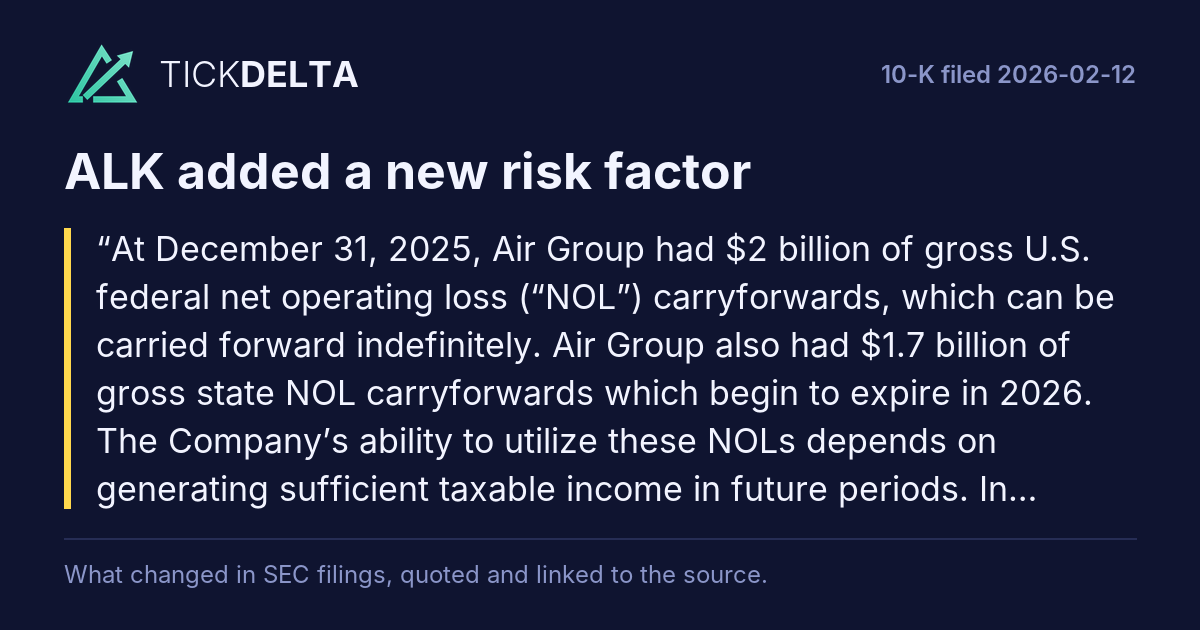
At December 31, 2025, Air Group had $2 billion of gross U.S. federal net operating loss (“NOL”) carryforwards, which can be carried forward indefinitely. Air Group also had $1.7 billion of gross state NOL carryforwards which begin to expire in 2026. The Company’s ability to utilize these NOLs depends on generating sufficient taxable income in future periods. In addition, NOLs remain subject to examination and adjustment by federal and state taxing authorities. If future operating results or economic conditions are less favorable than expected, the company may be required to record additional valuation allowances against its deferred tax assets, which could be material.
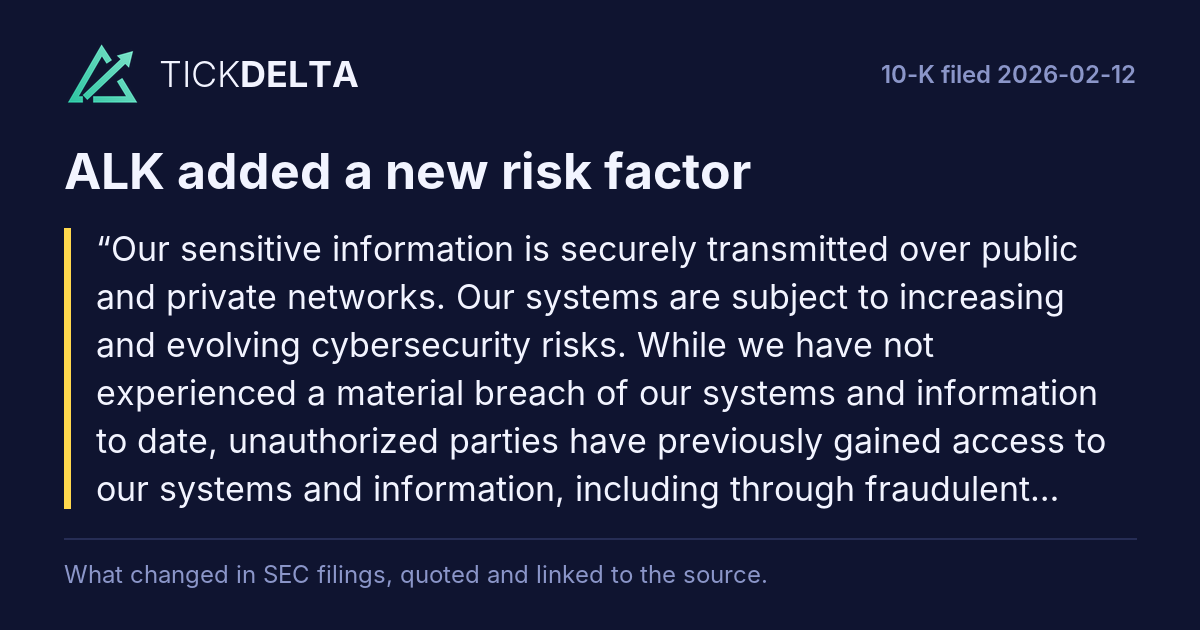
Our sensitive information is securely transmitted over public and private networks. Our systems are subject to increasing and evolving cybersecurity risks. While we have not experienced a material breach of our systems and information to date, unauthorized parties have previously gained access to our systems and information, including through fraudulent misrepresentation and other means of deception. In June 2025, Hawaiian Airlines identified a cybersecurity incident affecting certain information technology systems. Upon identifying this incident, we followed our response protocols and immediately took steps to safeguard our network by disconnecting impacted Hawaiian systems and applications. Access for all systems was restored. Hawaiian's flights were not interrupted and continued to operate safely throughout our response.
Although we have protocols in place to address cybersecurity incidents, unauthorized access to or misuse of the personal and financial information of our guests and employees as a result of a cyber-attack could result in substantial costs for response and remediation, adversely affect our operations and our reputation, and expose us to litigation, regulatory enforcement, or other legal action. Additionally, a cybersecurity attack impacting our onboard or other operational systems may result in an accident or incident onboard or significant operational disruptions, which could adversely affect our reputation, operation and financial position.
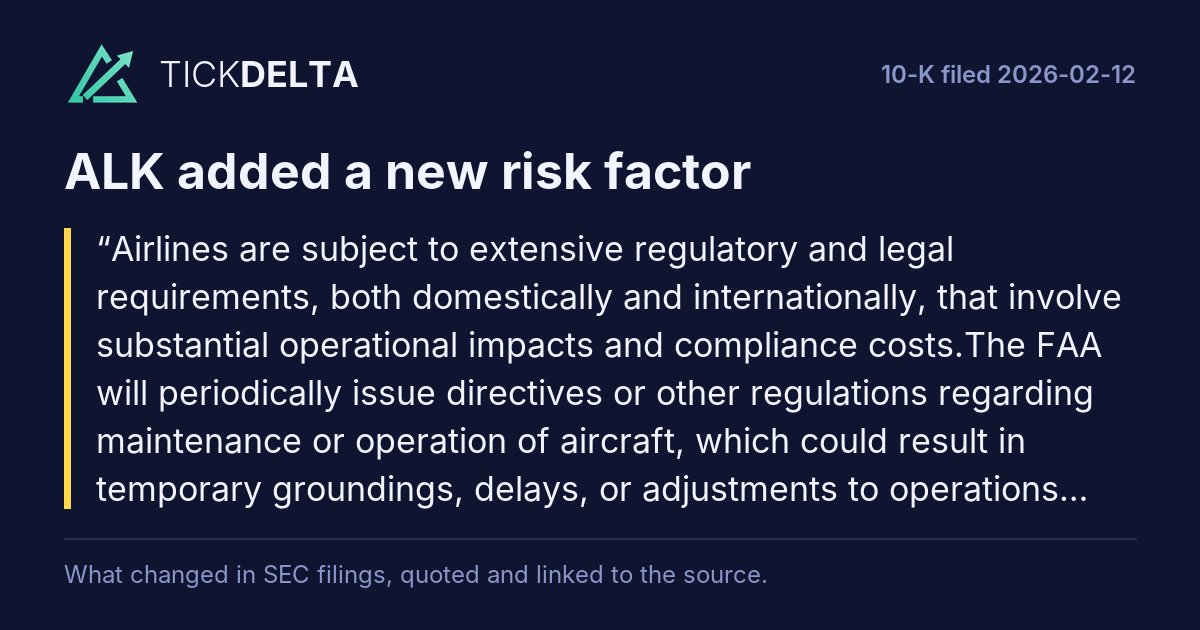
Airlines are subject to extensive regulatory and legal requirements, both domestically and internationally, that involve substantial operational impacts and compliance costs.The FAA will periodically issue directives or other regulations regarding maintenance or operation of aircraft, which could result in temporary groundings, delays, or adjustments to operations and consequently could negatively impact our financial results. Additionally, the FAA is responsible for the efficient and safe operation of air traffic. Any inefficiencies in air traffic control, including the failure to modernize the air traffic control system in a manner consistent with the growth of air travel, could adversely affect our operations. Access to airport slots can also be limited due to government regulation. Obtaining access to these slots to support our growth plans may require significant financial commitments.
Paragraphs in the 10-Q filed Nov 6, 2026 that were not in the one before
New in the latest 10-Q
12 paragraphs in the 10-Q filed Nov 6, 2026 with nothing like
them in the 10-Q filed Aug 4, 2026 (at least half the words must differ; new numbers alone do not count).
Quoted exactly, grouped by the item heading above them. This is text that changed, not a judgement of how serious it is.
10-Q
In the third quarter of 2026, the Company revised its full-year outlook from a pretax income to a pretax loss primarily due to elevated fuel prices. This reduced the Company's estimated annual effective tax rate (AETR), which lowered the expected tax benefit associated with previously recorded losses. As required under the AETR methodology, the Company recorded a corresponding adjustment to income tax expense in the third quarter, including $ 151 million related to the first and second quarters of 2026.
Read in the 10-Qopen_in_new
In November 2024, the FASB issued ASU 2024-03, Income Statement - Reporting Comprehensive Income - Expense Disaggregation Disclosures (Topic 220), which requires public entities to disclose disaggregated information about certain income statement line items. ASU 2024-03 is effective for fiscal years beginning after December 15, 2026 and interim periods
Read in the 10-Qopen_in_new
within fiscal years beginning after December 15, 2027. Early adoption is permitted. The Company is currently evaluating the impact of ASU 2024-03, and we anticipate that upon adoption, we will be required to include additional disclosures within the notes accompanying our financial statements.
Read in the 10-Qopen_in_new
In October 2023, an aviation accident occurred during a training flight operated by Hillsboro Aero Academy (“Hillsboro”), an independently owned and operated and FAA-regulated Part 141-certified flight school in Oregon. This accident resulted in the death of a Hillsboro student and flight instructor and significant injuries to another Hillsboro student onboard. Both students were members of Ascend Pilot Academy, a program designed to provide Hillsboro students, upon graduation from Hillsboro and completion of other flight training requirements, an opportunity to interview for pilot positions with Horizon. Alaska Airlines and Horizon did not provide the students’ flight training or employ the instructor. Multiple lawsuits were filed in numerous courts in Washington and Oregon by parties impacted by the accident, naming Hillsboro, Alaska, and Horizon as defendants. The lawsuits allege, among other things, that Alaska and Horizon, along with Hillsboro, bear responsibility for the accident and for plaintiffs’ resulting economic and non-economic damages. Subsequent to quarter end, the Company reached a settlement in principle to resolve all claims by the estate of the deceased student. The Company recorded its contribution to the settlement, which is not material, to the unaudited condensed consolidated financial statements, within Special items - operating in the condensed consolidated statements of operations for the three months ended September 30, 2026. The lawsuit filed by the injured student remains ongoing. The Company disputes the allegations in that lawsuit and intends to vigorously defend against them.
Read in the 10-Qopen_in_new
The outcomes of legal proceedings and other contingencies are unpredictable and subject to significant uncertainty. The Company regularly evaluates developments in its legal proceedings to determine whether a loss is probable and reasonably estimable. Adverse outcomes in these proceedings could be material to the Company’s financial results in a particular period. For matters that are disclosed without an estimated loss or range of losses, a loss is either reasonably possible but not probable, or the amount of loss cannot be reasonably estimated or is immaterial.
Read in the 10-Qopen_in_new
Show the other 7
(in millions) Marketable Securities Employee Benefit Plan Interest Rate Derivatives Tax Effect Total
Read in the 10-Qopen_in_new
In September, we announced enhancements to Atmos Rewards, including greater flexibility in how members can earn points. Beginning in October, members can choose to earn points based on distance traveled, price paid, or segments flown, on flights departing on or after January 1, 2027. Additionally, we announced our intent to join the Atlantic and Pacific Joint International Businesses, which will increase global connectivity for our guests.
Read in the 10-Qopen_in_new
Subsequent to quarter end, we announced initiatives aimed at reducing our overhead expense, which are expected to drive approximately $100 million in savings in 2027. The initiatives included contractor and professional services reductions, as well as the implementation of a reduction in force that impacted approximately 200 employees. The initiatives were designed to preserve momentum on key strategic projects while reducing overhead spend. In connection with the reduction in force, we expect to incur approximately $11 million of costs, primarily related to severance and other employee termination benefits in the fourth quarter of 2026. These costs will be recognized within Special items - operating on the consolidated income statement.
Read in the 10-Qopen_in_new
Non-operating expense increased $27 million, or 73%, primarily due to higher interest expense associated with elevated financing activity in 2026.
Read in the 10-Qopen_in_new
In the third quarter of 2026, the Company revised its full-year outlook from a pretax income to a pretax loss primarily due to elevated fuel prices. This reduced the Company's AETR, which lowered the expected tax benefit associated with previously recorded losses. As required under the AETR methodology, the Company recorded a corresponding adjustment to income tax expense in the third quarter, including $151 million related to the first and second quarters of 2026.
Read in the 10-Qopen_in_new
Non-operating expense increased $36 million, or 32%, primarily due to higher interest expense associated with elevated financing activity in 2026, partially offset by an increase to non-operating income associated with our qualified pension plans, details of which are disclosed within Note 5 to the condensed consolidated financial statements.
Read in the 10-Qopen_in_new
(a) For September 30, 2026, the Company is presenting its short-term EETC debt, maturing in the third quarter of 2027, within its debt-to-capitalization ratio. At December 31, 2025, this debt was included within Long-term debt and finance leases, net of current portion.
Read in the 10-Qopen_in_new
The 10-Q's risk factors against the 10-K
Item 1A of the 10-Q filed Nov 6, 2026 against Item 1A of the 10-K filed Feb 12, 2026.
A 10-Q repeats only the risks that changed, so a 10-K paragraph that is missing from it is not counted as removed.
Added is a paragraph with nothing like it in the 10-K, Reworded a sentence that is in both with several words changed,
Quiet changes a sentence in both where one to four words changed and one is a hedge or a modal
(cut words struck through, new words highlighted).
Text on the page, not a score; each links to the filing at sec.gov.
What the 10-Q itself says about its risk factors:See Part I, Item 1A. "Risk Factors," in our 2025 Form 10-K for a detailed discussion of risk factors affecting Alaska Air Group.
Read in the 10-Qopen_in_new
Added10-Q Nov 6, 2026 vs 10-K Feb 12, 2026
In December 2024, the Board of Directors authorized a $1 billion share repurchase program. The Company did not make any repurchases under this program during the three months ended September 30, 2026. The plan has remaining authorization to purchase an additional $180 million in shares.
Read it in the 10-Q at sec.govopen_in_new
We are expected to incur substantial integration and transition expenses in connection with the acquisition of Hawaiian Airlines, including the necessary costs associated with integrating the operations of Alaska and Hawaiian Airlines. There are a large number of processes, policies, procedures, operations, technologies and systems that must be integrated, including reservations, loyalty program, ticketing/distribution, maintenance, and flight operations. While we have assumed that a certain level of expenses will be incurred, there are many factors beyond our control that could affect the...
In the 10-K filed Feb 14, 2025open_in_new
Hawaiian Airlines has experienced an “ownership change” as defined in Section 382 of the Internal Revenue Code of 1986, as amended (the “Code”). Section 382 of the Code imposes an annual limitation on the amount of pre-ownership change NOLs of the corporation that experiences ownership change. The limitation imposed by Section 382 of the Code for any post-ownership change year generally would be determined by multiplying the value of such corporation’s stock immediately before the ownership change by the applicable long-term tax-exempt rate. Any unused annual limitation may, subject to...
In the 10-K filed Feb 14, 2025open_in_new
We continue to focus on strategic initiatives designed to increase our brand appeal to a diverse and evolving demographic of airline travelers. These efforts could include significant enhancements to our in-airport and on-board environments, increasing our direct customer relationships through improvements to our purchasing portals (digital and mobile), and management of our customer loyalty program. In pursuit of these efforts, we may negatively affect our reputation with some of our existing customer base.
In the 10-K filed Feb 14, 2025open_in_new
As of the acquisition closing date, Hawaiian Airlines had federal net operating loss carryforwards (“NOLs”) of approximately $817 million available to offset future taxable income, that have indefinite carryover, but are limited to 80% utilization, and state NOLs of approximately $1.0 billion. The majority of the state NOLs relate to the state of Hawai'i. Certain state NOLs will expire, if unused, beginning in 2025.
In the 10-K filed Feb 14, 2025open_in_new
Sources
Item 1A of each 10-K and 10-Q on EDGAR, quoted exactly. Each paragraph links to the filing at sec.gov.
Also
10-K change: what was reworded or cut, section by section.
Work with it
Excel workbook · CSV. Google Sheet that stays up to date: paste =IMPORTDATA("https://tickdelta.com/company/ALK/export.csv") into a cell.