Screener / SEC EDGAR /CIK 0001529274 /10-K filed Feb 26, 2026, compared with Feb 28, 2025 /Numbers from the XBRL of the 10-Ks
Nasdaq Technology · Software

Alkami Technology, Inc. ALKT

Compare with peers Embed
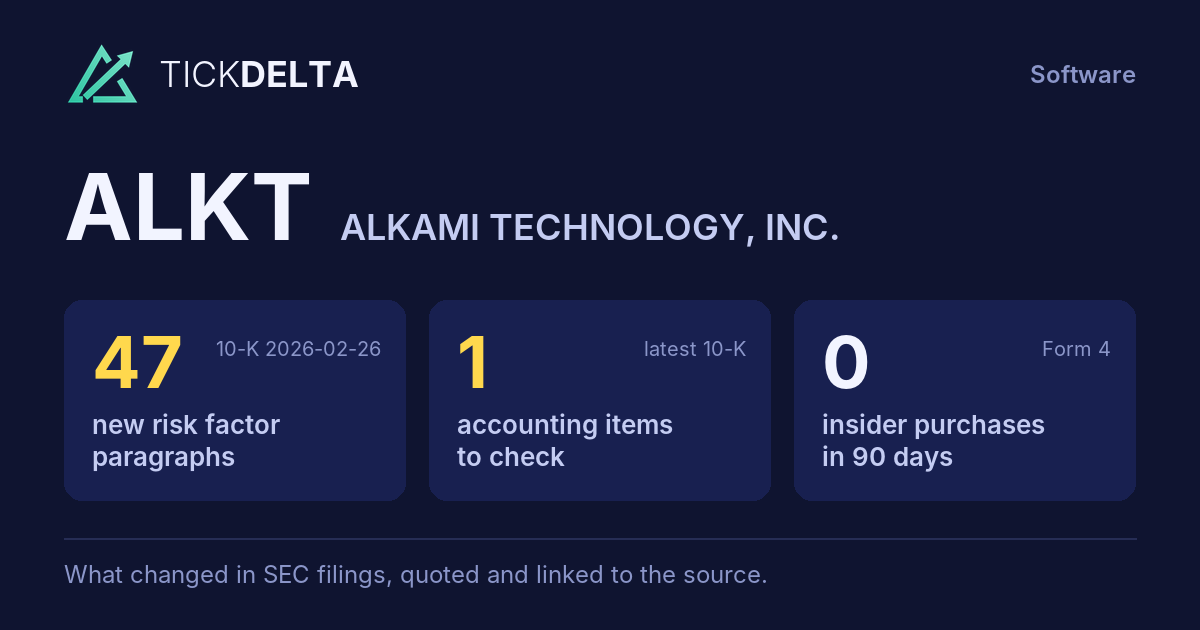
New in the 10-K 47 paragraphs with nothing like them in the 10-K filed Feb 28, 2025 New in the 10-Q 9 paragraphs not in the 10-Q filed Jul 30, 2026 10-Q against the 10-K 2 risk factor paragraphs and sentences added or reworded

New risk paragraphs, branching off last year

Each branch is a paragraph in Risk Factors with nothing like it in the 10-K filed Feb 28, 2025. A box jumps to the paragraph as filed, below.

47 new

Paragraphs with nothing like them in last year's 10-K

Quoted exactly

47 paragraphs in Risk Factors of the 10-K filed Feb 26, 2026 with nothing like them in the 10-K filed Feb 28, 2025. Quoted exactly. Paragraphs that were only edited are under 10-K change.

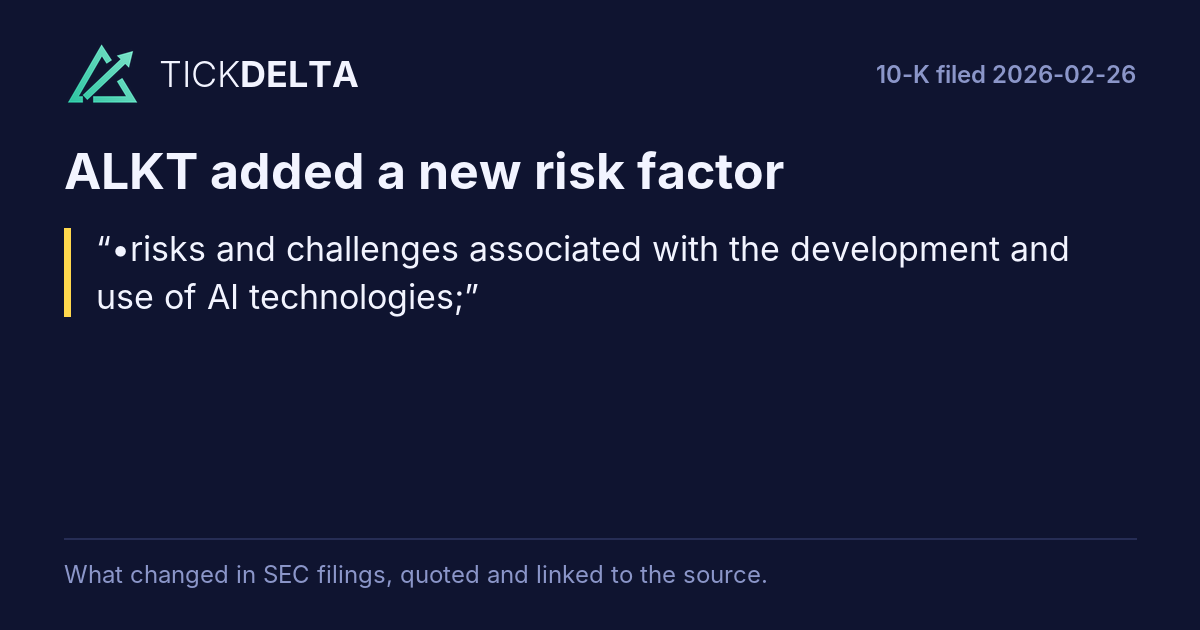
•risks and challenges associated with the development and use of AI technologies;

Read in the 10-K

•regulations and laws applicable to us, our clients and our solutions, including the impact of tariffs and trade policies on us and our clients;

Read in the 10-K

•our ability to raise necessary funds to repurchase the 2030 Convertible Notes (as defined below) or to pay any cash amounts due upon their maturity or conversion of the 2030 Convertible Notes and dilution to our common stock upon the conversion of the 2030 Convertible Notes;

Read in the 10-K

•provisions in the Indenture (as defined below) delaying or preventing beneficial takeover and anti-takeover and exclusive forum provisions in our governing documents;

Read in the 10-K

AI presents risks and challenges that can impact our business, including by posing security risks to our confidential information, proprietary information and personal data, increasing our regulatory and compliance burden and increasing competition.

As with many technological innovations, AI presents opportunities for enhanced productivity and innovation, but also presents risks and challenges that could impact our business. Issues in the development and use of AI, combined with an uncertain regulatory environment and emerging ethical issues, may result in reputational harm, liability or other adverse consequences to our business operations. We currently incorporate AI technologies into our operations and certain of our products, and we may continue to adopt and integrate AI, including generative AI, into our operations and products in the future for specific use cases. Additionally, our employees, vendors and third-party partners may use AI to perform their work. Our vendors could in turn incorporate AI tools into their offerings, and the providers of these AI tools may not meet existing or rapidly evolving regulatory or industry standards, including with respect to privacy and data security. If we, our vendors, or our third-party partners experience an actual or perceived data breach or cybersecurity incident because of the use of AI, we may lose valuable intellectual property, personal data and/or confidential information, and our reputation and the public perception of the effectiveness of our security measures could be harmed. Further, bad actors around the world use increasingly sophisticated methods, including the use of AI, to engage in illegal activities involving the theft and misuse of personal information, confidential information, and intellectual property. Any of these outcomes could damage our reputation, subject us to legal liability, result in the loss of valuable property and information, and adversely impact our business.

The rapid evolution of AI will require the application of significant resources to design, develop, test and maintain such systems to help ensure that AI is implemented in accordance with applicable law and regulation and in a socially responsible manner and to minimize any real or perceived unintended harmful impacts. For example, AI systems can present risks of bias, errors and false or “hallucinatory” inferences or outputs. Furthermore, if the content, analyses, or recommendations that AI systems assist in producing are, or are alleged or perceived to be inaccurate, deficient, or biased, our reputation, competitive position, business, financial condition, and results of operations may be adversely affected. The use of certain AI technologies can also give rise to intellectual property risks, including by disclosing or otherwise compromising our confidential or proprietary intellectual property, or by undermining our ability to assert or defend ownership rights in intellectual property created with the assistance of AI tools. Any of these effects could damage our reputation, result in the loss of valuable property and information, and adversely impact our business.

We use AI technologies licensed from third parties, including in our products, and our ability to continue to use such third-party AI at the scale we need may be dependent on access to specific third-party software and infrastructure. We cannot control the availability or pricing of such third-party AI technologies, especially in a highly competitive environment, and we may be unable to negotiate favorable economic terms with the applicable providers. If any such third-party AI technologies become incompatible with our products and programs or unavailable for use, or if the providers of such models unfavorably change the terms on which their AI technologies are offered or terminate their relationship with us, our products may become less appealing to our clients and our business may be adversely affected. In addition, to the extent any third-party AI technologies are used as a hosted service, any disruption, outage, or loss of information through such hosted services could disrupt our operations or solutions, damage our reputation, cause a loss of confidence in our products, or result in legal claims or proceedings, for which we may be unable to recover damages from the affected provider.

The regulatory framework for AI is rapidly evolving as many federal, state and foreign government bodies and agencies have enacted or are currently considering laws and regulations governing AI. Additionally, existing laws and regulations may be interpreted or enforced in ways that would affect our use of AI. As a result, implementation standards and enforcement practices are likely to remain uncertain for the foreseeable future, and we cannot predict the impact future laws, regulations, or standards, or the market perception of their requirements, may have on our business or how we will respond to these laws or regulations. In the U.S., states have enacted various laws regulating different aspects of AI. For example, California has enacted laws and regulations related to AI safety protocols, reporting and transparency, among other AI-related topics. In addition, Colorado’s Artificial Intelligence Act will require developers and deployers of “high-risk” AI systems to implement certain safeguards against algorithmic discrimination (among other requirements), and the Texas Responsible Artificial Intelligence Governance Act prohibits the development and deployment of AI systems for certain purposes. In Europe, on August 1, 2024, the EU Artificial Intelligence Act (the “EU AI Act”) entered into force, establishing a comprehensive, risk-based governance framework for AI in the EU, with the majority of its substantive requirements becoming applicable August 2, 2026. The EU AI Act applies to companies that develop, use and/or provide AI in the EU and—depending on the AI use case—includes requirements around transparency, conformity assessments and monitoring, risk assessments, human oversight, security, accuracy, general purpose AI and foundation models. Any or all of the foregoing regulatory developments could affect our use of AI and our ability to provide, improve or commercialize our services, require changes to our operations and processes, and materially adversely affect our business, results of operations, and financial condition. Further, any failure or perceived failure by us to comply with existing or newly enacted laws, regulations and other requirements relating to AI could result in legal claims or proceedings (including class actions), regulatory investigations or enforcement actions.

In addition, our competitive position could be harmed if we fail to adopt and integrate AI effectively into our operations and product offerings. While we believe that AI technologies present opportunities for improving our operations and enhancing our product offerings, the successful implementation of AI technology requires significant investment in talent, infrastructure, and ongoing research and development. Developing, testing and deploying AI systems may also increase the cost profile of our products due to the nature of the computing costs involved in such systems. Market acceptance, understanding, and valuation and consumer perceptions of platforms, products, and programs that incorporate AI technologies are uncertain and the perceived value of AI technologies could be inaccurate. Misjudging the convergence of AI with our business needs may lead to inefficiencies or obsolescence of our services or products. Further, if our use of AI technologies is restricted or limited due to legal or regulatory requirements or becomes controversial due to implementation or emerging ethical issues, our service offerings may be impacted, our business may be less efficient, we may suffer brand or reputation harm or we may be at a competitive disadvantage.

Our future success will depend, in part, on our ability to leverage AI responsibly, effectively and in compliance with laws and regulations. Because AI technology is highly complex and rapidly developing, it is not possible to predict all of the legal, operational or technological risks that may arise relating to the use of AI.

Read in the 10-K
Show the other 6

Our indebtedness and liabilities could limit the cash flow available for our operations, expose us to risks that could adversely affect our business, financial condition and results of operations and impair our ability to satisfy our obligations under the 2030 Convertible Notes.

Our indebtedness could have significant negative consequences for our security holders and our business, results of operations and financial condition by, among other things:

•requiring the dedication of a substantial portion of our cash flow from operations to service our indebtedness, which will reduce

•diluting the interests of our existing stockholders as a result of issuing shares of our common stock upon conversion of the 2030

Read in the 10-K

Our business may not generate sufficient funds, and we may otherwise be unable to maintain sufficient cash reserves, to pay amounts due under our indebtedness, including the 2030 Convertible Notes and the Amended Credit Agreement, and our cash needs may increase in the future. If we fail to comply with certain covenants or to make payments under our indebtedness when due, then we would be in default under that indebtedness, which could, in turn, result in that and our other indebtedness becoming immediately payable in full.

Read in the 10-K

We may be unable to raise the funds necessary to repurchase the 2030 Convertible Notes for cash following a fundamental change or to pay any cash amounts due upon maturity or conversion of the 2030 Convertible Notes, and our other indebtedness may limit our ability to repurchase the 2030 Convertible Notes or to pay any cash amounts due upon their maturity or conversion.

In March 2025, we issued $345 million principal amount of our 1.50% Convertible Senior Notes due 2030 (the “2030 Convertible Notes” or “Notes”) pursuant to an indenture (the “Indenture”), dated as of March 13, 2025, between the Company and U.S. Bank Trust Company, National Association, as trustee.

Noteholders may, subject to a limited exception, require us to repurchase their 2030 Convertible Notes following a “fundamental change” (as defined in the Indenture) at a cash repurchase price generally equal to the principal amount of the 2030 Convertible Notes to be repurchased, plus accrued and unpaid interest, if any. Upon maturity of the 2030 Convertible Notes, we must pay their principal amount and accrued and unpaid interest in cash, unless they have been previously repurchased, redeemed or converted. In addition, upon conversion, we will satisfy part or all of our conversion obligation in cash unless we elect to settle conversions solely in shares of our common stock. We may not have enough available cash or be able to obtain financing at the time we are required to repurchase the 2030 Convertible Notes or pay the cash amounts, if any, due upon their maturity or conversion. In addition, applicable law, regulatory authorities and the agreements governing our other indebtedness may restrict our ability to repurchase the 2030 Convertible Notes or to pay the cash amounts, if any, due upon their maturity or conversion. For example, the Amended Credit Agreement includes restrictions on our ability to settle conversions of the 2030 Convertible Notes in cash. Our failure to repurchase 2030 Convertible Notes or to pay the cash amounts, if any, due upon their maturity or conversion when required will constitute a default under the Indenture. A default under the Indenture or the fundamental change itself could also lead to a default under agreements governing our other indebtedness, which may result in that other indebtedness becoming immediately payable in full. We may not have sufficient funds to satisfy all amounts due under the other indebtedness and the 2030 Convertible Notes.

The accounting method for the 2030 Convertible Notes could adversely affect our reported financial condition and results.

The accounting method for reflecting the 2030 Convertible Notes on our balance sheet and accruing interest expense for the 2030 Convertible Notes may adversely affect our reported loss and financial condition.

In accordance with applicable accounting standards, the 2030 Convertible Notes are reflected as a liability on our balance sheets, with the initial carrying amount equal to the principal amount of the 2030 Convertible Notes, net of discount and issuance costs. The issuance costs are treated as a debt discount for accounting purposes, which are amortized into interest expense over the term of the 2030 Convertible Notes. As a result of this amortization, the interest expense recognized for the 2030 Convertible Notes for accounting purposes is greater than the cash interest payments, which results in higher reported losses.

Furthermore, if any of the conditions to the convertibility of the 2030 Convertible Notes is satisfied, then we may be required under applicable accounting standards to reclassify the liability carrying value of the 2030 Convertible Notes as a current, rather than a long-term, liability. This reclassification could be required even if no noteholders convert their 2030 Convertible Notes and could materially reduce our reported working capital.

In connection with the issuance of the 2030 Convertible Notes, we entered into Capped Calls with certain financial institutions (collectively, the “option counterparties”). The Capped Calls are expected generally to reduce the potential dilution to our common stock upon any conversion of the 2030 Convertible Notes and/or offset any cash payments we are required to make in excess of the principal amount of converted 2030 Convertible Notes, as the case may be, with such reduction and/or offset subject to a cap.

The option counterparties are financial institutions, and we will be subject to the risk that any or all of them might default under the Capped Calls. Our exposure to the credit risk of the option counterparties will not be secured by any collateral. Past and recent global economic conditions have resulted in the actual or perceived failure or financial difficulties of many financial institutions. If an option counterparty becomes subject to insolvency proceedings, we will become an unsecured creditor in those proceedings with a claim equal to our exposure at that time under the Capped Calls with such option counterparty. Our exposure will depend on many factors but, generally, an increase in our exposure will be correlated to an increase in the market price and in the volatility of our common stock. In addition, upon a default by an option counterparty, we may suffer adverse tax consequences and more dilution than we currently anticipate with respect to our common stock. We can provide no assurances as to the financial stability or viability of the option counterparties.

Read in the 10-K

Transactions relating to our 2030 Convertible Notes may affect the value of our common stock.

The conversion of some or all of the 2030 Convertible Notes would dilute the ownership interests of existing stockholders to the extent we satisfy our conversion obligation by delivering shares of our common stock upon any conversion of such 2030 Convertible Notes. Our 2030

Convertible Notes may become, in the future, convertible at the option of their holders under certain circumstances. If holders of our 2030 Convertible Notes elect to convert their notes, in certain circumstances we will be required to settle our conversion obligation by delivering shares of our common stock, which would cause dilution to our existing stockholders.

From time to time, the option counterparties and/or their respective affiliates may modify their hedge positions by entering into or unwinding various derivative transactions with respect to our common stock and/or purchasing or selling our common stock or other securities of ours in secondary market transactions prior to the maturity of the 2030 Convertible Notes (and are likely to do so (x) during any observation period related to a conversion of the 2030 Convertible Notes or following any repurchase of the 2030 Convertible Notes by us in connection with any redemption or fundamental change, (y) following any other repurchase of the 2030 Convertible Notes if we elect to unwind a corresponding portion of the Capped Calls in connection with such repurchase and (z) if we otherwise unwind all or a portion of the Capped Calls). This activity could cause or avoid an increase or a decrease in the market price of our common stock.

Read in the 10-K

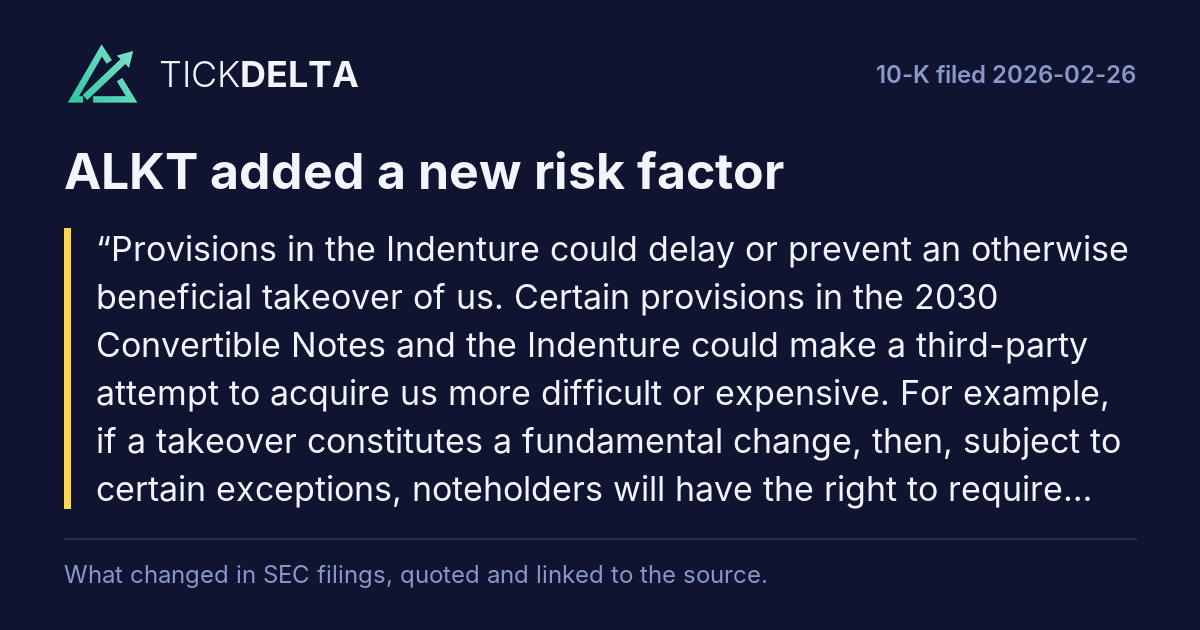
Provisions in the Indenture could delay or prevent an otherwise beneficial takeover of us.

Certain provisions in the 2030 Convertible Notes and the Indenture could make a third-party attempt to acquire us more difficult or expensive. For example, if a takeover constitutes a fundamental change, then, subject to certain exceptions, noteholders will have the right to require us to repurchase their 2030 Convertible Notes for cash. In addition, if a takeover constitutes a make-whole fundamental change, then we may be required to temporarily increase the conversion rate. In either case, and in other cases, our obligations under the 2030 Convertible Notes and the Indenture could increase the cost of acquiring us or otherwise discourage a third party from acquiring us, including in a transaction that noteholders or holders of our common stock may view as favorable.

Read in the 10-K

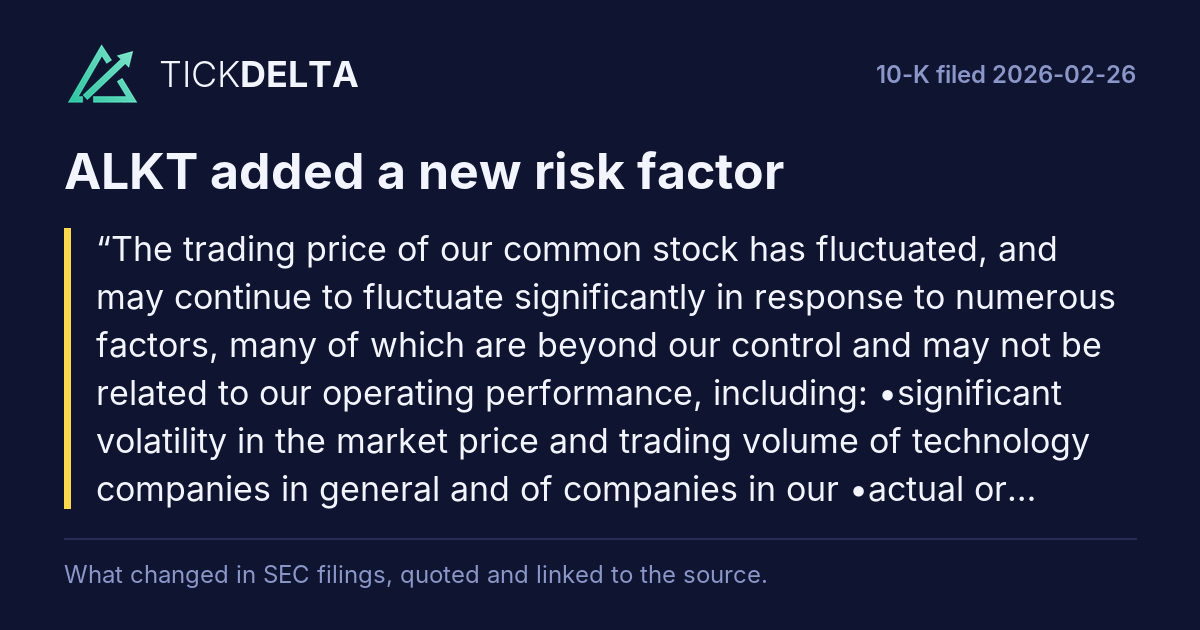
The trading price of our common stock has fluctuated, and may continue to fluctuate significantly in response to numerous factors, many of which are beyond our control and may not be related to our operating performance, including:

•significant volatility in the market price and trading volume of technology companies in general and of companies in our

•actual or anticipated changes in our results of operations or fluctuations in our operating results;

•whether our operating results meet the expectations of securities analysts or investors;

•issuance of new or updated research or reports by securities or industry analysts, including the publication of unfavorable reports

•cessation of coverage of our company or failure to publish reports on our company by one or more securities or industry analysts;

•actual or anticipated developments in our competitors’ businesses or the competitive landscape generally;

•general economic conditions and trends, including the impact of interest rates on the overall stock market and the market for

In several recent situations where the price of a stock has been volatile, holders of that stock have instituted securities class action litigation against the issuer. If any of our stockholders were to bring a lawsuit against us, the defense and disposition of the lawsuit could be costly and divert the time and attention of our management and harm our business, operating results and financial condition.

Our business could be negatively affected as a result of actions of activist stockholders or others.

We are at times subject to actions or proposals from activist stockholders or others, and these may not align with our business strategies or the interests of our other stockholders. As a result, we could incur significant expenses related to stockholder matters in the future. Such activist stockholders frequently propose to involve themselves in the governance, strategic direction and operations of companies, including companies’ efforts regarding environmental, sustainability and governance standards. Responding to actions from activist stockholders can be costly and time-consuming, disrupt our business and operations, and divert the attention of our board of directors, management, and employees from the pursuit of our business strategies. Such activities could interfere with our ability to execute our strategic plan. Activist stockholders or others may create perceived uncertainties as to the future direction of our business or strategy, which may be exploited by our competitors and may make it more difficult to attract and retain qualified personnel and potential clients, and may affect our relationships with current clients, vendors, investors, and other third parties. In addition, a proxy contest for the election of directors at our annual meeting of stockholders would require us to incur significant

legal fees and proxy solicitation expenses and require significant time and attention by management and our board of directors. The perceived uncertainties as to our future direction also could affect the market price and volatility of our securities.

We incur significant expenses and administrative burdens as a public company, which could have a material adverse effect on our operations and financial results.

As a public company, we incur significant legal, accounting, administrative and other costs and expenses. Compliance with rules and regulations applicable to public companies may increase our costs, make some activities more time-consuming, and divert management’s attention from operational and other business matters to devote substantial time to these public company requirements.

Ensuring that we have adequate internal financial and accounting controls and procedures in place so that we can produce accurate financial statements on a timely basis is a costly and time-consuming effort that needs to be re-evaluated frequently. Our internal control over financial reporting is a process designed to provide reasonable assurance regarding the reliability of financial reporting and preparation of financial statements in accordance with U.S. generally accepted accounting principles, or GAAP. If we identify any issues in complying with public company reporting requirements (for example, if our financial systems prove inadequate or we or our auditors identify deficiencies in our internal control over financial reporting), we could incur additional costs rectifying those issues, and the existence of those issues could adversely affect us, our reputation or investor perceptions of us. While we have documented and assessed our internal controls, we continue to evaluate opportunities to further strengthen the effectiveness and efficiency of our internal controls and procedures for compliance with Section 404 of the Sarbanes-Oxley Act, which requires annual management assessment and annual independent registered public accounting firm attestation reports of the effectiveness of our internal control over financial reporting. If we make additional acquisitions, we will need to similarly assess and ensure the adequacy of the internal financial and accounting controls and procedures of such acquisitions. If we fail to maintain proper and effective internal controls, including with respect to acquired businesses, our ability to produce accurate and timely financial statements could be impaired, which could harm our operating results, harm our ability to operate our business and reduce the trading price of our common stock.

In addition, changing laws, regulations and standards relating to corporate governance and public disclosure are creating uncertainty for public companies, increasing legal and financial compliance costs and making some activities more time-consuming. These laws, regulations and standards are subject to varying interpretations, in many cases due to their lack of specificity, and, as a result, their application in practice may evolve over time as new guidance is provided by regulatory and governing bodies. This situation could result in continuing uncertainty regarding compliance matters and higher costs necessitated by ongoing revisions to disclosure and governance practices. We may be required to invest additional resources to comply with evolving laws, regulations and standards. If our efforts to comply with new laws, regulations and standards differ from the activities intended by regulatory or governing bodies due to ambiguities related to their application and practice, regulatory authorities may initiate investigations, inquiries, administrative proceedings or legal proceedings against us and our business may be adversely affected. Additionally, proposals submitted by stockholders at our annual meeting or other advocacy efforts by stockholders and third parties also may prompt additional changes in governance and reporting requirements, which could further increase our costs.
Read in the 10-K

Paragraphs in the 10-Q filed Oct 29, 2026 that were not in the one before

New in the latest 10-Q

9 paragraphs in the 10-Q filed Oct 29, 2026 with nothing like them in the 10-Q filed Jul 30, 2026 (at least half the words must differ; new numbers alone do not count). Quoted exactly, grouped by the item heading above them. This is text that changed, not a judgement of how serious it is.

Financial statements and notes

In September 2026, the Company entered into agreements to assign its remaining rights and obligations under the lease for its headquarters in Plano, Texas to a third party effective on July 1, 2027. In connection with the agreements, the Company has agreed to make incentive payments to the third party totaling approximately $ 4.0 million, due within 30 days after the assignment effective date. The assignment and the Company’s payment obligation are contingent upon, among other things, the surrender of the premises on February 1, 2027, the landlord’s release of the Company from obligations arising under the lease after the assignment effective date and the landlord’s receipt of replacement security from the third party. Until the contingencies are resolved, the Company remains the primary obligor under the lease.

Read in the 10-Q

As of September 30, 2026, the Company continues to account for the lease, the related right-of-use asset and the related property and equipment (as disclosed in Note 3) under their existing terms, and no impairment has been identified related to the assignment. The Company will continue to monitor quarterly for impairment through the assignment effective date.

Read in the 10-Q

In September 2026, the Company incurred broker commissions of $ 2.1 million in connection with the assignment, which were included in general and administrative expenses for the three months ended September 30, 2026.

Read in the 10-Q

In September 2026, we entered into agreements to assign our remaining rights and obligations under the lease for our headquarters in Plano, Texas to a third party effective on July 1, 2027. In connection with the agreements, we have agreed to make payments to the third party totaling approximately $4.0 million, due within 30 days after the assignment effective date. The assignment and our payment obligation are contingent on, among other things, the surrender the premises on February 1, 2027, the landlord’s release of our obligations arising under the lease after the assignment effective date and the landlord’s receipt of replacement security from the third party. Until the contingencies are resolved, we remain the primary obligor under the lease.

Read in the 10-Q

As of September 30, 2026, we continue to account for the lease, the related right-of-use asset and the related property and equipment (as disclosed in Note 3 to our Notes to the Unaudited Condensed Consolidated Financial Statements) under their existing terms, and no impairment has been identified related to the assignment. We will continue to monitor quarterly for impairment through the assignment effective date.

Read in the 10-Q
Show the other 4

In September 2026, we incurred broker commissions of $2.1 million in connection with the assignment, which were included in general and administrative expenses for the three months ended September 30, 2026.

Read in the 10-Q

(1) Stockholder matters related expenses consist primarily of legal, consulting, advisory fees and other related costs, including expenses related to the strategic review process, which was completed in the third quarter of 2026.

Read in the 10-Q

(2) Lease assignment related expenses relate to expenses incurred for the execution of the lease assignment arrangement.

Read in the 10-Q

Other information

During the three months ended September 30, 2026, no director or officer of the Company adopted or terminated a “Rule 10b5-1 trading arrangement” or “non-Rule 10b5-1 trading arrangement,” as each term is defined in Item 408 of Regulation S-K.

Read in the 10-Q

The 10-Q's risk factors against the 10-K

Item 1A of the 10-Q filed Oct 29, 2026 against Item 1A of the 10-K filed Feb 26, 2026. A 10-Q repeats only the risks that changed, so a 10-K paragraph that is missing from it is not counted as removed. Added is a paragraph with nothing like it in the 10-K, Reworded a sentence that is in both with several words changed, Quiet changes a sentence in both where one to four words changed and one is a hedge or a modal (cut words struck through, new words highlighted). Text on the page, not a score; each links to the filing at sec.gov.

What the 10-Q itself says about its risk factors:There are no material changes to the risk factors previously disclosed under the heading "Risk Factors" in our Annual Report on Form 10-K for the year ended December 31, 2025, filed with the SEC on February 26, 2026, other than the additional risk factor discussed below.

Read in the 10-Q
Added10-Q Oct 29, 2026 vs 10-K Feb 26, 2026
Share repurchases could increase the volatility of the trading price of our common stock and diminish our cash reserves, and we cannot guarantee that our stock repurchase program will enhance long-term stockholder value.

Read it in the 10-Q at sec.gov

Added10-Q Oct 29, 2026 vs 10-K Feb 26, 2026
On April 23, 2026, our Board authorized a stock repurchase program to repurchase up to $100.0 million of our common stock. Repurchases under the stock repurchase program may be made from time to time, at management’s discretion, using a variety of methods, including open market purchases, privately negotiated transactions, and other means all in accordance with federal securities laws and other applicable legal requirements, including pursuant to one or more Rule 10b5-1 trading plans. The timing and size of any repurchases will be determined by management based on prevailing share prices, general economic and market conditions, our liquidity and capital needs, and other factors deemed relevant. The stock repurchase program does not obligate us to repurchase any specific number of shares, and may be modified, suspended, or terminated at any time at the discretion of the Board. The stock repurchase program has been authorized through December 31, 2028. Repurchases of shares of our common stock could affect the trading price of our common stock and could increase volatility of securities. Similarly, the future announcement of the modification, termination, or suspension of the stock repurchase program, or our decision not to utilize the full authorized repurchase amount under the stock repurchase program, could result in a decrease in the trading price of our common stock. In addition, the stock repurchase program could reduce our cash reserves, which may impact our ability to finance our growth, fund working capital, strategic acquisitions or business opportunities, execute our strategic plan or deploy cash for other general corporate purposes. Although the stock repurchase program is intended to enhance long-term stockholder value, there can be no assurance that it will do so, because the trading price of our common stock may decline below the levels at which we repurchased our shares, and short-term stock price fluctuations could reduce the effectiveness of the stock repurchase program.

Read it in the 10-Q at sec.gov

Phrases used for the first time

Two-word phrases in Risk Factors of the 10-K filed Feb 26, 2026 that are in none of the 1 earlier 10-Ks stored, back to Feb 28, 2025

convertible notes ×43cash amounts ×6digital sales ×6service platform ×6fundamental change ×6capped calls ×6amounts due ×5sales service ×5principal amount ×5option counterparties ×5activist stockholders ×5conversion obligation ×3interest expense ×3option counterparty ×3beneficial takeover ×2exploited vulnerability ×2
Where each one is used
  • convertible notes: •our ability to raise necessary funds to repurchase the 2030 Convertible Notes (as defined below) or to pay any cash amounts due upon their maturity or conversion of the 2030 Convertible Notes and dilution to our common stock upon the conversion of the 2030 Convertible Notes;
  • cash amounts: •our ability to raise necessary funds to repurchase the 2030 Convertible Notes (as defined below) or to pay any cash amounts due upon their maturity or conversion of the 2030 Convertible Notes and dilution to our common stock upon the conversion of the 2030 Convertible Notes;
  • digital sales: To increase our revenues, we will need to continue to attract new clients and succeed in having our current clients expand the use of our solutions across their institutions. In addition, for us to maintain or improve our results of operations, it is important that our clients renew their subscriptions with us on...
  • service platform: To increase our revenues, we will need to continue to attract new clients and succeed in having our current clients expand the use of our solutions across their institutions. In addition, for us to maintain or improve our results of operations, it is important that our clients renew their subscriptions with us on...
  • fundamental change: We may be unable to raise the funds necessary to repurchase the 2030 Convertible Notes for cash following a fundamental change or to pay any cash amounts due upon maturity or conversion of the 2030 Convertible Notes, and our other indebtedness may limit our ability to repurchase the 2030 Convertible Notes or to pay...
  • capped calls: In connection with the issuance of the 2030 Convertible Notes, we entered into Capped Calls with certain financial institutions (collectively, the “option counterparties”). The Capped Calls are expected generally to reduce the potential dilution to our common stock upon any conversion of the 2030 Convertible Notes...
  • amounts due: •our ability to raise necessary funds to repurchase the 2030 Convertible Notes (as defined below) or to pay any cash amounts due upon their maturity or conversion of the 2030 Convertible Notes and dilution to our common stock upon the conversion of the 2030 Convertible Notes;
  • sales service: The Alkami Digital Sales & Service Platform integrates with other third-party systems used by our clients, including core processing and payment systems. We do not have formal arrangements with many of these third-party providers regarding our access to their application program interfaces to enable these client...

The 10-K at sec.gov

Used at least twice, small words left out. Counted, not picked: a phrase can be new because the company renamed something.

What was taken out

17 paragraphs of last year's Risk Factors with nothing like them now. The longest are quoted.

Across all companies
We began business in 2009 and, as a result, have only a limited operating history upon which to evaluate our business and future prospects. We have encountered and will continue to encounter risks and difficulties frequently experienced by rapidly growing companies in constantly evolving industries, including the risks described in this document. If we do not address these risks successfully, our business, financial condition and results of operations will be adversely affected and the market value of our common stock could decline. Further, because we have limited historical financial...
In the 10-K filed Feb 28, 2025
The Alkami Digital Banking Platform is complex and may contain defects or errors when implemented or when new functionality is released, or when we modify, enhance, upgrade and implement new systems, procedures and controls to reflect changes in our business, technological advancements and changing industry trends. From time to time, we have discovered, and may in the future discover, defects or errors in
In the 10-K filed Feb 28, 2025
We expect that compliance with these additional requirements will substantially increase our legal and financial compliance costs. In addition, any failure to comply with these additional requirements in a timely manner, or at all, could have an adverse effect on our business and results of operations and could cause a decline in the price of our common stock.
In the 10-K filed Feb 28, 2025
You should not consider our revenue growth rate in recent periods as indicative of our future performance. You should not rely on our revenues for any prior quarterly or annual periods as an indication of our future revenues or revenue growth. If we are unable to maintain revenue growth, it may be difficult for us to achieve and maintain profitability.
In the 10-K filed Feb 28, 2025

Sources

Item 1A of each 10-K and 10-Q on EDGAR, quoted exactly. Each paragraph links to the filing at sec.gov.

Also

10-K change: what was reworded or cut, section by section.

Work with it

Excel workbook · CSV. Google Sheet that stays up to date: paste =IMPORTDATA("https://tickdelta.com/company/ALKT/export.csv") into a cell.

Next:10-K change
Esc

Type a ticker such as AAPL, a name, an investor such as Buffett, or a topic such as tariffs. ↑ ↓ to move, Enter to open.