Ally Financial Inc. ALLY
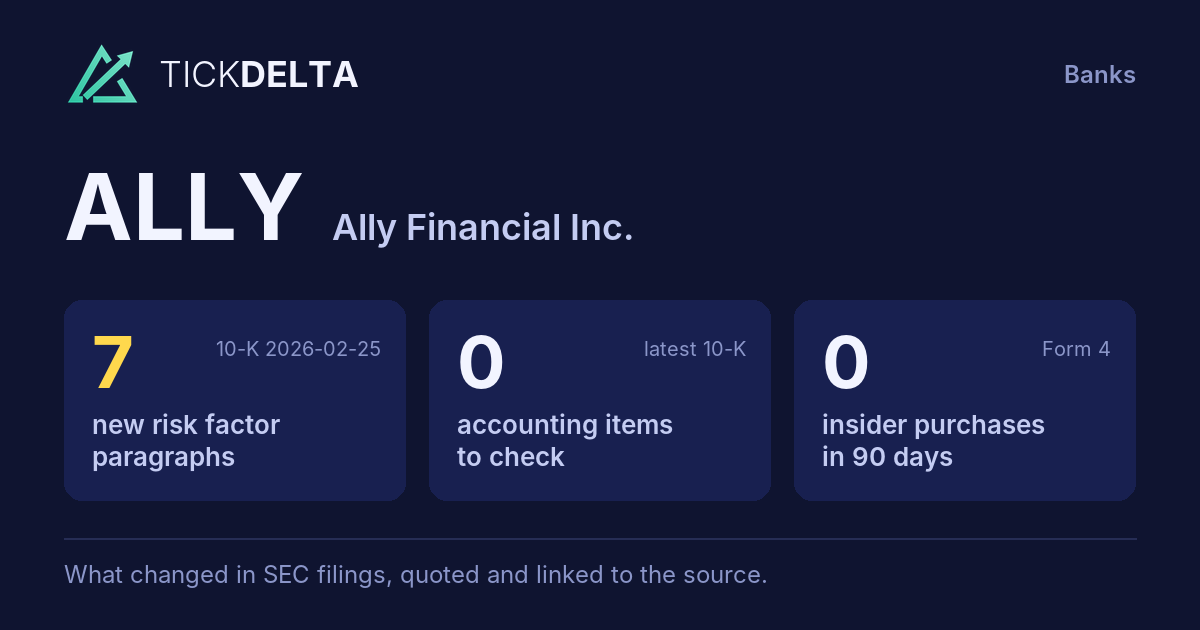
New risk paragraphs, branching off last year
Each branch is a paragraph in Risk Factors with nothing like it in the 10-K filed Feb 19, 2025. A box jumps to the paragraph as filed, below.
Paragraphs with nothing like them in last year's 10-K
7 paragraphs in Risk Factors of the 10-K filed Feb 25, 2026 with nothing like them in the 10-K filed Feb 19, 2025. Quoted exactly. Paragraphs that were only edited are under 10-K change.
•The development and use of AI is rapidly evolving and our failure to appropriately evaluate, adopt, govern, or effectively integrate AI where beneficial could adversely affect us.
U.S. federal debt ceiling, or any federal government shutdown, downgrade in the U.S. sovereign credit rating or other adverse effects of a prolonged period of elevated budget deficits, including changes in fiscal and monetary policies, could have severe repercussions on us and our clients.
Our ability to manage credit risk depends in part on the effectiveness of our loan and operating lease servicing activities, including payment processing, billing and collections, customer communications, collateral management, and loss mitigation. Failures, deficiencies, or delays in these servicing functions—whether due to process breakdowns, system limitations, human or AI-related errors, third-party service providers, or increases in servicing volumes—could impair our ability to identify, monitor, and remediate emerging credit issues in a timely manner. Inadequate servicing performance may also result in delayed collections, increased delinquencies, higher charge-offs, or diminished recoveries. Servicing failures may also negatively affect customer behavior, particularly during periods of economic stress. Any such developments could result in higher credit losses which could adversely affect our business and financial results.
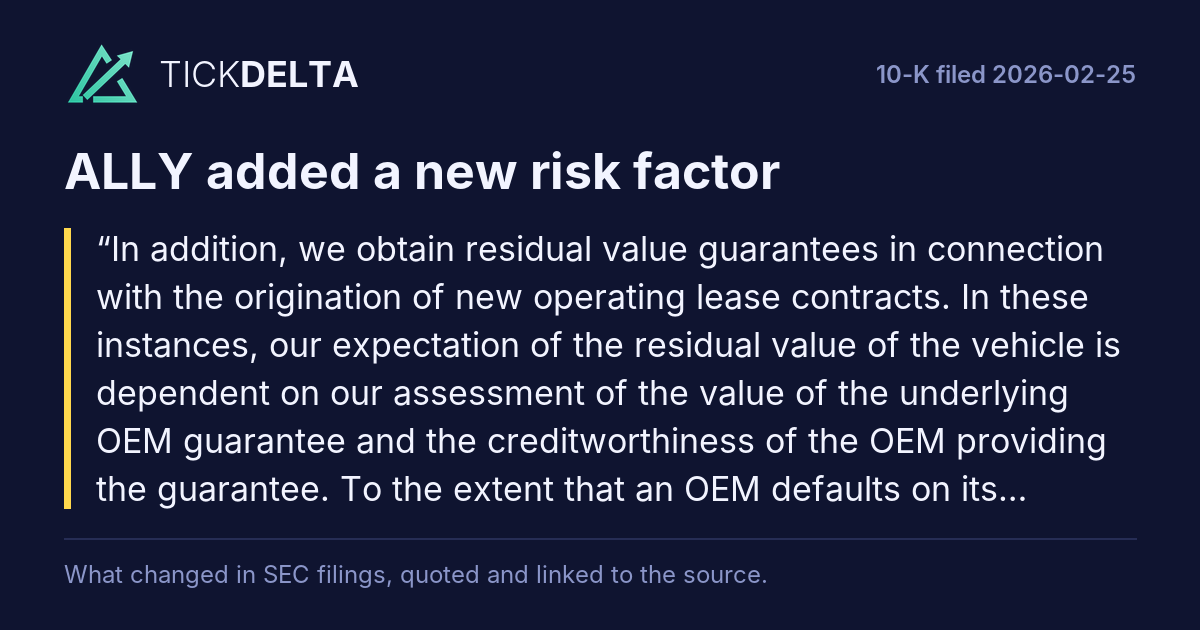
In addition, we obtain residual value guarantees in connection with the origination of new operating lease contracts. In these instances, our expectation of the residual value of the vehicle is dependent on our assessment of the value of the underlying OEM guarantee and the creditworthiness of the OEM providing the guarantee. To the extent that an OEM defaults on its obligations under any residual value guarantee, it could have an adverse impact on our financial position and results of operations.
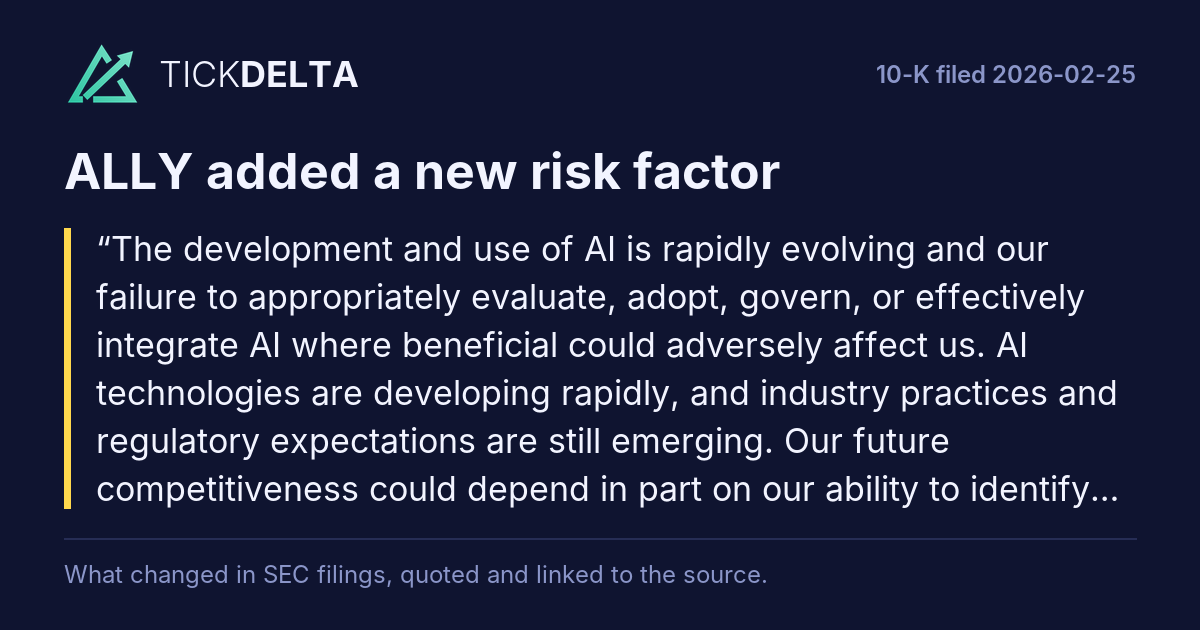
The development and use of AI is rapidly evolving and our failure to appropriately evaluate, adopt, govern, or effectively integrate AI where beneficial could adversely affect us.
AI technologies are developing rapidly, and industry practices and regulatory expectations are still emerging. Our future competitiveness could depend in part on our ability to identify where AI can create value, prudently adopt and integrate AI-enabled tools and processes, and maintain appropriate governance, risk management, and controls over such technologies and the data we input into them. If we fail to keep pace with advances in AI, we may be slower or less effective than peers in realizing its benefits. Even where we determine AI adoption is appropriate, we may be unable to recruit or develop the necessary talent or successfully integrate AI into existing systems. Overly cautious adoption, or delays in deploying AI while peers advance, could result in missed opportunities, lower productivity, or loss of market share. The deployment and use of AI within our businesses and operations may present new or increased legal, regulatory, reputational, operational and other risks that further complicate model risk management, data security and privacy protection, data governance and management, and third-party risk management. AI models, including generative AI models and AI agents, may produce output that is incorrect, incomplete, misleading, or biased, or that inadvertently discloses proprietary or confidential information or infringes on the intellectual property of others, any of which could be difficult to detect, and the deployment of these models by us or our third-party service providers to produce output or perform tasks may lead to unintended consequences, the risks of which may vary depending on whether our AI use is internal or customer-facing, what systems an AI solution is integrated with, what data is being used by the AI solution, and what level of autonomy an AI solution is granted, and which our AI governance and risk management practices may not effectively mitigate. The complex nature of AI models may make it difficult to understand and explain their outputs or accurately and consistently measure model performance, particularly for frontier models developed, or fine-tuned or otherwise modified by, a third party. Our reliance on third-party service providers that develop, host, or operate AI solutions on our behalf introduces additional risks, including limited transparency into their models and dependence on their controls and monitoring activities. We may become overly reliant on the limited number of frontier model developers due to the great expense of developing such models. The legal and regulatory framework for AI—particularly in financial services—is increasingly complex, fragmented, and evolving rapidly, and there is no uniform regulatory regime for the development, deployment, and use of this technology. Multiple U.S. states, including Utah, Colorado, Texas, California, and New York, have enacted AI-specific regulations or frameworks or are
considering how existing laws and regulations apply to these technologies, while the federal government in the United States has sought to establish a national standard for AI policy to spur innovation and sustain and enhance the United States’ global AI dominance, including by issuing a directive that seeks to limit state AI laws that are inconsistent with this policy. This fragmented regulatory landscape may impose new, inconsistent obligations or constraints, and meeting these requirements could increase costs and risk of noncompliance, limit certain AI applications, or necessitate changes to existing processes or controls. If we do not appropriately monitor developments in AI, invest selectively and responsibly in relevant capabilities, and implement effective controls commensurate with our risk profile, we could be subjected to regulatory scrutiny, and our business, financial results, and reputation could be adversely affected.
Paragraphs in the 10-Q filed Nov 2, 2026 that were not in the one before
New in the latest 10-Q
5 paragraphs in the 10-Q filed Nov 2, 2026 with nothing like them in the 10-Q filed Jul 23, 2026 (at least half the words must differ; new numbers alone do not count). Quoted exactly, grouped by the item heading above them. This is text that changed, not a judgement of how serious it is.
Financial statements and notes
(c) Commercial includes $ 24 million of allowance for loan losses recognized on PCD loans acquired during the nine months ended September 30, 2025.
Read in the 10-Q
(a) Represents liquidated losses, net of recoveries, on the underlying financial assets.
Read in the 10-Q
September 30, 2026 December 31, 2025 ───────────────────────────────────────────────────────────────────────────────────────────────────────────────────────────────────────────────────────── Series B preferred stock (a) Issuance date April 22, 2021 Carrying value ($ in millions) $ — $ 1,335 Par value (per share) $ — $ 0.01 Liquidation preference (per share) $ — $ 1,000 Number of shares authorized — 1,350,000 Number of shares issued and outstanding — 1,350,000 Dividend/coupon Prior to May 15, 2026 —% 4.700% On and after May 15, 2026 —% Five Year Treasury + 3.868% Series C preferred stock (b) Issuance date June 2, 2021 June 2, 2021 Carrying value ($ in millions) $ 989 $ 989 Par value (per share) $ 0.01 $ 0.01 Liquidation preference (per share) $ 1,000 $ 1,000 Number of shares authorized 1,000,000 1,000,000 Number of shares issued and outstanding 1,000,000 1,000,000 Dividend/coupon Prior to May 15, 2028 4.700% 4.700% On and after May 15, 2028 Seven Year Treasury + 3.481% Seven Year Treasury + 3.481% Series D preferred stock (b) Issuance date May 1, 2026 Carrying value ($ in millions) $ 987 $ — Par value (per share) $ 0.01 $ — Liquidation preference (per share) $ 1,000 $ — Number of shares authorized 1,000,000 — Number of shares issued and outstanding 1,000,000 — Dividend/coupon Prior to August 15, 2031 7.100% —% On and after August 15, 2031 Five Year Treasury + 3.148% —%
Read in the 10-Q
Three months ended September 30, Nine months ended September 30, ($ in millions) 2026 2025 2026 2025 ────────────────────────────────────────────────────────────────────────────────────────────────────────────────────────────────────────────────────────────────────────────── Gain (loss) recognized in earnings Interest rate contracts Gain on mortgage and automotive loans, net $ — $ — $ — $ 1 Total interest rate contracts — — — 1 Foreign exchange contracts Other operating expenses — 1 1 (1) Total foreign exchange contracts — 1 1 (1) Credit contracts Other income, net of losses 1 — (1) — Total credit contracts 1 — (1) — Equity contracts Other income, net of losses — — (4) — Total equity contracts — — (4) — Total gain (loss) recognized in earnings $ 1 $ 1 $ (4) $ —
Read in the 10-Q
September 30, 2026 December 31, 2025 ─────────────────────────────────────────────────────────────────────────────────── Industry Financial services (a) 45.0 % 43.0% Health services 21.5 20.7 Services 10.8 13.2 Chemicals and metals 6.2 7.1 Machinery, equipment, and electronics 4.1 5.5 Automotive and transportation 4.1 4.6 Wholesale 1.9 2.7 Paper, printing, and publishing 1.9 0.2 Other manufactured products 1.4 0.7 Electric, gas, and sanitary services 1.2 0.3 Construction 1.1 1.2 Other 0.8 0.8 Total finance receivables and loans 100.0 % 100.0%
Read in the 10-Q
The 10-Q's risk factors against the 10-K
Item 1A of the 10-Q filed Nov 2, 2026 against Item 1A of the 10-K filed Feb 25, 2026.
A 10-Q repeats only the risks that changed, so a 10-K paragraph that is missing from it is not counted as removed.
Added is a paragraph with nothing like it in the 10-K, Reworded a sentence that is in both with several words changed,
Quiet changes a sentence in both where one to four words changed and one is a hedge or a modal
(cut words struck through, new words highlighted).
Text on the page, not a score; each links to the filing at sec.gov.
What the 10-Q itself says about its risk factors:There have been no material changes to the Risk Factors described in our 2025 Annual Report on Form 10-K.
Read in the 10-Q
1 paragraph in the 10-Q's Item 1A, and none of them adds, rewords or quietly edits a paragraph of the 10-K's.
Phrases used for the first time
Two-word phrases in Risk Factors of the 10-K filed Feb 25, 2026 that are in none of the 1 earlier 10-Ks stored, back to Feb 19, 2025
Where each one is used
- qualified tools: •Our business and operations make extensive use of models and certain other qualified tools, and we could be adversely affected if our design, implementation, or use of models and certain other qualified tools are flawed.
- sustainability-related matters: •Our business and financial results may be negatively affected by governmental actions related to climate and other sustainability-related matters.
- investment advisory: •The markets for automotive financing, insurance, banking, brokerage, and investment advisory services are extremely competitive, and competitive pressures could adversely affect our business and financial results.
- advisory services: •The markets for automotive financing, insurance, banking, brokerage, and investment advisory services are extremely competitive, and competitive pressures could adversely affect our business and financial results.
- recent resurgence: Ally Bank is a key part of our funding strategy, and we place great reliance on deposits at Ally Bank as a source of funding. Our reliance on deposits as a source of funding has increased in recent years. As of December 31, 2025, deposits represented approximately 87% of our liability-based funding sources....
- liquidity prospects: We face many risks and uncertainties, any one or more of which could have a material adverse effect on our business, results of operations, financial condition (including capital and liquidity), prospects or the value of our return on an investment in Ally. We describe certain of these risks and uncertainties in...
- standards failures: •Weak or deteriorating economic conditions, failures in underwriting, changes in underwriting standards, failures in servicing loans and operating leases, financial or systemic shocks, or continued growth in our nonprime or used vehicle financing business could increase our credit risk, which could adversely affect...
- appropriately evaluate: •The development and use of AI is rapidly evolving and our failure to appropriately evaluate, adopt, govern, or effectively integrate AI where beneficial could adversely affect us.
Used at least twice, small words left out. Counted, not picked: a phrase can be new because the company renamed something.
What was taken out
5 paragraphs of last year's Risk Factors with nothing like them now. The longest are quoted.
Sources
Item 1A of each 10-K and 10-Q on EDGAR, quoted exactly. Each paragraph links to the filing at sec.gov.
Also
10-K change: what was reworded or cut, section by section.
Work with it
Excel workbook · CSV. Google Sheet that stays up to date: paste =IMPORTDATA("https://tickdelta.com/company/ALLY/export.csv") into a cell.