harmed and our ability to generate product revenues from any of these product candidates may be delayed or eliminated. Any of these occurrences may harm our ability to develop other product candidates, and may harm our business, financial condition and prospects significantly.
Any funding, personnel, policy or other disruptions at the FDA and other agencies may also delay those agencies’ review and response to our or our collaborators’ regulatory submissions, which would adversely affect our business. For example, over
Our six marketed products, including two products that are commercialized by collaborators, and any product candidates for which we or our collaborators may ultimately receive marketing authorization, are subject to ongoing regulatory
•the availability of adequate government and private third-party payor coverage and reimbursement;
•our direct sales and marketing efforts may not be successful, or may be limited by future government policies or initiatives.
In addition, the FDA may implement regulatory, policy, or enforcement changes that materially limit our ability and that of our third-party contractors to promote our products to consumers, which could materially impact our business. In September 2025, FDA stated that it intends to more aggressively enforce requirements for direct-to-consumer, or DTC, drug advertising and sent more than 100 warning or untitled letters to companies for allegedly deceptive prescription drug advertising, which represents a dramatic increase in such actions as compared to prior years. FDA also announced plans to expand its oversight of digital and social media advertising and to initiate a rulemaking that would call for drug companies to disclose additional safety information in DTC broadcast advertisements. In connection with these developments, we received an untitled letter from the FDA’s Center for Drug Evaluation and Research asserting that a particular DTC television advertisement for AMVUTTRA was false and misleading. We responded to the untitled letter and subsequently received a close-out letter from the FDA in November 2025. The nature and extent of changes to FDA’s regulations and enforcement approach is unclear but may impact pharmaceutical marketing efforts across the industry, including ours, which could in turn impact our sales and operations.
Under the current presidential administration, there has been significant reform activity focused on drug pricing and reimbursement. For example, President Trump issued an Executive Order in April 2025 with multiple directives aimed at lowering drug prices, including refining the Medicare drug price negotiation program established by the IRA; accelerating competition for high-cost prescription drugs by accelerating approval of generics and biosimilars and facilitating the process for re-classifying prescription drugs as over-the-counter drugs; and increasing drug importation. In May 2025, President Trump issued another Executive Order that directed government agencies and officials to identify most-favored nation pricing targets for prescription drugs (and looked to pharmaceutical manufacturers to make significant progress towards delivering target prices to patients); prevent foreign countries from disproportionately shifting the cost of global pharmaceutical research and development to the United States; and facilitate direct-to-consumer purchasing programs for pharmaceutical manufacturers to sell their products to patients at the most-favored-nation price. In the wake of the Executive Orders and related executive initiatives, a number of pharmaceutical manufacturers have announced direct-to-consumer offerings with discounted prices and/or reached agreement with the federal government regarding pricing for drugs, including prices for Medicaid drugs and newly launched products. A future website sponsored by the federal government that is anticipated to offer pharmaceutical direct-to-consumer channels has also been announced. Federal agencies are developing new drug pricing pilot programs, such as the GENEROUS model which would authorize the federal government to negotiate Medicaid supplemental rebates with participating manufacturers on behalf of state Medicaid programs, in exchange for standardized coverage criteria for participating manufacturer drugs, and proposed Medicare Part B (GLOBE model) and Part D (GUARD model) pilot models that, if finalized as proposed, would supplement existing inflation-based Medicare rebates with rebates determined on the basis of international prices, for drugs and patients subject to the model.
Other healthcare reform efforts or actions may affect access to healthcare coverage or the funding of health care benefits, although the full impact of such efforts or actions cannot be predicted. For example, Congressional Budget Office has estimated that Medicaid provisions in the 2025 budget reconciliation legislation, including restrictions in eligibility and funding for Medicaid, as well as changes to the healthcare marketplace such as the elimination of certain subsidies, will increase the number of uninsured.
There is uncertainty regarding the nature or impact of any pharmaceutical or broader federal healthcare reform proposed or implemented by the current presidential administration through executive or administrative action or by Congress, and the extent to which any such action will be subject to litigation or other challenges. It is unclear how any such healthcare reform measures will impact our business. Healthcare reforms and action taken by the healthcare industry in response could adversely affect reimbursement, competitive dynamics, and our business. We continue to monitor reform efforts and assess their potential impact on our operations, but we cannot predict their ultimate effect on our business.
In addition, local governments and private purchasers, such as hospitals or health systems, are increasingly using bidding procedures to determine what pharmaceutical products and which suppliers will be included in their prescription drug and other healthcare purchasing programs. These measures could reduce the demand for our products, once approved, or put pressure on our product pricing.
Other federal healthcare reform efforts or actions may affect access to healthcare coverage or the funding of health care benefits, although the full impact of such efforts or actions cannot be predicted. For example, the Congressional Budget Office has estimated that Medicaid provisions in the 2025 budget reconciliation legislation, including restrictions in eligibility and funding for Medicaid, as well as changes to the healthcare marketplace such as the elimination of certain subsidies, will increase the number of uninsured.
In addition, other broader legislative changes have been adopted that could have an adverse effect upon, and could prevent, our products’ commercial success. For example, the Budget Control Act of 2011, as amended, resulted in the imposition of reductions in Medicare (but not Medicaid) payments to providers in 2013 and remains in effect through 2032 unless additional Congressional action is taken. Any significant spending reductions affecting Medicare, Medicaid or other publicly funded or subsidized health programs that may be implemented and/or any significant taxes or fees that may be imposed on us could have an adverse impact on our results of operations.
The nature and extent of future healthcare or budget reforms cannot be predicted. Although further reform efforts are likely, here is significant uncertainty regarding the nature or impact of any drug pricing or broader healthcare reform implemented at the federal or state level and the extent to which such action may be subject to litigation or other challenges.
Ongoing efforts to contain or reduce costs of healthcare and/or impose price controls may adversely affect the demand for our products and our ability to achieve our Alnylam 2030 strategy and maintain profitability.
If we are unable to achieve and maintain coverage and adequate reimbursement from third-party payors for AMVUTTRA or our other products, the commercial success of these products may be severely hindered.
Successful commercialization of AMVUTTRA and our other products will depend in part on the extent to which coverage and adequate reimbursement are available from third-party payors, including governmental healthcare programs such as Medicare and Medicaid, commercial health insurers and managed care organizations, and whether and how quickly we can obtain such coverage and reimbursement. Third-party payors determine which medications they will cover and establish reimbursement levels. Reimbursement decisions by third-party payors depend upon a number of factors, including, among other things, each third-party payor’s determination that use of a product is:
Obtaining coverage and reimbursement approval from third-party payors is often a time consuming and costly process that could require us to provide supporting scientific, clinical and cost-effectiveness data, including results from pharmacoeconomic studies, to each third-party payor. No uniform policy for coverage and reimbursement for products exists among third-party payors in the U.S. and coverage and reimbursement for products can differ significantly from payor to payor. There could be significant delays in obtaining coverage and there is no guarantee that we will be able to provide data sufficient to gain acceptance with respect to coverage and reimbursement, and any coverage we do obtain could be more limited than the purposes for which the product is approved by the FDA or foreign regulatory authorities. Furthermore, rules and regulations regarding reimbursement change frequently, in some cases on short notice, and we believe that further changes in these rules and regulations are likely.
Cost containment is a primary concern of the U.S. healthcare industry and elsewhere as well as for governmental authorities. Third-party payors are increasingly attempting to contain healthcare costs by limiting both coverage and the level of reimbursement for medical products and services. Third-party payors may deny reimbursement for covered products if they determine that a medical product was not used in accordance with third-party payor coverage policies, such as required procedures for cost-effective diagnosis methods, and may establish other conditions that must be met before the third-party payor will provide coverage for use of AMVUTTRA or one of our other products. For example, insurers may establish a “step-edit” system that requires a patient to first use a lower price alternative product prior to becoming eligible for reimbursement of a higher price product. Third-party payors also may refuse to reimburse for products deemed to be experimental, or that are prescribed for an unapproved indication. It is also possible that a third-party payor may consider AMVUTTRA or our other products as substitutable by less expensive therapies and only offer to reimburse patients for the less expensive product. Even if we show improved efficacy or improved convenience of administration with our products, pricing of existing drugs may limit the amount that can be charged for our products. Interim payments for new products, if applicable, may also not be sufficient to cover our costs and may not be made permanent. Payors may also deny or revoke coverage for a given product or establish prices for new or existing marketed products at levels that are too low to enable us to realize an appropriate return on our investment in product development. Further, third-party payors may limit coverage to specific products on an approved list, or formulary, which might not include all of the FDA-approved products for a particular indication, and it is possible that AMVUTTRA or our other products will not be included on the formularies of certain third-party payors.
The process for determining whether a payor will provide coverage for a product may be separate from the process for setting the price or reimbursement rate that the payor will pay for the product once coverage is approved. Levels of reimbursement may also decrease in the future, and future legislation, regulation or reimbursement policies of third-party payors may adversely affect the reimbursement available for and the pricing for AMVUTTRA or our other products, which in turn, could negatively impact the demand for AMVUTTRA or our other products. If providers are not adequately reimbursed for AMVUTTRA or our other products, they may reduce or discontinue purchases of them, which would have a significant negative impact on our business, prospects, operating results and financial condition.
In some countries, including Member States of the EU, or Japan, the pricing of prescription drugs may be subject to governmental control. Additional countries may adopt similar approaches to the pricing of prescription drugs. In such countries,
Additionally, governments in certain markets such as in EU, the U.K., Japan, and China, provide healthcare at low (or zero) direct costs to consumers at the point of care, and thus have significant power as large single payers to regulate prices or impose other cost control mechanisms.
Efforts to ensure that our activities comply with applicable healthcare laws and regulations involves substantial costs. We remain focused on enhancing our global compliance infrastructure as we prepare for the launch of our products in additional countries, assuming regulatory approvals. Although effective compliance programs can mitigate the risk of investigation and prosecution for violations of these laws, these risks cannot be entirely eliminated.
Given the breadth of the laws and regulations, limited guidance for certain laws and regulations, and evolving government interpretations of the laws and regulations, governmental authorities may possibly conclude that our business practices may not comply with such laws. If our operations are found to be in violation of any of these laws or any other governmental regulations that may apply to us, we may be subject to significant civil, criminal, and administrative penalties, damages, fines, exclusion from participation in federal health care programs such as Medicare and Medicaid, the curtailment or restructuring of our operations, and other actions. Further, defending against any such actions can be costly, time-consuming, and may require significant personnel resources. Therefore, even if we are successful in defending against any such actions that may be brought against us, our business may be impaired. In October 2025, we received a subpoena from the U.S. Attorney’s Office for the District of Massachusetts seeking documents pertaining to our government price reporting for AMVUTTRA, ONPATTRO, OXLUMO and GIVLAARI, including certain fee and discount arrangements with distributors, and certain other related documents and communications. We have produced and will continue to produce records responsive to the subpoena and anticipate that, even if government authorities conclude that our business practices were fully compliant with laws, responding to the subpoena will result in significant expense and require attention of our management.
We are subject to U.S. and international privacy laws, including, for example, health privacy laws, comprehensive state privacy laws, consumer protection laws, data localization laws, and genetic privacy laws.
In the U.S., there are numerous federal and state laws and regulations governing the privacy and the collection, use, disclosure and other processing of personal data, health data, genetic data, and children's data. For example, at the federal level, the Federal Trade Commission, or FTC, sets requirements for safeguarding personal data and for providing a level of privacy commensurate to promises made to consumers. The failure to meet these requirements may constitute unfair or deceptive acts or practices in violation of Section 5 of the FTC Act. The FTC also has the power to enforce the Health Breach Notification Rule, which imposes notification obligations on companies for breaches of certain health information contained in personal health records. Enforcement by the FTC can result in civil penalties or enforcement actions. Additionally, at the state level, many states have enacted comprehensive consumer privacy laws, and many other consumer privacy laws are expected to go into effect in the near future. In addition, sector- and data-specific laws, such as those addressing consumer health data privacy, marketing communications, data security, and the sale/transfer of certain bulk sensitive data, may apply to aspects of our operations or the operations of our collaborators. These laws include certain transparency and other requirements to protect personal data and grant residents of such states with certain rights regarding their personal data.
Competitors could enter the market with generic versions of AMVUTTRA or our or our collaborators’ other marketed products developed in collaboration with us, which may result in a material decline in sales of affected product(s).
Under the Hatch-Waxman Act, a pharmaceutical manufacturer may file an abbreviated new drug application, or an ANDA, seeking approval of a generic copy of an approved, innovator product such as AMVUTTRA or our or our collaborators’ other marketed products developed in collaboration with us. Under the Hatch-Waxman Act, a manufacturer may also submit a 505(b)(2) application that references the FDA’s finding of safety and effectiveness of a previously approved innovator product. A 505(b)(2) application product may be for a new or improved version of the original innovator product. Innovative products may be eligible for certain periods of regulatory exclusivity (e.g., five years for new chemical entities, three years for changes to an approved drug requiring a new clinical study, and seven years for orphan drugs), which preclude FDA approval (or in some circumstances, FDA filing and review of) an ANDA or 505(b)(2) application relying on the FDA’s finding of safety and effectiveness for the innovative drug. In addition to the benefits of regulatory exclusivity, an innovator NDA holder may have patents claiming the active ingredient, product formulation or an approved use of the drug, which would be listed with the product in the Orange Book. If there are patents listed in the Orange Book, a generic applicant that seeks to market its product before expiration of the patents must include a Paragraph IV certification in the ANDA or 505(b)(2) application challenging the validity or enforceability of, or claiming non-infringement of, the listed patent or patents. Notice of the Paragraph IV
certification must be given to the innovator, and if within 45 days of receiving notice the innovator sues to enforce its patents, approval of the ANDA is stayed for 30 months, or as lengthened or shortened by the court.
In January 2026, our collaborator, Novartis, received notice of a Paragraph IV certification for Leqvio. Novartis has 45 days from the date it received the notice to initiate a patent infringement lawsuit in order for the court to impose the 30-month stay. Novartis is responsible for enforcing our Orange Book patents relating to Leqvio, in consultation with us, and our views may differ from theirs with respect to process or strategy, and we have a reduced ability to control the outcome of the litigation. We cannot predict the outcome of any litigation to enforce the Leqvio patents, nor can we predict whether there will be additional ANDA filings or 505(b)(2) applications for Leqvio, or whether there will be ANDA filings for AMVUTTRA or our or our collaborators’ other product candidates developed in collaboration with us.
There have been a number of recent regulatory and legislative initiatives designed to encourage generic competition for pharmaceutical products. For instance, in December 2019, the Creating and Restoring Equal Access to Equivalent Samples Act, or the CREATES Act, was enacted, which provides a legislatively defined private right of action under which eligible product developers can bring suit against companies who refuse to sell sufficient quantities of their branded products on commercially reasonable, market-based terms to support such eligible product developers’ marketing applications.
We and our collaborators may not be successful in securing or maintaining proprietary patent protection for our marketed products. Moreover, if any patents that are granted and listed in the Orange Book are successfully challenged by way of a Paragraph IV certification and subsequent litigation, the affected product could more immediately face generic competition and its sales would likely decline materially. For instance, if the existing ANDA filers or additional competitors are able to enter the market with generic versions of Leqvio, Novartis’ sales of Leqvio could materially decline which could have an adverse impact on the royalties that we receive on Leqvio sales.
•results of clinical trials, or emerging real world evidence, for our competitors’ products or product candidates;
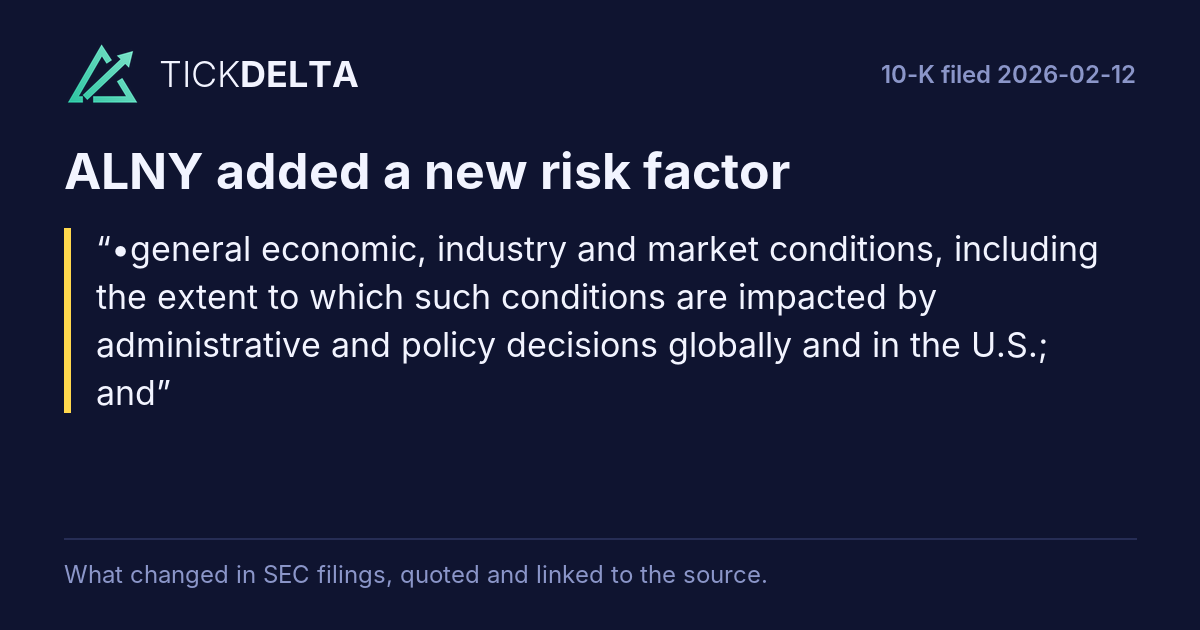
•general economic, industry and market conditions, including the extent to which such conditions are impacted by administrative and policy decisions globally and in the U.S.; and
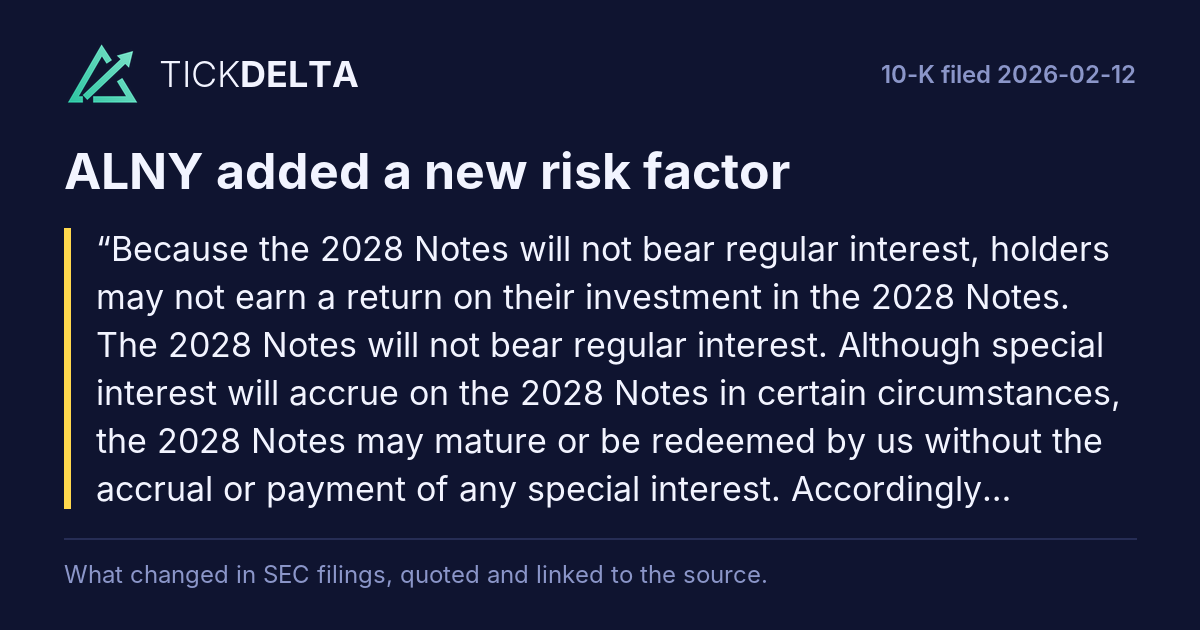
Because the 2028 Notes will not bear regular interest, holders may not earn a return on their investment in the 2028 Notes.
The 2028 Notes will not bear regular interest. Although special interest will accrue on the 2028 Notes in certain circumstances, the 2028 Notes may mature or be redeemed by us without the accrual or payment of any special interest. Accordingly, holders of 2028 Notes may not earn any return on their investment in the 2028 Notes unless they resell them at a price that exceeds the price at which they purchased the 2028 Notes or they realize a gain in connection with the conversion of their 2028 Notes. Holders of 2028 Notes may not be able to resell their 2028 Notes at favorable prices, and the trading price of our common stock may never exceed the conversion price of the 2028 Notes. As a result, investment in the 2028 Notes may not earn any return at all and may result in losses.