Paragraph 77 · 49% changed
Every version of it
Screener
/
SEC EDGAR
/CIK 0001623925
/10-K filed Feb 11, 2026, compared with Feb 12, 2025
/Numbers from the XBRL of the 10-Ks
NYSE
Energy · Pipelines
Antero Midstream Corp AM
The 10-K against last year's
109 changes: 20 added, 11 removed, 75 reworded, 3 quiet changes
10-K Feb 11, 2026 vs Feb 12, 2025
Risk Factors
18.3%
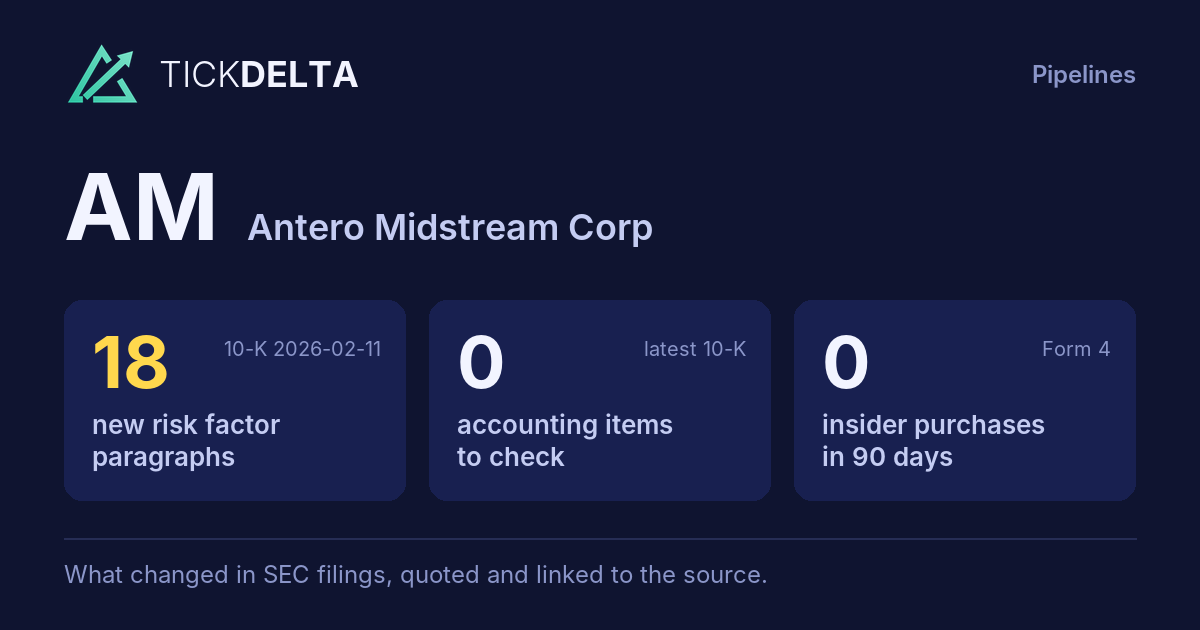
of the text changed · 19,312 words now · 18 new paragraphs, 8 gone
MD&A
19.8%
of the text changed · 6,091 words now · 2 new paragraphs, 3 gone
10-K 0001104659-26-013380 (Feb 11, 2026) vs 10-K 0001558370-25-000862 (Feb 12, 2025) Not compared: Legal Proceedings, Accounting Policies.
Every paragraph, and how much of it changed
One bar per paragraph, in the order of the 10-K. Height and colour show the share of its words not in the closest paragraph a year earlier; the tallest bars are new paragraphs.
Risk Factors
214 paragraphs · 18 new · 43 reworded · 8 gone · 10-K Feb 11, 2026 against Feb 12, 2025
New paragraph
Reworded (5% of its words or more)
Same or nearly
Paragraph 40 · 46% changed
Every version of it
Paragraph 212 · 40% changed
Every version of it
Paragraph 64 · 39% changed
Every version of it
Terrorist attacks or cyberattacks may significantly affect the energy industry, including our operations and those of our suppliers and customers, as well as general economic conditions, consumer confidence and spending and market liquidity. Cyber incidents, including deliberate attacks, have increased in frequency globally. Strategic targets, such as energy related assets, may be at greater risk of future attacks than other targets in the United States. We depend on digital technology in many areas of our business and operations, including, but not limited to, performing many of our gathering and compression and water handling services, processing and recording financial and operating data, oversight and analysis of our operations and communications with the employees supporting our operations and our customers or service providers. We also collect and store sensitive data in the ordinary course of our business, including personally identifiable information as well as our proprietary business information and that of our customers, suppliers, investors and other stakeholders. The growing regulatory landscape around data protection adds additional complexity to safeguarding this information. The secure processing, maintenance and transmission of information is critical to our operations, and we monitor our key information technology systems in an effort to detect and prevent cyberattacks, security breaches or unauthorized access. Despite our security measures, our information technology systems may undergo cyberattacks or security breaches including as a result of employee error, malfeasance or other threat vectors, which could lead to the corruption, loss, or disclosure of proprietary and sensitive data, misdirected wire transfers, and an inability to: perform services for our customers; complete or settle transactions; maintain our books and records; prevent environmental damage; and maintain communications or operations. Significant liability to the Company or third parties may result. We are not able to anticipate, detect or prevent all cyberattacks, particularly because the methodologies used by attackers change frequently or may not be recognized until an attack is already underway or significantly thereafter, and because attackers are increasingly using technologies specifically designed to circumvent cybersecurity measures and avoid detection. Cybersecurity attacks are also becoming more sophisticated and include, but are not limited to, ransomware, credential stuffing, spear phishing, social engineering, use of deepfakes (e.g., highly realistic synthetic media generated by artificial intelligence) and other attempts to gain unauthorized access to data for purposes of extortion or other malfeasance.
Paragraph 160 · 39% changed
Every version of it
The federal regulation of methane from oil and gas facilities has been subject to substantial uncertainty in recent years. In June 2016, the EPA finalized NSPS, known as Subpart OOOOa, that established emission standards for methane and VOCs from new and modified oil and natural gas production and natural gas processing and transmission facilities. Most recently, in December 2023, the EPA finalized more stringent methane rules for new, modified, and reconstructed facilities, known as OOOOb, as well as standards for existing sources for the first time ever, known as OOOOc. Under However, in March 2025, the final rules, states have two years to prepare and submit their EPA announced plans to impose methane emission controls on existing sources. The presumptive standards established under reconsider OOOOb and OOOOc, in line with the Trump administration’s deregulatory agenda. Additionally, in November 2025, the EPA finalized an interim rule extending the compliance deadlines for certain provisions provided in OOOOb and OOOOc. Litigation challenging the EPA’s final interim rule are generally the same extending such compliance deadlines for both new and existing sources. The requirements include enhanced leak detection survey requirements using optical oil and gas imaging and other advanced monitoring to encourage the deployment of innovative technologies to detect and reduce methane emissions, reduction of emissions by 95% through capture and control systems and zero-emission requirements for certain devices. The rule also establishes a “super emitter” response program that would allow third parties to make reports to EPA of large methane emission events, triggering certain investigation and repair requirements. Fines and penalties for violations of these rules can be substantial. These rules are currently subject to legal challenges, and we sources remains pending. We cannot predict what additional actions the final outcome. However, the OOOOb rules are currently in effect. The Trump administration may seek to revise or repeal these rules; however, we cannot predict what actions the new administration may take, if at all, or on what timelines, take or how they may affect our business operations. Moreover, compliance with the new rules may affect the amount we owe under the IRA’s methane fee described above, because compliance with EPA’s methane rules would exempt an otherwise covered facility from the requirement to pay the methane fee. The requirements of the EPA’s final methane rules have the potential to increase our operating costs and thus may adversely affect our financial results and cash flows. Moreover, However, failure to comply with these CAA requirements can result in the imposition of substantial fines and penalties as well as costly injunctive relief. Given the long-term trend toward increasing regulation, future federal GHG regulations of the oil and gas industry remain a possibility, and several states, including West Virginia and Ohio, have separately imposed their own regulations on methane emissions from oil and gas production activities.
Paragraph 44 · 37% changed
Every version of it
Furthermore, our reputation, as well as our stakeholder relationships, could be adversely impacted as a result of, among other things, any failure to meet our ESG sustainability plans or goals or stakeholder perceptions of certain statements made by us, others in our industry, our employees and executives, agents, or other third parties or public pressure from investors or policy groups to change our policies. Such statements with respect to ESG sustainability matters are becoming increasingly subject to heightened scrutiny from public and governmental authorities authorities, as well as other parties, related to the risk of potential “greenwashing,” i.e., misleading information or false claims overstating potential ESG sustainability benefits. As a result, Additionally, certain employment practices and social initiatives are the subject of scrutiny by both those calling of the continued advancement of such policies, as well as those who believe they should be curbed, including government actors, and the complex regulatory and legal frameworks applicable to such initiatives continue to evolve. We cannot be certain of the impact of such regulatory, legal and other developments on our business. More recent political developments could mean that we may face increased increasing criticism or litigation risks from private parties and certain “anti-ESG” parties, including various governmental authorities related to our ESG efforts. Moreover, any alleged claims of greenwashing against us or others in our industry agencies. Such sentiment may lead to negative sentiment towards our company or industry. To the extent that the Company is unable to respond timely and appropriately to any negative publicity, our reputation could be harmed. Damage to our overall reputation could have a negative impact focus on our financial results and require additional resources for the Company environmental commitments or our pursuit of certain employment practices or social initiatives that are alleged to rebuild its reputation. be political or polarizing in nature or are alleged to violate laws based, in part, on changing
Paragraph 141 · 37% changed
Every version of it
In addition, new or additional regulations, new interpretations of existing requirements or changes in our operations could also trigger the need for Environmental Assessments or more detailed Environmental Impact Statements under the National Environmental Policy Act (“NEPA”) and analogous state laws, or that impose new permitting requirements on our operations could result in increased costs or delays of, or denial of rights to conduct, our development programs. For instance, there have been several recent developments regarding the NEPA regulatory regime. Most recently, following a Trump administration Executive Order, in January 2023, February 2025, the White House’s Council on Environmental Quality (“CEQ”) released an interim final rule rescinding its regulations implementing NEPA. Federal agencies have begun the process of preparing their own new or updated NEPA-implementing rules or guidelines, with the first batch of updates released in July 2025. In May 2025, the Supreme Court issued its opinion in Seven County Infrastructure Coalition v. Eagle County, emphasizing the “substantial judicial deference” that courts must grant agencies when considering NEPA challenges. And, in September 2025, CEQ issued new guidance to assist federal agencies in assessing implementing NEPA encouraging them to limit their NEPA reviews, rely more heavily on sponsor-prepared documents, and streamline the GHG emissions and climate change effects of their proposed actions under NEPA. In May 2024, the CEQ published a final rule which, in the second and final “phase” of updates, revised the implementing regulations of procedural provisions of NEPA and implements NEPA amendments included in the Financial Responsibility Act of 2023. process. The final rule was challenged by various states. In the U.S. District Court for the District of North Dakota in February 2025, the court issued an order vacating the May 2024 rule citing a November 2024 opinion of the U.S. Court of Appeals for the D.C. Circuit, which held that the CEQ lacks authority to issue NEPA regulations. As a result of these rulings and the recent change in presidential administration, there is significant uncertainty with respect to current and future NEPA regulations. For example, on January 20, 2025, President Trump issued an Executive Order directing the CEQ to issue guidance and propose rescinding existing NEPA regulations to “expedite and simplify the permitting process.” While the full impact of these developments is remains unclear at this time, but any disruption in our ability to obtain permits could result in costs that could have a material adverse effect on our business, financial condition and results of operations.
Paragraph 45 · 32% changed
Every version of it
Paragraph 77 · 49% changed
Every version of it
10-K Feb 12, 2025Debt we incur in the future may limit our flexibility to obtain financing and to pursue other business opportunities.
10-K Feb 11, 2026
The provisions of the Credit Facility and the indentures governing our senior notes may affect our ability to obtain future financing and pursue attractive business opportunities and our flexibility in planning for, and reacting to, changes in business
Paragraph 40 · 46% changed
Every version of it
10-K Feb 12, 2025Resources implemented efficiency improvements and water initiatives during 2020, which reduced the amount of fresh water needed to complete their operations. Furthermore, the availability of water supply for our operations may be limited due to, among other things, prolonged drought or state and local governmental authorities restricting the use of water for hydraulic fracturing. The availability of water may also change over time in ways that we cannot control, including as a result of climate related effects such as shifting meteorological and hydrological patterns. Any decrease in the demand for water handling services, or the water supply we need to provide such services, would adversely affect our business and results of operations.
10-K Feb 11, 2026
shifting meteorological and hydrological patterns. Any decrease in the demand for water handling services, or the water supply we need to provide such services, would adversely affect our business and results of operations.
Paragraph 212 · 40% changed
Every version of it
10-K Feb 12, 2025Our certificate of incorporation provides that, unless we consent in writing to the selection of an alternative forum, the Court of Chancery of the State of Delaware (the “Court of Chancery”) will, to the fullest extent permitted by applicable law, be the sole and exclusive forum for (i) any derivative action or proceeding brought on our behalf, (ii) any action or proceeding asserting a claim of breach of a fiduciary duty owed by any of our current or former directors, officers, stockholders, employees or agents to us or our stockholders, (iii) any action or proceeding asserting a claim arising pursuant to any provision of the DGCL, our certificate of incorporation or our bylaws as to which the DGCL confers jurisdiction on the Court of Chancery or (iv) any action or proceeding asserting a claim against us governed by the internal affairs doctrine, in each such case subject to the Court of Chancery having personal jurisdiction over the indispensable parties named as defendants therein. The foregoing provision does not apply to claims under the Securities Act, the Exchange Act or any claim for which the U.S. federal courts have exclusive jurisdiction. Furthermore, if the Court of Chancery lacks subject matter jurisdiction for any such matter, any state or federal court located within Delaware will be the sole and exclusive forum for that matter. Any person or entity purchasing or otherwise acquiring or holding any interest in shares of our capital stock will be deemed to have notice of, and consented to, the provisions of certificate of incorporation described in the preceding sentence. This choice of forum provision may limit our stockholder’s ability to bring a claim in a judicial forum that it finds favorable for disputes with it or its directors, officers, employees or agents, which may discourage such lawsuits against us and such persons. Alternatively, if a court were to find these provisions of our certificate of incorporation inapplicable to, or unenforceable in respect of, one or more of the specified types of actions or proceedings, we may incur additional costs associated with resolving such matters in other jurisdictions, which could adversely affect our business, financial condition and results of operations.
10-K Feb 11, 2026
preceding sentence. This choice of forum provision may limit our stockholder’s ability to bring a claim in a judicial forum that it finds favorable for disputes with it or its directors, officers, employees or agents, which may discourage such lawsuits against us and such persons. Alternatively, if a court were to find these provisions of our certificate of incorporation inapplicable to, or unenforceable in respect of, one or more of the specified types of actions or proceedings, we may incur additional costs associated with resolving such matters in other jurisdictions, which could adversely affect our business, financial condition and results of operations.
Paragraph 64 · 39% changed
Every version of it
10-K Feb 12, 2025
Terrorist attacks or cyberattacks may significantly affect the energy industry, including our operations and those of our suppliers and customers, as well as general economic conditions, consumer confidence and spending and market liquidity. Cyber incidents, including deliberate attacks, have increased in frequency globally. Strategic targets, such as energy related assets, may be at greater risk of future attacks than other targets in the United States. We depend on digital technology in many areas of our business and operations, including, but not limited to, performing many of our gathering and compression and water handling services, processing and recording financial and operating data, oversight and analysis of our operations and communications with the employees supporting our operations and our customers or service providers. We also collect and store sensitive data in the ordinary course of our business, including personally identifiable information as well as our proprietary business information and that of our customers, suppliers, investors and other stakeholders. The growing regulatory landscape around data protection adds additional complexity to safeguarding this information. The secure processing, maintenance and transmission of information is critical to our operations, and we monitor our key information technology systems in an effort to detect and prevent cyberattacks, security breaches or unauthorized access. Despite our security measures, our information technology systems may undergo cyberattacks or security breaches including as a result of employee error, malfeasance or other threat vectors, which could lead to the corruption, loss, or disclosure of proprietary and sensitive data, misdirected wire transfers, and an inability to: perform services for our customers; complete or settle transactions; maintain our books and records; prevent environmental damage; and maintain communications or operations. Significant liability to the Company or third parties may result. We are not able to anticipate, detect or prevent all cyberattacks, particularly because the methodologies used by attackers change frequently or may not be recognized until an attack is already underway or significantly thereafter, and because attackers are increasingly using technologies specifically designed to circumvent cybersecurity measures and avoid detection. Cybersecurity attacks are also becoming more sophisticated and include, but are not limited to, ransomware, credential stuffing, spear phishing, social engineering, use of deepfakes (e.g., highly realistic synthetic media generated by artificial intelligence) and other attempts to gain unauthorized access to data for purposes of extortion or other malfeasance.
10-K Feb 11, 2026
Terrorist attacks or cyberattacks may significantly affect the energy industry, including our operations and those of our suppliers and customers, as well as general economic conditions, consumer confidence and spending and market liquidity. Cyber incidents, including deliberate attacks, have increased in frequency globally. Strategic targets, such as energy related assets, may be at greater risk of future attacks than other targets in the United States. We depend on digital technology in many areas of our business and operations, including, but not limited to, performing many of our gathering and compression and water handling services, processing and recording financial and operating data, oversight and analysis of our operations and communications with the employees supporting our operations and our customers or service providers. We also collect and store sensitive data in the ordinary course of our business, including personally identifiable information as well as our proprietary business information and that of our
Paragraph 160 · 39% changed
Every version of it
10-K Feb 12, 2025
The federal regulation of methane from oil and gas facilities has been subject to substantial uncertainty in recent years. In June 2016, the EPA finalized NSPS, known as Subpart OOOOa, that established emission standards for methane and VOCs from new and modified oil and natural gas production and natural gas processing and transmission facilities. Most recently, in December 2023, the EPA finalized more stringent methane rules for new, modified, and reconstructed facilities, known as OOOOb, as well as standards for existing sources for the first time ever, known as OOOOc. Under the final rules, states have two years to prepare and submit their plans to impose methane emission controls on existing sources. The presumptive standards established under the final rule are generally the same for both new and existing sources. The requirements include enhanced leak detection survey requirements using optical gas imaging and other advanced monitoring to encourage the deployment of innovative technologies to detect and reduce methane emissions, reduction of emissions by 95% through capture and control systems and zero-emission requirements for certain devices. The rule also establishes a “super emitter” response program that would allow third parties to make reports to EPA of large methane emission events, triggering certain investigation and repair requirements. Fines and penalties for violations of these rules can be substantial. These rules are currently subject to legal challenges, and we cannot predict the final outcome. However, the OOOOb rules are currently in effect. The Trump administration may seek to revise or repeal these rules; however, we cannot predict what actions the new administration may take, if at all, or on what timelines, or how they may affect our business operations. Moreover, compliance with the new rules may affect the amount we owe under the IRA’s methane fee described above, because compliance with EPA’s methane rules would exempt an otherwise covered facility from the requirement to pay the methane fee. The requirements of the EPA’s final methane rules have the potential to increase our operating costs and thus may adversely affect our financial results and cash flows. Moreover, failure to comply with these CAA requirements can result in the imposition of substantial fines and penalties as well as costly injunctive relief. Given the long-term trend toward increasing regulation, future federal GHG regulations of the oil and gas industry remain a possibility, and several states, including West Virginia and Ohio, have separately imposed their own regulations on methane emissions from oil and gas production activities.
10-K Feb 11, 2026
The federal regulation of methane from oil and gas facilities has been subject to substantial uncertainty in recent years. In December 2023, the EPA finalized more stringent methane rules for new, modified, and reconstructed facilities, known as OOOOb, as well as standards for existing sources for the first time ever, known as OOOOc. However, in March 2025, the EPA announced plans to reconsider OOOOb and OOOOc, in line with the Trump administration’s deregulatory agenda. Additionally, in November 2025, the EPA finalized an interim rule extending the compliance deadlines for certain provisions provided in OOOOb and OOOOc. Litigation challenging the EPA’s final interim rule extending such compliance deadlines for new and existing oil and gas sources remains pending. We cannot predict what additional actions the Trump administration may take or how they may affect our business operations. However, failure to comply with these CAA requirements can result in the imposition of substantial fines and penalties as well as costly injunctive relief. Given the long-term trend toward increasing regulation, future federal GHG regulations of the oil and gas industry remain a possibility, and several states, including West Virginia and Ohio, have separately imposed their own regulations on methane emissions from oil and gas production activities.
Paragraph 44 · 37% changed
Every version of it
10-K Feb 12, 2025
Furthermore, our reputation, as well as our stakeholder relationships, could be adversely impacted as a result of, among other things, any failure to meet our ESG plans or goals or stakeholder perceptions of statements made by us, our employees and executives, agents, or other third parties or public pressure from investors or policy groups to change our policies. Such statements with respect to ESG matters are becoming increasingly subject to heightened scrutiny from public and governmental authorities related to the risk of potential “greenwashing,” i.e., misleading information or false claims overstating potential ESG benefits. As a result, we may face increased litigation risks from private parties and governmental authorities related to our ESG efforts. Moreover, any alleged claims of greenwashing against us or others in our industry may lead to negative sentiment towards our company or industry. To the extent that the Company is unable to respond timely and appropriately to any negative publicity, our reputation could be harmed. Damage to our overall reputation could have a negative impact on our financial results and require additional resources for the Company to rebuild its reputation.
10-K Feb 11, 2026
Furthermore, our reputation, as well as our stakeholder relationships, could be adversely impacted as a result of, among other things, any failure to meet our sustainability plans or goals or stakeholder perceptions of certain statements made by us, others in our industry, our employees and executives, agents, or other third parties or public pressure from investors or policy groups to change our policies. Such statements with respect to sustainability matters are becoming increasingly subject to heightened scrutiny from public and governmental authorities, as well as other parties, related to the risk of potential “greenwashing,” i.e., misleading information or false claims overstating potential sustainability benefits. Additionally, certain employment practices and social initiatives are the subject of scrutiny by both those calling of the continued advancement of such policies, as well as those who believe they should be curbed, including government actors, and the complex regulatory and legal frameworks applicable to such initiatives continue to evolve. We cannot be certain of the impact of such regulatory, legal and other developments on our business. More recent political developments could mean that we face increasing criticism or litigation risks from certain “anti-ESG” parties, including various governmental agencies. Such sentiment may focus on our environmental commitments or our pursuit of certain employment practices or social initiatives that are alleged to be political or polarizing in nature or are alleged to violate laws based, in part, on changing
Paragraph 141 · 37% changed
Every version of it
10-K Feb 12, 2025
In addition, new or additional regulations, new interpretations of existing requirements or changes in our operations could also trigger the need for Environmental Assessments or more detailed Environmental Impact Statements under the National Environmental Policy Act (“NEPA”) and analogous state laws, or that impose new permitting requirements on our operations could result in increased costs or delays of, or denial of rights to conduct, our development programs. For instance, in January 2023, the White House’s Council on Environmental Quality (“CEQ”) released guidance to assist federal agencies in assessing the GHG emissions and climate change effects of their proposed actions under NEPA. In May 2024, the CEQ published a final rule which, in the second and final “phase” of updates, revised the implementing regulations of procedural provisions of NEPA and implements NEPA amendments included in the Financial Responsibility Act of 2023. The final rule was challenged by various states. In the U.S. District Court for the District of North Dakota in February 2025, the court issued an order vacating the May 2024 rule citing a November 2024 opinion of the U.S. Court of Appeals for the D.C. Circuit, which held that the CEQ lacks authority to issue NEPA regulations. As a result of these rulings and the recent change in presidential administration, there is significant uncertainty with respect to current and future NEPA regulations. For example, on January 20, 2025, President Trump issued an Executive Order directing the CEQ to issue guidance and propose rescinding existing NEPA regulations to “expedite and simplify the permitting process.” While the full impact of these developments is unclear at this time, any disruption in our ability to obtain permits could result in costs that could have a material adverse effect on our business, financial condition and results of operations.
10-K Feb 11, 2026
In addition, new or additional regulations, new interpretations of existing requirements or changes in our operations could also trigger the need for Environmental Assessments or more detailed Environmental Impact Statements under the National Environmental Policy Act (“NEPA”) and analogous state laws, or that impose new permitting requirements on our operations could result in increased costs or delays of, or denial of rights to conduct, our development programs. For instance, there have been several recent developments regarding the NEPA regulatory regime. Most recently, following a Trump administration Executive Order, in February 2025, the White House’s Council on Environmental Quality (“CEQ”) released an interim final rule rescinding its regulations implementing NEPA. Federal agencies have begun the process of preparing their own new or updated NEPA-implementing rules or guidelines, with the first batch of updates released in July 2025. In May 2025, the Supreme Court issued its opinion in Seven County Infrastructure Coalition v. Eagle County, emphasizing the “substantial judicial deference” that courts must grant agencies when considering NEPA challenges. And, in September 2025, CEQ issued new guidance to federal agencies implementing NEPA encouraging them to limit their NEPA reviews, rely more heavily on sponsor-prepared documents, and streamline the NEPA process. The full impact of these developments remains unclear at this time, but any disruption in our ability to obtain permits could result in costs that could have a material adverse effect on our business, financial condition and results of operations.
Paragraph 45 · 32% changed
Every version of it
10-K Feb 12, 2025Furthermore, our reputation, as well as our stakeholder relationships, could be adversely impacted as a result of, among other things, any failure to meet our ESG plans or goals or stakeholder perceptions of statements made by us, our employees and executives, agents, or other third parties or public pressure from investors or policy groups to change our policies. Such statements with respect to ESG matters are becoming increasingly subject to heightened scrutiny from public and governmental authorities related to the risk of potential “greenwashing,” i.e., misleading information or false claims overstating potential ESG benefits. As a result, we may face increased litigation risks from private parties and governmental authorities related to our ESG efforts. Moreover, any alleged claims of greenwashing against us or others in our industry may lead to negative sentiment towards our company or industry. To the extent that the Company is unable to respond timely and appropriately to any negative publicity, our reputation could be harmed. Damage to our overall reputation could have a negative impact on our financial results and require additional resources for the Company to rebuild its reputation.
10-K Feb 11, 2026
priorities of, or interpretations by, federal agencies or state governments. Consideration of sustainability and social-related factors in our decision making could be subject to increasing scrutiny and objection from such anti-ESG parties. As a result, we may face increased litigation risks from private parties and governmental authorities related to our sustainability efforts. Moreover, any alleged claims of greenwashing against us or others in our industry may lead to negative sentiment towards our company or industry. To the extent that the Company is unable to respond timely and appropriately to any negative publicity, our reputation could be harmed. Damage to our overall reputation could have a negative impact on our financial results and require additional resources for the Company to rebuild its reputation.
MD&A
62 paragraphs · 2 new · 35 reworded · 3 gone · 10-K Feb 11, 2026 against Feb 12, 2025
New paragraph
Reworded (5% of its words or more)
Same or nearly
Paragraph 37 · 46% changed
Loss on early extinguishment of debt. long-lived assets. During the year ended December 31, 2024, 2025, we repurchased or otherwise fully redeemed the $550 million aggregate principal amount of our 2026 Notes at a weighted average premium of 101.975% of the principal amount thereof, plus accrued and unpaid interest, and recognized a loss on early debt extinguishment long-lived assets of $14 million. $87 million related to the write-down of our Utica Shale net assets held for sale to the cash consideration expected to be received in the Utica Shale Divestiture less costs to sell. There was no loss on early extinguishment of debt for long-lived assets during the year ended December 31, 2023. 2024. See Note 8—Long-Term Debt 3—Transactions to our consolidated financial statements for additional information.
Paragraph 41 · 46% changed
Paragraph 57 · 46% changed
Paragraph 32 · 38% changed
Other fluid handling services revenue decreased $4 increased $16 million period over period primarily due to decreased increased other fluid handling volumes of 1 MMBbl, or 3 MBbl/d, as a result of higher wastewater handling services trucking and lower high rate transfer volumes during the year ended December 31, 2024, partially offset by blending volumes, as well as higher costs that are billed at cost plus 3% and blending cost of service fees between periods.
Paragraph 35 · 37% changed
Equity-based compensation expenses. Equity-based compensation expenses increased by 40% from $32 remained relatively consistent at $44 million for the year ended December 31, 2023 to $44 and $46 million for the year ended December 31, 2024 primarily due to annual equity-based awards granted during the first quarter of 2024. Our equity-based awards vest over three or four year service periods. and 2025, respectively. See Note 10—Equity-Based 11—Equity-Based Compensation to our consolidated financial statements for additional information.
Paragraph 38 · 36% changed
Interest expense. Interest expense decreased by 5%, 8%, from $217 million for the year ended December 31, 2023 to $207 million for the year ended December 31, 2024 to $190 million for the year ended December 31, 2025 primarily due to lower Credit Facility borrowings between periods and interest expense on our senior notes due to the repurchase and redemption of $550 million principal amount the 7.875% senior notes due May 15, 2026 (the “2026 Notes”) during the year ended December 31, 2024, and the redemption of the 2026 2027 Notes during the year ended December 31, 2024, 2025, as well as lower interest rates on our Credit Facility between periods, partially offset by the issuance issuances of $600 million principal amount of the 6.625% senior notes due February 1, 2032 (the “2032 Notes”), 2033 Notes during the year ended December 31, 2024. and 2034 Notes and higher average borrowing on our Credit Facility between periods. See Note 9—Long-Term Debt to our consolidated financial statements for additional information.
Paragraph 34 · 32% changed
General and administrative (excluding equity-based compensation) expenses. General and administrative expenses (excluding equity-based compensation expense) increased by 6%, from $39 million for the year ended December 31, 2023 to remained consistent at $42 million for the year ended December 31, 2024 primarily due to higher costs allocated to us from Antero Resources. and 2025, respectively.
Paragraph 49 · 31% changed
Operating Activities. activities. Net cash provided by operating activities was $779 $844 million and $844 $932 million for the years ended December 31, 2023 2024 and 2024, 2025, respectively. The This increase in cash flows provided by operations operating activities between periods was primarily due to higher gathering and processing and water handling revenues and increased distributions from our equity method investments during the year ended December 31, 2024, changes in working capital, partially offset by lower water handling revenues increased direct operating expenses between periods. See “Item 7. Management’s Discussion and Analysis of Financial Condition and Results of Operations —Results of Operations” for additional information on the period over period changes in our gathering and processing and water handling revenues.
Paragraph 37 · 46% changed
10-K Feb 12, 2025
Loss on early extinguishment of debt. During the year ended December 31, 2024, we repurchased or otherwise fully redeemed the $550 million aggregate principal amount of our 2026 Notes at a weighted average premium of 101.975% of the principal amount thereof, plus accrued and unpaid interest, and recognized a loss on early debt extinguishment of $14 million. There was no loss on early extinguishment of debt for the year ended December 31, 2023. See Note 8—Long-Term Debt to our consolidated financial statements for additional information.
10-K Feb 11, 2026
Loss on long-lived assets. During the year ended December 31, 2025, we recognized a loss on long-lived assets of $87 million related to the write-down of our Utica Shale net assets held for sale to the cash consideration expected to be received in the Utica Shale Divestiture less costs to sell. There was no loss on long-lived assets during the year ended December 31, 2024. See Note 3—Transactions to our consolidated financial statements for additional information.
Paragraph 41 · 46% changed
10-K Feb 12, 2025Equity-based compensation expenses. Equity-based compensation expenses increased by 40% from $32 million for the year ended December 31, 2023 to $44 million for the year ended December 31, 2024 primarily due to annual equity-based awards granted during the first quarter of 2024. Our equity-based awards vest over three or four year service periods. See Note 10—Equity-Based Compensation to our consolidated financial statements for additional information.
10-K Feb 11, 2026
Transaction expense. During the year ended December 31, 2025, we incurred $5 million of transaction expense related to the HG Acquisition. There were no transaction expenses during the year ended December 31, 2024. See Note 3—Transactions to our consolidated financial statements for additional information.
Paragraph 57 · 46% changed
10-K Feb 12, 2025The discussion and analysis of our financial condition and results of operations are based upon our financial statements, which have been prepared in accordance with GAAP. Any new accounting policies or updates to existing accounting policies as a result of recently adopted accounting standards have been included in Note 2—Summary of Significant Accounting Policies to our consolidated financial statements. The preparation of our consolidated financial statements requires us to make estimates and assumptions that affect the reported amounts of assets, liabilities, revenues and expenses and related disclosure of contingent liabilities. Accounting estimates and assumptions are considered to be critical if there is reasonable likelihood that materially different amounts could have been reported under different conditions, or if different assumptions had been used. We evaluate our estimates and assumptions on a regular basis. We base our estimates on historical experience and various other assumptions that are believed to be reasonable under the circumstances, the results of which form the basis for making judgments about the reported amounts in our consolidated financial statements that are not readily apparent from other sources. Actual results may differ from these estimates and assumptions used in preparation of our financial statements.
10-K Feb 11, 2026
be reasonable under the circumstances, the results of which form the basis for making judgments about the reported amounts in our consolidated financial statements that are not readily apparent from other sources. Actual results may differ from these estimates and assumptions used in preparation of our financial statements.
Paragraph 32 · 38% changed
10-K Feb 12, 2025
Other fluid handling services revenue decreased $4 million period over period primarily due to decreased wastewater handling services and lower high rate transfer volumes during the year ended December 31, 2024, partially offset by higher blending cost of service fees between periods.
10-K Feb 11, 2026
Other fluid handling services revenue increased $16 million period over period primarily due to increased other fluid handling volumes of 1 MMBbl, or 3 MBbl/d, as a result of higher wastewater trucking and blending volumes, as well as higher costs that are billed at cost plus 3% and blending cost of service fees between periods.
Paragraph 35 · 37% changed
10-K Feb 12, 2025
Equity-based compensation expenses. Equity-based compensation expenses increased by 40% from $32 million for the year ended December 31, 2023 to $44 million for the year ended December 31, 2024 primarily due to annual equity-based awards granted during the first quarter of 2024. Our equity-based awards vest over three or four year service periods. See Note 10—Equity-Based Compensation to our consolidated financial statements for additional information.
10-K Feb 11, 2026
Equity-based compensation expenses. Equity-based compensation expenses remained relatively consistent at $44 million and $46 million for the year ended December 31, 2024 and 2025, respectively. See Note 11—Equity-Based Compensation to our consolidated financial statements for additional information.
Paragraph 38 · 36% changed
10-K Feb 12, 2025
Interest expense. Interest expense decreased by 5%, from $217 million for the year ended December 31, 2023 to $207 million for the year ended December 31, 2024 primarily due to lower Credit Facility borrowings between periods and the repurchase and redemption of $550 million principal amount of the 2026 Notes during the year ended December 31, 2024, partially offset by the issuance of $600 million principal amount of 2032 Notes during the year ended December 31, 2024.
10-K Feb 11, 2026
Interest expense. Interest expense decreased by 8%, from $207 million for the year ended December 31, 2024 to $190 million for the year ended December 31, 2025 primarily due to lower interest expense on our senior notes due to the repurchase and redemption of the 7.875% senior notes due May 15, 2026 (the “2026 Notes”) during the year ended December 31, 2024, and the redemption of the 2027 Notes during the year ended December 31, 2025, as well as lower interest rates on our Credit Facility between periods, partially offset by the issuances of the 6.625% senior notes due February 1, 2032 (the “2032 Notes”), 2033 Notes and 2034 Notes and higher average borrowing on our Credit Facility between periods. See Note 9—Long-Term Debt to our consolidated financial statements for additional information.
Paragraph 34 · 32% changed
10-K Feb 12, 2025
General and administrative (excluding equity-based compensation) expenses. General and administrative expenses (excluding equity-based compensation expense) increased by 6%, from $39 million for the year ended December 31, 2023 to $42 million for the year ended December 31, 2024 primarily due to higher costs allocated to us from Antero Resources.
10-K Feb 11, 2026
General and administrative (excluding equity-based compensation) expenses. General and administrative expenses (excluding equity-based compensation expense) remained consistent at $42 million for the year ended December 31, 2024 and 2025, respectively.
Paragraph 49 · 31% changed
10-K Feb 12, 2025
Operating Activities. Net cash provided by operating activities was $779 million and $844 million for the years ended December 31, 2023 and 2024, respectively. The increase in cash provided by operations between periods was primarily due to higher gathering and processing revenues and increased distributions from our equity method investments during the year ended December 31, 2024, partially offset by lower water handling revenues between periods. See “Item 7. Management’s Discussion and Analysis of Financial Condition and Results of Operations —Results of Operations” for additional information on the period over period changes in our gathering and processing and water handling revenues.
10-K Feb 11, 2026
Operating activities. Net cash provided by operating activities was $844 million and $932 million for the years ended December 31, 2024 and 2025, respectively. This increase in cash flows provided by operating activities between periods was primarily due to higher gathering and processing and water handling revenues and changes in working capital, partially offset by increased direct operating expenses between periods.
A paragraph is matched with the one last year that shares the most of its words; under half in common makes it new. The paragraphs shown are the 8 reworded the most in each section.
The paragraph that changed most in each section
The redline
Marked against last year's 10-K: cut words struck through, new words highlighted.
Risk Factors354 words changed in this paragraph; it is 31% similar to last year's version.
Source: Item 1A, 10-K 0001104659-26-013380 vs Item 1A, 10-K 0001558370-25-000862
MD&A154 words changed in this paragraph; it is 52% similar to last year's version.
Investing Activities. activities. Net cash flows used in investing activities was $183 $243 million and $243 $169 million for the years ended December 31, 2023 2024 and 2024, 2025, respectively. The increase decrease in cash flows used in investing activities between periods was primarily due to our acquisition of gathering and compression assets during the second quarter of 2024 of $70 million, before closing adjustments, and increased lower capital spending related to our gathering systems and facilities of $50 million, partially offset by higher capital spending on our water handling systems of $40 million and additional investment in Stonewall of $4 million between periods. The decreased capital spending for our gathering systems and facilities is primarily due to decreased high pressure pipeline projects of $12 million, partially offset by decreased 7 miles in West Virginia. The increased capital spending for our water handling systems is primarily due to increased surface pipeline projects of $23 million between periods. During the year ended December 31, 2023, we expanded our gathering systems and facilities by building 17 8 miles of pipeline and adding capacity to one existing compressor station and water handling systems by building buried and surface pipelines of 6 miles and 9 miles, respectively. During the year ended December 31, 2024, we expanded our gathering systems and facilities by building 29 miles of pipeline and one new compressor station and water handling systems by building buried and surface pipelines of 1 mile and 17 miles, respectively. in West Virginia.
Source: Item 7, 10-K 0001104659-26-013380 vs Item 7, 10-K 0001558370-25-000862
Sentences and paragraphs added, removed or reworded
Every change, by type
Sentences and paragraphs of AM's Risk Factors and MD&A, 10-K Feb 11, 2026 against 10-K Feb 12, 2025. Each links to the text at sec.gov.
Quiet changes are sentences kept from last year with one to four words changed, at least one of them a hedge, a modal or a qualifier (may, could, will, not, significant, material…). A year or date rolling forward is not counted.
The full word list
adverse, adversely, all, although, anticipate, anticipates, any, approximately, believe, believes, can, cannot, certain, could, expect, expects, generally, however, if, intend, intends, largely, likely, many, material, materially, may, might, most, must, never, no, not, possible, primarily, probable, should, significant, significantly, some, substantial, substantially, unlikely, will, would
AddedRisk Factors
Accordingly, we are indirectly subject to the business risks of Antero Resources, including, among others:
Read it in 10-K Feb 11, 2026 at sec.gov
AddedRisk Factors
Finally, the 2019 gathering and compression agreement, Marcellus gathering and compression agreement, water services agreement and right-of-first-offer agreement between us and Antero Resources permits Antero Resources to sell, transfer, convey, assign, grant or otherwise dispose of dedicated properties free of the dedication under such agreements, provided that the number of
Read it in 10-K Feb 11, 2026 at sec.gov
AddedRisk Factors
The construction of gathering pipelines, compressor stations, processing and fractionation facilities and water handling assets is subject to construction cost overruns due to costs and availability of equipment and materials such as steel. If third-party providers of steel products essential to our capital improvements and additions are unable to obtain raw materials, including steel, at historical prices, they may raise the price we pay for such products.
Read it in 10-K Feb 11, 2026 at sec.gov
AddedRisk Factors
Price increases for materials used in the construction of our assets, including as a result of tariffs, supply chain disruptions, or inflation of prices for commodities, materials, products and shipping, may result in increased costs associated with the continued build-out of our assets, as well as projects under development. Because we generate substantially all of our revenue under agreements with Antero Resources that provide for fixed fee structures, we will generally be unable to pass these cost increases along to our customers, and our income from operations and cash flows may be adversely affected.
Read it in 10-K Feb 11, 2026 at sec.gov
AddedRisk Factors
Sustainability matters and conservation measures may adversely impact our business.
Read it in 10-K Feb 11, 2026 at sec.gov
AddedRisk Factors
An impairment of our assets, including property and equipment and/or intangible assets could reduce our earnings.
Read it in 10-K Feb 11, 2026 at sec.gov
AddedRisk Factors
GAAP requires us to test certain assets for impairment on either an annual basis or when events or circumstances occur which indicate that the carrying value of such assets might be impaired. The outcome of such testing could result in impairments of our assets, including property and equipment and/or intangible assets. Additionally, any asset monetizations could result in impairments if any assets are sold or otherwise exchanged for amounts less than their carrying value. If we determine that an impairment has occurred, we would be required to take an immediate noncash charge to earnings. During the year ended December 31, 2025, we reduced the carrying value of the Utica Shale Property and Equipment to the estimated selling price less costs to sell and recorded a loss on long-lived assets of $87 million in our consolidated statements of operations and comprehensive income.
Read it in 10-K Feb 11, 2026 at sec.gov
AddedRisk Factors
We may not achieve the intended benefits of the HG Acquisition, and the HG Acquisition may disrupt our existing plans or operations.
Read it in 10-K Feb 11, 2026 at sec.gov
Show the other 44
AddedRisk Factors
There can be no guarantee that we will be able to successfully integrate the assets and operations to be acquired in, or otherwise realize the expected benefits of, the HG Acquisition. Difficulties in integrating the assets acquired in the HG Acquisition may result in operational and other challenges, including the diversion of management’s attention from ongoing business concerns; the diversion of resources to integration processes; the retention of existing business and operational relationships, including customers, suppliers and other counterparties; the attraction of new business and operational relationships; the possibility of faulty assumptions underlying expectations regarding integration processes and associated expenses; the elimination of duplicative corporate or operational processes; as well as unanticipated issues in integrating certain systems, including internal controls over financial reporting and disclosure controls and procedures. An inability to realize the full extent of the intended benefits of the HG Acquisition, and any delays encountered in the integration process, could have an adverse effect on our revenues and level of expenses and results of operations. In addition, the integration may result in additional or unforeseen expenses. Although we expect the strategic benefits to offset incremental transaction-related costs over time, if we are not able to adequately and effectively address integration challenges, we may be unable to successfully integrate operations or realize anticipated benefits of the integration.
Read it in 10-K Feb 11, 2026 at sec.gov
AddedRisk Factors
We may not complete the Utica Shale Divestiture within the anticipated timeframe or at all.
Read it in 10-K Feb 11, 2026 at sec.gov
AddedRisk Factors
The completion of the Utica Shale Divestiture is subject to a number of conditions. The failure to satisfy all of the required conditions could delay the completion of the Utica Shale Divestiture for a significant period of time or prevent it from occurring at all. A delay in completing the Utica Shale Divestiture could cause us to realize some or all of the benefits later than we otherwise expect to realize them if the Utica Shale Divestiture was successfully completed within the anticipated timeframe, which could result in additional transaction costs or in other negative effects associated with uncertainty around completion of the divestiture.
Read it in 10-K Feb 11, 2026 at sec.gov
AddedRisk Factors
Notwithstanding the due diligence investigation that we performed in connection with our entry into the definitive agreement to purchase HG Midstream, HG Midstream may have liabilities, losses or other exposures for which we do not have adequate insurance coverage or other protection.
Read it in 10-K Feb 11, 2026 at sec.gov
RemovedRisk Factors
RemovedRisk Factors
RemovedRisk Factors
RemovedRisk Factors
RemovedRisk Factors
RemovedRisk Factors
RemovedRisk Factors
RemovedRisk Factors
RewordedRisk Factors
RewordedRisk Factors
Natural gas prices were substantially lower higher in 2024 2025 than they were in 2023, 2024, while oil prices were relatively consistent decreased substantially in 2024 and 2023. 2025 as compared to 2024.
Read it in 10-K Feb 11, 2026 at sec.gov
RewordedRisk Factors
RewordedRisk Factors
If additional levels of regulation and permits were required through the adoption of new laws and regulations at the federal, state or local level, that could lead to delays, increased operating costs and process prohibitions that could reduce the amount of natural gas that moves through our gathering and processing systems or reduce the number of wells drilled and completed that require fresh water for hydraulic fracturing activities, which in turn could materially and adversely affect our revenues and results of operations.
Read it in 10-K Feb 11, 2026 at sec.gov
RewordedRisk Factors
RewordedRisk Factors
Our lack of control over the Joint Venture’s day-to-day operations and the associated costs of operations could result in receiving lower cash distributions from the Joint Venture than currently anticipated.
Read it in 10-K Feb 11, 2026 at sec.gov
RewordedRisk Factors
The EPA finalized a rule implementing this charge in November 2024. 2024; however, in February 2025, Congress repealed the rule under the Congressional Review Act.
Read it in 10-K Feb 11, 2026 at sec.gov
RewordedRisk Factors
Although Antero Resources has not been required to temporarily shut-in a portion of its production due to storage capacity constraints, it may do so in the future.
Read it in 10-K Feb 11, 2026 at sec.gov
RewordedRisk Factors
Because Antero Resources’ production and reserves predominantly consist of natural gas (59% and NGLs (61% and 38% of equivalent proved reserves), reserves, respectively), changes in natural gas and NGLs prices have a significantly greater impact on Antero Resources’ financial results than oil prices.
Read it in 10-K Feb 11, 2026 at sec.gov
RewordedRisk Factors
Such statements with respect to ESG sustainability matters are becoming increasingly subject to heightened scrutiny from public and governmental authorities authorities, as well as other parties, related to the risk of potential “greenwashing,” i.e., misleading information or false claims overstating potential ESG sustainability benefits.
Read it in 10-K Feb 11, 2026 at sec.gov
RewordedRisk Factors
RewordedRisk Factors
Quiet changesRisk Factors
Quiet changesRisk Factors
AddedMD&A
On December 5, 2025, we entered into a definitive agreement to acquire 100% of the issued and outstanding equity interests of HG Midstream for cash consideration of $1.1 billion, subject to the terms and conditions thereof. The HG Acquisition includes gathering pipelines and integrated water handling assets in the core of the Marcellus Shale in West Virginia. Pursuant to the same agreement, Antero Resources agreed to acquire 100% of the issued and outstanding equity interests of HG Production for total cash consideration of $2.8 billion, subject to the terms and conditions thereof. The HG Upstream Acquisition includes approximately 385,000 net acres in the core of the Marcellus Shale in West Virginia. These acquisitions closed on February 3, 2026. The HG Acquisition was funded with net proceeds of the 2034 Notes (as defined below), borrowing under the Credit Facility and restricted cash. See Note 3—Transactions to our consolidated financial statements for additional information. We intend to make certain modifications to our existing commercial arrangements with Antero Resources to provide for on-pad compression with respect to certain wells and to provide a transition period through 2026 before certain water services would be provided under the existing agreements with Antero Resources.
Read it in 10-K Feb 11, 2026 at sec.gov
AddedMD&A
On December 5, 2025, we entered into the Utica Shale PSA with the Buyer Parties to sell substantially all of our Utica Shale Property and Equipment in Ohio, for aggregate cash consideration of $400 million, subject to the terms and conditions thereof. The Utica Shale Property and Equipment includes 118 miles of gathering pipelines, 0.7 Bcfe/d of compression capacity, 85 miles of water pipelines and 12 water impoundments with storage capacity of approximately 2 million barrels. The Utica Shale Divestiture is expected to close in February 2026, subject to the satisfaction of certain customary closing conditions. The net proceeds from the Utica Shale Divestiture are expected to be used for the repayment of long-term debt. See Note 3—Transactions to our consolidated financial statements for additional information.
Read it in 10-K Feb 11, 2026 at sec.gov
RemovedMD&A
RemovedMD&A
RemovedMD&A
RewordedMD&A
Water handling direct operating expenses decreased increased by 2%, 8%, from $117 million for the year ended December 31, 2023 to $115 million for the year ended December 31, 2024 to $124 million for the year ended December 31, 2025 primarily due to decreased fresh water and increased other fluid handling volumes volumes, higher wastewater trucking and disposal costs, and increased blending costs between periods, partially offset by increased pipeline maintenance, repair and monitoring activities. periods.
Read it in 10-K Feb 11, 2026 at sec.gov
RewordedMD&A
During the year ended December 31, 2024, we repurchased recognized a loss on early extinguishment of debt of $14 million related to the premium paid to repurchase or otherwise fully redeemed the $550 million aggregate principal amount redeem all of our 2026 Notes at a weighted average premium of 101.975% of the principal amount thereof, plus accrued and unpaid interest, and recognized a loss on early debt extinguishment as well as the write-off of $14 million. unamortized deferred financing costs.
Read it in 10-K Feb 11, 2026 at sec.gov
RewordedMD&A
Gathering and processing direct operating expenses increased by 8% 5% from $96 million for the year ended December 31, 2023 to $103 million for the year ended December 31, 2024 to $108 million for the year ended December 31, 2025 primarily due to increased high pressure gathering and compression volumes between periods and our acquisition of volumes, higher costs for the two compressor stations and 48 miles of high pressure gathering lines acquired during the second quarter of 2024. 2024 and increased heavy maintenance expense between periods.
Read it in 10-K Feb 11, 2026 at sec.gov
RewordedMD&A
RewordedMD&A
Low pressure gathering revenue increased $59 $24 million period over period primarily due to lower growth incentive rebates increased throughput volumes of $52 million due to the expiration of the program on December 31, 2023 48 Bcf, or 141 MMcf/d, and increased low pressure gathering rates as a result of annual CPI-based adjustments, partially offset by decreased throughput volumes of 3 Bcf, or 17 MMcf/d. adjustments.
Read it in 10-K Feb 11, 2026 at sec.gov
RewordedMD&A
RewordedMD&A
RewordedMD&A
Low pressure gathering volumes decreased increased between periods primarily due to natural production decline from wells connected to our system, partially offset by 51 78 additional wells being connected to our system since December 31, 2023. 2024, partially offset by natural production decline of the wells connected to our system between periods.
Read it in 10-K Feb 11, 2026 at sec.gov
RewordedMD&A
Compression volumes increased between periods primarily due to 51 78 additional wells being connected to our system since December 31, 2023 and two compressor stations that were acquired during 2024, partially offset by natural production decline of the second quarter of 2024. wells connected to our system between periods.
Read it in 10-K Feb 11, 2026 at sec.gov
RewordedMD&A
General and administrative expenses (excluding equity-based compensation expense) increased by 6%, from $39 million for the year ended December 31, 2023 to remained consistent at $42 million for the year ended December 31, 2024 primarily due to higher costs allocated to us from Antero Resources. and 2025, respectively.
Read it in 10-K Feb 11, 2026 at sec.gov
RewordedMD&A
During the year ended December 31, 2024, 2025, we repurchased or otherwise fully redeemed $550 $650 million aggregate principal amount of our 7.875% 5.75% senior notes due May 15, 2026 March 1, 2027 (the “2026 “2027 Notes”) at a weighted average premium of 101.975% of the principal amount thereof, par, plus accrued and unpaid interest.
Read it in 10-K Feb 11, 2026 at sec.gov
RewordedMD&A
Income tax expense increased by 15% 2%, from $128 million for the year ended December 31, 2023 to $148 million for the year ended December 31, 2024, 2024 to $151 million for the year ended December 31, 2025, which reflects effective tax rates of 25.7% 26.9% and 26.9%, 26.8%, respectively.
Read it in 10-K Feb 11, 2026 at sec.gov
Quiet changesMD&A
We are subject to state and U.S. federal income taxes but are currently not in a material cash tax paying position with respect to state and U.S. federal income taxes.
Read it in 10-K Feb 11, 2026 at sec.gov
Sources
The two latest 10-Ks on EDGAR, section by section. Each change links to the text at sec.gov.
Also
New risk factors: paragraphs with nothing like them last year, quoted in full.
Work with it
Excel workbook · CSV. Google Sheet that stays up to date: paste =IMPORTDATA("https://tickdelta.com/company/AM/export.csv") into a cell.