Screener / SEC EDGAR /CIK 0001004434 /10-K filed Feb 17, 2026, compared with Feb 14, 2025 /Numbers from the XBRL of the 10-Ks
NYSE Financials · Asset Management

Affiliated Managers Group, Inc. AMG

Compare with peers Embed
SEC comment letters, last 20 years

5 reviews of AMG's filings by SEC staff

UPLOAD and CORRESP
Reviews 5 latest letter Dec 22, 2021
Questions asked 40 each answered in the company's own letter
No closing letter 0 reviews without a letter saying the staff completed it

When the SEC's staff reviews a filing, it writes to the company with numbered questions, and the company answers each one in a letter. SEC publishes the exchange once the review is over, at least 20 business days later. A question is not an accusation; most reviews end with the company adding detail to its next filing.

How the reviews went

Every review on EDGAR, from the first staff letter to the letter that closes it

  1. 1. Staff letters 6 UPLOAD
  2. 2. Questions in them 40 numbered comments
  3. 3. Company replies 9 CORRESP
  4. 4. Reviews closed 5 of 5 closing letter

Half the closed reviews took 88 days or less from the first letter to the closing letter.

Form 10-K

2021-12-22 to 2022-02-09 · 15 questions · 2 letters from the SEC, 2 from the company
Review closed 2022-02-09
Results discussion (MD&A)RevenueGoodwill and impairment
Item 7. Management's Discussion and Analysis of Financial Condition and Results of · Operations, page 20
SEC asked (1)
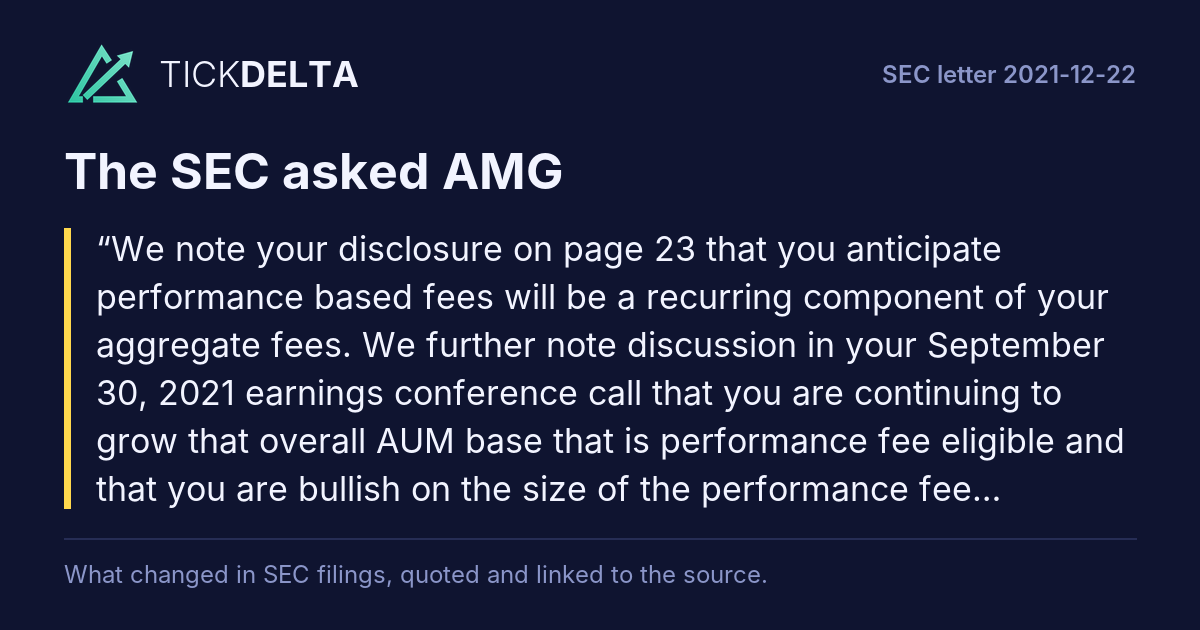
We note your disclosure on page 23 that you anticipate performance based fees will be a recurring component of your aggregate fees. We further note discussion in your September 30, 2021 earnings conference call that you are continuing to grow that overall AUM base that is performance fee eligible and that you are bullish on the size of the performance fee opportunity.
Rest of the question

In future filings, please separately quantify the AUM base that is performance fee eligible for consolidated affiliates and affiliates accounted for using the equity method, and discuss the impact of performance based fees on financial metrics and trends. Please provide us your proposed disclosure.

AMG answered
In future filings, in the Operating Performance Measures section of Management’s Discussion and Analysis (“MD&A”), we will expand (i) the Aggregate Fees discussion to separately quantify the AUM that could potentially earn performance-based fees for consolidated Affiliates and Affiliates accounted for under the equity method and (ii) the Assets Under Management section to discuss the impact of performance-based fees on financial metrics.

To illustrate how we intend to present the AUM base that is performance-based fee eligible in future filings, the following are excerpts from the Aggregate
Rest of the answer

Fees section of MD&A from our 2020 Form 10-K with textual changes marked to show the proposed changes, for your convenience.

The first paragraph of the Aggregate Fees discussion within the Operating Performance Measures section of MD&A on page 23 of our 2020 Form 10-K:

Aggregate fees consist of assetand performance-based fees of our consolidated and equity method Affiliates. Asset-based fees include advisory and other fees earned by our Affiliates for services provided to their clients and are typically determined as a percentage of the value of a client’s assets under management. Performance-based fees are based on investment performance, typically on an absolute basis or relative to a benchmark, and are generally recognized when it is improbable that there will be a significant reversal in the amount of revenue recognized. Performance-based fees are generally billed less frequently than asset-based fees, and although performance-based fees inherently depend on investment performance and will vary from period to period, we anticipate performance-based fees will be a recurring component of our aggregate fees. As of December 31, 2020, approximately 26% of our total assets under management could potentially earn performance-based fees. These percentages were approximately 13% and 43%, respectively, of our assets under management for our consolidated Affiliates and Affiliates accounted for under the equity method, respectively.

To illustrate how we intend to present the impact of performance-based fees on financial metrics in future filings, the following are excerpts from the Assets Under Management section of our MD&A with textual changes marked to show the proposed changes, for your convenience.

The first paragraph of the Assets Under Management discussion within the Operating Performance Measures section of MD&A on page 26 of our 2021 Form 10-Q:

Through our Affiliates, we provide a comprehensive and diverse range of return-oriented strategies designed to assist institutional, retail, and high net worth clients worldwide in achieving their investment objectives. We continue to see demand for return-oriented strategies, particularly in illiquid alternative and multi-asset and fixed income strategies where we have been experiencing net inflows, reflecting continued investor demand for returns that are less correlated to traditional equity markets. In addition, investor demand for passively-managed products, including exchange traded funds, has continued, and we have experienced outflows in certain equity strategies consistent with this industry-wide trend. However, we believe the best performing active equity managers (whether global-, regional-, or country-specific) will continue to have significant opportunities to grow as a result of performance and net client cash inflows. We believe we are well-positioned to benefit from these trends. In some cases, if product returns exceed certain performance thresholds, we will participate in performance-based fees; however, we do not anticipate these fees will be a significant component of our Consolidated revenue as these fees are predominantly earned by our Affiliates accounted for under the equity method.

As noted above and in our response to Comment 4, the performance-based fees we have earned through our consolidated Affiliates have not been material. We have earned material performance-based fees through our Affiliates accounted for under the equity method and, in future filings, we will continue to disclose the impact of such performance-based fees on financial metrics for the periods covered by our filing in a manner similar to our disclosure in the third paragraph of our Aggregate Fees discussion within the Operating Performance Measures section of our MD&A, the third paragraph of our Consolidated Revenue discussion within the Results of Operations section of our MD&A, and fifth and sixth paragraphs of our Equity Method Loss (net) discussion within the Results of Operations section of our MD&A, on pages 23, 24, and 26, respectively, of our 2020 Form 10-K.

The third paragraph of the Aggregate Fees discussion within the Operating Performance Measures section of MD&A on page 23 of our 2020 Form 10-K is reproduced below for reference:

Aggregate fees were $4,626.4 million in 2020, a decrease of $336.3 million or 7% as compared to 2019. The decrease in our aggregate fees was due to a $525.0 million or 11% decrease in assetbased fees, partially offset by a $188.7 million or 4% increase in performance-based fees. The decrease in asset-based fees was due to a decrease in our average assets under management, due to net client cash outflows principally in our quantitative strategies, and a change in the composition of our assets under management.

The third paragraph of Consolidated Revenue discussion within the Results of Operations section of MD&A on page 24 of our 2020 Form 10-K is reproduced below for reference:

Our Consolidated revenue decreased $212.1 million or 9% in 2020, due to a $191.2 million or 9% decrease in asset-based fees and a $20.9 million or less than 1% decrease in performance-based fees. The decrease in asset-based fees was due to a decrease in consolidated Affiliate average assets under management, due to net client cash outflows principally in our equity strategies, and a change in the composition of our assets under management.

The fifth and sixth paragraphs of Equity Method Loss (Net) discussion within the Results of Operations section of MD&A on page 26 of our 2020 Form 10-K is reproduced below for reference:

Our equity method revenue decreased $124.2 million or 5% in 2020, due to a $333.8 million or 13% decrease in asset-based fees, partially offset by a $209.6 million or 8% increase in performance-based fees. The decrease in asset-based fees was primarily due to a decrease in equity method Affiliate average assets under management, due to net client cash outflows principally in our quantitative strategies, and a change in the composition of our assets under management. These decreases were partially offset by the impact of new investments, which had higher asset-based fee ratios than our average asset-based fee ratio.

While equity method revenue decreased $124.2 million or 5% in 2020, equity method earnings decreased $0.8 million or less than 1%. Equity method earnings decreased less than equity method revenue on a percentage basis due to the recognition of performance-based fees at Affiliates in which we hold more of an economic interest, partially offset by a decline in earnings at certain Affiliates in which we share in revenue less agreed-upon expenses.

If in future periods we anticipate forecasted performance-based fees to be potentially material, we will also discuss that within our MD&A.

Read in the reply
In its next report

First report after the company's reply of Jan 21, 2022: 10-K filed Feb 18, 2022 ↗, against the 10-K filed Feb 19, 2021 ↗.

Tickdelta does not hold the text of both reports, so they are not compared here.
Assets Under Management, page 21
SEC asked (2)
In future filings, please disclose information to provide investors with a meaningful understanding of the performance of your investment strategies and the impact on AUM and revenue. Please discuss any relevant benchmarks and the performance against these benchmarks. Please provide us your proposed disclosure.
AMG answered
In future filings, we will disclose the performance of our investment strategies against the relevant benchmarks for the threeand five-year return periods (or, for illiquid strategies, recent vintages), which we believe are most relevant to how consultants, advisors, and end-clients evaluate our Affiliates’ products.
Rest of the answer

Such disclosure is consistent with information we currently provide in the Investor Relations section of our website.

We have expanded the Assets Under Management discussion in the Operating Performance Measures section of our MD&A from our 2021 Form 10-Q to illustrate how we intend to discuss the performance of our investment strategies against the relevant benchmarks.

Addition to Assets Under Management discussion within the Operating Performance Measures section of our MD&A beginning on page 26 of our 2021 Form 10-Q:

The following table presents performance of our investment strategies, where available, measured by the percentage of assets under management ahead of their relevant benchmark:

AUM Weight

% AUM Ahead of Benchmark(1)

3-year 5year

Liquid Alternatives(2)

16% 63% 60%

Global Equity(2)

37% 53% 58%

U.S. Equity(2)

15% 76% 67%

Multi-Asset and Fixed Income(3)

17% N/A N/A

IRR Latest Vintage IRR Last Three Vintages

Illiquid Alternatives(4)

15% 91% 89%

__________________________

(1)Past performance is not indicative of future results. Performance and AUM information is as of September 30, 2021 and is based on data available at the time of calculation. Product returns are sourced from Affiliates while benchmark returns are generally sourced via third-party subscriptions.

(2)For Liquid Alternative, Global Equity, and U.S. Equity products, performance is reported as a percentage of assets that have outperformed benchmarks across the indicated periods, and excludes market-hedging products and Multi-Asset & Fixed Income products. For purposes of investment performance comparisons, products are an aggregation of portfolios (separate accounts, investment funds, and other products) that each represent a particular investment objective, using the most representative portfolio for the performance comparison. Performance is presented for products with a threeor five-year track record and is measured on a consistent basis relative to the most appropriate benchmarks. Benchmark appropriateness is generally reviewed annually to reflect any changes in how underlying portfolios/mandates are managed. Both product and benchmark performance are reflected as total return and are annualized. Reported product performance is gross-of-fees for institutional and high-net-worth separate accounts, and generally net-of-fees across retail funds and other commingled vehicles such as hedge funds.

(3)Multi-Asset and Fixed Income products are mainly our wealth management and solutions offerings. These investment products are primarily customized toward wealth preservation, estate planning, liability and tax management, and therefore are typically not measured against a benchmark.

(4)For Illiquid Alternative products, performance is reported as a percentage of assets that have outperformed benchmarks on a since-inception internal rate of return basis. Benchmarks utilized include a combination of public market equivalents, peer medians, and absolute returns where benchmarks are not available. For purposes of investment performance comparisons, the latest vintage comparison includes the most recent vehicles and strategies (traditional long-duration investment funds, customized vehicles, and other evergreen vehicles and product structures) where meaningful performance is available and calculable. In order to illustrate the performance of our illiquid product category over a longer period of history, the last three vintages comparison incorporates the latest vintage vehicles and the prior two vintages for traditional long-duration investment funds, as well as additional vehicles and strategies launched during the equivalent time period as the last three vintages of traditional long duration investment funds. Due to the nature of these investments and vehicles, reported performance is typically on a threeto six-month lag basis.

In future filings, we will also disclose the impact of the performance of our investment strategies on AUM and Consolidated revenue. To illustrate how we intend to disclose this, the following is an excerpt from the Consolidated Revenue section of Results of Operations of our MD&A with textual changes marked to show the proposed changes, for your convenience.

The third paragraph of Consolidated Revenue discussion within the Results of Operations section of MD&A on page 30 of our 2021 Form 10-Q:

Our Consolidated revenue increased $247.4 million or 17% for the nine months ended September 30, 2021, due to a $239.0 million or 16% increase from asset-based fees and an $8.4 million or 1% increase from performance-based fees. The increase in asset-based fees was due to an increase in consolidated Affiliate average assets under management, primarily in global equity strategies and U.S. equity strategies driven by strong Affiliate investment performance and market appreciation. This increase was partially offset by a change in the composition of our assets under management.

Read in the reply
In its next report

First report after the company's reply of Jan 21, 2022: 10-K filed Feb 18, 2022 ↗, against the 10-K filed Feb 19, 2021 ↗.

Tickdelta does not hold the text of both reports, so they are not compared here.

Assets Under Management, page 21
SEC asked (3)
We note you include client commitments in your AUM roll forwards. In future filings, please clarify if your affiliates receive fees from client commitments. Please provide us your proposed disclosure.
AMG answered
In future filings, we will clarify that our Affiliates generally receive fees on client commitments.

We have expanded the Operating Performance Measures section of MD&A from our 2020 Form 10-K to illustrate how we intend to clarify that our Affiliates generally receive fees on client commitments, with textual changes marked for your convenience.

The first paragraph of Aggregate Fees discussion within the Operating Performance Measures section of MD&A on page 23 of our 2020 Form 10-K:

Aggregate fees consist of assetand performance-based fees of our consolidated and equity method Affiliates.
Rest of the answer

Asset-based fees include advisory and other fees earned by our Affiliates for services provided to their clients and are typically determined as a percentage of the value of a client’s assets under management, generally inclusive of uncalled commitments. Performance-based fees are based on investment performance, typically on an absolute basis or relative to a benchmark, and are generally recognized when it is improbable that there will be a significant reversal in the amount of revenue recognized. Performance-based fees are generally billed less frequently than asset-based fees, and although performance-based fees inherently depend on investment performance and will vary from period to period, we anticipate performance-based fees will be a recurring component of our aggregate fees.

Read in the reply
In its next report

First report after the company's reply of Jan 21, 2022: 10-K filed Feb 18, 2022 ↗, against the 10-K filed Feb 19, 2021 ↗.

Tickdelta does not hold the text of both reports, so they are not compared here.

Results of Operations - Consolidated Revenue, page 24
SEC asked (4)
In future filings, please quantify the amount of revenue related to asset based fees, performance based fees and any other significant revenue activity. Please provide us your proposed disclosure. Additionally, please tell us how you considered whether to present disaggregated revenue in the notes to your financial statements in accordance with ASC 606-10-50-5.
AMG answered
Historically, we have not presented disaggregated revenue in accordance with ASC 606-10-50-5 because performance-based fees and other revenues have not been significant. Advisory fees typically represent approximately 95% of our Consolidated revenue. Performance-based fees are not a significant component of our Consolidated revenue, typically representing approximately 1% – 2% of our Consolidated revenue.
Rest of the answer

The remainder of our Consolidated revenue relates to a variety of services, typically administrativeand distribution-related in nature, which are also not significant.

In future filings, if performance-based fees or other fees represent a significant portion of our Consolidated revenue, we will separately report the amount of revenue related to each.

Read in the reply
In its next report

First report after the company's reply of Jan 21, 2022: 10-K filed Feb 18, 2022 ↗, against the 10-K filed Feb 19, 2021 ↗.

Tickdelta does not hold the text of both reports, so they are not compared here.

Equity Method Loss (Net), page 25
SEC asked (5)
Noting material amounts of equity method intangible amortization and equity method impairments, please revise your financial performance measures table in future filings to separately present these amounts. Please provide us your proposed disclosure. Note 1. Business and Summary of Significant Accounting Policies - (m) Revenue Recognition,
AMG answered
In future filings, we will separately present material amounts of equity method intangible amortization and equity method impairments in our financial performance measures table.

We have expanded the Results of Operations section of MD&A from our 2020 Form 10-K, to illustrate how we intend to present the financial performance measures table, with textual changes marked for your convenience.

Table of equity method Affiliate operating and financial performance measures within the Equity Method Loss (Net) section of MD&A on the top of page 26 of our 2020 Form 10-K:

For the Years Ended
Rest of the answer

December 31,

(in millions, except as noted) 2018 2019 % Change 2020 % Change

Operating Performance Measures

Equity method Affiliate average assets under management (in billions) $ 400.3 $ 363.0 (9) % $ 301.8 (17) %

Equity method revenue $ 3,064.0 $ 2,723.1 (11) % $ 2,598.9 (5) %

Financial Performance Measures

Equity method earnings $ 370.6 $ 289.4 (22) % $ 288.6 0 %

Equity method intangible amortization and impairments (370.8) (627.4) 69 % (332.0) (47) %

Equity method intangible amortization (97.5) (140.1) 44 % (147.0) 5 %

Equity method intangible impairments (273.3) (487.3) 78 % (185.0) (62) %

Equity method loss (net) $ (0.2) $ (338.0)

N.M.(1)

$ (43.4) (87) %

(1)Percentage change is not meaningful.

Read in the reply
In its next report

First report after the company's reply of Jan 21, 2022: 10-K filed Feb 18, 2022 ↗, against the 10-K filed Feb 19, 2021 ↗.

Tickdelta does not hold the text of both reports, so they are not compared here.

Equity Method Loss (Net), page 25
SEC asked (6)
We note your disclosure on page 7 that in the ordinary course of business, your Affiliates may reduce or waive fees on certain products for particular time periods, to attract or retain assets or for other reasons.
Rest of the question

In future filings, please quantify these amounts, if material, more clearly describe how these amounts impact the contractual revenue or income attributed to you, and disclose your accounting policies (e.g. gross vs. net) for these amounts. Please provide us your proposed disclosure.

AMG answered
As described in our 2020 Form 10-K, our financial results depend on our Affiliates’ receipt of assetand performance-based fees, and are impacted, among other factors, by changes in fee levels. Our Affiliates’ ability to maintain current fee levels depends on a number of factors, including competition and trends in the asset management industry. As noted in the Staff’s comment, and as disclosed in Item 1A. Risk Factors on page 7 of our 2020 Form 10-K, in the ordinary course of business, our Affiliates may reduce or waive fees on certain products or for certain clients.
Rest of the answer

Our Affiliates predominantly offer active return-oriented strategies, which are offered under investment management contracts that in certain cases have negotiable fee structures and, as is common in the industry, certain products or clients may receive fee concessions for particular time periods, to attract or retain client assets or for other reasons. These concessions, as described in the Risk Factors, are distinct from waivers at registered mutual funds, and instead occur as upfront negotiated reductions from the fee rates offered initially or relative to other clients, an Affiliate agreeing to forego revenue from a specific client account or fund where the right to collect is retained, or another form of a concession resulting in a reduction in overall fees. Where fee reductions occur, regardless of how they are structured, they reduce our Consolidated revenue (i.e., they are presented net).

The disclosure referenced in the Staff’s comment is included in a risk factor, describing the range of factors that could impact the level of assetand performance-based fees received by our Affiliates, which we believe is appropriate as it is possible that in future periods reductions in fees, regardless of their cause or how they are structured, could have a material impact on our financial performance. Our Affiliates manage over 500 products incorporating over 10,000 client accounts, and as a result, we do not quantify all of the different reasons or structures used by our Affiliates to retain or attract clients with reduced fees. We can confirm that fee waivers, defined as foregoing the contractual right to revenue, have not been material. For example, in 2018, 2019, and 2020, consolidated Affiliate fee waivers were less than 1% of Consolidated revenue. Further, we monitor overall changes in fee ratios on our assets under management, and if reductions in fee rates, regardless of structure or source, are material to our financial results, we include a description in MD&A explaining where changes in the composition of assets across our strategies that realize different asset-based fee ratios has impacted our Consolidated revenue and Net income and will continue to do so in future filings.

In future filings, we will update our Significant Accounting Policies to make it clearer that waivers and reductions in fees are presented on a net basis. We have included below the portion of the Significant Accounting Policies section of the Notes to our Consolidated Financial Statements from our 2020 Form 10-K to illustrate this proposed disclosure, with textual changes marked for your convenience. For ease of reference, we have identified the location of the disclosure by reference to our 2020 Form 10-K.

The first paragraph of Note 1. Business and Summary of Significant Accounting Policies (m) Revenue Recognition beginning on the bottom of page 49 of our 2020 Form 10-K:

Consolidated revenue primarily represents assetand performance-based fees earned by the Company and its Affiliates for managing the assets of clients. Substantially all of the Company’s and its Affiliates’ contracts contain a single performance obligation, which is the provision of investment management services. Investment management, broker-dealer, and administrative services are performed and consumed simultaneously and, therefore, the Company recognizes these asset-based fees ratably over time. Substantially all the Company’s asset-based fees for services are based on the value of client assets over time, which are typically determined using observable market data. Services may be invoiced in advance or in arrears and are payable upon receipt. Any asset-based fees collected in advance are deferred and recognized as the services are performed and consumed. Consolidated revenue recognized by the Company is adjusted for any expense reimbursement arrangements. The Company’s Affiliates may periodically either waive or reduce fees in order to attract or retain client assets or for other reasons. Fee waivers or reductions are presented as a reduction to Consolidated revenue.

Read in the reply
In its next report

First report after the company's reply of Jan 21, 2022: 10-K filed Feb 18, 2022 ↗, against the 10-K filed Feb 19, 2021 ↗.

Tickdelta does not hold the text of both reports, so they are not compared here.

Equity Method Loss (Net), page 25
SEC asked (7)
We note your disclosure on page 11 that you may elect to defer or forgo the receipt of your share of an Affiliate’s revenue or earnings, or to adjust any expenses allocated to you, to permit the Affiliate to fund expenses in light of unanticipated changes in revenue or operating expenses, with the aim of maximizing the long-term benefits.
Rest of the question

In future filings, please quantify these amounts, if material, and disclose your accounting policies for these amounts. Please provide us your proposed disclosure.

AMG answered
As described in our 2020 Form 10-K, each of our Affiliates operates under an agreement that reflects our customized arrangements with respect to governance, economic participation, equity incentives, and the other terms of our relationship. The terms of our economic participation in the Affiliate, in each case, uses a structured partnership interest to ensure alignment of our economic interests with those of Affiliate management.

The referenced disclosure on page 11 of our 2020 Form 10-K is included in a risk factor describing the potential risks associated with changes that we may elect to
Rest of the answer

make to the terms of our structured partnership interests with a specific Affiliate. In certain situations or economic environments, our structured partnership interests at a particular Affiliate may not leave sufficient economics for the Affiliate to fund operating expenses at desired levels. In these situations, we may choose to reduce our contractual share of earnings in order to fund those expenses with a goal of maximizing the long-term benefits for us and the Affiliate.

When we take these discretionary actions, our contractual share of the Affiliate’s earnings is reduced, which ultimately reduces Net income (controlling interest) by the after-tax amount of the expense we are funding. These situations have occurred, from time to time, but have not been significant. For example, the aggregate impact of these reduced earnings in 2018, 2019, and 2020 was, in each case, less than 1% when measured against our contractual share of earnings.

There is a risk that these types of activities may increase in size during future periods if our Affiliates’ revenues decline rapidly. While we believe it remains appropriate to highlight this potential risk to investors, we do not believe that the current activity warrants separate disclosure. In future filings, if these activities are material, we will disclose and quantify their impact.

Read in the reply
In its next report

First report after the company's reply of Jan 21, 2022: 10-K filed Feb 18, 2022 ↗, against the 10-K filed Feb 19, 2021 ↗.

Tickdelta does not hold the text of both reports, so they are not compared here.

Equity Method Loss (Net), page 25
SEC asked (8)
We note your disclosure on page 50 that consolidated revenue is adjusted for any expense reimbursement arrangements. In future filings, please quantify these amounts, if material, and tell us how you considered whether these amounts should be presented on a gross basis citing appropriating accounting guidance that supports your net presentation. Please provide us your proposed disclosure.
AMG answered
Historically, expense reimbursements have not been material at our consolidated Affiliates. For example, in each of 2018, 2019, and 2020, expense reimbursements were less than 1% of Consolidated revenue. These expenses are presented net within Consolidated revenue as these expense reimbursements are components of the transaction price in accordance with ASC 606-10-32 (i.e., the amount the Affiliate expects to be entitled to associated with its management contracts).

In future filings, if expense reimbursements are material to Consolidated revenue, we will quantify and discuss these amounts
Rest of the answer

within the Notes to our Consolidated Financial Statements.

Read in the reply
In its next report

First report after the company's reply of Jan 21, 2022: 10-K filed Feb 18, 2022 ↗, against the 10-K filed Feb 19, 2021 ↗.

Tickdelta does not hold the text of both reports, so they are not compared here.

Note 10. Equity Method Investments in Affiliates, page 59
SEC asked (9)
In future filings, please disclose the name of each investee and percentage of ownership of common stock. Refer to ASC 323-50-3.a.1 for guidance. Please provide us your proposed disclosure.
AMG answered
In future filings, we will expand our disclosure to further explain the structure of our ownership interests in our equity method Affiliates. However, we do not believe that the disclosure of the name of each Affiliate accounted for under the equity method and the percentage of common equity ownership in each Affiliate is information that would be useful to investors for two primary reasons: First, the structured partnership interests we own in our Affiliates cannot be determined and disclosed in a manner prescribed by the accounting standard.
Rest of the answer

Second, none of our Affiliates accounted for under the equity method is a significant contributor to our pre-tax income.

We currently have investments in 41 independent investment management firms, which we refer to as Affiliates. Of these Affiliates, 21 are accounted for under the equity method, all of which are private companies that are not required to publicly disclose information on the profitability of their businesses.

Each of our Affiliates operates under an agreement that reflects our customized arrangements with respect to governance, economic participation, and the other terms of our relationship. The majority of these Affiliates are partnerships with structured interests that define how the Company will participate in Affiliate earnings, typically based upon a fixed percentage of revenue reduced by, in some cases, certain agreed-upon expenses. These partnership agreements do not define our ownership of the equity of the business in the event of a sale or liquidation, as we enter into relationships with our Affiliates with an intention to be permanent or long-term partners. Were an Affiliate to enter a sale or liquidation process, we would engage in a negotiation over our ownership percentage at that time, and that outcome may vary over time depending on the size and profitability of the business, as well as, other factors. We do not believe that our contractually structured economic sharing arrangements with our Affiliates are reflective of equity ownership in a way that is similar to common stock as contemplated in ASC 323-50-3.a.1. Further, translating our contractual right to earnings into a specific equity ownership percentage of the relevant Affiliate would require a number of assumptions and estimates, and is unlikely to depict an accurate representation of our rights to an Affiliate’s equity over time (or at all), or conform to the accounting standard.

Further, on an individual basis, none of our Affiliates accounted for under the equity method are currently a significant contributor to our pre-tax net income. We disclose aggregate information about these Affiliates in our financial statements, as required, under Rule 4-08(g). In cases where an Affiliate, or a group of Affiliates, is deemed to be significant under Rule 3-09, we will provide the required additional disclosure for any such Affiliates, although currently none of our equity method Affiliates are significant under those rules.

For these reasons, we do not believe that disclosure of an estimated percentage of our equity ownership in each of our equity method Affiliates would be useful information for investors, and believe that any estimated equity percentages are unlikely to accurately reflect our economic interest and could be confusing and, in some cases, misleading to investors.

In future filings, we will describe why these percentages are not disclosed. We have included expanded disclosure below to our Equity Method Investments in Affiliates note from our 2020 Form 10-K, illustrating this proposed disclosure. For ease of reference, we have identified the location of the disclosure by reference to our 2020 Form 10-K.

Addition to Note 10. Equity Method Investments in Affiliates beginning on page 59 of our 2020 Form 10-K:

The Company had 16 and 18 Affiliates accounted for under the equity method in 2019 and 2020, respectively. The majority of these Affiliates are partnerships with structured interests that define how the Company will participate in Affiliate earnings, typically based upon a fixed percentage of revenue reduced by, in some cases, certain agreed-upon expenses. The partnership agreements do not define a fixed percentage for the Company’s ownership of the equity of the Affiliate. These percentages would be subject to a separate future negotiation if an Affiliate were to be sold or liquidated.

Read in the reply
In its next report

First report after the company's reply of Jan 21, 2022: 10-K filed Feb 18, 2022 ↗, against the 10-K filed Feb 19, 2021 ↗.

Tickdelta does not hold the text of both reports, so they are not compared here.

Note 10. Equity Method Investments in Affiliates, page 59
SEC asked (10)
We note that the carrying amount of equity method investments in affiliates was $2,074.8 million at December 31, 2020 and the Company’s share of undistributed earnings from equity method investments was $170.6 million at December 31, 2020. In future filings, please quantify each material item which creates the difference. Please provide us your
AMG answered
The difference between the carrying amount of Equity method investments in Affiliates and our share of undistributed earnings from equity method investments is primarily attributable to acquired intangible assets and goodwill. In future filings, in addition to undistributed earnings from equity method investments in Affiliates, we will also disclose the balances of our definite-lived acquired client relationships, indefinite-lived acquired client relationships, and goodwill attributable to our Equity method investments in Affiliates.

We have included below a portion of the Equity method
Rest of the answer

investments in Affiliates note to the Consolidated Financial Statements from our 2020 Form 10-K, to illustrate how we will present the composition of our Equity method investments in Affiliates (net), with textual changes marked for your convenience.

Addition of table to Note 10. Equity Method Investments in Affiliates on the top of page 61 of our 2020 Form 10-K:

Equity method investments in Affiliates (net) consisted of the following:

December 31,

Read in the reply
In its next report

First report after the company's reply of Jan 21, 2022: 10-K filed Feb 18, 2022 ↗, against the 10-K filed Feb 19, 2021 ↗.

Tickdelta does not hold the text of both reports, so they are not compared here.

September 30, 2021 Form 10-Q · Note 4. Other Investments, page 9
SEC asked (11)
We note your disclosure that you account for the majority of your interests in private equity funds under the equity method of accounting. We also note disclosure on page 12 that you may consolidate affiliate sponsored investment products if your interests are considered substantial.
Rest of the question

In future filings, please separately quantify investments accounted for under the equity method and those accounted for using other accounting methods. Please clearly describe the relevance of NAV in your accounting for each. Please ensure your disclosure here and in MD&A clearly provides investors the information necessary to understand the activity and investments driving the recognition of the material amounts of investment and other income. Please provide us your proposed disclosure.

AMG answered
You will note, in our response to Comment 12, that our Affiliates are generally required to consolidate Undertakings for the Collective Investment of Transferable Securities (“UCITS”) for a short period of time. None of our private equity funds are consolidated and all are accounted for under the equity method.

In future filings we will separately quantify Other investments accounted for under the equity method, where we measure fair value using NAV of these investments as a practical expedient, and investments without readily determinable fair values.
Rest of the answer

We will also describe the relevance of NAV.

We have included below the Other investments note to the Consolidated Financial Statements from our 2021 Form 10-Q, to illustrate how we intend to separately present Other investments accounted under different methods, and we have also described the relevance of NAV in accounting for each, with textual changes marked for your convenience. For illustrative purposes, the table below that presents the changes in Other investments includes activity for the nine months ended September 30, 2021. Future filings will include comparative disclosures.

Additions to Note 4. Other Investments on page 9 of our 2021 Form 10-Q:

4.Other Investments

Other investments consist of investments in funds advised by the Company’s Affiliates that are carried at net asset value (“NAV”) as a practical expedient and investments without readily determinable fair values. The income or loss related to these investments is recorded in Investment and other income on the Consolidated Statements of Income.

Investments Measured at NAV as a Practical Expedient

The Company’s Affiliates sponsor investment products in which the Company and its consolidated Affiliates may make general partner and seed capital investments. The Company accounts for its interests in these investments using the equity method of accounting and uses the NAV of these investments as a practical expedient for their fair values. The following table summarizes the fair value of these investments and any related unfunded commitments:

December 31, 2020 September 30, 2021

Category of Investment Fair Value Unfunded

Commitments Fair Value Unfunded

Commitments

Private equity funds(1)

$ 235.4 $ 122.2 $ 307.0 $ 114.1

Investments in other strategies(2)

8.0 — 16.6 —

Total(3)

$ 243.4 $ 122.2 $ 323.6 $ 114.1

(1)The Company accounts for the majority of its interests in private equity funds under the equity method of accounting and uses NAV as a practical expedient, one quarter in arrears (adjusted for current period calls and distributions), to determine the fair value. These funds primarily invest in a broad range of third-party funds and direct investments. Distributions will be received as the underlying assets are liquidated over the life of the funds, which is generally up to 15 years.

(2)These are multi-disciplinary funds that invest across various asset classes and strategies, including equity, credit, and real estate. Investments are generally redeemable on a daily, monthly, or quarterly basis.

(3)Fair value attributable to the controlling interest was $164.4 million and $217.7 million as of December 31, 2020 and September 30, 2021, respectively.

The following table presents the changes in Other investments:

Measured at NAV as Practical Expedient Without Readily Determinable Fair Values Total

Balance, as of December 31, 2020 $ 243.4 $ 13.8 $ 257.2

Net realized and unrealized gains(1)

68.2 19.7 87.9

Purchases and commitments 44.6 — 44.6

Sales and distributions (32.6) — (32.6)

Balance, as of September 30, 2021 $ 323.6 $ 33.5 $ 357.1

(1)Recognized in Investment and other income in the Consolidated Statements of Income

Investments Without Readily Determinable Fair Values

The Company accounts for its investments without readily determinable fair values using the alternative measurement approach allowable in accordance with ASC 321-10-35-2. The following table summarizes the cost, cumulative upward adjustments, and carrying amount of investments without readily determinable fair values:

2020 September 30,

2021

Cost $ 8.5 $ 8.5

Cumulative upward adjustments 5.3 25.0

Carrying amount $ 13.8 $ 33.5

During the three and nine months ended September 30, 2021, the Company recorded an upward adjustment of $19.7 million based on an observable price change in the underlying investment.

Read in the reply
In its next report

First report after the company's reply of Jan 21, 2022: 10-K filed Feb 18, 2022 ↗, against the 10-K filed Feb 19, 2021 ↗.

Tickdelta does not hold the text of both reports, so they are not compared here.

September 30, 2021 Form 10-Q · Note 4. Other Investments, page 9
SEC asked (12)
Please tell us the accounting guidance that supports your accounting policy to consolidate affiliate sponsored investment products if your interests are considered substantial. In closing, we remind you that the company and its management are responsible for the accuracy and adequacy of their disclosures, notwithstanding any review, comments, action or absence of action by the staff.
AMG answered
Affiliate sponsored investment products consist of various types of investment funds including, but not limited to, mutual funds under the Investment Company Act of 1940 (“’40 Act” and “’40 Act Funds”), hedge funds, private equity funds, UCITS and other foreign-domiciled series funds, and alternative investment funds. Such investment funds may be structured as a variety of legal entities including limited partnerships, LLCs, or utilize various trust structures.
Rest of the answer

The consolidation conclusions reached will depend on the specific facts and circumstance of the Affiliate’s involvement with the investment product, as well as the investment product’s characteristics.

While there are a variety of investment products and structures that our consolidated Affiliates may need to consolidate, the most common product that we are required to consolidate are UCITS that are seeded with capital from our consolidated Affiliates. These products are determined to be variable interest entities (“VIEs”) under ASC 810-10-15-14(b)(i) and are evaluated for consolidation under the primary beneficiary test. The primary beneficiary is defined as the party who has both characteristics of a controlling financial interest, the power to direct the activities of a VIE that most significantly impact the VIE’s economic performance (the “Power Criterion”), and the obligation to absorb losses or right to receive returns of the VIE that could potentially be significant to the VIE (the “Economic Criterion”). We most often need to consolidate UCITS because our consolidated Affiliate, as the investment manager, has the power to direct the activities of the investment product and our Affiliate has an exposure to the economics of the VIE that is more than insignificant, though generally only for a short period while the product is established and has yet to attract significant other investors. When determining if a consolidated Affiliate absorbs more than an insignificant amount of variability, we have generally interpreted “significant” as greater than 10% of the total NAV of the fund. We believe that this interpretation is consistent with industry practice. We disclose our policy to consolidate Affiliate sponsored investment products in the sub-section Affiliate Sponsored Investment Products of section (c) Principles of Consolidation of Note 1. Business and Summary of Significant Accounting Policies on page 46 of our 2020 Form 10-K and in the sub-section Affiliate Sponsored Investment Products of Note 6. Investments in Affiliates and Affiliate Sponsored Investment Products beginning on page 12 of our 2021 Form 10-Q.

We have not separately disclosed the assets, liabilities, and redeemable non-controlling interests of these consolidated products because they are consolidated for a relatively short period of time and we do not view this disclosure as material to investors.

***********

If you should have any questions about this letter or require any further information, please call me at (617) 747-3305.

Read in the reply
In its next report

First report after the company's reply of Jan 21, 2022: 10-K filed Feb 18, 2022 ↗, against the 10-K filed Feb 19, 2021 ↗.

Tickdelta does not hold the text of both reports, so they are not compared here.

September 30, 2021 Form 10-Q · Note 4. Other Investments, page 9
SEC asked (1)
Please refer to comment 11. For interests in private equity funds accounted for using the equity method of accounting, please tell us the guidance in ASC 323 that supports measuring the interest at fair value and using the NAV as a practical expedient. Please tell us how your disclosure and accounting policies are consistent with the guidance in ASC 323-10-35.
AMG answered
We and our consolidated Affiliates make certain investments, typically as the general partner, in private equity funds managed by our consolidated Affiliates. These funds generally operate in partnership form and are assessed for consolidation. In situations where the investors of these funds have sufficient rights to remove the general partner, or where the investment is not significant, these funds are not consolidated and are accounted for under the equity method in accordance with ASC 970-323-25-6.
Rest of the answer

These funds qualify as investment companies under ASC 946, and, under ASC 323-10-25-7, we are required to retain the specialized accounting applied by an investment company. Because the funds’ investments do not have readily determinable fair values, these funds qualify for the practical expedient to determine the fair value using NAV.

Read in the reply
In its next report

First report after the company's reply of Feb 8, 2022: 10-K filed Feb 18, 2022 ↗, against the 10-K filed Feb 19, 2021 ↗.

Tickdelta does not hold the text of both reports, so they are not compared here.

September 30, 2021 Form 10-Q · Note 4. Other Investments, page 9
SEC asked (2)
Please refer to comment 11. Please clarify for us how you considered whether investments accounted for under ASC 321-10-35-2 were in the scope of ASC 323. If they were, please tell us how you determined your accounting policies were consistent with the guidance in ASC 323.
AMG answered
Our investment accounted for under ASC 321-10-35-2 is in a corporation in which we do not have a sufficient level of ownership (or rights disproportionate to our ownership level) to exercise significant influence and, therefore, cannot apply ASC 323. With respect to Comments 1 and 2, in future filings we will enhance our Other Investments note to more clearly describe why these accounting treatments apply.

We have included below the Other Investments note to the Consolidated Financial Statements from our 2021 Form 10-Q, to illustrate how we intend to describe how the accounting treatment
Rest of the answer

under ASC 321-10-35-2 applies and separately present Other investments accounted under different methods, and we have also described the relevance of NAV in accounting for each, with textual changes marked for your convenience. For illustrative purposes, the table below that presents the changes in Other Investments includes activity for the nine months ended September 30, 2021. Future filings will include comparative disclosures.

Additions to Note 4. Other Investments on page 9 of our 2021 Form 10-Q:

4.Other Investments

Other investments consist of investments in funds advised by the Company’s Affiliates that are carried at net asset value (“NAV”) as a practical expedient and other investments without readily determinable fair values. The income or loss related to these investments is recorded in Investment and other income on the Consolidated Statements of Income.

Investments Measured at NAV as a Practical Expedient

The Company’s Affiliates sponsor fundsinvestment products in which the Company and its consolidated Affiliates may make general partner and seed capital investments. These funds operate in partnership form and apply the specialized fair value accounting for investment companies. The Company accounts for its interests in these funds using the equity method of accounting and is required to retain the specialized accounting of the investment companies. Because the funds’ investments do not have readily determinable fair values, the Company uses the NAV of these investments as a practical expedient for their fair values. The following table summarizes the fair value of these investments and any related unfunded commitments:

December 31, 2020 September 30, 2021

Category of Investment Fair Value Unfunded

Commitments Fair Value Unfunded

Commitments

Private equity funds(1)

$ 235.4 $ 122.2 $ 307.0 $ 114.1

Investments in other strategies(2)

8.0 — 16.6 —

Total(3)

$ 243.4 $ 122.2 $ 323.6 $ 114.1

__________________________

(1)The Company accounts for the majority of its interests in private equity funds under the equity method of accounting and uses NAV as a practical expedient, one quarter in arrears (adjusted for current period calls and distributions), to determine the fair value. These funds primarily invest in a broad range of third-party funds and direct investments. Distributions will be received as the underlying assets are liquidated over the life of the funds, which is generally up to 15 years.

(2)These are multi-disciplinary funds that invest across various asset classes and strategies, including equity, credit, and real estate. Investments are generally redeemable on a daily, monthly, or quarterly basis.

(3)Fair value attributable to the controlling interest was $164.4 million and $217.7 million as of December 31, 2020 and September 30, 2021, respectively.

Investments Without Readily Determinable Fair Values

The Company made an investment in a private corporation where it does not exercise significant influence. Because this investment does not have a readily determinable fair value, the Company has elected to measure this investment at its cost minus impairments, if any, plus or minus changes resulting from observable price changes in orderly transactions for identical or similar investments in the private corporation. The following table summarizes the cost, cumulative unrealized gainsupward adjustments, and carrying amount of investments without readily determinable fair values:

December 31,

2020 September 30,

2021

Cost $ 8.5 $ 8.5

Cumulative unrealized gainsupward adjustments

5.3 25.0

Carrying amount $ 13.8 $ 33.5

During the three and nine months ended September 30, 2021, the Company recorded an unrealized gainupward adjustment of $19.7 million based on an observable price change in the underlying investment.

The following table presents the changes in Other investments:

Measured at NAV as Practical Expedient Without Readily Determinable Fair Values Total

Balance, as of December 31, 2020 $ 243.4 $ 13.8 $ 257.2

Net realized and unrealized gains(1)

68.2 19.7 87.9

Purchases and commitments 44.6 — 44.6

Sales and distributions (32.6) — (32.6)

Balance, as of September 30, 2021 $ 323.6 $ 33.5 $ 357.1

(1)Recognized in Investment and other income in the Consolidated Statements of Income

Read in the reply
In its next report

First report after the company's reply of Feb 8, 2022: 10-K filed Feb 18, 2022 ↗, against the 10-K filed Feb 19, 2021 ↗.

Tickdelta does not hold the text of both reports, so they are not compared here.

September 30, 2021 Form 10-Q · Note 4. Other Investments, page 9
SEC asked (3)
Please refer to comment 12. Please tell us why you believe your disclosure that you consolidate affiliate sponsored investment products if your interests are considered substantial is consistent with the accounting determinations discussed in your response and as disclosed on page 11.
Rest of the question

Alternatively, revise your disclosure in future filings to clarify your consolidation policies for affiliate sponsored investment products.

AMG answered
We disclose that we generally do not consolidate our Affiliate sponsored investment products unless our or our consolidated Affiliates’ interests in these products are considered substantial. Our use of the term substantial was intended to be synonymous with the term significant (i.e., greater than 10%) used earlier in our disclosures on page 11 of our 2021 Form 10-Q and in our prior response. In future filings, we will clarify this policy.

We have expanded the sub-section Affiliate Sponsored Investment Products of Note 6.
Rest of the answer

Investments in Affiliates and Affiliate Sponsored Investment Products beginning on page 11 of our 2021 Form 10-Q to illustrate how we intend to clarify this policy, with textual changes marked for your convenience.

The second paragraph of the sub-section Affiliate Sponsored Investment Products of Note 6. Investments in Affiliates and Affiliate Sponsored Investment Products beginning on page 11 of our 2021 Form 10-Q

Third-party investors in Affiliate sponsored investment products are generally entitled to substantially all of the economics of these products, except for the assetand performance-based fees earned by the Company’s Affiliates or any gains or losses attributable to the Company’s or its Affiliates’ investments in these products. As a result, the Company generally does not consolidate these products unless the Company’s or its consolidated Affiliate’s interest in the product is considered substantial. However, for certain products, the Company’s consolidated Affiliates, as the investment manager, have the power to direct the activities of the investment product and have an exposure to the economics of the VIE that is more than insignificant, though generally only for a short period while the product is established and has yet to attract significant other investors. When the Company’s or its consolidated Affiliates’ interests are considered substantial and the products are consolidated, the Company retains the specialized investment company accounting principles of the underlying products, and all of the underlying investments are carried at fair value in Investments in marketable securities in the Consolidated Balance Sheets, with corresponding changes in the investments’ fair values included in Investment and other income. Purchases and sales of securities are presented within purchases and sales by consolidated Affiliate sponsored investment products in the Consolidated Statements of Cash Flows, respectively, and the third-party investors’ interests are recorded in Redeemable non-controlling interests. When the Company or its consolidated Affiliates no longer control these products, due to a reduction in ownership or other reasons, the products are deconsolidated with only the Company’s or its consolidated Affiliate’s investment in the product reported from the date of deconsolidation.

***********

If you should have any questions about this letter or require any further information, please call me at (617) 747-3305.

Read in the reply
In its next report

First report after the company's reply of Feb 8, 2022: 10-K filed Feb 18, 2022 ↗, against the 10-K filed Feb 19, 2021 ↗.

Tickdelta does not hold the text of both reports, so they are not compared here.

Also in this review: closing letter, 2022-02-09
Form 10-K for the Fiscal Year Ended December 31, 2018

2019-04-03 to 2019-04-15 · 1 question · 1 letter from the SEC, 1 from the company
Review closed 2019-04-15
China
Notes to Consolidated Financial Statements · Note 4 - Investments in Affiliates and Affiliate Sponsored Investment Products, page 55
SEC asked
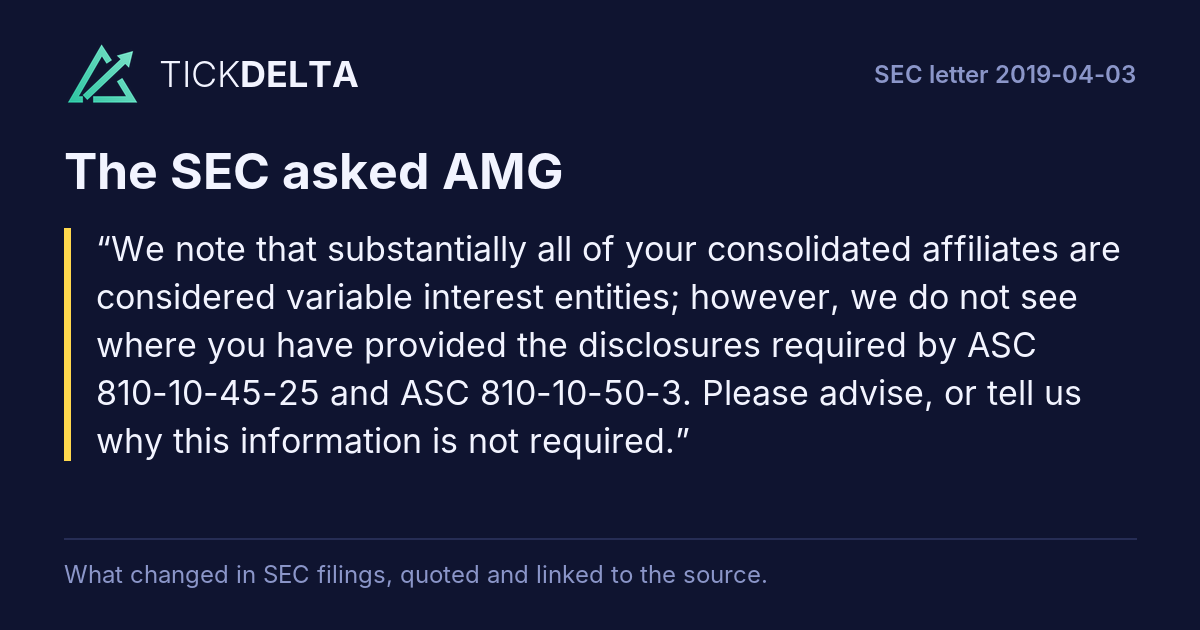
We note that substantially all of your consolidated affiliates are considered variable interest entities; however, we do not see where you have provided the disclosures required by ASC 810-10-45-25 and ASC 810-10-50-3. Please advise, or tell us why this information is not required.
AMG answered
Substantially all the Company's consolidated Affiliates that are considered variable interest entities ("VIEs") meet all of the criteria described in the last paragraph of ASC 810-10-50-3. Therefore, the Company determined that it is not required to make the disclosures in ASC 810-10-50-3 (bb) through (d). The last paragraph of ASC 810-10-50-3 states that “a VIE may issue voting equity interests, and the entity that holds a majority voting interest also may be the primary beneficiary of the VIE.
Rest of the answer

If so, and if the VIE meets the definition of a business and the VIE's assets can be used for purposes other than the settlement of the VIE's obligations, the disclosures in paragraph 810-10-50-3(bb) through (d) are not required.”

All of the Company’s consolidated Affiliates meet the definition of a business as defined in ASC 805-10-55-3A, the Company controls each of its consolidated Affiliates either because it holds a majority of the voting interests or is the manager member or general partner of the Affiliate and, because the Company controls each of its consolidated Affiliates, its Affiliates’ assets can be used for purposes other than the settlement of an Affiliate’s obligations.

For the same reasons, the Company has determined that the disclosures required by ASC 810-10-45-25 are not applicable.

In future filings, the Company will update its description of consolidated Affiliates that are considered VIEs to make it clear that it controls these Affiliates either because it holds a majority of the voting interest or it is the manager member or general partner of the Affiliate.

***********

If you should have any questions about this letter or require any further information, please call me at (617) 747-3303.

Read in the reply
In its next report

First report after the company's reply of Apr 12, 2019: 10-Q filed May 9, 2019 ↗, against the 10-Q filed Nov 1, 2018 ↗.

Tickdelta does not hold the text of both reports, so they are not compared here.

Also in this review: closing letter, 2019-04-15

Form 10-K

2017-06-07 to 2018-01-09 · 7 questions · 1 letter from the SEC, 2 from the company
Review closed 2018-01-09
RevenueResults discussion (MD&A)Critical estimatesGoodwill and impairment
Aggregate Revenue, page 21
SEC asked (1)
We note that you present a discussion and analysis of aggregate revenues which includes the revenue from consolidated affiliates as well as equity method revenue. Although we do not object to your presentation and discussion of equity method revenue as you have done throughout your MD&A (e.g. pages 19, 26, and 27), the aggregation of your U.S.
Rest of the question

GAAP revenues and revenues generated from your equity method affiliates (which is reported as a component of income from equity method investments outside of operating income) is confusing and could be viewed as misleading. Please revise to remove all references to this measure from your future filings (including future earnings releases and earnings calls).

AMG answered
As noted in your comment, we introduced two new operating measures in our 2016 Form 10-K. The first was equity method revenue, which consists of asset based and performance fees earned by our Affiliates accounted for under the equity method. The second was aggregate revenue, which combines the revenue of our consolidated Affiliates (“U.S. GAAP revenue”) with equity method revenue.

We acknowledge your comment that combining equity method revenue with U.S. GAAP revenue to determine aggregate revenue, a key operating measure, could be confusing and misleading.
Rest of the answer

The results of our Affiliates accounted for under the equity method are reported outside of Operating income in Income from equity method investments on our Consolidated Statements of Income. Our U.S. GAAP revenue, on the other hand, is reported as a component of our Operating income. In order to resolve the potential for confusion and to clarify that Income from equity method investments should be considered as part of our Operating income, we will revise our Consolidated Statements of Income in future filings to include Income from equity method investments as a component of Operating income. We believe the SEC staff has indicated that this presentation is appropriate where equity method investees are an integral part of an investor’s operations.

We also acknowledge your request that we remove all references to aggregate revenue from our future public filings, as well as earnings releases and earnings calls. As disclosed in our 2016 Form 10-K, our discussion of aggregate revenue provides investors with important information regarding our operating performance and the material trends impacting our business, regardless of the accounting treatment of our Affiliate investments, and is an important component of our MD&A disclosure. We believe that excluding disclosure on this key operating measure, which management uses to evaluate our business performance, would be inconsistent with the goal of transparency and could disadvantage investors who rely on this measure to better understand our business.

Read in the reply
In its next report

First report after the company's reply of Jun 16, 2017: 10-Q filed Aug 3, 2017 ↗, against the 10-Q filed May 5, 2017 ↗.

Tickdelta does not hold the text of both reports, so they are not compared here.

Critical Accounting Estimates and Judgments · Equity and Cost Method Investments, page 34
SEC asked (2)
We note your equity method investments have grown significantly as a result of new investments. Please revise your disclosure in future filings to include a discussion of the following:  For each period presented disclose the number of new equity method investments and the amount of consideration paid.
Rest of the question

Include expanded discussions of any new individually significant investments along with any significant estimates and assumptions.  Quantify the amount of purchase price allocated to goodwill and other intangible assets (definite and indefinite-lived), and the estimated useful lives, as applicable.  Quantify the amount of amortization expense recognized for each period presented. Financial Statements and Supplementary Data Note 1 – Business and Summary of Significant Accounting Policies (a) Organization and Nature of Operations, page 45

AMG answered
In future filings, to the extent we complete any new individually significant investments that require significant estimates and assumptions in the allocation of our purchase price, we will include an expanded discussion of these judgments within the Critical Accounting Estimates and Judgments section of our MD&A.
Rest of the answer

In addition, in future filings we will quantify the portion of any purchase price allocated to definite and indefinite-lived acquired client relationships and goodwill, along with the estimated useful lives assumed in such purchase price allocations within Note 14 - Equity Method Investments in Affiliates. We note that the acquisition dates, the aggregate consideration paid for our interests, the weighted average life of definite-lived acquired relationships and the amount of amortization expense recognized for each period are presented within Note 14 - Equity Method Investments in Affiliates.

Financial Statements and Supplementary Data

Note 1 - Business and Summary of Significant Accounting Policies

(a) Organization and Nature of Operations, page 45

Read in the reply
In its next report

First report after the company's reply of Jun 16, 2017: 10-Q filed Aug 3, 2017 ↗, against the 10-Q filed May 5, 2017 ↗.

Tickdelta does not hold the text of both reports, so they are not compared here.

Critical Accounting Estimates and Judgments · Equity and Cost Method Investments, page 34
SEC asked (3)
We note your disclosure relating those instances when AMG owns a majority of the equity interest in an Affiliate. Please confirm that intercompany transactions are eliminated in consolidation and revise your future filings to clarify. (c) Principles of Consolidation
AMG answered
We confirm that all intercompany transactions are eliminated in consolidation, and we will revise our future filings to clarify.

(c) Principles of Consolidation
Read in the reply
In its next report

First report after the company's reply of Jun 16, 2017: 10-Q filed Aug 3, 2017 ↗, against the 10-Q filed May 5, 2017 ↗.

Tickdelta does not hold the text of both reports, so they are not compared here.

Investments in Affiliates, page 46
SEC asked (4)
Tell us whether you consider your minority interest in Affiliates to be VIEs or VREs and provide us with your consolidation analysis. As it relates to your minority interest in Affiliates, expand your disclosure in future filings to differentiate more clearly the attributes of those you consider VIEs and those that you consider VREs. (j) Equity Investments in Affiliates, page 48
AMG answered
Substantially all of our Affiliates accounted for under the equity method are VIEs because the at-risk equity holders (including AMG) lack power over the Affiliate. In future filings, we will expand our disclosure to more clearly differentiate the attributes that we consider when determining which entities are VIEs and which are VREs.

Consolidation Analysis:

Substantially all of our Affiliates accounted for under the equity method are structured as partnerships (or similar entities) and we are not the general partner.
Rest of the answer

Additionally, we and the other limited partners lack substantive kick-out or participating rights and, therefore, have concluded that the at-risk equity holders of these Affiliates lack power over the partnership. Accordingly, the partnership is considered a VIE under ASC 810-10-15-14(b). Because we lack the power to direct the activities that most significantly impact the Affiliate’s economic performance, we do not consolidate these Affiliates. Pursuant to ASC 323-30-S99-1, we apply the equity method to our investments in these Affiliates because they are structured in partnership form and our interest is considered more than minor.

(j) Equity Investments in Affiliates, page 48

Read in the reply
In its next report

First report after the company's reply of Jun 16, 2017: 10-Q filed Aug 3, 2017 ↗, against the 10-Q filed May 5, 2017 ↗.

Tickdelta does not hold the text of both reports, so they are not compared here.

Investments in Affiliates, page 46
SEC asked (5)
We note your disclosure related to equity method investments and that your share of the Affiliate’s revenue (without regard to expenses, or less certain agreed-upon expenses) is included in income from equity method investments within your consolidated statements of income (page 38).
Rest of the question

Please address the following:  Tell us why you classify your share of Affiliate’s revenue within your income from equity method investments versus classification within revenue. Provide us with the specific authoritative guidance you used to support your accounting treatment.  Tell us, and revise your disclosure in future filings to clarify, how you compute your share of earnings or losses from your equity method investees.

AMG answered
We do not classify our share of an Affiliate’s revenue within Income from equity method investments. We only include our share of an Affiliate’s earnings or losses within Income from equity method investments. To clarify, our share of certain equity method Affiliates' earnings or losses is contractually calculated, allocated and distributed using a formula whereby our share is based on a percentage of an Affiliate’s revenue.
Rest of the answer

In future filings, we will update our disclosure to further clarify that while our share of Affiliate earnings or losses may be calculated based on a percentage of revenue, Income from equity method investments represents only our share of Affiliate’s earnings or losses.

An example of this proposed disclosure follows (the underlined text represents additions to our 2016 Form 10-K disclosure).

For Equity method investments in Affiliates, the Company’s share of an equity method Affiliate’s earnings or losses is contractually calculated, allocated and distributed using a formula whereby the Company’s share is based on a percentage of an Affiliate’s revenue without regard to expenses or less certain agreed-upon expenses, net of amortization of intangible assets related to the Company’s investment. The Company’s share of an Affiliate’s earnings or losses is included within Income from equity method investments in the Consolidated Statements of Income.

Read in the reply
In its next report

First report after the company's reply of Jun 16, 2017: 10-Q filed Aug 3, 2017 ↗, against the 10-Q filed May 5, 2017 ↗.

Tickdelta does not hold the text of both reports, so they are not compared here.

Note 14 - Equity Method Investments in Affiliates, page 60
SEC asked (6)
Considering comment five above, please revise your table of changes in equity method investments in future filings, as necessary, to disaggregate your share of revenue from your share of equity method earnings or losses.
AMG answered
As noted in our response to Comment 5, our table presenting the changes in our equity method investments includes only our share of equity method Affiliates' earnings or losses and does not include any Affiliate revenue.
Read in the reply
In its next report

First report after the company's reply of Jun 16, 2017: 10-Q filed Aug 3, 2017 ↗, against the 10-Q filed May 5, 2017 ↗.

Tickdelta does not hold the text of both reports, so they are not compared here.

Note 14 - Equity Method Investments in Affiliates, page 60
SEC asked (7)
Tell us, and revise your future filings to clarify, what the distributions from equity method investments represent and quantify the related amounts. For example, quantify the amounts related to allocations or distributions of revenues separate from distributions representing a return of your investment.
AMG answered
All of the Distributions from equity method investments presented in the table of changes in equity method investments are related to our contractually calculated share of earnings (i.e., returns on our investments); none relate to a return of our investments. In future filings, we will rename the line item in the table to “Distributions of earnings from equity method investments” to clarify.

***********

If you should have any questions about this letter or require any further information, please call me at (617) 747-3303.
Read in the reply
In its next report

First report after the company's reply of Jun 16, 2017: 10-Q filed Aug 3, 2017 ↗, against the 10-Q filed May 5, 2017 ↗.

Tickdelta does not hold the text of both reports, so they are not compared here.

Also in this review: company letter, Dec 28, 2017, closing letter, 2018-01-09

Form 10-K for the Fiscal Year Ended December 31, 2014

2015-07-27 to 2015-10-23 · 8 questions · 1 letter from the SEC, 2 from the company
Review closed 2015-10-23
RevenueResults discussion (MD&A)Liquidity and cashAcquisitions
Item 1. Business, page 1 · Structure and Relationships with Affiliates, page 3
SEC asked (1)
We note from your website that you disclose flow charts that reflect your structure and relationships with Affiliates, including how future growth at Affiliates can impact future run rates and allocations to you based on the structure of your revenue sharing agreements. We think this information would be helpful for investors to understand.
Rest of the question

Please revise your disclosure to include this information in your discussion and present the related flow charts. Provide us with a draft of your proposed disclosure.

AMG answered
We will revise future Form 10-K filings to include a discussion and flow chart representation of how future growth at Affiliates can impact future run rates and allocations to the controlling interest based on the structure of our revenue sharing agreements. An example of our future disclosure is presented below (the underlined text and the graphic are additions to our most recent Form 10-K disclosure).

Item 1.
Rest of the answer

Business

Our Structure and Relationship with Affiliates

We establish and maintain long-term partnerships with our Affiliates, believing that Affiliate equity ownership (along with our ownership) aligns our interests and provides a powerful incentive for the principal owners of our Affiliates to continue to grow their businesses. Our partnership approach allows for the principal owners of our Affiliates to retain equity sufficient to address their particular needs and to maintain operational autonomy in managing their businesses, thereby preserving their entrepreneurial culture and independence. Although the equity structure of each investment is tailored to meet the needs of a particular Affiliate, in all cases, we maintain a meaningful equity interest in the firm, with the remaining equity interests retained by Affiliate management.

The contractual structures of our investments vary from Affiliate to Affiliate, reflecting our tailored partnership approach. Where we own a majority of the equity interests of a firm, we typically use structures referred to as revenue sharing arrangements where a set percentage of revenue is allocable to fund operating expenses, including compensation (the “Operating Allocation”), while the remaining revenue (the “Owners’ Allocation”) is allocable to us and Affiliate management (see Exhibit 1). Following our initial investment, we and Affiliate management share in any increase or decrease in revenue in proportion to our respective ownership interests through the Owners’ Allocation and Affiliate management (not AMG) also participates in any increases or decreases in margin through the Operating Allocation.

Exhibit 1 (Initial Investment)

In other revenue sharing arrangements, we own a minority interest and are allocated a set percentage of the Affiliate’s revenue, with the remaining revenue available to the Affiliate to pay operating expenses and profit distributions to the other owners. Under our revenue sharing arrangements, our contractual share of revenue generally has priority over allocations to Affiliate management. Certain of our Affiliates operate under profit-based arrangements through which we receive a distribution of net profits, rather than a percentage of revenue through a typical revenue sharing agreement. As a result, we participate in increases or decreases in the margin of such firms. From time to time, we may consider changes to the structure of our relationship with an Affiliate in order to better support the Affiliate’s growth strategy.

Read in the reply
In its next report

First report after the company's reply of Aug 21, 2015: 10-Q filed Nov 9, 2015 ↗, against the 10-Q filed May 5, 2015 ↗.

Tickdelta does not hold the text of both reports, so they are not compared here.

Operations, page 18 · Assets under Management, page 20
SEC asked (2)
We note that your rollforward of AUM (by distribution channel) presented on page 21 includes AUM from your consolidated affiliates as well as AUM from your equity method affiliates. In an effort to provide more clarity and linkage to your discussion of the changes in revenue and changes in your revenue by distribution channel within your results of operations (pages 22-24), please revise your future filings to
Rest of the question

disaggregate your AUM from consolidated affiliates from your equity method affiliates. Also, disaggregate the impact of your foreign exchange from your investment performance. Provide us with your draft disclosure.

AMG answered
In future filings, we will disclose the impact of foreign exchange translation as a separate line item in our Assets under Management rollforward. A draft of our disclosure is presented below (please note this disclosure is presented for the year ended December 31, 2014 and will be presented for all required periods in our future filings).

Assets under Management

The following table presents changes in our reported Assets under Management by distribution channel:

Statement of Changes

(in billions)

Institutional

Mutual Fund

High Net Worth

Total

December 31,
Rest of the answer

2013

$

300.6

169.4

67.3

537.3

Client cash inflows

52.1

42.9

10.7

105.7

Client cash outflows

(31.9

)

(43.1

(9.3

(84.3

Net Client cash flows

20.2

(0.2

1.4

21.4

New investments

25.2

14.4

4.1

43.7

Market changes

7.4

4.5

22.6

Foreign exchange(1)

(4.0

(2.6

(1.0

(7.6

Other

2.9

—

(0.1

2.8

December 31, 2014

355.6

188.4

76.2

620.2

____________________________

(1)

Foreign exchange reflects the impact of translating non-U.S. dollar denominated AUM into U.S. dollars for reporting purposes.

A rollforward of Assets under Management does not take into account the timing of changes in Assets under Management and, therefore, we do not believe it serves as the best metric for describing changes in our Revenue or changes in our Revenue by distribution channel from period to period. We use Average Assets under Management as we believe it is a better metric for providing a meaningful discussion of changes in Revenue and Revenue by distribution channel.

We disaggregate our Average Assets under Management for consolidated Affiliates in total and by distribution channel and also present Revenue by distribution channel directly beneath it in a table immediately preceding our discussion of Revenue (see Exhibit 2 below, which also appears on page 22 of our 2014 Form 10-K).

We believe that our current presentation provides clarity and linkage to our discussion of the changes in Revenue and changes in Revenue by distribution channel within our Results of Operations as Average Assets under Management not only takes into account the billing cycle of each account or product in a distribution channel, but also takes into account the timing of client cash flows, market changes and new investment activity during the period. These are the most significant factors impacting changes in Revenue from period to period and, accordingly, are the factors we discuss in our Results of Operations discussion on pages 23 - 24 of our 2014 Form 10-K.

Exhibit 2

For the Years Ended December 31,

(in millions, except as noted)

2012

2013

% Change

2014

Average Assets under Management (in billions)

Including equity method Affiliates

230.9

277.1

%

334.0

103.4

145.7

178.5

46.9

61.0

73.4

381.2

483.8

585.9

Consolidated Affiliates

154.0

188.6

85.1

116.3

141.7

37.1

49.1

57.5

276.2

334.8

387.8

Revenue(1)

861.3

948.7

1,022.8

774.4

1,023.0

1,242.6

169.8

217.1

245.5

1,805.5

2,188.8

2,510.9

Net income (controlling interest)(2)

126.0

219.9

227.0

Mutual Fund(3)

27.3

279

180.1

20.7

37.2

45.0

174.0

360.5

107

452.1

EBITDA (controlling interest)(4)

323.5

493.3

482.8

(2

)%

169.5

246.1

324.9

50.4

80.5

93.1

543.4

819.9

900.8

In 2012, 2013 and 2014, revenue attributable to clients domiciled outside the U.S. was approximately 41%, 38% and 37% of total revenue, respectively.

(2)

In 2012 and 2013, we adjusted our estimate of contingent payment obligations. In 2012, we recognized a gain of $35.8 million ($22.0 million net of tax) and allocated $19.9 million, $15.6 million and $0.3 million to our Institutional,

Mutual Fund and High Net Worth channels, respectively. In 2013, we recognized a loss totaling $10.3 million and allocated $9.6 million and $0.7 million to our Mutual Fund and High Net Worth channels, respectively.

(3)

During 2012, we reduced the carrying value of an indefinite-lived intangible asset at one of our Affiliates and, accordingly, recorded expenses of $102.2 million ($63.4 million net of tax).

(4)

EBITDA (controlling interest), including a reconciliation to Net income (controlling interest), is a non-GAAP performance measure and is discussed in “Supplemental Performance Measure.”

Read in the reply
In its next report

First report after the company's reply of Aug 21, 2015: 10-Q filed Nov 9, 2015 ↗, against the 10-Q filed May 5, 2015 ↗.

Tickdelta does not hold the text of both reports, so they are not compared here.

Results of Operations, page 22 · Revenue, page 23
SEC asked (3)
We note within your discussion here and within your changes in revenue by distribution channel that you attribute year-over-year changes to changes in the composition of your AUM within the distribution channel, including changes in products. In an effort to provide more meaningful and transparent disclosure, please revise your future filings to include your AUM by asset class (e.g.
Rest of the question

equity, alternative, fixed income, etc.) for each distribution channel and discuss how the average fee rates differ within each class. Provide us with your draft

AMG answered
Unlike most asset managers, our consolidated Affiliates predominantly manage active risk-oriented products and not core fixed income products, index or passive investment products or money market products, all of which generally carry much lower fee rates than active risk-oriented products. Meaningful changes in our Revenue are primarily driven by changes in the composition of our Assets under Management across our distribution channels (Institutional, Mutual Fund and High Net Worth) which realize different fee rates, from performance fees and from investments in new Affiliates which can
Rest of the answer

change the composition of our Assets under Management across our distribution channels or within a distribution channel (as described in Management’s Discussion and Analysis of Financial Condition and Results of Operations on pages 23 - 24 of our 2014 Form 10-K). As a result, we continue to believe that a comprehensive discussion regarding changes in the composition of our Assets under Management across distribution channels and within distribution channels provides the most meaningful and transparent disclosure, and that a presentation focused on differences in our Assets under Management by asset class does not provide additional meaningful information relevant to understanding the material factors and trends contributing to changes in our Revenue.

Read in the reply
Item 8. Financial Statements and Supplementary Data, page 34 · Consolidated Statement of Changes in Equity, page 39
SEC asked (4)
Please revise your future filings to disaggregate Affiliate equity activity at a level that better informs investors of the nature of each transaction with Affiliates such that the amounts could be reconciled with your disclosures in the respective financial statement footnotes. Provide us with your draft disclosure.
AMG answered
In future filings, we will disaggregate the Affiliate equity-related activity in the Consolidated Statement of Changes in Equity to a level that better informs investors of the nature of each transaction and ensure that the amounts reconcile to our Affiliate equity disclosures in the financial statement footnotes.
Rest of the answer

A draft of our proposed Consolidated Statement of Changes in Equity is presented below (please note this disclosure is presented for the year ended December 31, 2014 and will be presented for all required periods in our future filings).

CONSOLIDATED STATEMENTS OF CHANGES IN EQUITY

(in millions)

Total Stockholders’ Equity

Shares Outstanding

Common

Stock

Additional

Paid-In

Capital

Accumulated

Comprehensive

Income (Loss)

Retained

Earnings

Treasury

Stock at

Cost

Non- controlling

Interests

Equity

53.9

0.5

479.9

74.0

1,711.2

(131.4

1,010.4

3,144.6

Net income

333.5

785.6

Other comprehensive income (loss)

(42.2

(16.1

(58.3

Share-based compensation

29.3

Common stock issued under share-based incentive plans

(134.4

129.1

(5.3

Tax benefit from share-based incentive plans

60.2

Settlement of convertible securities

1.9

0.1

276.4

276.5

Shares repurchases

(238.6

Forward equity

(45.0

Investments in Affiliates

235.0

Affiliate equity activity:

Affiliate equity expense

29.2

37.0

66.2

Issuances

10.8

Repurchases

19.6

(19.6

Changes in Redemption value of Redeemable non-controlling interests

(43.0

Transfers to Redeemable non-controlling interests

(22.7

Capital Contributions by Affiliate partners

17.3

Distributions to non-controlling interests

(569.4

55.8

0.6

672.2

31.8

2,163.3

(240.9

Read in the reply
In its next report

First report after the company's reply of Aug 21, 2015: 10-Q filed Nov 9, 2015 ↗, against the 10-Q filed May 5, 2015 ↗.

Tickdelta does not hold the text of both reports, so they are not compared here.

Notes to Consolidated Financial Statements, page 41 · Note 17. Related Party Transactions, page 57
SEC asked (5)
We note that you periodically issue Affiliate equity interests to and repurchase Affiliate equity interests from your Affiliate partners and that you paid $32.6 million and received $11.0 million for the year ended December 31, 2014.
Rest of the question

Please tell us and revise your future filings to clarify how such amounts reconcile to the activity presented in the Change from Net Income (Controlling Interest) and Net Transfers with Non-Controlling Interests of $418.8 on page 61.

AMG answered
As further described below, the amounts in our Related Party Transactions footnote are prepared on a different basis from and are not directly comparable to the amounts in our Affiliate Equity footnote for two reasons.

i)

The amounts received upon issuance and paid to acquire Affiliate equity interests represent the cash received or cash paid for the Affiliate equity interest, whereas the Increase (decrease) in controlling interest paid-in capital from the sale or repurchase of Affiliate equity represents the economic gain or loss related to the transactions (with such gain or loss being
Rest of the answer

recognized within Additional paid-in capital).

ii)

The total repurchase value within our Related Party Transactions footnote is comprised of transactions that settled during the fiscal year (i.e., on a cash basis), while the Increase (decrease) in controlling interest paid-in capital from the sale of Affiliate equity is comprised of transactions for which we have either delivered or received call or put notices, but which may not have settled during the fiscal year (i.e., on an accrual basis).

While we do not believe that providing a reconciliation in our future Related Party Transactions footnote disclosures is useful without all the information described in our Affiliate Equity footnote, we acknowledge the lack of comparability and agree to provide more clarity. As a result, we will revise our future Affiliate Equity footnote disclosures to incorporate the cash received upon issuance and cash paid to acquire Affiliate equity interests and describe how our Affiliate equity-related transactions reconcile to the cash received or paid. We will remove the cash received or paid from our Related Party Transactions footnotes to avoid confusion, but we will cross reference readers to the Affiliate Equity footnote which will be revised to include such information. This will avoid duplication of information in the Related Party Transactions footnote which we believe would be difficult to understand fully without the details provided in the Affiliate Equity footnote.

Read in the reply
In its next report

First report after the company's reply of Aug 21, 2015: 10-Q filed Nov 9, 2015 ↗, against the 10-Q filed May 5, 2015 ↗.

Tickdelta does not hold the text of both reports, so they are not compared here.

Note 20. Affiliate Equity, page 60
SEC asked (6)
We note that you recognized “Transactions in Redeemable Non-Controlling Interest” of ($61.7) million in 2014. In an effort to provide more granular disclosure to investors, please revise your rollforward in future filings to disaggregate these transactions. Provide us with your draft disclosure.
AMG answered
In future filings, we will provide disaggregated information regarding changes in Redeemable non-controlling interest. A draft of our disaggregated changes in Redeemable non-controlling interests for the year ended December 31, 2014 has been presented below (please note that the numbers reconcile to the proposed Consolidated Statement of Changes in Equity described in our response to Comment 4 above).

The following table presents the changes in Redeemable non-controlling interests during the period:

Balance, as of January 1

641.9

Repurchases of redeemable Affiliate
Rest of the answer

equity

(61.7

Transfers from Non-controlling interests

22.7

Changes in redemption value

43.0

Decrease attributable to consolidated products

(0.4

Read in the reply
In its next report

First report after the company's reply of Aug 21, 2015: 10-Q filed Nov 9, 2015 ↗, against the 10-Q filed May 5, 2015 ↗.

Tickdelta does not hold the text of both reports, so they are not compared here.

Note 20. Affiliate Equity, page 60
SEC asked (7)
Please explain to us how the sale of Affiliate equity as reflected in the Change in Net Income (Controlling Interest) and Net Transfers with Non-Controlling Interest resulted in a decrease in Controlling Interest Paid-in Capital of $33.3 million and how this amount reconciles to Affiliate equity activity presented in the Consolidated Statements of Changes in Equity on page 39.
AMG answered
The activity presented within Increase (decrease) in controlling interest Additional paid-in capital from the sale of Affiliate equity includes both issuances and repurchases of Affiliate equity. In 2014, the increase in paid-in capital resulting from the issuance of Affiliate equity was more than offset by the decrease in paid-in capital related to the repurchase of Affiliate equity.

In future filings, we will disaggregate the increases and decreases in Additional paid-in capital related to the issuance and repurchase of Affiliate equity which will more clearly identify the impact of these
Rest of the answer

transactions. A draft of this disclosure for the year ended December 31, 2014 has been presented below.

Net income (controlling interest)

Increase in controlling interest paid-in capital related to Affiliate equity issuances

2.5

Decrease in controlling interest paid-in capital related to Affiliate equity repurchases

(35.8

Net income attributable to controlling interest and transfers (to) or from Non-controlling interest

418.8

We note however that the activity reflected in this footnote will not directly agree with the newly disaggregated Affiliate equity activity presented in response to Comment 4 because we have elected to disclose this information based on the impact of actual issuances or repurchases of non-controlling interests (required by ASC 810-10-50-1A(d)). We elected this presentation because we believe the disclosure requirements were intended to identify the impact that actual ownership changes had on Additional paid-in capital during the year.

Read in the reply
In its next report

First report after the company's reply of Aug 21, 2015: 10-Q filed Nov 9, 2015 ↗, against the 10-Q filed May 5, 2015 ↗.

Tickdelta does not hold the text of both reports, so they are not compared here.

Note 20. Affiliate Equity, page 60
SEC asked (8)
We note that Affiliate equity interests provide holders with a ratable portion of ownership in Affiliates and that you periodically issue Affiliate equity interests to and repurchase Affiliate equity interests from your Affiliate partners and officers of AMG, with vesting, rights to cash flows and repurchase rights established at the time of grant or sale.
Rest of the question

In an effort to provide enhanced transparency of the terms of Affiliate equity interests that you periodically issue, please address the following:  Tell us and revise your future filings to discuss if such interests and terms are different from the Affiliate equity interests issued in in connection with investments in new Affiliates business combinations, clarify whether they include the typical revenue sharing and other profits sharing arrangements that you use when you initially acquire interests in Affiliates, clarify if these equity interests always provide you with a conditional right to call and holders with a conditional right to put the equity interests at certain intervals and when such rights typically become exercisable.  Clarify how Affiliate equity interests are recognized upon vesting.

AMG answered
An Affiliate equity interest issued at a consolidated revenue-share Affiliate (either in connection with a new Affiliate investment or issued subsequently) will participate in earnings based on its pro rata share of the Affiliate’s Owners’ Allocation (as further described in our response to Comment 1).
Rest of the answer

An Affiliate equity interest issued at a consolidated profit-based Affiliate (either in connection with a new Affiliate investment or issued subsequently) will participate in earnings based on its pro rata share of the Affiliate’s net profits.

For subsequent issuances of Affiliate equity at our consolidated Affiliates (i.e., revenue-share or profit-based), we have conditional rights to call (on an annual basis following an Affiliate equity-holder’s departure) and Affiliate equity-holders have a conditional right to put Affiliate equity interests at certain intervals. Put rights become exercisable between five and fifteen years from the date the equity interest is received or on an annual basis following an Affiliate equity-holder’s departure.

Proposed Disclosure:

Affiliate equity interests provide holders with a ratable portion of ownership in one of the Company’s Affiliates. Affiliate equity interests are allocated income in a manner that is consistent with the revenue or profit sharing arrangements in place at the respective Affiliate, with holders participating in the Affiliate’s earnings based on their pro rata share of Owners’ Allocation, in the case of a revenue-based Affiliate, or their pro rata share of net profits in the case of a profit-based Affiliate.

The Company's Affiliate equity interests provide the Company a conditional right to call (on an annual basis following an Affiliate equity-holder’s departure) and holders have a conditional right to put their interests at certain intervals (between five and fifteen years from the date the equity interest is received or on an annual basis following an Affiliate equity-holder’s departure). Holders are also permitted to sell their equity interests to other individuals or entities in certain cases, subject to the Company's approval or other restrictions.

Clarify how Affiliate equity interests are recognized upon vesting.

Response:

When Affiliate equity interests are sold for an amount that is less than the current fair value or if they are granted for no consideration, we may utilize vesting conditions, and in those situations, we will recognize Affiliate equity expense equal to the difference between the interest’s fair value and the consideration received over the requisite service period, if any (i.e., if no service is required then we recognize the Affiliate equity expense when issued).

***********

The Company hereby acknowledges that (i) it is responsible for the adequacy and accuracy of the disclosure in its filings; (ii) staff comments or changes to disclosure in response to staff comments do not foreclose the

Commission from taking any action with respect to the filings; and (iii) the Company may not assert staff comments as a defense in any proceeding initiated by the Commission or any person under the federal securities laws of the United States.

I hope that the foregoing has been responsive to your comments. If you should have any questions about this letter or require any further information, please call me at (617) 747-3303.

Read in the reply
In its next report

First report after the company's reply of Aug 21, 2015: 10-Q filed Nov 9, 2015 ↗, against the 10-Q filed May 5, 2015 ↗.

Tickdelta does not hold the text of both reports, so they are not compared here.

Also in this review: company letter, Oct 13, 2015, closing letter, 2015-10-23

Form 10-K for the Fiscal Year Ended December 31, 2012

2013-08-06 to 2013-11-18 · 9 questions · 1 letter from the SEC, 2 from the company
Review closed 2013-11-18
Results discussion (MD&A)Liquidity and cashRevenueExecutive payAcquisitionsRisk factorsCritical estimatesChina
Item 1. Business, page 1 · Government Regulation, page 6
SEC asked (1)
Please expand this section in future filings to describe more fully the regulatory environment in which you operate; for example, disclose your primary regulators and the material rules and regulations to which you are subject.
Rest of the question

Your revised disclosure also should clarify the regulations applicable to your affiliates, including whether any are registered as investment advisers or broker-dealers, or whether you or your affiliates rely on any exemptions from registration. Briefly describe your compliance structure and explain how you ensure your affiliates comply with applicable laws, rules and regulations.

AMG answered
We will revise future filings as the Staff has requested.
Read in the reply
In its next report

First report after the company's reply of Aug 28, 2013: 10-Q filed Nov 12, 2013 ↗, against the 10-Q filed Aug 6, 2013 ↗.

Tickdelta does not hold the text of both reports, so they are not compared here.

Item 1A. Risk Factors, page 7 · We expect that we will need to raise additional capital in the future…, page 10
SEC asked (2)
In future filings, please clarify whether the additional purchase payments related to prior acquisitions could represent amounts that are material to your business and operations and, if so, quantify these amounts. Please also clarify under what circumstances you would be required to purchase additional equity from your affiliates.
AMG answered

No numbered answer found in the reply. Read the reply ↗

In its next report

First report after the company's reply of Aug 28, 2013: 10-Q filed Nov 12, 2013 ↗, against the 10-Q filed Aug 6, 2013 ↗.

Tickdelta does not hold the text of both reports, so they are not compared here.

Results of Operations, page 22 · Revenue, page 22
SEC asked (3)
We note that the decline in your ratio of revenue to average assets under management (AUM) resulted from changes in the composition of your AUM, including decreases in AUM in certain products that realize comparatively higher fee rates and increases in AUM in certain products that realize comparatively lower fee rates.
Rest of the question

Please revise your future filings to more clearly identify the asset classes generating higher fees to which the mix has shifted, as well as the asset classes generating lower fees from which the mix has shifted. To the extent possible, quantify the range or relative differential between the fees of these respective classes.

AMG answered
In future filings, to the extent there are significant changes in the composition of AUM across our operating segments or within an operating segment, we will include an enhanced discussion of the changes including, to the extent possible, quantification of the impact of the change on our ratio of revenue to average assets under management. We would like to note that, as discussed in our public disclosure generally, we manage our business on the basis of our three operating segments, representing our three distribution channels (institutional, mutual fund and high net worth).
Read in the reply
Liquidity and Capital Resources, page 28 · Market Risk, page 34
SEC asked (4)
We note that your revenue is derived primarily from advisory fees which are based on AUM. Please revise your future filings to include a sensitivity analysis that demonstrates the impact that changes in the fair value of your managed assets could have on your results of operations (e.g. revenues and net income, etc.). Item 8.
Rest of the question

Financial Statements and Supplementary Data, page 40 Notes to Consolidated Financial Statements, page 48 Note 1. Business and Summary of Significant Accounting Policies, page 48 (k) Revenue Recognition, page 51

AMG answered
Item 8. Financial Statements and Supplementary Data, page 40

Notes to Consolidated Financial Statements, page 48

Note 1. Business and Summary of Significant Accounting Policies, page 48

(k) Revenue Recognition, page 51
Read in the reply
In its next report

First report after the company's reply of Aug 28, 2013: 10-Q filed Nov 12, 2013 ↗, against the 10-Q filed Aug 6, 2013 ↗.

Tickdelta does not hold the text of both reports, so they are not compared here.

Liquidity and Capital Resources, page 28 · Market Risk, page 34
SEC asked (5)
We note that asset-based advisory fees are based upon a percentage of the value of client assets managed. For payments to brokers and advisors related to the placement of these products, please revise your future filings to address the following:  Clearly address how the expenses paid are computed for the various products.
Rest of the question

Also, quantify the amount of distribution expense related to your AUM and explain how these amounts are reflected in your Statements of Income.  Explain whether the amounts involved are reported on a gross or net basis and how you considered the guidance of ASC 605-45 in terms of reporting the distribution expenses related to the placement of these products.

AMG answered

No numbered answer found in the reply. Read the reply ↗

In its next report

First report after the company's reply of Aug 28, 2013: 10-Q filed Nov 12, 2013 ↗, against the 10-Q filed Aug 6, 2013 ↗.

Tickdelta does not hold the text of both reports, so they are not compared here.

Liquidity and Capital Resources, page 28 · Market Risk, page 34
SEC asked (6)
We note that your performance-based advisory fees are recognized when they are earned based on the contractual terms of the agreements and when collection is reasonably assured. Please identify and quantify the extent to which these fees are subject to contingent repayment based on the applicable funds achieving earnings in excess of a specified minimum return.
AMG answered
Under our revenue recognition policy, we do not recognize revenue from performance fees until such fees are no longer subject to contingent repayment. In future filings, we will expand our summary of significant accounting policies to clarify this policy.
Read in the reply
In its next report

First report after the company's reply of Aug 28, 2013: 10-Q filed Nov 12, 2013 ↗, against the 10-Q filed Aug 6, 2013 ↗.

Tickdelta does not hold the text of both reports, so they are not compared here.

Note 6. Variable Interest Entities, page 59 · Sponsored Investment Funds, page 59
SEC asked (7)
Please revise your disclosure in future filings to provide a more detailed discussion regarding your process to determine whether to consolidate any of the Affiliates’ investment funds. For those funds that are VIEs in accordance with ASC 810-10-15-14, explain the quantitative assessment you perform to determine whether you are the primary beneficiary.
Rest of the question

For those funds that you determined do not meet the definition of a VIE, disclose that these funds are considered voting interest entities and describe the process you go through to evaluate the rights of the limited partners to determine whether to consolidate the fund in accordance with ASC 810-20-25.

AMG answered

No numbered answer found in the reply. Read the reply ↗

In its next report

First report after the company's reply of Aug 28, 2013: 10-Q filed Nov 12, 2013 ↗, against the 10-Q filed Aug 6, 2013 ↗.

Tickdelta does not hold the text of both reports, so they are not compared here.

Compensation Discussion and Analysis, page 11 · 2012 Compensation Elements – Performance-based Cash Compensation, page 19
SEC asked (8)
Please revise your disclosure in future filings to clarify how you use the Executive Incentive Plan formula to determine the bonus pool amount. For example, we note that achievement of the baseline earnings target (10%) results in an initial discretionary bonus pool of $18 million.
Rest of the question

It is unclear how achievement of the secondary growth target (16%) translated to $27.5 million available for payment to named executive officers. Also describe the additional factors the committee considered in exercising its discretion when determining the actual bonus amounts.

AMG answered

No numbered answer found in the reply. Read the reply ↗

In its next report

First report after the company's reply of Aug 28, 2013: 10-Q filed Nov 12, 2013 ↗, against the 10-Q filed Aug 6, 2013 ↗.

Tickdelta does not hold the text of both reports, so they are not compared here.

2012 Compensation Elements – Equity-based Compensation Awards, page 21
SEC asked (9)
In future filings, please expand your disclosure to specify the elements of corporate and individual performance that you considered when granting the equity-based awards to your named executive officers and to clarify the reasons underlying disparate award amounts or year-over-year changes. In this regard, we note that you increased the amount of equity awards granted in 2012 significantly.
Rest of the question

It is unclear why you awarded a greater increase in compensation to your chief executive officer, while imposing an across-the-board increase for all other named executive officers.

AMG answered
With respect to your comment about our increases in compensation in 2012, we would also like to note that the increase in compensation to our chief executive officer, president, and chief financial officer was generally in line (the percentage change varied only modestly, from 31% on the lower end to 33% on the upper end).

The Company hereby acknowledges that (i) it is responsible for the adequacy and accuracy of the disclosure in its filings; (ii) staff comments or changes to disclosure in response to staff comments do not foreclose the Commission from taking any action with respect to the
Rest of the answer

filings; and (iii) the Company may not assert staff comments as a defense in any proceeding initiated by the Commission or any person under the federal securities laws of the United States.

I hope that the foregoing has been responsive to your comments. If you should have any questions about this letter or require any further information, please call me at (617) 747-3303.

Read in the reply
In its next report

First report after the company's reply of Aug 28, 2013: 10-Q filed Nov 12, 2013 ↗, against the 10-Q filed Aug 6, 2013 ↗.

Tickdelta does not hold the text of both reports, so they are not compared here.

Also in this review: company letter, Sep 20, 2013, closing letter, 2013-11-18

From the SEC's correspondence on EDGAR: staff letters (form UPLOAD) and company letters (form CORRESP), 20 letters filed since 2013-08-07. Questions and answers are matched by their numbers; topics come from words in each question. The reports are compared word for word (same form, before the first SEC letter against the first report after the company's reply). No AI.

Sources

The SEC's correspondence on EDGAR: staff letters (form UPLOAD) and company letters (form CORRESP), matched question by question. No AI.

Also

Filings: the letters in the filing list.

Work with it

Excel workbook · CSV. Google Sheet that stays up to date: paste =IMPORTDATA("https://tickdelta.com/company/AMG/export.csv") into a cell.

Next in Owners and insiders:Insider trades
Esc

Type a ticker such as AAPL, a name, an investor such as Buffett, or a topic such as tariffs. ↑ ↓ to move, Enter to open.