Paragraph 99 · 48% changed
Every version of it
Screener
/
SEC EDGAR
/CIK 0001562401
/10-K filed Feb 20, 2026, compared with Feb 21, 2025
/Numbers from the XBRL of the 10-Ks
NYSE
Real estate · REIT
American Homes 4 Rent AMH
The 10-K against last year's
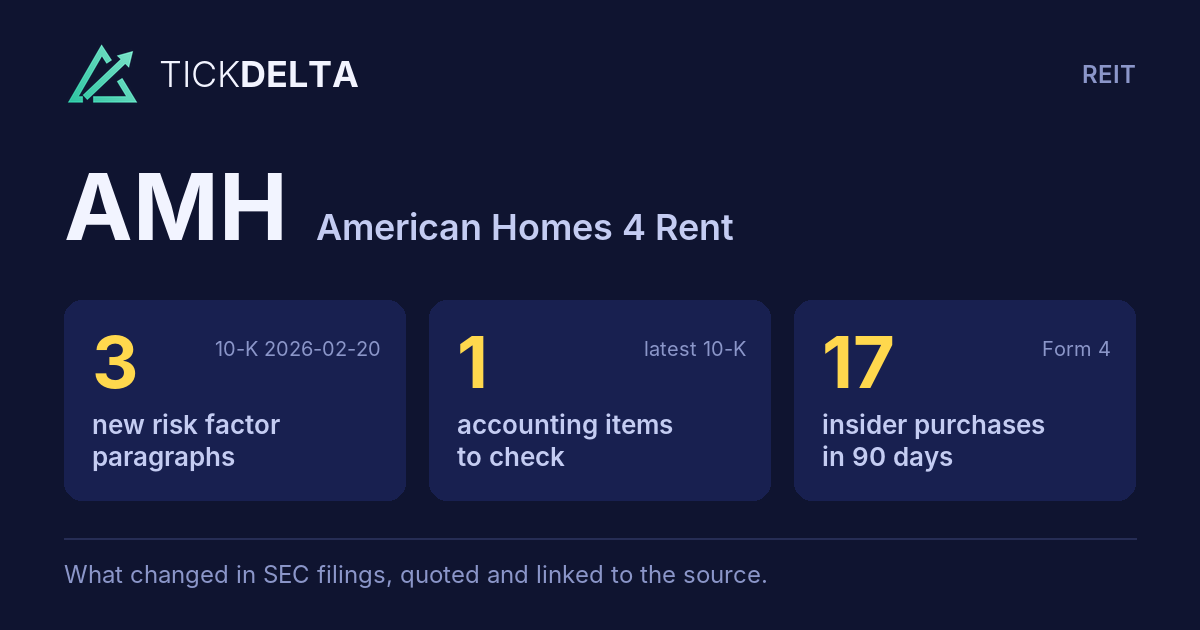
94 changes: 4 added, 8 removed, 80 reworded, 2 quiet changes
10-K Feb 20, 2026 vs Feb 21, 2025
Risk Factors
11.4%
of the text changed · 11,461 words now · 3 new paragraphs, 7 gone
MD&A
22.5%
of the text changed · 9,206 words now · 1 new paragraphs, 1 gone
Legal Proceedings
11.8%
of the text changed · 414 words now
Accounting Policies
13.5%
of the text changed · 5,848 words now
10-K 0001562401-26-000010 (Feb 20, 2026) vs 10-K 0001562401-25-000013 (Feb 21, 2025)
Every paragraph, and how much of it changed
One bar per paragraph, in the order of the 10-K. Height and colour show the share of its words not in the closest paragraph a year earlier; the tallest bars are new paragraphs.
Risk Factors
111 paragraphs · 3 new · 31 reworded · 7 gone · 10-K Feb 20, 2026 against Feb 21, 2025
New paragraph
Reworded (5% of its words or more)
Same or nearly
Paragraph 91 · 46% changed
Every version of it
Paragraph 53 · 43% changed
Every version of it
We have begun to utilize AI technologies in various aspects of our business, including applications for data analysis, software development, customer communication, employee productivity and cybersecurity monitoring. Prior to our deployment of AI technologies, such technologies are subject to an AI governance framework requiring the identification of risks associated with each use of each AI application. Based on an initial risk classification of an AI use case, a committee is convened comprising members from the business, legal, IT and cybersecurity teams, which assesses the risks and benefits of the use case and approves or disapproves the application for use within the business. Once approved, use cases are inventoried and periodically reviewed for productivity and compliance purposes. Even with this governance framework, AI technologies are susceptible to errors and other malfunctions which could lead to operational challenges and reputational risks. In addition, we may be subject to increasing increased regulations related to our use of AI, including regulations related to privacy, data security, security and intellectual property rights, which could expose us to legal risks.
Paragraph 51 · 36% changed
Every version of it
A pandemic, such as the COVID-19 pandemic, or similar pandemic and other public health emergencies could negatively impact the global economy, disrupt financial markets and international trade, and result in varying unemployment levels, all of which could negatively impact our business, results of operations, cash flows, and financial condition. These types of events could lead governments and other authorities around the world, including federal, state and local authorities in the United States, to impose measures intended to mitigate the issue, including restrictions on freedom of movement and business operations such as issuing guidelines, travel bans, border closings, business closures, quarantine orders, and orders not allowing the collection of rents, rent increases, or eviction of non-paying tenants.
Paragraph 69 · 30% changed
Every version of it
Paragraph 52 · 30% changed
Every version of it
Paragraph 49 · 24% changed
Every version of it
Our revolving credit facility, facility and unsecured senior notes and securitizations contain financial and operating covenants, such as debt ratios, minimum liquidity, unencumbered asset value, minimum debt service coverage ratio, and other limitations that may restrict our ability to make distributions or other payments to the Company’s shareholders and the Operating Partnership’s ability to make distributions on its OP units and may restrict our investment activities. Our securitizations require, among other things, that a cash management account controlled by the lender collect all rents and cash generated by the properties securing the portfolio. Upon the occurrence of an event of default or failure to satisfy the required minimum debt yield or debt service coverage ratio, the lender may apply any excess cash as the lender elects, including prepayment of principal and amounts due under the loans. These covenants may restrict our ability to engage in transactions that we believe would otherwise be in the best interests of our shareholders. Further, such restrictions could adversely impact our ability to maintain our qualification as a REIT for tax purposes. Failure to meet our financial covenants could result from, among other things, changes in our results of operations, the incurrence of additional debt, substantial impairments in the value of our properties or changes in general economic conditions. If we violate covenants in our financing arrangements, we could be required to repay all or a portion of our indebtedness before maturity at a time when we might be unable to arrange financing for such repayment on attractive terms or at all.
Paragraph 68 · 24% changed
Every version of it
The Company’s board of trustees may, without shareholder approval, amend its declaration of trust to increase or decrease the aggregate number of the Company’s shares or the number of shares of any class or series that the Company has the authority to issue and to classify or reclassify any unissued common or preferred shares, and set the preferences, rights and other terms of the classified or reclassified shares. As a result, the Company’s board of trustees may authorize the issuance of additional shares or establish a series of common or preferred shares that may delay or prevent a change in control of the Company, including transactions at a premium over the market price of the Company’s shares, even if the Company’s shareholders believe that a change in control is in their interest. These provisions, along with the restrictions on ownership and transfer contained in the Company’s declaration of trust and certain provisions of Maryland law, could discourage unsolicited acquisition proposals or make it more difficult for a third-party to gain control of the Company, which could adversely affect the market price of the Company’s securities.
Paragraph 99 · 48% changed
Every version of it
10-K Feb 21, 2025To satisfy the REIT distribution requirements, we may be forced to take certain actions to raise funds if we have insufficient cash flow which could materially and adversely affect us and the trading price of our common or preferred shares.
10-K Feb 20, 2026
cause us to curtail our investment activities and/or to dispose of assets at inopportune times, and could materially and adversely affect us and the trading price of our common or preferred shares.
Paragraph 91 · 46% changed
Every version of it
10-K Feb 21, 2025The REIT provisions of the Code may limit our ability to hedge our assets and operations. Under the Code, any income that we generate from transactions intended to hedge our interest rate risk will be excluded from gross income for purposes of the REIT 75% and 95% gross income tests if the instrument hedges interest rate risk on liabilities used to carry or acquire real estate assets or manages the risk of certain currency fluctuations, and such instrument is properly identified under applicable Treasury Regulations. Income from hedging transactions that do not meet these requirements will generally constitute non-qualifying income for purposes of both the REIT 75% and 95% gross income tests. As a result of these rules, we may have to limit our use of hedging techniques that might otherwise be advantageous or implement those hedges through a TRS. This could increase the cost of our hedging activities because our TRS would be subject to tax on gains or expose us to greater risks associated with changes in interest rates than we would otherwise want to bear. In addition, losses in our TRS may only be carried forward and may only be deducted against 80% of future taxable income in the TRS.
10-K Feb 20, 2026
because our TRS would be subject to tax on gains or expose us to greater risks associated with changes in interest rates than we would otherwise want to bear. In addition, losses in our TRS may only be carried forward and may only be deducted against 80% of future taxable income in the TRS.
Paragraph 53 · 43% changed
Every version of it
10-K Feb 21, 2025
We have begun to utilize AI technologies in various aspects of our business. AI technologies are susceptible to errors and other malfunctions which could lead to operational challenges and reputational risks. In addition, we may be subject to increasing regulations related to our use of AI, including regulations related to privacy, data security, and intellectual property rights, which could expose us to legal risks.
10-K Feb 20, 2026
We have begun to utilize AI technologies in various aspects of our business, including applications for data analysis, software development, customer communication, employee productivity and cybersecurity monitoring. Prior to our deployment of AI technologies, such technologies are subject to an AI governance framework requiring the identification of risks associated with each use of each AI application. Based on an initial risk classification of an AI use case, a committee is convened comprising members from the business, legal, IT and cybersecurity teams, which assesses the risks and benefits of the use case and approves or disapproves the application for use within the business. Once approved, use cases are inventoried and periodically reviewed for productivity and compliance purposes. Even with this governance framework, AI technologies are susceptible to errors and other malfunctions which could lead to operational challenges and reputational risks. In addition, we may be subject to increased regulations related to our use of AI, including regulations related to privacy, data security and intellectual property rights, which could expose us to legal risks.
Paragraph 51 · 36% changed
Every version of it
10-K Feb 21, 2025
A pandemic, such as the COVID-19 pandemic, or similar public health emergencies could negatively impact the global economy, disrupt financial markets and international trade, and result in varying unemployment levels, all of which could negatively impact our business, results of operations, cash flows, and financial condition. These types of events could lead governments and other authorities around the world, including federal, state and local authorities in the United States, to impose measures intended to mitigate the issue, including restrictions on freedom of movement and business operations such as issuing guidelines, travel bans, border closings, business closures, quarantine orders, and orders not allowing the collection of rents, rent increases, or eviction of non-paying tenants.
10-K Feb 20, 2026
A pandemic and other public health emergencies could negatively impact the global economy, disrupt financial markets and international trade, and result in varying unemployment levels, all of which could negatively impact our business, results of operations, cash flows, and financial condition. These types of events could lead governments and other authorities around the world,
Paragraph 69 · 30% changed
Every version of it
10-K Feb 21, 2025The Company’s board of trustees may, without shareholder approval, amend its declaration of trust to increase or decrease the aggregate number of the Company’s shares or the number of shares of any class or series that the Company has the authority to issue and to classify or reclassify any unissued common or preferred shares, and set the preferences, rights and other terms of the classified or reclassified shares. As a result, the Company’s board of trustees may authorize the issuance of additional shares or establish a series of common or preferred shares that may delay or prevent a change in control of the Company, including transactions at a premium over the market price of the Company’s shares, even if the Company’s shareholders believe that a change in control is in their interest. These provisions, along with the restrictions on ownership and transfer contained in the Company’s declaration of trust and certain provisions of Maryland law, could discourage unsolicited acquisition proposals or make it more difficult for a third-party to gain control of the Company, which could adversely affect the market price of the Company’s securities.
10-K Feb 20, 2026
over the market price of the Company’s shares, even if the Company’s shareholders believe that a change in control is in their interest. These provisions, along with the restrictions on ownership and transfer contained in the Company’s declaration of trust and certain provisions of Maryland law, could discourage unsolicited acquisition proposals or make it more difficult for a third-party to gain control of the Company, which could adversely affect the market price of the Company’s securities.
Paragraph 52 · 30% changed
Every version of it
10-K Feb 21, 2025A pandemic, such as the COVID-19 pandemic, or similar public health emergencies could negatively impact the global economy, disrupt financial markets and international trade, and result in varying unemployment levels, all of which could negatively impact our business, results of operations, cash flows, and financial condition. These types of events could lead governments and other authorities around the world, including federal, state and local authorities in the United States, to impose measures intended to mitigate the issue, including restrictions on freedom of movement and business operations such as issuing guidelines, travel bans, border closings, business closures, quarantine orders, and orders not allowing the collection of rents, rent increases, or eviction of non-paying tenants.
10-K Feb 20, 2026
including federal, state and local authorities in the United States, to impose measures intended to mitigate the issue, including restrictions on freedom of movement and business operations such as issuing guidelines, travel bans, border closings, business closures, quarantine orders, and orders not allowing the collection of rents, rent increases, or eviction of non-paying tenants.
Paragraph 49 · 24% changed
Every version of it
10-K Feb 21, 2025
Our revolving credit facility, unsecured senior notes and securitizations contain financial and operating covenants, such as debt ratios, minimum liquidity, unencumbered asset value, minimum debt service coverage ratio, and other limitations that may restrict our ability to make distributions or other payments to the Company’s shareholders and the Operating Partnership’s ability to make distributions on its OP units and may restrict our investment activities. Our securitizations require, among other things, that a cash management account controlled by the lender collect all rents and cash generated by the properties securing the portfolio. Upon the occurrence of an event of default or failure to satisfy the required minimum debt yield or debt service coverage ratio, the lender may apply any excess cash as the lender elects, including prepayment of principal and amounts due under the loans. These covenants may restrict our ability to engage in transactions that we believe would otherwise be in the best interests of our shareholders. Further, such restrictions could adversely impact our ability to maintain our qualification as a REIT for tax purposes. Failure to meet our financial covenants could result from, among other things, changes in our results of operations, the incurrence of additional debt, substantial impairments in the
10-K Feb 20, 2026
Our revolving credit facility and unsecured senior notes contain financial and operating covenants, such as debt ratios, minimum liquidity, unencumbered asset value, minimum debt service coverage ratio, and other limitations that may restrict our ability to make distributions or other payments to the Company’s shareholders and the Operating Partnership’s ability to make distributions on its OP units and may restrict our investment activities. These covenants may restrict our ability to engage in transactions that we believe would otherwise be in the best interests of our shareholders. Further, such restrictions could adversely impact our ability to maintain our qualification as a REIT for tax purposes. Failure to meet our financial covenants could result from, among other things, changes in our results of operations, the incurrence of additional debt, substantial impairments in the value of our properties or changes in general economic conditions. If we violate covenants in our financing arrangements, we could be required to repay all or a portion of our indebtedness before maturity at a time when we might be unable to arrange financing for such repayment on attractive terms or at all.
Paragraph 68 · 24% changed
Every version of it
10-K Feb 21, 2025
The Company’s board of trustees may, without shareholder approval, amend its declaration of trust to increase or decrease the aggregate number of the Company’s shares or the number of shares of any class or series that the Company has the authority to issue and to classify or reclassify any unissued common or preferred shares, and set the preferences, rights and other terms of the classified or reclassified shares. As a result, the Company’s board of trustees may authorize the issuance of additional shares or establish a series of common or preferred shares that may delay or prevent a change in control of the Company, including transactions at a premium over the market price of the Company’s shares, even if the Company’s shareholders believe that a change in control is in their interest. These provisions, along with the restrictions on ownership and transfer contained in the Company’s declaration of trust and certain provisions of Maryland law, could discourage unsolicited acquisition proposals or make it more difficult for a third-party to gain control of the Company, which could adversely affect the market price of the Company’s securities.
10-K Feb 20, 2026
The Company’s board of trustees may, without shareholder approval, amend its declaration of trust to increase or decrease the aggregate number of the Company’s shares or the number of shares of any class or series that the Company has the authority to issue and to classify or reclassify any unissued common or preferred shares, and set the preferences, rights and other terms of the classified or reclassified shares. As a result, the Company’s board of trustees may authorize the issuance of additional shares or establish a series of common or preferred shares that may delay or prevent a change in control of the Company, including transactions at a premium
MD&A
107 paragraphs · 1 new · 63 reworded · 1 gone · 10-K Feb 20, 2026 against Feb 21, 2025
New paragraph
Reworded (5% of its words or more)
Same or nearly
Paragraph 7 · 50% changed
Paragraph 8 · 50% changed
Paragraph 89 · 49% changed
Paragraph 83 · 42% changed
During the year ended December 31, 2024, 2025, the Company also issued the 2034 Notes I, the 2034 Notes II and the 2035 2030 Notes, receiving $1.59 billion $646.4 million in proceeds, net of discount, and paid $13.7 million in related deferred financing costs as well as received $8.6 million for the settlement of two treasury locks in connection with the pricing of the 2035 Notes. The Company also entered into a new credit agreement with a $1.25 billion sustainability-linked revolving credit facility and paid $11.5 $5.2 million in related deferred financing costs. During the year ended December 31, 2024, the Company borrowed $400.0 million and paid down $490.0 million on its revolving credit facility as well as repaid an additional $19.8 million on its asset-backed securitizations.
Paragraph 16 · 41% changed
Paragraph 81 · 40% changed
$1.25 billion and matures in 2028 with two six-month extension options at the Company’s election if certain conditions are met. During the year ended December 31, 2023, 2025, the Company borrowed $200.0 $770.0 million and paid down $240.0 $410.0 million on its revolving credit facility, and the Company repaid $24.5 resulting in $360.0 million on its asset-backed securitizations. of outstanding borrowings as of December 31, 2025.
Paragraph 80 · 40% changed
As of December 31, 2024, 2025, the Company had outstanding asset-backed securitizations maturing in 2045 with an aggregate principal amount of $925.4 million and outstanding unsecured senior notes with varying maturities starting in 2028 with an aggregate principal amount of $4.15 $4.8 billion. The Company has provided notice to the third-party lender of its intent to repay all amounts due under the AMH 2015-SFR1 securitization during the second quarter of 2025 and we also expect to repay all amounts due under the AMH 2015-SFR2 securitization in 2025. The Company’s revolving credit facility has a maximum borrowing capacity of $1.25 billion and matures in 2028 with two six-month extension options at the Company’s election if certain conditions are met. As of December 31, 2024, the Company had no outstanding borrowings under its revolving credit facility
Paragraph 31 · 37% changed
As we continue to grow our portfolio with a portion of our homes still recently developed, acquired and/or renovated, we distinguish our portfolio of homes between Same-Home properties and Non-Same-Home and Other properties in evaluating our operating performance. We classify a property as Same-Home if it has been stabilized longer than 90 days prior to the beginning of the earliest period presented under comparison and if it has not been classified as held for sale or experienced a casualty loss, which allows the performance of these properties to be compared between periods. Single-family properties that we acquire individually (i.e., not through a bulk purchase) are classified as either stabilized or non-stabilized. A property is classified as stabilized once it has been renovated by the Company or newly constructed and then initially leased or available for rent for a period greater than 90 days. Properties acquired through a bulk purchase are first considered non-stabilized, as an entire group, until (1) we have owned them for an adequate period of time to allow for complete on-boarding to our operating platform, and (2) a substantial portion of the properties have experienced tenant turnover at least once under our ownership, providing the opportunity for renovations and improvements to meet our property standards. After such time has passed, properties acquired through a bulk purchase are then evaluated on an individual property basis under our standard stabilization criteria. All other properties, including those classified as held for sale or taken out of service as a result of a casualty loss, are classified as Non-Same-Home and Other.
Paragraph 7 · 50% changed
10-K Feb 21, 2025The following table summarizes certain key single-family properties metrics as of December 31, 2024:
10-K Feb 20, 2026
(1)Excludes 1,142 single-family properties held for sale as of December 31, 2025.
Paragraph 8 · 50% changed
10-K Feb 21, 2025The following table summarizes certain key single-family properties metrics as of December 31, 2024:
10-K Feb 20, 2026
(1)Excludes 1,142 single-family properties held for sale as of December 31, 2025.
Paragraph 89 · 49% changed
10-K Feb 21, 2025The Company’s board of trustees authorized the establishment of our share repurchase program for the repurchase of up to $300.0 million of our outstanding Class A common shares and up to $250.0 million of our outstanding preferred shares from time to time in the open market or in privately negotiated transactions. The program does not have an expiration date, but may be suspended or discontinued at any time without notice. All repurchased shares are constructively retired and returned to an authorized and unissued status. The Operating Partnership funds the repurchases and constructively retires an equivalent number of corresponding Class A units. During the years ended December 31, 2024 and 2023, we did not repurchase and retire any of our Class A common shares or preferred shares. As of December 31, 2024, we had a remaining repurchase authorization of up to $265.1 million of our outstanding Class A common shares and up to $250.0 million of our outstanding preferred shares under the program.
10-K Feb 20, 2026
In 2018, the Company’s board of trustees authorized the establishment of a share repurchase program for the repurchase of up to $300.0 million of our outstanding Class A common shares and up to $250.0 million of our outstanding preferred shares from time to
Paragraph 83 · 42% changed
10-K Feb 21, 2025
During the year ended December 31, 2024, the Company also issued the 2034 Notes I, the 2034 Notes II and the 2035 Notes, receiving $1.59 billion in proceeds, net of discount, and paid $13.7 million in related deferred financing costs as well as received $8.6 million for the settlement of two treasury locks in connection with the pricing of the 2035 Notes. The Company also entered into a new credit agreement with a $1.25 billion sustainability-linked revolving credit facility and paid $11.5 million in related deferred financing costs. During the year ended December 31, 2024, the Company borrowed $400.0 million and paid down $490.0 million on its revolving credit facility as well as repaid an additional $19.8 million on its asset-backed securitizations.
10-K Feb 20, 2026
During the year ended December 31, 2025, the Company also issued the 2030 Notes, receiving $646.4 million in proceeds, net of discount, and paid $5.2 million in related deferred financing costs.
Paragraph 16 · 41% changed
10-K Feb 21, 2025Since our formation, we have rapidly but systematically grown our portfolio of single-family properties. Our ability to identify and acquire homes that meet our investment criteria is impacted by home prices in our target markets, the inventory of properties available-for-sale through traditional acquisition channels, the availability of bulk portfolio acquisition opportunities, competition for our target assets and our available capital. We are also focused on developing “built-for-rental” homes through our internal AMH Development Program. In addition, we acquire newly constructed homes from third-party developers through our National Builder
10-K Feb 20, 2026
opportunities and the level of capital available to invest. We have strategically scaled back acquisitions of single-family properties through broker sales via the MLS and our National Builder Program as the housing market adjusts to the current macroeconomic environment. In the past, our ability to identify and acquire homes through traditional channels that met our investment criteria was impacted by home prices in our target markets, the inventory of properties available, the availability of bulk portfolio acquisition opportunities, competition for our target assets and our available capital.
Paragraph 81 · 40% changed
10-K Feb 21, 2025
During the year ended December 31, 2023, the Company borrowed $200.0 million and paid down $240.0 million on its revolving credit facility, and the Company repaid $24.5 million on its asset-backed securitizations.
10-K Feb 20, 2026
$1.25 billion and matures in 2028 with two six-month extension options at the Company’s election if certain conditions are met. During the year ended December 31, 2025, the Company borrowed $770.0 million and paid down $410.0 million on its revolving credit facility, resulting in $360.0 million of outstanding borrowings as of December 31, 2025.
Paragraph 80 · 40% changed
10-K Feb 21, 2025
As of December 31, 2024, the Company had outstanding asset-backed securitizations maturing in 2045 with an aggregate principal amount of $925.4 million and outstanding unsecured senior notes with varying maturities starting in 2028 with an aggregate principal amount of $4.15 billion. The Company has provided notice to the third-party lender of its intent to repay all amounts due under the AMH 2015-SFR1 securitization during the second quarter of 2025 and we also expect to repay all amounts due under the AMH 2015-SFR2 securitization in 2025. The Company’s revolving credit facility has a maximum borrowing capacity of $1.25 billion and matures in 2028 with two six-month extension options at the Company’s election if certain conditions are met. As of December 31, 2024, the Company had no outstanding borrowings under its revolving credit facility
10-K Feb 20, 2026
As of December 31, 2025, the Company had outstanding unsecured senior notes with varying maturities starting in 2028 with an aggregate principal amount of $4.8 billion. The Company’s revolving credit facility has a maximum borrowing capacity of
Paragraph 31 · 37% changed
10-K Feb 21, 2025
performance. We classify a property as Same-Home if it has been stabilized longer than 90 days prior to the beginning of the earliest period presented under comparison and if it has not been classified as held for sale or experienced a casualty loss, which allows the performance of these properties to be compared between periods. Single-family properties that we acquire individually (i.e., not through a bulk purchase) are classified as either stabilized or non-stabilized. A property is classified as stabilized once it has been renovated by the Company or newly constructed and then initially leased or available for rent for a period greater than 90 days. Properties acquired through a bulk purchase are first considered non-stabilized, as an entire group, until (1) we have owned them for an adequate period of time to allow for complete on-boarding to our operating platform, and (2) a substantial portion of the properties have experienced tenant turnover at least once under our ownership, providing the opportunity for renovations and improvements to meet our property standards. After such time has passed, properties acquired through a bulk purchase are then evaluated on an individual property basis under our standard stabilization criteria. All other properties, including those classified as held for sale or taken out of service as a result of a casualty loss, are classified as Non-Same-Home and Other.
10-K Feb 20, 2026
As we continue to grow our portfolio with a portion of our homes still recently developed, acquired and/or renovated, we distinguish our portfolio of homes between Same-Home properties and Non-Same-Home and Other properties in evaluating our operating performance. We classify a property as Same-Home if it has been stabilized longer than 90 days prior to the beginning of the earliest period presented under comparison and if it has not been classified as held for sale or experienced a casualty loss, which allows the performance of these properties to be compared between periods. Single-family properties that we acquire individually (i.e., not through a bulk purchase) are classified as either stabilized or non-stabilized. A property is classified as stabilized once it has been
A paragraph is matched with the one last year that shares the most of its words; under half in common makes it new. The paragraphs shown are the 8 reworded the most in each section.
The paragraph that changed most in each section
The redline
Marked against last year's 10-K: cut words struck through, new words highlighted.
MD&A264 words changed in this paragraph; it is 44% similar to last year's version.
Source: Item 7, 10-K 0001562401-26-000010 vs Item 7, 10-K 0001562401-25-000013
Accounting Policies201 words changed in this paragraph; it is 47% similar to last year's version.
Single-family properties and land lots are classified as held for sale when they meet the applicable GAAP criteria in accordance with ASC 360-10, Property, Plant, and Equipment - Overall, including, but not limited to, the availability of the property for immediate sale in its present condition, the existence of an active program to locate a buyer and the probable sale of the property within one year. Single-family properties and land lots classified as held for sale are reported at the lower of their carrying value or estimated fair value less costs to sell, and are presented separately in single-family properties and land held for sale, net within the consolidated balance sheets. As of December 31, 2024 and 2023, the Company had 805 and 862 single-family properties, respectively, classified as held for sale, and recorded $ 9.2 million, $ 1.9 million and $ 2.5 million of impairment on single-family properties and land held for sale for the years ended December 31, 2024, 2023 and 2022, respectively, which is included in gain on sale and impairment of single-family properties and other, net within the consolidated statements of operations. The results of operations of properties that have either been sold or classified as held for sale, if due to a strategic shift that has (or will have) a major effect on our operations or financial results, are reported in the consolidated statements of operations as discontinued operations for both current and prior periods presented through the date of the applicable disposition in accordance with ASC 205-20, Presentation of Financial Statements - Discontinued Operations. During the years ended December 31, 2024, 2023 and 2022, no ne of the properties classified as held for sale met the criteria to be reported as a discontinued operation.
Source: 10-K text, Note 2 – Significant Accounting Policies, 10-K 0001562401-26-000010 vs 10-K text, Note 2 – Significant Accounting Policies, 10-K 0001562401-25-000013
Risk Factors128 words changed in this paragraph; it is 67% similar to last year's version.
Our revolving credit facility, facility and unsecured senior notes and securitizations contain financial and operating covenants, such as debt ratios, minimum liquidity, unencumbered asset value, minimum debt service coverage ratio, and other limitations that may restrict our ability to make distributions or other payments to the Company’s shareholders and the Operating Partnership’s ability to make distributions on its OP units and may restrict our investment activities. Our securitizations require, among other things, that a cash management account controlled by the lender collect all rents and cash generated by the properties securing the portfolio. Upon the occurrence of an event of default or failure to satisfy the required minimum debt yield or debt service coverage ratio, the lender may apply any excess cash as the lender elects, including prepayment of principal and amounts due under the loans. These covenants may restrict our ability to engage in transactions that we believe would otherwise be in the best interests of our shareholders. Further, such restrictions could adversely impact our ability to maintain our qualification as a REIT for tax purposes. Failure to meet our financial covenants could result from, among other things, changes in our results of operations, the incurrence of additional debt, substantial impairments in the value of our properties or changes in general economic conditions. If we violate covenants in our financing arrangements, we could be required to repay all or a portion of our indebtedness before maturity at a time when we might be unable to arrange financing for such repayment on attractive terms or at all.
Source: Item 1A, 10-K 0001562401-26-000010 vs Item 1A, 10-K 0001562401-25-000013
Legal Proceedings38 words changed in this paragraph; it is 69% similar to last year's version.
We have a retirement savings plan pursuant to Section 401(k) of the Code whereby our employees may contribute a portion of their compensation to their respective retirement accounts in an amount not to exceed the maximum allowed under the Code. In addition to employee contributions, we have elected to provide company contributions (subject to statutory limitations), which amounted to approximately $ 3.8 million, $ 3.6 million and $ 3.1 million for the years ended December 31, 2024, 2023 and 2022, respectively.
Source: Item 3, via Note 14 – Commitments and Contingencies, 10-K 0001562401-26-000010 vs Item 3, via Note 14 – Commitments and Contingencies, 10-K 0001562401-25-000013
Sentences and paragraphs added, removed or reworded
Every change, by type
Sentences and paragraphs of AMH's Risk Factors and MD&A, 10-K Feb 20, 2026 against 10-K Feb 21, 2025. Each links to the text at sec.gov.
Quiet changes are sentences kept from last year with one to four words changed, at least one of them a hedge, a modal or a qualifier (may, could, will, not, significant, material…). A year or date rolling forward is not counted.
The full word list
adverse, adversely, all, although, anticipate, anticipates, any, approximately, believe, believes, can, cannot, certain, could, expect, expects, generally, however, if, intend, intends, largely, likely, many, material, materially, may, might, most, must, never, no, not, possible, primarily, probable, should, significant, significantly, some, substantial, substantially, unlikely, will, would
AddedRisk Factors
Various legislative and regulatory bodies, including at the federal, state and local level, have been focused on the shortage of residential housing in the U.S. and significant increases in the cost of housing. Some states and local jurisdictions have passed or proposed regulations (i) imposing prohibitions or limitations on corporate entities purchasing and renting single-family homes, (ii) restricting developers from selling single-family homes to corporate entities intending to rent such homes, (iii) imposing tax and financial disincentives on corporate ownership of single-family homes for rent, and (iv) imposing adverse zoning restrictions on corporate ownership of single-family homes for rent. Similar restrictions are being considered at the federal level. We expect this trend to continue given the current political climate. Any such laws or regulations could impose significant costs, could require that we suspend or limit property acquisitions or otherwise modify or cease existing business practices or divest properties, could restrict the locations where we can operate our business, and could adversely impact our tax profile, including our status as a REIT.
Read it in 10-K Feb 20, 2026 at sec.gov
AddedRisk Factors
from and the value of such properties could be adversely affected. We believe these types of measures will continue given increasing political support.
Read it in 10-K Feb 20, 2026 at sec.gov
AddedRisk Factors
We have been and may continue to be adversely impacted by extreme weather events, such as hurricanes, floods, droughts and wildfires. In addition to direct costs relating to these events, including property damage and delays in leasing or development projects, the increases in property damage due to these events have also contributed to the increases in costs we have faced in property insurance.
Read it in 10-K Feb 20, 2026 at sec.gov
RemovedRisk Factors
RemovedRisk Factors
RemovedRisk Factors
RemovedRisk Factors
RemovedRisk Factors
Show the other 30
RemovedRisk Factors
RemovedRisk Factors
RewordedRisk Factors
We cannot assure you that we will have access to such capital on favorable terms at the desired times, or at all, which may cause us to curtail our investment activities and/or to dispose of assets at inopportune times, and could materially and adversely affect us and the trading price of our common or preferred shares.
Read it in 10-K Feb 20, 2026 at sec.gov
RewordedRisk Factors
As a result, the Company’s board of trustees may authorize the issuance of additional shares or establish a series of common or preferred shares that may delay or prevent a change in control of the Company, including transactions at a premium over the market price of the Company’s shares, even if the Company’s shareholders believe that a change in control is in their interest.
Read it in 10-K Feb 20, 2026 at sec.gov
RewordedRisk Factors
Because such laws vary by state and locality, we and any regional and local property managers we hire will need to take all appropriate steps to comply with all applicable landlord tenant laws, and we will need to incur supervisory and legal expenses to ensure such compliance.
Read it in 10-K Feb 20, 2026 at sec.gov
RewordedRisk Factors
The Hughes Family and affiliates own all of the Class B common shares and, together with the Class A common shares they own, hold 15.4% of the voting power of the Company.
Read it in 10-K Feb 20, 2026 at sec.gov
RewordedRisk Factors
We have begun to utilize AI technologies in various aspects of our business. business, including applications for data analysis, software development, customer communication, employee productivity and cybersecurity monitoring.
Read it in 10-K Feb 20, 2026 at sec.gov
RewordedRisk Factors
A pandemic, such as the COVID-19 pandemic, or similar pandemic and other public health emergencies could negatively impact the global economy, disrupt financial markets and international trade, and result in varying unemployment levels, all of which could negatively impact our business, results of operations, cash flows, and financial condition.
Read it in 10-K Feb 20, 2026 at sec.gov
RewordedRisk Factors
Failure to meet our financial covenants could result from, among other things, changes in our results of operations, the incurrence of additional debt, substantial impairments in the value of our properties or changes in general economic conditions.
Read it in 10-K Feb 20, 2026 at sec.gov
RewordedRisk Factors
If property taxes, over which we have no control, continue were to increase at recent rates, significantly in the future, and if we are unable to increase rental rates to offset such increased expense, it would adversely affect our operating results, including our net operating income.
Read it in 10-K Feb 20, 2026 at sec.gov
RewordedRisk Factors
New and proposed laws and regulations restricting institutional ownership of single-family homes could impede our ability to operate or grow our business.
Read it in 10-K Feb 20, 2026 at sec.gov
RewordedRisk Factors
RewordedRisk Factors
For example, 58.0% 57.9% of our operating properties are located in Atlanta, GA, Charlotte, NC, Dallas-Fort Worth, TX, Nashville, TN, Jacksonville, FL, Phoenix, AZ, Jacksonville, FL, Indianapolis, IN, Tampa, FL, Las Vegas, NV and Houston, TX.
Read it in 10-K Feb 20, 2026 at sec.gov
RewordedRisk Factors
Our revolving credit facility, facility and unsecured senior notes and securitizations contain financial and operating covenants that could restrict our business and investment activities.
Read it in 10-K Feb 20, 2026 at sec.gov
AddedMD&A
On July 4, 2025, the President signed into law H.R. 1, originally titled the “One Big Beautiful Bill Act” (the “Act”). The Act made several tax changes that impact us and our shareholders, the most significant of which are summarized as follows. First, the Act preserves the eligibility of REIT ordinary dividends for the qualified business income deduction in Section 199A of the Code, and it makes that deduction permanent. Second, effective for taxable years beginning after December 31, 2025, the Act increases the quarterly asset test limit on securities of taxable REIT subsidiaries from 20% to 25%. Finally, for purposes of the limitation on business interest deductions in Section 163(j) of the Code, the Act applies the more favorable earnings before interest, taxes, depreciation and amortization (“EBITDA”) calculation for taxable years starting on or after January 1, 2025, and makes the more favorable EBITDA calculation permanent and, for taxable years beginning on or after January 1, 2026, the Act generally calculates the Section 163(j) limitation prior to the application of any interest capitalization provisions.
Read it in 10-K Feb 20, 2026 at sec.gov
RemovedMD&A
RewordedMD&A
RewordedMD&A
Cash paid for development activity $ (810,507) $ (845,851) $ (979,848) $ 133,997 Cash paid for single-family properties (495,912) (12,784) (483,128) 35,344 Recurring and other capital expenditures for single-family properties (118,211) (121,751) (134,176) 12,425 3,540 Renovations to single-family properties (40,645) (34,052) (40,137) 6,085 (6,593) Cash paid for single-family properties (23,587) (495,912) 472,325 Investment in unconsolidated joint ventures (15,078) (19,680) (12,614) (7,066) 4,602 Change in escrow deposits for purchase of single-family properties (2,495) 5,482 (7,977) Cash paid for deposits on land option contracts — (653) (1,142) 489 653 Other investing activities (30,933) (29,158) (38,752) 9,594 (1,775) $ (1,547,057) (1,041,456) $ (1,219,453) (1,541,575) $ (327,604) 500,119 Net cash used for investing activities $ (328,167) $ (825,876) $ (692,578) $ (133,298) 497,709
Read it in 10-K Feb 20, 2026 at sec.gov
RewordedMD&A
Net proceeds received from sales of single-family properties and other $ 630,352 $ 573,182 $ 469,463 $ 103,719 57,170 Distributions from joint ventures unconsolidated entities 78,702 116,311 47,736 68,575 (37,609) Proceeds received from asset-backed securitization certificates 25,666 storm-related insurance claims 4,020 — 25,666 Change in escrow deposits for purchase of single-family properties 5,482 4,928 554 4,020 Proceeds from notes receivable related to the sale of properties 215 540 698 (158) (325) Proceeds received from storm-related insurance claims asset-backed securitization certificates — 4,050 (4,050) 25,666 (25,666) $ 721,181 713,289 $ 526,875 715,699 $ 194,306 (2,410) Uses of cash for investing activities:
Read it in 10-K Feb 20, 2026 at sec.gov
RewordedMD&A
RewordedMD&A
Net cash provided by operating activities increased $72.8 $52.8 million, or 9.9%, 6.5%, from $738.7 million during the year ended December 31, 2023 to $811.5 million during the year ended December 31, 2024, 2024 to $864.3 million during the year ended December 31, 2025 primarily due to increased cash inflows generated from growth in our portfolio and higher rental rates and changes in working capital primarily related to the timing of payments for prepaid expenses and other assets and accounts payable and accrued expenses, rates, partially offset by higher cash outflows for property related expenses.
Read it in 10-K Feb 20, 2026 at sec.gov
RewordedMD&A
Adjusted EBITDAre is a supplemental non-GAAP financial measure calculated by adjusting EBITDAre for (1) acquisition and other transaction costs incurred with business combinations and the acquisition or disposition of properties as well as nonrecurring items unrelated to ongoing operations, operations and adjustments for investments in proptech venture capital funds related to the pro rata equity pickup of realized and unrealized gains and losses from their portfolio investments, (2) noncash share-based compensation expense, (3) hurricane-related charges, net, which result in material charges to our single-family property portfolio, and (4) gain or loss on early extinguishment of debt.
Read it in 10-K Feb 20, 2026 at sec.gov
RewordedMD&A
During the year ended December 31, 2024, 2025, the Company paid off the $460.6 $493.2 million outstanding principal on the AMH 2014-SFR2 2015-SFR1 securitization and the $471.8 $426.1 million outstanding principal on the AMH 2014-SFR3 2015-SFR2 securitization, which resulted in $1.0 $0.4 million and $0.5 million, respectively, of aggregated charges related to legal and bank fees and write-offs that were included in loss on early extinguishment of unamortized deferred financing costs. debt within the consolidated statements of operations included in a separate section in Part IV, “Item 15.
Read it in 10-K Feb 20, 2026 at sec.gov
RewordedMD&A
For the Years Ended December 31, 2025 2024 2023 Net income $ 513,392 $ 468,142 $ 432,142 Interest expense 185,198 165,351 140,198 Depreciation and amortization 504,341 477,010 456,550 EBITDA $ 1,202,931 $ 1,110,503 $ 1,028,890 Gain on sale and impairment of single-family properties and other, net (231,460) (225,756) (209,834) Adjustments for unconsolidated real estate joint ventures 6,940 4,722 3,711 EBITDAre $ 978,411 $ 889,469 $ 822,767 Noncash share-based compensation - general and administrative 16,078 20,617 16,379 Noncash share-based compensation - property management 4,090 4,814 4,030 Acquisition, other transaction costs and other 11,180 12,192 16,910 Hurricane-related charges, net — 8,884 — Loss on early extinguishment of debt 396 6,323 — Adjusted EBITDAre $ 1,010,155 $ 942,299 $ 860,086 Recurring Capital Expenditures (72,605) (76,281) (76,098) Leasing costs (3,623) (3,966) (3,113) Fully Adjusted EBITDAre $ 933,927 $ 862,052 $ 780,875
Read it in 10-K Feb 20, 2026 at sec.gov
RewordedMD&A
During the year ended December 31, 2024, 2025, the Company also issued the 2034 Notes I, the 2034 Notes II and the 2035 2030 Notes, receiving $1.59 billion $646.4 million in proceeds, net of discount, and paid $13.7 $5.2 million in related deferred financing costs as well as received $8.6 million for the settlement of two treasury locks in connection with the pricing of the 2035 Notes. costs.
Read it in 10-K Feb 20, 2026 at sec.gov
RewordedMD&A
This increase was primarily attributable to higher Average Monthly Realized Rent per property, which increased 5.3% 3.7% to $2,189 $2,282 per month for the year ended December 31, 2024 2025 compared to $2,078 $2,200 per month for the year ended December 31, 2023, 2024, as well as higher fees from single-family properties and lower uncollectible rents, partially offset by a decrease in Average Occupied Days Percentage, which was 96.2% for the year ended December 31, 2024 compared to 96.7% for the year ended December 31, 2023. rents.
Read it in 10-K Feb 20, 2026 at sec.gov
RewordedMD&A
RewordedMD&A
Additionally, further labor shortages, supply chain disruptions, disruptions and inflationary increases pressures, including as a result of tariffs, have impacted and may in labor and material costs and labor shortages may have the potential to future impact certain aspects of our business, including our AMH Development Program, our renovation program associated with acquired properties and our maintenance program.
Read it in 10-K Feb 20, 2026 at sec.gov
Quiet changesMD&A
We are also primarily focused on developing “built-for-rental” homes through our internal AMH Development Program.
Read it in 10-K Feb 20, 2026 at sec.gov
Quiet changesMD&A
Historically, it has taken approximately 20 to 90 days to complete the renovation process, which will fluctuate fluctuated based on our overall acquisition volume as well as availability of construction labor and materials.
Read it in 10-K Feb 20, 2026 at sec.gov
Sources
The two latest 10-Ks on EDGAR, section by section. Each change links to the text at sec.gov.
Also
New risk factors: paragraphs with nothing like them last year, quoted in full.
Work with it
Excel workbook · CSV. Google Sheet that stays up to date: paste =IMPORTDATA("https://tickdelta.com/company/AMH/export.csv") into a cell.