Screener / SEC EDGAR /CIK 0001047127 /10-K filed Feb 20, 2026, compared with Feb 21, 2025 /Numbers from the XBRL of the 10-Ks
Nasdaq Technology · Semiconductors

Amkor Technology, Inc. AMKR

Compare with peers Embed
New in the 10-K 8 paragraphs with nothing like them in the 10-K filed Feb 21, 2025 New in the 10-Q 1 paragraphs not in the 10-Q filed Jul 28, 2026 10-Q against the 10-K 43 risk factor paragraphs and sentences added or reworded

New risk paragraphs, branching off last year

Each branch is a paragraph in Risk Factors with nothing like it in the 10-K filed Feb 21, 2025. A box jumps to the paragraph as filed, below.

8 new

Paragraphs with nothing like them in last year's 10-K

Quoted exactly

8 paragraphs in Risk Factors of the 10-K filed Feb 20, 2026 with nothing like them in the 10-K filed Feb 21, 2025. Quoted exactly. Paragraphs that were only edited are under 10-K change.

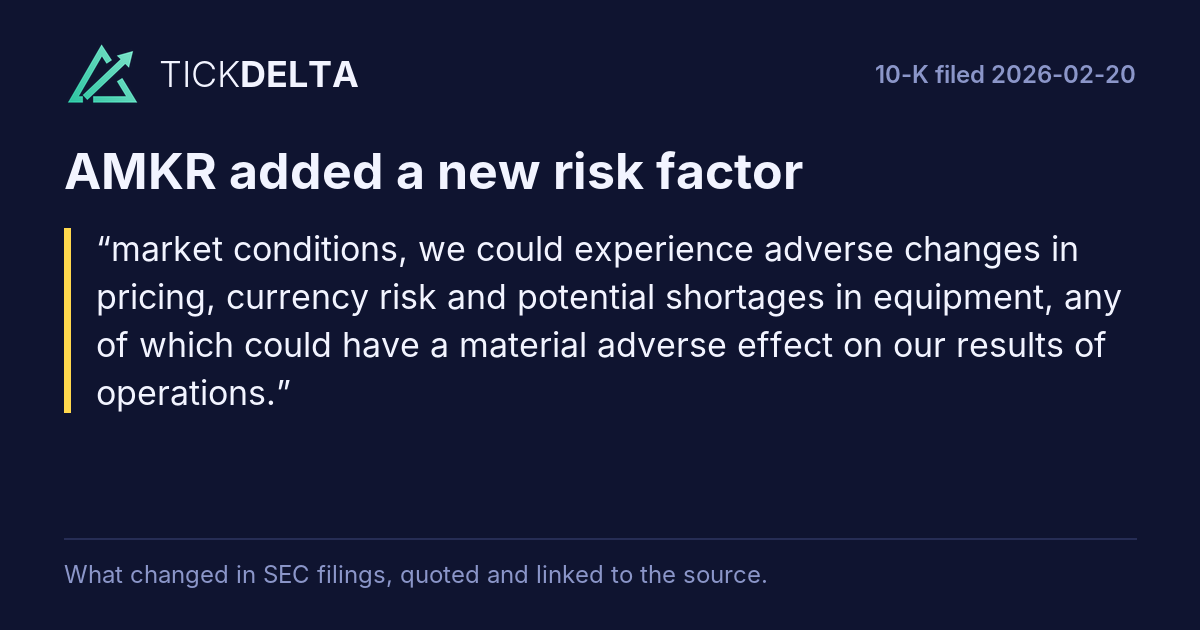
market conditions, we could experience adverse changes in pricing, currency risk and potential shortages in equipment, any of which could have a material adverse effect on our results of operations.

Read in the 10-K

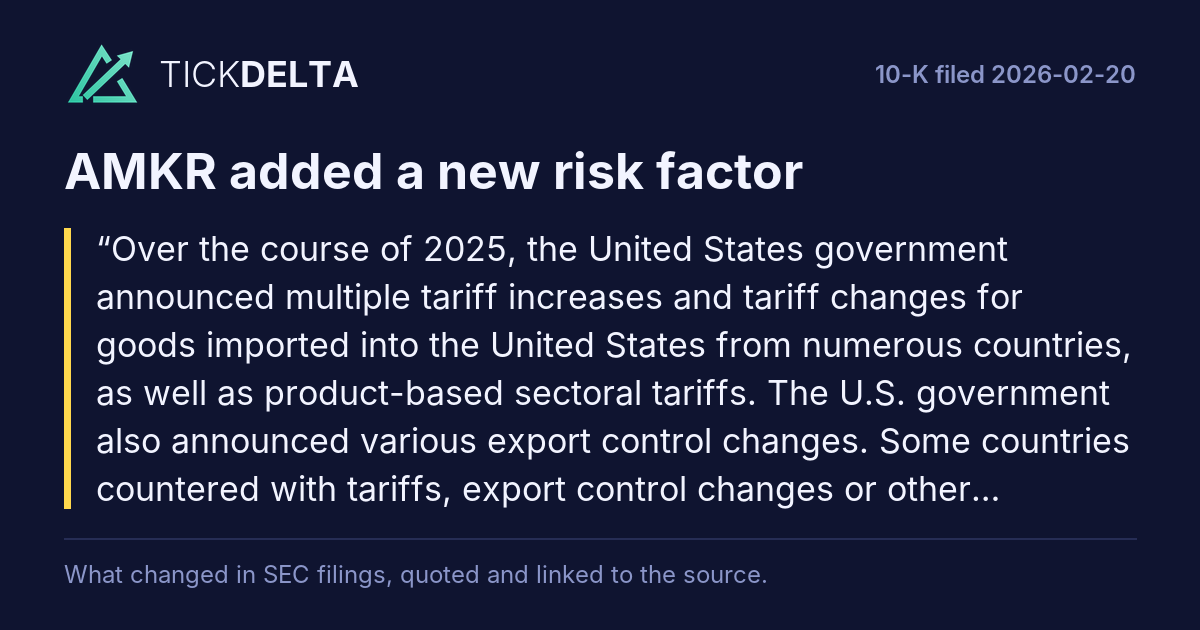
Over the course of 2025, the United States government announced multiple tariff increases and tariff changes for goods imported into the United States from numerous countries, as well as product-based sectoral tariffs. The U.S. government also announced various export control changes. Some countries countered with tariffs, export control changes or other actions, and the U.S. entered into broad trade negotiations with many countries. Many of the U.S. actions, as well as

those of other countries, were subsequently paused or revised. We cannot predict what further actions may ultimately be taken by the U.S. with respect to tariffs, export restrictions or other trade measures, what products or entities may be subject to such actions, or what actions may be taken by other countries in response to these U.S. actions. Imposed tariffs may affect end-user demand in each geography where our customers sell their products and services, which may materially and adversely affect demand for our services, our operating results and our financial condition.

Read in the 10-K

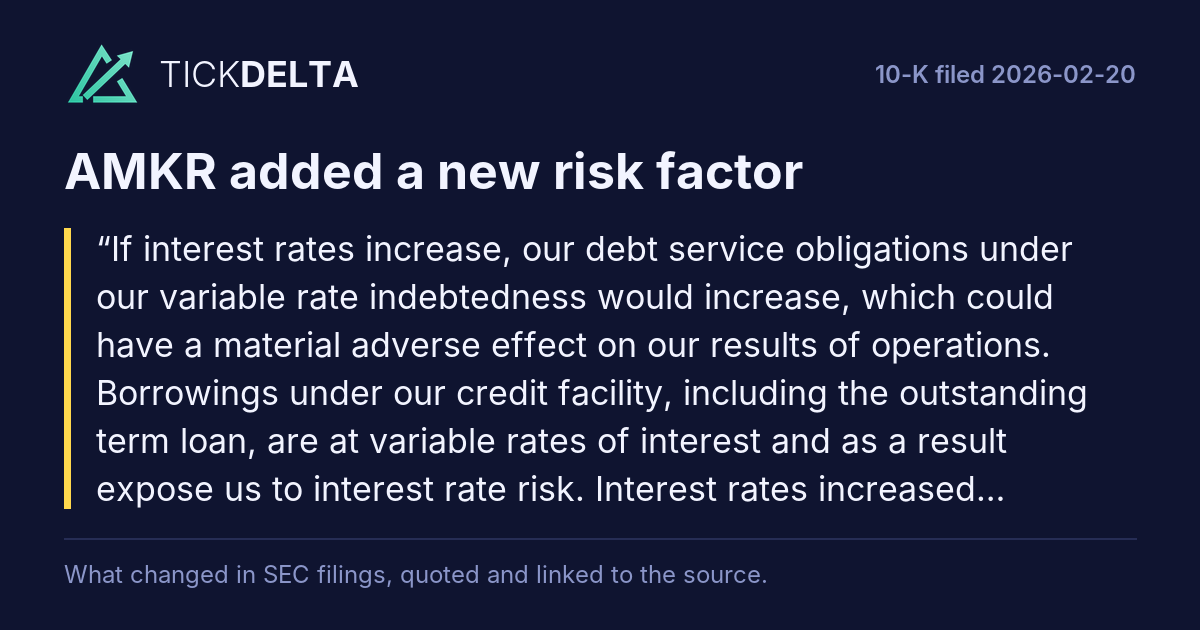
If interest rates increase, our debt service obligations under our variable rate indebtedness would increase, which could have a material adverse effect on our results of operations.

Borrowings under our credit facility, including the outstanding term loan, are at variable rates of interest and as a result expose us to interest rate risk. Interest rates increased throughout 2022 and 2023. While interest rates stabilized and have begun to decrease since 2024, if interest rates increase, our debt service obligations on the variable rate indebtedness would increase even though the amount borrowed remained the same, and our net income and cash flows, including cash available for servicing our indebtedness, will correspondingly decrease. We currently do not maintain interest rate swaps with respect to all of our variable rate indebtedness, and any swaps we enter into may not fully mitigate our interest rate risk. To the extent the risk materializes and is not fully mitigated, the resulting increase in interest expense could have a material adverse effect on our results of operations. Further, significant changes in our credit rating, disruptions in the global financial markets, including bank failures, or incurrence of new or refinancing of existing indebtedness at higher interest rates could have a material and adverse effect on our access to and cost of capital for future financings, and financial condition.

Read in the 10-K

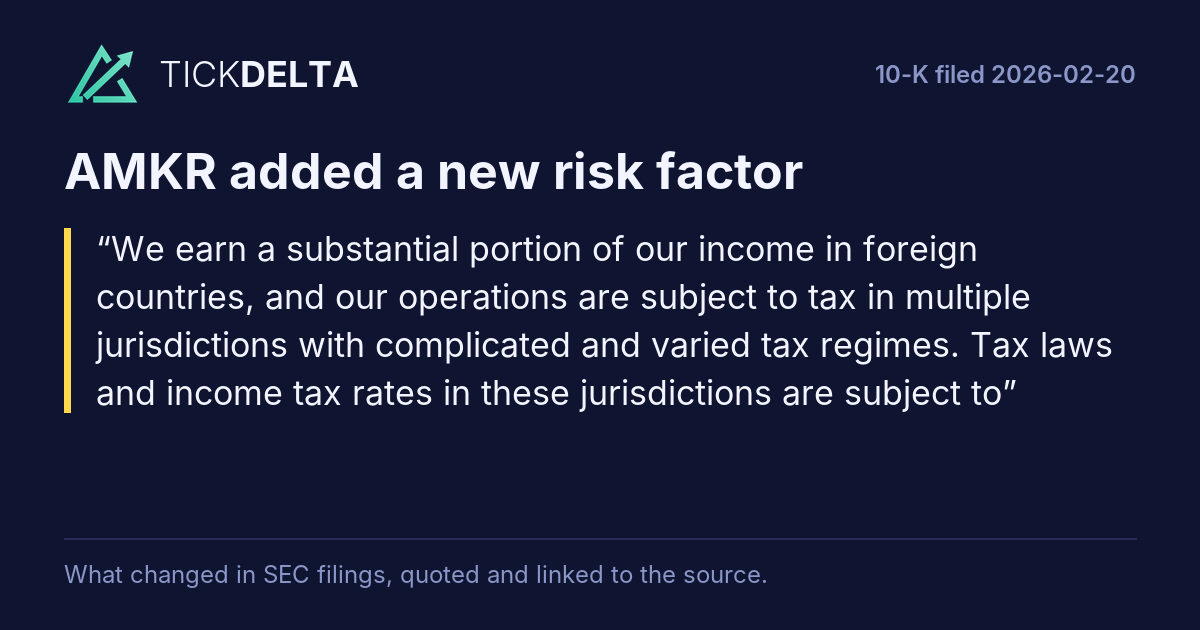
We earn a substantial portion of our income in foreign countries, and our operations are subject to tax in multiple jurisdictions with complicated and varied tax regimes. Tax laws and income tax rates in these jurisdictions are subject to

Read in the 10-K

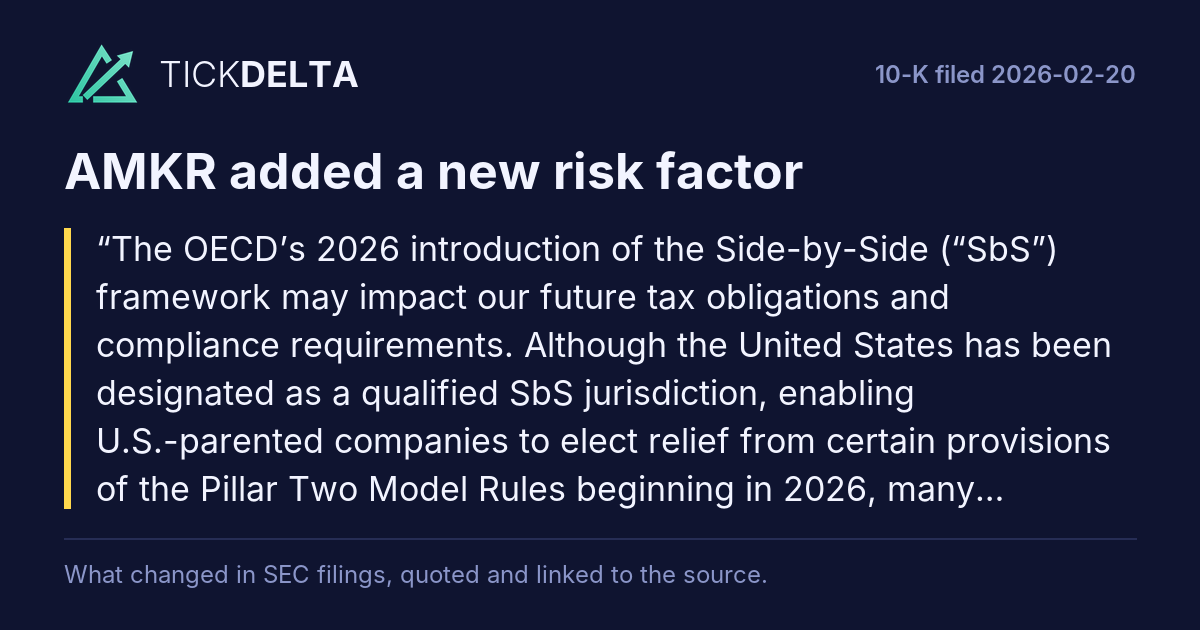
The OECD’s 2026 introduction of the Side-by-Side (“SbS”) framework may impact our future tax obligations and compliance requirements. Although the United States has been designated as a qualified SbS jurisdiction, enabling U.S.-parented companies to elect relief from certain provisions of the Pillar Two Model Rules beginning in 2026, many jurisdictions continue to require Qualified Domestic Minimum Top-Up Taxes (“QDMTTs”) and may adopt additional administrative rules that affect our operations. There remains significant uncertainty regarding the pace and consistency of global implementation. Our ability to accurately forecast tax obligations and the impact on our financial results may be affected.

On July 4, 2025, the One Big Beautiful Bill Act (the “OBBBA”) was enacted in the United States, which includes significant provisions such as modifications to the international tax framework and the investment tax credit rate under the CHIPS Act, and restoration of tax treatment for certain business provisions. The legislation has multiple effective dates, with certain provisions effective in 2025 and others implemented through 2027. Changes in U.S. or foreign tax laws, including new or modified guidance with respect to existing tax laws, could have a material adverse impact on our liquidity, results of operations, financial condition and cash flows.

Read in the 10-K

Paragraphs in the 10-Q filed Oct 27, 2026 that were not in the one before

New in the latest 10-Q

1 paragraph in the 10-Q filed Oct 27, 2026 with nothing like it in the 10-Q filed Jul 28, 2026 (at least half the words must differ; new numbers alone do not count). Quoted exactly, grouped by the item heading above them. This is text that changed, not a judgement of how serious it is.

Financial statements and notes

related to this agreement, which is included in restricted cash and other non-current liabilities in our Consolidated Balance Sheets.

Read in the 10-Q

The 10-Q's risk factors against the 10-K

Item 1A of the 10-Q filed Oct 27, 2026 against Item 1A of the 10-K filed Feb 20, 2026. A 10-Q repeats only the risks that changed, so a 10-K paragraph that is missing from it is not counted as removed. Added is a paragraph with nothing like it in the 10-K, Reworded a sentence that is in both with several words changed, Quiet changes a sentence in both where one to four words changed and one is a hedge or a modal (cut words struck through, new words highlighted). Text on the page, not a score; each links to the filing at sec.gov.

Added10-Q Oct 27, 2026 vs 10-K Feb 20, 2026
• terms of the 2031 Notes could delay or prevent an otherwise beneficial takeover of us, may dilute the ownership interest of existing stockholders or may otherwise adversely affect the price of our common stock; and

Read it in the 10-Q at sec.gov

Added10-Q Oct 27, 2026 vs 10-K Feb 20, 2026
Our strategy depends in part on sustained demand for advanced semiconductor packaging driven by AI, HPC and related data center applications. If the pace of AI infrastructure buildout slows, if demand for AI-related semiconductors contracts due to changes in technology, regulatory constraints on AI, shifts in customer spending priorities or otherwise or if we are unable to develop and scale the advanced packaging technologies required to serve AI and HPC applications, our results of operations could be materially and adversely affected. The current level of AI-driven demand for semiconductor packaging may not be sustained, and a reversal or significant slowdown in such demand could result in excess capacity, reduced utilization and downward pressure on average selling prices, any of which could have a material adverse effect on our business, liquidity, results of operations, financial condition and cash flows.

Read it in the 10-Q at sec.gov

Added10-Q Oct 27, 2026 vs 10-K Feb 20, 2026
We also rely on raw materials, including steel and other construction materials, in connection with construction and expansion projects, such as our Arizona Facility. Any shortages or delays in procuring such construction materials can materially delay construction milestones, which could have a material adverse effect on our business, financial condition, results of operations and cash flows.

Read it in the 10-Q at sec.gov

Added10-Q Oct 27, 2026 vs 10-K Feb 20, 2026
customers may move their business to other suppliers, and our reputation and business could be materially and adversely affected.

Read it in the 10-Q at sec.gov

Show the other 19
Added10-Q Oct 27, 2026 vs 10-K Feb 20, 2026
otherwise. Our competitors may also have established relationships, or enter into new strategic relationships, with one or more of the large semiconductor companies that are our current or potential customers or key suppliers to these customers. Consolidation among our competitors could also strengthen their competitive position.

Read it in the 10-Q at sec.gov

Added10-Q Oct 27, 2026 vs 10-K Feb 20, 2026
reducing our manufacturing costs, our business, liquidity, results of operations, financial condition and cash flows could be materially and adversely affected.

Read it in the 10-Q at sec.gov

Added10-Q Oct 27, 2026 vs 10-K Feb 20, 2026
continuing to evaluate the impact of these restrictions on our business, but these actions may have direct and indirect material adverse impacts on our revenues and results of operations in China and elsewhere. In addition, our success in the Chinese markets may be adversely affected by China’s evolving policies, laws and regulations, including those relating to antitrust, cybersecurity, data protection and data privacy, the environment, indigenous innovation and the promotion of a domestic semiconductor industry and intellectual property rights and enforcement and protection of those rights.

Read it in the 10-Q at sec.gov

Added10-Q Oct 27, 2026 vs 10-K Feb 20, 2026
For example, we are in the process of implementing a new enterprise resource planning (ERP) system. Large-scale technology implementations of this nature are inherently complex and involve significant investment in human and financial resources. Implementation of the new ERP system and related systems could result in significant potential risks, including failure of the systems to operate as designed, unexpected impacts on related systems or processes, potential loss or corruption of data, failures in security processes and internal controls, cost overruns, implementation delays or errors, disruption of operations and the potential inability to meet business and reporting requirements, any of which could materially and adversely affect our business, financial condition, results of operations and cash flows.

Read it in the 10-Q at sec.gov

Added10-Q Oct 27, 2026 vs 10-K Feb 20, 2026
• dilute the interests of our existing stockholders as a result of issuing shares of our common stock upon conversion of our 2031 Notes;

Read it in the 10-Q at sec.gov

Added10-Q Oct 27, 2026 vs 10-K Feb 20, 2026
We may be unable to raise the funds necessary to repurchase the 2031 Notes for cash following a fundamental change or to pay any cash amounts due upon maturity or conversion of the 2031 Notes, and our other indebtedness limits our ability to repurchase the 2031 Notes or to pay any cash amounts due upon their maturity or conversion.

Read it in the 10-Q at sec.gov

Added10-Q Oct 27, 2026 vs 10-K Feb 20, 2026
Holders of our 2031 Notes have the right, subject to certain conditions and limited exceptions, to require us to repurchase their 2031 Notes following a “fundamental change” (as defined in the indenture for the 2031 Notes) at a cash repurchase price generally equal to the principal amount of the 2031 Notes to be repurchased, plus accrued and unpaid interest, if any. Upon maturity of the 2031 Notes, we must pay their principal amount and accrued and unpaid interest in cash, unless they have been previously repurchased, redeemed or converted. In addition, all conversions of 2031 Notes will be settled partially or entirely in cash. We may not have enough available cash or be able to obtain financing at the time we are required to repurchase the 2031 Notes or pay the cash amounts due upon their maturity or conversion. In addition, applicable law, regulatory authorities and the agreements governing our other indebtedness may restrict our ability to

Read it in the 10-Q at sec.gov

Reworded10-Q Oct 27, 2026 vs 10-K Feb 20, 2026
We may become liable under these and other environmental, health and safety laws and regulations, including for the cost of compliance and cleanup of any disposal or release of hazardous materials arising out of our former or current operations, or otherwise as a result of the emission of greenhouse gases (“GHG”) or other chemicals, the existence of hazardous materials on our properties or the existence of hazardous substances in the products for which we perform our services.

Read it in the 10-Q at sec.govThe 10-K sentence

Reworded10-Q Oct 27, 2026 vs 10-K Feb 20, 2026
For example, geopolitical events, including the Covid-19 pandemic ongoing conflicts in the Middle East and resulting tensions between China and Taiwan, could disrupt global supply chain disruptions chains and economic turbulence created extended lead times for some adversely affect the availability and cost of materials and equipment, and furthermore, fire, severe weather, earthquakes, flooding and tsunamis in the past have impacted the supply of specialty chemicals, substrates, silicon wafers, equipment and other supplies to the electronics industry.

Read it in the 10-Q at sec.govThe 10-K sentence

Reworded10-Q Oct 27, 2026 vs 10-K Feb 20, 2026
Such operations are or could be subject to: natural disasters, such as earthquakes, tsunamis, typhoons, floods, droughts, extreme heat, volcanoes volcanoes, heavy winds and other severe weather and geological events, and other calamities, such as fire; the outbreak of infectious diseases (such as Covid-19 and other coronaviruses, Ebola or flu); industrial strikes; government-imposed travel restrictions or quarantines; breakdowns of equipment; difficulties or delays in obtaining materials, equipment, utilities and services, including electricity and water; political events or instability; acts of war or armed conflict (such as ongoing conflicts in Ukraine and Israel); terrorist incidents sanctions imposed by the U.S. and other hostilities countries in regions where we connection with geopolitical tensions; changes in trade policies,

Read it in the 10-Q at sec.govThe 10-K sentence

Reworded10-Q Oct 27, 2026 vs 10-K Feb 20, 2026
While interest rates stabilized As a result of this increase and have begun to decrease since 2024, if interest rates increase, the potential for further increases, our debt service obligations on the variable rate indebtedness would increase even though the amount borrowed remained the same, and our net income and cash flows, including cash available for servicing our indebtedness, will correspondingly decrease.

Read it in the 10-Q at sec.govThe 10-K sentence

Reworded10-Q Oct 27, 2026 vs 10-K Feb 20, 2026
If we experience declining average selling prices and are unable to offset such declines by developing and marketing new packages with higher prices, reducing our purchasing costs, recovering more of our material cost increases from our customers and reducing our manufacturing costs, our business, liquidity, results of operations, financial condition and cash flows could be materially and adversely affected.

Read it in the 10-Q at sec.govThe 10-K sentence

Reworded10-Q Oct 27, 2026 vs 10-K Feb 20, 2026
The awards and incentives from the agreement with the Commerce Department pursuant to the CHIPS and Science Act of 2022 (“CHIPS Act”) might not materialize as such awards and incentives are conditional upon achieving or maintaining certain outcomes and compliance with other obligations, are subject to reduction, termination, or clawback and would impose certain restrictions on our business.

Read it in the 10-Q at sec.govThe 10-K sentence

Reworded10-Q Oct 27, 2026 vs 10-K Feb 20, 2026
As of December 31, 2025, September 30, 2026, our total debt balance was $1,445.2 $2,467.2 million, of which $162.4 $149.5 million was classified as a current liability and $956.2 $845.8 million was collateralized indebtedness.

Read it in the 10-Q at sec.govThe 10-K sentence

Reworded10-Q Oct 27, 2026 vs 10-K Feb 20, 2026
While manufacturing has begun at the Vietnam Facility and construction has begun on of our Arizona Facility, Facility is underway, there can be no assurance that the actual scope, costs or benefits of these projects will be consistent with our current expectations.

Read it in the 10-Q at sec.govThe 10-K sentence

Reworded10-Q Oct 27, 2026 vs 10-K Feb 20, 2026
We have experienced, and expect to continue to experience, change in the scope and complexity of our operations resulting primarily from existing and future facility and operational consolidations, facility and operational expansions, strategic acquisitions, joint ventures and other partnering arrangements.

Read it in the 10-Q at sec.govThe 10-K sentence

Reworded10-Q Oct 27, 2026 vs 10-K Feb 20, 2026
For example, changes in U.S.-China relations, the political environment or international trade policies could result in further revisions to laws or regulations or their interpretation and enforcement, increased taxation, trade sanctions, the imposition of import or export duties and tariffs, restrictions on imports or exports, currency revaluations or retaliatory actions, including retaliatory tariffs, legal challenges or currency manipulation, which have had and may continue to have an adverse effect on our business plans and operating results.

Read it in the 10-Q at sec.govThe 10-K sentence

The first 24 of 43 are shown (at most 12 of each type).

Phrases used for the first time

Two-word phrases in Risk Factors of the 10-K filed Feb 20, 2026 that are in none of the 1 earlier 10-Ks stored, back to Feb 21, 2025

commerce department ×4variable rate ×3rate indebtedness ×3control changes ×2tariffs export ×2rates increase ×2service obligations ×2rate risk ×2tax obligations ×2
Where each one is used
  • commerce department: The awards and incentives from the agreement with the U.S. Department of Commerce (the “Commerce Department”) pursuant to the U.S. CHIPS and Science Act of 2022 (“CHIPS Act”) might not materialize as such awards and incentives are conditional upon achieving or maintaining certain outcomes and compliance with other...
  • variable rate: If interest rates increase, our debt service obligations under our variable rate indebtedness would increase, which could have a material adverse effect on our results of operations.
  • rate indebtedness: If interest rates increase, our debt service obligations under our variable rate indebtedness would increase, which could have a material adverse effect on our results of operations.
  • control changes: Over the course of 2025, the United States government announced multiple tariff increases and tariff changes for goods imported into the United States from numerous countries, as well as product-based sectoral tariffs. The U.S. government also announced various export control changes. Some countries countered with...
  • tariffs export: Over the course of 2025, the United States government announced multiple tariff increases and tariff changes for goods imported into the United States from numerous countries, as well as product-based sectoral tariffs. The U.S. government also announced various export control changes. Some countries countered with...
  • rates increase: If interest rates increase, our debt service obligations under our variable rate indebtedness would increase, which could have a material adverse effect on our results of operations.
  • service obligations: If interest rates increase, our debt service obligations under our variable rate indebtedness would increase, which could have a material adverse effect on our results of operations.
  • rate risk: Borrowings under our credit facility, including the outstanding term loan, are at variable rates of interest and as a result expose us to interest rate risk. Interest rates increased throughout 2022 and 2023. While interest rates stabilized and have begun to decrease since 2024, if interest rates increase, our debt...

The 10-K at sec.gov

Used at least twice, small words left out. Counted, not picked: a phrase can be new because the company renamed something.

What was taken out

5 paragraphs of last year's Risk Factors with nothing like them now. The longest are quoted.

Across all companies
From time to time, we make additions or changes to our information technology systems. For example, we continue to further integrate information technology systems in our facilities in Japan into our existing systems and processes. We face risks in connection with current and future projects to install or integrate new information technology systems or upgrade our existing systems. These risks include:
In the 10-K filed Feb 21, 2025
obsolete. If we cannot achieve advances in packaging design or obtain access to advanced packaging designs developed by others, our business could suffer.
In the 10-K filed Feb 21, 2025
shift them to another location. As a result, our ability to fulfill customer orders may be impaired or delayed, and we could incur significant losses.
In the 10-K filed Feb 21, 2025
other long-term obligations out of our operating cash flows or refinance debt at or prior to maturity with the proceeds of debt or equity financings.
In the 10-K filed Feb 21, 2025

Sources

Item 1A of each 10-K and 10-Q on EDGAR, quoted exactly. Each paragraph links to the filing at sec.gov.

Also

10-K change: what was reworded or cut, section by section.

Work with it

Excel workbook · CSV. Google Sheet that stays up to date: paste =IMPORTDATA("https://tickdelta.com/company/AMKR/export.csv") into a cell.

Next:10-K change
Esc

Type a ticker such as AAPL, a name, an investor such as Buffett, or a topic such as tariffs. ↑ ↓ to move, Enter to open.