Added10-Q 2026-10-30 vs 10-K 2026-02-19
There have been no material changes in the risk factors provided in Part I, Item 1A of our 2025 10-K.
Tickdelta is free for now. Sign up and get Pro free
Ameriprise Financial, Inc. is a diversified financial services company with a more than 130-year history of providing solutions to help clients confidently achieve their financial objectives. 10-K, Item 1
7 paragraphs in Risk Factors of the 10-K filed Feb 19, 2026 with nothing like them in the 10-K filed Feb 20, 2025. Quoted exactly. Paragraphs that were only edited are under 10-K change.
Compared with the Risk Factors in the latest 10-K of the other 75 Financials companies: a paragraph with at least half its words the same at another company is called similar, and the companies are listed under it. A paragraph most of them have is marked boilerplate. No line means no other company has one like it. This counts text; it does not say how serious a risk is.
Our success relies on attracting, engaging and retaining top talent in an increasingly competitive market. While the job market has cooled in some industries, financial services remains exceptionally competitive for the best talent. We actively manage retention risks and invest in our people to sustain our position as an employer of choice. To expand access to top talent, we have strategically broadened our footprint, ensuring we have the right capabilities in place to support long-term growth.
A robust advisor network underpins our wealth management growth, requiring focused recruitment, retention, and succession planning as demographics shift. In asset management, delivering strong performance and sustaining client relationships depends on the strategic decisions of our portfolio managers and analysts.
Regulatory changes and industry trends can alter competitive dynamics or adversely affect our business. Loss of employees or advisors without succession plans increases the risk of client attrition. Prolonged challenges in attracting and retaining talent, or significant increases in related costs, could materially impact our financial performance.
Read in the 10-K ↗
We establish reserves as estimates of our liabilities to provide for future obligations under our insurance policies, annuities and investment certificate contracts. Reserves do not represent an exact calculation of the liability but, rather, are estimates of contract
Read in the 10-K ↗
On a corporate basis, various laws and regulations, and in some cases contractual obligations, require us to establish and maintain corporate policies and technical and operational measures designed to protect sensitive client, employee, contractor and vendor information, and to respond to cybersecurity incidents in certain ways and timeframes. We have established policies and implemented
Read in the 10-K ↗
advisable to provide support to certain of our subsidiaries in order to maintain adequate capital for regulatory or other purposes and we may provide such support in the future. The provision of such support could adversely affect our capital, liquidity, and the dividends or other permitted payments received from our subsidiaries.
Read in the 10-K ↗
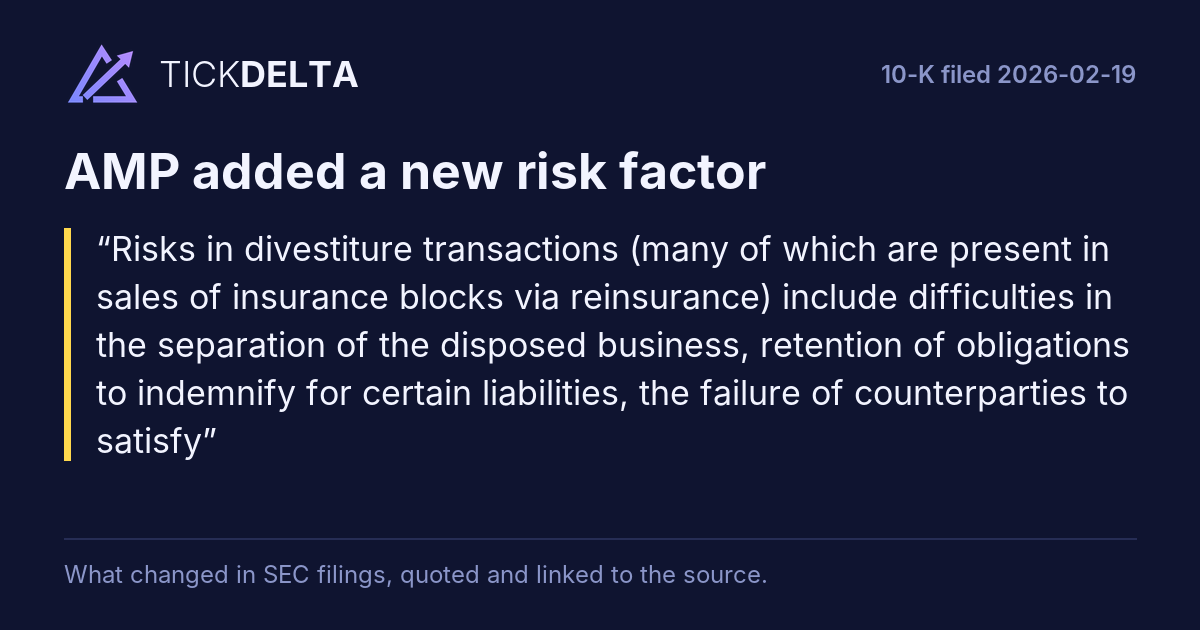
Risks in divestiture transactions (many of which are present in sales of insurance blocks via reinsurance) include difficulties in the separation of the disposed business, retention of obligations to indemnify for certain liabilities, the failure of counterparties to satisfy
Read in the 10-K ↗
14 paragraphs in the 10-Q filed Oct 30, 2026 with nothing like them in the 10-Q filed Aug 4, 2026 (at least half the words must differ; new numbers alone do not count). Quoted exactly, grouped by the item heading above them. This is text that changed, not a judgement of how serious it is.
prospectively. The adoption of the standard will not have an impact on the Company’s consolidated results of operations and financial condition.
Read in the 10-Q ↗
On September 15, 2026, the Company repaid $ 500 million principal amount of its 2.9 % senior notes at maturity.
Read in the 10-Q ↗
and financial covenants. The Company was in compliance with all such covenants as of both September 30, 2026 and December 31, 2025.
Read in the 10-Q ↗
Pretax Income Tax Benefit (Expense) Net of Tax Pretax Income Tax Benefit (Expense) Net of Tax
Read in the 10-Q ↗
Reclassification of net (gains) losses on securities included in net income (2) (6) 1 (5) (11) 2 (9)
Read in the 10-Q ↗
Pretax Income Tax Benefit (Expense) Net of Tax Pretax Income Tax Benefit (Expense) Net of Tax
Read in the 10-Q ↗
Reclassification of net (gains) losses on securities included in net income (2) — — — (1) — (1)
Read in the 10-Q ↗
Net unrealized gains (losses) on derivatives arising during the period — — — (11) 2 (9)
Read in the 10-Q ↗
In the third quarter, we conducted our annual review of life insurance, annuity and long term care (“LTC”) valuation assumptions relative to current experience and management expectations including modeling changes. These annual assumption updates, including model changes, are collectively referred to as unlocking throughout this document. See our Consolidated and Segment Results of Operations sections for the pretax impacts on our revenues and expenses attributable to unlocking.
Read in the 10-Q ↗
discontinued operations; and the impact of consolidating CIEs, best reflect the underlying performance of our core operations and facilitate a more meaningful trend analysis.
Read in the 10-Q ↗
Includes a $3 million net benefit related to the fair value of market risk benefits for the three months ended September 30, 2026 and a $28 million net benefit primarily related to the market impact on IUL benefits for the three months ended September 30, 2025, which is excluded from adjusted operating earnings. Refer to Results of Operations by Segment for the impact to pretax adjusted operating earnings attributable to unlocking.
Read in the 10-Q ↗
The primary drivers of the unlocking impact for the three months ended September 30, 2026 included net unfavorable changes to variable annuity surrender and utilization assumptions, universal life surrender assumptions, and LTC morbidity and mortality assumptions. In the prior year period, the primary driver of the unlocking impact included net unfavorable changes to variable annuity surrender and utilization assumptions, net unfavorable changes in LTC morbidity and mortality assumptions, favorable claims incidence rates on disability insurance, and net favorable model changes primarily related to reinsurance cost estimates and index credits associated with non-traditional insurance products.
Read in the 10-Q ↗
• A decrease in expense from the impact of lower sales of life contingent payout annuities.
Read in the 10-Q ↗
The following table presents the segment pretax adjusted operating impacts on our revenues and expenses attributable to unlocking for the three months ended September 30:
Read in the 10-Q ↗
Item 1A of the 10-Q filed Oct 30, 2026 against Item 1A of the 10-K filed Feb 19, 2026.
A 10-Q repeats only the risks that changed, so a 10-K paragraph that is missing from it is not counted as removed.
Added is a paragraph with nothing like it in the 10-K, Reworded a sentence that is in both with several words changed,
Quiet changes a sentence in both where one to four words changed and one is a hedge or a modal
(cut words struck through, new words highlighted and underlined).
Text on the page, not a score; each links to the filing at sec.gov.
Work on AMP in a spreadsheet:
Excel workbook (a sheet per section, ten years by column, charts, links to the filings) ·
CSV.
For a Google Sheet that stays up to date, paste =IMPORTDATA("https://tickdelta.com/company/AMP/export.csv") into a cell.