tickdelta
Sign in

Tickdelta is free for now. Sign up and get Pro free

← Screener

AMTAmerican Tower

Real estate · REIT · NYSE
Compare with peers → Embed

When the SEC's staff reviews a filing, it writes to the company with numbered questions, and the company answers each one in a letter. SEC publishes the exchange once the review is over, at least 20 business days later. Below: what the staff asked AMT, and the company's answer to each question, quoted from the letters. A question is not an accusation; most reviews end with the company adding detail to its next filing.

Form 10-K for the year ended December 31, 2022

2023-03-07 to 2023-04-07 · 1 question · 1 letter from the SEC, 2 from the company
Review closed 2023-04-07
Liquidity and cash
Notes to Consolidated Financial Statements
SEC asked
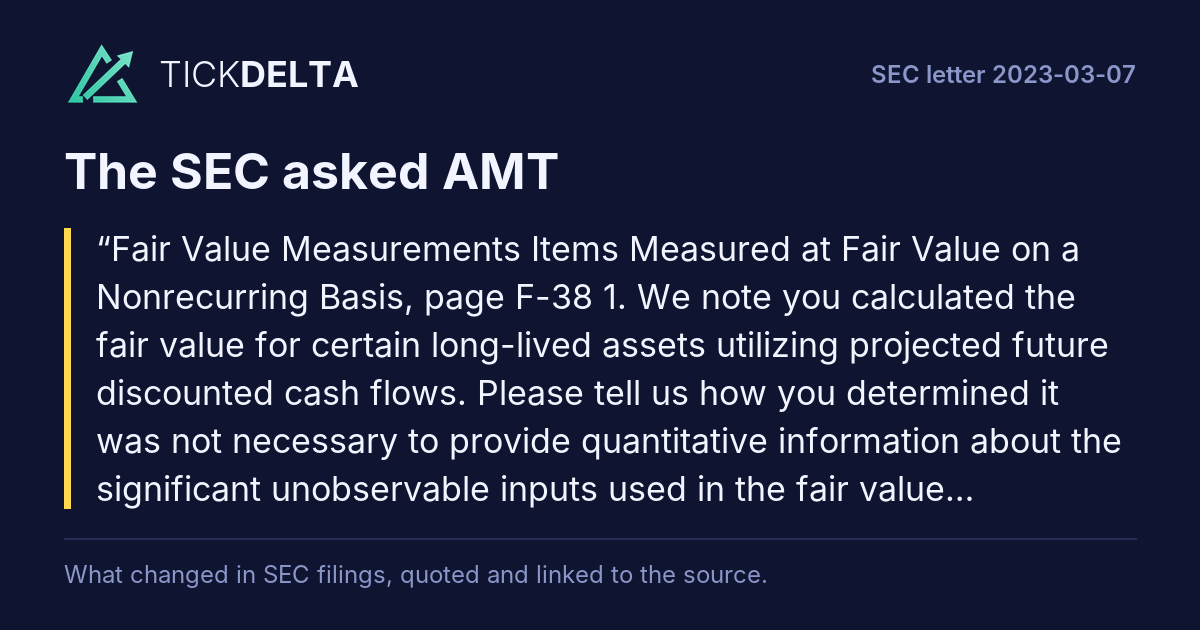
Fair Value Measurements Items Measured at Fair Value on a Nonrecurring Basis, page F-38 1. We note you calculated the fair value for certain long-lived assets utilizing projected future discounted cash flows. Please tell us how you determined it was not necessary to provide quantitative information about the significant unobservable inputs used in the fair value measurement of these assets.
Rest of the question

Please refer to ASC 820-10-50-2(bbb). We remind you that the company and its management are responsible for the accuracy and adequacy of their disclosures, notwithstanding any review, comments, action or absence of action by the staff.

AMT answered
The Company reviews its tangible assets and intangible assets subject to amortization on an annual basis, or more frequently if indicators of impairment are present. This review is conducted on an individual site location basis, which can include multiple assets and asset classes, on approximately 225,000 sites in over 25 countries.
Rest of the answer

In those instances in which the tangible or intangible assets are determined to not be recoverable in connection with such review, the Company determines the amount of impairment by applying the fair value concepts in ASC 820 Fair Value Measurement, as prescribed by ASC 360 Property, Plant and Equipment and ASC 350 Intangibles – Goodwill and Other.

While the methodologies employed in determining the fair value of impaired assets are consistent across each of the countries in which the Company operates, the unobservable inputs used can vary across the same class of assets, and as a result, there is no single value, but a range of values utilized in these determinations. The primary unobservable inputs include growth, if any, on contractual revenues existing at the measurement date, the terminal growth rate of the cash flows for the tower and network location assets, and a country-specific weighted average cost of capital with respect to the assets subject to fair value measurement as a result of impairment testing. Terminal growth rates are not used in the valuation of tenant-related intangible assets. Within each class of assets (tangible and intangible assets) only those assets for which an impairment has been recorded are subject to fair value remeasurement, while all others are reflected at historical cost, therefore, only a small subset of each asset class is subject to fair value measurement.

We did not provide quantitative information about the significant unobservable inputs used in the fair value measurement of the impaired assets, as any reasonable change in any of the unobservable inputs would not significantly impact the fair value of the assets reviewed and the resultant impairment taken, either individually or in the aggregate, beyond what was reported. For context, in 2022, while we disclose the total carrying value of $46.1 billion of the assets that had been subject to our impairment review, approximately $0.8 billion had been remeasured using fair value (approximately 2%), which were subsequently written down to approximately $0.2 billion.

The following table shows the percentage of the carrying value of each category of assets, as of December 31, 2022 and December 31, 2021, that were subsequently remeasured to fair value during the respective years:

2022 2021

Towers and related assets 1% 1%

Acquired network location intangible assets 2% 1%

Acquired tenant-related intangible assets 5% <1%

In response to the Staff’s comment, we will expand our disclosure in future filings in a manner similar to the disclosure set forth below, in order to provide additional context to the types and subjectivity of the unobservable inputs used, as well as information around the sensitivity of changes in inputs on the impairment recorded. The following disclosure is based on the disclosure included in our most recent Form 10-K, and the supplemental disclosure to be included in future filings has been marked in bold.

Items Measured at Fair Value on a Nonrecurring Basis

Assets Held and Used—The Company’s long-lived assets are recorded at amortized cost and, if impaired, are adjusted to fair value using Level 3 inputs.

During the year ended December 31, 2022, certain long-lived assets held and used with a carrying value of $46.1 billion included assets of approximately $0.8 billion that were written down to their net realizable value of approximately $0.2 billion as a result of an asset impairment charge of $655.9 million. During the year ended December 31, 2021, certain long-lived assets held and used with a carrying value of $49.0 billion included assets of $0.2 billion that were written down to their net realizable value of less than $0.1 billion as a result of an asset impairment charge of $173.7 million. The asset impairment charges are recorded in Other operating expenses in the accompanying consolidated statements of operations. These adjustments were determined by comparing the estimated fair value of the subject assets utilizing projected future discounted cash flows to be provided from the long-lived assets to the asset’s carrying value. The significant unobservable inputs used to determine the fair value of the individual tower and acquired network location intangible assets subject to impairment in 2022 included assumptions with respect to net growth in existing operating revenues, if any, terminal growth rates on cash flows of approximately 3% to 7%, on a local currency basis, with a weighted average of approximately 3%, and the weighted average cost of capital specific to the country of each impaired asset, which ranged from 5.9% to 34.9%, with a weighted average of 12.7%. The majority of the tenant relationships measured at fair value for impairment purposes in 2022 utilized a weighted average cost of capital of 14.9%; however, terminal growth rates are not used in the valuation of acquired tenant-related intangible assets. The table below indicates the percentages of the asset class that were subject to fair value measurement and subsequently impaired:

The Company believes any reasonable change in the significant unobservable inputs utilized would not have a material impact on the fair value of the assets used in connection with the impairment recorded.

There were no other items measured at fair value on a nonrecurring basis during the year ended December 31, 2022.

To the extent the classes of assets measured at fair value change we will update the disclosure accordingly.

* * * *

If you require additional information, please do not hesitate to contact the undersigned at 781-926-7863 or Robert J. Meyer at 617-585-7747.
Read in the reply ↗

Also in this review: company letter, 2023-03-28, closing letter, 2023-04-07
Form 10-K for the fiscal year ended December 31, 2017

2018-03-19 to 2018-04-02 · 1 question · 1 letter from the SEC, 1 from the company
Review closed 2018-04-02
RevenueResults discussion (MD&A)Acquisitions
Item 7. Management’s Discussion and Analysis Of Financial Condition and Results of · Operations
SEC asked
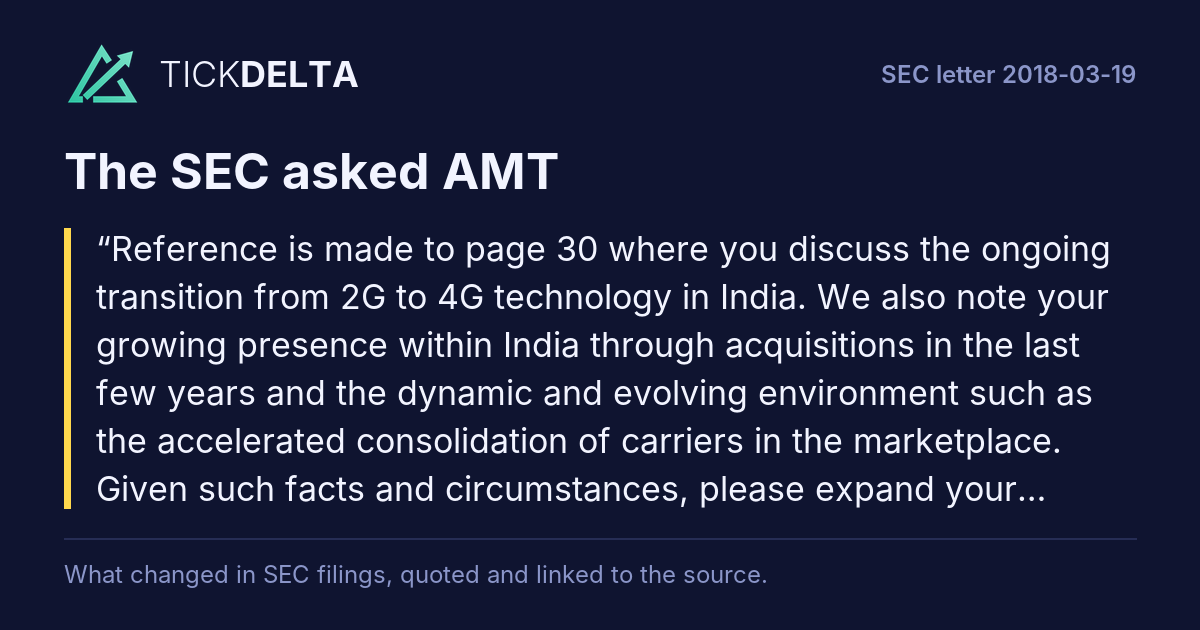
Reference is made to page 30 where you discuss the ongoing transition from 2G to 4G technology in India. We also note your growing presence within India through acquisitions in the last few years and the dynamic and evolving environment such as the accelerated consolidation of carriers in the marketplace.
Rest of the question

Given such facts and circumstances, please expand your discussion in future filings to include a more robust discussion and analysis of any known trends or uncertainties related to the current Indian marketplace and its reasonably expected impact upon your operations and any events that are likely to cause a material change in the relationship between costs and revenues. Reference is made to Rule 303(a)(3)(ii) of Regulation S-K and SEC Interpretive Release 33-8350 “Interpretation: Commission Guidance Regarding Management's Discussion and Analysis of Financial Condition and Results of Operations”.

AMT answered
We acknowledge the Staff’s comment and in response will clarify and expand our disclosures to include more detail, to the extent material, commencing with our Quarterly Report on Form 10-Q for the quarter ended March 31, 2018.

Further, we respectfully submit to the Staff that the existing disclosure in the Form 10-K includes a discussion and analysis of the material trends or uncertainties related to the current Indian marketplace and their reasonably expected impacts on our operations.
Rest of the answer

For example, in addition to the discussion noted by the Staff on page 30 of the Form 10-K, on page 28, we disclose that “[w]e do anticipate an increase in revenue lost from cancellations or non-renewals in 2018 primarily due to carrier consolidation-driven churn in Asia, which is likely to result in a modestly higher impact on our revenues, including tenant billings, as compared to the historical average.” (We note that India currently comprises the entirety of the Asia segment.) Furthermore, on pages 53-54, we discuss certain critical accounting estimates that were and could be further impacted by the carrier consolidation in India. We based this disclosure on the facts and circumstances known at the time, will continue to monitor changes in the marketplace and factor those changes, if any, into our estimates.

We propose to revise our disclosure to be substantially similar to the following, with proposed revisions indicated in bold and italics and deletions indicated in strikethrough, subject to changes to reflect then-current market conditions and expectations:

On page 28:

“We do anticipate an increase in revenue lost from cancellations or non-renewals in 2018 primarily due to carrier consolidation-driven churn in Asia India, which is likely to result in a modestly higher impact on our revenues, including tenant billings, as compared to the historical average, particularly in our Asia property segment. We also expect this churn will compress our gross margin and operating profit for the duration of the carrier consolidation process, particularly in our Asia property segment, although we expect this to be partially offset by lower expenses due to reduced tenancy on existing sites. In addition, we expect to periodically evaluate the carrying value of our Indian assets, which may result in the realization of impairment expense or other similar charges. For more information, please see Item 7 of our Annual Report on Form 10-K for the year ended December 31, 2017 under the caption “Management’s Discussion and Analysis of Financial Condition and Results of Operations-Critical Accounting Policies and Estimates.”

[For the quarter ended [March 31], 2018, Indian carrier consolidation-driven churn negatively impacted our consolidated property revenue by $[•] million, including approximately $[•] million in pass through revenue, and negatively impacted our gross margin and operating profit margin by [•] and [•] basis points, respectively.] [To be included to the extent material]

On page 30:

“In India, the ongoing transition from 2G technology to 4G technology has included and is expected to continue to include a period of carrier consolidation over the next several years, whereby the number of carriers operating in the marketplace will be reduced through mergers, acquisitions and select carrier exits from the marketplace. Over the long term, this consolidation process is expected to result in a more favorable structural environment for both the wireless carriers as well as communications infrastructure providers. In the shorter term, the consolidation process has resulted and is likely to further result as discussed above, we expect the consolidation process to continue to result in elevated levels of churn within our India business, as certain components of the combined carrier networks and carrier exits are decommissioned to allow for a more robust 4G deployment in the future as merging carriers rationalize redundant legacy equipment installations and as select carriers exit the marketplace.”

* * * *

If you require additional information or would like to discuss, please telephone the undersigned at (617) 375-7500.

Read in the reply ↗
In its next report

First report after the company's reply of 2018-03-30: 10-Q filed 2018-05-02 ↗, against the 10-Q filed 2017-10-31 ↗.

Tickdelta does not hold the text of both reports, so they are not compared here.

Also in this review: closing letter, 2018-04-02

From the SEC's correspondence on EDGAR: staff letters (form UPLOAD) and company letters (form CORRESP), 7 letters filed since 2018-03-19. Questions and answers are matched by their numbers; topics come from words in each question. The reports are compared word for word (same form, before the first SEC letter against the first report after the company's reply). No AI.

Next in Owners and insiders Insider trades →

Work on AMT in a spreadsheet: Excel workbook (a sheet per section, ten years by column, charts, links to the filings) · CSV. For a Google Sheet that stays up to date, paste =IMPORTDATA("https://tickdelta.com/company/AMT/export.csv") into a cell.