Abercrombie & Fitch Co ANF
New risk paragraphs, branching off last year
Each branch is a paragraph in Risk Factors with nothing like it in the 10-K filed Mar 31, 2025. A box jumps to the paragraph as filed, below.
Paragraphs with nothing like them in last year's 10-K
20 paragraphs in Risk Factors of the 10-K filed Mar 26, 2026 with nothing like them in the 10-K filed Mar 31, 2025. Quoted exactly. Paragraphs that were only edited are under 10-K change.
•Effectively marketing our products to consumers across varying demographic markets, including through social media platforms, search engines, and emerging AI-enabled discovery;
•Effectively identifying, evaluating, and competing on new and emerging digital selling platforms and commerce models, including social commerce platforms and AI‑enabled or agentic shopping experiences;
Because we primarily serve individual consumers, our business is sensitive to changes in consumer confidence and discretionary spending levels. In addition, as a global business that sources a significant portion of our merchandise from outside the United States and generates revenue across domestic and international markets, we are exposed to macroeconomic conditions, trade policies, and currency fluctuations that may affect costs and demand across regions.
Our retail stores, corporate offices, distribution centers, and digital operations, as well as the operations of our vendors and manufacturers, are vulnerable to disruption from natural disasters and other adverse weather events; negative climate patterns; public health crises; geopolitical uncertainty or unrest, such as acts of terrorism, war, civil disturbance or disobedience, and other political instability; power interruptions or infrastructure disruptions; and other catastrophic events. In the past, events of this nature, including public health crises and geopolitical conflict, have disrupted commerce, and future occurrences of such events, whether domestic or international, could similarly disrupt commerce and adversely affect our operations.
Events of this nature may also undermine consumer confidence and consumer spending, and adversely affect our operating results by causing, among other things, loss of customers and revenues due to store closures or an inability to respond to customer demand, increased costs to meet consumer demand (which we may not be able to pass on to customers), reduced consumer demand or confidence, and changes in consumers’ discretionary spending habits. In addition, historically, our operations have been seasonal, and natural disasters, adverse weather conditions, or unseasonable weather patterns occurring , may diminish demand for our seasonal merchandise and influence consumer preferences, fashion trends, consumer traffic, and shopping habits.
•Reduced consumer demand or customer traffic to our stores in certain regions due to actual or perceived risks arising from geopolitical instability, armed conflict, or other catastrophic events;
Show the other 7
•hiring, training, and retaining qualified personnel and maintaining effective labor relations, including in regions where associates are represented by workers’ councils and unions;
•the substantial investments of time and resources we make to operate in international markets may not achieve acceptable returns, and sustained declines in revenue or profitability in one or more international regions or operating segments could result in store closures, divestitures, restructuring costs, or impairment losses, all of which could adversely impact our business, profitability, and results of operations; for example, in March 2026, we announced that we are conducting a review of strategic alternatives for our APAC region.
Our reputation also depends on the success of our corporate social responsibility and sustainability initiatives, which require Company-wide coordination and alignment on managing related risks and costs and may ultimately not be successful. Increased focus by governmental and nongovernmental organizations, regulators, investors, employees, and consumers on matters such as climate change, human capital, labor, and risk oversight heightens the risk of negative public reaction, public backlash, or pressure regarding our disclosures, initiatives, products, or practices related to sustainability or social issues, which could adversely affect our reputation, business operations, and financial results. These risks also include increased regulatory and stakeholder pressure to expand disclosures, make commitments, set targets, or establish additional goals and take actions to meet them, which could expose us to business, legal, market, reputational, operational, and execution risks and costs. If we announce such initiatives or goals, we may fail, or be perceived to fail, to appropriately set, timely meet, or report our progress, or act responsibly with respect to such initiatives or goals. In addition, divergent stakeholder perspectives regarding environmental, social, and governance, and other corporate responsibility matters, may result in criticism of the nature, scope, or revision of our initiatives or goals, and we may not be able to satisfy all expectations, potentially leading to negative publicity, consumer backlash (including boycotts), and adverse impacts on our reputation, results of operations, financial condition, and cash flows.
If our information technology systems are disrupted or fail to operate effectively, or if we are unable to successfully implement new technology, including significant system upgrades, our business and results of operations could be adversely affected.
We have made and expect to continue to make significant investments of capital, time, and management attention to modernize our core systems, and the effectiveness of these investments may be less predictable than others and may fail to deliver the anticipated benefits or returns. As part of these efforts, we began a multi‑year process to upgrade our merchandising ERP system and to implement a new human capital management system. In March 2026, we went live with a new merchandising ERP system. The transition to the new system temporarily impacted operations, including limiting inventory receipts and movement across the business, which is expected to unfavorably affect net sales during the first quarter of Fiscal 2026. We also expect to incur additional implementation‑related costs, which are expected to unfavorably impact our operating margin during the first quarter of Fiscal 2026.
Additional system upgrades and transformation activities are expected to continue in phases over the next few years. System upgrades and implementations involve inherent risks, including system disruptions, inaccurate system information, changes to internal control processes, increased operating and administrative costs, demands on management time, and challenges with user adoption. Any failure, disruption, or delay in implementing or operating new or upgraded systems, particularly during peak selling periods, could adversely impact our ability to manage our inventory, fulfill customer orders, or it may cause information to be lost or delayed, including data related to customer orders. Such investments may not provide the anticipated benefits or desired rates of returns.
Additionally, we rely on third-party vendors and platforms for certain information technology processes, including point-of-sale, digital operations, inventory management, supply chain, planning, sourcing, merchandising, payroll, scheduling, financial reporting, and managing third-party relationships, including our brand representatives and influencer network, and our wholesale, franchise licensing, or marketplace partners. This reliance increases our exposure to failures by such third parties to perform adequately or maintain effective internal controls, which could disrupt our operations or adversely affect our business.
Use of artificial intelligence technologies by us and our service providers could subject us to operational, technological, and business risks that could adversely affect our business.
The use of rapidly evolving technologies, such as AI technologies, by us and our third-party service providers presents risks and challenges to our business. Using AI and other machine learning technologies may expose us to unintended outcomes, liability, reputational harm, particularly if such technology produces errors or hallucinations, results in content that is biased, infringes on intellectual property, or otherwise does not function as intended. Moreover, with the use of certain AI and other machine learning technologies, including those licensed from third parties, there may be a lack of transparency regarding how such technologies generate outputs, and we may not be able to fully validate their accuracy or reliability. To the extent that we rely on AI‑enabled tools to support operational processes or decision‑making, limitations in model performance, data quality, or human oversight could adversely affect our operations, customer experience, or financial performance.
The use of AI and other machine learning technologies, by us or our service providers, in connection with the creation or development of intellectual property may present challenges in asserting ownership over the resulting output. Further, the use of such technologies may increase the risk that confidential information becomes accessible by third parties or results in legal or regulatory exposure. We also rely on third-party service providers that may use AI in their business activities, and failures by one or more of such service providers to meet our expectations may have an adverse effect on our operations or financial condition.
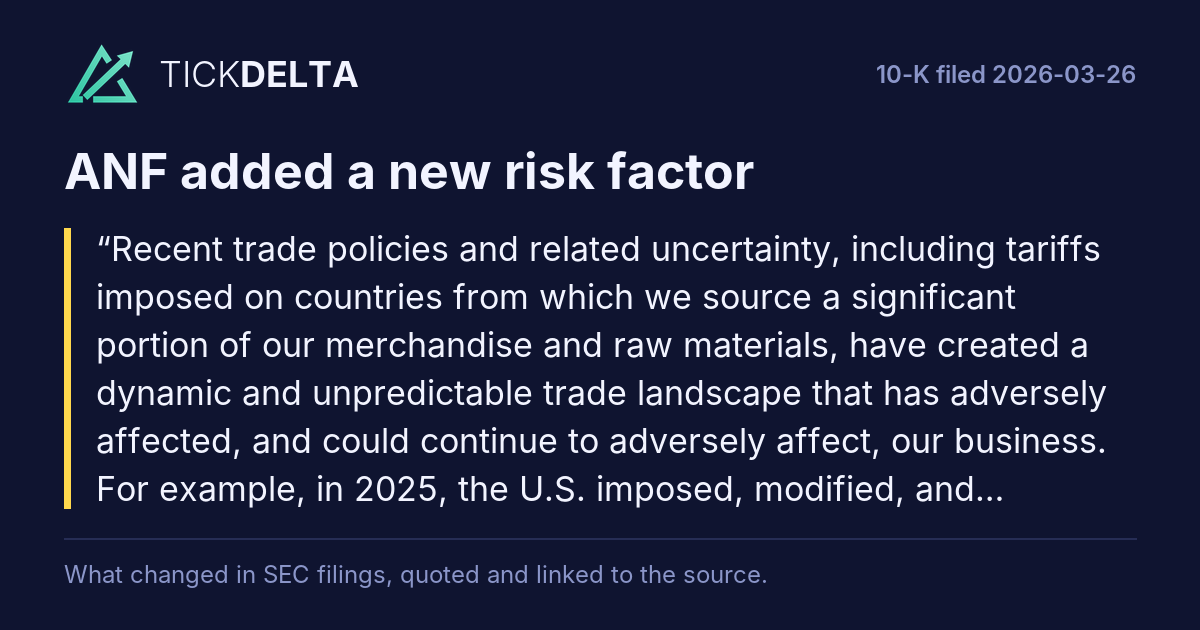
Recent trade policies and related uncertainty, including tariffs imposed on countries from which we source a significant portion of our merchandise and raw materials, have created a dynamic and unpredictable trade landscape that has adversely affected, and could continue to adversely affect, our business. For example, in 2025, the U.S. imposed, modified, and rescinded certain tariffs, including those pursuant to the International Emergency Economic Powers Act (“IEEPA”). In February 2026, the U.S. Supreme Court held that IEEPA did not authorize the imposition of such tariffs, and subsequently the U.S. administration continued to impose, modify, and propose new tariffs pursuant to various statutes and trade authorities, including the imposition of a 10% global tariff pursuant to Section 122 of the Trade Act of 1974. While certain tariffs have been struck down, modified, or replaced, other tariffs remain in effect, and additional tariff programs may be imposed in the future through various statutes and trade authorities. In addition, there can be no assurance that any duties paid under tariffs that are subsequently struck down, including those imposed pursuant to the IEEPA, will be refunded in whole or in part, or that any such refunds would be received on a timely basis, if at all.
In addition, certain countries have imposed retaliatory tariffs on U.S. exports, and other U.S. trading partners may take additional retaliatory measures or modify their trade or business policies in response to changes in U.S. trade policy, which could further disrupt global trade flows and adversely affect our business.
It is likely that tariffs and international trade arrangements will continue to change, potentially without warning and to an extent or duration that is difficult to predict. Changing tariff rates and shifting trade policies have created, and may continue to create, significant uncertainty for suppliers, consumers, and us, and these risks may be heightened if trade tensions between the U.S. and other countries worsen. If tariffs on goods from countries from which we source products are increased or maintained at elevated levels, our merchandise costs would remain higher relative to typical costs, which could negatively impact our margins and consumer demand for our products. In response to increased costs, we may choose to adjust pricing or promotions or take other actions, which could adversely affect customer demand or our competitive position. Moreover, tariff-related cost pressures and supply chain disruptions may lead to reputational harm if we are unable to deliver our products or services on expected
Although such changes have implications across the entire industry, we may fail to effectively adapt to and manage the adjustments in strategy that would be necessary in response to these developments. We continue to evaluate and implement measures to mitigate the impact of current and potential tariffs, including managing product costs, considering operating expense reductions, and pursuing average unit retail (“AUR”) growth. However, these mitigation efforts may take time to implement and take effect, may involve additional costs, may not be accepted by consumers, and may not be sufficient to offset the full impact of tariffs.
Paragraphs in the 10-Q filed Sep 4, 2026 that were not in the one before
New in the latest 10-Q
13 paragraphs in the 10-Q filed Sep 4, 2026 with nothing like them in the 10-Q filed Jun 5, 2026 (at least half the words must differ; new numbers alone do not count). Quoted exactly, grouped by the item heading above them. This is text that changed, not a judgement of how serious it is.
Financial statements and notes
During the second quarter of Fiscal 2025, the Company entered into a settlement related to the resolution of a payment card interchange fee litigation in which it was a plaintiff. The settlement resulted in a $ 39 million net benefit recorded in the Condensed Consolidated Statements of Operations and Comprehensive Income for the thirteen and twenty-six weeks ended August 2, 2025. The net benefit is comprised of a $ 43 million settlement benefit recorded within selling expense and a $ 4 million settlement-related expense recorded within general and administrative expense.
Read in the 10-Q
During the thirteen weeks ended August 1, 2026, the Company recognized approximately $ 100 million in refunds plus accrued interest of $ 3 million of IEEPA tariffs previously paid. The refunds received were reflected as a reduction of cost of sales, with the accrued interest reflected in interest income in the Condensed Consolidated Statements of Operations and Comprehensive Income. Subsequent to August 1, 2026, the Company received approximately $ 18 million in refunds related to IEEPA tariffs, of which approximately $ 4 million had been recognized as a receivable as of the end of the second quarter of 2026. The remaining $ 14 million received will be reflected as a reduction of cost of sales in the third quarter of 2026, with accrued interest reflected in interest income, in the Condensed Consolidated Statements of Operations and Comprehensive Income.
Read in the 10-Q
During the thirteen weeks ended August 1, 2026, the Company recognized approximately $100 million in refunds plus accrued interest of $3 million of IEEPA tariffs previously paid. The refunds received were reflected as a reduction of cost of sales, with the accrued interest reflected in interest income in the Condensed Consolidated Statements of Operations and Comprehensive Income. Subsequent to August 1, 2026, the Company received approximately $18 million in refunds related to IEEPA tariffs, of which approximately $4 million had been recognized as a receivable as of the end of the second quarter of 2026. The remaining $14 million received will be reflected as a reduction of cost of sales in the third quarter of 2026, with accrued interest reflected in interest income, in the Condensed Consolidated Statements of Operations and Comprehensive Income.
Read in the 10-Q
• Operating (loss) not attributed to segments increased primarily related to an increase in employee compensation and technology costs.
Read in the 10-Q
• Operating (loss) not attributed to segments increased primarily related to an increase in employee compensation and technology costs.
Read in the 10-Q
Show the other 8
(1) The tax effect of pre-tax excluded items is the difference between the tax provision calculation on a GAAP basis and on an adjusted non-GAAP basis. Refer to “NON-GAAP FINANCIAL MEASURES,” for details of pre-tax excluded items.
Read in the 10-Q
(1) Excluded items presented above under “Operating income,” and “Income tax expense.” Refer to “NON-GAAP FINANCIAL MEASURES” for further details.
Read in the 10-Q
(1) Excluded items presented above under “Operating income” and “Income tax expense”.
Read in the 10-Q
The following financial measures are disclosed on a GAAP and on an adjusted non-GAAP basis excluding the following items, as applicable:
Read in the 10-Q
Financial measures (1) Excluded items Selling expense Litigation Settlement General and administrative expense Legal fees in connection with the Litigation Settlement Operating income Litigation Settlement, net of legal fees Income tax expense (2) Tax effect of pre-tax excluded items Net income and net income per share attributable to A&F (2) Pre-tax excluded items and the tax effect of pre-tax excluded items
Read in the 10-Q
(1) Certain of these financial measures are also expressed as a percentage of net sales.
Read in the 10-Q
(2) The tax effect of excluded items is the difference between the tax provision calculation on a GAAP basis and on an adjusted non-GAAP basis.
Read in the 10-Q
(2) Excluded item consists of the favorable Litigation Settlement, net of legal fees
Read in the 10-Q
The 10-Q's risk factors against the 10-K
Item 1A of the 10-Q filed Sep 4, 2026 against Item 1A of the 10-K filed Mar 26, 2026.
A 10-Q repeats only the risks that changed, so a 10-K paragraph that is missing from it is not counted as removed.
Added is a paragraph with nothing like it in the 10-K, Reworded a sentence that is in both with several words changed,
Quiet changes a sentence in both where one to four words changed and one is a hedge or a modal
(cut words struck through, new words highlighted).
Text on the page, not a score; each links to the filing at sec.gov.
What the 10-Q itself says about its risk factors:The Company’s risk factors as of August 1, 2026 have not changed materially from those disclosed in Part I, “Item 1A. Risk Factors” of the Fiscal 2025 Form 10-K.
Read in the 10-Q
1 paragraph in the 10-Q's Item 1A, and none of them adds, rewords or quietly edits a paragraph of the 10-K's.
Phrases used for the first time
Two-word phrases in Risk Factors of the 10-K filed Mar 26, 2026 that are in none of the 1 earlier 10-Ks stored, back to Mar 31, 2025
Where each one is used
- international markets: Because we primarily serve individual consumers, our business is sensitive to changes in consumer confidence and discretionary spending levels. In addition, as a global business that sources a significant portion of our merchandise from outside the United States and generates revenue across domestic and...
- system upgrades: If our information technology systems are disrupted or fail to operate effectively, or if we are unable to successfully implement new technology, including significant system upgrades, our business and results of operations could be adversely affected.
- learning technologies: The use of rapidly evolving technologies, such as AI technologies, by us and our third-party service providers presents risks and challenges to our business. Using AI and other machine learning technologies may expose us to unintended outcomes, liability, reputational harm, particularly if such technology produces...
- social commerce: The sale of apparel, personal care products and accessories for men, women and kids is a highly competitive business with numerous participants, including individual and chain specialty apparel retailers, local, regional, national and global department stores, discount stores, fast-fashion retailers,...
- net sales: Uncertainty as to, and the state of, the global economy and global financial condition could have an adverse effect on our operating results and business. Our business is subject to factors that are impacted by worldwide economic conditions, including heightened inflation levels (which has occurred), unemployment...
- crises geopolitical: The impact of natural disasters, negative climate patterns, public health crises, geopolitical tension, armed conflict, acts of terrorism, social unrest, civil disturbance or disobedience, political crises, and other unexpected and catastrophic events could result in interruptions to our operations, as well as to...
- increased fuel: These events could disrupt the operations of our corporate offices, global stores, and supply chain and those of our third-party partners, including our vendors and manufacturers. In addition to impacts on global operations, events of this nature could result in a reduction in the availability and quality, and as a...
- corporate social: •Our position or perceived lack of position on corporate social responsibility topics, public policy or other similar issues and any perceived lack of transparency about those matters.
Used at least twice, small words left out. Counted, not picked: a phrase can be new because the company renamed something.
What was taken out
20 paragraphs of last year's Risk Factors with nothing like them now. The longest are quoted.
Sources
Item 1A of each 10-K and 10-Q on EDGAR, quoted exactly. Each paragraph links to the filing at sec.gov.
Also
10-K change: what was reworded or cut, section by section.
Work with it
Excel workbook · CSV. Google Sheet that stays up to date: paste =IMPORTDATA("https://tickdelta.com/company/ANF/export.csv") into a cell.