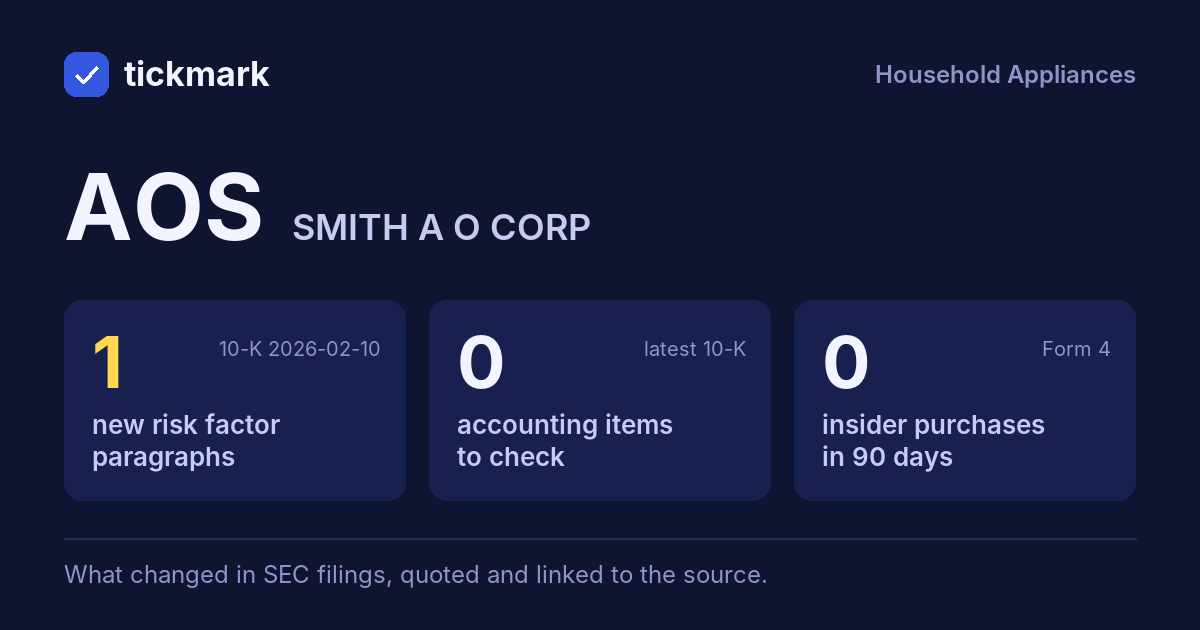
10-K 0000091142-26-000008 (2026-02-10) vs 10-K 0000091142-25-000036 (2025-02-11)
| Section | Compared text | Words now | Changed |
|---|
| Risk Factors | Item 1A | 4,790 |
5.8% |
| MD&A | Item 7 | 5,105 |
22.2% |
| Legal Proceedings | Item 3, via Note 15 – Commitments and Contingencies | 549 |
8.6% |
| Accounting Policies | Item 8, Note 1 – Organization and Significant Accounting Policies | 2,224 |
7.2% |
The redline: what was cut and what was added
In each section, the paragraph that changed most, marked against last year's 10-K:
cut words struck through, new words highlighted and underlined.
MD&A 338 words changed in this paragraph; it is 34% similar to last year's version.
In our North America segment, we saw soft residential and commercial water heater order demand sales increased one percent in the second half of 2025 compared to 2024 after a strong first half of the year. as pricing benefits and higher commercial volumes were partially offset by lower wholesale residential volumes. We believe estimate that a pre-buy ahead of our March 1st price increase pulled forward some demand into the first half of the year. We also believe our second half order demand was negatively impacted by our improved lead times. Those factors along with caution around softening of end market demand may have driven some customers to reduce their inventory levels. 2024 2025 residential industry unit volumes were approximately flat compared to the prior year and we project 2025 2026 industry residential unit volumes will be flat as well. Proactive replacement has been above historical levels for the last several years and we project that will continue to down, driven by softness in 2025. We believe that new home construction remains in a deficit and will be flat compared to 2024. construction. We anticipate that commercial water heater industry volumes will increase mid-single digits in 2026 after growing approximately five percent in 2025. We believe that the 2026 growth will come from the buy ahead of products that will be approximately flat eliminated as a part of the DOE regulatory change for commercial water heaters that will take effect in October 2026. In response to higher steel and other input costs, including tariffs, we announced price increases on most of our water heater and boiler products in the first half of 2025. In addition to pricing, we continue to mitigate the impact of tariffs through footprint optimization, strategic sourcing actions and other cost containment initiatives. Our boiler sales grew eight percent in 2025 after minimal growth in 2024 driven by growth in commercial electric water heaters greater than 55 gallons which was offset by lower shipments of commercial gas water heaters. primarily due to higher volumes and pricing benefits. We expect our boilers boiler sales to grow between three six and five eight percent in 2025 compared 2026 due to 2024 as we continue to benefit from the transition to higher carryover pricing benefits and continued demand for our commercial high efficiency condensing gas boilers. We anticipate sales of our North America water treatment products will be grow between $235 million 10 and $245 million, a year-over-year decrease of approximately five 12 percent primarily due to tariff-related pricing benefits and as we de-emphasize certain channels and focus on continue to expand our more profitable channels. dealer network.
Source: Item 7, 10-K 0000091142-26-000008 vs Item 7, 10-K 0000091142-25-000036
Risk Factors 86 words changed in this paragraph; it is 84% similar to last year's version.
In the ordinary course of business, we utilize information systems for day-to-day operations, to collect and store sensitive data and information, including our proprietary and regulated business information and personally identifiable information of our customers, suppliers and business partners, as well as personally identifiable information about our employees. Our information systems are susceptible to outages due to system failures, cybersecurity threats, failures on the part of third-party information system providers, natural disasters, power loss, telecommunications failures, viruses, fraud, theft, malicious actors or breaches of security. Like many companies, we, and some third parties upon which we rely, have experienced cybersecurity incidents and attacks on information technology networks and systems, products and services in the past but, to date, none have resulted in a material breach or had a material adverse impact on our financial condition, results of operations, or cash flows. We may experience such incidents and attacks in the future, potentially with increasing frequency from increasingly sophisticated cyber threats. In addition, remote work and remote access to our systems have increased in recent years, which may heighten these risks. Use of artificial intelligence software may also create risks from unintentional disclosure of proprietary, confidential, personal or otherwise sensitive information. Although we have a response plan in place in the event of a data breach and we have an active program to maintain and improve data security and address these risks and uncertainties by implementing and improving internal controls, security technologies, insurance programs, network and data center resiliency and recovery processes, a successful attack in the future could result in operations failure or breach of security that could lead to disruptions of our business activities and the loss or disclosure of both our and our customers’ financial, product and other confidential information and could result in regulatory actions, significant expense and litigation and have a material adverse effect on our financial condition, results of operations and cash flows and our reputation.
Source: Item 1A, 10-K 0000091142-26-000008 vs Item 1A, 10-K 0000091142-25-000036
Accounting Policies 66 words changed in this paragraph; it is 66% similar to last year's version.
In December 2023, the FASB amended ASC 740 (issued under ASU 2023-09, “Improvements to Income Tax Disclosures”). This ASU requires added disclosures related to the tax rate reconciliation and income taxes paid and includes other amendments intended to improve effectiveness and comparability. The amendment update is effective for the Company beginning with its 2025 annual disclosures with early adoption permitted and should be applied on interim periods beginning in 2026. As a prospective basis. result of adoption, income tax disclosures for prior periods presented have been revised to conform to the new disclosure requirements. The Company is currently evaluating the impact the adoption of ASU 2023-09 will have on did not affect the Company’s financial position or its annual results of operations. Refer to Note 14, Income Taxes, for additional disclosures.
Source: Item 8, Note 1 – Organization and Significant Accounting Policies, 10-K 0000091142-26-000008 vs Item 8, Note 1 – Organization and Significant Accounting Policies, 10-K 0000091142-25-000036
Legal Proceedings 27 words changed in this paragraph; it is 81% similar to last year's version.
The Provider is required to indemnify the Company for any losses the Company would incur in the event of an inventory repurchase under these arrangements. Potential losses under the repurchase arrangements represent the difference between the repurchase price and net proceeds from the resale of product plus costs incurred in the process, less related distributor rebates. As of December 31, 2025, the Company terminated the arrangement with the Provider. Existing loan balances will be paid down throughout 2026 with no new loans offered.
Source: Item 3, via Note 15 – Commitments and Contingencies, 10-K 0000091142-26-000008 vs Item 3, via Note 16 – Commitments and Contingencies, 10-K 0000091142-25-000036
Every change, by type
Sentences and paragraphs of AOS's Risk Factors and MD&A, 10-K 2026-02-10 against 10-K 2025-02-11.
Each links to the text at sec.gov.
Quiet changes are sentences kept from last year with one to four words changed, at least one of them a hedge, a modal or a qualifier
(may, could, will, not, significant, material…). A year or date rolling forward is not counted.
The full word list
adverse, adversely, all, although, anticipate, anticipates, any, approximately, believe, believes, can, cannot, certain, could, expect, expects, generally, however, if, intend, intends, largely, likely, many, material, materially, may, might, most, must, never, no, not, possible, primarily, probable, should, significant, significantly, some, substantial, substantially, unlikely, will, would
AddedRisk Factors
In 2025, we announced a strategic assessment of our China business. This may lead to uncertain outcomes, costs, and impacts that could negatively affect the company. The announcement might also cause uncertainty among employees, customers, suppliers, and investors that could have a material adverse effect on our financial position, results of operations and cash flows.
Read it in 10-K 2026-02-10 at sec.gov ↗
RemovedRisk Factors
In the ordinary course of business, we utilize information systems for day-to-day operations, to collect and store sensitive data and information, including our proprietary and regulated business information and personally identifiable information of our customers, suppliers and business partners, as well as personally identifiable information about our employees. Our information systems are susceptible to outages due to system failures, cybersecurity threats, failures on the part of third-party information system providers, natural disasters, power loss, telecommunications failures, viruses, fraud, theft, malicious
Read it in 10-K 2025-02-11 at sec.gov ↗
RewordedRisk Factors
For example, the Department of Energy (DOE) The DOE has also adopted a new efficiency rule for commercial water heaters that will take effect in 2026 and for our residential water heaters that will take effect in 2029. 2029, which seeks to rapidly increase market adoption of heat pump water heating technology.
Read it in 10-K 2026-02-10 at sec.gov ↗
RewordedRisk Factors
There are also a number of foreign, federal, foreign, state and local governments adopting laws, regulations and codes in response to climate change that will require a mandatory transition to non-fossil fuel based sources of energy production as well as significantly reducing or eliminating the on-site combustion of fossil fuels space and water heating equipment in the building sector.
Read it in 10-K 2026-02-10 at sec.gov ↗
RewordedRisk Factors
Our level of indebtedness may increase in the future if we finance acquisitions with debt, which would cause us to incur additional interest expense and could increase our vulnerability to general adverse economic and industry conditions and limit our ability to service our debt or obtain additional financing.
Read it in 10-K 2026-02-10 at sec.gov ↗
RewordedRisk Factors
For example, the Department of Energy (DOE) has adopted a new efficiency rule for commercial water heaters that will take effect in 2026 and for our residential water heaters that will take effect in 2029. October 2026.
Read it in 10-K 2026-02-10 at sec.gov ↗
RewordedRisk Factors
Also, the current U.S. administration has expressed a desire to impose substantial imposed new tariffs and raised the possibility of imposing additional new or increased tariffs.
Read it in 10-K 2026-02-10 at sec.gov ↗
RewordedRisk Factors
Changes in consumer preferences and purchasing behaviors including preferences for e-commerce and manufacturer emphasis on brand ecosystems and connectivity, weakening consumer confidence and sentiment, as well as economic uncertainty, sociopolitical and demographic risks, availability of
Read it in 10-K 2026-02-10 at sec.gov ↗
RewordedRisk Factors
Residential new construction activity in North America declined in 2025 and industry-wide replacement-related volume of water heaters were was flat in 2024 after growth in 2023. compared to 2024.
Read it in 10-K 2026-02-10 at sec.gov ↗
RewordedRisk Factors
However, a any further significant change changes to regulatory or code requirements that promotes require a transition to alternative energy sources as a replacement for gas, or a significant shift shifts in industry standards, could may substantially increase manufacturing costs, capital expenditures, transportation costs and raw material costs, alter distribution channels, attract new competitors, impact the size and timing of demand for our products, affect the types of products we are able to offer or put us at a competitive disadvantage, any of which could harm our business and have a material adverse effect on our financial condition, results of operations and cash flow.
Read it in 10-K 2026-02-10 at sec.gov ↗
RewordedRisk Factors
In addition, new evolving national drinking water standards regulating per- and poly-fluoroalkyl substances (PFAS), as well as lead, mandatory lead pipe replacements by public water utilities, could affect the demand for our water filtration products.
Read it in 10-K 2026-02-10 at sec.gov ↗
RewordedRisk Factors
New residential housing starts in the U.S. are projected to be approximately flat and housing completions are expected to decrease in 2026 compared to 2025.
Read it in 10-K 2026-02-10 at sec.gov ↗
RewordedRisk Factors
Commercial construction activity in North America grew in 2024, although at a slower rate than 2023. 2025.
Read it in 10-K 2026-02-10 at sec.gov ↗
RewordedRisk Factors
In recent years, businesses and commercial spaces have experienced and may experience in the future, fluctuation in demand and in occupancy that may reduce demand for our products, and commercial sectors, such as the restaurant and hospitality industries in which we have customers, may experience long-term shifts in consumer behavior which could negatively impact demand or capacity and may not return to pre-pandemic levels. capacity.
Read it in 10-K 2026-02-10 at sec.gov ↗
AddedMD&A
In our North America segment, water heater sales increased one percent in 2025 compared to 2024 as pricing benefits and higher commercial volumes were partially offset by lower wholesale residential volumes. We estimate that 2025 residential industry unit volumes were approximately flat compared to the prior year and we project 2026 industry residential unit volumes will be flat to down, driven by softness in new construction. We anticipate that commercial water heater industry volumes will increase mid-single digits in 2026 after growing approximately five percent in 2025. We believe that the 2026 growth will come from the buy ahead of products that will be eliminated as a part of the DOE regulatory change for commercial water heaters that will take effect in October 2026. In response to higher steel and other input costs, including tariffs, we announced price increases on most of our water heater and boiler products in the first half of 2025. In addition to pricing, we continue to mitigate the impact of tariffs through footprint optimization, strategic sourcing actions and other cost containment initiatives. Our boiler sales grew eight percent in 2025 primarily due to higher volumes and pricing benefits. We expect our boiler sales to grow between six and eight percent in 2026 due to carryover pricing benefits and continued demand for our commercial high efficiency condensing gas boilers. We anticipate sales of our North America water treatment products will grow between 10 and 12 percent primarily due to tariff-related pricing benefits and as we continue to expand our dealer network.
Read it in 10-K 2026-02-10 at sec.gov ↗
AddedMD&A
In our Rest of World segment, China third-party sales declined 12 percent in local currency in 2025 due to continued weak consumer demand and the cessation of the government appliance subsidy programs in the second half of the year. For the full year 2026, we project our third-party sales in China to decrease mid-single digits in local currency compared to 2025 due to continued softness in consumer demand. In the third quarter of 2025, we initiated an assessment of strategic opportunities for our China business, including strategic partnerships and other alternatives. We believe the China market has substantial long-term prospects and are committed to realizing the potential upside inherent in our China business. The assessment is ongoing.
Read it in 10-K 2026-02-10 at sec.gov ↗
AddedMD&A
On January 6, 2026, we completed the acquisition of Leonard Valve for $470 million. The acquisition was funded under a new three-year, $470 million term loan with a group of eight banks. The Company borrowed the full available amount on January 5, 2026 and used the proceeds to finance the purchase.
Read it in 10-K 2026-02-10 at sec.gov ↗
RemovedMD&A
In our North America segment, we saw soft residential and commercial water heater order demand in the second half of 2024 after a strong first half of the year. We believe that a pre-buy ahead of our March 1st price increase pulled forward some demand into the first half of the year. We also believe our second half order demand was negatively impacted by our improved lead times. Those factors along with caution around softening of end market demand may have driven some customers to reduce their inventory levels. 2024 residential industry unit volumes were flat compared to the prior year and we project 2025 industry residential unit volumes will be flat as well. Proactive replacement has been above historical levels for the last several years and we project that will continue in 2025. We believe that new home construction remains in a deficit and will be flat compared to 2024. We anticipate that commercial water heater industry volumes will be approximately flat in 2025 after minimal growth in 2024 driven by growth in commercial electric water heaters greater than 55 gallons which was offset by lower shipments of commercial gas water heaters. We expect our boilers sales to grow between three and five percent in 2025 compared to 2024 as we continue to benefit from the transition to higher efficiency boilers. We anticipate sales of our North America water treatment products will be between $235 million and $245 million, a year-over-year decrease of approximately five percent as we de-emphasize certain channels and focus on our more profitable channels.
Read it in 10-K 2025-02-11 at sec.gov ↗
RemovedMD&A
In our Rest of World segment, after sales growth of three percent in the first half of the year, our full-year 2024 third-party sales in China declined six percent due to a further weakening of consumer demand in the second half of the year. In 2025, we project our third-party sales in China to decrease between five to eight percent in local currency compared to 2024 as we expect consumer demand softness will persist in 2025.
Read it in 10-K 2025-02-11 at sec.gov ↗
RemovedMD&A
(1) Includes pre-tax restructuring and impairment expenses of $11.3 million and $6.3 million, within the Rest of World segment and North America segment, respectively.
Read it in 10-K 2025-02-11 at sec.gov ↗
RewordedMD&A
Important factors that could cause actual results to differ materially from these expectations include, among other things, the following: further weakening in North American residential or commercial construction or instability in the Company’s replacement markets; failure to realize the expected benefits of acquisitions or expected synergies; difficulties in predicting results of operations of an acquired business; negative impact to the Company’s businesses from international tariffs, including any new or increased tariffs that could also trigger retaliatory responses from other countries, as well as trade disputes and geopolitical differences, including the conflicts in Ukraine and the Middle East; further softening in U.S. residential and commercial water heater demand; negative impacts to the Company, particularly the demand for its products, resulting from global inflationary pressures or a potential recession in one or more of the markets in which the Company participates; the Company’s ability to continue to obtain commodities, components, parts and accessories on a timely basis through its supply chain and at expected costs; negative impacts to demand for the Company’s products, particularly commercial products, as a result of changes in commercial property usage that followed the COVID-19 pandemic; further weakening in North American residential or commercial construction or instability in the Company's replacement markets; inability of the Company to implement or maintain pricing actions; inconsistent recovery of the Chinese economy or a further decline in the growth rate of consumer spending or housing sales in China; the availability, timing or effects of China stimulus programs; negative impact uncertain outcomes and costs and other potential impacts of the Company’s assessment relating to the Company’s businesses from international tariffs, trade disputes and geopolitical differences, including the conflicts in Ukraine and the Middle East; China business; potential weakening in the high-efficiency gas boiler segment in the U.S.; substantial defaults in payment by, material reduction in purchases by or the loss, bankruptcy or insolvency of a major customer; foreign currency fluctuations; the Company’s inability to successfully integrate or achieve its strategic objectives resulting from acquisitions; failure to realize the expected benefits of acquisitions or expected synergies; failure to realize the expected benefits, timing and extent, extent of regulatory changes; competitive pressures on the Company’s businesses; businesses, including new technologies and new competitors; the impact of potential information technology or data security breaches; negative impact of changes in government regulations or regulatory requirements; the inability to respond to secular trends toward decarbonization and energy efficiency efficiency; and adverse developments in general economic, political and business conditions in key regions of the world.
Read it in 10-K 2026-02-10 at sec.gov ↗
RewordedMD&A
Interest expense 13.5 6.7 12.0 Total Segment Earnings (non-GAAP) $804.1 $771.6 $809.6 North America(2) America(1) $727.9 $707.5 $726.7 Rest of World(3) World(2) 76.4 64.5 83.4 Inter-segment earnings elimination (0.2) (0.4) (0.5) Total Segment Earnings (non-GAAP) $804.1 $771.6 $809.6 Additional Information (1)Corporate expense $(63.9) $(64.1) Pension settlement income, before tax — (0.2) Impairment expense, before tax — 3.1 Adjusted Corporate expense (non-GAAP) $(63.9) $(61.2) (2)North (1)North America $727.9 $707.5 $726.7 Restructuring and impairment expenses, before tax — 6.3 — Pension settlement income, before tax — (0.7) Adjusted North America (non-GAAP) $727.9 $713.8 $726.0 (3)Rest (2)Rest of World $76.4 $64.5 $83.4 Restructuring and impairment expenses, before tax — 11.3 15.7 Adjusted Rest of World (non-GAAP) $76.4 $75.8 $99.1
Read it in 10-K 2026-02-10 at sec.gov ↗
RewordedMD&A
Twelve Months Ended December 31, 2025 2024 2023 Net Earnings (GAAP) $533.6 $556.6 $ 546.2 $ 533.6 Restructuring and impairment expenses, before tax — 17.6 18.8 Pension settlement income, before tax — (0.9) Tax effect on above items — (3.2) 0.3 Adjusted Earnings (non-GAAP) $548.0 $574.8 $ 546.2 $ 548.0 Diluted Earnings Per Share (GAAP)(1) $3.63 $3.69 $ 3.85 $ 3.63 Restructuring and impairment expenses, per diluted share, before tax — 0.12 0.12 Pension settlement income per diluted share, before tax — — Tax effect on above items per diluted share — (0.02) — Adjusted Earnings Per Share (non-GAAP)(1) $3.73 $3.81 $ 3.85 $ 3.73
Read it in 10-K 2026-02-10 at sec.gov ↗
RewordedMD&A
Our decrease These positive factors outweighed the impact of decreased volumes in net sales was primarily driven by China, lower residential water heater volumes sales in North America, lower sales in China, and an unfavorable currency translation of approximately $18 $7 million due to the depreciation of foreign currencies compared to the U.S. dollar, which more than offset our higher boiler sales and pricing actions. dollar.
Read it in 10-K 2026-02-10 at sec.gov ↗
RewordedMD&A
The increase in SG&A expenses in 2024 2025 compared to the prior year was primarily due to higher employee costs from increased wages and higher selling and advertising expenses to support costs, partially offset by benefits of our strategic initiatives. 2024 China restructuring actions.
Read it in 10-K 2026-02-10 at sec.gov ↗
RewordedMD&A
The fair value of each of our reporting units significantly exceeded its carrying value and a 20 percent decrease in the estimated fair value of our reporting units would not have resulted in a different conclusion. value.
Read it in 10-K 2026-02-10 at sec.gov ↗
RewordedMD&A
The decrease in working capital was primarily related to lower inventory, cash balances, and receivable balances, partially offset by higher inventory balances, lower accounts payable and lower payroll-related accruals. increased short term debt maturities.
Read it in 10-K 2026-02-10 at sec.gov ↗
RewordedMD&A
Other (income) expense, income - net for 2025 was $8.5 million income of income in 2024 $0.6 million, compared to income of $6.9 $8.5 million in 2023. 2024.
Read it in 10-K 2026-02-10 at sec.gov ↗
RewordedMD&A
The change in the effective income tax rate in 2024 2025 compared to the prior year was primarily due to the restructuring and impairment expense recorded reductions in 2023 with no associated tax benefit. US cross-border tax.
Read it in 10-K 2026-02-10 at sec.gov ↗
RewordedMD&A
Rest of World segment earnings were $76.4 million in 2025 and higher compared to $64.5 million in 2024 and lower compared to $83.4 million in 2023. 2024.
Read it in 10-K 2026-02-10 at sec.gov ↗
RewordedMD&A
Our working capital was $429.0 million at December 31, 2025, compared with $495.7 million at December 31, 2024, compared with $555.0 million at December 31, 2023. 2024.
Read it in 10-K 2026-02-10 at sec.gov ↗
RewordedMD&A
Our leverage, as measured by the ratio of total debt to total capitalization, was 7.7 percent at December 31, 2025, compared with 9.3 percent at December 31, 2024, compared with 6.5 percent at December 31, 2023. 2024.
Read it in 10-K 2026-02-10 at sec.gov ↗