Form 10-K
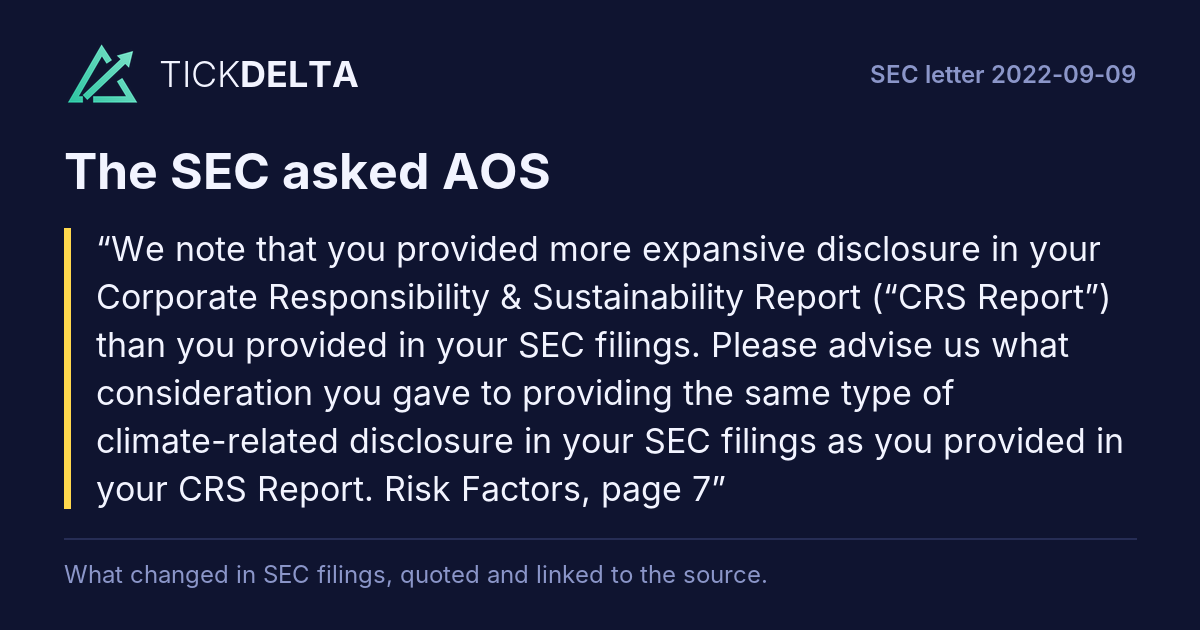
We note that you provided more expansive disclosure in your Corporate Responsibility & Sustainability Report (“CRS Report”) than you provided in your SEC filings. Please advise us what consideration you gave to providing the same type of climate-related disclosure in your SEC filings as you provided in your CRS Report. Risk Factors, page 7
A. O. Smith’s corporate responsibility and sustainability (CRS) programs support our management of environmental, social, and governance (ESG) issues. In 2021, we voluntarily published our second CRS report for the year ended December 31, 2020 (the “CRS report”), designed to inform and engage a broad stakeholder base, including our investors, employees, suppliers, and others, on the ESG efforts we are undertaking.
Our CRS report addresses sustainability reporting practices and other matters of varying degrees of importance to a broad set of stakeholders.Read in the reply ↗Rest of the answer
These disclosures are not reflective of SEC disclosure requirements, providing disclosures beyond that considered material for investors in the context of disclosures required in our SEC filings, and are informed by, among other items, various ESG frameworks (such as the Sustainability Accounting Standards Board (SASB). The ESG frameworks are intended for a wide-ranging audience of interested stakeholders, many of whom are interested in climate-related disclosures even if such information is not material to warrant inclusion in federal securities filings.
In contrast, the contents of our SEC filings were guided by compliance with the requirements of the SEC’s forms, rules, and interpretive guidance applicable to us. In evaluating whether to include climate-related disclosures from the CRS report in the Form 10-K or other filings, the disclosure requirements of Regulation S-K (including Items 101, 103, 105 and 303) were considered, as well as whether the information constituted “material information as may be necessary to make the required statements, in the light of the circumstances under which they were made, not misleading” pursuant to Rule 12b-20 of the Securities Exchange Act of 1934, as amended.
We further considered relevant Interpretive Releases, including Guidance Regarding Disclosure Related to Climate Change (Release No. 34-61469) and Guidance Regarding Management’s Discussion and Analysis of Financial Condition and Results of Operations (Release No. 34-48960). In preparing the Form 10-K or other SEC filings, we considered whether it should provide the same type of climate-related disclosure in its SEC filings as it provides in its CRS report based on materiality. We respectfully advise the Staff that we designed our CRS report to go beyond the SEC’s disclosure framework and the disclosure requirements of Regulation S-K and therefore are more expansive than those provided in filings with the SEC and are not material to investors in the context of SEC reporting.
As A. O. Smith’s business and the markets in which it participates evolve, and the size and extent of A. O. Smith’s climate initiatives continue to develop, we will continue to monitor and evaluate our climate-related disclosures, including whether additional climate-related information is appropriate for future SEC filings.
First report after the company's reply of 2022-10-11: 10-Q filed 2022-10-28 ↗, against the 10-Q filed 2022-07-29 ↗.
Tickdelta does not hold the text of both reports, so they are not compared here.
Disclose the material effects of transition risks related to climate change that may affect your business, financial condition, and results of operations, such as market trends that may alter business opportunities, credit risks, or technological changes.
We have interpreted the term “transition risks” to mean risks associated with a transition to a lower-carbon economy. Transition risks identified as likely to be the most relevant to us include:
•Market trends and changing consumer preferences,
•Mandates on and regulation of existing products, and
•Technological changes
A. O. Smith evaluates risks to its business in a number of ways, primarily through its Enterprise Risk Management (“ERM”) process, which it conducts enterprise-wide on a periodic basis. In its ERM process, A. O.Read in the reply ↗Rest of the answer
Smith’s management, representing key functional areas and business units, evaluates strategic, operational, financial, and compliance risks that have the potential to adversely impact our business, financial condition, and results of operations. For risks that A. O. Smith prioritizes through its ERM process, a company executive is assigned to address each risk, and lead action plans to monitor and manage it. Management updates the Board of Directors on a regular basis regarding identified risks.
In addition, A. O. Smith has established certain disclosure controls and procedures to monitor and respond to potential risks that might impact its business, financial condition, and operations. A. O. Smith’s Disclosure Committee meets quarterly, and the Company’s Chief Financial Officer and General Counsel report to the Audit Committee of the Board of Directors on any matters, including these potential risks, that are identified by the Disclosure Committee.
A. O. Smith’s ERM process and additional disclosure controls and procedures assist in identifying if any additional or expanded disclosures are needed in our filings with the SEC. As a result of these processes, we have considered transition risks, including the ones listed above, and have provided the following disclosure on pages 9 and 11 of our most recent annual report on Form 10-K:
•Our business could be adversely impacted by changes in consumer purchasing behavior, consumer preferences and technological changes
Consumer preferences for products and the methods in which they purchase products are constantly changing based on, among other factors, cost, convenience, environmental and social concerns, and perceptions. Consumer purchasing behavior may shift the product mix in the markets we participate in or result in a shift to other distribution channels, including e-commerce, which continues to expand. For example, consumer preferences may shift toward more efficient gas products or electric-powered products due to the increased attention on the impact of greenhouse gas emissions on the environment in response to utility incentive programs or the emergence of state or federal incentives. In addition, technologies are ever-changing.
Our ability to timely develop and successfully market new products and to develop, acquire, retain and protect necessary intellectual property rights is essential to our continued success but cannot reasonably be assured. It is possible that we will not be able to develop new technologies, products or distribution channels to align with consumer purchasing behavior and consumer preferences, which could materially and adversely affect our financial condition, results of operations, and cash flows.
•Changes in regulations or standards could adversely affect our business
Our products are subject to a wide variety of statutory, regulatory, and industry standards and requirements related to, among other items, energy and water efficiency, environmental emissions, labeling, and safety. While we believe our products are currently efficient, safe, and environment-friendly, federal, foreign, state, and local governments may adopt laws, regulations and codes that will require a transition to non-fossil fuel-based sources of energy production as well as significantly reducing or eliminating the on-site combustion of fossil fuels in the building sector, such as limiting or prohibiting the delivery of natural gas in new construction. A significant change to regulatory requirements that promote a transition to alternative energy sources as a replacement for gas, or a significant shift in industry standards, could substantially increase manufacturing costs, impact the size and timing of demand for our products, affect the types of products we are able to offer or put us at a competitive disadvantage, any of which could harm our business and have a material adverse effect on our financial condition, results of operations and cash flow.
As discussed in more detail in response to Comment #5 below, A. O. Smith has seen customer demand for higher efficiency products (regardless of energy source), particularly with respect to commercial products or in connection with utility rebate programs. A. O. Smith also notes below in response to Comment #5 that some state and local governments have passed or are evaluating regulation of on-site combustion of fossil fuels.
Currently, we believe that any changing customer behavior or government regulation will have a neutral to positive benefit and will not have a material negative effect on our financial condition, results of operations or cash flow. We offer a complete line of water and hydronic heating products, including electric-powered water heaters and boilers, and we believe that any reduction in fossil fuel-powered products would be counterbalanced by the demand for our non-fossil fuel powered products. We are confident that our continued emphasis on product design and innovation, as noted below in response to Comment #5, will keep us well positioned to deliver products demanded by customers, regardless of fuel source.
While we have not seen a material impact from these potential transition risks for purposes of the disclosure requirements of Regulation S-K, we believe that it is important to lend our voice and experience to the conversation surrounding government regulation of fossil fuels as a source of energy for our products. In September 2021, we published a white paper on state and local regulation of on-site combustion of fossil fuels titled “Electrification of Water and Space Heating in Buildings, https://www.aosmith.com/decarbonization. The contents of its September 2021 white paper are informed by discussions and correspondence with many different stakeholders. The white paper presented us with an opportunity to present information, perspectives, and future considerations that may be of interest to A. O. Smith employees, customers, the investor community, and other stakeholders. These disclosures go beyond the SEC’s disclosure framework and the requirements of Regulation S-K and are, consequently, more expansive and contain information that is not material to investors in light of requirements of an annual report on Form 10-K, applicably materiality standards, and the relevant rules and guidance of the SEC.
Through its ERM process, other disclosure controls, and its interaction with customers, government authorities, and other stakeholders, A. O. Smith intends to continue to monitor transition risks for future SEC filings and, as appropriate, provide disclosure to the extent that such risks are material.
First report after the company's reply of 2022-10-11: 10-Q filed 2022-10-28 ↗, against the 10-Q filed 2022-07-29 ↗.
Tickdelta does not hold the text of both reports, so they are not compared here.
We note your disclosure regarding environmental litigation on page 13. Please disclose any material litigation risks related to climate change and explain the potential impact to the company.
A. O. Smith defines climate change-related litigation as a proceeding where the primary allegations depend on (a) certain climate change impacts being attributed to our operations, (b) allegations of a failure by A. O. Smith to meet applicable legal or regulatory requirements related to climate change or (c) alleged failure by A. O. Smith to mitigate risks to our business due to the impact of climate change.
As part of its disclosure controls and procedures, A. O.Read in the reply ↗Rest of the answer
Smith’s legal department meets quarterly with the Company’s finance function regarding pending litigation and regulatory matters, including potential exposures to such matters. Our management considers applicable disclosure rules, regulations, and guidance when preparing its SEC filings. In particular, our management assesses the materiality of pending or threatened litigation by reference to the accounting standards applicable to loss contingencies under ASC Topic 450 as well as qualitative factors.
A. O. Smith currently does not have any pending or, to our knowledge, threatened litigation related to climate change. The disclosure on page 13 of the Form 10-K regarding certain environmental legal proceedings is exclusively related to legacy hazardous waste sites, for which approximately $6.9 million (undiscounted, as of December 31, 2021) had been accrued for the estimated liability for environmental cleanup and related proceedings. This amount is not material compared to net income and does not pertain to climate change-related litigation.
Additionally, we monitor trends and developments in litigation and regulation to help inform our risk assessments. We note that, to date, most climate litigation involving private entities has been brought against companies in the fossil fuel sector or that otherwise have annual greenhouse gas emissions that are substantially in excess of A. O. Smith’s emissions inventory.
We intend to continue to monitor the risks of climate change-related litigation for future SEC filings and, as appropriate, provide disclosure to the extent that the risks of climate change-related litigation are material.
First report after the company's reply of 2022-10-11: 10-Q filed 2022-10-28 ↗, against the 10-Q filed 2022-07-29 ↗.
Tickdelta does not hold the text of both reports, so they are not compared here.
It appears you have identified climate-related projects in your CRS Report, such as energy efficiency projects to lessen environmental impacts. Tell us how you considered providing disclosure regarding past and future capital expenditures for climate-related projects. Include quantitative information for the periods covered by your Form 10-K and for future periods as part of your response.
We consider climate-related projects to be ones primarily focused on reducing GHG emissions. Our capital expenditures concerning climate-related initiatives have also resulted in operational efficiencies for us. These projects include, among others, building system technology to monitor and help reduce consumption and LED lighting.Read in the reply ↗Rest of the answer
In response to the Staff’s comment, we respectfully advise the Staff that we did not incur material capital expenditures related to climate-related projects that would require disclosure in our Form 10-K, as demonstrated in the following table:
2021 2020 2019
Capital expenditures for climate-related projects $ 1.8 $ 0.3 $ 0.6
Total capital expenditures $ 75.1 $ 56.8 $ 64.4
As a % of total capital spend 2.4 % 0.5 % 0.9 %
Net Sales $ 3,538.9 $ 2,895.3 $ 2,992.7
As a % of net sales 0.1 % 0.0 % 0.0 %
Net Earnings $ 487.1 $ 344.9 $ 370.0
As a % of net income 0.4 % 0.1 % 0.2 %
While not a climate-related project, we recently completed an approximately 7,000-foot berm, flood gates, and pumping stations around our Ashland City, Tennessee facility for approximately $11 million, which was incurred over several years. A. O. Smith built the berm in response to a flood that occurred in May 2010 at this facility, which sits near the Cumberland River, and to prevent or mitigate a future flood of similar magnitude. To the extent that the berm reduces the risk of a flood that may result from climate change, the capital cost of the berm was not material in any given year to our overall annual capital expenditures. We currently estimate total 2022 capital expenditures for climate-related projects to be approximately $0.7 million, which we do not believe is material.
We currently expect future capital expenditures to be similar to prior years and of a similar kind. We will continue to monitor spending for climate-related projects and report these amounts in future SEC filings if material.
First report after the company's reply of 2022-10-11: 10-Q filed 2022-10-28 ↗, against the 10-Q filed 2022-07-29 ↗.
Tickdelta does not hold the text of both reports, so they are not compared here.
To the extent material, discuss the indirect consequences of climate-related regulation or business trends, such as the following: • decreased demand for goods that produce significant greenhouse gas emissions or are related to carbon-based energy sources; • increased competition to develop innovative new products that result in lower emissions; • increased demand for generation and transmission of energy fromRest of the question
alternative energy sources; and • any anticipated reputational risks resulting from operations or products that produced material greenhouse gas emissions.
We respectively advise the Staff that A. O. Smith has not identified any indirect consequences of climate-related regulation or business trends that have or were reasonably likely to have materially affected our business, financial condition, or results of operations. A. O. Smith management periodically reviews business activities, including a review of performance metrics to determine if a trend is material for purposes of our MD&A disclosures in the Form 10-K. A. O.Read in the reply ↗Rest of the answer
Smith's management also reviews historical and current total sales data for products and product categories, customer orders, and outcome of “voice of the customer” market research reviews to determine product demand trends that may be connected to climate-related matters. A. O. Smith considered financial, operational, and other market information known to its management and whether these trends had, or were reasonably likely to have, a material impact on our liquidity, capital resources, or results of operations. The information below is our response to each of the items specifically referenced in this comment.
•decreased demand for goods that produce significant greenhouse gas emissions or are related to carbon-based energy sources;
A. O. Smith has not experienced material decreased demand for products that are related to carbon-based energy sources. A. O. Smith believes that customer demand for products are driven by a multitude of business factors, including product features, performance metrics, reliability, energy efficiency, and cost (together, the “Primary Considerations”). A. O. Smith has not experienced decreased demand for its products as a result of customers indicating that those products produce significant greenhouse gases or are related to carbon-based energy sources. While there are rebate programs in which A. O. Smith participates and government regulation that are promoting products powered by electricity as opposed to fossil fuels, we believe that the demand for our products is independent of climate-related concerns. Through partnerships with customers, A. O. Smith is seeing foundational activities toward creating sustainable supply chain programs. We expect these programs to develop in parallel with rebate programs and government regulations. Additionally, as noted above in response to Comment #2, we believe that any decrease in demand for fossil fuel-powered goods would likely be counterbalanced by an effectively equivalent demand for other goods that A. O. Smith also produces and markets. A. O. Smith continues to monitor these trends in the periodic business reviews referenced above in this response to Comment #5.
While A. O. Smith monitors competitive product offerings, we are not aware of any material increased competition to develop new products that result in lower emissions to address climate change. A. O. Smith management reviews external market trends in developing strategic plans and continues to develop and launch products to meet consumer demand.
As A. O. Smith notes above, there is some demand from customers for products that use less carbon-based energy sources, largely driven by voluntary utility rebate programs and, a combination of government incentives (e.g., tax credits) and state or local government regulation. However, A. O. Smith believes that the Primary Considerations of the majority of its customers are prioritized over a desire for a product with lower carbon emissions, and, consequently, we believe that there is not a significant increase in competition based exclusively and directly upon an effort to lower product emissions. A. O. Smith believes there is continued and expected competition to design and provide products with particular features, reliability, energy efficiency, and cost as primary considerations. With respect to energy efficiency of fossil fuel-powered products, we believe that customers are driven more by cost and product payback than by a desire to reduce carbon-based emissions specifically, even if that is a direct benefit. A. O. Smith expects design around the factors identified above to drive innovation and that such innovation may have the added benefit of reducing emissions. Nevertheless, A. O. Smith believes that its line of water heaters and boilers are among the most energy-efficient products available, which includes a broad array of products that qualify for the Environmental Protection Agency’s ENERGY STAR® program. We expect to continue to put an emphasis on developing energy-efficient products and that doing so is part of our values and our vision of sustainability.
We respectfully advise the Staff that we believe the increased demand for generation and transmission of energy from alternative energy sources has no material business impacts to our operations due to A. O. Smith operating in jurisdictions that currently do not have regulatory or legal requirements for alternative energy generation or transmission or emission offset requirements.
As part of our ESG strategy, A. O. Smith has implemented voluntary projects, including energy efficiency and alternate energy generation in our operations. On the product side, as noted above, utilities are developing demand-response programs involving water heaters in an effort to reduce energy demand and more efficiently manage grid demand, and A. O. Smith participates in those efforts. However, A. O. Smith has not experienced an increased demand for the generation and transmission of energy from alternative energy sources that would be material under Regulation S-K.
•any anticipated reputational risks resulting from operations or products that produced material greenhouse gas emissions.
Through its ERM process, additional risk assessments, and market trend analysis, A. O. Smith has not identified a reputational risk resulting from operations or products that produced material greenhouse gas emissions.
Starting with its 2018 CRS report, A. O. Smith began communicating more broadly to stakeholders about its product attributes, goal, metrics, and progress toward reducing greenhouse gas emissions in its operations and products. Although the costs associated with our ESG reporting are included in response to Comment #6 and are not material, A. O. Smith believes the release of our CRS reports and annual scorecard has been favorably received by its stakeholders.
A. O. Smith will continue to monitor indirect consequences of climate-related regulation or business trends, and if they have or are considered reasonably likely to have a material effect on its business, financial condition, or results of operations, A. O. Smith will include this information in SEC filings as appropriate.
First report after the company's reply of 2022-10-11: 10-Q filed 2022-10-28 ↗, against the 10-Q filed 2022-07-29 ↗.
Tickdelta does not hold the text of both reports, so they are not compared here.
Please discuss the physical effects of climate change on your operations and results. This disclosure may include the following: • quantification of weather-related damages to your property or operations; • potential for indirect weather-related impacts that have affected or may affect your major customers; and • any weather-related impacts on the cost or availability of insurance.Rest of the question
Include quantitative information for each of the periods covered by your Form 10-K and explain whether increased amounts are expected in future periods as part of your response, as applicable.
We face potential risks associated with the physical effects of weather-related events, including those resulting from climate change, such as more frequent or severe storms and flooding. We identified these risks on page 9 of our Form 10-K:
•The occurrence or threat of extraordinary events, including natural disasters, political disruptions, terrorist attacks, public health issues, and acts of war, could significantly disrupt production, or impact consumer spending
As a global company with a large international footprint, we are subject to increased risk of damage or disruption to us andRead in the reply ↗Rest of the answer
our employees, facilities, suppliers, distributors, or customers. Extraordinary events, including natural disasters resulting from but not limited to climate change, political disruptions, terrorist attacks, public health issues, such as the current COVID-19 pandemic, and acts of war may disrupt our business and operations and impact our supply chain and access to necessary raw materials or could adversely affect the economy generally, resulting in a loss of sales and customers. Two of our manufacturing plants are located within a floodplain that has experienced past flooding events. We also have other manufacturing facilities located in hurricane and earthquake zones. Any of these disruptions or other extraordinary events outside of our control that impact our operations or the operations of our suppliers and key distributors could affect our business negatively, harming operating results. In addition, these types of events also could negatively impact consumer spending in the impacted regions or depending on the severity, globally, which could materially and adversely affect our financial condition, results of operations and cash flows.
As noted in our response to your Comment #2, A. O. Smith conducts an enterprise-wide risk assessment on a periodic basis through its ERM process and evaluates the potential risks of natural disasters, such as flooding, as part of that process. As part of our risk identification and mitigation processes and as noted in our response to your Comment #4, we recently completed an approximately 7,000-foot berm, flood gates, and pumping stations around our Ashland City facility, a multi-year project that cost a total of approximately $11 million to prevent future flooding at this facility. While A. O. Smith did not construct the berm as a climate-related project, it did build it to prevent or mitigate flooding at its Ashland City facility, regardless of the cause of such flooding.
We also have other manufacturing facilities located in hurricane zones but have not experienced any material damage due to hurricanes.
Disruptions associated with weather-related events resulting from climate change could impact our operations or the operations of our suppliers and key distributors and could affect our business negatively, harming operating results, but A. O. Smith has not experienced a material impact as of the date of this response and currently does not expect any future events to have a material impact. Weather-related damages to our property were not material during the years covered in the Form 10-K. For the year ended December 31, 2021, and 2020, we incurred approximately $0.4 million and $0.3 million, respectively, on damages associated with weather-related events, which were less than 0.1% of our net sales each year and not material to our consolidated statement of earnings and cash flows.. For the year ended December 31, 2019, we did not incur any costs associated with weather-related events.
There have been no changes to the overall insurance coverage due to weather-related events, and pricing for A. O. Smith’s insurance program has remained at the prevailing market rate with no change in the current year’s premium rates from the prior year. Our annual insurance costs for the three years ended December 31 2021, 2020, and 2019 were $3.3 million, $3.0 million, and $2.8 million, respectively or approximately 0.1% of our net sales each year and not material to our consolidated statement of earnings and cash flows. We note that the increase in premiums was driven by the increase in property values and not insurance premium rates. We currently do not expect insurance premiums to materially increase in the current or future years.
A. O. Smith monitors and will continue to monitor weather-related events these and, as appropriate, provide disclosure in future SEC filings to the extent that the physical effects of such events become material.
First report after the company's reply of 2022-10-11: 10-Q filed 2022-10-28 ↗, against the 10-Q filed 2022-07-29 ↗.
Tickdelta does not hold the text of both reports, so they are not compared here.
We note your disclosure on page 26 about compliance costs related to federal, foreign, state, and local environmental laws. Please tell us about and quantify any compliance costs related to climate change for each of the last three fiscal years and explain whether increased amounts are expected to be incurred in future periods.
A. O. Smith has interpreted “compliance costs related to climate change” in this comment to mean the direct operational costs incurred to comply with environmental laws and regulations pertaining specifically to climate change as the primary purpose that are applicable to A. O. Smith. As noted in response to Comment #2, through our ERM process and other disclosure procedures, we stay apprised of developments in climate change regulation and international accords and have not identified any such developments impacting our business, financial condition, and results of operations that would beRead in the reply ↗Rest of the answer
considered material and necessitate disclosure in the Form 10-K under applicable disclosure requirements.
A. O. Smith’s climate change related compliance costs relate primarily to statutory and regulatory environmental licenses and permits. The costs of acquiring and maintaining such licenses and permits are less than $1.0 million and less than 0.1% of net sales for each of the years ending 2019-2021, and not material. Environmental regulations applicable to us have not significantly changed over recent years, and we are not aware of any pending material changes. As such, we respectfully advise the Staff that we do not currently expect a material increase in climate-change compliance costs in the future.
We have made voluntary commitments to reduce our environmental impact. A. O. Smith is utilizing energy management measures, sustainable best practices, and operational energy savings efforts to achieve those commitments. As reported in its 2021 ESG Scorecard, A. O. Smith’s operations reduced greenhouse gas emissions intensity since the 2019 baseline year. Although these commitments are not mandated by statute and do not represent compliance costs, the fees paid to third-party advisors on climate-related matters, including support for ESG reporting, are $0.2 million in aggregate for the years 2019-2021. These costs are determined not to be material due to its de minimis impact on our net income for the periods presented in the Form 10-K.
A. O. Smith intends to continue monitor these costs for future SEC filings, and as appropriate, provide disclosure on compliance costs related to climate change to the extent such costs are material.
First report after the company's reply of 2022-10-11: 10-Q filed 2022-10-28 ↗, against the 10-Q filed 2022-07-29 ↗.
Tickdelta does not hold the text of both reports, so they are not compared here.
If material, please provide disclosure about any purchase or sale of carbon credits or offsets and any material effects on your business, financial condition, and results of operations. Include quantitative information regarding these types of transactions for each of the periods for which financial statements are presented in your Form 10-K and for future periods as part of your response.
We have not engaged in purchasing or selling carbon credits or offsets in the past three years or the current fiscal year and we do not expect to be engaged in purchasing or selling carbon credits or offsets in 2022 and near future periods. However, to the extent that in the future, we purchase or sell carbon credits or offsets, and such transactions are material to our business, financial condition, or results of operations, we will provide appropriate disclosure in our SEC filings in accordance with applicable disclosure requirements. Read in the reply ↗
First report after the company's reply of 2022-10-11: 10-Q filed 2022-10-28 ↗, against the 10-Q filed 2022-07-29 ↗.
Tickdelta does not hold the text of both reports, so they are not compared here.
We note your response to prior comment 5. Please provide us with additional detail explaining how you considered providing disclosure regarding reputational risks resulting from operations or products that produce greenhouse gas emissions to investor perception and your ability to obtain external financing.
As stated in response to prior Comment #2, A. O. Smith evaluates risk primarily through its Enterprise Risk Management (“ERM”) process, and supported by disclosure controls and procedures. These processes take into account emerging market trends, customer feedback, and investor perspectives, among other factors. A. O. Smith’s ERM process considers reputational risks in addition to business, operational, or financial risk, and asks specific questions related to our reputation and perception of our brands.
A. O.Read in the reply ↗Rest of the answer
Smith develops, manufactures and sells comprehensive lines of high efficiency residential and commercial heat pumps, gas and electric water heaters, tanks and boilers and we believe our customers value energy efficiency and that it is a primary consideration in the purchase of our products. We feel that our focus on product innovation in response to customer and market demands, as reflected in our disclosed spending on research and development, is a brand and company differentiator. We also believe that any changing customer behavior over time that would favor products with alternative energy sources to gas would have a neutral to positive benefit to us as we manufacture and sell a variety of electric-powered water heaters and boilers, including heat pump products. A. O. Smith perceives its investors and banks to positively see the value and benefit of its broad and varied product portfolio, its focus on innovation, and emphasis on energy efficiency regardless of energy source.
We respectfully note that based on our ERM and other processes, A. O. Smith has not identified any reputational risks to investor perception and our ability to obtain external financing. Access to capital trends are considered as part of our periodic reviews by management as described in our previous response letter. A. O. Smith believes that access to, and cost of, capital is driven by a multitude of factors, including macroeconomic conditions, existing capital structure, and company operating and financial condition, among others. A. O. Smith has not experienced a decreased availability (or increased cost) of capital attributable to investor or lender perceptions of greenhouse gas (GHG) emissions associated with our operations or gas-powered products that we manufacture.
While certain investors and lenders have announced ambitions to achieve net zero financed emissions, we note that such ambitions are generally anticipated to be realized on a gradual timeline, often over several decades (usually with a timeline of approximately 2050). We believe that any actions to achieve such ambitions would likewise be gradual, to which we can respond if and when they arise. In addition, we believe that perceptions of our GHG emissions profile may naturally decrease among investors and lenders, to the extent they consider it in their capital decisions, as a result of increased demand for our electric-powered products as discussed above and in our previous response letter.
The Company does appreciate the risk inherent in negative publicity and has discussed such risk in the Risk Factors section of the Form 10-K (pages 10-11 of the Form 10-K) under captions “An inability to adequately maintain our information systems and their security, as well as to protect data and other confidential information, could adversely affect our business and reputation”; “Our business may be adversely impacted by product defects”; and “Our results of operations may be negatively impacted by product liability lawsuits and claims.”
A. O. Smith continues to monitor and evaluate reputational risk as part of its ERM process and other disclosure controls and, to the extent that such risk rises to the level of materiality required for disclosure under SEC regulations, we will update our SEC filings accordingly.
First report after the company's reply of 2022-11-02: 10-K filed 2023-02-14 ↗, against the 10-K filed 2022-02-11 ↗.
Tickdelta does not hold the text of both reports, so they are not compared here.
Also in this review: request for more time, 2022-09-14, request for more time, 2022-10-07, closing letter, 2022-11-08