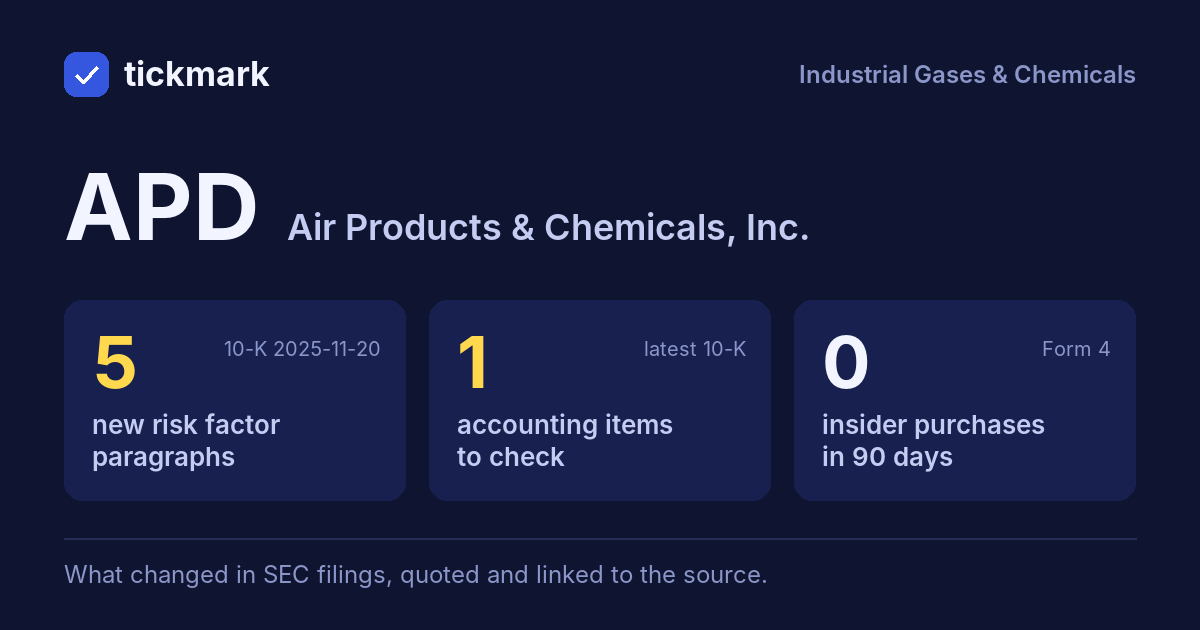
Marked against last year's 10-K:
cut words struck through, new words highlighted and underlined.
MD&A 177 words changed in this paragraph; it is 37% similar to last year's version.
Capital expenditures totaled $5.1 billion in fiscal year 2024 totaled $5,152.0 compared to $5,224.4 2025, a 2% decrease from capital expenditures of $5.2 billion in fiscal year 2023. 2024. Spending for in fiscal year 2025 was driven by $7.0 billion in additions to plant and equipment equipment, primarily included project spending for supporting our clean energy projects such as initiatives, including the NEOM Green Hydrogen Project in NEOM City, Saudi Arabia, as well as our and clean energy complexes in Louisiana, United States, and Alberta, Canada. Additionally, we We also continued to invest capital in our core industrial gas business for gases business, funding the development of new industrial gas plants as well as maintaining and replacing the maintenance and replacement of existing facilities. We did not recognize any investments in and advances to unconsolidated affiliates during fiscal year 2024; however, we expect to complete our remaining investment of approximately $115 associated with our investment in JIGPC in fiscal year 2025. Refer to Note 10, Equity Affiliates, to the consolidated financial statements for additional information. The investment in financing receivables of $403.0 primarily reflects payments associated with the purchase of renewable fuel assets from World Energy as well as remaining payments on the purchase of a natural gas-to-syngas processing facility in Uzbekistan. Refer to Note 3, Variable Interest Entities and to Note 6, Acquisition, to the consolidated financial statements for additional information.
Source: Item 7, 10-K 0000002969-25-000055 vs Item 7, 10-K 0000002969-24-000056
Legal Proceedings 103 words changed in this paragraph; it is 55% similar to last year's version.
In September 2010, the Brazilian Administrative Council for Economic Defense ("CADE") issued a decision against our Brazilian subsidiary, Air Products Brasil Ltda., and several other Brazilian industrial gas companies for alleged anticompetitive activities. CADE imposed a civil fine of R$179.2 million (approximately $33 million at $34 as of 30 September 2024) 2025) on Air Products Brasil Ltda. This fine Ltda., which was based on a recommendation by a unit of the Brazilian Ministry of Justice, following an investigation beginning in 2003, which alleged violation of competition laws with respect to the sale of industrial and medical gases. The fines are based on a percentage of our total revenue in Brazil in 2003. In May 2014, our appeal was granted and the fine was dismissed. CADE appealed that ruling and in October 2025 the Supreme Court of Brazil rendered a judgment confirming the appellate ruling, which annulled the administrative proceeding and the fine imposed by CADE. Under applicable law, no further remedies are available and the judgment is final.
Source: Item 3, 10-K 0000002969-25-000055 vs Item 3, 10-K 0000002969-24-000056
Risk Factors 102 words changed in this paragraph; it is 73% similar to last year's version.
In addition, certain of our growth strategy is projects are partially dependent on a regulatory environment that favors technologies focused on limiting the impact of climate change, in particular toward the production and distribution of clean hydrogen. For example, we anticipate benefits from tax incentives created by the U.S. Inflation Reduction Act of 2022 for carbon sequestration and clean hydrogen production in future years once our projects in these areas come on-stream in the U.S. If there is a reversal in the regulatory environment or a discontinuation or reduction of incentives or benefits for the development of technologies limiting the impact of climate change, particularly those focused on low- and zero-carbon hydrogen production, or significant uncertainty regarding such efforts, certain of our projects may be threatened and for completed projects demand for our products may be less than we anticipate and certain projects and our long-term growth strategy could be adversely affected. Any such occurrence For example, in fiscal year 2025, we cancelled a project to build a green liquid hydrogen project in the U.S., based in part on a regulatory development that rendered existing hydroelectric power supply ineligible for the Clean Hydrogen Production Tax Credit (45V) and incurred a significant impairment charge for the amount that we had invested in the project. Further negative regulatory developments could adversely affect our projected returns, which could lead us to re-evaluate certain projects and may harm our business and financial performance.
Source: Item 1A, 10-K 0000002969-25-000055 vs Item 1A, 10-K 0000002969-24-000056
Accounting Policies 79 words changed in this paragraph; it is 61% similar to last year's version.
Intangible assets with determinable lives primarily consist of customer relationships, purchased patents and technology, and certain land use rights. relationships. The cost of intangible assets with determinable lives is amortized on a straight-line basis over the estimated period of economic benefit. No residual value is estimated for these intangible assets. Indefinite-lived intangible assets consist of trade names and trademarks. Indefinite-lived intangibles are subject to tested for impairment testing at least annually. In addition, intangible assets are tested annually, and more frequently if a change events or changes in circumstances or indicate that the occurrence assets may be impaired. During fiscal year 2025, no triggering events were identified that would require impairment testing for any of events indicates that potential our indefinite-lived intangible assets. We completed our annual impairment exists. test for these assets and concluded there were no indications of impairment.
Source: Item 8, Note 1 – BASIS OF PRESENTATION AND MAJOR ACCOUNTING POLICIES, 10-K 0000002969-25-000055 vs Item 8, Note 1 – BASIS OF PRESENTATION AND MAJOR ACCOUNTING POLICIES, 10-K 0000002969-24-000056