Rest of the answer
In conjunction with the investment agreement, we entered into a separate 15-year tolling services agreement under which Air Products operates the facility and converts feedstocks supplied and owned by UNG, including natural gas and utilities, into syngas and hydrogen. UNG maintains ownership of all inputs and outputs throughout the production process. In return, Air Products receives a monthly fee, regardless of whether UNG requires the output from the facility. At the conclusion of the contract term, UNG has the unilateral right to re-acquire the facility.
Summarized Accounting Analysis
The following paragraphs provide a summary of the analysis we performed to determine that the arrangement should be accounted for as a financing arrangement, including reference to the corresponding authoritative literature that we considered.
In evaluating the arrangement, we first considered the guidance in ASC 360 – Property, Plant, and Equipment (“ASC 360”). As there is no guidance directly on point in ASC 360 with respect to how a buyer of assets should consider whether it obtained accounting control of the assets in the context of a seller’s unilateral right to re-acquire the asset, we next considered ASC 805 – Business Combinations (“ASC 805”). The acquisition method under ASC 805-10-05-04 first requires an assessment of whether we meet the definition of an acquirer, which is defined as “the entity that obtains control of the acquiree.” The definition of control within ASC 805 has the same meaning as controlling financial interest in ASC 810 – Consolidation (“ASC 810”). The concept of control when the seller has a unilateral right to reacquire the assets at the end of the term is also not clear within ASC 805 or ASC 810. As such, we considered whether we obtained control under ASC 606 – Revenue Recognition (“ASC 606”).
While ASC 606-10-55-66 through ASC 606-10-55-70 is written in contemplation of the seller’s accounting, it addresses whether control is deemed to have transferred when a repurchase right exists.
606-10-55-66: A repurchase agreement is a contract in which an entity sells an asset and also promises or has the option (either in the same contract or in another contract) to repurchase the asset. The repurchased asset may be the asset that was originally sold to the customer, an asset that is substantially the same as that asset, or another asset of which the asset that was originally sold is a component.
606-10-55-67: Repurchase agreements generally come in three forms:
a.An entity's obligation to repurchase the asset (a forward) b.An entity's right to repurchase the asset (a call option) c.An entity's obligation to repurchase the asset at the customer's request (a put option).
606-10-55-68: If an entity has an obligation or a right to repurchase the asset (a forward or a call option), a customer does not obtain control of the asset because the customer is limited in its ability to direct the use of, and obtain substantially all of the remaining benefits from, the asset even though the customer may have physical possession of the asset. Consequently, the entity should account for the contract as either of the following:
a.A lease in accordance with Topic 842 on leases, if the entity can or must repurchase the asset for an amount that is less than the original selling price of the asset unless the contract is part of a sale and leaseback transaction. If the contract is part of a sale and leaseback transaction, the entity should account for the contract as a financing arrangement and not as a sale and leaseback transaction in accordance with Subtopic 842-40.
b.A financing arrangement in accordance with paragraph 606-10-55-70, if the entity can or must repurchase the asset for an amount that is equal to or more than the original selling price of the asset.
606-10-55-69: When comparing the repurchase price with the selling price, an entity should consider the time value of money.
606-10-55-70: If the repurchase agreement is a financing arrangement, the entity should continue to recognize the asset and also recognize a financial liability for any consideration received from the customer. The entity should recognize the difference between the amount of consideration received from the customer and the amount of consideration to be paid to the customer as interest and, if applicable, as processing or holding costs (for example, insurance).”
Based on this guidance, we concluded that the seller’s unilateral right to re-acquire the facility at the end of the term limits our ability to direct the use of, and obtain substantially all of the remaining benefits from, the asset. That is, we would expect symmetry in ASC 606 accounting between the seller and buyer. Given the seller would not derecognize the facility because of the unilateral right to re-acquire the asset, we would not recognize (i.e., control) the facility. Unlike a commodity where it’s possible for control to transfer despite inclusion of a repurchase right, this facility is unique in nature and cannot be readily substituted by another facility. Rather, we would be contractually required to return legal title for these specific assets at the end of the contract term. When comparing the repurchase price through the end of the contract term with the original selling price, we concluded that the discounted contractual cash inflows to be received from UNG on a monthly basis were greater than the price we paid to purchase the facility. As such, we viewed the arrangement with UNG as a financing arrangement consistent with ASC 606-10-55-68(b), whereby we did not obtain accounting control of the facility.
In terms of the initial and ongoing accounting for this transaction, we included a new accounting policy disclosure in Note 1, Basis of Presentation and Major Accounting Policies, which reads as follows:
Financing Receivables
Some of our acquisitions include terms that provide the seller with both the right to receive all output from the acquired asset for an agreed upon term as well as the right to reacquire the asset at a future date. In these instances, we evaluate the contract terms to determine whether we have obtained control of the underlying asset, or the transaction qualifies as a financing arrangement. For transactions that qualify as financing arrangements, we record our investment as a financing receivable, net of any allowances for credit losses, on our consolidated balance sheets. We then recognize a portion of the payments received as a reduction to the financing receivable. Related interest income is presented within “Sales” on our consolidated income statements with revenue received to operate the plant. Interest income on our financing receivables was not material in fiscal year 2023.
We record the related financing income within the “Sales” line of our consolidated income statements based on the following guidance provided by Deloitte in its Revenue Recognition Roadmap:
Section 6.4.7: “Interest income arising from a significant financing component should be presented separately from revenue from contracts with customers in an entity’s statement of comprehensive income in accordance with ASC 606-10-32-20. However, this requirement to separately present interest income does not necessarily prevent interest income from being presented as revenue on the face of the statement of comprehensive income. For more information about whether it is appropriate to classify interest income as revenue, see Section 14.7.3.”
Section 14.7.3: “For purposes of the consolidated financial statements, the interest income generated from certain financing arrangements may be classified as revenue in the income statement. Paragraph BC29 of ASU 2014-09 states that the FASB and IASB “decided not to amend the existing definitions of revenue in each of their conceptual frameworks.” The legacy guidance in paragraph 79 of FASB Concepts Statement 6 indicates that cash inflows, such as interest, that are the result of an entity’s ongoing major or central operations represent revenue. When the major activity of a subsidiary is the financing of products, the interest income generated from this financing would represent its major revenue-generating activity. Therefore, this interest income would continue to be classified as revenue for consolidated financial statement purposes. However, the interest income (i.e., the financing component) should be presented separately from the revenue from the sale (i.e., revenue from contracts with customers) in accordance with the requirements of ASC 606-10-32-20.”
The supply of industrial gases to UNG is an activity that is consistent with our underlying business in which we use facilities to supply gases to our customers. Accordingly, we believe it is appropriate to include the revenues (i.e., the financing income) associated with this transaction within our sales line. We disclosed additional information in Note 3, Revenue Recognition, as follows: “Interest income associated with financing and lease arrangements accounted for less than 1% of our total consolidated sales in fiscal year 2023.”
Expanded Disclosure
In future filings, we will update our disclosure as underlined below to further clarify our conclusion regarding control of the facility.
Uzbekistan Asset Purchase
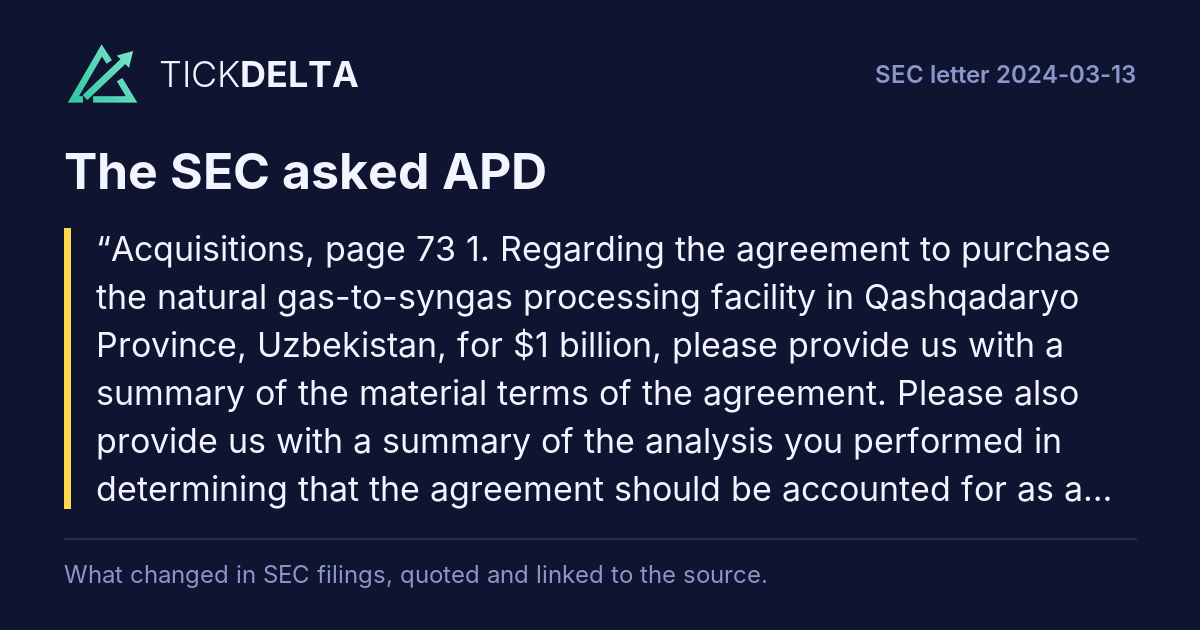
On 25 May 2023, we entered into an investment agreement with the Government of the Republic of Uzbekistan and Uzbekneftegaz JSC (“UNG”) to purchase a natural gas-to-syngas processing facility in Qashqadaryo Province, Uzbekistan, for $1 billion. Under the agreement, Air Products will acquire, own, and operate the facility and supply all offtake products to UNG under a 15-year on-site contract, with UNG supplying the feedstock natural gas and utilities.
We are accounting for the transaction as a financing arrangement because UNG has the unilateral right to reacquire the facility at the end of the contract term and therefore, we did not obtain accounting control of the facility. Accordingly, progress payments of approximately $800, of which $600 was completed during fiscal year 2023, are reflected within "Financing Receivables" on our consolidated balance sheet as of 30 September 2023. The progress payments are reflected within “Investment in financing receivables” on our consolidated statement of cash flows. In early fiscal year 2024, we made an additional progress payment of $100.