tickdelta
Sign in

Tickdelta is free for now. Sign up and get Pro free

← Screener

APHAmphenol

Technology · Electronic Components · NYSE
Employees
170,000
Headquarters
Wallingford, CT
CEO
Richard Adam Norwitt
Next results
around Jan 27, 2027
Compare with peers → Embed

When the SEC's staff reviews a filing, it writes to the company with numbered questions, and the company answers each one in a letter. SEC publishes the exchange once the review is over, at least 20 business days later. Below: what the staff asked APH, and the company's answer to each question, quoted from the letters. A question is not an accusation; most reviews end with the company adding detail to its next filing.

Form 10-K for the Fiscal Year Ended December 31, 2024

2025-04-10 to 2025-06-25 · 3 questions · 1 letter from the SEC, 2 from the company
Review closed 2025-06-25
AcquisitionsResults discussion (MD&A)
SEC asked (2)
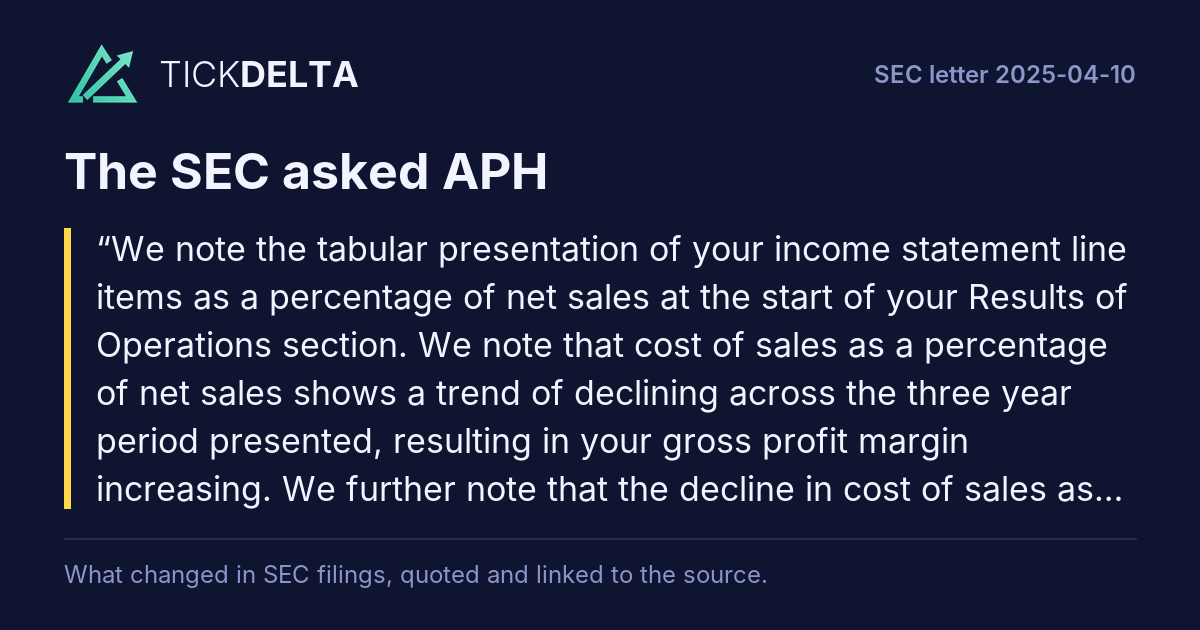
We note the tabular presentation of your income statement line items as a percentage of net sales at the start of your Results of Operations section. We note that cost of sales as a percentage of net sales shows a trend of declining across the three year period presented, resulting in your gross profit margin increasing.
Rest of the question

We further note that the decline in cost of sales as a percentage of net sales is almost fully offset each year by an increase in your operating expenses as a percentage of net sales, resulting in a net nominal change to your operating margin each year. As such, a robust analysis of the underlying factors driving changes in your operating income and operating margin should address both the changes in cost of sales and the changes in your operating expenses in order to provide your investors with a view of the company's financial results through the eyes of management. Please revise future filings to more clearly provide management's insight into the underlying drivers of material changes in cost of sales as a percentage of net sales or gross profit margin, either within your analysis of operating income or as a separate analysis.

APH answered
The Company respectfully acknowledges the Staff’s comment. When preparing the discussion of period to period changes in operating income in the 2024 Form 10-K, we considered whether there were material changes in cost of sales that we believed were relevant to the analysis of the changes in operating income. Similar to the changes in organic net sales, as noted in the response to Comment 1, changes in cost of sales are primarily attributable to changes in volume of goods sold.
Rest of the answer

In future filings, we will continue to consider whether additional information regarding material changes in cost of sales should be included in our analysis of changes in operating income.

As noted in the response to Comment 1 above, we sell a broad portfolio of products on a global basis to thousands of customers in a diversified set of end markets. The factors impacting the cost of these products vary among customers, markets and regions. As a result, we do not analyze changes in costs at a granular level. We do, however, consider and will disclose if there are material factors that we believe have impacted the changes in our cost of sales and are relevant to the analysis of the changes in operating income.

We believe, based on these considerations and with our commitment in response to the Staff’s comment to continue to consider whether additional information about the material changes in cost of sales should be included in our analysis of operating income, our future disclosures will provide information responsive to the Staff’s comment.

Read in the reply ↗
Notes to Consolidated Financial Statements · Note 11 - Acquisitions, page 87
SEC asked (3)
We note that you provide limited disclosures regarding your acquisition of CIT and state that further details have not been presented since the 2024 Acquisitions are not material, either individually or in the aggregate.
Rest of the question

Please revise your upcoming March 31, 2025 Form 10-Q to provide all disclosures required by ASC 805 for your acquisition of CIT, or explain to us in detail how you determined the acquisition of CIT was immaterial such that the disclosures prescribed by ASC 805 are not applicable. We note the purchase price you paid for CIT, net of cash acquired, is equivalent to approximately 12% of your total assets as of December 31, 2023.

APH answered
The Company respectfully acknowledges the Staff’s comment. We considered the requirements of ASC 805 when preparing the disclosures regarding the CIT acquisition and concluded that the disclosures provided our investors with the information necessary to evaluate the financial effects of the acquisition.
Rest of the answer

In addition to a description of the acquisition, the purchase price and the financing used for the acquisition, we included information about the recognition of allocation of the purchase price to goodwill, intangible assets (including acquired customer relationships and backlog) and other identifiable assets acquired and liabilities assumed as well as the acquisition-related expenses incurred and the tax deductibility of purchase price.

Although the purchase price paid for CIT, net of cash acquired, represented approximately 12% of Amphenol’s total assets as of December 31, 2023 (9% of Amphenol’s total assets as of December 31, 2024), based on an analysis of both the quantitative and qualitative factors of the acquisition, as required by ASC 805, and the disclosures in the 2024 Form 10-K provided, we determined that the acquisitions of CIT, Lutze-US and Lutze-Europe (together, the “2024 acquisitions”) were not material individually or in the aggregate, and that therefore, additional information (such as pro forma financial information as well as further details regarding purchase price allocations) about the 2024 acquisitions was not necessary for investors to further evaluate the financial effects of such acquisitions.

Quantitative Analysis

The Company notes that ASC 805 does not provide specific quantitative metrics or thresholds to be used in determining materiality for new acquisitions. In assessing materiality, the Company evaluated the contribution of the 2024 acquisitions to Amphenol’s consolidated financial results for the year ended December 31, 2024 by percentage of consolidated revenue, operating income and net income on both an individual acquisition and combined basis, the results of which have been furnished to the Staff on a supplemental basis. None of those percentages, individually or on a combined basis are typically considered material.

Qualitative Analysis

The Company also considered qualitative factors. The acquired businesses primarily manufacture wire and cable products and cable assemblies, which are aligned with Amphenol’s existing product offerings. The

2024 acquisitions did not represent a shift in strategic direction, nor did they introduce entry into a new market or a new type of technology. The acquired operations were located in geographies (United States, Mexico, Germany and China) where

Amphenol already maintains significant operations, and the customer base for each acquisition significantly overlapped with Amphenol’s existing key customers in the commercial aerospace, defense, industrial and medical sectors.

The businesses’ economics and profitability are consistent with Amphenol’s existing operations and are not expected to alter the financial statement user’s ability to understand the Company's financial risk profile, cash flow, or capital structure.

Conclusion

Based on the foregoing quantitative and qualitative considerations, the Company concluded that the 2024 acquisitions were not material individually or in the aggregate, and that the disclosures included in the 2024 Form 10-K provided our investors with the information necessary to evaluate the financial effects of the acquisitions. Accordingly, the Company respectfully submits that additional business combination disclosures (such as pro forma financial information as well as further details regarding purchase price allocations) were not required pursuant to ASC 805 in our Form 10-Q for the period ended March 31, 2025 (the “Q1 2025 Form 10-Q”).

Read in the reply ↗
In its next report

First report after the company's reply of 2025-05-16: 10-Q filed 2025-07-25 ↗, against the 10-Q filed 2024-10-25 ↗.

Tickdelta does not hold the text of both reports, so they are not compared here.
Notes to Consolidated Financial Statements · Note 11 - Acquisitions, page 87
SEC asked (4)
Similarly, please confirm to us that your upcoming March 31, 2025 Form 10-Q will provide all disclosures required by ASC 805 for your acquisition of CommScope's mobile networks business, or explain to us in detail how you determined the acquisition of this business was immaterial such that the disclosures prescribed by ASC 805 are not applicable.
Rest of the question

We note the purchase price you paid for CommScope's mobile networks business is equivalent to approximately 10% of your total assets as of December 31, 2024.

APH answered
The Company respectfully acknowledges the Staff’s comment. We considered the requirements of ASC 805 when preparing the disclosures regarding the Andrew (formerly CommScope’s mobile networks business) acquisition and concluded the disclosures included in the Q1 2025 Form 10-Q provided our investors with the information necessary to evaluate the financial effects of the acquisition.
Rest of the answer

In addition to a description of the acquisition, the purchase price and the financing used for the acquisition, we included information about the recognition of the allocation of the purchase price to goodwill, intangible assets and other identifiable assets acquired and liabilities assumed as well as the acquisition-related expenses for this acquisition incurred in the first quarter. We also included more detailed information about the allocation to customer relationships, proprietary technology, backlog and the tax deductibility of purchase price.

Although the purchase price paid for the Andrew business, net of cash acquired, was approximately 10% of Amphenol’s total assets as of December 31, 2024, the Company respectfully submits that, based on both quantitative and qualitative factors considered as required by ASC 805, the acquisitions of Andrew and Lifesync Corporation (together, the “2025 acquisitions”) were not material individually or in the aggregate and that therefore, additional information about the 2025 acquisitions (such as pro forma financial information as well as further details regarding purchase price allocations) was not necessary for investors to further evaluate the financial effects of such acquisitions.

The Company notes that ASC 805 does not provide specific quantitative metrics or thresholds to be used in determining materiality for new acquisitions. In assessing materiality, the Company evaluated the contribution of the 2025 acquisitions to its consolidated financial results for the three months ended March 31,

2025 by percentage of consolidated revenue, operating income and net income on both an individual acquisition and combined basis, the results of which have been furnished to the Staff on a supplemental basis. Each of these metrics is below the range of what might be considered quantitatively material with the exception of the revenue metric, which is at the lowest end of the range. Therefore, we do not believe the 2025 acquisitions, individually or on a combined basis, are quantitatively material.

The Company also considered qualitative factors. The acquired businesses’ products—namely, antenna systems and wireless network solutions (Andrew) and medical interconnect systems (Lifesync)—are aligned with Amphenol’s existing product offerings in the communications networks and medical industrial markets. The 2025 acquisitions did not represent a shift in strategic direction, nor did they introduce entry into a new market or a new type of technology. The acquired operations were located in geographies (United States, Mexico, China and India) where Amphenol already maintains significant operations, and the customer base for each acquisition significantly overlapped with Amphenol’s existing key customers in the communications and medical sectors.

The businesses’ economics and profitability are consistent with Amphenol’s existing operations and are not expected to alter the financial statement user’s ability to understand the Company's financial risk profile, cash flow, or capital structure.

Based on the foregoing quantitative and qualitative considerations, the Company concluded that additional information regarding the 2025 acquisitions, either individually or in the aggregate, was not necessary for investors to evaluate the financial effects of the 2025 acquisitions. Accordingly, the Company respectfully submits that the business combination disclosures in the Q1 2025 Form 10-Q satisfy the requirements of ASC 805.

* * *

If you have any further questions, please call me at (203) 265-8625 or email me at CLampo@amphenol.com.

Read in the reply ↗
In its next report

First report after the company's reply of 2025-05-16: 10-Q filed 2025-07-25 ↗, against the 10-Q filed 2024-10-25 ↗.

Tickdelta does not hold the text of both reports, so they are not compared here.

Also in this review: company letter, 2025-06-20, closing letter, 2025-06-25
Form 10-K

2022-09-15 to 2022-10-20 · 8 questions · 1 letter from the SEC, 1 from the company
Review closed 2022-10-20
ClimateResults discussion (MD&A)Risk factorsLegal and contingencies
After reviewing your response to these comments, we may have additional comments. General
SEC asked (1)
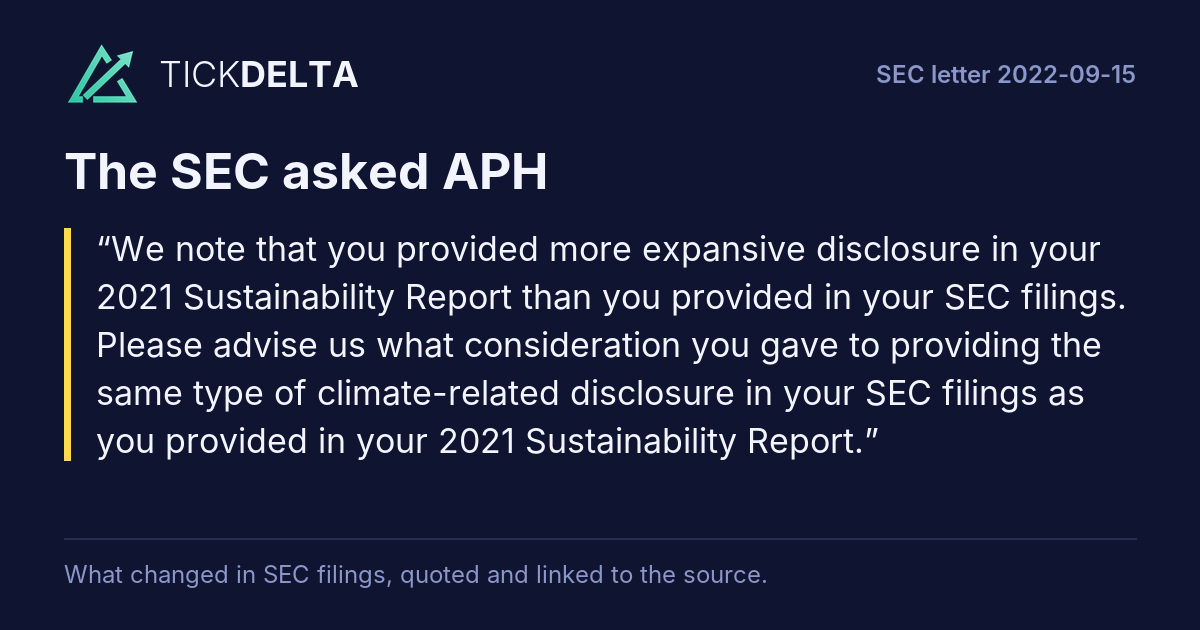
We note that you provided more expansive disclosure in your 2021 Sustainability Report than you provided in your SEC filings. Please advise us what consideration you gave to providing the same type of climate-related disclosure in your SEC filings as you provided in your 2021 Sustainability Report.
APH answered
The Company believes that making sustainable business choices, building strong relationships with our stakeholders and engaging in good corporate governance create long-term value for our Company. To that end, the Company publishes an annual Sustainability Report to highlight our goals and many areas of progress and success in sustainability matters, including climate-related topics.
Rest of the answer

The information included in the 2021 Sustainability Report was prepared with reference to the Global Reporting Initiative (“GRI”) Standards framework and topics identified as material under the Sustainability Accounting Standards Board (“SASB”) standard and is designed to inform and engage the Company’s broad range of environmental, social and governance (“ESG”) stakeholders, such as governments, community members, employees, suppliers, customers and investors. Our 2021

Sustainability Report also outlined board and executive-level oversight of climate-related risks and opportunities identified in the Task Force on Climate-Related Financial Disclosures (“TCFD”) recommendations. The GRI,

SASB and TCFD standards and recommendations in many cases encourage companies to make disclosures about climate-related topics that are important to certain interested stakeholders, even if not material for purposes of the federal securities laws.

For that reason, many of our more expansive climate-related disclosures in our 2021 Sustainability Report did not warrant inclusion in the Company’s 2021 Form 10-K.

In preparing the Company’s 2021 Form 10-K, we considered the applicable provisions of Regulation S-K (including Items 101, 103, 105 and 303) and Regulation S-X, as well as Rule 12b-20 of the Securities Exchange Act of 1934 and other guidance available from the Staff, including but not limited to the 2010 Commission Guidance Regarding Disclosure Related to Climate Change. The

Company believes its 2021 Form 10-K and all other SEC filings comply with those requirements.

While the initiatives and goals identified in the 2021 Sustainability Report were strategically important to the Company’s overall sustainability program, the Company concluded that these initiatives were not material under the SEC’s rules, regulations and interpretive guidance noted above, either quantitatively or qualitatively. The items discussed in our 2021 Sustainability Report have not required material capital expenditures or operating expenses, nor caused, and are not expected to cause in the foreseeable future, significant operational challenges or risks to the Company’s business or results of operations beyond those items disclosed in “Item 1A. Risk

Factors” of the 2021 Form 10-K within the risk factor titled “The Company may be subject to incremental cost and risk associated with efforts to combat the negative effects of climate change” and the risk factor titled “The Company may be negatively impacted by extreme weather conditions and natural catastrophic events, including those caused by climate change and global warming”. As discussed in greater detail below in the Company’s response to Comments #4, #6, #7 and #8, each of the Company’s

(1) capital expenditures, (2) weather related damages and insurance cost, (3) compliance cost and (4) purchase or sale of carbon credits or offsets, as they relate to climate change, was immaterial in the periods covered by the 2021 Form 10-K.

For its future filings with the Commission, the Company will continue to consider all relevant facts and circumstances and follow applicable rules and guidance related to climate-related disclosures.

Read in the reply ↗
In its next report

First report after the company's reply of 2022-10-12: 10-Q filed 2022-10-28 ↗, against the 10-Q filed 2022-07-29 ↗.

Tickdelta does not hold the text of both reports, so they are not compared here.

Risk Factors, page 14
SEC asked (2)
Disclose the material effects of transition risks related to climate change that may affect your business, financial condition, and results of operations, such as market trends that may alter business opportunities, credit risks, or technological changes.
APH answered
The Company has not identified any material effects of transition risks related to climate change that may affect our business, financial condition and results of operations in the foreseeable future.

In arriving at our conclusion, the Company considered climate-related transition risks such as those driven by the market-based need to transition to a low-carbon economy, including the development of, and investment in, new technologies and services that support such transition.
Rest of the answer

We considered whether the increasing development of new technologies with lower energy consumption and lower greenhouse gas emissions could significantly alter business opportunities for the Company, particularly in the end markets we serve associated with electric vehicles, charging infrastructure and the generation of renewable energy. In this regard, we note that market trends and opportunities are driven by a host of complex factors occurring in a broad and dynamic global context, in which climate change considerations are one of many factors in play. For instance, as discussed in greater detail below in our response to

Comment #5, due to the diversity of the end markets we serve and the fact that our products are typically a small component integrated into a larger system, we do not currently expect any material change in the demand for our products based on their carbon intensity or other climate-related impacts.

Another category of risk we considered was a range of legal, regulatory, policy, liability and reputational issues associated with a transition to a low-carbon economy. As discussed in the Company’s 2021 Form 10-K, transition risks likely to be relevant to the Company in the future are associated with the risk that the Company may be subject to additional and/or unforeseen compliance costs and limitations, including increased energy and raw material costs and capital expenditures as a result of compliance with policy-driven responses to climate change such as those that mandate energy and fuel efficiency, regulate greenhouse gas emissions or restrict or mandate specific energy sources. Specifically, we considered whether and how laws, rules and regulations may affect the Company in jurisdictions in which we manufacture our products if, for example, such laws and regulations require use of additional abatement equipment or require changes to our current manufacturing process, which can increase our operating costs or capital expenditures. Further, we also considered whether such laws and regulations could impose additional costs, fees or reporting requirements on the direct or indirect use of energy, natural resources or materials or gases used or emitted into the environment in connection with the manufacture of our products. However, as discussed in greater detail in our response to Comment

#5, our production process is generally not carbon intensive as compared to the other aspects of the production of our customers’ end products.

The Company routinely monitors regulations and policies in regions in which we operate to identify proposed revisions and amendments to such regulations and policies. Although the impact of future or pending laws and regulations cannot be predicted with certainty, as discussed in greater detail in our response to Comment #7, climate-related compliance costs have not had a material impact on the Company’s financial condition or results of operations.

The Company will continue to evaluate the actual and potential impact of transition risks associated with climate change and will update disclosures in future filings with the

Commission, as necessary.

Read in the reply ↗
In its next report

First report after the company's reply of 2022-10-12: 10-Q filed 2022-10-28 ↗, against the 10-Q filed 2022-07-29 ↗.

Tickdelta does not hold the text of both reports, so they are not compared here.

Risk Factors, page 14
SEC asked (3)
Disclose any material litigation risks related to climate change and explain the potential impact to the company.
APH answered
Amphenol defines climate change-related litigation as a proceeding where the primary allegations depend on (a) certain climate change impacts being attributed to the

Company’s operations, (b) allegations of a failure by the Company to meet applicable legal or regulatory requirements related to climate change or (c) alleged failure by the Company to mitigate risks to the Company’s business due to the impact of climate change.
Rest of the answer

Based on this definition, we have never had any litigation and, to our knowledge, no litigation is currently threatened, in each case related to climate change.

The Company’s Legal Department monitors legal trends and risks that could impact the Company, tracking lawsuits and claims made against the Company, other similar manufacturers and other large businesses in the U.S. Among the many factors that are considered regarding litigation risks are the likelihood that a claim will be made against us, our views on the merits of the claim and our potential exposures if such a claim were to be successful, including quantitative and qualitative factors. The risks identified as material to the Company were included in the Company’s risk factors in its 2021 Form 10-K.

Climate-related litigation has not been a risk identified by our internal risk evaluation process as material. As a result, Amphenol did not identify any litigation risk, current or potential, related to climate change for the 2021 Form 10-K.

Should these circumstances change, and the Company becomes aware of material litigation risks related to climate change, future disclosures will be updated accordingly.

Read in the reply ↗
In its next report

First report after the company's reply of 2022-10-12: 10-Q filed 2022-10-28 ↗, against the 10-Q filed 2022-07-29 ↗.

Tickdelta does not hold the text of both reports, so they are not compared here.

Management's Discussion and Analysis of Financial Condition and Results of Operations, page
SEC asked (4)
It appears you have identified climate-related projects in your Sustainability Report. Please tell us about and quantify past and/or future capital expenditures for climate-related projects for each of the periods for which financial statements are presented in your Form 10-K and those planned for future periods.
APH answered
Climate-related projects that support incremental improvements in the areas of waste reduction and recycling, renewable energy and energy savings, and water sanitation and use reduction are key elements to meet our clean water, energy and emission reduction goals. Although these goals are important to the Company, none of these efforts have resulted in, or are expected to result in, capital expenditures or other actions that are material to the Company taken as a whole.

More specifically, in fiscal years 2019, 2020 and 2021, the Company’s total capital expenditures were $295.0, $276.8 and
Rest of the answer

$360.4 million, respectively, and in each year the Company’s capital expenditures associated with climate-related projects were approximately 1% of such total expenditures. Therefore, the Company has concluded that the total costs related to its climate-related projects have not been and are not reasonably likely to be material to the Company’s overall financial condition or results of operations taken as a whole. As such, the Company has concluded that disclosure related to specific climate-related capital expenditures in SEC filings is not required at this time.

In addition, we do not expect the nature and amount of capital expenditures for climate-related projects as a percentage of total capital expenditures to be materially different in

2022 and 2023 to reach our sustainability goals.

Read in the reply ↗
In its next report

First report after the company's reply of 2022-10-12: 10-Q filed 2022-10-28 ↗, against the 10-Q filed 2022-07-29 ↗.

Tickdelta does not hold the text of both reports, so they are not compared here.

Management's Discussion and Analysis of Financial Condition and Results of Operations, page
SEC asked (5)
To the extent material, discuss the indirect consequences of climate-related regulation or business trends, such as the following: • decreased demand for goods or services that produce significant greenhouse gas emissions or are related to carbon-based energy sources; • increased demand for goods that result in lower emissions than competing products; • increased competition to develop innovative new products that
Rest of the question

result in lower emissions; and • increased demand for generation and transmission of energy from alternative energy sources. Also, disclosure on page 23 of your Form 10-K appears to address reputational risks related to regulatory changes surrounding greenhouse gas emissions and other climate change-related laws and regulations. Tell us how you considered providing disclosure regarding reputational risks as an indirect consequence of climate-related business trends.

APH answered
The Company has not identified any material indirect consequences of climate-related regulation or business trends. The following is a discussion of why we believe we have not identified any material indirect consequences of climate-related regulation or business trends:

• decreased demand for goods or services that produce significant greenhouse gas emissions or are related to carbon-based energy sources increased demand for goods that result in lower emissions than competing products

During the periods covered by the 2021 Form 10-K, the Company did not experience and we do not currently
Rest of the answer

expect to experience any material change in the demand for our products based on any increase or decrease in demand for goods and services based on their carbon intensity or other climate-related impacts. To the extent there is any such impact, given the nature and scope of our products, we would expect such impact to be a net positive for the Company’s revenues and profitability.

Our high-technology products and solutions span the broadest range of connectors, sensors, antennas, flexible and rigid printed circuits, cables and value-added assemblies and our businesses operate in eight diverse end markets. Furthermore, our products are typically a small component integrated into a larger system and as a result generally represent only a small fraction of the energy consumption and overall emissions of the larger system. As an example, the automotive end market makes up approximately 20% of the Company’s consolidated revenues. However, the majority of our automotive revenues are derived from sales of products unrelated to whether the vehicle is an electronic vehicle or is powered by a traditional combustion engine. These products include antennas, infotainment and communications components, lighting, power management, safety and security systems, sensing systems and telematics systems. Generally, the demand for each of these products is driven by the proliferation of electronic content in cars and not by climate-related regulation or business trends.

We further considered whether demand for our products could change based on our reputation and customers’ perception of how the Company is addressing concerns related to climate change. For instance, our customers may demand that the Company reduce our carbon intensity and/or divert purchases to our competitors perceived to have made greater strides in reducing greenhouse gases in their production process.

As detailed in our discussion below, we have not identified any material risks relating to reputational matters.

increased competition to develop innovative new products that result in lower emissions

As we disclosed in “Item 1A. Risk Factors” of the 2021 Form 10-K, within the risk factor titled “The Company encounters competition in substantially all areas of our business”, the Company competes primarily on the basis of technology innovation, product quality and performance, price, customer service and delivery time. Although the interconnect industry has historically had many new entrances of smaller companies that serve and compete on niche applications, to date, the Company is not aware of, nor have we experienced, any material increased competition to develop new products that result in lower emissions to address climate change. There continues to be strong competition in all of the markets and geographies we serve and the competition we have typically encountered has not changed, nor do we expect it to materially change, as new products are developed or modified to support applications that will result in lower emissions. As it relates to the emissions created by the manufacturing of our products, that has not been, nor do we expect it to be, a critical or material consideration by our customers in using our products as our components are typically a very small part of our customers’ end product and our manufacturing process is generally not carbon intensive compared to other aspects of the production of our customers’ end products. At the same time, the Company does continue to strive to reduce the environmental footprint of our products by limiting emissions and waste related to their manufacturing.

increased demand for generation and transmission of energy from alternative energy sources

For the reasons outlined above, we do not anticipate any material impact on the Company from the increased demand for generation and transmission of energy from alternative energy sources. To the extent there is any impact, given the nature and scope of our products, we would expect such impact to be a net positive for the Company’s revenues and profitability as any such increased demand would provide the

Company with new opportunities to sell its products.

Also, disclosure on page 23 of your Form 10-K appears to address reputational risks related to regulatory changes surrounding greenhouse gas emissions and other climate change-related laws and regulations. Tell us how you considered providing disclosure regarding reputational risks as an indirect consequence of climate-related business trends.

Response:

Climate change has been identified as a potential source of reputational risk as disclosed in “Item 1A. Risk Factors” of the 2021 Form 10-K, within the risk factor titled “The Company may be subject to incremental costs and risks associated with efforts to combat the negative effects of climate change”. In particular, we considered the reputational risk associated with changing customer, supplier, employee, investor and community perceptions of the Company’s contribution to or detraction from the transition to a lower-carbon economy as well as their preferences for maintaining relationships with companies with lower emissions. In addition, companies that are perceived to be inattentive to the risks of climate change and/or unresponsive to increasing demands for information and action by the abovementioned stakeholders run the risk of adverse publicity such as negative social media coverage and/or product boycotts. To date, none of these issues have had a material impact on the Company.

Read in the reply ↗
In its next report

First report after the company's reply of 2022-10-12: 10-Q filed 2022-10-28 ↗, against the 10-Q filed 2022-07-29 ↗.

Tickdelta does not hold the text of both reports, so they are not compared here.

Management's Discussion and Analysis of Financial Condition and Results of Operations, page
SEC asked (6)
We note your disclosure on page 16 regarding the impacts of extreme weather conditions and natural disasters, including those caused by climate change. Please further discuss the physical effects of climate change on your operations and results, such as weather-related damages to your property or operations, and weather-related impacts on the cost or availability of insurance.
Rest of the question

Include quantitative information with your response for each of the periods covered by your Form 10-K and explain whether increased amounts are expected in future periods.

APH answered
As background for the Staff, the Company has a diverse geographic presence internationally with approximately 230 manufacturing facilities in approximately 40 countries. As a result of the Company’s geographic diversity, local and regional climate change and weather-related disasters, such as tornadoes, hurricanes, fires or snowstorms, have not materially adversely impacted the Company’s overall financial performance during the periods covered by the 2021 Form 10-K.

As disclosed in “Item 1A.
Rest of the answer

Risk Factors” of the 2021 Form 10-K in the risk factor titled “The Company may be negatively impacted by extreme weather conditions and natural catastrophic events, including those caused by climate change and global warming”, unexpected events such as severe weather conditions and natural disasters such as tornadoes, hurricanes, fires or snowstorms could negatively impact our operations and results primarily due to property damage and temporary loss of business.

However, while the Company has been affected by extreme weather conditions and natural disasters in the past, because of our geographical diversity, we did not experience any weather-related damages to our property or operations in excess of our main insurance carrier deductible of $150,000 per occurrence in 2019 and $250,000 in 2020 and 2021, respectively. Accordingly, for the fiscal years 2019, 2020 and 2021, the

Company did not experience any material impact from extreme weather conditions or natural catastrophic events.

Another potential risk of extreme weather conditions and natural disasters, including those caused by climate change, is the potential negative impact on our suppliers, vendors, customers and distributors. While the Company has experienced some climate-related disruptions in its supply chain and climate-related impacts to customer demands from time to time, none of these impacts have been material to the Company taken as a whole.

Because the Company’s weather-related claims have been relatively insignificant, the cost or availability of the Company’s property insurance is directly tied to events happening in the broader macroeconomic environment and the overall insurance market. The Company’s total property insurance costs, which include property premiums and risk mitigation costs, were approximately 0.1% of the Company’s operating expenses in each period presented in the 2021 Form 10-K and thus not material. The Company is not budgeting for any material change in the cost or availability of insurance in the near term for climate-related reasons.

Based upon our historical experience and current knowledge, we have no reason to believe that the impact of weather-related events on our overall property, operations or cost of insurance is expected to materially change in the foreseeable future.

Read in the reply ↗
In its next report

First report after the company's reply of 2022-10-12: 10-Q filed 2022-10-28 ↗, against the 10-Q filed 2022-07-29 ↗.

Tickdelta does not hold the text of both reports, so they are not compared here.

Management's Discussion and Analysis of Financial Condition and Results of Operations, page
SEC asked (7)
Tell us about and quantify any compliance costs related to climate change during the periods for which financial statements are presented in your Form 10-K and explain whether increased amounts are expected in future periods.
APH answered
The Company notes that for the periods reported in the 2021 Form 10-K, it did not incur any material increased compliance costs related to climate change. Our expenditures for climate-related compliance costs, consisting primarily of sustainability data system development, data analysis, report development, stakeholder outreach activity and reporting, and other recurring administrative costs, were less than $1 million for each of the periods presented in our 2021 Form 10-K.
Rest of the answer

As such, our compliance costs related to climate change were not material to our results of operations and financial condition in any of the years presented in the 2021 Form 10-K. In making this determination, the Company considered federal, state and international rules and regulations specifically related to climate change that were in effect and applicable to the Company for the periods reported in the 2021 Form 10-K.

We expect compliance costs to increase in the future with additional regulations expected in the United States and internationally, such as the SEC’s proposed climate-related disclosure rules, but we do not expect these increased costs to be material to the Company taken as a whole. For example, even if these costs increased tenfold (which we think is highly unlikely), they would still be immaterial for each of the periods presented in our 2021 Form 10-K. However, as new laws, rules and regulations are announced, finalized or become effective, we will assess the materiality of any associated compliance costs to determine whether these costs, either individually or in the aggregate, would require disclosure in our future filings with the Commission.

Read in the reply ↗
In its next report

First report after the company's reply of 2022-10-12: 10-Q filed 2022-10-28 ↗, against the 10-Q filed 2022-07-29 ↗.

Tickdelta does not hold the text of both reports, so they are not compared here.

Management's Discussion and Analysis of Financial Condition and Results of Operations, page
SEC asked (8)
If material, provide disclosure about your purchase or sale of carbon credits or offsets and any material effects on your business, financial condition, and results of operations. Provide us with quantitative information regarding your purchase or sale of carbon credits or offsets during the last three fiscal years and amounts budgeted for future periods.
Rest of the question

We remind you that the company and its management are responsible for the accuracy and adequacy of their disclosures, notwithstanding any review, comments, action or absence of action by the staff.

APH answered
The Company has never purchased or sold carbon credits or offsets and currently has no amounts budgeted for future periods. Accordingly, there were no related disclosures in any of the periods presented in our 2021 Form 10-K.

* * *

If you have any further questions, please call me at (203) 265-8625 or email me at CLampo@amphenol.com. Read in the reply ↗
In its next report

First report after the company's reply of 2022-10-12: 10-Q filed 2022-10-28 ↗, against the 10-Q filed 2022-07-29 ↗.

Tickdelta does not hold the text of both reports, so they are not compared here.

Also in this review: closing letter, 2022-10-20

Form 10-K for the Fiscal Year Ended December 31, 2019

2020-03-31 to 2020-12-09 · 6 questions · 2 letters from the SEC, 2 from the company
Review closed 2020-12-09
SegmentsGoodwill and impairment
Notes to Consolidated Financial Statements · Note 13 - Reportable Business Segments and International Operations, page 74
SEC asked (1)
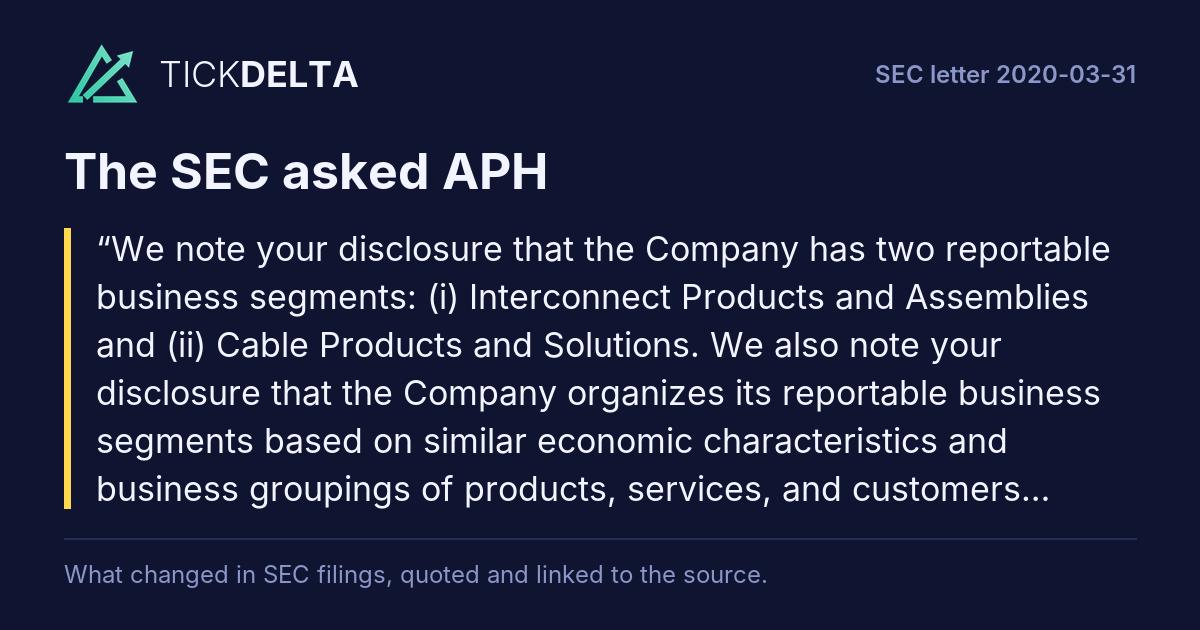
We note your disclosure that the Company has two reportable business segments: (i) Interconnect Products and Assemblies and (ii) Cable Products and Solutions. We also note your disclosure that the Company organizes its reportable business segments based on similar economic characteristics and business groupings of products, services, and customers.
Rest of the question

Please tell us, and clarify in future filings, whether you are aggregating operating segments into your Interconnect Products and Assemblies reportable segment as required by ASC 280-10-50-2. If you are aggregating operating segments, please also address the following: • Identify your operating segments; • Demonstrate to us how you determined your aggregation of operating segments complies with the requirements of ASC 280-10-50-11, including how you concluded they exhibit similar economic characteristics; and • Explain to us how you determined you have two reporting units for goodwill impairment testing based on the requirements of ASC 350-20.

APH answered

No numbered answer found in the reply. Read the reply ↗

In its next report

First report after the company's reply of 2020-05-26: 10-Q filed 2020-07-24 ↗, against the 10-Q filed 2019-10-25 ↗.

Tickdelta does not hold the text of both reports, so they are not compared here.

Notes to Consolidated Financial Statements · Note 13 - Reportable Business Segments and International Operations, page 74
SEC asked (2)
We note you identify eight primary end markets in your Business Section including: Automotive; Broadband Communications; Commercial Aerospace; Industrial; Information Technology and Data Communications; Military; Mobile Devices; and Mobile Networks.
Rest of the question

We also note you identify eight operating groups on your website including: Military and Aerospace; Automotive Products; Industrial Products; Mobile Consumer Products; Interconnect and Sensor Systems; Information Communications and Commercial Products; RF, Optics and Broadband; and Sensor Technology and your Management Team identifies Senior Vice Presidents and Group General Managers or Vice Presidents and Group General Managers for each operating group. Please address the following: • Explain to us how your operating groups are reflected in your reportable segments; • Tell us how you assessed whether each operating group is an operating segment as defined in ASC 280-10-50-1 and explain to us the nature and extent of the discrete financial information available for operating groups. If you have determined that your operating groups are not operating segments, fully explain to us how you made that determination; • Identify your CODM and explain to us how that determination was made; and • Describe the nature and extent of the financial information reviewed by the CODM to assess performance and allocate resources.

APH answered
The Company respectfully acknowledges the Staff’s comments and advises the Staff that the Company identified two operating segments: (i) Interconnect Products and

Assemblies (“Interconnect”) and (ii) Cable Products and Solutions (“Cable”), based on the management approach provided in ASC 280.

Operating Groups and End Markets are part of the Interconnect and Cable segments and do not represent operating segments because they do not meet all of the criteria of ASC 280-10-50-1.
Rest of the answer

Accordingly, the reportable segments presented in the Company’s financial statements do not include any aggregated operating segments.

Company Background

The Company operates through two operating segments – our Interconnect and Cable segments – which are differentiated by the economic and other distinct characteristics of the product categories. The Company has also established Operating Groups, which were put in place primarily from a human resource and administrative perspective, to simplify the administration of our global organization, to optimize “span of control” and, in some cases, to proliferate and maximize the sharing of certain resources, including sales, marketing, and engineering. The Company also maintains a diversified presence across several high-growth economic sectors and end markets where we primarily sell our products (“End Markets”), including Military; Commercial Aerospace; Automotive; Industrial; Mobile Devices; Information Technology & Data communications (“IT Datacom”); Mobile Networks; and Broadband.

More specifically, our Interconnect segment designs, manufactures and markets a range of connector and connector systems, value-add interconnect products and other related products, that are integrated into our customers’ electronics-related applications and ultimately used as an electronic component within their end products. Operations within the Interconnect segment are organized around seven

Operating Groups as described above. These Operating Groups are loosely defined around end markets and product technologies. Each Operating Group is comprised of a collection of independent businesses, each of which is focused on a distinct range of interconnect product technologies. Some of these independent businesses target specific geographic regions and/or serve distinct end markets, but all of our Operating Groups serve multiple end markets due to the broad application of the underlying businesses’ product technology. Each of our independent businesses is encouraged and incentivized to collaborate within and across Operating Groups and in some cases share certain resources, including sales, marketing, and engineering. In addition, these independent businesses are frequently moved from one Operating Group to another in order to maximize the potential for collaboration. This flexibility and agility is key to the Company’s operating strategy of managing and maneuvering its collection of underlying businesses to address the rapidly changing end markets and evolving product technologies within its Operating Groups, in order to drive long term revenue growth.

Our Cable segment primarily designs, manufactures and markets cable, value-add cable related products and components, the vast majority of which are installed by our customers (primarily broadband service providers) in their networks within the Broadband end market. Due to the size of the segment, which is small as compared to the entire Company, this segment is included within our RF,

Optics and Broadband Operating Group. While the relative size of the Cable segment has been shrinking over the last 10 years as we have experienced significant growth in the Interconnect segment, we continue to evaluate the Cable segment separately from the Interconnect segment due to its substantially different characteristics such as, among other things, the economics of the product categories, the sophistication of the manufacturing processes, the go-to-market strategy, the competitive landscape and the way our customers ultimately use the products.

Identification of Chief Operating Decision Maker (CODM)

The Company identified the President/Chief Executive Officer (CEO), Adam Norwitt, as the CODM in accordance with ASC 280 and based on:

●

The CEO’s responsibility for making the primary operating and resource allocation decisions (the Company does not have anyone serving in the capacity of

Chief Operating Officer),

The CEO’s direct reporting line to the Company’s Board of Directors.

While the Group General Managers have functional as well as operational responsibilities for their respective groups and the CEO receives input and recommendations from various other individuals throughout the organization, the CEO retains the primary operational decision-making role and is responsible for driving the Company’s strategy and evaluating the Company’s operating results to assess performance and allocate resources.

Identification of what the CODM Reviews

Our CODM receives financial information used to evaluate total Company and segment performance primarily in two monthly reporting packages referred to internally as the “Flash Report” and the “Forecast Package” as well as two quarterly reporting packages referred to internally as the “Press Release Package” and the “Customer Sales Report”. The lowest level of discrete financial information in these reports, with the exception of the Forecast Package, includes profitability metrics only at the operating segment level. Beyond consolidated segment profitability, the financial performance data of the Operating Groups and End Markets is limited to sales and/or orders. The Forecast Package is distributed more broadly to include the CFO, Corporate Controller and Director of Financial Planning & Analysis (“FP&A”) and has a broad range of financial information at the Company, End Market and operating segment level as well as limited profitability information of the Operating Groups and the underlying businesses (the report is in excess of 100 pages). The primary users of the Operating Group and underlying business profitability data are the CFO,

Corporate Controller and Director of FP&A (for the limited purposes of short-term financial planning and analysis). The CEO does not regularly rely upon the limited profitability information for the Operating Groups to assist in his assessment of financial performance for purposes of the allocation of resources.

Further, when the CODM presents and discusses financial information with our Board of Directors, investors and financial analysts, he only uses the operating segment profit and loss information as well as the End Market sales data.

Identification of operating segments

ASC 280-10-50-1 lists three criteria that are required to be met in order for a component of a public entity to be defined as an operating segment. Operating Groups and End Markets do not represent separate operating segments because they do not meet all the criteria. Specifically, we do not consider the Operating Groups to represent individual operating segments because operating decisions are made, and resources are allocated, based on assessed performance at the

Interconnect and Cable segment level by our CODM as described above. Results of Operating Groups are not separately identified in the regular reporting used by our CODM to assess performance for purposes of resource allocation. The Operating Groups within each operating segment all support the electronics market with similar technology solutions in overlapping end markets; and independent businesses within an Operating Group are frequently changed to a different Operating Group to ensure the organization structure within each Operating Group is aligned to best capture the market and/or customer opportunity. This is one important reason why our CODM does not regularly review and rely upon the limited Operating Group financial information presented in the Forecast Package to assess financial performance in order to make decisions about resource allocations.

In addition, we do not consider the End Markets to represent individual operating segments because they do not engage in business activities. The context in which End

Markets were used in the Business Section of the Form 10-K was to describe the eight primary end markets to which the Company sells its products and not to describe how the Company is managed from an operating segment perspective.

For all of the above reasons, we have concluded that we have two operating and reportable segments (Interconnect and Cable) in accordance with the ASC 280 management approach. We note that Dan Murdock, when he was Deputy Chief Accountant at the SEC, highlighted this key consideration in a speech he delivered at the AICPA conference on December 8, 2014. In particular, Mr. Murdock noted the following:

ASC 280 employs a management approach to the identification of operating segments, which means it is based on the way that management organizes the segments within the entity for the purpose of making operating decisions and assessing performance. Consequently, segments will often be evident from the structure of an entity’s internal organization. Some of you may interpret this to mean that simply looking at the entity’s organizational chart will be sufficient. While this may be a good data point, let me caution you that the organizational chart is simply a data point – the underlying principle requires consideration of the nature and extent of information that is reported to the CODM by each of the positions you identify on that chart.

Furthermore, our Board of Directors generally only receives the operating results for our Interconnect and Cable segments and certain sales metrics for our End Markets. When discussing the Company’s results with investors, the CODM discusses the full operating results for our Interconnect and Cable segments and only the sales results for our End Markets. He does not discuss Operating Group financial information with investors.

We respectfully submit, therefore, that we are not aggregating operating segments into reportable segments. As you requested, in future filings we will clarify that we have two operating segments that are also our reportable segments.

Determination of reporting units for goodwill impairment testing

The Company considered ASC 350-20-35 and ASC 280-10-50 to appropriately determine our reporting units for goodwill impairment testing. With respect to the Interconnect operating segment, we concluded that each of our seven Operating Groups met the criteria to be considered components of an operating segment.

Further, ASC 350-20-35-36 states that an operating segment shall be deemed to be a reporting unit if all of its components are similar. We have concluded that the

Operating Groups within our Interconnect segment are similar and should be combined; therefore, we have determined that our Interconnect operating segment is also our reporting unit. The criteria for aggregation of the Operating Groups were met by applying the guidance within ASC 280-10-50-11 as well as ASC 350-20-55. From a qualitative perspective, the Operating Groups within the Interconnect segment are similar from the manner in which their operations are run, to the products manufactured, types of customers, and sales channels. In addition, the seven Operating Groups share certain assets and resources, and certain collaborative research and development projects in certain cases are supported by and benefit multiple Operating Groups.

Most importantly, we believe goodwill is recoverable from the combined operations of the seven Operating Groups working in concert, because our CODM regularly makes changes to the composition of each Operating Group by realigning businesses from one Operating Group to another to strategically respond to the rapidly evolving electronics market. This flexibility and agility are key to the Company’s strategy and ultimately positions the Company to properly address anticipated market and customer technology needs, which we find over time increasingly overlap between the markets and customers we serve.

As the Broadband Solutions Group is the only component within the Cable operating segment, it is a single reporting unit operating segment.

* * *

If you have any further questions, please call me at (203) 265-8625 or email me at CLampo@amphenol.com.

Read in the reply ↗
In its next report

First report after the company's reply of 2020-05-26: 10-Q filed 2020-07-24 ↗, against the 10-Q filed 2019-10-25 ↗.

Tickdelta does not hold the text of both reports, so they are not compared here.

Notes to Consolidated Financial Statements · Note 13 - Reportable Business Segments and International Operations, page 74
SEC asked (1)
We note your responses to comments 1 and 2 in our letter dated March 31, 2020. Please address the following: • Provide us with additional details about your management structure and how your company is organized. In your response, expand on your description of the Operating Groups and the independent businesses they are comprised of.
Rest of the question

• Describe the role and responsibilities of your CODM and each of the individuals reporting to the CODM. • Identify and describe the role of each of your segment managers. • Describe the key operating decisions, who makes these decisions, how performance is assessed and how resources are allocated within your business. • Expand on your description of the changes your CODM regularly makes to the composition of each Operating Group by realigning businesses from one Operating Group to another, including how the CODM determines such changes should be made, what financial information the CODM reviews when making such changes, and the frequency of such changes. • Tell us how often the CODM meets with his direct reports, what is typically discussed in those meetings, the financial information the CODM reviews in conjunction with those meetings, and the other participants at those meetings. • Explain how budgets are prepared, who approves the budget at each step of the process, the level of detail discussed and individuals that participate at each step, and the level at which the CODM makes changes to the budget. • Describe the basis for determining the compensation for each individual that reports to the CODM.

APH answered
As noted above, our CODM views and manages the business as reflected in our two reportable and operating segments: Interconnect and Cable. In addition, our business model and the Company’s strategy are organized around a diversified set of eight End Markets.

Due to the relative size of the Cable segment, which has been steadily shrinking as a percentage of the Company’s overall sales for several years, the business units under the Cable segment are aligned within our ARFOB and AICC Operating Group (see Appendix A of the supplementary data for more details).

Operating Group Organization

As
Rest of the answer

illustrated in Appendix A of the supplementary data, the

Company has seven Operating Groups comprised of a collection of independent business units (as determined solely by the CODM).

The description of the activities published on our website that make up each Operating Group below supports that the products designed, manufactured and sold within our interconnect segment can be broadly defined as enabling interconnect solutions and applications for our customers:

· Amphenol Military Aerospace Operations (“AMAO”) businesses design, manufacture and supply high performance interconnect systems primarily for harsh environment military and commercial aerospace applications, and also supply products into the industrial market.

· Amphenol Automotive Product Group (“AAPG”) businesses design, manufacture and supply advanced interconnect systems for automotive applications, and also supply products into the commercial aerospace market.

· Amphenol Industrial Products Group (“AIPG”) businesses design, manufacture and supply high-performance interconnect systems for a broad range of industrial applications, and also supply products into the military, commercial aerospace, automotive and mobile networks markets.

· Mobile Consumer Products Group (“MCP”) businesses design and manufacture an extensive range of interconnect products, antennas and electromechanical components for a wide variety of mobile devices, and also supply products into the industrial, IT Datacom and automotive markets.

· Amphenol Interconnect and Sensors Systems Group (“AISS”) businesses design, manufacture and supply value-add interconnect and sensor solutions across a variety of end markets, including industrial, automotive, mobile networks and IT Datacom.

· Amphenol Information Communications and Commercial Group (“AICC”) businesses design, manufacture and supply interconnect solutions across a variety of end markets, including IT Datacom, mobile networks, industrial, automotive and mobile devices.

· Amphenol Radio Frequency, Optics and Broadband Group (“ARFOB”) businesses design, manufacture and supply radio frequency (RF) interconnect technology for a variety of end markets including mobile networks, IT Datacom, automotive, industrial, military and broadband. The [***] business units within this Operating Group selling cable, value-added cable products and related components are for use primarily in the broadband market and are reported under the

Cable segment.

While our Operating Groups may appear (based on their names) to reflect a dedicated focus to a particular End Market, they do not. As described above, Operating Groups are only loosely based on End Markets; [***]. There are many other similar examples of significant disconnects between the Operating Groups and End Markets served that are illustrated in Pages 13-21 of the Forecast Package provided as Appendix F of the supplementary data. In certain cases (notably AISS and ARFOB), our Operating Groups have no correlation to our End Markets.

Since our Operating Groups were created primarily for human resource and administrative purposes to simplify the administration of our global organization, the number and makeup of these

Operating Groups have changed frequently over time. These changes were generally unrelated to financial performance. [***]

Our CODM has the ability to re-shuffle the number and makeup of Operating Groups because the business units within a segment are so similar that frequent changes from one Operating Group to another can be made without any negative impact on our Segment’s overall operations. In contrast, business units have never been moved from one Segment to another. This frequent movement of business units among the various Operating Groups is one important reason why the CODM does not rely on detailed financial information at a level lower than our Interconnect and Cable Segments for purposes of making resource allocation decisions. As noted above, the regular re-alignment of independent business units amongst the seven Operating Groups is undertaken to maximize the performance of the Segments and the Company as a whole and is not done based on changes to our Segments or End Markets, which tend to be very stable over time.

Operating Group Management

Each Operating Group consists of a lean management team: a Group

General Manager (who directly reports to the CODM – see Appendix A of the supplementary data) and a Group Controller. In addition to these two individuals, each Group management team includes a limited number [***] of other supporting roles.

Each of our more than 120 business units is managed by a business unit General Manager who reports directly to the Group General Manager and who is incented to grow and develop his or her business and to manage entrepreneurially in developing, marketing and producing innovative, timely and cost-effective product solutions to meet customer needs regardless of Operating Group placement. In addition to the General Manager, each business unit is made up of a local management team with a deep understanding of their respective countries and customers and includes all the functions necessary to run the business on a stand-alone basis, including sales, marketing, engineering, research & development, operations, quality, finance, human resources, and information technology, all of which functions report into the General Manager.

Our CODM is the chief architect of this unique operating culture that has enabled the Company to deliver sustained growth, profitability and shareholder value over a long period of time. Our CODM is primarily responsible for key operational decisions to capitalize on our value-creating technology solutions and growth trends in our markets. Our CODM is also solely responsible (with oversight of the Board) for all significant capital allocation decisions, such as investing in new products, equipment, facilities and capabilities to fuel future growth and expansion and funding strategic acquisitions that complement our existing businesses and further expand our product lines, technological capabilities and geographic presence.

This entrepreneurial and collaborative management structure and flexible capital allocation philosophy is driven by our belief in the need to be agile and collaborative across our entire portfolio due to the rapidly changing electronics industry that cuts across all of our interconnect product categories and the

End Markets we serve. The CODM’s primary focus is on Interconnect and Cable product sales to our End Markets. He does not assess financial performance (i.e., review the financial performance of each of the Operating Groups or individual businesses) for purposes of allocating resources to each of those businesses.

The executive-level management structure as at year end 2019

(and as of the date of this letter) is included in Appendix B of the supplementary data.

• Describe the role and responsibilities of your

CODM and each of the individuals reporting to the CODM.

Role and Responsibilities of CODM

As discussed in our previous response, the CODM for the Company is our CEO who is responsible for the primary operational decisions of the Company, driving the Company’s strategy and evaluating the Company’s and each Segment’s results to assess performance and allocate resources.

The CODM’s primary responsibilities include:

· Developing the overall strategy and financial goals for each Segment and the overall Company including what markets and product areas the Segments and the Company should target.

· Evolving the decentralized organizational structure of the Company in order to protect the entrepreneurial and highly accountable culture of the Company. This includes reviewing and making changes to the business units included within each Operating Group to ensure they are aligned with the Operating Group that will maximize the overall Segment’s potential for revenue and profitability growth.

· Driving collaboration between the business units.

· Oversight of Group General Managers to ensure strategic direction of Operating Groups and business units are aligned with that of the Segments and the Company.

· Reviewing and approving all capital expenditures over $[***] requested by the business unit General Managers (the Board is required to approve over certain higher thresholds).

· Interfacing with strategic customers on a regular basis on various topics including business reviews and negotiations.

· Actively involved and final authority (other than the Board, where required) regarding the Company’s capital deployment priorities including M&A, dividends and share repurchases

· Actively involved in the acquisition process including final determination of what businesses the Company targets, key decisions made based on information identified during the diligence process, approval of critical contract terms and final determination of valuation of the acquisition.

· Involved with investor relations

Role and Responsibilities of Headquarters Direct Reports

The CFO’s primary responsibilities include those typical of a public company chief financial officer.

The General Counsel’s primary responsibilities include those typical of a public company general counsel, including but not limited to advising executive management and the Board of

Directors on a variety of legal and compliance matters.

The Senior Vice President, Human Resources’ (“SVP

HR”) primary responsibilities include oversight of all aspects of human resources management and industrial relations policies, practices and operations.

The Vice President, Strategy & Investor Relations’

(“VP IR”) primary responsibilities include research of market trends, monitoring and reporting on industry news, involvement in Environmental, Social and Governance initiatives and investor relations activities.

Our CFO, General Counsel, SVP HR and VP IR meet directly with the CODM regularly and primarily on an unscheduled basis to discuss whatever topics are of importance at the time.

Role of Group General Managers

The Group General Managers’ primary responsibilities include:

· Driving collaboration between the business units within their respective

Operating Group as well as among the various other Operating Groups.

· Oversight of business unit General Managers including involvement in hiring decisions (ultimately requiring CODM approval) to ensure strategic direction of the business is aligned with overall direction set by the CODM.

· Approval of capital expenditure requests under $[***] by the business unit General Managers.

· Interacting with customers when needed, typically for higher level communications or important topics and negotiations.

· Oversight of Group-level team which at minimum includes a Group Controller whose main purpose is review and indirect oversight of the business unit finance function mainly from a financial reporting and internal control perspective.

Our Group General Managers meet directly with the CODM on a regular basis. As discussed in our previous response, our CODM retains the primary operational decision-making role and therefore is responsible for driving the Segments’ and the Company’s strategy and evaluating the Segments’ and the Company’s operating results to assess performance and allocate resources. The Group General Manager roles are not Board or shareholder facing roles. For all the above reasons, our Group General Managers are not segment managers.

• Identify and describe the role of each of your segment managers.

Our CODM is also the segment manager for each of our two segments.

As such, please refer to the roles and responsibilities above for our CODM in response to this question.

• Describe the key operating decisions, who makes these decisions, how performance is assessed and how resources are allocated within your business.

The key operating decisions of the Company and each Segment are centered around the following:

· Decisions determining Segment and overall Company strategy and direction including what markets or product areas the Company should target

· Organization of the Company including making changes to existing Operating

Groups and business units to maximize the potential for revenue and operating income growth at the Segment level

· Critical hiring decisions especially hiring decisions involving key

HQ functions, business unit General Managers and Group General Managers

· Determination of how resources should be allocated to capture opportunities including capital expenditures and facility leases

· Decisions regarding significant customer relationships

· Decisions regarding capital deployment and acquisitions including what businesses to target and buy as well as valuation decisions and contract terms

· Annual budget setting process

Our CODM is primarily responsible for each of the operating decisions outlined above.

Our CODM and our Board assess performance by comparing actual financial results (orders, revenue, operating income and cash flows) of the Company and its Segments to those of the prior year and those outlined in the annual budget. As stated in our previous response letter, in order to achieve this, our CODM receives financial information for the consolidated Company and each Segment contained in CODM packages described below and more fully in

Appendix D of the supplementary data.

• Expand on your description of the changes your CODM regularly makes to the composition of each Operating Group by realigning businesses from one Operating Group to another, including how the CODM determines such changes should be made, what financial information the CODM reviews when making such changes, and the frequency of such changes.

We currently have seven Operating Groups. Since we created our

Operating Group structure in 2000, we have had as many as [***] Operating Groups and as few as [***] Operating Groups. The dynamic nature of our evolving markets, customers, product technologies and competitive landscape requires frequent re-alignment of our business units within each Operating Group. In just the last ten years, the CODM has moved over [***] business units from one Operating

Group to another Operating Group and has made several changes to the overall number of Operating Groups; if Operating Groups were operating segments, we would have to effectively restate our segment disclosure on an almost annual basis, if not more frequently.

[***]

The CODM does not consider current financial performance as a key factor in the decision to realign business units. The decision is based on a multitude of operational data and strategic considerations including responding to changes in technologies, customers and/or market trends, or for more administrative or personnel-related reasons as described above. The frequent realignment is focused on the long-term to enhance the level of collaboration between complementary businesses and therefore maximize the potential opportunities not only for that business unit but for other business units within the Operating Group and ultimately the Segment.

This flexibility and agility described above are key to the

CODM’s operating strategy of managing and maneuvering the Company’s collection of underlying businesses to address the rapidly changing end markets and evolving product technologies within its Operating Groups, in order to drive long term revenue and income growth. This further demonstrates that the CODM allocates resources at the Interconnect and Cable Segment level rather than the Operating Group level as the makeup of each group is fluid over time to ensure the overall competitiveness and long-term outperformance of the Company and its two Segments. This agility is well-understood and appreciated by the Company’s investors and is a consistent theme on the Company’s quarterly earnings calls.

• Tell us how often the CODM meets with his direct reports, what is typically discussed in those meetings, the financial information the CODM reviews in conjunction with those meetings, and the other participants at those meetings.

The CODM meets regularly with all of his direct reports to discuss initiatives and general updates pertaining to the Company as a whole. These meetings take place individually and as a group. Individual interactions between the CODM and his direct reports vary based on the needs at the time, but generally occur at least weekly on an unscheduled basis, as needed, to manage the business and implement the strategy determined by the CODM and approved by our Board.

The subject matter for these meetings and the information the CODM reviews in conjunction with these meetings varies greatly depending on the persons involved and may include financial results and performance updates, legal and/or human resource matters, customer, market, product and technology updates or governmental and regulatory matters, among many other topics.

In addition to the unscheduled meetings discussed above, the formally scheduled meetings between the CODM and his direct reports include the following: [***]. There is no defined content and format for the financial or other information included in these meetings as the financial information is tailored to the topics being discussed and changes from meeting to meeting. [***]

• Explain how budgets are prepared, who approves the budget at each step of the process, the level of detail discussed and individuals that participate at each step, and the level at which the CODM makes changes to the budget.

The budget process starts with guidance provided by the CODM and CFO regarding expectations and timing of the upcoming budgets and budget process. The budgets are developed annually on a “bottoms up” basis by each independent business unit. These budgets are then submitted into the Company’s financial consolidation system. The data submitted includes full income statement and balance sheet information including other supplemental supporting data including customer, product and End Market information. The budgets are then reviewed by the Group General Manager and Group

Controller who typically meet with each business unit General Manager and controller to review their budget. Any resulting changes are then made to the budget submittals. Those budgets are then compiled and reviewed by the headquarters finance team led by the

Corporate Controller and CFO. Prior to the budget meeting with headquarters personnel (including the CODM and CFO), a presentation is submitted by each Group Controller which provides an overview of the budget for each business unit, which in addition to financial data generally includes customer, product and End Market information (there is no defined format).

The annual strategy and budget planning meetings with the CODM,

CFO and other members of executive management then take place [***]. Each business unit General Manager will briefly present his or her business plan and financial budget for the upcoming year. The CODM participates in these budget meetings by leading discussions primarily related to markets, customers, competition, manufacturing strategy and product technology. Final budgets reflecting any changes made by each business unit General Manager are typically submitted several weeks later and these budgets are then consolidated up to the Segment and Company level for final review and approval by the CODM (any changes made to the budget by the CODM which is ultimately presented to the Board is at the Segment and Company level).

The consolidated Company and Segment budgets are then reviewed and approved by the Board at the [***] meeting; individual Operating Group budgets are neither provided nor reviewed by the Board.

• Describe the basis for determining the compensation for each individual that reports to the CODM.

The Compensation Committee of our Board determines the compensation for our executive officers, with input from the CODM.

The compensation program for all executive officers (including the Group General Managers) includes the following elements:

· Base Salary o Determined based on the size, scope and complexity of the executive officer’s responsibility, among other things.

· Management Incentive Plan o Determined based on achievement of financial goals. For headquarters executive officers the goals have most recently been based on consolidated revenue and EPS growth of the consolidated company. For Group General Managers the goals have most recently been based on revenue and operating income growth of their respective Operating Group.

· Stock Options o Each executive officer including Group General Managers is granted stock options on an annual basis. The purpose of the stock option grants is to align the long-term interests of the management team and our shareholders.

For 2019, the base salary of our executive officers as a group comprised less than 25% of total compensation, while at-risk compensation (Management Incentive Plan + Stock Options) comprised more than 75% of total compensation. With respect to the incentive compensation, a significant majority of every executive officer’s incentive pay was comprised of stock options. As such, the compensation of every executive officer including the Group General Managers is tied predominantly to the consolidated results of the Company.

Read in the reply ↗
In its next report

First report after the company's reply of 2020-09-18: 10-Q filed 2020-10-23 ↗, against the 10-Q filed 2019-10-25 ↗.

Tickdelta does not hold the text of both reports, so they are not compared here.

Notes to Consolidated Financial Statements · Note 13 - Reportable Business Segments and International Operations, page 74
SEC asked (2)
You state in your response the CODM receives two monthly reporting packages referred to internally as the “Flash Report” and the “Forecast Package” as well as two quarterly reporting packages referred to internally as the “Press Release Package” and the “Customer Sales Report”.
Rest of the question

Please describe in additional detail the financial information included in these packages, and tell us what financial information is reviewed by the CODM for the purpose of allocating resources and assessing performance. You also state in your response that the Forecast Package includes “limited profitability information of the Operating Groups and the underlying businesses”, and that your “CEO does not regularly rely upon the limited profitability information for the Operating Groups to assist in his assessment of financial performance for purposes of the allocation of resources”. Please describe this limited profitability information and tell us whether the CODM uses this information for the purpose of allocating resources and assessing performance, and if so, in what circumstances and with what frequency.

APH answered
The detailed financial information included in these packages are included in Appendix D of the supplementary data.

For the purpose of allocating resources and assessing performance, the CODM receives financial information for the consolidated company which includes, revenues, gross margin, operating income, net income and earnings per share information. The CODM also receives financial information for each of the two Segments, including revenues, book to bill ratio, operating income, return on sales and conversion margins.
Rest of the answer

The supplemental information for End Markets and Operating Groups included in these four reports are limited to net orders and revenues (i.e., there is no profitability measure below the segment level) except for the Forecast Package.

The Forecast Package (which is approximately 120 pages in length) is prepared monthly for multiple users including the headquarter Executive Officers, Corporate Controller, Treasurer and Director of Financial Planning & Analysis (FP&A). The Operating Group profitability information which is primarily used by the CFO,

Corporate Controller and Director of FP&A is the second to last item on the table of contents and is used for the purpose of short-term financial planning and analysis.

You also state in your response that the Forecast

Package includes “limited profitability information of the Operating Groups and the underlying businesses”, and that your “CEO does not regularly rely upon the limited profitability information for the Operating Groups to assist in his assessment of financial performance for purposes of the allocation of resources”. Please describe this limited profitability information and tell us whether the CODM uses this information for the purpose of allocating resources and assessing performance, and if so, in what circumstances and with what frequency.

The financial information included in the Forecast Package includes a comparison of actual and forecasted orders, revenue and operating income to the prior forecast, prior year and budgeted amounts for the Operating Groups and underlying business units. The limited profitability information included therein does not present a complete picture of the financial performance of the Company or its components, and the CODM does not use Operating Group profitability information to assess performance for the purpose of allocating resources.

The CODM assesses performance for the Company and its two Segments for the purpose of allocating resources on a constant basis, relying on a broad range of financial and operational information, which includes Company, Segment and End Market information, general industry and competitive data as well as conversations with his direct reports and other industry participants. No single Company report or other type of information plays a predominant role in his assessment; instead he relies on the total mix of information available to him.

Read in the reply ↗
In its next report

First report after the company's reply of 2020-09-18: 10-Q filed 2020-10-23 ↗, against the 10-Q filed 2019-10-25 ↗.

Tickdelta does not hold the text of both reports, so they are not compared here.

Notes to Consolidated Financial Statements · Note 13 - Reportable Business Segments and International Operations, page 74
SEC asked (3)
We note your discussion of the financial information your board of directors generally receives. Please describe in additional detail the financial information received by your Board of Directors and how frequently that information is received.
APH answered
The Board receives the “Flash Report” described in Appendix D of the supplementary data on a monthly basis and also receives a “Business Report”, “Board Financial

Package” and the “Earnings Release” on a quarterly basis. None of them have any profitability information at the Operating Group or underlying business unit level.
Rest of the answer

These reports and presentations only have financial information that the

CODM considers important and meaningful at the consolidated, Segment and/or End Market level (which is consistent with the information we present to shareholders during our quarterly earnings release). As detailed in our response above, the Company does not consider profitability information at the Operating Group level to be meaningful for the purposes of the allocation of resources and, therefore, the Board does not receive it.

Read in the reply ↗
In its next report

First report after the company's reply of 2020-09-18: 10-Q filed 2020-10-23 ↗, against the 10-Q filed 2019-10-25 ↗.

Tickdelta does not hold the text of both reports, so they are not compared here.

Notes to Consolidated Financial Statements · Note 13 - Reportable Business Segments and International Operations, page 74
SEC asked (4)
Please be advised we are and will continue to assess your reporting units based on the information we receive in response to the above comments.
APH answered
We understand that segment reporting conclusions involve a level of judgment based on an entity's individual facts and circumstances, and that no single factor or characteristic is determinative.

Based on the unique facts and circumstances applicable to Amphenol, we believe we have appropriately concluded that we have two reportable segments, two operating segments and two reporting units. [***]

* * *

If you have any further questions, please call me at (203) 265-8625 or email me at CLampo@amphenol.com. Read in the reply ↗
In its next report

First report after the company's reply of 2020-09-18: 10-Q filed 2020-10-23 ↗, against the 10-Q filed 2019-10-25 ↗.

Tickdelta does not hold the text of both reports, so they are not compared here.

Also in this review: closing letter, 2020-12-09

From the SEC's correspondence on EDGAR: staff letters (form UPLOAD) and company letters (form CORRESP), 12 letters filed since 2020-03-31. Questions and answers are matched by their numbers; topics come from words in each question. The reports are compared word for word (same form, before the first SEC letter against the first report after the company's reply). No AI.

Work on APH in a spreadsheet: Excel workbook (a sheet per section, ten years by column, charts, links to the filings) · CSV. For a Google Sheet that stays up to date, paste =IMPORTDATA("https://tickdelta.com/company/APH/export.csv") into a cell.