21 paragraphs in Risk Factors of the 10-K filed Feb 25, 2026
with nothing like them in the 10-K filed Feb 24, 2025. Quoted exactly.
Paragraphs that were only edited are under 10-K change.
Compared with the Risk Factors in the latest 10-K of the other 75 Financials companies:
a paragraph with at least half its words the same at another company is called similar, and the companies are listed under it.
A paragraph most of them have is marked boilerplate. No line means no other company has one like it.
This counts text; it does not say how serious a risk is.
Evolving political, market and economic conditions, including increased policy uncertainty and market volatility, may adversely affect our businesses and financial results.
Read in the 10-K ↗
Past, ongoing and potential armed conflicts and military hostilities in various regions, such as the conflict between Russia and Ukraine and the conflict in the Middle East, and heightened political and economic uncertainty across certain emerging markets and certain regions of strategic geopolitical significance, have increased, and may continue to increase in the future, global economic and political uncertainty. In response to such conflicts, hostilities and uncertainties, governments may impose a range
Read in the 10-K ↗
In addition, certain investments by funds or vehicles we manage may be based, in part, on assumptions regarding the availability, amount or duration of federal, state, local or foreign government programs, incentives, subsidies, regulatory frameworks or tax credits applicable to particular industries, assets or business activities. Such programs or incentives are often available only for limited periods, may be subject to phase-outs, caps or eligibility requirements, and may depend on continued legislative, regulatory or budgetary support. As a result, such programs or incentives may not be available for the full anticipated investment horizon, or on the terms initially expected, and may be delayed, modified, not renewed or eliminated. Any such developments could adversely affect the anticipated profitability, cash flows, valuation or exit opportunities of these investments, which in turn could negatively affect the performance of the funds or vehicles we manage, and our results of operations and cash flows.
Read in the 10-K ↗
our outstanding indebtedness and debt service requirements, which would increase the risks of investing in our shares, and may adversely impact our results of operations and financial condition.
Similar paragraph at 5 of 75 other Financials companies:
AIG,
AIZ,
AJG,
AMP,
PFG
Competition for our business extends beyond fundraising and includes competition to source, originate, structure, finance and syndicate investments, acquire portfolio companies and strategic assets and deploy capital across private equity, private credit, real assets and other alternative strategies. We also compete with financial institutions and other market participants in connection with acquisitions, investments, financings, originations, syndications and other strategic transactions, and competitive pressures in these areas may affect pricing, transaction terms, investment returns and our ability to deploy capital efficiently. In addition, our retirement services business faces significant competition from traditional insurers and reinsurers, asset managers and other financial institutions offering annuity, pension risk transfer and other retirement products, as well as from alternative capital providers seeking exposure to similar long-duration liabilities or asset classes. In these markets, competition is based on factors such as pricing, product design and structure, underwriting standards, investment performance, financial strength, financial strength ratings, credit ratings, scale, distribution capabilities, regulatory capital considerations and the ability to source and manage assets aligned with retirement and insurance liabilities.
Our competitors may have greater financial, fundraising, technical, research, marketing and other resources, more established relationships, broader product offerings, lower costs of capital or higher risk tolerances than we do. Some competitors may be willing or able to pursue opportunities or strategies or retirement-related transactions on more aggressive terms, including by accepting lower returns or greater risk, which could reduce the availability of attractive opportunities or require us to adjust pricing, structure or terms. As a result of these competitive dynamics across our asset management and retirement services businesses, we may experience increased difficulty in attracting and retaining investors, originating or executing transactions on favorable terms, maintaining or increasing fees, deploying capital effectively or achieving our growth objectives.
In addition, we may face other competitive risks beyond those specific to the businesses in which we operate. For example, the use and implementation of artificial intelligence, including machine learning technology and generative artificial intelligence (collectively, “AI Technologies”), and products and platforms involving digital assets and distributed ledger technologies also have the potential to significantly disrupt the way financial institutions, including investment managers and asset managers, do business or attract and address investor demands and strategies, resulting in further competitive pressures for our business. These competitive pressures may materially adversely affect on our growth, business, financial condition, results of operations, cash flows and prospects.
Read in the 10-K ↗
Additionally, although the prevalence and scope of applications of distributed ledger technology, cryptocurrency and similar technologies is growing, the technology is nascent and may be vulnerable to cyberattacks or have other inherent technological weaknesses. We and the funds we manage are exposed to risks, and may become exposed to additional risks, related to distributed ledger technology and the financial products that use it, such as blockchain, cryptocurrencies and other digital assets, or decentralized finance (DeFi) and related applications, including through our offering funds and other products, facilitating clients’ activities and investing in financial products that use blockchain, cryptocurrencies or other digital assets; our reliance on companies that use, develop or rely on distributed ledger technology; use of distributed ledger technology by third-party vendors, clients, counterparties, clearinghouses and other financial intermediaries with whom we transact; and the receipt of cryptocurrencies or other digital assets as collateral. Market volatility of financial products using distributed ledger technology may increase these risks and may also expose us to increased compliance risks.
Similar paragraph at 1 of 75 other Financials companies:
GS
Through our use of AI Technologies, we avail ourselves of the potential benefits, insights and efficiencies resulting from these technologies. For example, our employees can utilize internal generative AI-powered applications to help summarize, search or
Similar paragraph at 1 of 75 other Financials companies:
BX
Regulations related to AI Technologies continue to evolve and may also impose on us certain obligations and costs related to monitoring and compliance. The costs of preparing for, monitoring and complying with laws and regulations related to AI Technologies, and any claims or penalties as the result of any use of or reliance on AI Technologies, could, if applicable, adversely affect us, us and/or third parties connected to us (whether directly or indirectly), which could adversely affect our business and results of operations.
Read in the 10-K ↗
10 more
We are subject to operating and financial restrictions arising from our indebtedness.
Similar paragraph at 2 of 75 other Financials companies:
BAC,
VWe are subject to operating and financial restrictions arising from our indebtedness, which include restrictive covenants that, subject to certain exceptions, limit certain operational, financial or structural decisions we can make. As a result of these restrictions, we may be limited in how we conduct our operations and may be unable to raise additional debt financing to compete effectively or to take advantage of new business opportunities. Any future indebtedness we incur may also contain significant operating and financial restrictions.
Read in the 10-K ↗
Conversely, so-called “anti-DEI” sentiment and related public policy actions have gained prominence in the U.S. In recent periods and as part of evolving public policy initiatives, certain federal and state authorities have issued executive orders, enacted or proposed legislation, issued legal opinions or taken other actions that restrict, discourage or prohibit DEI initiatives, including by eliminating or limiting DEI programs or offices within governmental entities, restricting DEI-related training or policies and, in some cases, imposing requirements or conditions on entities that contract with, receive funding from, or otherwise conduct business with governmental authorities. For example, certain executive orders have directed federal agencies to terminate DEI programs and to eliminate policies perceived as providing preferential treatment based on protected characteristics, and similar actions have been taken or proposed at the state level. In addition, certain governmental officials and regulators have publicly criticized or targeted DEI-related policies and practices and have initiated or threatened investigations, enforcement actions or other proceedings in connection with such initiatives. If we, the funds we manage, or the portfolio companies in which they invest, are perceived to promote or implement DEI-related policies or practices that are viewed as inconsistent with such legal, regulatory or policy developments, we could be subject to increased scrutiny, investigations, litigation, fines, suspension or debarment from government contracting, or reputational harm. Moreover, certain investors, counterparties or governmental entities may elect not to invest in, allocate capital to, conduct business with, or otherwise engage with us, the funds we manage or certain investment vehicles, or the portfolio companies in which they invest, may withdraw existing investments, or may seek to exclude us based on perceptions of our DEI-related practices, which could adversely affect the price of our common stock, the performance of the funds we manage, the ability to raise future capital, business results or financial condition, or cause reputational harm.
Read in the 10-K ↗
•Rapid and unforeseen technological transformations, such as the emergence of large language models and generative AI, and/or the anticipated impact of such transformations, may introduce operating risks to certain portfolio companies and other investments, particularly those in the software industry and other related sectors, may cause volatility in their valuations and their stock price and may negatively affect their performance.
Read in the 10-K ↗
•Certain of the funds we manage invest in private credit opportunities (including through direct origination), which may be illiquid, difficult to value and exit prior to maturity, and susceptible to credit deterioration, restructurings or losses.
Read in the 10-K ↗
In connection with the services rendered by our affiliates to the funds we manage and their portfolio companies, such affiliates and/or the portfolio companies receive fees from the funds we manage, portfolio companies of the funds we manage and third-party borrowers. Furthermore, a borrower or an issuer may view all fees, expense reimbursements and interest related to
Read in the 10-K ↗
As we and the funds we manage become more actively involved in digital asset markets, the regulatory risks described herein will be heightened and we will be subject to supplemental and/or increased regulation that applies (or, in the future, will likely apply) specifically to digital assets and related activities. The scope, interpretation, and practical impact of such regulatory measures will depend on their implementation, interpretation, and interaction with existing regulatory regimes, continue to evolve, and may differ materially across jurisdictions, resulting in increased compliance costs and obligations for us and the funds we manage.
Read in the 10-K ↗
to such assessments. If material, any such future assessments may have an adverse effect on our financial condition, results of operations, liquidity or cash flows, and any liability we have previously established for these potential assessments may not be adequate.
Similar paragraph at 2 of 75 other Financials companies:
HOOD,
KKR
On January 5, 2026, members of the Inclusive Framework agreed on several new safe harbors as part of a package of measures on Pillar Two aimed at reducing compliance burdens and ensuring fair treatment of substance-based tax incentives. A key element of the package includes measures designed to ensure that, subject to certain conditions, neither the IIR nor the UTPR would apply to certain U.S. headquartered MNEs (or any foreign subsidiaries included in the group’s consolidated financial statements) for financial years commencing on or after January 1, 2026 (the “SbS Safe Harbor”). While these measures could, if implemented as contemplated, significantly reduce the potential impact of the Pillar Two rules to some or all of our business, the practical impact of these measures remains uncertain and will depend on local law enactment, administrative guidance, and interpretation in the relevant jurisdictions. In addition, local Pillar Two regimes, including qualified domestic minimum top-up taxes, may continue to apply in jurisdictions in which our business operates. In the U.K., the Exchequer Secretary to His Majesty’s Treasury announced on January 7, 2026 that measures to implement the new provisions in the U.K., applicable to accounting periods beginning on or after January 1, 2026, will be subject to technical consultation and then brought forward in the next Finance Bill. However, no assurances can be provided that such measures will be enacted or, if enacted, what their effective date may be.
Read in the 10-K ↗
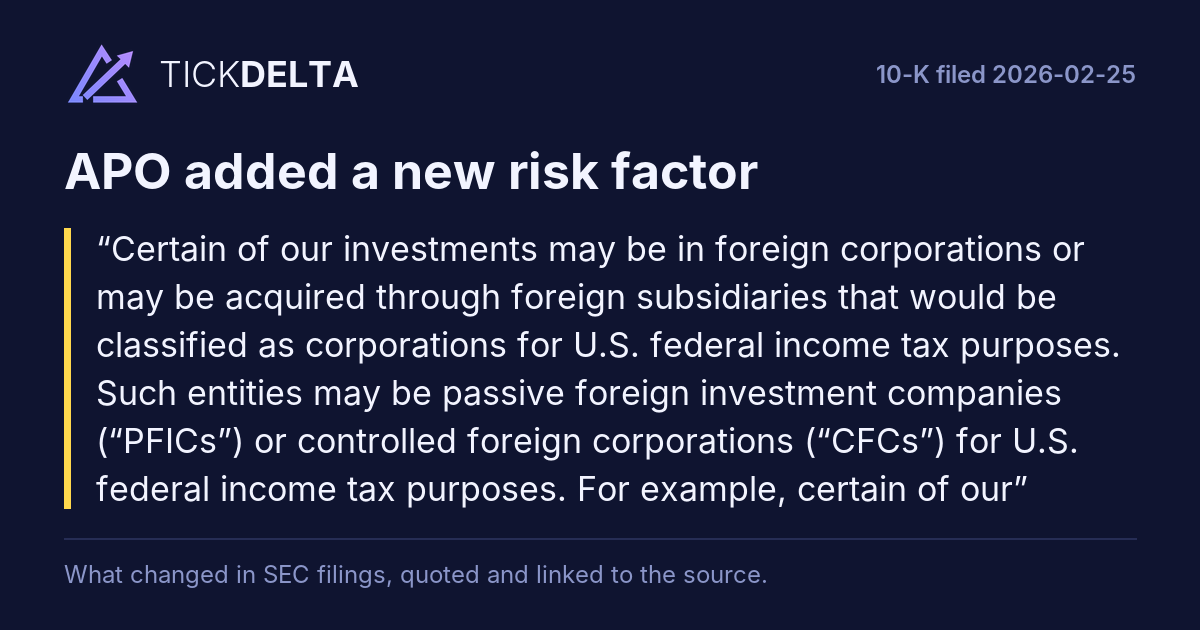
Certain of our investments may be in foreign corporations or may be acquired through foreign subsidiaries that would be classified as corporations for U.S. federal income tax purposes. Such entities may be passive foreign investment companies (“PFICs”) or controlled foreign corporations (“CFCs”) for U.S. federal income tax purposes. For example, certain of our
Read in the 10-K ↗
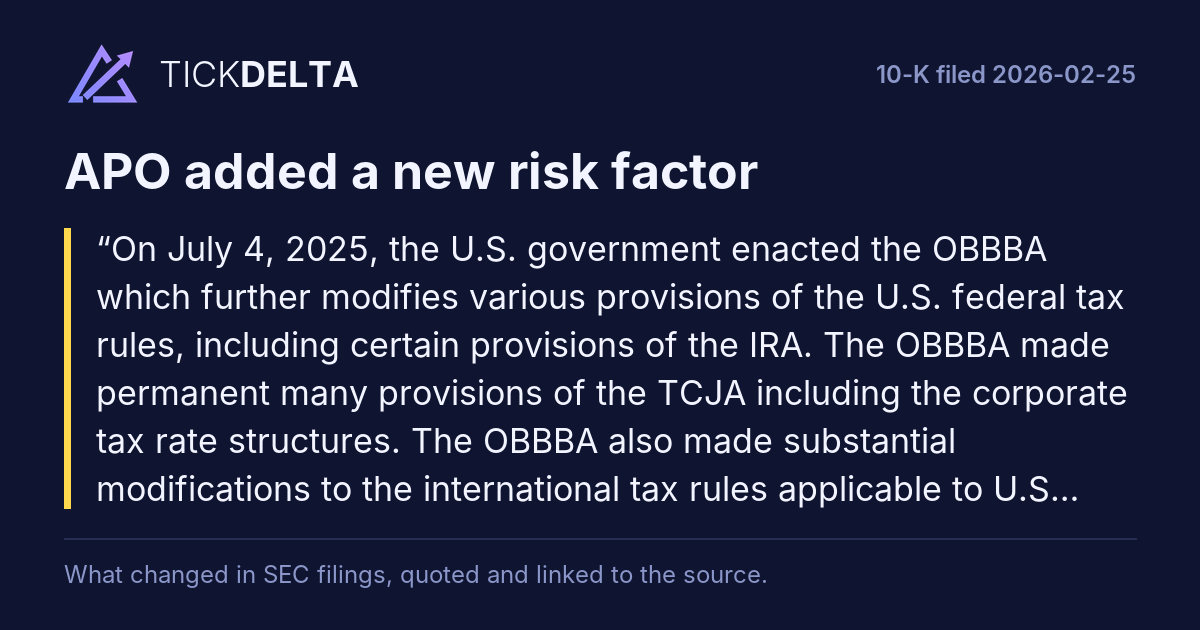
On July 4, 2025, the U.S. government enacted the OBBBA which further modifies various provisions of the U.S. federal tax rules, including certain provisions of the IRA. The OBBBA made permanent many provisions of the TCJA including the corporate tax rate structures. The OBBBA also made substantial modifications to the international tax rules applicable to U.S. persons, including changes to the global intangible low-taxed income regime, the foreign-derived deduction eligible income regime, and BEAT (as discussed above). The OBBBA introduced other legislative changes, including the restoration of deductible net business interest expense under Internal Revenue Code Section 163(j) to 30% of earnings before interest, taxes, depreciation and amortization. The impact of the OBBBA on our financial condition will depend on the facts and circumstances of each year.
Read in the 10-K ↗
New in the latest 10-Q
17 paragraphs in the 10-Q filed Nov 5, 2026 with nothing like
them in the 10-Q filed Aug 10, 2026 (at least half the words must differ; new numbers alone do not count).
Quoted exactly, grouped by the item heading above them. This is text that changed, not a judgement of how serious it is.
10-Q
Realized performance fees Carried interest and incentive fees, received in either cash or equity, earned by Apollo as general partner or investment manager that have been crystallized through a realization event. Realized performance fees also include capital solutions fees and other, net earned above certain performance thresholds which are closely aligned to our principal investing activities.
Read in the 10-Q ↗
Financial statements and notes
Payments related to issuances of common stock for equity-based awards 1,018,379 — 4 (20) — (16) — (16)
Read in the 10-Q ↗
Conversion of Mandatory Convertible Preferred Stock 14,587,520 (1,398) 1,398 — — — — —
Read in the 10-Q ↗
Payments related to issuances of common stock for equity-based awards 3,650,964 — 28 (260) — (232) — (232)
Read in the 10-Q ↗
Conversion of Mandatory Convertible Preferred Stock 14,587,520 (1,398) 1,398 — — — — —
Read in the 10-Q ↗
Investment funds and contributions to equity method investments (11,203) (2,434)
Read in the 10-Q ↗
On July 1, 2026 (the “Petros Acquisition Date”), Apollo completed the acquisition of Petros II (“Petros NewCo”), a related party of the Company, for a cash purchase price of $ 148 million, of which $ 145 million was recognized as goodwill. The goodwill is expected to be deductible for tax purposes. Petros NewCo holds the intangible assets, technology and workforce of a commercial property assessed clean energy (“C-PACE”) origination platform. Petros NewCo’s results are included in the condensed consolidated financial statements commencing from the Petros Acquisition Date.
Read in the 10-Q ↗
Fair Value Measurement - Investment Companies with Equity Securities Subject to Contractual Sale Restrictions (ASU 2026-03)
Read in the 10-Q ↗
In September 2026, the FASB issued amendments to the guidance in ASC 820, Fair Value Measurement, related to equity securities subject to contractual sale restrictions. The amendments provide an exception for investment companies within the scope of ASC 946, Financial Services - Investment Companies, requiring that a contractual sale restriction be considered in measuring the fair value of an equity security, and requiring disclosure of the amount of the discount attributable to the contractual sale restriction.
Read in the 10-Q ↗
The Company finalized purchase accounting within one year following the Bridge Acquisition Date and recorded adjustments which increased provisional goodwill by $ 19 million, primarily due to an adjustment to the Bridge TRA.
Read in the 10-Q ↗
During the third quarter of 2026, ACMP entered into a credit default swap, which provides credit protection to an Apollo-managed fund on notes that are serviced by lease payments, but is nonrecourse to AGM or its consolidated subsidiaries excluding ACMP. Upon certain credit-related events, such as bankruptcy or failure to pay, ACMP would receive the notes outstanding in exchange for par plus 50 % of accrued interest and could recover amounts paid from the value of the notes received. The credit default swap has an expected term of five years. The maximum potential amount of future undiscounted payments is $ 500 million. The fair value of the credit default swap was $ 15 million as of September 30, 2026, and is included in other liabilities of consolidated VIEs on the condensed consolidated statements of financial position.
Read in the 10-Q ↗
actual potential loss. If the Company is required to pay additional federal and state tax, interest, and, potentially, penalties, then such amounts could be material.
Read in the 10-Q ↗
See note 17 for further information on AHL’s purchase obligation guarantee related to the Capital Solution Agreement.
Read in the 10-Q ↗
In October 2026, the Company entered into a definitive agreement to make an equity investment of $ 1.25 billion in Mubadala Capital Asset Management, the alternative asset management arm of Mubadala Investment Company. The transaction is expected to close in the fourth quarter of 2026 for cash consideration to be exchanged in 2026 and 2027, subject to customary closing conditions and the receipt of regulatory approvals.
Read in the 10-Q ↗
The Company’s credit AUM primarily comprises private credit assets, but also public credit assets including government debt, government-guaranteed debt, and publicly registered securities. Private credit is a core financing channel for the economy that spans assets typically held on bank, insurance company, or pension plan balance sheets, including a mix of direct lending (including loans to larger investment-grade borrowers), consumer and commercial credit, trade credit, privately placed asset-backed credit, private placement debt, non-agency residential and commercial mortgage debt, credit instruments issued under Rule 144A, and other private market credit financings. The Company defines private credit to include all credit assets except for government debt, government-guaranteed debt (e.g., Ginnie Mae mortgage debt), debt with an implied government guarantee (e.g., Fannie Mae and Freddie Mac mortgage debt), and publicly registered securities. As of September 30, 2026, approximately $620 billion of our $870 billion of credit AUM is private credit exposure.
Read in the 10-Q ↗
quarter of 2026 up 30.1% from the second quarter of 2026, primarily reflecting renewed tensions in the Middle East. Further escalation could create additional inflationary pressure through higher energy prices.
Read in the 10-Q ↗
Other information
During the three months ended September 30, 2026, no director or officer (as defined in Rule 16a-1(f) under the Exchange Act) of AGM adopted or terminated a “Rule 10b5-1 trading arrangement” or “non-Rule 10b5-1 trading arrangement,” as each term is defined in Item 408(a) of Regulation S-K.
Read in the 10-Q ↗
The 10-Q's risk factors against the 10-K
Item 1A of the 10-Q filed Nov 5, 2026 against Item 1A of the 10-K filed Feb 25, 2026.
A 10-Q repeats only the risks that changed, so a 10-K paragraph that is missing from it is not counted as removed.
Added is a paragraph with nothing like it in the 10-K, Reworded a sentence that is in both with several words changed,
Quiet changes a sentence in both where one to four words changed and one is a hedge or a modal
(cut words struck through, new words highlighted and underlined).
Text on the page, not a score; each links to the filing at sec.gov.
What the 10-Q itself says about its risk factors:
For a discussion of our potential risks and uncertainties, see the information under the heading “Item 1A. Risk Factors” in our 2025 Annual Report, which is accessible on the SEC's website at www.sec.gov. There have been no material changes to the risk factors disclosed in the 2025 Annual Report.
Read in the 10-Q ↗
Added10-Q 2026-11-05 vs 10-K 2026-02-25
The risks described in our 2025 Annual Report are not the only risks facing us. Additional risks and uncertainties not currently known to us or that we currently deem to be immaterial also may materially adversely affect our business, financial condition and/or operating results.
Read it in the 10-Q at sec.gov ↗