Screener / SEC EDGAR /CIK 0001433270 /10-K filed Feb 11, 2026, compared with Feb 12, 2025 /Numbers from the XBRL of the 10-Ks
NYSE Energy · Oil & Gas Production

ANTERO RESOURCES Corp AR

Compare with peers Embed
SEC comment letters, last 20 years

3 reviews of AR's filings by SEC staff

UPLOAD and CORRESP
Reviews 3 latest letter Sep 6, 2024
Questions asked 15 each answered in the company's own letter
No closing letter 0 reviews without a letter saying the staff completed it

When the SEC's staff reviews a filing, it writes to the company with numbered questions, and the company answers each one in a letter. SEC publishes the exchange once the review is over, at least 20 business days later. A question is not an accusation; most reviews end with the company adding detail to its next filing.

How the reviews went

Every review on EDGAR, from the first staff letter to the letter that closes it

  1. 1. Staff letters 4 UPLOAD
  2. 2. Questions in them 15 numbered comments
  3. 3. Company replies 4 CORRESP
  4. 4. Reviews closed 3 of 3 closing letter

Half the closed reviews took 32 days or less from the first letter to the closing letter.

Schedule 14A

2024-09-06 to 2024-09-17 · 1 question · 1 letter from the SEC, 1 from the company
Review closed 2024-09-17
Non-GAAP measuresExecutive payDebt
SEC asked
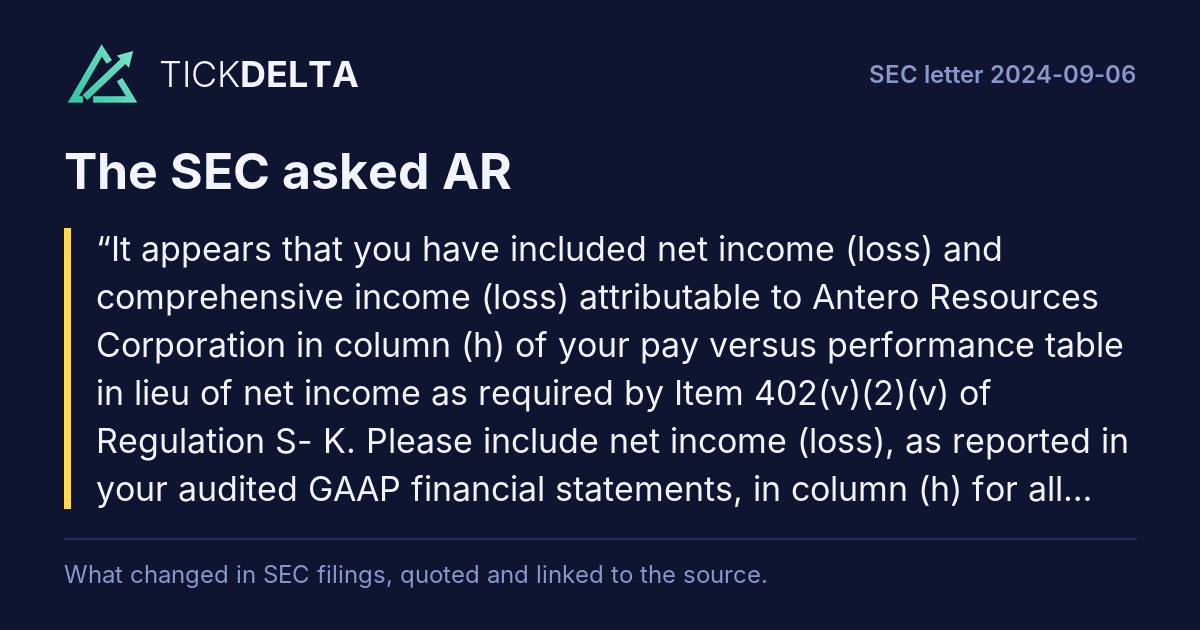
It appears that you have included net income (loss) and comprehensive income (loss) attributable to Antero Resources Corporation in column (h) of your pay versus performance table in lieu of net income as required by Item 402(v)(2)(v) of Regulation S- K. Please include net income (loss), as reported in your audited GAAP financial statements, in column (h) for all years covered by the table.
Rest of the question

Refer to Regulation S-K Compliance and Disclosure Interpretations Question 128D.08. Please note that you may voluntarily provide supplemental measures of net income or financial performance, so long as any additional disclosure is “clearly identified as supplemental, not misleading, and not presented with greater prominence than the required disclosure.” See Pay Versus Performance, Release No. 34-95607 (August 25, 2022) [87 FR 55134 (September 8, 2022)] at Section II.F.3. We note that you have included Total Net Debt, a non-GAAP measure, as your Company-2. Selected Measure pursuant to Item 402(v)(2)(vi) of Regulation S-K. While Company- Selected Measure disclosure is not subject to Regulation G or Item 10(e) of Regulation S- K, you must disclose how the measure is calculated from your audited financial statements. It is not clear from your disclosure on pages 44-45 how the Company-Selected Measure is calculated from your audited financial statements. Please tell us and revise future filings to explain how Total Net Debt is calculated from your audited financial statements. Note that incorporation by reference to disclosure in a separate filing, such as your earnings release, will not satisfy this disclosure requirement. We remind you that the company and its management are responsible for the accuracy and adequacy of their disclosures, notwithstanding any review, comments, action or absence of action by the staff.

AR answered
In future proxy disclosures, we will include in column (h) in the pay versus performance table net income as required by Item 402(v)(2)(v) of Regulation

S-K.
Read in the reply

Also in this review: closing letter, 2024-09-17
Form 10-K

2018-10-29 to 2018-11-30 · 6 questions · 1 letter from the SEC, 1 from the company
Review closed 2018-11-30
Reserves and insuranceDebtNon-GAAP measuresSegmentsResults discussion (MD&A)
Estimated Proved Reserves · Proved Undeveloped Reserves, page 7
SEC asked (1)
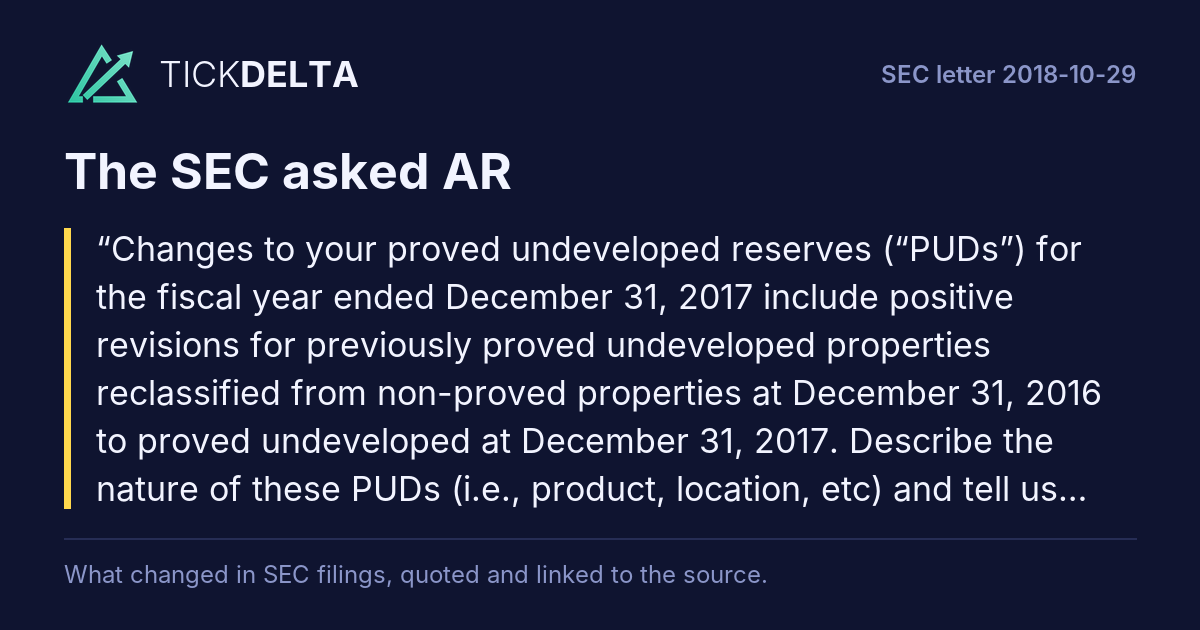
Changes to your proved undeveloped reserves (“PUDs”) for the fiscal year ended December 31, 2017 include positive revisions for previously proved undeveloped properties reclassified from non-proved properties at December 31, 2016 to proved undeveloped at December 31, 2017.
Rest of the question

Describe the nature of these PUDs (i.e., product, location, etc) and tell us when they were initially booked and when they were removed from your reported PUD quantities. In addition, tell us when these PUDs are scheduled for drilling and whether any have been drilled through September 30, 2018.

AR answered
The reserves identified as having been classified as PUDs at December 31, 2017 due to positive revisions include 155 processable natural gas locations, 136 of which are in the Marcellus Shale in West Virginia and 19 of which are in the Utica Shale in Ohio. Of these 155 locations, 43 were inadvertently characterized as positive revisions in 2017 although they had not previously been booked as PUDs. While these 43 locations were correctly booked as PUDs at December 31, 2017, their addition to our PUD reserves should have been characterized as extensions rather than revisions.
Rest of the answer

In future filings, we will not characterize the addition of PUDs as revisions unless those reserves were previously booked as PUDs and subsequently removed.

The table below identifies each of the 155 locations classified as PUDs at December 31, 2017 as a result of positive revisions, the year they were initially booked as PUDs and the year they were removed as PUDs.

Year Removed

Year Added

2013

2014

2015

2016

N/A

Total

2012

—

2017

155

At December 31, 2017, each of the 155 locations was scheduled to be drilled within five years. The table below identifies, as of December 31, 2017, the year in which it was anticipated that each of these locations would be turned to production. As of September 30, 2018, nine of the wells anticipated to be turned to production in 2018 were on production.

Read in the reply
In its next report

First report after the company's reply of Nov 8, 2018: 10-K filed Feb 13, 2019 ↗, against the 10-K filed Feb 13, 2018 ↗.

Tickdelta does not hold the text of both reports, so they are not compared here.

Estimated Proved Reserves · Proved Undeveloped Reserves, page 7
SEC asked (2)
Disclosures in your previous filings on Form 10-K suggest that PUDs removed in prior years due to the impact of the 5-year development rule were primarily dry gas locations. Tell us how the previously removed PUDs that are again part of your development plan fit within your broader drilling program which has historically targeted the “more liquidsrich areas in [y]our portfolio.”
AR answered
While the PUD locations removed in prior years due to the impact of the 5-year development rule were generally in drier areas of our portfolio, the 112 locations added back at December 31, 2017 have an average wellhead heating content of 1,202 Btu per scf. These locations fit within our stated strategy of drilling the more liquids rich locations in our portfolio and at December 31, 2017 were scheduled to be drilled within five years.
Read in the reply
In its next report

First report after the company's reply of Nov 8, 2018: 10-K filed Feb 13, 2019 ↗, against the 10-K filed Feb 13, 2018 ↗.

Tickdelta does not hold the text of both reports, so they are not compared here.

Estimated Proved Reserves · Proved Undeveloped Reserves, page 7
SEC asked (3)
You have revised your disclosed quantities of PUDs in the current year and in prior years due to the requirement per Rule 4-10(a)(31) of Regulation S-X to develop PUDs within five years of the initial booking date. Provide us with a description of the process through which changes to your development schedule are determined by management and approved by the Board of Directors.
Rest of the question

As part of your response, specifically address the manner in which decisions are made to remove PUDs that will not be developed within five years of their initial booking as proved reserves.

AR answered
We maintain a five year detailed development plan, which includes the timing, location and capital commitment of wells to be drilled. The development plan is reviewed and approved annually by senior management and by our Board of Directors. In accordance with the guidance associated with Question 131.04 of the Compliance and Disclosure Interpretations, only PUDs that are reasonably certain to be drilled within five years of booking and are supported by final investment decision to drill them are included in our development plan.

A detailed review of the previously-approved development plan
Rest of the answer

is performed by in-house reservoir engineers on a quarterly basis to validate reserves classifications for appropriateness. This analysis includes reviewing (i) the aging of wells classified as PUDs to confirm they remain economic, (ii) the PUD development schedule for consistency with the approved development plan and (iii) that PUDs are scheduled to be developed within five years of initial booking.

Our Vice President, Reservoir Engineering and Planning, approves all aspects of the reserve report, including the PUD development schedule, which provides the basis for removing PUDs that will not be developed within five years. On an annual basis, our Vice President, Reservoir Engineering and Planning reviews the reserve report with senior management and the Audit Committee of the Board of Directors. This review includes a discussion of any material changes to reserves, including PUD reserves changes and categorization. Separately, our third party independent reserves engineering firm performs an audit and provides a signed certification to evidence that reserve calculations are performed in accordance with SEC regulations.

Management’s Discussion and Analysis of Financial Condition and Results of Operations Stand-Alone Exploration and Production (E&P) Information, page 66

Read in the reply
In its next report

First report after the company's reply of Nov 8, 2018: 10-K filed Feb 13, 2019 ↗, against the 10-K filed Feb 13, 2018 ↗.

Tickdelta does not hold the text of both reports, so they are not compared here.

Management’s Discussion and Analysis of Financial Condition and Results of Operations · Stand-Alone Exploration and Production (E&P) Information, page 66
SEC asked (4)
We note your presentation of selected financial information on a stand-alone basis for Antero (Parent) and your statement that you believe this information is useful to investors “as a means to evaluate Antero’s operations on a stand-alone basis and its ability to service its debt obligations that are not guaranteed by Antero Midstream or to incur additional debt.” Tell us in greater detail why you believe this
Rest of the question

information is meaningful and the degree to which it is meant to convey information regarding your exploration, development, and production operations to investors in light of your segment disclosure provided pursuant to FASB ASC 280-10-50 and results of operations disclosure provided pursuant to FASB ASC 932-235-50.

AR answered
Antero Midstream Partners GP LLC (“AMP GP”) is the general partner of Antero Midstream Partners LP (“Antero Midstream”). AMP GP is a wholly owned subsidiary of Antero Midstream GP LP (“AMGP”). Rather than being consolidated by AMGP, Antero Midstream is currently consolidated by Antero Resources under the variable interest model of consolidated financial reporting.
Rest of the answer

We believe this is a somewhat unique circumstance, which resulted in extensive discussion with the Staff in 2017 in connection with AMGP’s initial public offering.

Antero Resources is the obligor under secured bank credit facilities and senior unsecured notes totaling $3.6 billion out of total consolidated indebtedness of $4.8 billion as of December 31, 2017. While Antero Resources consolidates Antero Midstream’s assets and operations, Antero Midstream does not guarantee any of Antero Resources’ indebtedness.

While information relative to our exploration, production and gas marketing operations is presented in the 2017 Form 10-K, including in the segment disclosures, the supplemental information on oil and gas producing activities contained within Note 20 to the consolidated financial statements and the condensed consolidating financial information contained within Note 18 to the consolidated financial statements, we have received feedback from investors and analysts that this information does not provide a clearly understandable summary of the results of operations, balance sheet data or other financial data relative to the legal entity Antero Resources Corporation. We have included Stand-Alone Exploration and Production (E&P) Information in the 2017 Form 10-K in an effort to provide in one place in the 2017 Form 10-K a concise summary of the assets, liabilities, results of operations and Adjusted EBITDAX of our E&P business in response to specific requests from investors and analysts to provide additional clarity to our financial information in light of our unique organizational structure and the significant assets and operations that we consolidate but that are not subject to the rights of Antero Resources’ creditors.

Read in the reply
In its next report

First report after the company's reply of Nov 8, 2018: 10-K filed Feb 13, 2019 ↗, against the 10-K filed Feb 13, 2018 ↗.

Tickdelta does not hold the text of both reports, so they are not compared here.

Exhibit 99.1, page 1
SEC asked (5)
You present a number of measures that appear to be non-GAAP, but are not identified as such (e.g., adjusted net income per diluted share, adjusted EBITDAX margin, stand-alone net debt, etc). Please review each of the measures you include in Exhibit 99.1 to determine whether they are non-GAAP and revise your disclosure as necessary for compliance with Item 10(e)(1)(i) of Regulation S-K.
AR answered
In the earnings release furnished as Exhibit 99.1 to the Current Report on Form 8-K filed with the Commission on October 31, 2018, we clearly identified each non-GAAP measure presented as such and included all information necessary for compliance with Item 10(e)(1)(i) of Regulation S-K, and we will do the same in the future when non-GAAP measures are presented.
Read in the reply
In its next report

First report after the company's reply of Nov 8, 2018: 10-K filed Feb 13, 2019 ↗, against the 10-K filed Feb 13, 2018 ↗.

Tickdelta does not hold the text of both reports, so they are not compared here.

Exhibit 99.1, page 1
SEC asked (6)
You reconcile the non-GAAP measure Adjusted EBITDAX to net income including noncontrolling interest. Revise to provide a reconciliation to net income as presented in the statement of operations under GAAP. Refer to Item 10(e)(1)(i)(A) of Regulation S-K and question 103.02 of the Compliance & Disclosure Interpretations regarding Non- GAAP Financial Measures.
AR answered
In the earnings release furnished as Exhibit 99.1 to the Current Report on Form 8-K filed with the Commission on October 31, 2018, we reconciled the non-GAAP measure Adjusted EBITDAX to net income as presented in our statement of operations under GAAP, and we will do the same in the future when Adjusted EBITDAX is presented.
Read in the reply
In its next report

First report after the company's reply of Nov 8, 2018: 10-K filed Feb 13, 2019 ↗, against the 10-K filed Feb 13, 2018 ↗.

Tickdelta does not hold the text of both reports, so they are not compared here.

Also in this review: closing letter, 2018-11-30

Form 10-K

2016-12-21 to 2017-02-10 · 8 questions · 2 letters from the SEC, 2 from the company
Review closed 2017-02-10
Reserves and insuranceLeasesResults discussion (MD&A)
Business and Properties, page 1 · Proved Undeveloped Reserves, page 6
SEC asked (1)
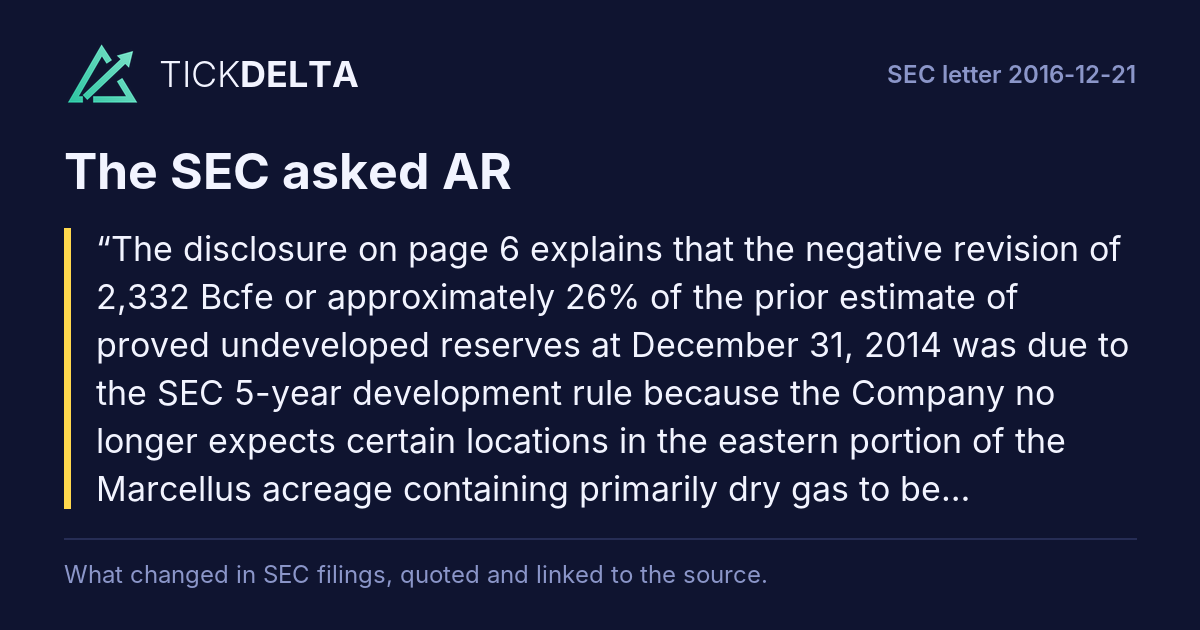
The disclosure on page 6 explains that the negative revision of 2,332 Bcfe or approximately 26% of the prior estimate of proved undeveloped reserves at December 31, 2014 was due to the SEC 5-year development rule because the Company no longer expects certain locations in the eastern portion of the Marcellus acreage containing primarily dry gas to be developed within five years.
Rest of the question

We note similar disclosure provided in your Form 10-K for the fiscal year ending December 31, 2014 explaining the negative revision of 1,417 Bcfe or approximately 25% of the prior estimate of proved undeveloped reserves at December 31, 2013 was due to the reclassification of 191 dry gas wells to the probable category because they were no longer expected to be drilled within five years as your drilling plans were more focused on liquids-rich acreage. Furthermore, disclosure provided in your Form 10-K for the fiscal year ending December 31, 2013 indicates that you reclassified 65 wells to the probable category because they are no longer expected to be drilled within five years of initial booking. Given the successive nature of the revisions to your proved undeveloped reserves, please tell us how the reserves disclosed for the fiscal years ending December 31, 2013, 2014 and 2015 complied with the requirement of reasonable certainty pursuant to Rule 410(a)(22) of Regulation S-X and the requirement relating to an adopted development plan and schedule as set forth in the definition of undeveloped reserves under Rule 410(a)(31)(ii) of Regulation S-X.

AR answered
We acknowledge the Staff’s comment and respectfully advise the Staff that we believe the reserves disclosed for the fiscal years ended December 31, 2013, 2014 and 2015 complied with the requirements of reasonable certainty pursuant to Rule 4-10(a)(22) of Regulation S-X and the requirements relating to an adopted development plan and schedule as set forth in the definition of undeveloped reserves under Rule 4-10(a)(31)(ii) of Regulation S-X.

Compliance with Rule 4-10(a)(22)

The Marcellus Shale can be characterized as a statistical mature Resource Play as defined in the Society of Petroleum
Rest of the answer

Evaluation Engineers Monograph 3. We believe the booking of our proved undeveloped (“PUD”) reserves is supported by our interpretation of the Marcellus Shale across our acreage block as a consistent, predictable reservoir. We believe this conclusion is appropriate based upon our analysis of geosteering interpretations available for the 433 horizontal Marcellus Shale wells we completed within a three county area of West Virginia between 2009 and 2016, each of which produces in commercially viable quantities. We believe the information obtained while drilling these wells, some of which with lateral lengths in excess of 10,000 feet, confirms the low dips in the Marcellus Shale that exists across our acreage position (generally less than two degrees), the absence of faulting and the consistency of the reservoir thickness. We also believe that geologic control from 149 vertical Marcellus Share well logs, and production data from a number of non-operated horizontal wells near or adjacent to our acreage, significantly de-risked our undeveloped acreage.

Based on our analysis of geoscience and engineering data, we believe the proved undeveloped reserve estimates we reported for the years ended December 31, 2013, 2014 and 2015, which were audited by DeGolyer & McNaughton, independent petroleum engineers, were estimated with reasonable certainty to be economically producible in compliance with Rule 4-10(a)(22) of Regulation S-X.

Compliance with Rule 410(a)(31 )(ii)

Since 2011, we have added more than 353,000 gross acres with Btu content of at least 1,100 Btu per Mcf in the Marcellus and Utica Shale through organic leasing and acreage acquisitions. In the past four years, we have increasingly focused our land additions to richer gas areas where well economics provide higher returns based on the relative prices of NGLs and oil to dry gas. As a result of these efforts, we have built a large inventory of undrilled Marcellus and Utica Shale locations, including 3,381 locations classified as PUD or probable as of December 31, 2015.

We maintain a 5-year drilling plan that supports our corporate production growth target. The drilling schedule is reviewed periodically to ensure capital is allocated to highest rate of return wells within our inventory of undrilled well locations. As our acreage position has grown and well economics have changed, we have reallocated 5-year capital away from lower rate of return areas. This has resulted in the reclassification of 404 Bcfe, 1,417 Bcfe, and 2,332 Bcfe of reserves from classification as PUD to probable during the years ended 2013, 2014, and 2015, respectively, due to the 5-year development rule. Based on our then-current acreage position, then-existing well economics and our development plans at the time these reserves were classified as proved, we believe the previous classification of the dry gas locations as PUDs was appropriate and supportable under Rule 10(a)(31)(ii) of Regulation S-X. There has been no change in our view of reasonable certainty of the undeveloped eastern drier wells. Rather, we have reallocated capital based on changing well economics and acreage positions to our rich gas locations where we have been more focused on land acquisitions. Therefore, we believe our reported proved reserves, by analysis of geoscience and engineering data, were estimated with reasonable certainty to be economically producible in compliance with Rule 4-10(a)(31 )(ii) of Regulation S-X.

Read in the reply
In its next report

First report after the company's reply of Jan 17, 2017: 10-K filed Feb 28, 2017 ↗.

No earlier 10-K before the SEC's letter is in Tickdelta, so there is nothing to compare with.

Business and Properties, page 1 · Proved Undeveloped Reserves, page 6
SEC asked (2)
To the extent that you continue to disclose dry gas locations as proved undeveloped reserves as of December 31, 2015, please quantify for us and expand your disclosure to provide the total number of locations and net proved reserve amounts pursuant to FASB ASC 932-235-50-10.
Rest of the question

Also refer to refer to Rule 4-10(a)(31)(ii) of Regulation S-X and to Question 131.04 in the Compliance and Disclosure Interpretations (C&DIs), issued October 26, 2009 and updated May 16, 2013, and affirm that all such locations are part of a development plan adopted by the Company’s management including approval by the Board, if such approval is required. You may find the C&DIs on our website at the following address: http://www.sec.gov/divisions/corpfin/guidance/oilandgas-interp.htm.

AR answered
We acknowledge the Staff’s comment and respectfully advise the Staff that as of December 31, 2015, we had only 20 Marcellus dry gas PUD locations, which we define as locations with less than 1,150 Btu per Mcf. These 20 PUD locations accounted for 181 Bcfe, or 1.4%, of our total proved reserve volumes at December 31, 2015. These 20 PUD locations were part of management’s 5-year development plan at year-end 2015.
Rest of the answer

Although we do not believe additional disclosure is required under FASB ASC 932-235-50-10 because of the immaterial reserves associated with these dry gas locations, if in the future reserves associated with dry gas locations are material, we will expand our disclosure to provide the total number of locations and net proved reserve amounts.

Read in the reply
In its next report

First report after the company's reply of Jan 17, 2017: 10-K filed Feb 28, 2017 ↗.

No earlier 10-K before the SEC's letter is in Tickdelta, so there is nothing to compare with.

Business and Properties, page 1 · Proved Undeveloped Reserves, page 6
SEC asked (3)
Your disclosure indicates that you have approximately $5.1 billion in future development costs to be incurred over the next five years relating to your proved undeveloped reserves which if calculated as a straight line five year average would represent expenditures of approximately $1.02 billion per year.
Rest of the question

However, the disclosure provided on page 6 and elsewhere on page 2 indicates that during 2015, you incurred approximately $577 million in capital expenditures to convert proved undeveloped reserves to proved developed reserves and that you plan to reduce the 2016 capital budget for drilling, completions and land for 2016 by 24% from your 2015 capital budget. You also disclose on page 2 that in conjunction with the reduction in capital expenditures during 2015, you deferred the completion of 50 wells. Please expand the disclosure relating to conversion of your proved undeveloped reserves to explain your development plans sufficiently to understand how you have complied with the timeframe stipulated for development within Rule 4-10(a)(31)(ii) of Regulation S-X, and how you have formulated a reasonable expectation that any financing necessary to proceed with development will be available, as required by Rule 4-10(a)(26) of Regulation S-X, prior to reporting these reserves.

AR answered
We acknowledge the Staff’s comment and respectfully advise the Staff that the $577 million in capital expenditures used to convert PUDs to proved developed reserves related directly to drilling and completion of wells classified as PUDs at the end of 2014, which resulted in their classification as proved developed wells at the end of 2015.
Rest of the answer

In addition to the estimated $577 million spent on those wells in 2015, we spent an additional $462 million on development costs related primarily to drilled and uncompleted wells and properties in the PUD classification at the end of 2014, resulting in total development spending of $1.039 billion, as disclosed on page F-37 of the Form 10-K. We believe this level of spending supports our 5-year development plan for PUDs. In addition to our development spending in 2015, we spent an additional $612 million for exploratory wells, as disclosed on page F-37 of the Form 10-K. For the year ended December 31, 2016, we planned to spend approximately $1.3 billion for development and exploratory costs, approximately $1.0 billion of which was spent during the nine months ended September 30, 2016. We have also realized operational efficiencies and cost reductions, which reduces the amount of capital required to develop our reserves. For 2017, we have budgeted an additional $1.3 billion for development and exploratory costs.

Historically, our primary sources of financing for our exploration and development activities have been through issuances of debt and equity securities, borrowings under our revolving credit facility, asset sales and net cash provided by operating activities.

The borrowing base under our revolving credit facility is redetermined semi-annually and is based on estimated future cash flows from our proved reserves and our commodity hedge positions. As of September 30, 2016, our revolving credit facility had a borrowing base of $4.75 billion, lender commitments of $4.0 billion and outstanding borrowings and letters of credit of $1.3 billion. As we continue to spend on drilling and completion, we expect that our reserves and resulting available borrowing base will continue to increase, which will further enhance our liquidity and ability to finance future development and exploration of our properties.

Our net cash provided by operating activities was approximately $1.0 billion for the year ended December 31, 2015 and $905 million for the nine months ended September 30, 2016. Our revenues are supported by a large gas hedge position, which provides price certainty supporting the planned future drilling program. Approximately 86% of targeted production is hedged through 2019 at $3.72/MMBtu, a $0.78 premium to current strip pricing.

We have a demonstrated ability to raise money in capital markets transactions and sales of non-core assets. During 2016, we raised approximately $1.0 billion through new issuances of our common stock, $178 million from our sale of common units representing limited partner interests in Antero Midstream Partners LP and $170 million from our sale of non-core Pennsylvania acreage. Additionally, in December 2016, we completed offering private placement of $600 million of 5.00% senior notes due in 2025 to refinance $525 million of outstanding 6.00% senior notes due in 2020.

We believe that cash provided by operating activities and availability under our revolving credit facilities will be sufficient to finance the future development costs related to our proved reserves in compliance with Rule 4-10 (a)(26) of Regulation S-X. To the extent these amounts are insufficient to finance our growing development and exploration activities, we believe we will have the ability to access the debt or equity capital markets in order to raise additional capital. In future filings, we will expand our disclosure to more thoroughly explain our development plans and reasonable expectation with respect to the availability of necessary financing.

Read in the reply
In its next report

First report after the company's reply of Jan 17, 2017: 10-K filed Feb 28, 2017 ↗.

No earlier 10-K before the SEC's letter is in Tickdelta, so there is nothing to compare with.

Business and Properties, page 1 · Proved Undeveloped Reserves, page 6
SEC asked (4)
Please provide us with your development schedule, indicating for each future annual period, the number of gross wells, the net quantities of proved reserves and estimated capital expenditures necessary to convert all of the proved undeveloped reserves disclosed as of December 31, 2015 to developed.
AR answered
We acknowledge the Staff’s comment and have set forth below our development schedule by annual period and number of gross wells, net quantities of proved reserves and estimated capital expenditures to develop all of the proved undeveloped reserves disclosed as of December 31, 2015:
Read in the reply
In its next report

First report after the company's reply of Jan 17, 2017: 10-K filed Feb 28, 2017 ↗.

No earlier 10-K before the SEC's letter is in Tickdelta, so there is nothing to compare with.

Undeveloped Acreage Expirations, page 9
SEC asked (5)
We note the acreage scheduled to expire over the next three years represents approximately 23% and 61% of the total net undeveloped Marcellus and Utica acreage, respectively. Please tell us the extent to which you have assigned any proved undeveloped reserves to locations which are currently scheduled to be drilled after lease expiration.
Rest of the question

If there are material quantities of net proved undeveloped reserves relating to such locations, please expand your disclosure to identify the number of locations, the related net reserve quantities, and clarify your plans and the related expenditures necessary to extend the time to expiration of such leases.

AR answered
We acknowledge the Staff’s comment and respectfully advise the Staff that we do not believe expiring acreage related to PUD development or the amounts required to retain such acreage are material.

At the end of 2015, we had 544 Marcellus PUD wells scheduled for drilling over the next 5 years across 74,783 acres. The Marcellus PUD acreage includes 20,764 separate leases. Most of the acreage, or 69,490 acres, is held by production or is scheduled to be drilled prior to lease expiration. However, an estimated 7%, or 5,293 acres, is subject to renewal prior to scheduled drilling.
Rest of the answer

Some of these leases have contract renewal options and some will need to be renegotiated. Historically, we have had an approximately 90% success rate in renewing Appalachian leases. Therefore, we estimate the 10% risked PUD volume to be approximately 46 Bcfe, or less than 1%, of our total proved reserves at December 31, 2015. We estimate a potential cost of $8.2 million, or $1,550/acre, to renew 5,293 Marcellus acres based upon current leasing authorizations and option to extend payments.

At the end of 2015, we had 88 Utica PUD wells scheduled for drilling and completion over the next 5 years across 13,008 acres. The Utica PUD acreage includes 349 separate leases. An estimated 121 leases covering 1,688 net acres is subject to renewal prior to scheduled drilling. Some of these leases have contract renewal options and some will need to be renegotiated. Assuming a 90% lease renewal rate, we estimate the 10% risked PUD volume to be approximately 11 Bcfe, or less than 1.5%, of our total proved reserves at December 31, 2015. We estimate a cost of $8.1 million, or $4,773/acre, to renew 1,688 Utica acres based upon current leasing authorizations and option to extend payments.

Read in the reply
In its next report

First report after the company's reply of Jan 17, 2017: 10-K filed Feb 28, 2017 ↗.

No earlier 10-K before the SEC's letter is in Tickdelta, so there is nothing to compare with.

Business and Properties, page 1 · Proved Undeveloped Reserves, page 6
SEC asked (1)
We have read your response to comment 1. Please expand your disclosure relating to the negative revisions in the previous estimates of your proved undeveloped dry gas reserves attributed to the SEC 5-year development rule to provide the explanation presented in your response under the section “Compliance with Rule 4-10(a)(31)(ii).”
AR answered
We acknowledge the Staff’s comment and in future filings we will expand our disclosure accordingly.
Read in the reply
In its next report

First report after the company's reply of Feb 8, 2017: 10-K filed Feb 28, 2017 ↗.

No earlier 10-K before the SEC's letter is in Tickdelta, so there is nothing to compare with.

Business and Properties, page 1 · Proved Undeveloped Reserves, page 6
SEC asked (2)
Your response to comment 3 indicates you spent $462 million on development costs during 2015 primarily related to drilled but uncompleted wells and properties in the PUD classification at the end of 2014. Please tell us the extent to which any of the proved undeveloped reserves attributable to your drilled but uncompleted wells will remain undeveloped for five years or more after disclosure as proved undeveloped
Rest of the question

reserves.

AR answered
We acknowledge the Staff’s comment and respectfully advise the Staff that we do not believe any proved reserves attributable to drilled but uncompleted wells will remain undeveloped for five years or more after disclosure as proved undeveloped reserves.
Read in the reply
In its next report

First report after the company's reply of Feb 8, 2017: 10-K filed Feb 28, 2017 ↗.

No earlier 10-K before the SEC's letter is in Tickdelta, so there is nothing to compare with.

Undeveloped Acreage Expirations, page 9
SEC asked (3)
We note your response to comment 5 refers to the historical success rate in renewing your leases and identifies certain proved undeveloped reserves attributable to locations that were scheduled to be drilled after lease expiration where the acreage was not held by production.
Rest of the question

The success rate to date in your lease renewal does not preclude the need to expand your disclosure as the unrisked reserve and acreage figures provided in your response appear to be material in relation to the total proved undeveloped reserves and acreage amounts disclosed as of year-end 2015. Therefore, we re-issue our prior comment.

AR answered
We acknowledge the Staff’s comment and in future filings we will expand our disclosure to identify the number of locations scheduled to be drilled after lease expiration and the related net reserve quantities associated and clarify our plans and the related expenditures necessary to extend the time to expiration of such leases.
Read in the reply
In its next report

First report after the company's reply of Feb 8, 2017: 10-K filed Feb 28, 2017 ↗.

No earlier 10-K before the SEC's letter is in Tickdelta, so there is nothing to compare with.

Also in this review: request for more time, Dec 29, 2016, closing letter, 2017-02-10

Letters without questions

Other letters

UPLOAD and CORRESP
4 other letters: notices that a filing will not be reviewed, requests to declare a registration effective, and the like

From the SEC's correspondence on EDGAR: staff letters (form UPLOAD) and company letters (form CORRESP), 16 letters filed since 2016-12-21. Questions and answers are matched by their numbers; topics come from words in each question. The reports are compared word for word (same form, before the first SEC letter against the first report after the company's reply). No AI.

Sources

The SEC's correspondence on EDGAR: staff letters (form UPLOAD) and company letters (form CORRESP), matched question by question. No AI.

Also

Filings: the letters in the filing list.

Work with it

Excel workbook · CSV. Google Sheet that stays up to date: paste =IMPORTDATA("https://tickdelta.com/company/AR/export.csv") into a cell.

Next in Owners and insiders:Insider trades
Esc

Type a ticker such as AAPL, a name, an investor such as Buffett, or a topic such as tariffs. ↑ ↓ to move, Enter to open.