Paragraph 48 · 49% changed
Every version of it
Screener
/
SEC EDGAR
/CIK 0000894405
/10-K filed Feb 25, 2026, compared with Mar 3, 2025
/Numbers from the XBRL of the 10-Ks
Nasdaq
Industrials · Trucking
Arcbest Corp ARCB
The 10-K against last year's
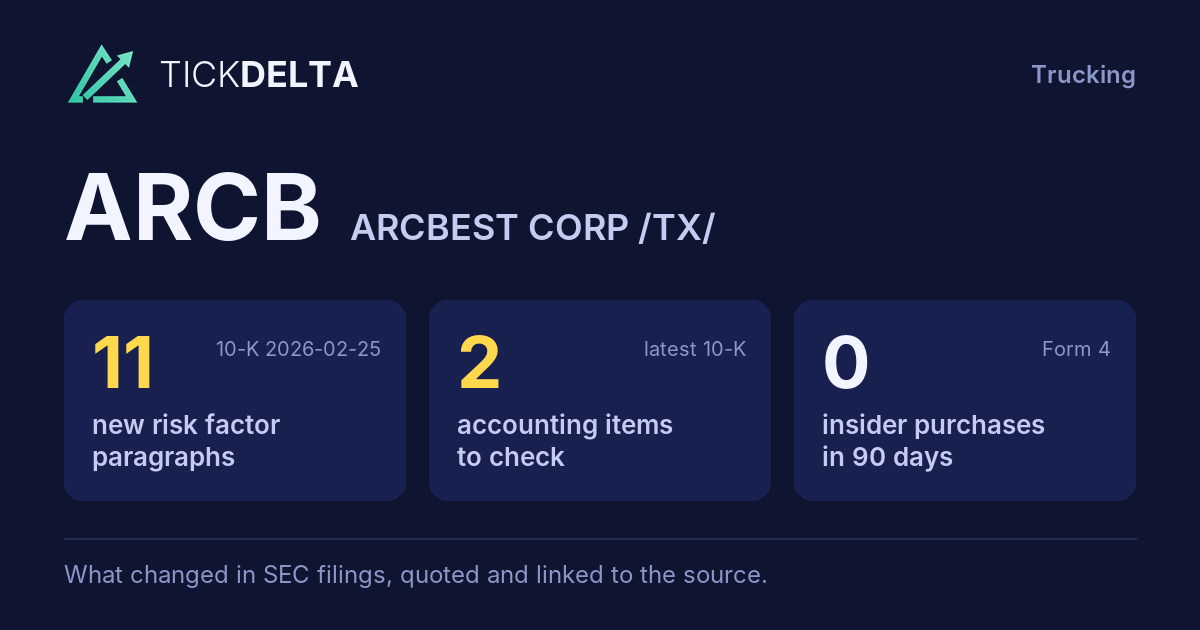
280 changes: 29 added, 41 removed, 206 reworded, 4 quiet changes
10-K Feb 25, 2026 vs Mar 3, 2025
Risk Factors
19.7%
of the text changed · 10,737 words now · 11 new paragraphs, 9 gone
MD&A
29.5%
of the text changed · 15,703 words now · 18 new paragraphs, 32 gone
10-K 0001104659-26-019699 (Feb 25, 2026) vs 10-K 0001558370-25-002037 (Mar 3, 2025) Not compared: Legal Proceedings, Accounting Policies.
Every paragraph, and how much of it changed
One bar per paragraph, in the order of the 10-K. Height and colour show the share of its words not in the closest paragraph a year earlier; the tallest bars are new paragraphs.
Risk Factors
124 paragraphs · 11 new · 72 reworded · 9 gone · 10-K Feb 25, 2026 against Mar 3, 2025
New paragraph
Reworded (5% of its words or more)
Same or nearly
Paragraph 92 · 45% changed
Every version of it
Paragraph 114 · 45% changed
Every version of it
Paragraph 4 · 43% changed
Every version of it
We have limited control over the operation, quality, maintenance, or continued availability of services provided by our vendors, including third-party software providers whose systems we rely on the suitability of for critical operations. We depend on the design and operating effectiveness of the internal controls maintained by our third-party software of these providers and obtain related assurance reports from independent service auditors engaged by our third-party software providers for all in-scope systems. systems in scope for our internal controls over financial reporting. However, we cannot ensure that these controls identified and performed by our third-party software providers are adequate to prevent, detect detect, or correct misstatements in processing or reporting transactions, or to adequately limit or eliminate mitigate system or operational vulnerabilities. Additionally, there is no guarantee that we will be able to maintain our software licensing arrangements that support key functions, or that we can renew or replace these arrangements on commercially reasonable terms or at all.
Paragraph 113 · 43% changed
Every version of it
Our goodwill and indefinite-lived intangible assets asset, which are primarily subject to annual impairment evaluations, are associated with acquisitions in the Asset-Light segment. Our annual impairment evaluations for goodwill and indefinite-lived intangible assets in 2024, 2023, and 2022 produced no indication of impairment of the recorded balances; however, there can be no assurance that balances in recent years. Our annual impairment evaluation of our indefinite-lived intangible asset resulted in an impairment will not occur in charge to write down the future. carrying value of our Panther trade name to the indicated fair
Paragraph 30 · 39% changed
Every version of it
inability to apply integrate and maintain our internal controls and comply with regulatory requirements; over financial reporting;
Paragraph 17 · 38% changed
Every version of it
Paragraph 26 · 37% changed
Every version of it
Paragraph 48 · 49% changed
Every version of it
10-K Mar 3, 2025A nationwide or global disruption in the supply chain could increase volatility in freight volumes and materially impact our business.
10-K Feb 25, 2026
Disruptions in domestic or global manufacturing activity, supply chains, and related changes in producer and consumer spending could materially reduce our freight volumes and adversely affect our business.
Paragraph 92 · 45% changed
Every version of it
10-K Mar 3, 2025Various international, federal, state, and local agencies exercise broad regulatory powers over the transportation industry, such as those described in “Environmental and Other Government Regulations” within Part I, Item 1 (Business) of this Annual Report on Form 10-K. We could become subject to new or more restrictive regulations, and the costs to comply with such regulations could increase our operating expenses. Such regulations could also influence the demand for transportation services. Failure to comply with laws and regulations can result in penalties, revocation of our permits or licenses, or both civil and criminal actions against us, in addition to potentially harming our reputation and brands.
10-K Feb 25, 2026
transportation services. Failure to comply with laws and regulations can result in penalties, revocation of our permits or licenses, or both civil and criminal actions against us, in addition to potentially harming our reputation and brands.
Paragraph 114 · 45% changed
Every version of it
10-K Mar 3, 2025Our goodwill and intangible assets are primarily associated with acquisitions in the Asset-Light segment. Our annual impairment evaluations for goodwill and indefinite-lived intangible assets in 2024, 2023, and 2022 produced no indication of impairment of the recorded balances; however, there can be no assurance that an impairment will not occur in the future.
10-K Feb 25, 2026
value (see Notes C and D to our consolidated financial statements included in Part II, Item 8 of this Annual Report on Form 10-K). There can be no assurance that an impairment of our goodwill or further impairment of our indefinite-lived intangible asset will not occur in the future.
Paragraph 4 · 43% changed
Every version of it
10-K Mar 3, 2025
We rely on the suitability of the design and operating effectiveness of internal controls maintained by our third-party software providers and obtain related assurance reports from independent service auditors engaged by our third-party software providers for all in-scope systems. However, we cannot ensure that controls identified and performed by our third-party software providers are adequate to prevent, detect or correct misstatements in processing or reporting transactions, or to adequately limit or eliminate system or operational vulnerabilities.
10-K Feb 25, 2026
We have limited control over the operation, quality, maintenance, or continued availability of services provided by our vendors, including third-party software providers whose systems we rely on for critical operations. We depend on the design and operating effectiveness of the internal controls of these providers and obtain assurance reports from independent service auditors engaged by our third-party software providers for systems in scope for our internal controls over financial reporting. However, we cannot ensure that these controls are adequate to prevent, detect, or correct misstatements or to mitigate system or operational vulnerabilities. Additionally, there is no guarantee that we will be able to maintain our software licensing arrangements that support key functions, or that we can renew or replace these arrangements on commercially reasonable terms or at all.
Paragraph 113 · 43% changed
Every version of it
10-K Mar 3, 2025
Our goodwill and intangible assets are primarily associated with acquisitions in the Asset-Light segment. Our annual impairment evaluations for goodwill and indefinite-lived intangible assets in 2024, 2023, and 2022 produced no indication of impairment of the recorded balances; however, there can be no assurance that an impairment will not occur in the future.
10-K Feb 25, 2026
Our goodwill and indefinite-lived intangible asset, which are subject to annual impairment evaluations, are associated with acquisitions in the Asset-Light segment. Our annual impairment evaluations for goodwill produced no indication of impairment of the recorded balances in recent years. Our annual impairment evaluation of our indefinite-lived intangible asset resulted in an impairment charge to write down the carrying value of our Panther trade name to the indicated fair
Paragraph 30 · 39% changed
Every version of it
10-K Mar 3, 2025
inability to apply and maintain our internal controls and comply with regulatory requirements;
10-K Feb 25, 2026
inability to integrate and maintain our internal controls over financial reporting;
Paragraph 17 · 38% changed
Every version of it
10-K Mar 3, 2025We are still in the early stages of developing and deploying generative AI, a process that is particularly complex. This complexity arises from the use of sensitive, proprietary, and confidential data that could be leaked, as well as the potential flaws in algorithms and models, which may include biases, errors, and limitations in handling certain data types or scenarios, ultimately affecting outputs. If we do not pursue technological advances or engage in innovation; if we fail to successfully or timely develop and deploy enhanced or new technology; if any enhanced or new technology does not yield the results we expect, or is developed by others; or if the decisions are made by us or our customers based on flawed AI or model outputs, we may be placed at a competitive disadvantage; lose customers; be led to make decisions that could bias certain individuals or classes of individuals and adversely impact their rights; incur higher than anticipated costs, including the possible impact of asset impairment or the write-off of software development costs; or fail to meet the goals of our internal growth strategy, any one of which could materially adversely impact our financial condition and results of operations.
10-K Feb 25, 2026
we may be placed at a competitive disadvantage; lose customers; be led to make decisions that could bias certain individuals or classes of individuals and adversely impact their rights; incur higher than anticipated costs, including the possible impact of asset impairment or the write-off of software development costs; or fail to meet the goals of our internal growth strategy, any one of which could materially adversely impact our financial condition and results of operations.
Paragraph 26 · 37% changed
Every version of it
10-K Mar 3, 2025We may be unable to generate sufficient revenue or earnings from the operations of MoLo, which we acquired on November 1, 2021, or any future acquired business, to offset our acquisition or investment costs, and the acquired business may otherwise fail to meet our operational or strategic expectations. Difficulties encountered in combining operations, including underestimation of the resources required to support an acquisition, could prevent us from realizing the full anticipated benefits, and within the anticipated timeframe, and could adversely impact our business, results of operations, and financial condition. If acquired operations fail to generate sufficient cash flows, we may incur impairments of goodwill, intangibles, and other assets in the future.
10-K Feb 25, 2026
workforce, systems, and operations of acquired companies, including underestimating the resources needed to support an acquisition, which could prevent us from realizing the full anticipated benefits of the acquisition, including within the anticipated timeframe, or inhibit our ability to provide consistent, high-quality service to customers. If acquired operations fail to generate sufficient cash flows, we may incur impairments of goodwill, intangibles, and other assets in the future.
MD&A
195 paragraphs · 18 new · 132 reworded · 32 gone · 10-K Feb 25, 2026 against Mar 3, 2025
New paragraph
Reworded (5% of its words or more)
Same or nearly
Paragraph 157 · 48% changed
Paragraph 79 · 48% changed
Paragraph 141 · 46% changed
Our A/R Securitization program Credit Facility was amended during second fourth quarter 2024 2025 to extend the maturity date to July 1, 2025, November 25, 2030 and increase the letter of credit sub-facility sublimit to $50.0 million, among other things. As of December 31, 2024, standby letters of credit of $15.3 million have been issued under the A/R Securitization which reduced our available borrowing capacity to $34.7 million.
Paragraph 136 · 46% changed
Cash provided by operating activities during 2024 2025 was $229.0 million, compared to $285.8 million compared to $321.4 million in 2023. 2024. Changes in operating assets and liabilities, excluding income taxes, decreased cash provided by operating activities by $26.2 million during 2025 and increased cash provided by operating activities by $1.9 million and $40.7 million during 2024 and 2023, respectively. Excluding the first quarter 2024 settlement by an insurer of the receivable (and offsetting liability) for insured third-party casualty claims recorded at December 31, 2023, the 2024. The year-over-year decreases decrease in accounts receivable payable, accrued expenses and prepaid expenses were other liabilities, partially offset by year-over-year increases the decrease in accounts payable and accrued expenses. The remainder of receivable, contributed to the change decrease in cash provided by operating assets and liabilities was primarily related to a lease buyout during the first quarter of 2024 of a property made available following the bankruptcy of a competitor in 2023. activities.
Paragraph 165 · 44% changed
The Company's total effective $32.9 million increase in deferred income taxes is primarily due to tax rate was 20.8% and 24.4% for 2024 and 2023, respectively, including discontinued operations, deductions allowed by the One Big Beautiful Bill Act, which are is discussed further discussed below in the Income Taxes section in Note D E to our consolidated financial statements included in Part II, Item 8 of this Annual Report on Form 10-K. Income tax expense reflected in discontinued operations, which primarily consisted 10-K, including depreciation and the expensing of federal research and state income taxes on the gain on the sale of FleetNet, was $0.2 million for 2024 and $18.3 million for 2023, or an effective tax rate of 25.5% for both periods. development costs previously capitalized.
Paragraph 20 · 43% changed
Our Asset-Based revenue decline reflects a 14.3% decrease in tonnage per day, partially offset by a 11.7% increase in billed revenue per hundredweight, including fuel surcharges, in 2024, decreased 1.3% for 2025, compared to 2023. 2024. The decrease was driven by a shift in tonnage freight profile, including fewer shipments from existing customers in the manufacturing sector and the decrease in the fuel surcharge revenue associated with lower fuel prices. Tonnage per day is a result of increased 1.2% for 2025, compared to the prior year, supported by higher daily shipment volumes, despite a softer market environment driven in part by a weaker continued weakness in the manufacturing sector. The increase in total billed revenue per hundredweight, including fuel surcharges, was driven by lower weight per shipment, a general rate increase implemented in third quarter 2024 and increases to deferred pricing agreements, partially offset by a decrease in fuel surcharge revenue associated with lower fuel prices and changes in business mix.
Paragraph 48 · 42% changed
Other companies within our industry may present different key performance indicators or operating statistics, or they may calculate their measures differently; therefore, our key performance indicators or operating statistics may not be comparable to similarly titled measures of other companies. Key performance indicators or operating statistics should be viewed in addition to, and not as an alternative for, our reported results. Our key performance indicators or operating statistics should not be construed as better measurements of our results than operating income, operating cash flow, net income, or earnings per share, as determined under GAAP.
Paragraph 23 · 42% changed
Innovative technology costs impacted our consolidated segment results during 2024 2025 and 2023. In February 2024, we announced the next step in including costs associated with our Vaux suite – Vaux Freight Movement System™, Vaux Smart Autonomy™, which combines autonomous mobile robot forklifts and reach trucks, intelligent software, and remote teleoperation capability to autonomously handle materials movement within warehouses, distribution centers, and manufacturing facilities, while being monitored by humans. In March 2023, we launched our customer offering of VauxTM – the innovative suite of hardware and software which modernizes and transforms how freight is loaded, unloaded, and transferred in warehouse and dock operations. Vaux Vision™. Certain costs related to our growing number of Vaux pilot programs in customer test locations and other initiatives to optimize performance through technological innovation are reported in the “Other and eliminations” line of consolidated operating income. For the year ended December 31, 2023, innovative technology costs also impacted our Asset-Based segment and included our freight handling pilot test program at ABF Freight, as further discussed in the Asset-Based Segment Results section. These combined costs decreased consolidated results by $29.1 million (pre-tax), or $22.2 million (after-tax) and $0.97 per diluted share, for 2025, compared to $34.1 million (pre-tax), or $26.1 million (after-tax) and $1.10 per diluted share, for 2024, compared to $52.4 million (pre-tax), or $39.7 million (after-tax) and $1.61 per diluted share, for 2023. 2024.
Paragraph 157 · 48% changed
10-K Mar 3, 2025The Company's total effective tax rate was 20.8% and 24.4% for 2024 and 2023, respectively, including discontinued operations, which are further discussed in Note D to our consolidated financial statements included in Part II, Item 8 of this Annual Report on Form 10-K. Income tax expense reflected in discontinued operations, which primarily consisted of federal and state income taxes on the gain on the sale of FleetNet, was $0.2 million for 2024 and $18.3 million for 2023, or an effective tax rate of 25.5% for both periods.
10-K Feb 25, 2026
Prepaid and refundable income taxes increased $16.8 million from December 31, 2024 to December 31, 2025, reflecting the current tax benefit accrual resulting from tax law changes under the One Big Beautiful Bill Act, which is discussed further in Note E to our consolidated financial statements included in Part II, Item 8 of this Annual Report on Form 10-K, in addition to year-to-date 2025 estimated tax payments.
Paragraph 79 · 48% changed
10-K Mar 3, 2025Insurance as a percentage of revenue increased 0.8 percentage point in 2024, compared to 2023, primarily due to an increase in the severity of third-party casualty claims, including an increase in the number of large claims in recent years and higher retention limits.
10-K Feb 25, 2026
Depreciation and amortization as a percentage of revenue increased 0.8 percentage points in 2025, compared to 2024, primarily due to recent service center renovations and higher purchase prices for new revenue equipment, which has resulted in an increase in depreciation expense per unit.
Paragraph 141 · 46% changed
10-K Mar 3, 2025
Our A/R Securitization program was amended during second quarter 2024 to extend the maturity date to July 1, 2025, among other things. As of December 31, 2024, standby letters of credit of $15.3 million have been issued under the A/R Securitization which reduced our available borrowing capacity to $34.7 million.
10-K Feb 25, 2026
Our Credit Facility was amended during fourth quarter 2025 to extend the maturity date to November 25, 2030 and increase the letter of credit sub-facility sublimit to $50.0 million, among other things.
Paragraph 136 · 46% changed
10-K Mar 3, 2025
Cash provided by operating activities during 2024 was $285.8 million compared to $321.4 million in 2023. Changes in operating assets and liabilities, excluding income taxes, increased cash provided by operating activities by $1.9 million and $40.7 million during 2024 and 2023, respectively. Excluding the first quarter 2024 settlement by an insurer of the receivable (and offsetting liability) for insured third-party casualty claims recorded at December 31, 2023, the year-over-year decreases in accounts receivable and prepaid expenses were partially offset by year-over-year increases in accounts payable and accrued expenses. The remainder of the change in operating assets and liabilities was primarily related to a lease buyout during the first quarter of 2024 of a property made available following the bankruptcy of a competitor in 2023.
10-K Feb 25, 2026
Cash provided by operating activities during 2025 was $229.0 million, compared to $285.8 million in 2024. Changes in operating assets and liabilities, excluding income taxes, decreased cash provided by operating activities by $26.2 million during 2025 and increased cash provided by operating activities by $1.9 million during 2024. The year-over-year decrease in accounts payable, accrued expenses and other liabilities, partially offset by the decrease in accounts receivable, contributed to the decrease in cash provided by operating activities.
Paragraph 165 · 44% changed
10-K Mar 3, 2025
The Company's total effective tax rate was 20.8% and 24.4% for 2024 and 2023, respectively, including discontinued operations, which are further discussed in Note D to our consolidated financial statements included in Part II, Item 8 of this Annual Report on Form 10-K. Income tax expense reflected in discontinued operations, which primarily consisted of federal and state income taxes on the gain on the sale of FleetNet, was $0.2 million for 2024 and $18.3 million for 2023, or an effective tax rate of 25.5% for both periods.
10-K Feb 25, 2026
The $32.9 million increase in deferred income taxes is primarily due to tax deductions allowed by the One Big Beautiful Bill Act, which is discussed further below in the Income Taxes section in Note E to our consolidated financial statements included in Part II, Item 8 of this Annual Report on Form 10-K, including depreciation and the expensing of research and development costs previously capitalized.
Paragraph 20 · 43% changed
10-K Mar 3, 2025
Our Asset-Based revenue decline reflects a 14.3% decrease in tonnage per day, partially offset by a 11.7% increase in billed revenue per hundredweight, including fuel surcharges, in 2024, compared to 2023. The decrease in tonnage per day is a result of a softer market environment driven in part by a weaker manufacturing sector. The increase in total billed revenue per hundredweight, including fuel surcharges, was driven by lower weight per shipment, a general rate increase implemented in third quarter 2024 and increases to deferred pricing agreements, partially offset by a decrease in fuel surcharge revenue associated with lower fuel prices and changes in business mix.
10-K Feb 25, 2026
Our Asset-Based billed revenue per hundredweight, including fuel surcharges, decreased 1.3% for 2025, compared to 2024. The decrease was driven by a shift in freight profile, including fewer shipments from existing customers in the manufacturing sector and the decrease in the fuel surcharge revenue associated with lower fuel prices. Tonnage per day increased 1.2% for 2025, compared to the prior year, supported by higher daily shipment volumes, despite a softer market environment driven in part by continued weakness in the manufacturing sector.
Paragraph 48 · 42% changed
10-K Mar 3, 2025
Other companies within our industry may present different key performance indicators or operating statistics, or they may calculate their measures differently; therefore, our key performance indicators or operating statistics may not be comparable to similarly titled measures of other companies. Key performance indicators or operating statistics should be viewed in addition to, and not as an alternative for, our reported results. Our key performance indicators or operating statistics should not be construed as better measurements of our results than operating income, operating cash flow, net income, or earnings per share, as determined under GAAP.
10-K Feb 25, 2026
Other companies within our industry may present different key performance indicators or operating statistics, or they may calculate their measures differently; therefore, our key performance indicators or operating statistics may not be
Paragraph 23 · 42% changed
10-K Mar 3, 2025
Innovative technology costs impacted our consolidated segment results during 2024 and 2023. In February 2024, we announced the next step in our Vaux suite – Vaux Smart Autonomy™, which combines autonomous mobile robot forklifts and reach trucks, intelligent software, and remote teleoperation capability to autonomously handle materials movement within warehouses, distribution centers, and manufacturing facilities, while being monitored by humans. In March 2023, we launched our customer offering of VauxTM – the innovative suite of hardware and software which modernizes and transforms how freight is loaded, unloaded, and transferred in warehouse and dock operations. Certain costs related to our growing number of Vaux pilot programs in customer test locations and other initiatives to optimize performance through technological innovation are reported in the “Other and eliminations” line of consolidated operating income. For the year ended December 31, 2023, innovative technology costs also impacted our Asset-Based segment and included our freight handling pilot test program at ABF Freight, as further discussed in the Asset-Based Segment Results section. These combined costs decreased consolidated results by $34.1 million (pre-tax), or $26.1 million (after-tax) and $1.10 per diluted share, for 2024, compared to $52.4 million (pre-tax), or $39.7 million (after-tax) and $1.61 per diluted share, for 2023.
10-K Feb 25, 2026
Innovative technology costs impacted consolidated segment results during 2025 and 2024, including costs associated with our Vaux suite – Vaux Freight Movement System™, Vaux Smart Autonomy™, and Vaux Vision™. Certain costs related to Vaux and other initiatives to optimize performance through technological innovation are reported in the “Other and eliminations” line of consolidated operating income. These combined costs decreased consolidated results by $29.1 million (pre-tax), or $22.2 million (after-tax) and $0.97 per diluted share, for 2025, compared to $34.1 million (pre-tax), or $26.1 million (after-tax) and $1.10 per diluted share, for 2024.
A paragraph is matched with the one last year that shares the most of its words; under half in common makes it new. The paragraphs shown are the 8 reworded the most in each section.
The paragraph that changed most in each section
The redline
Marked against last year's 10-K: cut words struck through, new words highlighted.
MD&A151 words changed in this paragraph; it is 36% similar to last year's version.
The Asset-Light segment generated operating loss of $15.3 million in 2025 and operating income of $58.4 million in 2024 and operating loss of $12.3 million in 2023. 2024. The year-over-year improvement decline in operating results reflects the changes in fair value of contingent earnout consideration related is primarily attributable to the MoLo acquisition and decreases in operating expenses discussed in the following paragraphs, partially offset by lower revenues. Changes $90.3 million reduction in the fair value of the contingent earnout consideration reduced expenses by $90.3 million for 2024, along with lower revenues and operating expense changes discussed in the year ended December 31, 2024, compared to $19.1 million the same period of 2023. The year ended December 31, 2024 was following paragraphs. Operating results were also impacted by $1.7 million in asset impairment charges related to adjusting our capacity within Asset-Light operations recognized during the fourth quarter 2025 of $6.6 million and during fourth quarter 2024 and $0.3 million in legal settlement expenses, compared to the year ended December 31, 2023, of $1.7 million, which was impacted by $14.4 million in lease-related asset impairment charges and $9.5 million in legal settlement expenses. are further described below.
Source: Item 7, 10-K 0001104659-26-019699 vs Item 7, 10-K 0001558370-25-002037
Risk Factors149 words changed in this paragraph; it is 60% similar to last year's version.
The nature of our business business, including both our Asset-Based and Asset-Light segments, exposes us to the potential for various claims and litigation, including class-action litigation and other legal proceedings brought by customers, suppliers, employees, or other parties, related to labor and employment, including wage and hour claims; competitive matters; personal injury; property damage; cargo claims; safety and contract compliance; environmental liability; and other matters, such as the matters, if any, described in Item 3 (Legal Proceedings) included in Part I of, or otherwise disclosed in, this Annual Report on Form 10-K. We are subject to risk and uncertainties related to liabilities, including damages, fines, penalties, and substantial legal and related costs, that may result from these claims and litigation. Some or all litigation arising from either segment of our expenditures to defend, settle, or litigate these matters may not be covered by insurance or could impact our cost of, and ability to obtain, insurance in the future. Litigation can be disruptive to normal business operations and could require a substantial amount of time and effort from our management team. Further, because of the potential risks, expenses, and uncertainties of litigation, we may, from time to time, settle disputes, even where we believe that we have meritorious claims or defenses. Any material litigation or a catastrophic accident or series of accidents could have a material adverse effect on our business, results of operations, and financial condition. Our business reputation and our relationship with our customers, suppliers, and employees may also be adversely impacted by our involvement in legal proceedings. business.
Source: Item 1A, 10-K 0001104659-26-019699 vs Item 1A, 10-K 0001558370-25-002037
Sentences and paragraphs added, removed or reworded
Every change, by type
Sentences and paragraphs of ARCB's Risk Factors and MD&A, 10-K Feb 25, 2026 against 10-K Mar 3, 2025. Each links to the text at sec.gov.
Quiet changes are sentences kept from last year with one to four words changed, at least one of them a hedge, a modal or a qualifier (may, could, will, not, significant, material…). A year or date rolling forward is not counted.
The full word list
adverse, adversely, all, although, anticipate, anticipates, any, approximately, believe, believes, can, cannot, certain, could, expect, expects, generally, however, if, intend, intends, largely, likely, many, material, materially, may, might, most, must, never, no, not, possible, primarily, probable, should, significant, significantly, some, substantial, substantially, unlikely, will, would
AddedRisk Factors
Some of our employees work remotely, including under hybrid work arrangements, which has increased demand for IT resources and heightened our exposure to unauthorized access to proprietary information or sensitive or confidential data and other cybersecurity incidents.
Read it in 10-K Feb 25, 2026 at sec.gov
AddedRisk Factors
We evaluate acquisition candidates and may pursue opportunities to acquire assets and businesses that we believe will complement our existing assets and business or enhance our service offerings. However, we may be unable to generate sufficient revenue or earnings from any future acquired business to offset acquisition or investment costs, and the acquired business may fail to meet operational or strategic expectations. We may encounter difficulties integrating the assets,
Read it in 10-K Feb 25, 2026 at sec.gov
AddedRisk Factors
VauxTM technologies may not achieve market acceptance or generate adequate returns.
Read it in 10-K Feb 25, 2026 at sec.gov
AddedRisk Factors
We have invested and expect to continue to invest significant resources in our suite of VauxTM technology offerings. These investments, including the following, may not be recovered if the technologies do not perform as intended, fail to gain traction in the logistics industry, or require ongoing investment at levels exceeding our expectations.
Read it in 10-K Feb 25, 2026 at sec.gov
AddedRisk Factors
Vaux Freight Movement SystemTM, which transforms the way that freight is loaded, unloaded and transferred through the use of proprietary hardware, depends on successfully delivering operational reliability and compatibility with customer facilities.
Read it in 10-K Feb 25, 2026 at sec.gov
AddedRisk Factors
Vaux Smart AutonomyTM, which includes combining autonomous mobile robot forklifts and reach trucks with fleet-management software and remote-teleoperation capabilities, must operate safely and consistently in complex, high-throughput logistics environments.
Read it in 10-K Feb 25, 2026 at sec.gov
AddedRisk Factors
Vaux VisionTM, a 3D perception technology that transforms forklifts and reach trucks into mobile freight dimensioners, depends on accurate perception and data processing across varied warehouse conditions.
Read it in 10-K Feb 25, 2026 at sec.gov
AddedRisk Factors
Even if these technologies are successfully developed, we may face challenges scaling production, integrating with customer operations, meeting regulatory requirements, and demonstrating sufficient operational or economic benefits to drive demand. Customer adoption may be slower than expected due to operational disruption concerns, competing priorities, or alternative technologies. Each of these Vaux initiatives involves substantial development and commercialization risks, and there is no assurance that they will achieve technical success, customer adoption, or financial returns. As a result, we may not recover the significant investments we have made and expect to continue making in these technologies, which could adversely affect our financial condition and long-term strategy.
Read it in 10-K Feb 25, 2026 at sec.gov
Show the other 64
AddedRisk Factors
Our operations depend on the steady production, movement, and consumption of goods. Widespread or prolonged disruptions—such as factory shutdowns, production slowdowns, shortages of raw materials or components, transportation bottlenecks, labor constraints, or changes in trade policy—can significantly reduce the volume of freight available to transport and alter producer and consumer spending patterns. These conditions may depress demand for transportation services, create volatility in shipping activity, and limit our ability to efficiently serve customers.
Read it in 10-K Feb 25, 2026 at sec.gov
AddedRisk Factors
As a result of these types of events, we have experienced in the past and may experience in the future an inability to timely or cost-effectively obtain tractors, trailers, and other equipment necessary for our business. The extent, duration, and severity of such disruptions are unpredictable and largely outside our control. Any sustained reduction in freight volumes, delays in equipment availability, or shifts in shipping patterns resulting from these factors could negatively impact our revenue, operating performance, and overall ability to meet customer needs.
Read it in 10-K Feb 25, 2026 at sec.gov
AddedRisk Factors
We could be held liable for personal injury, property damage, and cargo claims arising not only in connection with the trucks we operate, but also from trucks that are operated by contracted owner-operators and brokered third-party carriers. Courts across the United States have reached differing conclusions regarding whether federal law preempts state-law negligent selection of motor carrier claims asserted against freight brokers. The U.S. Supreme Court is reviewing this issue in Montgomery v Caribe Transport II, LLC with a hearing date set for March 2026. The outcome of this case, as well as future judicial or regulatory developments, could expand the circumstances under which freight brokers may be subject to state-law negligent selection or similar claims. The elimination or limitation of federal preemption could increase our litigation exposure, lead to higher insurance premiums or make obtaining adequate insurance coverage more difficult, and result in additional compliance and operational burdens related to carrier selection and monitoring.
Read it in 10-K Feb 25, 2026 at sec.gov
RemovedRisk Factors
RemovedRisk Factors
RemovedRisk Factors
RemovedRisk Factors
RemovedRisk Factors
RemovedRisk Factors
RemovedRisk Factors
RemovedRisk Factors
RemovedRisk Factors
RewordedRisk Factors
If we do not pursue technological advances or engage in innovation; if we fail to successfully or timely develop and deploy enhanced or new technology; if any enhanced or new technology does not yield the results we expect, or is developed by others; or if the decisions are made by us or our customers based on flawed AI or model outputs, we may be placed at a competitive disadvantage; lose customers; be led to make decisions that could bias certain individuals or classes of individuals and adversely impact their rights; incur higher than anticipated costs, including the possible impact of asset impairment or the write-off of software development costs; or fail to meet the goals of our internal growth strategy, any one of which could materially adversely impact our financial condition and results of operations.
Read it in 10-K Feb 25, 2026 at sec.gov
RewordedRisk Factors
Our IT systems and third-party applications that we utilize are vulnerable to interruption by adverse weather conditions or conditions; natural disasters; power loss; power, internet, or telecommunications failures; terrorist attacks; internet failures and other disruptions to technology, including outages; computer viruses viruses; and cybersecurity incidents such as denial of service, intentional or inadvertent acts by employees or vendors with access to our systems or data, phishing, disruption by malware, attacks enabled by AI, artificial intelligence (“AI”)-enabled attacks, or other security or data breach; and breaches; as well as other events beyond our control.
Read it in 10-K Feb 25, 2026 at sec.gov
RewordedRisk Factors
RewordedRisk Factors
RewordedRisk Factors
RewordedRisk Factors
RewordedRisk Factors
We may also encounter difficulties in collecting and managing data that impact timely compliance or incur significant costs to comply with increased regulation regarding environmental monitoring and financial reporting disclosure requirements, including those described in “Environmental and Other Government Regulations” within Part I, Item 1 (Business) of this Annual Report on Form 10-K.
Read it in 10-K Feb 25, 2026 at sec.gov
RewordedRisk Factors
RewordedRisk Factors
The transportation industry has experienced, and will likely continue to experience, is experiencing rapid changes in technology, including driven by the development and implementation of new technology; the deployment of and emerging technology, such as technologies, including generative AI and machine learning; learning, and enhancements in existing technology.
Read it in 10-K Feb 25, 2026 at sec.gov
RewordedRisk Factors
RewordedRisk Factors
Despite our efforts to adapt to and address these concerns, our efforts may be insufficient. insufficient and could result in the loss of business, including loss of customers, affect our ability to secure new customer relationships, and otherwise impede our growth initiatives.
Read it in 10-K Feb 25, 2026 at sec.gov
RewordedRisk Factors
Quiet changesRisk Factors
Any material litigation or a catastrophic accident or series of accidents could have a material adverse effect on our business, results of operations, and financial condition.
Read it in 10-K Feb 25, 2026 at sec.gov
AddedMD&A
(2) Earnings per common share is calculated in total and may not equal the sum of earnings per common share from continuing operations and discontinued operations due to rounding.
Read it in 10-K Feb 25, 2026 at sec.gov
AddedMD&A
Consolidated operating results benefited from the sale of certain properties, including two former service center locations, during the third quarter of 2025, which resulted in a net gain of $15.7 million (pre-tax), or $11.8 million (after-tax) and $0.51 per diluted share, for the year ended December 31, 2025.
Read it in 10-K Feb 25, 2026 at sec.gov
AddedMD&A
for a description of the Asset-Based segment and additional segment information, including revenues, operating expenses, and operating income for the years ended December 31, 2025, 2024, and 2023.
Read it in 10-K Feb 25, 2026 at sec.gov
AddedMD&A
handling freight that is generally considered difficult to handle. CMC is an additional pricing mechanism to better capture the value we provide in transporting these shipments.
Read it in 10-K Feb 25, 2026 at sec.gov
AddedMD&A
August 1, 2024 and August 1, 2025. These rate adjustments resulted in a combined contractual wage and benefits top hourly rate increase of approximately 2.9% in 2025 and 2.7% in 2024.
Read it in 10-K Feb 25, 2026 at sec.gov
AddedMD&A
As compared to the 2018 National Master Freight Agreement with the IBT, the 2023 ABF NMFA provides for:
Read it in 10-K Feb 25, 2026 at sec.gov
AddedMD&A
The increase in tonnage per day for 2025, compared to 2024, was driven by a 3.0% increase in daily shipments, reflecting changes in the Asset-Based business mix, including the onboarding of new core LTL customers. Ongoing weakness in the manufacturing sector and evolving freight dynamics, including the shift of some heavier LTL shipments to the truckload market due to lower rates amid excess capacity, resulted in lower average weight per shipment levels year-over-year.
Read it in 10-K Feb 25, 2026 at sec.gov
AddedMD&A
The Asset-Based segment generated operating income of $172.0 million in 2025, compared to $242.6 million in 2024, with an operating ratio of 93.7% in 2025, compared to 91.2% in 2024. The 2.5 percentage-point increase in the Asset-Based segment’s operating ratio, primarily reflects the increase in operating expenses and slightly lower revenue levels. The Asset-Based segment’s operating ratio was positively impacted by the gain on the sale of property and equipment of $15.8 million, including gains on two service center sales.
Read it in 10-K Feb 25, 2026 at sec.gov
AddedMD&A
increase of 2.9% in 2025 and 2.7% in 2024. Lower accruals for incentives, improved productivity, as measured by shipments per DSY hour, and higher utilization of purchased transportation, as discussed later in this section, partially offset the increase in salaries, wages and benefits.
Read it in 10-K Feb 25, 2026 at sec.gov
AddedMD&A
Operating expenses were also impacted by the gain on the sale of property and equipment of $15.8 million, including gains on two service center sales during third quarter 2025, as previously discussed.
Read it in 10-K Feb 25, 2026 at sec.gov
AddedMD&A
were lower primarily due to reduced spending on outside services and employee-related cost reductions in relation to lower business levels and productivity improvements in shipments per person per day.
Read it in 10-K Feb 25, 2026 at sec.gov
AddedMD&A
Economic conditions in 2025 reflected slowing but continued growth, shifting trade and tariff policies, persistent but cooling inflation, elevated interest rates, ongoing supply chain disruptions, and a slowing labor market. Geopolitical conflicts present uncertain and potentially increasing economic impacts going into 2026. Certain economic factors, including housing cost growth, stabilized or improved during 2025. As pricing pressures eased and in response to signs of economic softening, the Federal Reserve cut interest rates three times in 2025 for a total of 75 basis points.
Read it in 10-K Feb 25, 2026 at sec.gov
RemovedMD&A
RemovedMD&A
RemovedMD&A
RemovedMD&A
RemovedMD&A
RemovedMD&A
RemovedMD&A
RemovedMD&A
RemovedMD&A
RemovedMD&A
RemovedMD&A
RemovedMD&A
RewordedMD&A
RewordedMD&A
RewordedMD&A
During the next twelve months and for the foreseeable future, we believe existing cash, cash equivalents, short-term investments, cash generated by operating activities, amounts available under our Credit Facility, including amounts borrowed in February 2025, Facility and A/R Securitization Securitization, until maturity on July 1, 2026, will be sufficient to finance our operating expenses; expenses and to fund our ongoing initiatives to and grow our business, including investments in technology; repay amounts due under our financing arrangements; and pay contingent earnout consideration related to the MoLo acquisition if it is earned. technology.
Read it in 10-K Feb 25, 2026 at sec.gov
RewordedMD&A
While we cannot determine with any certainty the contributions that will be required under future collective bargaining agreements for ABF Freight’s contractual employees, our future contribution rates to multiemployer pension plans may employees cannot be less likely to increase as a result of predicted with certainty, legislation in recent years that has provided funding relief to many underfunded plans which may reduce the likelihood of future contribution rate increases (see Note J I to our consolidated financial statements included in Part II, Item 8 of this Annual Report on Form 10-K).
Read it in 10-K Feb 25, 2026 at sec.gov
RewordedMD&A
RewordedMD&A
RewordedMD&A
RewordedMD&A
RewordedMD&A
A significant disruption in our IT systems or a significant cybersecurity incident, systems, including but not limited to those previously mentioned, such as denial of service, service or system failure, security breach, intentional or inadvertent acts by employees or vendors with access to our systems or data, disruption by malware, or other damage, could interrupt or delay our operations, damage our reputation, cause a loss of customers, cause errors or delays in financial reporting, result in violation of privacy laws, expose us to a risk of loss or litigation, and/or cause us to incur significant time and expense to remedy such an event.
Read it in 10-K Feb 25, 2026 at sec.gov
RewordedMD&A
Financial reporting income differs significantly from taxable income because of items such as contingent earnout consideration, accelerated depreciation for tax purposes, gains and losses on sale of assets, immediate expensing of certain research and a significant number development costs for tax purposes, and the deductibility of liabilities, including accrued liabilities – such as workers’ compensation reserves and compensation, third-party casualty claims, legal expenses, and operating leases, which, for tax purposes, are generally deductible leases – only when paid.
Read it in 10-K Feb 25, 2026 at sec.gov
RewordedMD&A
RewordedMD&A
In 2024, 2025, the economy grew at a slower pace than 2023 2024 as measured by U.S. real gross domestic product (“real GDP”), with the fourth quarter 2024 2025 annual real GDP rate increase being primarily driven by increased increases in consumer spending and investment, partially offset by decreases in exports and government spending, partially offset by a decrease in investment. including reductions associated with the 43-day government shutdown, which began on October 1, 2025.
Read it in 10-K Feb 25, 2026 at sec.gov
Quiet changesMD&A
Since most pricing is established individually by account, the Asset-Based Asset‑Based segment focuses on individual account profitability rather than a single measure of billed revenue per hundredweight when considering customer account or market evaluations.
Read it in 10-K Feb 25, 2026 at sec.gov
Quiet changesMD&A
This measure is particularly meaningful for analysis of our Asset-Light segment, segment because it excludes amortization of acquired intangibles and software, changes in the fair value of contingent earnout consideration, asset impairment charges, and certain legal settlement expenses, which are significant expenses or gains resulting from strategic decisions or other factors rather than core daily operations.
Read it in 10-K Feb 25, 2026 at sec.gov
Quiet changesMD&A
Due to the uncertainty of these matters, we cannot estimate the impact effect of any future climate-related developments on our operations or financial condition at this time.
Read it in 10-K Feb 25, 2026 at sec.gov
Sources
The two latest 10-Ks on EDGAR, section by section. Each change links to the text at sec.gov.
Also
New risk factors: paragraphs with nothing like them last year, quoted in full.
Work with it
Excel workbook · CSV. Google Sheet that stays up to date: paste =IMPORTDATA("https://tickdelta.com/company/ARCB/export.csv") into a cell.