Paragraph 194 · 50% changed
Every version of it
Screener
/
SEC EDGAR
/CIK 0001086600
/10-K filed Feb 26, 2026, compared with Feb 27, 2025
/Numbers from the XBRL of the 10-Ks
Nasdaq
Energy · Bituminous Coal & Lignite Surface Mining
Alliance Resource Partners L.P. ARLP
The 10-K against last year's
96 changes: 14 added, 17 removed, 62 reworded, 3 quiet changes
10-K Feb 26, 2026 vs Feb 27, 2025
Risk Factors
9.0%
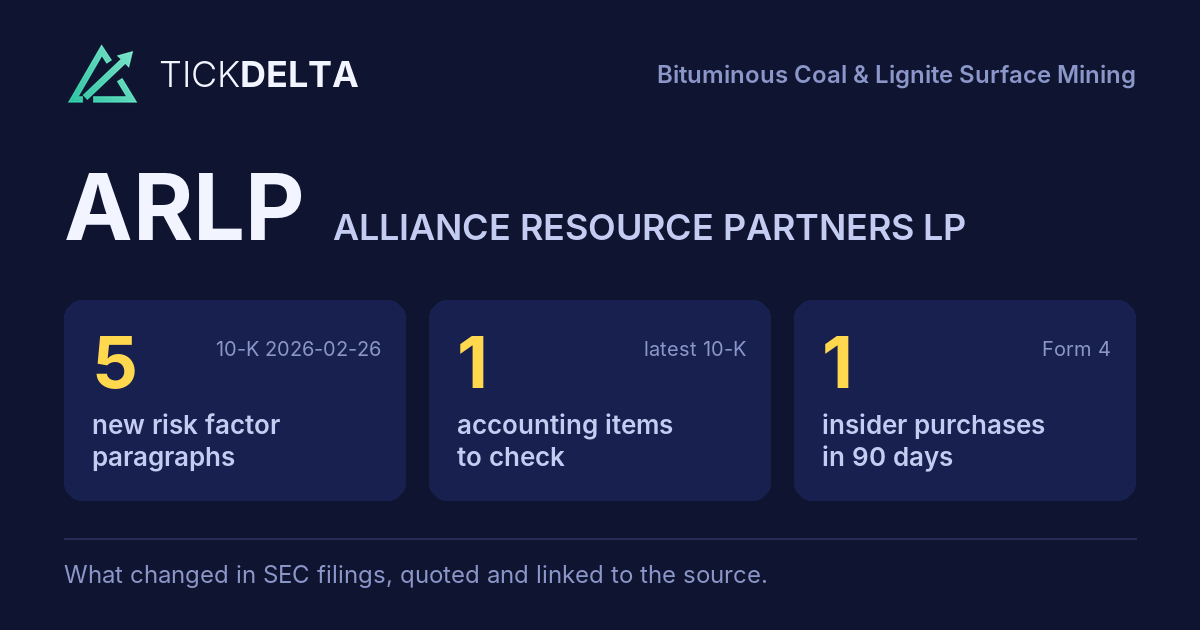
of the text changed · 21,041 words now · 5 new paragraphs, 6 gone
MD&A
21.9%
of the text changed · 6,780 words now · 9 new paragraphs, 11 gone
Legal Proceedings
12.0%
of the text changed · 451 words now
Accounting Policies
14.5%
of the text changed · 5,977 words now
10-K 0001104659-26-020468 (Feb 26, 2026) vs 10-K 0001558370-25-001805 (Feb 27, 2025)
Every paragraph, and how much of it changed
One bar per paragraph, in the order of the 10-K. Height and colour show the share of its words not in the closest paragraph a year earlier; the tallest bars are new paragraphs.
Risk Factors
299 paragraphs · 5 new · 44 reworded · 6 gone · 10-K Feb 26, 2026 against Feb 27, 2025
New paragraph
Reworded (5% of its words or more)
Same or nearly
Paragraph 144 · 43% changed
Every version of it
Paragraph 141 · 39% changed
Every version of it
Additionally, certain employment or business practices and social initiatives are the subject of scrutiny by both those calling for the continued advancement of such policies, as well as those who believe they should be curbed, including government actors, and the complex regulatory and legal frameworks applicable to such initiatives continue to evolve. We cannot be certain of the impact of such regulatory, legal and other developments on our business. More recent political developments could mean that the Partnership faces increasing criticism or litigation risks from certain “anti-ESG” parties, including various governmental agencies. Such sentiment may focus on the Partnership’s environmental commitments (such as reducing GHG emissions) or its pursuit of certain employment practices or social initiatives that are alleged to be political or polarizing in nature or are alleged to violate laws based, in part, on changing priorities of, or interpretations by, federal agencies or state governments. Consideration of ESG-related factors in the Partnership’s decision-making could be subject to increasing scrutiny and objection from such anti-ESG parties. As a result, we may face increased litigation risks from private parties and governmental authorities related to our ESG-related efforts.
Paragraph 270 · 38% changed
Every version of it
partnership tax treatment. Recent proposals have provided for the expansion of the qualifying income exception for publicly traded partnerships in certain circumstances and other proposals have provided for the total elimination of the qualifying income exception upon which we rely for our partnership tax treatment. Further, while unitholders of publicly traded partnerships are, subject to certain limitations, entitled to a deduction equal to 20% of their allocable share of a publicly traded partnership’s “qualified business income,” this deduction is scheduled to expire with respect to taxable years beginning after December 31, 2025, unless extended by Congress.
Paragraph 205 · 37% changed
Every version of it
Paragraph 203 · 30% changed
Every version of it
Paragraph 127 · 28% changed
Every version of it
Volatility in coal and oil & gas prices has been and may continue to be heightened as a result of the Russian-Ukrainian conflict, hostilities in the Middle East and the potential impact to global shipping and the evolving situation in Venezuela. These events have caused volatility in the aforementioned commodity markets. Such conflicts and the resulting volatility may significantly affect prices for our coal and oil & gas or the cost of supplies and equipment, as well as the prices of competing sources of energy for our electric power plant customers.
Paragraph 180 · 27% changed
Every version of it
The geological characteristics of some of our coal mineral reserves, such as depth of overburden and coal seam thickness, make them difficult and costly to mine. As mines become depleted, replacement reserves may not be available when required or, if available, may not be mineable at costs comparable to those of the depleting mines. In addition, permitting, licensing, and other environmental and regulatory requirements associated with certain of our mining operations are more costly and time-consuming to satisfy. Subsidence issues are particularly important to our operations engaged in longwall mining. Failure to timely and economically secure subsidence rights or any associated mitigation agreements could materially affect our results by causing delays or changes in our mining plan. These factors could materially adversely affect the mining operations and cost structures of, and our customers’ ability to use coal produced by, our mines.
Paragraph 194 · 50% changed
Every version of it
10-K Feb 27, 2025Oil & gas production on the properties in which we hold mineral interests utilizes hydraulic fracturing. Hydraulic fracturing is a common practice that is used to stimulate the production of hydrocarbons from tight formations, including shales. The process involves the injection of water, sand, and chemicals under pressure into formations to fracture the surrounding rock and stimulate production. The Federal Safe Drinking Water Act regulates the underground injection of substances through the UIC program. Hydraulic fracturing is generally exempt from regulation under the UIC program, and the hydraulic-fracturing process is typically regulated by state oil & gas commissions.
10-K Feb 26, 2026
program. Hydraulic fracturing is generally exempt from regulation under the UIC program, and the hydraulic-fracturing process is typically regulated by state oil & gas commissions.
Paragraph 144 · 43% changed
Every version of it
10-K Feb 27, 2025disposal well locations, or otherwise, or requiring the operators to shut down or limit the operation of disposal wells, could have a material adverse effect on our business, financial condition and results of operations.
10-K Feb 26, 2026
able to resolve those disputes in a satisfactory manner, which could have a material adverse effect on our business, financial condition, and results of operations.
Paragraph 141 · 39% changed
Every version of it
10-K Feb 27, 2025
Additionally, certain employment practices and social initiatives are the subject of scrutiny by both those calling for the continued advancement of such policies, as well as those who believe they should be curbed, including government actors, and the complex regulatory and legal frameworks applicable to such initiatives continue to evolve. We cannot be certain of the impact of such regulatory, legal and other developments on our business. More recent political developments could mean that the Partnership faces increasing criticism or litigation risks from certain “anti-ESG” parties, including various governmental agencies. Such sentiment may focus on the Partnership’s environmental commitments (such as reducing GHG emissions) or its pursuit of certain employment practices or social initiatives that are alleged to be political or polarizing in nature or are alleged to violate laws based, in part, on changing priorities of, or interpretations by, federal agencies or state governments. Consideration of ESG-related factors in the Partnership’s decision-making could be subject to increasing scrutiny and objection from such anti-ESG parties. As a result, we may face increased litigation risks from private parties and governmental authorities related to our ESG-related efforts.
10-K Feb 26, 2026
Additionally, certain employment or business practices and social initiatives are the subject of scrutiny by both those calling for the continued advancement of such policies, as well as those who believe they should be curbed, including government actors, and the complex regulatory and legal frameworks applicable to such initiatives continue to evolve. We cannot be certain of the impact of such regulatory, legal and other developments on our business.
Paragraph 270 · 38% changed
Every version of it
10-K Feb 27, 2025
partnership tax treatment. Recent proposals have provided for the expansion of the qualifying income exception for publicly traded partnerships in certain circumstances and other proposals have provided for the total elimination of the qualifying income exception upon which we rely for our partnership tax treatment. Further, while unitholders of publicly traded partnerships are, subject to certain limitations, entitled to a deduction equal to 20% of their allocable share of a publicly traded partnership’s “qualified business income,” this deduction is scheduled to expire with respect to taxable years beginning after December 31, 2025, unless extended by Congress.
10-K Feb 26, 2026
partnership tax treatment. Recent proposals have provided for the expansion of the qualifying income exception for publicly traded partnerships in certain circumstances and other proposals have provided for the total elimination of the qualifying income exception upon which we rely for our partnership tax treatment.
Paragraph 205 · 37% changed
Every version of it
10-K Feb 27, 2025Separately, the SEC adopted a rule in March 2024 that establishes a framework for the reporting of climate risks, targets and metrics. The rule is being challenged in the U.S. Court of Appeals for the Eighth Circuit and the implementation of the rule has been voluntarily stayed by the SEC pending the outcome of the legal challenge. Moreover, on February 11, 2025, SEC Acting Chairman Mark T. Uyeda requested that the U.S. Court of Appeals for the Eighth Circuit not schedule argument in the case while the SEC reconsiders the final rule. While the Trump Administration may seek to repeal or otherwise modify the rule, we cannot predict whether or how such action would occur or its timing. Relatedly, California has enacted new laws requiring additional disclosure with respect to certain climate-related risks and GHG emission reduction claims, some of which are already subject to legal challenge. While the outcome of such challenges is uncertain at this time, the judge in the case has declined to grant a temporary injunction of the laws while the litigation moves forward. Other states are considering similar laws. Non-compliance with these new laws may result in the imposition of substantial fines or penalties. Any new laws or regulations imposing more stringent requirements on our business related to the disclosure of climate related risks may result in reputation harms among certain stakeholders if they disagree with our approach to mitigating climate-related risks, increased compliance costs resulting from the development of any disclosures, and increased costs of and restrictions on access to capital to the extent we do not meet any climate-related expectations or requirements of financial institutions.
10-K Feb 26, 2026
In addition, some states (such as California) have adopted or are considering adopting laws requiring the disclosure of certain climate-related risks and GHG emission reduction claims. Lawsuits have been filed challenging the implementation of these laws, but we cannot predict the outcome of these suits at this time. Other states are considering similar laws. Non-compliance with these new laws may result in the imposition of substantial fines or penalties. Any new laws or regulations imposing more stringent requirements on our business related to the disclosure of climate related risks may result in reputation harms among certain stakeholders if they disagree with our approach to mitigating climate-related risks, increased compliance costs resulting from the development of any disclosures, and increased costs of and restrictions on access to capital to the extent we do not meet any climate-related expectations or requirements of financial institutions.
Paragraph 203 · 30% changed
Every version of it
10-K Feb 27, 2025Biden issued an executive order that committed to substantial action on climate change, calling for, among other things, the increased use of zero-emissions vehicles by the federal government, the elimination of subsidies provided to the fossil-fuel industry, a doubling of electricity generated by offshore wind by 2030, and increased emphasis on climate-related risks across governmental agencies and economic sectors. Although the Trump Administration has already announced its disagreement with various of these initiatives, we cannot predict what action the Trump Administration may take regarding these commitments or the timing of such action. Further, although Congress has not passed comprehensive climate legislation, almost half of the states have begun to address GHG emissions, primarily through the planned development of emissions inventories, regional GHG cap and trade programs, or the establishment of renewable energy requirements for utilities. Depending on the particular program, we, our customers, or operators of our mineral interests could be required to control GHG emissions or to purchase and surrender allowances for GHG emissions resulting from our operations. Litigation risks are also increasing. For more information, see our risk factor titled “We, our customers, or the operators of our oil & gas mineral interests could be subject to litigation related to climate change.”
10-K Feb 26, 2026
Although Congress has not passed comprehensive climate legislation, almost half of the states have begun to address GHG emissions, primarily through the planned development of emissions inventories, regional GHG cap and trade programs, or the establishment of renewable energy requirements for utilities. Depending on the particular program, we, our customers, or operators of our mineral interests could be required to control GHG emissions or to purchase and surrender allowances for GHG emissions resulting from our operations. Litigation risks are also increasing. For more information, see our risk factor titled “We, our customers, or the operators of our oil & gas mineral interests could be subject to litigation related to climate change.”
Paragraph 127 · 28% changed
Every version of it
10-K Feb 27, 2025
aforementioned commodity markets. Such conflicts and the resulting volatility may significantly affect prices for our coal and oil & gas or the cost of supplies and equipment, as well as the prices of competing sources of energy for our electric power plant customers.
10-K Feb 26, 2026
Volatility in coal and oil & gas prices has been and may continue to be heightened as a result of the Russian-Ukrainian conflict, hostilities in the Middle East and the potential impact to global shipping and the evolving situation in Venezuela. These events have caused volatility in the aforementioned commodity markets. Such conflicts and the resulting volatility may significantly affect prices for our coal and oil & gas or the cost of supplies and equipment, as well as the prices of competing sources of energy for our electric power plant customers.
Paragraph 180 · 27% changed
Every version of it
10-K Feb 27, 2025
The geological characteristics of some of our coal mineral reserves, such as depth of overburden and coal seam thickness, make them difficult and costly to mine. As mines become depleted, replacement reserves may not be available when required or, if available, may not be mineable at costs comparable to those of the depleting mines. In addition, permitting, licensing, and other environmental and regulatory requirements associated with certain of our mining
10-K Feb 26, 2026
The geological characteristics of some of our coal mineral reserves, such as depth of overburden and coal seam thickness, make them difficult and costly to mine. As mines become depleted, replacement reserves may not be available when required or, if available, may not be mineable at costs comparable to those of the depleting mines. In addition, permitting, licensing, and other environmental and regulatory requirements associated with certain of our mining operations are more costly and time-consuming to satisfy. Subsidence issues are particularly important to our operations engaged in longwall mining. Failure to timely and economically secure subsidence rights or any associated mitigation agreements could materially affect our results by causing delays or changes in our mining plan. These factors could materially adversely affect the mining operations and cost structures of, and our customers’ ability to use coal produced by, our mines.
MD&A
102 paragraphs · 9 new · 37 reworded · 11 gone · 10-K Feb 26, 2026 against Feb 27, 2025
New paragraph
Reworded (5% of its words or more)
Same or nearly
Paragraph 49 · 50% changed
Paragraph 51 · 50% changed
Paragraph 66 · 41% changed
Paragraph 4 · 38% changed
We are the second largest coal producer in the eastern United States with and as of December 31, 2025, we operated seven operating underground mining complexes near many of the major eastern utility generating plants and on major coal hauling railroads in across Illinois, Indiana, Kentucky, Maryland, Pennsylvania, and West Virginia, as well as Virginia and a coal-loading terminal in Indiana. Two of our mines also have loading facilities located on the Ohio River. River in Indiana. We manage and report our coal operations under two regions, Illinois Basin and Appalachia. We market our coal production to major domestic and international utilities and industrial customers.
Paragraph 6 · 37% changed
Paragraph 69 · 35% changed
Net cash used in investing activities was $331.3 million for 2025 compared to $440.7 million for 2024 compared to $553.3 million for 2023. 2024. The decrease in cash used in investing activities was primarily due to acquisitions of the decrease in capital expenditures and a decrease in oil & gas reserves including the JC Resources Acquisition and purchase of investments reserve acquisitions in 2023 2025 as well as an increase compared to 2024. This decrease was partially offset by increased contributions to equity method investments, changes in accounts payable and accrued liabilities for property, plant and equipment. These decreases were partially offset by increased capital expenditures the purchase of equity securities during 2024. See “Item 8. Financial Statements and Supplementary Data—Note 4 – Acquisitions” for more information on the Belvedere, Jase, JC Resources and Skyland Acquisitions. 2025.
Paragraph 38 · 33% changed
Coal sales decreased $98.4 million or 4.5% to $1.93 billion in 2025 compared to $2.11 billion for 2024 from $2.21 billion for 2023. in 2024. The decrease was attributable to lower tons sold, which reduced coal sales by $72.1 million, and lower average coal sales prices, which reduced coal sales by $26.3 $157.0 million and lower tons sold, which reduced coal sales by $22.3 million. Coal sales volumes decreased by 3.3% primarily due to reduced tons sold from our River View and Tunnel Ridge mines due to reduced domestic demand, partially offset by increased export sales volumes from our Gibson South operation. Coal sales prices decreased by 1.2% primarily 7.5% as a result of lower domestic price realizations at several mines due to the continued roll-off of higher-priced contracts entered into during the energy crisis and reduced export price realizations from our Appalachian segment. MC Mining and Mettiki mines.
Paragraph 40 · 33% changed
Segment Adjusted EBITDA Expense increased 8.9% decreased 9.1% to $1.53 $1.39 billion in 2025 primarily related to our coal operations which increased 8.0% decreased 9.3% to $1.50 $1.36 billion, as a result of higher lower per ton costs, partially offset by lower coal costs and sales volumes. Segment Adjusted EBITDA Expense per ton sold for our coal operations increased 11.6% decreased 8.4% to $41.29 per ton sold in 2025 compared to $45.07 per ton sold in 2024 compared to $40.38 per ton in 2023, 2024, primarily due to certain an increased sales mix of tons from lower cost increases, which are discussed below by category: operations, higher recoveries from several mines and fewer longwall move days at our Hamilton operation as well as the following per ton cost decreases:
Paragraph 49 · 50% changed
10-K Feb 27, 2025In January 2025, we extended the term of the Securitization Facility to January 2026 and decreased the borrowing availability under the facility to $75.0 million. For additional information on the Securitization Facility please read “Item 8. Financial Statements and Supplementary Data—Note 12 – Long-Term Debt”.
10-K Feb 26, 2026
During 2025, we recorded impairments totaling $28.0 million on our equity and debt investments in Ascend. Please read “Item 8. Financial Statements and Supplementary Data—Note 10 – Investments” for more information.
Paragraph 51 · 50% changed
10-K Feb 27, 2025Net income attributable to ARLP for 2024 was $360.9 million, or $2.77 per basic and diluted limited partner unit, compared to $630.1 million, or $4.81 per basic and diluted limited partner unit, for 2023 as a result of lower revenues, increased operating expenses and a $31.1 million non-cash impairment charge, partially offset by a $22.4 million increase in the fair value of our digital assets.
10-K Feb 26, 2026
a decrease in the fair value of our digital assets in 2025, partially offset by reduced operating expenses and increased investment income.
Paragraph 66 · 41% changed
10-K Feb 27, 2025In January 2023, the Board of Directors authorized a $93.5 million increase to the unit repurchase program, which had $6.5 million of available capacity as of December 31, 2022. As a result, we were authorized to repurchase up to a total of $100.0 million of ARLP’s limited partner common units. No units were repurchased during the year ended December 31, 2024. The remaining authorized amount for unit repurchases under this program was $80.6 million at December 31, 2024. Please read “Item 5. Market for Registrant’s Common Equity, Related Unitholder Matters and Issuer Purchases of Equity Securities” for more information on the unit repurchase program.
10-K Feb 26, 2026
We have $80.6 million remaining authorized under our unit repurchase program as of December 31, 2025. No units were repurchased during the year ended December 31, 2025. The program has no time limit and we may repurchase units from time to time in the open market or in other privately negotiated transactions. The unit repurchase program authorization does not obligate us to repurchase any dollar amount or number of units, and repurchases may be commenced or suspended from time to time without prior notice. The timing of any future unit repurchases and the ultimate number of units to be purchased will depend on several factors, including business and market conditions, our future financial performance, and other capital priorities. Please read “Item 5. Market for Registrant’s Common Equity, Related Unitholder Matters and Issuer Purchases of Equity Securities” for more information on the unit repurchase program.
Paragraph 4 · 38% changed
10-K Feb 27, 2025
We are the second largest coal producer in the eastern United States with seven operating underground mining complexes near many of the major eastern utility generating plants and on major coal hauling railroads in Illinois, Indiana, Kentucky, Maryland, Pennsylvania, and West Virginia, as well as a coal-loading terminal in Indiana. Two of our mines also have loading facilities located on the Ohio River.
10-K Feb 26, 2026
We are the second largest coal producer in the eastern United States and as of December 31, 2025, we operated seven underground mining complexes across Illinois, Indiana, Kentucky, Maryland, Pennsylvania, and West Virginia and a coal-loading terminal on the Ohio River in Indiana. We manage and report our coal operations under two regions, Illinois Basin and Appalachia. We market our coal production to major domestic and international utilities and industrial customers.
Paragraph 6 · 37% changed
10-K Feb 27, 2025In addition to our mining operations, Alliance Resource Properties owns or leases substantially all of our coal mineral resources and the majority of our coal mineral reserves in the Illinois and Appalachia Basins that are (a) leased to our internal mining complexes or (b) near our coal mining operations but not yet leased.
10-K Feb 26, 2026
We also hold coal mineral reserves and resources in Illinois, Indiana, Kentucky, Pennsylvania and West Virginia. Substantially all of our coal mineral resources and a majority of our coal mineral reserves are owned or leased by Alliance Resource Properties, which are (a) leased or subleased to our mining complexes or (b) near other internal and external coal mining operations but not yet leased. We generate intercompany royalty income through the leasing and development of our coal mineral reserves and resources.
Paragraph 69 · 35% changed
10-K Feb 27, 2025
Net cash used in investing activities was $440.7 million for 2024 compared to $553.3 million for 2023. The decrease in cash used in investing activities was primarily due to acquisitions of oil & gas reserves including the JC Resources Acquisition and purchase of investments in 2023 as well as an increase in accounts payable and accrued liabilities for property, plant and equipment. These decreases were partially offset by increased capital expenditures during 2024. See “Item 8. Financial Statements and Supplementary Data—Note 4 – Acquisitions” for more information on the Belvedere, Jase, JC Resources and Skyland Acquisitions.
10-K Feb 26, 2026
Net cash used in investing activities was $331.3 million for 2025 compared to $440.7 million for 2024. The decrease in cash used in investing activities was primarily due to the decrease in capital expenditures and a decrease in oil & gas reserve acquisitions in 2025 as compared to 2024. This decrease was partially offset by increased contributions to equity method investments, changes in accounts payable and accrued liabilities and the purchase of equity securities during 2025.
Paragraph 38 · 33% changed
10-K Feb 27, 2025
Coal sales decreased $98.4 million or 4.5% to $2.11 billion for 2024 from $2.21 billion for 2023. The decrease was attributable to lower tons sold, which reduced coal sales by $72.1 million, and lower average coal sales prices, which reduced coal sales by $26.3 million. Coal sales volumes decreased by 3.3% primarily due to reduced tons sold from our River View and Tunnel Ridge mines due to reduced domestic demand, partially offset by increased export sales volumes from our Gibson South operation. Coal sales prices decreased by 1.2% primarily as a result of reduced export price realizations from our Appalachian segment.
10-K Feb 26, 2026
Coal sales decreased to $1.93 billion in 2025 compared to $2.11 billion in 2024. The decrease was attributable to lower average coal sales prices, which reduced coal sales by $157.0 million and lower tons sold, which reduced coal sales by $22.3 million. Coal sales prices decreased by 7.5% as a result of lower domestic price realizations at several mines due to the continued roll-off of higher-priced contracts entered into during the energy crisis and reduced export price realizations from our MC Mining and Mettiki mines.
Paragraph 40 · 33% changed
10-K Feb 27, 2025
Segment Adjusted EBITDA Expense increased 8.9% to $1.53 billion primarily related to our coal operations which increased 8.0% to $1.50 billion, as a result of higher per ton costs, partially offset by lower coal sales volumes. Segment Adjusted EBITDA Expense per ton sold for our coal operations increased 11.6% to $45.07 per ton sold in 2024 compared to $40.38 per ton in 2023, primarily due to certain cost increases, which are discussed below by category:
10-K Feb 26, 2026
Segment Adjusted EBITDA Expense decreased 9.1% to $1.39 billion in 2025 primarily related to our coal operations which decreased 9.3% to $1.36 billion, as a result of lower per ton costs and sales volumes. Segment Adjusted EBITDA Expense per ton sold for our coal operations decreased 8.4% to $41.29 per ton sold in 2025 compared to $45.07 per ton in 2024, primarily due to an increased sales mix of tons from lower cost operations, higher recoveries from several mines and fewer longwall move days at our Hamilton operation as well as the following per ton cost decreases:
A paragraph is matched with the one last year that shares the most of its words; under half in common makes it new. The paragraphs shown are the 8 reworded the most in each section.
The paragraph that changed most in each section
The redline
Marked against last year's 10-K: cut words struck through, new words highlighted.
Risk Factors190 words changed in this paragraph; it is 54% similar to last year's version.
Source: Item 1A, 10-K 0001104659-26-020468 vs Item 1A, 10-K 0001558370-25-001805
MD&A179 words changed in this paragraph; it is 36% similar to last year's version.
Source: Item 7, 10-K 0001104659-26-020468 vs Item 7, 10-K 0001558370-25-001805
Accounting Policies132 words changed in this paragraph; it is 50% similar to last year's version.
The funded status of our pension benefit plan is recognized separately in our consolidated balance sheets as either an asset or liability. asset. The funded status is the difference between the fair value of plan assets and the plan’s benefit obligation. Pension In December 2025, we entered into a pension buy-in transaction with an insurance carrier by purchasing a buy-in contract to secure pension benefits for plan participants. The buy-in contract is accounted for as a plan asset as we retain the underlying pension obligation. Subsequent to the buy-in, we measure the pension obligation at an amount equal to the fair value of the buy-in contract, reflecting the rate at which the obligation could be effectively settled. Accordingly, the discount rate used to measure the obligation reflects the rate at which the obligation could be effectively settled, as evidenced by the pricing of the buy-in contract. Prior to the buy-in, pension obligations and net periodic benefit costs are were actuarially determined and impacted by various assumptions and estimates including expected return on assets, discount rates, mortality assumptions, employee turnover rates and retirement dates. We evaluate our assumptions periodically and make adjustments to these assumptions and the recorded liability as necessary.
Source: Item 8, Note 2 – SUMMARY OF SIGNIFICANT ACCOUNTING POLICIES, 10-K 0001104659-26-020468 vs Item 8, Note 2 – SUMMARY OF SIGNIFICANT ACCOUNTING POLICIES, 10-K 0001558370-25-001805
Legal Proceedings114 words changed in this paragraph; it is 83% similar to last year's version.
Litigation was initiated in November 2019 in the U.S. District Court for the Western District of Kentucky (Branson v. Webster County Coal, LLC, et al.) against certain of our subsidiaries in which the plaintiffs allege violations of the Fair Labor Standards Act and state law due to alleged failure to compensate for time “donning” and “doffing” equipment and to account for certain bonuses in the calculation of overtime rates and pay. A similar lawsuit was initiated in March 2020 in the U.S. District Court for the Eastern District of Kentucky (Brewer v. Alliance Coal, LLC, et al.). Subsequently, four additional lawsuits making similar allegations were initiated against certain of our subsidiaries: filed March 4, 2021 in the Circuit Court for Hopkins County, Kentucky (Johnson v. Hopkins County Coal, LLC, et al.); filed April 6, 2021 in the U.S. District Court for the Northern District of West Virginia (Rettig v. Mettiki Coal WV, LLC, et al.); filed April 9, 2021 in the U.S. District Court for the Southern District of Illinois (Cates v. Hamilton County Coal, LLC, et al.); and filed April 13, 2021 in the U.S. District Court for the Southern District of Indiana (Prater v. Gibson County Coal, LLC, et al.). The plaintiffs in these cases sought class and collective action certification, which we opposed. The plaintiffs sought to recover alleged compensatory, liquidated and/or exemplary damages for the alleged underpayment, and costs and fees that potentially may be recoverable under applicable law. In April 2024, we entered into a settlement agreement with the plaintiffs pursuant to which we agreed to settle all six cases for $15.3 million. The In November 2025, the court approved the parties’ settlement is subject to and awaiting court approval. If settlement checks were distributed in December 2025. Following an acceptance period, the settlement is not approved by the court, we believe our ultimate exposure, if any should litigation resume, parties will not be material to our results of operations or financial position; however, if our current belief as to the merit file a joint notice of the claims in these lawsuits is not upheld if litigation were to resume, it is reasonably possible that the ultimate resolution acceptance period’s conclusion and a notice of these matters could result in a potential loss that may be material to our results of operations. voluntary dismissal with prejudice.
Source: Item 3, 10-K 0001104659-26-020468 vs Item 3, 10-K 0001558370-25-001805
Sentences and paragraphs added, removed or reworded
Every change, by type
Sentences and paragraphs of ARLP's Risk Factors and MD&A, 10-K Feb 26, 2026 against 10-K Feb 27, 2025. Each links to the text at sec.gov.
Quiet changes are sentences kept from last year with one to four words changed, at least one of them a hedge, a modal or a qualifier (may, could, will, not, significant, material…). A year or date rolling forward is not counted.
The full word list
adverse, adversely, all, although, anticipate, anticipates, any, approximately, believe, believes, can, cannot, certain, could, expect, expects, generally, however, if, intend, intends, largely, likely, many, material, materially, may, might, most, must, never, no, not, possible, primarily, probable, should, significant, significantly, some, substantial, substantially, unlikely, will, would
AddedRisk Factors
quarantines, to address an outbreak and (v) restrictions that we and our contractors, subcontractors and our customers impose, including facility shutdowns, to ensure the safety of employees.
Read it in 10-K Feb 26, 2026 at sec.gov
AddedRisk Factors
Companies across all industries, including companies in fossil-fuel industries, have faced increased scrutiny from stakeholders related to their sustainability practices in the past. Companies that did not adapt or comply with evolving
Read it in 10-K Feb 26, 2026 at sec.gov
AddedRisk Factors
Investors’, lenders’ and other stakeholders’ focus on sustainability-related metrics have increased and waned over time, in particular as governmental administrations both domestic and international change from time to time. Companies in general have received pressure from investors, lenders or other stakeholders to adopt climate or other sustainability-related metrics, and to the extent that those pressures impact the fossil fuel industry and, in particular, the coal industry as investors’, lenders’ and other stakeholders’ sentiments regarding sustainability change over time, we cannot guarantee that we will be able to meet such metrics because of potential costs, inaccurate assumptions or technical or operational obstacles. A failure or a perception of failure (whether or not valid) to pursue, implement or make progress against such metrics could result in governmental investigations or enforcement, private litigation and damage our reputation, cause our investors or consumers to lose confidence in us, and negatively impact our operations.
Read it in 10-K Feb 26, 2026 at sec.gov
AddedRisk Factors
new or changes in legislation or regulations that have the effect of increasing our operating costs; and
Read it in 10-K Feb 26, 2026 at sec.gov
AddedRisk Factors
profitability. Please read “Item 1. Business—Environmental, Health and Safety Regulations—Mining Permits and Approvals.”
Read it in 10-K Feb 26, 2026 at sec.gov
RemovedRisk Factors
RemovedRisk Factors
RemovedRisk Factors
Show the other 50
RemovedRisk Factors
RemovedRisk Factors
RemovedRisk Factors
RewordedRisk Factors
RewordedRisk Factors
RewordedRisk Factors
The adoption or implementation of any new laws or regulations that restrict the operators’ ability to use hydraulic fracturing or dispose of produced water gathered from drilling and production activities by limiting volumes, disposal rates, disposal well locations, or otherwise, or requiring the operators to shut down or limit the operation of disposal wells, could have a material adverse effect on our business, financial condition and results of operations.
Read it in 10-K Feb 26, 2026 at sec.gov
RewordedRisk Factors
In addition, in December 2024, New York adopted a law requiring companies that emitted over one billion tons of GHG emissions into the atmosphere between 2000 and 2018, with sufficient connections to the state, to pay into a “climate superfund” to support climate-related adaptation and mitigation projects.
Read it in 10-K Feb 26, 2026 at sec.gov
RewordedRisk Factors
Certain public statements with respect to ESG matters, such as emission reduction goals, other environmental targets, or other commitments addressing certain social issues, are becoming increasingly sustainability matters have been in the past subject to heightened scrutiny from public and governmental authorities, as well as other parties, related to the risk of potential “greenwashing,” i.e., misleading information or false claims overstating potential ESG sustainability benefits.
Read it in 10-K Feb 26, 2026 at sec.gov
RewordedRisk Factors
While we cannot predict what actions the Trump Administration future federal or state regulators may take with respect to environmental regulation in the short term, we believe the trend of regulation, more expansive and stricter environmental legislation and regulations will continue. could be possible in the future.
Read it in 10-K Feb 26, 2026 at sec.gov
RewordedRisk Factors
Relatedly, in December 2023, in response to continued seismicity within the area, the TRRC issued a notice to suspend the permits of all deep disposal wells within the Northern Culberson-Reeves Seismic Response Area and, in May 2024, the TRRC released a seismicity response plan curtailing permitted injection volumes for certain wells in the Stanton Seismic Response Area.
Read it in 10-K Feb 26, 2026 at sec.gov
RewordedRisk Factors
RewordedRisk Factors
Future environmental regulation of GHG emissions also could accelerate the use by utilities of fuels other than coal, although the short-term future is uncertain as policy changes develop and are implemented by the Trump Administration. coal.
Read it in 10-K Feb 26, 2026 at sec.gov
RewordedRisk Factors
In 2024, 2025, we derived more than 10% of our total revenues from each of American Electric Power Company Inc., Louisville Gas and Electric Company and American Electric Power Company, and Tennessee Valley Authority. Inc.
Read it in 10-K Feb 26, 2026 at sec.gov
RewordedRisk Factors
Complying with these laws and regulations could be costly and time-consuming and could delay the commencement or continuation of exploration or production operations.
Read it in 10-K Feb 26, 2026 at sec.gov
RewordedRisk Factors
Quiet changesRisk Factors
Transportation costs represent a significant portion of the total cost of coal for many of our customers and, as a result, the cost of transportation is a critical factor in a customer’s purchasing decision.
Read it in 10-K Feb 26, 2026 at sec.gov
Quiet changesRisk Factors
Quiet changesRisk Factors
AddedMD&A
We also own mineral and royalty interests in approximately 70,000 net royalty acres, including approximately 4,000 net royalty acres attributable to our equity interest in AllDale III, in premier oil & gas producing regions in the United States, primarily the Permian, Anadarko, and Williston Basins. While we own both oil & gas mineral and royalty interests, we refer to them collectively as mineral interests throughout our discussions of our business as the majority of our holdings are mineral interests. We market our oil & gas mineral interests for lease to operators in those regions and generate royalty income from their development of those mineral interests. We expect reserve additions and the related cash flows to grow through further development of our existing mineral interests as well as acquisitions of additional mineral interests.
Read it in 10-K Feb 26, 2026 at sec.gov
AddedMD&A
Beyond our core mineral platform, we have invested in growth-oriented businesses and energy-related technologies. Our subsidiary, Matrix Group, develops and markets industrial, mining and technology products and services worldwide and our subsidiary, Bitiki, mines bitcoin. We have also made investments in emerging energy and infrastructure opportunities, including Infinitum, NGP ET IV and Gavin Generation.
Read it in 10-K Feb 26, 2026 at sec.gov
AddedMD&A
Outside coal purchases decreased to $21.8 million in 2025 compared to $35.8 million in 2024. The decrease in outside coal purchases benefited costs per ton in 2025 since the cost of outside coal purchases is generally higher on a per ton basis than our produced coal.
Read it in 10-K Feb 26, 2026 at sec.gov
AddedMD&A
We had equity method investment income of $21.0 million in 2025 compared to an equity method investment loss of $5.0 million in 2024. The change was primarily due to income attributable to our investments in Gavin Generation and NGP ET IV.
Read it in 10-K Feb 26, 2026 at sec.gov
AddedMD&A
We recorded a $4.4 million decrease in the fair value of our digital assets in 2025 compared to an increase of $22.4 million during 2024 reflecting the movement in the price of bitcoin during each period.
Read it in 10-K Feb 26, 2026 at sec.gov
AddedMD&A
For 2026, we are targeting total capital expenditures between $280 million and $300 million. We project average estimated annual maintenance capital expenditures over the next five years of approximately $7.23 per ton produced.
Read it in 10-K Feb 26, 2026 at sec.gov
AddedMD&A
We expect to incur significant future cash outflows for scheduled payments on long-term debt, lease obligations, asset retirement obligation costs and workers’ compensation and pneumoconiosis as follows:
Read it in 10-K Feb 26, 2026 at sec.gov
AddedMD&A
For additional information on our future cash requirements other than capital expenditures, please see “Item 8. Financial Statements and Supplementary Data—Note 12 – Long-Term Debt,” “—Note 11 – Leases,” “—Note 14 – Employee Benefit Plans,” “—Note 15 – Asset Retirement Obligations,” and “—Note 13 – Accrued Workers’ Compensation and Pneumoconiosis Benefits”
Read it in 10-K Feb 26, 2026 at sec.gov
AddedMD&A
In addition to the cash outflows discussed above, we have liabilities totaling $164.9 million expected to be paid in 2026 and $55.6 million in years thereafter. Our liabilities include accounts payable, accrued expenses, contingent consideration and other miscellaneous liabilities which include amounts payable for subsidence and deferred income taxes. We also have contractual commitments of $94.3 million as of December 31, 2025, that we expect to pay during 2026. Please see “Item 8. Financial Statements and Supplementary Data—Note 16 – Commitments and Contingencies.”
Read it in 10-K Feb 26, 2026 at sec.gov
RemovedMD&A
RemovedMD&A
RemovedMD&A
RemovedMD&A
RemovedMD&A
RemovedMD&A
RemovedMD&A
RemovedMD&A
RemovedMD&A
RemovedMD&A
RemovedMD&A
RewordedMD&A
RewordedMD&A
We are the second largest coal producer in the eastern United States with and as of December 31, 2025, we operated seven operating underground mining complexes near many of the major eastern utility generating plants and on major coal hauling railroads in across Illinois, Indiana, Kentucky, Maryland, Pennsylvania, and West Virginia, as well as Virginia and a coal-loading terminal on the Ohio River in Indiana.
Read it in 10-K Feb 26, 2026 at sec.gov
RewordedMD&A
These decreases increases were partially offset by the redemption of our remaining 7.5% Senior Notes due reduced payments on long-term debt, reduced distributions paid to partners in 2025 and the payment for cash settlement of grants under our deferred compensation plans. plans in 2024.
Read it in 10-K Feb 26, 2026 at sec.gov
RewordedMD&A
The decrease increase in cash used in financing activities was primarily attributable to proceeds from the issuance of our 8.625% 2029 Senior Notes due 2029, borrowings under our February 2024 Equipment Financing and the purchase of units under our repurchase program from an equipment financing in 2023. 2024.
Read it in 10-K Feb 26, 2026 at sec.gov
RewordedMD&A
Other, Corporate and Elimination includes marketing and administrative activities, the Matrix Group, Bitiki, which Bitiki (which holds our crypto-mining activities, activities), our investments in Francis, Infinitum, NGP ET IV and Ascend, non-oil & gas investments, Wildcat Insurance, which Insurance (which assists the ARLP Partnership with its insurance requirements, requirements), and AROP Funding and Alliance Resource Finance Corporation (both discussed in “Item 8.
Read it in 10-K Feb 26, 2026 at sec.gov
RewordedMD&A
Labor and benefit expenses per ton produced, expenses, excluding workers’ compensation, increased 14.8% per ton produced decreased 6.8% to $13.06 per ton in 2025 from $14.01 per ton in 2024 from $12.20 per ton in 2023. 2024.
Read it in 10-K Feb 26, 2026 at sec.gov
RewordedMD&A
RewordedMD&A
The decrease was attributable to lower tons sold, which reduced coal sales by $72.1 million, and lower average coal sales prices, which reduced coal sales by $26.3 $157.0 million and lower tons sold, which reduced coal sales by $22.3 million.
Read it in 10-K Feb 26, 2026 at sec.gov
RewordedMD&A
Segment Adjusted EBITDA Expense increased 8.9% decreased 9.1% to $1.53 $1.39 billion in 2025 primarily related to our coal operations which increased 8.0% decreased 9.3% to $1.50 $1.36 billion, as a result of higher lower per ton costs, partially offset by lower coal costs and sales volumes.
Read it in 10-K Feb 26, 2026 at sec.gov
RewordedMD&A
The decrease of $29.7 $76.0 million was primarily attributable to lower third-party transportation rates in 2025 and decreased coal shipments to the international markets for which we arrange third-party transportation and reduced average third-party transportation rates in 2024. transportation.
Read it in 10-K Feb 26, 2026 at sec.gov
RewordedMD&A
Total revenues decreased 4.6% 10.4% to $2.19 billion in 2025 compared to $2.45 billion in 2024 compared to $2.57 billion in 2023 primarily due to lower coal sales pricing and transportation revenues, partially offset by higher other revenues.
Read it in 10-K Feb 26, 2026 at sec.gov
RewordedMD&A
The decrease of $166.6 $30.4 million was primarily attributable to lower coal sales, which decreased 15.7% 17.2% to $590.2 million in 2025 from $712.7 million in 2024 from $845.3 million in 2023, and higher 2024, partially offset by lower operating expenses.
Read it in 10-K Feb 26, 2026 at sec.gov
Sources
The two latest 10-Ks on EDGAR, section by section. Each change links to the text at sec.gov.
Also
New risk factors: paragraphs with nothing like them last year, quoted in full.
Work with it
Excel workbook · CSV. Google Sheet that stays up to date: paste =IMPORTDATA("https://tickdelta.com/company/ARLP/export.csv") into a cell.