Archrock, Inc. AROC
New risk paragraphs, branching off last year
Each branch is a paragraph in Risk Factors with nothing like it in the 10-K filed Feb 25, 2025. A box jumps to the paragraph as filed, below.
Paragraphs with nothing like them in last year's 10-K
16 paragraphs in Risk Factors of the 10-K filed Feb 26, 2026 with nothing like them in the 10-K filed Feb 25, 2025. Quoted exactly. Paragraphs that were only edited are under 10-K change.
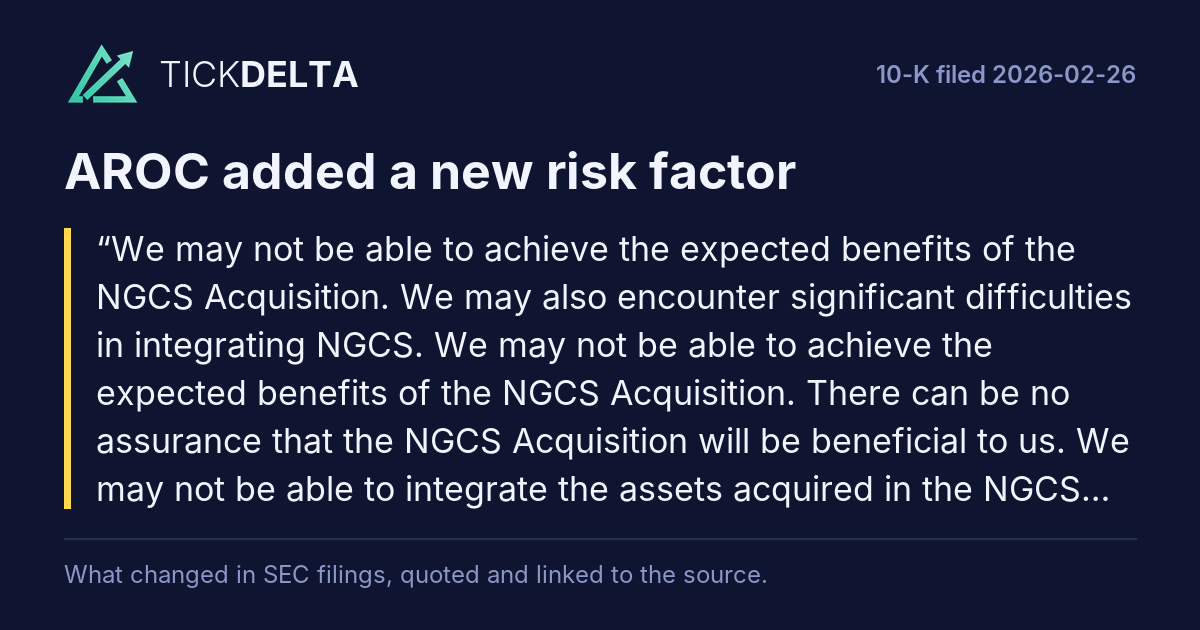
We may not be able to achieve the expected benefits of the NGCS Acquisition. We may also encounter significant difficulties in integrating NGCS.
We may not be able to achieve the expected benefits of the NGCS Acquisition. There can be no assurance that the NGCS Acquisition will be beneficial to us. We may not be able to integrate the assets acquired in the NGCS Acquisition without increases in costs or other difficulties. The integration of a business is a complex, costly and time-consuming process. As a result, we will be required to devote significant management attention and resources to integrating our business practices and operations with the business practices and operations of NGCS. The integration process may disrupt our business and, if implemented ineffectively, would restrict the full realization of the anticipated benefits from the NGCS Acquisition. The failure to meet the challenges involved in integrating NGCS and to realize the anticipated benefits of the NGCS Acquisition could have an adverse effect on our business, results of operations, financial condition and prospects, as well as the market price of our common stock. The challenges of integrating the operations of acquired businesses include, among others:
difficulties with the integration of the business of NGCS and workforce following the completion of the NGCS Acquisition;
conditions in the oil and natural gas industry, including the level of production of, demand for or price of oil or natural gas;
our reduced profit margins or the loss of market share resulting from competition or the introduction of competing technologies by other companies;
changes in economic or political conditions, including terrorism and legislative changes;
the inherent risks associated with our operations, such as equipment defects, impairments, malfunctions and natural disasters;
the risk that counterparties will not perform their obligations under our financial instruments;
our ability to timely and cost-effectively obtain components necessary to conduct our business;
employment and workforce factors, including our ability to hire, train and retain key employees;
changes in governmental safety, health, environmental or other regulations, which could require us to make significant expenditures;
the effectiveness of our control environment, including the identification of control deficiencies; and
Many of these factors are outside of our control, and any one of them could result in increased costs and liabilities, decreases in the amount of expected revenue and earnings, and diversion of management’s time and energy, which could have a material adverse effect on our business, financial condition and results of operations. Further, additional unanticipated costs may be incurred in the integration of the acquired business.
The market price of our common stock may decline as a result of the NGCS Acquisition if, among other things, the integration of the properties acquired in the NGCS Acquisition is unsuccessful or transaction costs related to the NGCS Acquisition are greater than expected. The market price of our common stock may decline if we do not achieve the perceived benefits of the NGCS Acquisition as rapidly or to the extent anticipated by us or by securities market participants or if the effect of the NGCS Acquisition on our business, results of operations or financial condition or prospects is not consistent with our expectations or those of securities market participants.
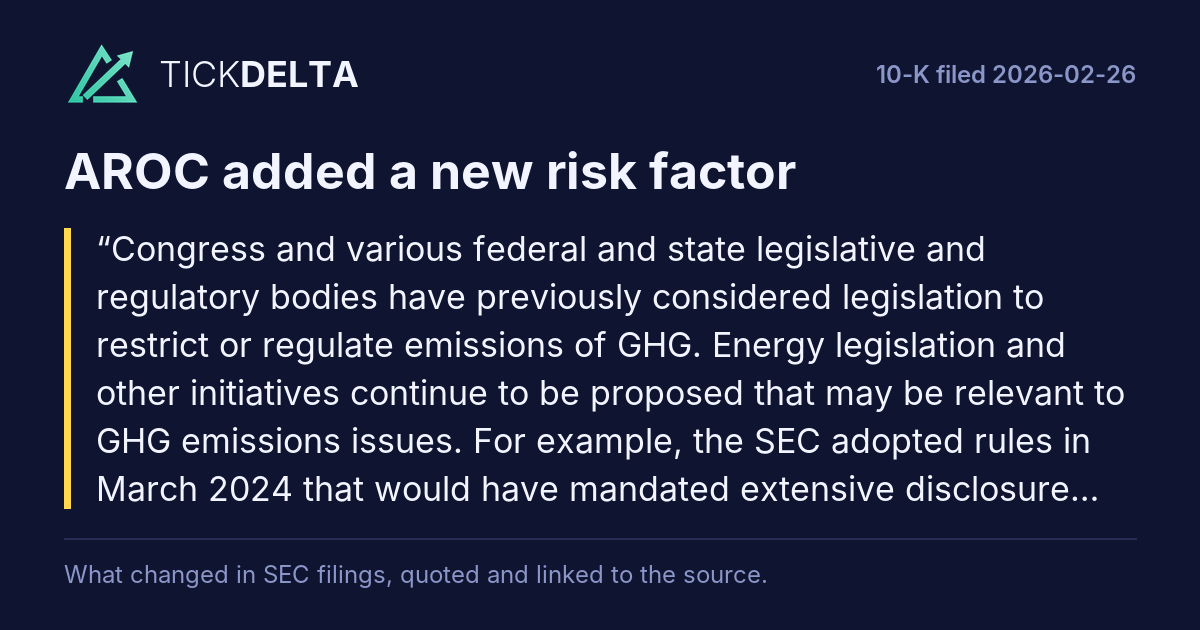
Congress and various federal and state legislative and regulatory bodies have previously considered legislation to restrict or regulate emissions of GHG. Energy legislation and other initiatives continue to be proposed that may be relevant to GHG emissions issues. For example, the SEC adopted rules in March 2024 that would have mandated extensive disclosure for certain public companies of climate-related data, risks and opportunities, including financial impacts, physical and transition risks, related governance and strategy, and greenhouse gas emissions. The SEC stayed those rules in April 2024, however, and in March 2025 voted not to defend the rules against ongoing legal challenges. Those legal challenges remain in abeyance pending an SEC decision on whether to rescind, repeal, or modify the rules but, in the meantime, the SEC climate rules remain suspended and without effect.
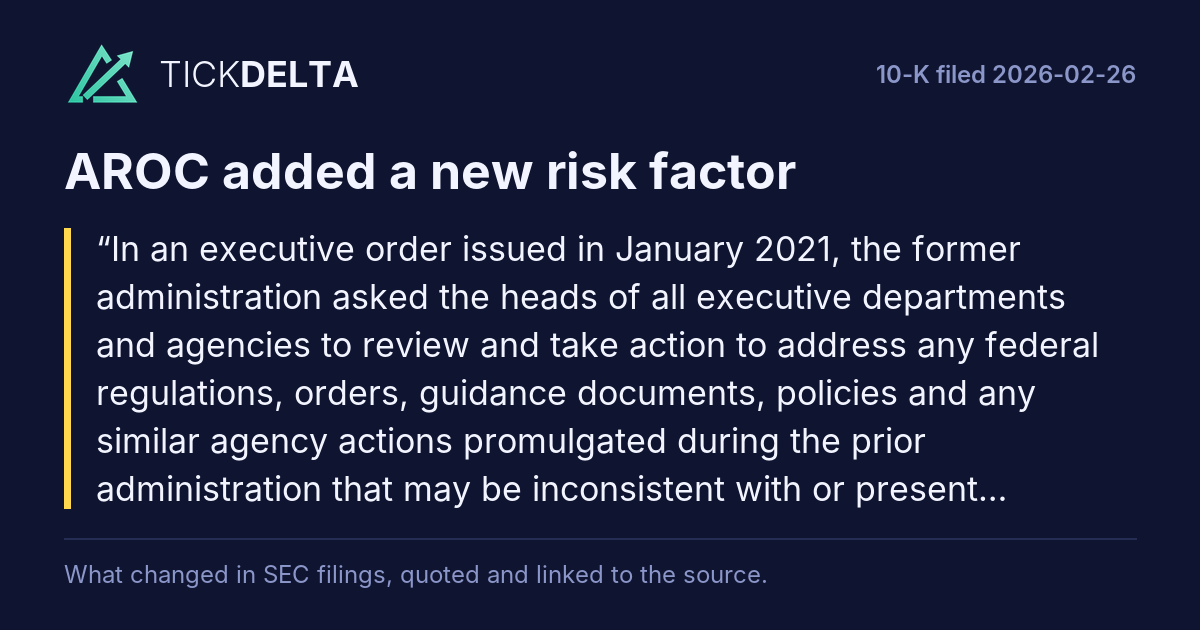
In an executive order issued in January 2021, the former administration asked the heads of all executive departments and agencies to review and take action to address any federal regulations, orders, guidance documents, policies and any similar agency actions promulgated during the prior administration that may be inconsistent with or present obstacles to the administration’s stated goals of protecting public health and the environment, and conserving national monuments and refuges. The executive order also established an Interagency Working Group on the Social Cost of Greenhouse Gases, which is called on to, among other things, capture the full costs of GHG emissions, including the “social cost of carbon,” “social cost of nitrous oxide” and “social cost of methane,” which are “the monetized damages associated with incremental increases in greenhouse gas emissions,” including “changes in net agricultural productivity, human health, property damage from increased flood risk, and the value of ecosystem services.” In early 2025, however, the new administration disbanded the Working Group and withdrew all of its published guidance, ordering EPA to review whether and how to use the social cost of carbon in federal permitting and regulatory decisions and directing the agencies in the meantime to follow OMB regulatory analysis guidance from 2003 that is virtually silent on climate. The current administration also released a series of executive orders impacting the energy sector, ranging from declaring a national emergency due to the U.S.’s inadequate energy supply, infrastructure, and prices, to halting wind energy leasing and promoting fossil fuel exploration. These executive orders are already reshaping the current direction of the U.S. climate agenda and have led to rulemaking actions by EPA that are beginning to undo U.S. climate regulation, including a February 12, 2026 final rule overturning the 2009 CAA endangerment finding respecting GHGs and all federal GHG emissions standards for vehicles and engines. At this time, we cannot determine how the current administration will continue to proceed and cannot accurately predict the ensuing impact of climate-related policy shifts on our business, financial condition, results of operations and cash flows.
Paragraphs in the 10-Q filed Nov 3, 2026 that were not in the one before
New in the latest 10-Q
9 paragraphs in the 10-Q filed Nov 3, 2026 with nothing like them in the 10-Q filed Aug 5, 2026 (at least half the words must differ; new numbers alone do not count). Quoted exactly, grouped by the item heading above them. This is text that changed, not a judgement of how serious it is.
Financial statements and notes
Our business can be hazardous, involving unforeseen circumstances such as uncontrollable flows of natural gas or well fluids and fires or explosions. As is customary in our industry, we review our safety equipment and procedures and carry insurance against some, but not all, risks of our business. Our insurance coverage includes property damage, general liability and commercial automobile liability and other coverage we believe is appropriate. We believe that our insurance coverage is customary for the industry and adequate for our business; however, losses and liabilities not covered by insurance would increase our costs.
Read in the 10-Q
Additionally, we are substantially self-insured for workers’ compensation and employee group health claims in view of the relatively high per-incident deductibles we absorb under our insurance arrangements for these risks. Losses up to the deductible amounts are estimated and accrued based upon known facts, historical trends and industry averages. We are also self-insured for property damage to our offshore assets.
Read in the 10-Q
As of September 30, 2026 and December 31, 2025, $2.9 million and $3.1 million, respectively, of the tax contingencies mentioned above had an offsetting indemnification asset.
Read in the 10-Q
In August 2025, we amended the limited liability agreement that we, together with ColdStream, entered into with FGC Holdco in October 2024, and agreed to, among other items, cancel our remaining MaCH4 NRS purchase commitments. We incurred and paid an amendment fee of $3.6 million to FGC Holdco, which is included in other (income) expense, net, in our condensed consolidated statements of operations during the three and nine months ended September 30, 2025.
Read in the 10-Q
Three Months Ended September 30, 2026 Compared to Three Months Ended September 30, 2025
Read in the 10-Q
Show the other 4
Other (income) expense, net. The change to other income during the three months ended September 30, 2026 from other expense during the three months ended September 30, 2025 was primarily due to a limited liability agreement amendment fee of $3.6 million paid to FGC Holdco during the three months ended September 30, 2025 (see Note 19 (“Related Party Transactions”) for further details), as well as indemnification expense of $0.8 million related to a change in a previously recognized indemnification asset recognized during the three months ended September 30, 2025.
Read in the 10-Q
Nine Months Ended September 30, 2026 Compared to Nine Months Ended September 30, 2025
Read in the 10-Q
Other (income) expense, net. The change to other income during the nine months ended September 30, 2026 from other expense during the nine months ended September 30, 2025 was primarily due to a limited liability agreement amendment fee of $3.6 million paid to FGC Holdco during the nine months ended September 30, 2025 (see Note 19 (“Related Party Transactions”) for further details), as well as indemnification expense of $0.8 million related to a change in a previously recognized indemnification asset recognized during the nine months ended September 30, 2025, partially offset by a decrease in proceeds from insurance and other settlements.
Read in the 10-Q
Provision for income taxes increased during the nine months ended September 30, 2026, primarily due to higher income before income taxes.
Read in the 10-Q
The 10-Q's risk factors against the 10-K
Item 1A of the 10-Q filed Nov 3, 2026 against Item 1A of the 10-K filed Feb 26, 2026.
A 10-Q repeats only the risks that changed, so a 10-K paragraph that is missing from it is not counted as removed.
Added is a paragraph with nothing like it in the 10-K, Reworded a sentence that is in both with several words changed,
Quiet changes a sentence in both where one to four words changed and one is a hedge or a modal
(cut words struck through, new words highlighted).
Text on the page, not a score; each links to the filing at sec.gov.
What the 10-Q itself says about its risk factors:There have been no material changes or updates to the risk factors previously disclosed in our 2025 Form 10-K.
Read in the 10-Q
1 paragraph in the 10-Q's Item 1A, and none of them adds, rewords or quietly edits a paragraph of the 10-K's.
Phrases used for the first time
Two-word phrases in Risk Factors of the 10-K filed Feb 26, 2026 that are in none of the 1 earlier 10-Ks stored, back to Feb 25, 2025
Where each one is used
- ngcs acquisition: Any acquisitions we complete, including the NGCS Acquisition, are subject to substantial risks that could reduce our ability to make distributions to our common stockholders.
- market price: We may not be able to achieve the expected benefits of the NGCS Acquisition. There can be no assurance that the NGCS Acquisition will be beneficial to us. We may not be able to integrate the assets acquired in the NGCS Acquisition without increases in costs or other difficulties. The integration of a business is a...
- inflation tariffs: The length of our contract operations service agreements with customers varies based on operating conditions and customer needs. Our initial contract terms typically are not long enough to enable us to recoup the cost of the equipment we utilize to provide contract operations services, and these contracts are...
- geopolitical conflicts: The conflict in Ukraine, the Israel-Hamas war, other geopolitical conflicts, and related price volatility and geopolitical instability could negatively impact our business.
- expected benefits: We may not be able to achieve the expected benefits of the NGCS Acquisition. We may also encounter significant difficulties in integrating NGCS.
- integrating ngcs: We may not be able to achieve the expected benefits of the NGCS Acquisition. We may also encounter significant difficulties in integrating NGCS.
- anticipated benefits: We may not be able to achieve the expected benefits of the NGCS Acquisition. There can be no assurance that the NGCS Acquisition will be beneficial to us. We may not be able to integrate the assets acquired in the NGCS Acquisition without increases in costs or other difficulties. The integration of a business is a...
- securities market: The market price of our common stock may decline as a result of the NGCS Acquisition if, among other things, the integration of the properties acquired in the NGCS Acquisition is unsuccessful or transaction costs related to the NGCS Acquisition are greater than expected. The market price of our common stock may...
Used at least twice, small words left out. Counted, not picked: a phrase can be new because the company renamed something.
What was taken out
5 paragraphs of last year's Risk Factors with nothing like them now. The longest are quoted.
Sources
Item 1A of each 10-K and 10-Q on EDGAR, quoted exactly. Each paragraph links to the filing at sec.gov.
Also
10-K change: what was reworded or cut, section by section.
Work with it
Excel workbook · CSV. Google Sheet that stays up to date: paste =IMPORTDATA("https://tickdelta.com/company/AROC/export.csv") into a cell.