Screener / SEC EDGAR /CIK 0000007789 /10-K filed Feb 12, 2026, compared with Feb 12, 2025 /Numbers from the XBRL of the 10-Ks
NYSE Financials · Banks

Associated Banc-Corp ASB

Compare with peers Embed
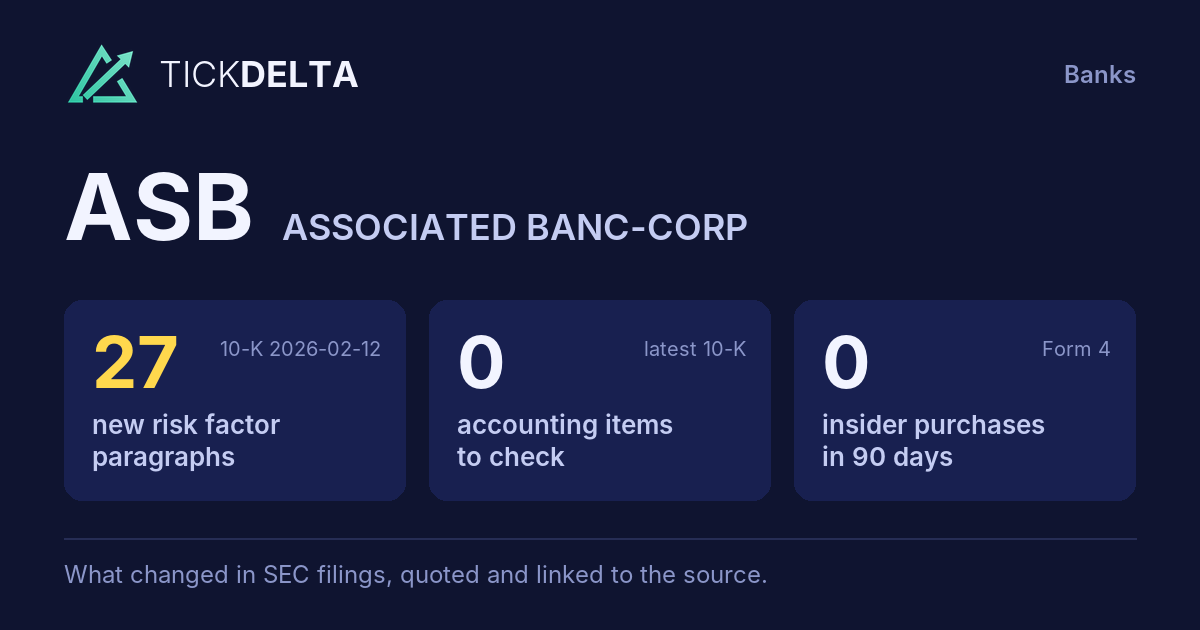
New in the 10-K 27 paragraphs with nothing like them in the 10-K filed Feb 12, 2025 New in the 10-Q 4 paragraphs not in the 10-Q filed Aug 4, 2026 10-Q against the 10-K 5 risk factor paragraphs and sentences added or reworded

New risk paragraphs, branching off last year

Each branch is a paragraph in Risk Factors with nothing like it in the 10-K filed Feb 12, 2025. A box jumps to the paragraph as filed, below.

27 new

Paragraphs with nothing like them in last year's 10-K

Quoted exactly

27 paragraphs in Risk Factors of the 10-K filed Feb 12, 2026 with nothing like them in the 10-K filed Feb 12, 2025. Quoted exactly. Paragraphs that were only edited are under 10-K change.

2023, approaching the Federal Reserve’s two percent inflation objective. The U.S. economy had strong GDP growth, loosening of tight labor markets and slowed inflation in 2025.

While this positive growth may continue in 2026, external factors such as stricter immigration policies, tariffs, and other trade policies, sanctions, geopolitical tensions, high unemployment, civil unrest, and other political or trade-related policies affecting domestic and global markets may cause greater economic uncertainty. Such conditions may adversely affect our asset quality, deposit levels, loan demand and results of operations.

Read in the 10-K

In the aftermath of the significant bank failures that occurred in 2023, the federal banking agencies have enhanced their scrutiny of banks' liquidity risk management.

In the event of financial distress, uninsured depositors historically have been more likely to withdraw their deposits. The Corporation had approximately $17.0 billion of uninsured deposits at December 31, 2025. Estimated uninsured and uncollateralized deposits, excluding intercompany deposits, were $9.4 billion or 26.5% of total deposits at December 31, 2025.

Read in the 10-K

magnitude of the downgrade, the rating relative to peers, the rating assigned by the relevant agency pre-downgrade, individual client behavior and future mitigating actions we might take.

Read in the 10-K

Our business is dependent on our and third parties' information technology systems and networks. Any failure, interruption, or breach in security or operational integrity of our or our third-party service providers' communications and information systems or networks, including those caused by a cyber-attack, could result in failures or disruptions in our customer relationship management, general ledger, deposit, loan, and other systems.

Our computer, communications, data processing, networks, backup, business continuity or other operating, information or technology systems and networks, including those that we outsource to providers, may fail to operate properly or become disabled, overloaded or damaged as a result of a number of factors, including events that are wholly or partially beyond our control, which could have a negative effect on our ability to conduct our business activities.

Read in the 10-K

Our obligations related to privacy and security are quickly changing in an increasingly stringent fashion and may be subject to differing applications and interpretations, which may be inconsistent or in conflict among jurisdictions. Preparing for and complying with these obligations requires us to devote significant resources and may necessitate changes to our business practices. We enter into agreements with third parties regarding our collection, sharing, use, storage and other processing of personal information and publish public privacy policies and make other public statements about our privacy and security practices. Although we endeavor to comply with our privacy and security obligations, we may at times fail to do so or may be perceived to have failed to do so, including due to the errors or omissions of our personnel and third parties upon which we rely.

Read in the 10-K
Show the other 7

If any of our employees or service providers use any third-party AI-powered software in connection with our business or the services they provide to us, it may lead to the inadvertent disclosure or incorporation of our confidential information into publicly available training sets, which may impact our ability to realize the benefit of, or adequately maintain, protect and enforce our intellectual property or confidential information, harming our competitive position and business. Any output created by us using AI tools may not be subject to copyright protection, which may adversely affect our intellectual property rights in, or ability to commercialize or use, any such content.

If we do not have sufficient rights to use the data or other material or content on which our AI solutions rely, or if we experience cybersecurity incidents in connection with our use of AI, we may incur liability through the violation of applicable laws and regulations, such as fair lending laws and regulations, third-party intellectual property, privacy or other rights, or contracts to which we are a party. We may not be able to sufficiently mitigate or detect any of the foregoing limitations or risks given our and other market participants' lack of experience with using AI, the pace of technological change, and rapid adoption of AI by our business partners and competitors. This exposes us to potential damage to our reputation, adverse impacts on our business operations, and violation of legal and regulatory obligations.

Read in the 10-K

time. On the other hand, any increase in the corporate tax rate or surcharges that may be adopted by Congress would adversely affect our results of operations in future periods.

Read in the 10-K

Climate-related risks could adversely affect our business and performance, including indirectly through impacts on our customers.

There continues to be a concern, including on the part of certain state regulators, regarding climate change and its impacts. Climate change could manifest as a financial risk to us either through changes in the physical climate or from the process of transitioning to a low-carbon economy. Both physical risks and transition risks associated with climate change could have negative impacts on the financial condition or creditworthiness of our customers, and on its exposure to those customers. Physical risks include the increased frequency or severity of acute weather events, such as floods, wildfires and tropical cyclones, and chronic shifts in the climate, such as persistent changes in precipitation levels, rising sea levels, or increases in average ambient temperature. Transition risks arise from societal adjustment to a low-carbon economy, such as changes in public policy, adoption of new technologies or changes in consumer preferences toward low-carbon goods and services. These risks could also be influenced by changes in the physical climate.

Concerns over the anticipated and unanticipated impacts of climate change (including physical risk and transition risk) have led and may continue to lead to governmental efforts to mitigate those impacts. The Corporation may be compelled to change or cease some of its business or operational practices or to incur additional capital, compliance, and other costs because of climate- or environmental-driven changes in applicable law or supervisory expectations or due to related political, social, market, or similar pressure. The Corporation and its customers may face cost increases, asset value reductions, operating process changes, and other issues. In addition, the Corporation could face reductions in creditworthiness on the part of some customers or in the value of asset securing loans. The Corporation's efforts to take these risks into account in making lending and other decisions may not be effective in protecting it from the negative impact of new laws and regulations or changes in consumer or business behavior.

Further, there is increased scrutiny of climate change-related and other ESG-related policies, goals and disclosures. The Corporation's stakeholders may disagree with these policies and goals, or conversely, believe that these policies and goals are insufficient, which may lead to a decrease in demand for our products and services or damage our reputation. For example, certain federal and state laws and regulations relating to climate or other ESG issues may include provisions that conflict with other laws and regulations, which may increase our costs or limit our ability to conduct business in certain jurisdictions In particular, there is an increasing number of state-level anti-ESG initiatives in the United States that may conflict with other regulatory requirements or our various stakeholders' expectations. Such divergent, sometimes conflicting, views on such matters increase the risk that any action or lack thereof by the Corporation on such matters will be perceived negatively by some stakeholders. The Corporation may also incur additional costs and require additional resources as it evolves its strategy, practices and related disclosures with respect to these matters. In addition, there are and will continue to be challenges related to capturing, verifying, analyzing and disclosing climate-related data that is subject to measurement uncertainties.

Read in the 10-K

We may not be able to successfully integrate American National or to realize the anticipated benefits of the acquisition.

Upon consummation of the acquisition of American National, we will begin the process of integrating its business with ours. A successful integration will depend substantially on the Corporation's ability to consolidate operations, corporate cultures,

systems and procedures and to eliminate redundancies and costs. We may not be able to combine our business with the business of American National without encountering difficulties that could adversely affect our ability to maintain relationships with existing clients, customers, depositors and employees, such as:

•additional costs or unexpected problems with operations, personnel, technology and credit;

•problems with the assimilation of new operations, system, sites or personnel, which could divert resources from regular banking operations.

Any disruption to the businesses could cause customers to remove their accounts and move their business to a competing financial institution. Integration efforts between the two companies may also divert management attention and resources. Additionally, general market and economic conditions or governmental actions affecting the financial industry generally may inhibit our successful integration of American National.

Further, we entered into the merger agreement to acquire American National with the expectation that the acquisition will result in various benefits including, among other things, benefits relating to enhanced revenues, a strengthened market position for the combined company, cross selling opportunities, technological efficiencies, cost savings and operating efficiencies. Achieving the anticipated benefits of the transactions contemplated by the merger agreement is subject to a number of uncertainties, including whether we integrate American National in an efficient, effective and timely manner, and general competitive factors in the marketplace. Failure to achieve these anticipated benefits on the anticipated timeframe, or at all, could result in a reduction in the price of our common stock as well as in increased costs, decreases in the amount of expected revenues and diversion of management's time and energy and could materially and adversely affect our business, financial condition and operating results. Additionally, upon consummation of the transactions contemplated by the merger agreement, we will make fair value estimates of certain assets and liabilities in recording the acquisition. Actual values of these assets and liabilities could differ from our estimates, which could result in our not achieving the anticipated benefits of the transaction. Finally, any cost savings that are realized may be offset by losses in revenues or other charges to earnings.

Read in the 10-K

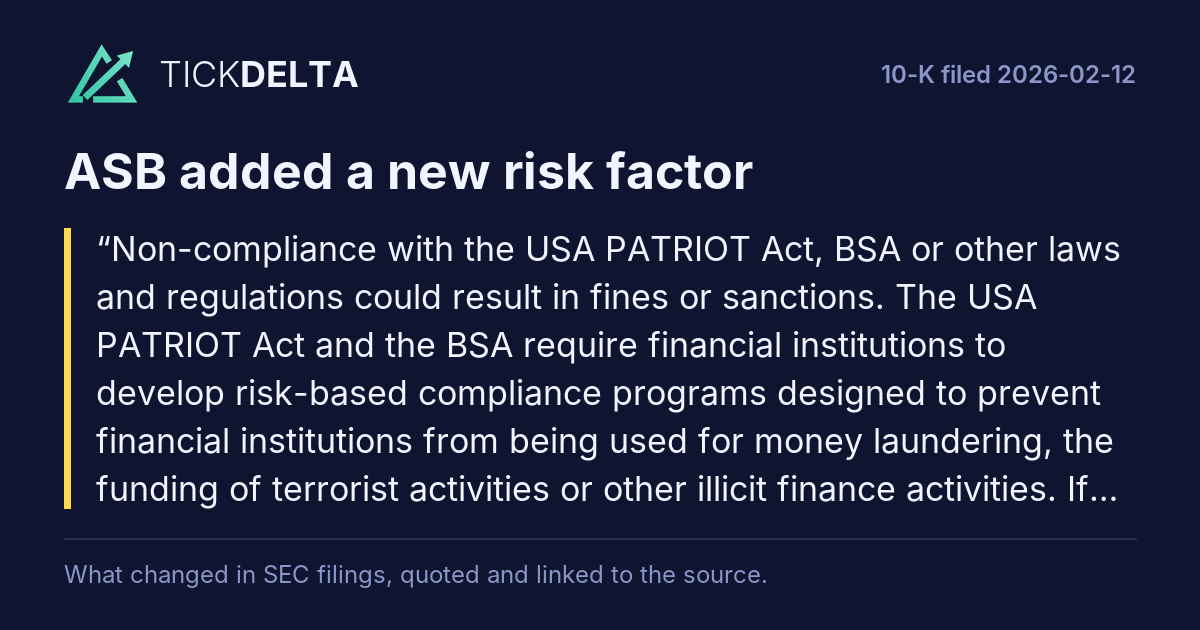
Non-compliance with the USA PATRIOT Act, BSA or other laws and regulations could result in fines or sanctions.

The USA PATRIOT Act and the BSA require financial institutions to develop risk-based compliance programs designed to prevent financial institutions from being used for money laundering, the funding of terrorist activities or other illicit finance activities. If such activities are detected, financial institutions are obligated to file suspicious activity reports with FinCEN. The BSA and its implementing regulations require covered financial institutions to establish procedures for identifying and verifying the identity of customers seeking to open new accounts. Failure to comply with the BSA and its implementing regulations could result in fines or sanctions. An increasing number of banking institutions have received large fines for non-compliance with the BSA and its implementing regulations. Although we have developed policies and procedures designed to assist in compliance with these laws and regulations, no assurance can be given that these policies and procedures will be effective in preventing violations of these laws and regulations.

Read in the 10-K

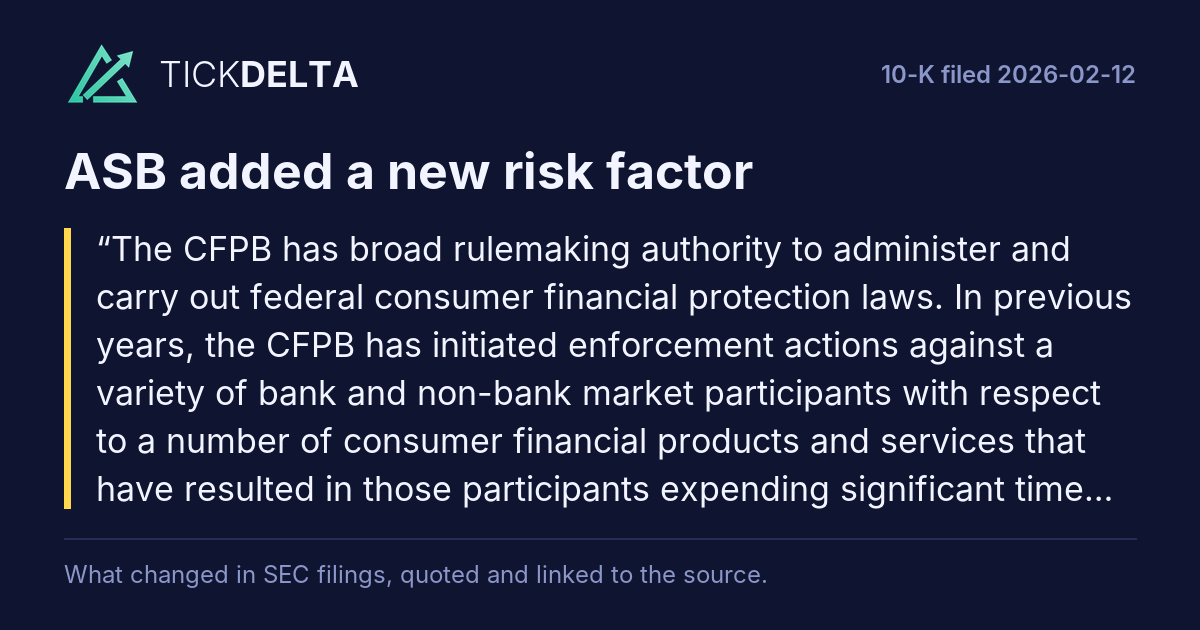
The CFPB has broad rulemaking authority to administer and carry out federal consumer financial protection laws. In previous years, the CFPB has initiated enforcement actions against a variety of bank and non-bank market participants with respect to a

number of consumer financial products and services that have resulted in those participants expending significant time, money and resources to adjust to the initiatives being pursued by the CFPB.

Read in the 10-K

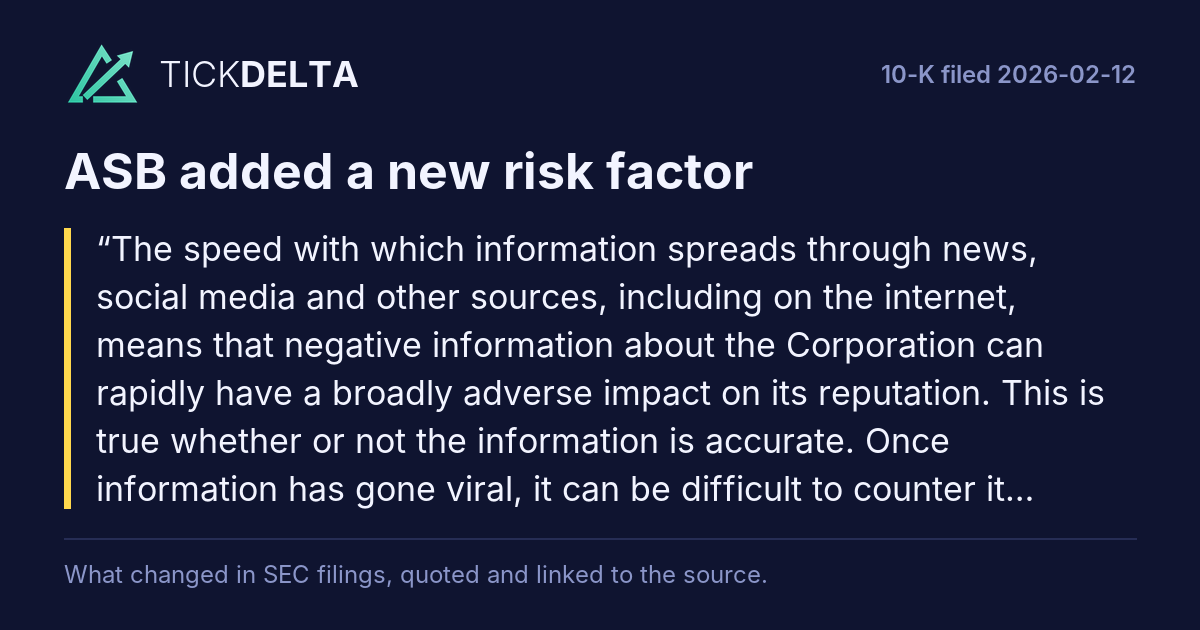
The speed with which information spreads through news, social media and other sources, including on the internet, means that negative information about the Corporation can rapidly have a broadly adverse impact on its reputation. This is true whether or not the information is accurate. Once information has gone viral, it can be difficult to counter it effectively, either by correcting inaccuracies or communicating remedial steps taken for actual issues. The potential impact of negative information going viral and the ease with which customers transact means that material reputational harm can result from a single discrete or isolated incident.
Read in the 10-K

Paragraphs in the 10-Q filed Oct 27, 2026 that were not in the one before

New in the latest 10-Q

4 paragraphs in the 10-Q filed Oct 27, 2026 with nothing like them in the 10-Q filed Aug 4, 2026 (at least half the words must differ; new numbers alone do not count). Quoted exactly, grouped by the item heading above them. This is text that changed, not a judgement of how serious it is.

Financial statements and notes

Nine Months Ended Sep 30, (in thousands) 2026 2025 ───────────────────────────────────────────────────────────────────────────────────────────────────────────────────────────────────────────────────────── Supplemental disclosures of cash flow information Cash paid for interest $ 730,605 $ 763,622 Issuance of common stock as consideration for the American National acquisition 594,144 — Assets acquired from the American National acquisition 5,228,544 — Liabilities assumed from the American National acquisition 4,634,400 — Loans transferred to (from) held for sale from (into) portfolio, net 4,878 (54,339)

Read in the 10-Q

• Noninterest expense of $751.4 million increased $115.2 million, or 18%, from the first nine months of 2025. The increase was primarily attributable to the American National acquisition, including recurring expenses such as personnel costs associated with new colleagues and amortization of CDI. The acquisition also resulted in nonrecurring expenses, including severance and retention bonuses impacting personnel expense, contract termination costs increasing technology expense, and transaction and integration-related legal and professional fees. In addition, technology expense increased due to higher subscription costs, increased equipment expense resulting from elevated small equipment purchases, and increased legal and professional expense due to information technology augmentation costs. These increases were offset by a gain on sale of an OREO property in the third quarter of 2026.

Read in the 10-Q

◦ Accrued expenses and other liabilities of $676.9 million at September 30, 2026 were up $213.8 million or 46% from December 31, 2025 primarily due to changes within the customer back-to-back derivative portfolio as a result of interest rate increases.

Read in the 10-Q

Item 6

Exhibit (10.1), Employment Transition - Letter Agreement, between Associated Banc-Corp and Randall J. Erickson, dated September 21, 2026, incorporated by reference to the Corporation's Current Report on Form 8-K dated September 21, 2026.

Read in the 10-Q

The 10-Q's risk factors against the 10-K

Item 1A of the 10-Q filed Oct 27, 2026 against Item 1A of the 10-K filed Feb 12, 2026. A 10-Q repeats only the risks that changed, so a 10-K paragraph that is missing from it is not counted as removed. Added is a paragraph with nothing like it in the 10-K, Reworded a sentence that is in both with several words changed, Quiet changes a sentence in both where one to four words changed and one is a hedge or a modal (cut words struck through, new words highlighted). Text on the page, not a score; each links to the filing at sec.gov.

What the 10-Q itself says about its risk factors:There have been no material changes in the Risk Factors described in the Corporation’s 2025 Annual Report on Form 10-K.

Read in the 10-Q
Added10-Q Oct 27, 2026 vs 10-K Feb 12, 2026
During the third quarter of 2026, the Corporation repurchased $101.4 million of common stock, of which $100.0 million were open market repurchases in accordance with an accelerated share repurchase agreement while $1.4 million were repurchases related to tax withholding on equity compensation. The repurchase details are presented in the table below:

Read it in the 10-Q at sec.gov

Added10-Q Oct 27, 2026 vs 10-K Feb 12, 2026
Total Number of Average Price Total Number of Maximum Number of Shares Purchased(a) Shares that May Yet Be Purchased Under Paid per Share Shares Purchased as the Plans or Programs(b)

Read it in the 10-Q at sec.gov

Added10-Q Oct 27, 2026 vs 10-K Feb 12, 2026
(a) During the third quarter of 2026, the Corporation repurchased 44,307 shares for minimum tax withholding settlements on equity compensation. These purchases do not count against the maximum value of shares remaining available for purchase under the Board of Directors' 2026 authorization.

Read it in the 10-Q at sec.gov

Added10-Q Oct 27, 2026 vs 10-K Feb 12, 2026
(b) On January 27, 2026 and April 28, 2026, the Board of Directors authorized the repurchase of up to $100 million each of the Corporation's common stock. At September 30, 2026, there remained $113.9 million authorized to be repurchased in the aggregate. Approximately 4.0 million shares of common stock remained available to be repurchased under the Board authorizations based on the closing share price on September 30, 2026.

Read it in the 10-Q at sec.gov

Added10-Q Oct 27, 2026 vs 10-K Feb 12, 2026
Repurchases under Board authorized repurchase programs are subject to any necessary regulatory approvals and other limitations and may occur from time to time in open market purchases, block transactions, private transactions, accelerated share repurchases, or similar facilities.

Read it in the 10-Q at sec.gov

Phrases used for the first time

Two-word phrases in Risk Factors of the 10-K filed Feb 12, 2026 that are in none of the 1 earlier 10-Ks stored, back to Feb 12, 2025

american national ×8corporation endeavors ×3intellectual property ×3merger agreement ×3cre lending ×2theft loss ×2loss destruction ×2destruction gathering ×2gathering monitoring ×2monitoring dissemination ×2dissemination misappropriation ×2misappropriation misuse ×2misuse alteration ×2parties communications ×2technology systems ×2providers communications ×2
Where each one is used
  • american national: As part of our growth strategy, from time to time we evaluate merger and acquisition opportunities and conduct due diligence activities related to possible transactions with other financial institutions and financial services companies, including our proposed acquisition of American National Corporation. As a...
  • corporation endeavors: The Corporation endeavors to regularly evaluate its systems and controls and implement upgrades as necessary. The additional cost to the Corporation of our cybersecurity monitoring and protection systems and controls includes the cost of hardware and software, third party technology providers, consulting and...
  • intellectual property: If any of our employees or service providers use any third-party AI-powered software in connection with our business or the services they provide to us, it may lead to the inadvertent disclosure or incorporation of our confidential information into publicly available training sets, which may impact our ability to...
  • merger agreement: Further, we entered into the merger agreement to acquire American National with the expectation that the acquisition will result in various benefits including, among other things, benefits relating to enhanced revenues, a strengthened market position for the combined company, cross selling opportunities,...
  • cre lending: Although CRE markets have shown signs of stabilization since 2024, the federal banking agencies have issued guidance on the sound risk management practices regarding CRE lending and regulatory scrutiny may increase depending on the concentration in CRE lending and changing economic conditions for the CRE markets....
  • theft loss: We rely on computer systems, hardware, software, technology infrastructure and online sites and networks for both internal and external operations that are critical to our business. Operational risk related to cyber-attacks is increasing as cyber-attacks evolve and have a greater and more pervasive economic impact....
  • loss destruction: We rely on computer systems, hardware, software, technology infrastructure and online sites and networks for both internal and external operations that are critical to our business. Operational risk related to cyber-attacks is increasing as cyber-attacks evolve and have a greater and more pervasive economic impact....
  • destruction gathering: We rely on computer systems, hardware, software, technology infrastructure and online sites and networks for both internal and external operations that are critical to our business. Operational risk related to cyber-attacks is increasing as cyber-attacks evolve and have a greater and more pervasive economic impact....

The 10-K at sec.gov

Used at least twice, small words left out. Counted, not picked: a phrase can be new because the company renamed something.

What was taken out

38 paragraphs of last year's Risk Factors with nothing like them now. The longest are quoted.

Across all companies
Further, in 2023, the federal banking agencies, including the OCC, issued a proposed rule to implement the final components of the Basel III standards. Among other things, the proposed rule would substantially change the existing calculation of risk-weighted assets and require banking organizations to use revised models for such calculations. The proposed rule, if adopted as proposed, would be applicable to banking organizations with $100 billion or more in total consolidated assets, and therefore would not apply to the Bank directly based upon its current asset size. However, many of the...
In the 10-K filed Feb 12, 2025
An entity (including a "group" composed of natural persons) owning or controlling with the power to vote 25% or more of our outstanding common stock, or 5% or more if such holder otherwise exercises a "controlling influence" over us, may be subject to regulation as a "bank holding company" in accordance with the BHC Act. In addition, (1) any bank holding company or foreign bank with a U.S. presence may be required to obtain the approval of the Federal Reserve under the BHC Act to acquire or retain 5% or more of our outstanding common stock, and (2) any person not otherwise defined as a...
In the 10-K filed Feb 12, 2025
In 2024, the FDIC, the OCC and the DOJ announced changes to their bank merger review processes in 2024 in response to President Biden’s Executive Order on Promoting Competition in the American Economy. The FDIC approved a final statement of policy on bank merger transactions and the OCC approved a final rule updating the agency’s regulations for business combinations involving national banks and federal savings associations. The OCC’s final rule modifies its procedures for reviewing bank merger applications under the Bank Merger Act applications, including the elimination of the expedited...
In the 10-K filed Feb 12, 2025
In addition to the potential for broader "anti-ESG/DEI" policies and laws, on January 21, 2025, President Trump issued an Executive Order requiring all federal agencies to terminate any policies, programs, mandates, guidance, regulations, and other actions and orders establishing DEI-based preferences, and to enforce federal civil rights laws to combat such preferences, mandates, policies, programs and activities of entities operating in the private sector. Further, the Executive Order directs federal agencies to take appropriate action to discourage private sector DEI-based initiatives....
In the 10-K filed Feb 12, 2025

Sources

Item 1A of each 10-K and 10-Q on EDGAR, quoted exactly. Each paragraph links to the filing at sec.gov.

Also

10-K change: what was reworded or cut, section by section.

Work with it

Excel workbook · CSV. Google Sheet that stays up to date: paste =IMPORTDATA("https://tickdelta.com/company/ASB/export.csv") into a cell.

Next:10-K change
Esc

Type a ticker such as AAPL, a name, an investor such as Buffett, or a topic such as tariffs. ↑ ↓ to move, Enter to open.