tickdelta
Sign in

Tickdelta is free for now. Sign up and get Pro free

← Screener

ATOAtmos Energy

Utilities · Gas Utilities · NYSE

Atmos Energy Corporation, a natural gas-only distributor, is an S&P 500 company headquartered in Dallas and incorporated in Texas and Virginia. 10-K, Item 1

Employees
5,487
Headquarters
Dallas, TX
CEO
John K. Akers
Next results
around Feb 2, 2027
Compare with peers → Embed

When the SEC's staff reviews a filing, it writes to the company with numbered questions, and the company answers each one in a letter. SEC publishes the exchange once the review is over, at least 20 business days later. Below: what the staff asked ATO, and the company's answer to each question, quoted from the letters. A question is not an accusation; most reviews end with the company adding detail to its next filing.

Form 10-K for the Fiscal Year ended September 30, 2024

2025-03-07 to 2025-04-15 · 1 question · 1 letter from the SEC, 1 from the company
Review closed 2025-04-15
Risk factors
SEC asked
We note your disclosure regarding the underground distribution and transmission mains, indicating you have a program of "continuous inspection and repair" and that you believe the system is in good condition. However, on page 78, you reference an investigation by the National Transportation Safety Board of two incidents early last year, though without providing details or context, or discussing the implications.
Rest of the question

Based on the preliminary report, we understand that the investigation pertains to two explosions that destroyed homes that were served by your natural gas distribution system in Jackson, Mississippi, and that you had known of gas leaks in close proximity to the explosions beforehand and subsequently found additional leaks on mechanical couplings near the previously identified leaks, to include the detection of subsurface gas near both locations where the explosions occurred and near the 1. foundations of adjacent homes. The report indicates the natural gas distribution system serving those properties was installed in the 1960s and early 1970s. Given these findings, and considering your risk factor disclosure on page 18, indicating significant capital expenditures are required to modernize your distribution and transmission system, it appears that you should provide more details regarding the condition, suitability, and adequacy of your pipeline systems, such as the age of those systems, incidence of leak detections, and programs to replace or upgrade those systems to comply with Instruction 1 to Item 102 of Regulation S-K. For example, considering the age of the system associated with the incidents, disclose your view on the remaining serviceability of the 50-60 year-old pipeline system, and clarify how the age of your other pipleline systems compare, with quantitative details that provide meaningful differentiation based on the age of your systems. Please discuss the nature and scope of any plans to replace or upgrade the aging systems in your network, to include the timeframe, duration, and estimated costs, or clarify if your approach is limited to conducting repairs, in which case also discuss the limitations of that approach. Please also discuss any factors that hinder your ability to upgrade and replace systems that are near the end of their servicable lives.

ATO answered
Safety is at the core of our business and essential to who we are. At Atmos Energy, it is our stated vision to be the safest provider of natural gas services.

As we provide information about the changes we propose making to certain language in our Annual Report on Form 10-K for the Fiscal Year ending September 30, 2025 (“2025 Form 10-K”) in response to the Staff’s comments regarding the condition, suitability, and adequacy of our pipeline systems, we want to make two clarifying points at the outset.

First, while we continue to cooperate with the National Transportation Safety Board
Rest of the answer

(“NTSB”), the Pipeline and Hazardous Materials Safety Administration (“PHMSA”), the Mississippi Public Service Commission (“MS PSC”), and other parties to the investigation regarding the 2024 incident in Jackson, Mississippi, that investigation is ongoing. There have been no findings of causal factors (including with respect to the age of our pipeline system) by any party, Atmos Energy’s party submission is not yet public, and we cannot comment on the cause of the incident. It is important to note, however, that with respect to leaks identified on the Atmos Energy transmission and distribution system, we investigate, grade, and repair such leaks in accordance with procedures that meet or exceed regulatory requirements.

Second, while we have a model for managing risks to the integrity of our natural gas infrastructure, no single factor is determinative in our decision to take mitigative actions. We describe in further detail below our integrity management programs and our ongoing efforts to consider the many factors that impact integrity management.

Consistent with our safety vision and PHMSA’s Distribution Integrity Management Rule, we have a distribution integrity management (“DIM”) program and plan, the primary objective of which is to manage the integrity and safety of our natural gas distribution systems. The DIM process integrates information sources and data, identifies risks to the integrity of distribution infrastructure, ranks risks, and designates measures and actions to reduce or mitigate risks as appropriate. Those mitigative actions can include a number of measures such as accelerated leak survey frequency, pipeline replacement, and additional public awareness.

As part of our DIM program, we use a framework for evaluating and ranking risks that was originally developed by a group of natural gas distribution operators in coordination with the Gas Technology Institute (“GTI”), and Operations Technology Development. We engaged a third-party global leader in assurance and risk management to incorporate this framework into a Distribution Risk Assessment Model, or DRAM, that configures over one hundred risk model input factors and weightings to reflect Atmos Energy’s distribution systems and operating environments.

In 2020, we engaged another third-party expert to perform an independent review and assessment of those input factors and weightings against industry best practices, and we adopted as appropriate its conclusions into the DRAM. Factors include, without limitation, population density, material and soil type, pipe age, legacy construction practices, leak history, pipe coating, and corrosion data. Most recently, we have updated the DRAM to address considerations related to the potential for unreported damage to be present on our facilities from third-party excavation activities, for differential ground movement in our service territories, for consequences related to rain and soil wetness, and for threats to combine and act together. No single factor, such as the age of pipe or leak history, is determinative in our decision to take mitigative actions on our distribution pipeline systems, including accelerated leak survey or pipeline replacement.

We also have a transmission integrity management (“TIM”) program and plan applicable to our transmission pipeline systems in our distribution and pipeline and storage segments. The TIM program and plan take into account a variety of factors and are consistent with our vision to be the safest provider of natural gas services and PHMSA’s Gas Transmission Pipeline Integrity Management Rule. As with our DIM program, no single factor is determinative in our decision to take mitigative actions on our transmission pipeline systems.

We periodically review our DIM and TIM programs, including potential alternative approaches to the risk analysis and risk mitigation methodologies, within the decision-making framework of these programs.

In response to the Staff’s comment to provide more detail regarding our program to replace or upgrade our systems, we propose to include in our 2025 Form 10-K:

To manage the integrity and safety of our natural gas distribution and transmission systems, consistent with PHMSA regulations, we have integrity management programs that integrate information sources and data, identify risks to infrastructure integrity, ranks risks, and designate measures and actions to reduce or mitigate risks as appropriate. These programs take into consideration numerous input factors and no single factor is determinative in our decision to take mitigative actions on our distribution or transmission pipeline systems. Based upon these programs, along with the oversight of state regulators responsible for adopting and enforcing the federal pipeline safety regulations, we believe that our distribution and transmission pipeline systems are suitable and adequate for our purposes.

We believe that the proposed disclosure, together with the disclosure already provided in Item 2 of our Form 10-K detailing (among other things) our miles of pipe, storage capacity and maximum delivery capability, provides investors with information that will reasonably inform them as to the suitability, adequacy and productive capacity of our pipeline systems as required by Instruction 1 to Item 102 of Regulation S-K.

Further, as the Staff notes, and as we have disclosed in our risk factors on page 18 of our Form 10-K, our business requires that we make significant capital expenditures on a long-term basis to continuously modernize our distribution and transmission system. These investments reflect our commitment to our vision to be the safest provider of natural gas services. Our anticipated capital expenditures also reflect costs associated with the need to continually build new capacity to serve our growing communities, and we anticipate incurring significant capital expenditures for the foreseeable future. Between fiscal years 2025 and 2029, we anticipate our capital expenditures to be approximately $24 billion, with more than 80% of this amount dedicated to safety and reliability spending, guided by our pipeline integrity management programs. The magnitude and allocation of these expenditures may be affected by factors such as new policy and regulations, population growth, increased labor and materials costs.

Our rates are established by the regulatory authorities in each of the states in which we operate and are intended to be sufficient to cover the costs of conducting business, including a reasonable return on invested capital. In order to seek a rate increase, we must submit to the applicable regulatory authorities supporting detail justifying the nature, timing, and costs (including costs to survey, inspect, repair, and replace our pipeline systems) that we seek to recover. We anticipate our costs to conduct business, including the costs incurred to execute our integrity management programs will be recovered. On pages 6-12 of our Form 10-K, we have summarized the various regulatory mechanisms and programs that are available to us to recover our costs.

In response to the Staff’s comment to provide more detail regarding our timeline, duration and estimated cost of replacement, upgrade and repair to our system, we propose to include the following information in our 2025 Form 10-K:

We anticipate making significant capital expenditures for the foreseeable future to modernize our distribution and transmission system, to comply with the safety rules and regulations issued by the regulatory authorities responsible for the service areas we in which we operate, and to prepare to serve the growing needs of the communities we serve. Between fiscal years 2025 and 2029, we anticipate spending approximately $24 billion, with more than 80% dedicated to safety and reliability spending. The magnitude and allocation of these expenditures may be affected by factors such as new policy and regulations, population growth, and increased labor and materials costs. Although we believe these costs are ultimately recoverable through our rates based on the regulatory frameworks currently available to us, full recovery is not assured.
Read in the reply ↗

Also in this review: closing letter, 2025-04-15
Form SF-1

2023-03-27 to 2023-05-26 · 2 questions · 1 letter from the SEC, 1 from the company
No closing letter
Description of the Securitized Utility Tariff Bonds · The Security for the Securitized Utility Tariff Bonds, page 68
SEC asked (1)
We note that, in addition to the securitized utility tariff property, the collection account and all of its subaccounts will also secure the bonds, including all “cash, instruments, investment property or other assets credited to or deposited in the collection account or any subaccount … and all financial assets and securities entitlements carried therein or credited thereto.” Please confirm whether any of the
Rest of the question

underlying collateral will consist of securities for purposes of Rule 190 under the Securities Act.

ATO answered
The

Registrants hereby confirm that none of the underlying collateral will consist of securities for purposes of Rule 190 under the Securities Act. Read in the reply ↗
Part II - Information Not Required in Prospectus · Item 14. Exhibits, page II-3
SEC asked (2)
Please file your remaining exhibits with your next amendment. Refer to Item 1100(f) of Regulation AB and Instruction 1 to Item 601 of Regulation S-K. Note that we may have additional comments on your registration statement following our review of any such exhibits.
ATO answered
Registrants are filing copies of the remaining exhibits with Amendment No. 1. Read in the reply ↗

Form 10-K for the Fiscal Year Ended September 30, 2019

2020-01-21 to 2020-01-28 · 2 questions · 1 letter from the SEC, 1 from the company
Review closed 2020-01-28
Non-GAAP measuresResults discussion (MD&A)
Selected Financial Data, page 21
SEC asked (1)
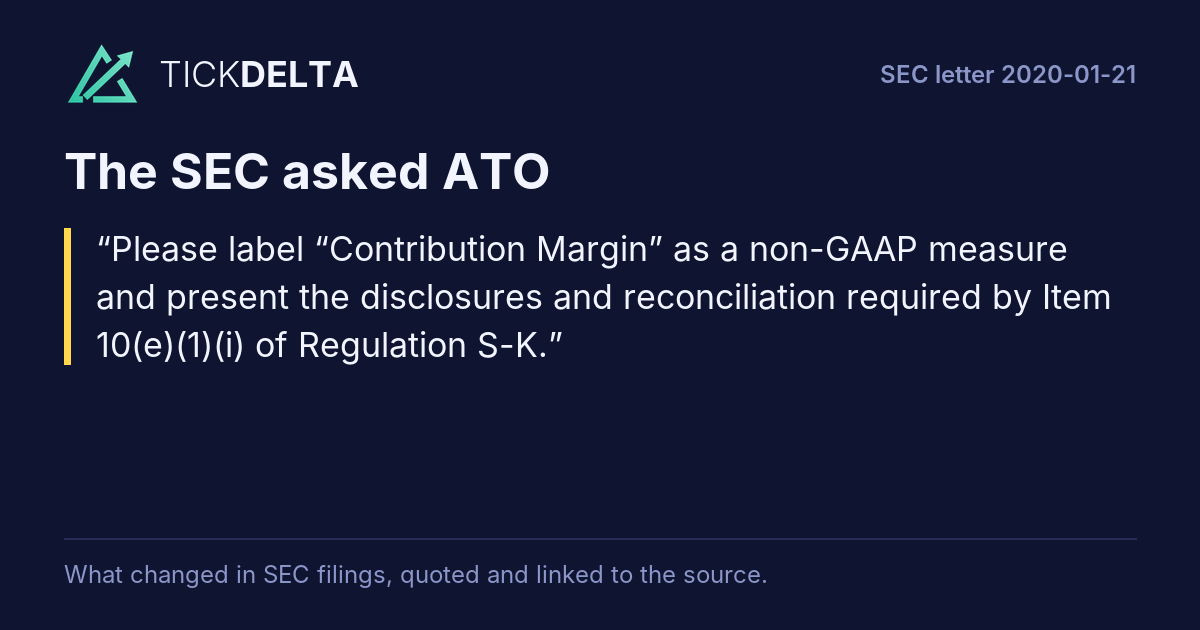
Please label “Contribution Margin” as a non-GAAP measure and present the disclosures and reconciliation required by Item 10(e)(1)(i) of Regulation S-K.
ATO answered
The Company respectfully acknowledges the Staff’s comment. The Company has decided to transition away from using contribution margin when discussing our financial results in future filings. As such, the Company will remove references to contribution margin when discussing our financial results in all future Form 10-K and 10-Q filings and in all future earnings releases furnished as exhibits to Form 8-K filings, beginning with our earnings release and Form 10-Q for the three months ended December 31, 2019.

Management's Discussion and Analysis of Financial Condition and Results of
Rest of the answer

Operations

Non-GAAP Financial Measures, page 25.

Read in the reply ↗
In its next report

First report after the company's reply of 2020-01-27: 10-Q filed 2020-02-04 ↗, against the 10-Q filed 2019-08-07 ↗.

Tickdelta does not hold the text of both reports, so they are not compared here.

Management's Discussion and Analysis of Financial Condition and Results of Operations · Non-GAAP Financial Measures, page 25
SEC asked (2)
Please present a reconciliation for your contribution margin non-GAAP measure. In doing so, reconcile this measure to the most directly comparable GAAP measure of gross margin. If you do not believe gross margin that includes depreciation and amortization is the most directly comparable GAAP measure, please tell us why in your response. Refer to Item 10(e)(1)(i)(B) of Regulation S-K.
ATO answered
The Company respectfully acknowledges the Staff’s comment. The Company has decided to transition away from using contribution margin when discussing our financial results in future filings. As such, the Company will remove references to contribution margin when discussing our financial results in all future Form 10-K and 10-Q filings and in all future earnings releases furnished as exhibits to Form 8-K filings, beginning with our earnings release and Form 10-Q for the three months ended December 31, 2019. Read in the reply ↗
In its next report

First report after the company's reply of 2020-01-27: 10-Q filed 2020-02-04 ↗, against the 10-Q filed 2019-08-07 ↗.

Tickdelta does not hold the text of both reports, so they are not compared here.

Also in this review: closing letter, 2020-01-28

Form 10-K for the Fiscal Year Ended September 30, 2017

2018-03-05 to 2018-03-27 · 3 questions · 2 letters from the SEC, 2 from the company
Review closed 2018-03-27
Non-GAAP measuresResults discussion (MD&A)Revenue
Management’s Discussion and Analysis of Financial Condition and Results of Operations · Non-GAAP Financial Measure, page 25
SEC asked (1)
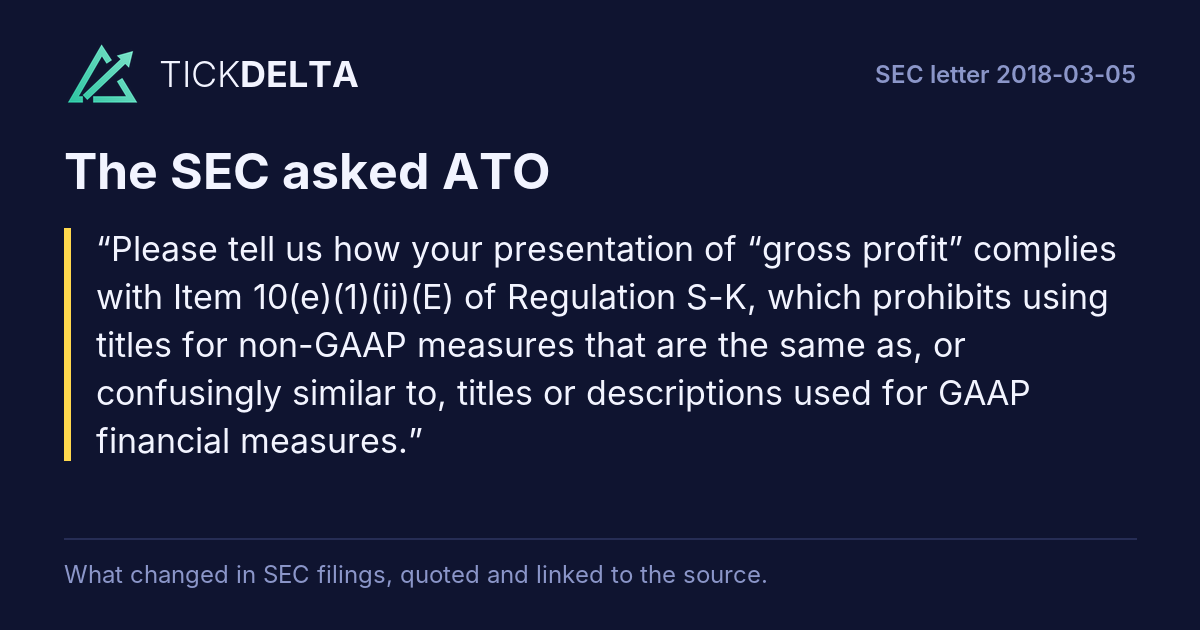
Please tell us how your presentation of “gross profit” complies with Item 10(e)(1)(ii)(E) of Regulation S-K, which prohibits using titles for non-GAAP measures that are the same as, or confusingly similar to, titles or descriptions used for GAAP financial measures.
ATO answered
We referenced the non-GAAP measure “gross profit” and included its computation in our filing to better discuss and analyze our financial performance. To better distinguish this non-GAAP measure from similar terms, we will revise the term “gross profit” to “net revenues” in future filings and earnings releases. The following statement is indicative of the disclosure that we may include regarding net revenues, a non-GAAP measure:

Our operations are affected by the cost of natural gas.
Rest of the answer

The cost of gas is passed through to our customers without markup and includes commodity price, transportation, storage, injection and withdrawal fees and settlements of financial instruments used to mitigate commodity price risk. These costs are reflected in the income statement as purchased gas cost. Therefore, increases in the cost of gas are offset by a corresponding increase in revenues. Accordingly, we believe net revenues, a non-GAAP financial measure defined as operating revenues less purchased gas cost, is a better indicator of our financial performance than operating income as it provides a useful and more relevant measure to analyze our financial performance. Further, the term net revenues is not intended to represent operating income, the most comparable GAAP measure, as an indicator of operating performance and is not necessarily comparable to similarly titled measures reported by other companies.

Read in the reply ↗
In its next report

First report after the company's reply of 2018-03-13: 10-Q filed 2018-05-02 ↗, against the 10-Q filed 2018-02-06 ↗.

Tickdelta does not hold the text of both reports, so they are not compared here.

Form 8-K filed February 6, 2018
SEC asked (2)
To avoid placing undue prominence on gross profit, a non-GAAP measure, your discussion on page 2 should include a similar discussion and analysis of the comparable GAAP measure in a location with equal or greater prominence. Your tabular disclosure of the non-GAAP measure on page 5 should be preceded with an equally prominent tabular disclosure of the comparable GAAP measure.
Rest of the question

In this regard, please show operating revenues and purchased gas cost in deriving the non-GAAP measure. Please review the guidance in our Compliance and Disclosure Interpretations issued on May 17, 2016, specifically question 102.10, when preparing your next earnings release. Reference is made to Item 2.02, Instruction 2, of Form 8-K and the requirements of paragraph (e)(1)(i) of Item 10 of Regulation S-K.

ATO answered
To avoid placing undue prominence on net revenues, a non-GAAP financial measure, in future earnings releases furnished as exhibits to Form 8-K filings, we will begin our discussion of results with a discussion of operating income rather than net revenues. Further, we will provide the operating revenues and purchased gas costs used in deriving net revenues in our tabular disclosures in all future earnings releases furnished as exhibits to Form 8-K filings. Read in the reply ↗
In its next report

First report after the company's reply of 2018-03-13: 10-Q filed 2018-05-02 ↗, against the 10-Q filed 2018-02-06 ↗.

Tickdelta does not hold the text of both reports, so they are not compared here.

Management’s Discussion and Analysis of Financial Condition and Results of Operations · Non-GAAP Financial Measure, page 25
SEC asked
We note your response to comment 1. Please tell us how your proposed presentation of "net revenues" complies with Item 10(e)(1)(ii)(E) of Regulation S-K, which prohibits using titles for non-GAAP measures that are the same as, or confusingly similar to, titles or descriptions used for GAAP financial measures.
ATO answered
In our prior response, we proposed to replace the term "gross profit" with "net revenues" as the non-GAAP financial measure we use to help measure and analyze our financial performance because it is commonly used in the utility industry. To comply with Item 10(e)(1)(ii)(E) of Regulation S-K, we will replace the term “gross profit” with "contribution margin" in future filings and earnings releases. The following statement is indicative of the disclosure that we may include regarding contribution margin, a non-GAAP financial measure:

Our operations are affected by the cost of natural gas.
Rest of the answer

The cost of gas is passed through to our customers without markup and includes commodity price, transportation, storage, injection and withdrawal fees and settlements of financial instruments used to mitigate commodity price risk. These costs are reflected in the income statement as purchased gas cost. Therefore, increases in the cost of gas are offset by a corresponding increase in revenues. Accordingly, we believe contribution margin, a non-GAAP financial measure defined as operating revenues less purchased gas cost, is a better indicator of our financial performance than operating income as it provides a useful and more relevant measure to analyze our financial performance. Further, the term contribution margin is not intended to represent operating income, the most comparable GAAP financial measure, as an indicator of operating performance and is not necessarily comparable to similarly titled measures reported by other companies.

Read in the reply ↗
In its next report

First report after the company's reply of 2018-03-26: 10-Q filed 2018-05-02 ↗, against the 10-Q filed 2018-02-06 ↗.

Tickdelta does not hold the text of both reports, so they are not compared here.

Also in this review: closing letter, 2018-03-27

Form 10-Q

2017-05-17 to 2017-05-23 · 1 question · 1 letter from the SEC, 1 from the company
No closing letter
RevenueNon-GAAP measuresSegmentsResults discussion (MD&A)
Results of Operations · Distribution Segment, page 37
SEC asked
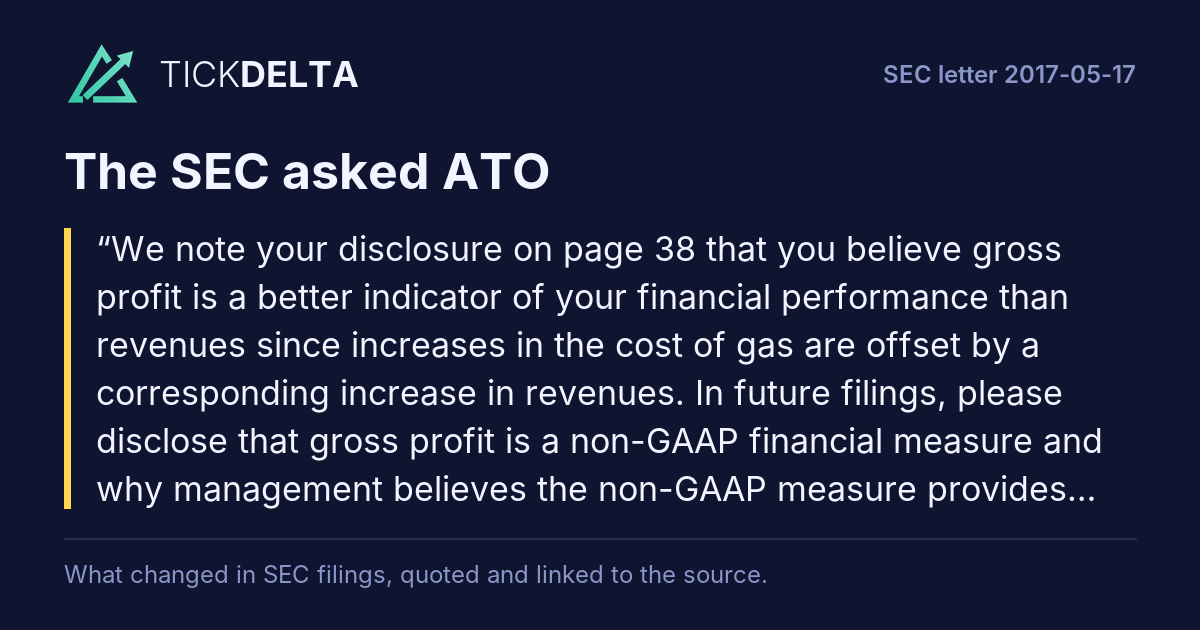
We note your disclosure on page 38 that you believe gross profit is a better indicator of your financial performance than revenues since increases in the cost of gas are offset by a corresponding increase in revenues. In future filings, please disclose that gross profit is a non-GAAP financial measure and why management believes the non-GAAP measure provides useful information to investors.
Rest of the question

Refer to Item 10(e) of Regulation S-K.

ATO answered
Beginning with our Form 10-Q for the three and nine months ended June 30, 2017, we will disclose that gross profit is a non-GAAP financial measure. We are also mindful of the additional disclosure requirements relating to the use of non-GAAP financial measures, as set forth in Item 10(e) of Regulation S-K.
Rest of the answer

The disclosures in our future filings that use any such financial measures will be prepared in accordance with such requirements, including the requirement in Item 10(e)(1)(i)(C) that a statement be included disclosing the reasons why management believes that presentation of the non-GAAP financial measure provides useful information to investors. The following statement is indicative of the disclosure that we may include regarding gross profit:

We calculate gross profit as operating revenues less purchased gas cost. This net amount is considered a non-GAAP financial measure. Management uses this financial measure because operating revenues include the cost of purchased gas, which is a tracked cost that is passed through to our customers without markup under purchased gas cost adjustment mechanisms. Accordingly, we believe that gross profit provides investors a useful and more relevant measure to analyze our financial performance than operating revenues because purchased gas cost does not impact our operating income.

To facilitate the reconciliation between gross profit and GAAP operating revenues, we will include operating revenues and purchased gas cost in the tables included in our financial highlights within Management's Discussion and Analysis in all our future Form 10-K and 10-Q filings.

Read in the reply ↗
In its next report

First report after the company's reply of 2017-05-23: 10-Q filed 2017-08-02 ↗, against the 10-Q filed 2017-05-04 ↗.

Tickdelta does not hold the text of both reports, so they are not compared here.

Form 10-K for the Fiscal Year Ended September 30, 2016

2017-05-02 to 2017-05-25 · 1 question · 1 letter from the SEC, 1 from the company
Review closed 2017-05-25
Liquidity and cash
Consolidated Statements of Income, page 47
SEC asked
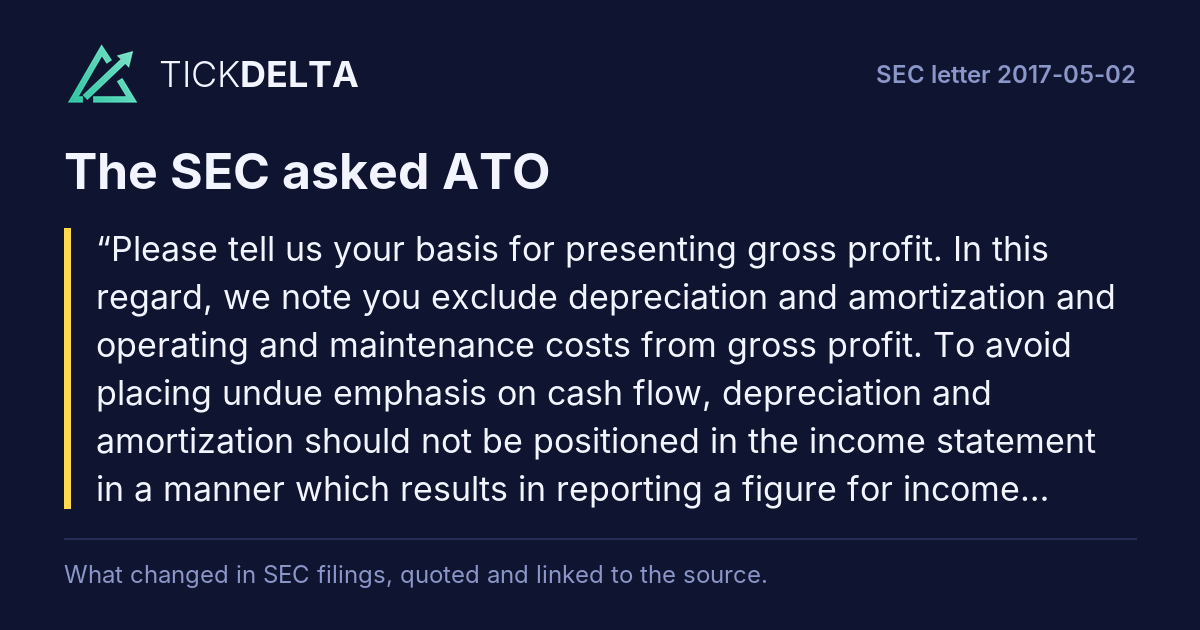
Please tell us your basis for presenting gross profit. In this regard, we note you exclude depreciation and amortization and operating and maintenance costs from gross profit. To avoid placing undue emphasis on cash flow, depreciation and amortization should not be positioned in the income statement in a manner which results in reporting a figure for income before depreciation. Refer to ASC 225-10-S99-8.
ATO answered
We reviewed the guidance in ASC 225-10-S99-8 and as a result, we will remove the subtotal “Gross profit” appearing in the income statements in our Financial Information and Supplementary Data in all our future Form 10-K and Form 10-Q filings, beginning with our Form 10-Q for the three and six months ended March 31, 2017. Read in the reply ↗
In its next report

First report after the company's reply of 2017-05-04: 10-Q filed 2017-08-02 ↗, against the 10-Q filed 2017-02-07 ↗.

Tickdelta does not hold the text of both reports, so they are not compared here.

Also in this review: closing letter, 2017-05-25

Form 10-K

2015-02-03 to 2015-02-12 · 1 question · 1 letter from the SEC, 1 from the company
Review closed 2015-02-12
RevenueResults discussion (MD&A)
Item 8. Financial Statements and Supplementary Data, page 46 · Consolidated Statements of Income, page 49
SEC asked
Please quantify, on an absolute dollar basis, the revenue generated from sales of products, sales of services and other sales within your non-regulated businesses. Additionally, please tell us what consideration you gave to separately disclosing revenues and cost of revenues for products, services and other pursuant to Rules 503(b)(1) and (2) of Regulation S-X for your non-regulated businesses.
ATO answered
The table below provides our nonregulated revenues, by class, in accordance with Rule 5-03(b)(1) of Regulation S-X.

2014

2013

2012

Nonregulated revenues

Percent of Consolidated Operating Revenues

(In thousands)

Product revenues

$

2,050,580

41.50%

1,568,462

40.47%

1,330,815

38.73%

Service revenues

Transportation

5,737

5,690

4,616

Other service revenues

1,427

3,956

3,253

Total service revenues

7,164

0.14%

9,646

0.25%

7,869

0.23%

Rental income

9,532

0.19%

9,786

10,260

0.30%

Other revenues

—%

Total

2,067,292

1,587,914

1,348,982

Consolidated operating
Rest of the answer

revenues

4,940,916

3,875,460

3,436,162

Product revenues represent the unregulated sale of natural gas to our Nonregulated segment's customers. Service revenues are earned through the transportation of gas and other services provided to the Nonregulated segment's customers. Rental income is derived from demand fees earned on proprietary storage and other facilities.

Rule 5-03(b) of Regulation S-X permits the aggregation of revenue classes if each class represents 10 percent or less of consolidated operating revenues. Revenues earned by our Nonregulated segment from sales of natural gas to customers represented approximately 40 percent of consolidated operating revenues for each of the last three fiscal years. However, other revenues earned by our Nonregulated segment, collectively, represented less than one percent of consolidated operating revenue. Therefore, as permitted by Rule 5-03(b) of Regulation S-X, we combined all nonregulated revenue classes into one line item in our Consolidated Statements of Income.

Applicable costs of revenues are reported as Purchased gas cost for the Nonregulated segment. The costs associated with sales of natural gas to customers exceeded 10 percent of consolidated purchase gas cost for each of the last three fiscal years. The costs associated with the remaining revenue classes, collectively, represented less than 10 percent of consolidated purchase gas cost. Therefore, as required by Rule 5-03(b), we combined all nonregulated purchase gas costs into one line item in our Consolidated Statements of Income.

We continue to monitor the components of our revenues and cost of sales and will include additional disclosure, as required by Rule 5-03(b)(1) of Regulation S-X, if the 10 percent threshold is met.

Atmos Energy Corporation acknowledges that (i) we are responsible for the adequacy and accuracy of the disclosure in the filing; (ii) staff comments or changes to disclosure in response to staff comments do not foreclose the Commission from taking any action with respect to the filing; and (iii) we may not assert staff comments as a defense in any proceeding initiated by the Commission or any person under the federal securities laws of the United States.

Read in the reply ↗
In its next report

First report after the company's reply of 2015-02-09: 10-Q filed 2015-05-06 ↗, against the 10-Q filed 2015-02-03 ↗.

Tickdelta does not hold the text of both reports, so they are not compared here.

Also in this review: closing letter, 2015-02-12

2 other letters: notices that a filing will not be reviewed, requests to declare a registration effective, and the like

From the SEC's correspondence on EDGAR: staff letters (form UPLOAD) and company letters (form CORRESP), 23 letters filed since 2015-02-03. Questions and answers are matched by their numbers; topics come from words in each question. The reports are compared word for word (same form, before the first SEC letter against the first report after the company's reply). No AI.

Work on ATO in a spreadsheet: Excel workbook (a sheet per section, ten years by column, charts, links to the filings) · CSV. For a Google Sheet that stays up to date, paste =IMPORTDATA("https://tickdelta.com/company/ATO/export.csv") into a cell.