tickdelta
Sign in

Tickdelta is free for now. Sign up and get Pro free

← Screener

ATOAtmos Energy

Utilities · Gas Utilities · NYSE
Compare with peers → Embed
SEC comment letters, last 20 years

3 reviews of ATO's filings by SEC staff

UPLOAD and CORRESP
ReviewsRead ↓
3
latest letter 2020-01-21
Questions asked
6
each answered in the company's own letter
No closing letter
1
reviews without a letter saying the staff completed it

When the SEC's staff reviews a filing, it writes to the company with numbered questions, and the company answers each one in a letter. SEC publishes the exchange once the review is over, at least 20 business days later. A question is not an accusation; most reviews end with the company adding detail to its next filing.

Form 10-K for the Fiscal Year Ended September 30, 2019

2020-01-21 to 2020-01-28 · 2 questions · 1 letter from the SEC, 1 from the company
Review closed 2020-01-28
Non-GAAP measuresResults discussion (MD&A)
Selected Financial Data, page 21
SEC asked (1)
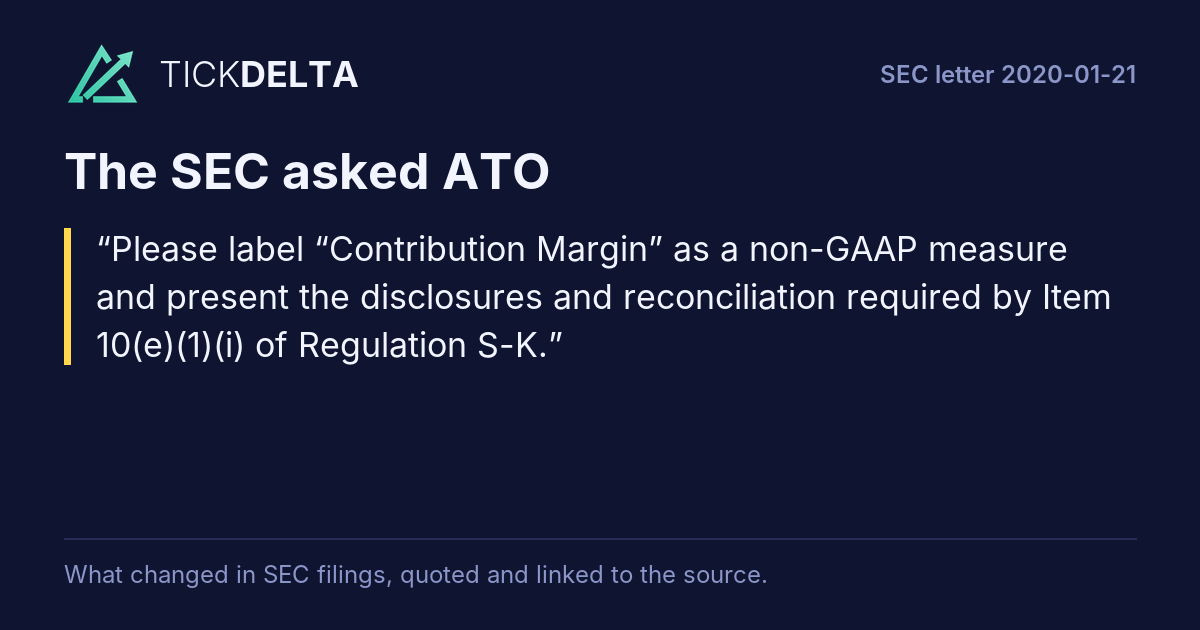
Please label “Contribution Margin” as a non-GAAP measure and present the disclosures and reconciliation required by Item 10(e)(1)(i) of Regulation S-K.
ATO answered
The Company respectfully acknowledges the Staff’s comment. The Company has decided to transition away from using contribution margin when discussing our financial results in future filings. As such, the Company will remove references to contribution margin when discussing our financial results in all future Form 10-K and 10-Q filings and in all future earnings releases furnished as exhibits to Form 8-K filings, beginning with our earnings release and Form 10-Q for the three months ended December 31, 2019.

Management's Discussion and Analysis of Financial Condition and Results of
Rest of the answer

Operations

Non-GAAP Financial Measures, page 25.

Read in the reply ↗
In its next report

First report after the company's reply of 2020-01-27: 10-Q filed 2020-02-04 ↗, against the 10-Q filed 2019-08-07 ↗.

Tickdelta does not hold the text of both reports, so they are not compared here.
Management's Discussion and Analysis of Financial Condition and Results of Operations · Non-GAAP Financial Measures, page 25
SEC asked (2)
Please present a reconciliation for your contribution margin non-GAAP measure. In doing so, reconcile this measure to the most directly comparable GAAP measure of gross margin. If you do not believe gross margin that includes depreciation and amortization is the most directly comparable GAAP measure, please tell us why in your response. Refer to Item 10(e)(1)(i)(B) of Regulation S-K.
ATO answered
The Company respectfully acknowledges the Staff’s comment. The Company has decided to transition away from using contribution margin when discussing our financial results in future filings. As such, the Company will remove references to contribution margin when discussing our financial results in all future Form 10-K and 10-Q filings and in all future earnings releases furnished as exhibits to Form 8-K filings, beginning with our earnings release and Form 10-Q for the three months ended December 31, 2019. Read in the reply ↗
In its next report

First report after the company's reply of 2020-01-27: 10-Q filed 2020-02-04 ↗, against the 10-Q filed 2019-08-07 ↗.

Tickdelta does not hold the text of both reports, so they are not compared here.

Also in this review: closing letter, 2020-01-28
Form 10-K for the Fiscal Year Ended September 30, 2017

2018-03-05 to 2018-03-27 · 3 questions · 2 letters from the SEC, 2 from the company
Review closed 2018-03-27
Non-GAAP measuresResults discussion (MD&A)Revenue
Management’s Discussion and Analysis of Financial Condition and Results of Operations · Non-GAAP Financial Measure, page 25
SEC asked (1)
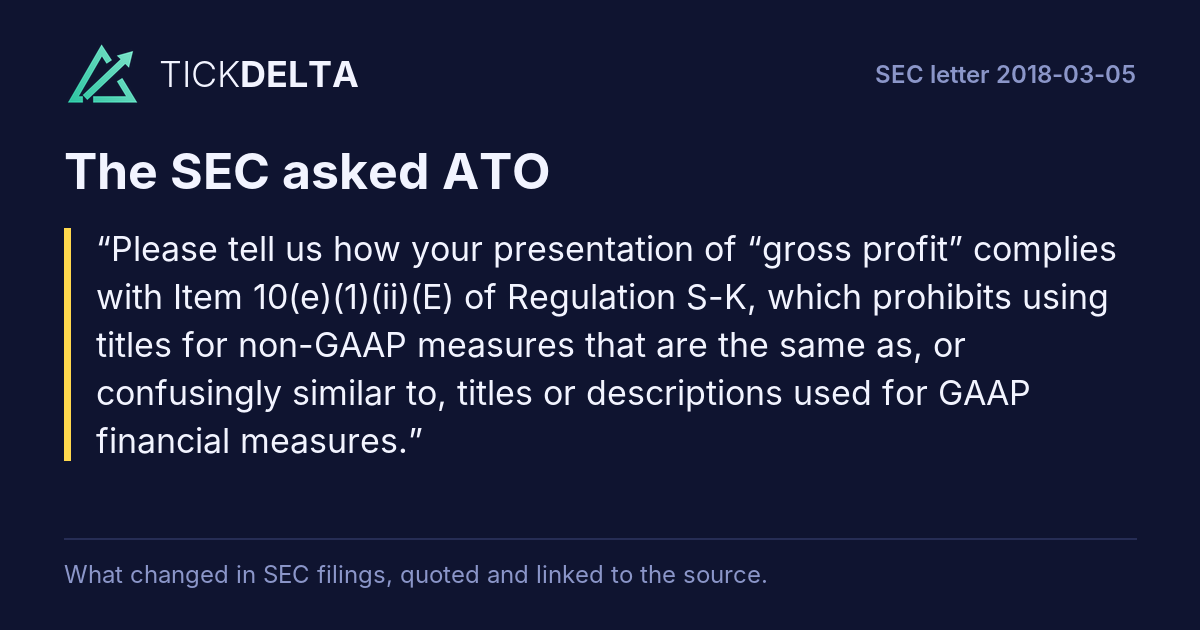
Please tell us how your presentation of “gross profit” complies with Item 10(e)(1)(ii)(E) of Regulation S-K, which prohibits using titles for non-GAAP measures that are the same as, or confusingly similar to, titles or descriptions used for GAAP financial measures.
ATO answered
We referenced the non-GAAP measure “gross profit” and included its computation in our filing to better discuss and analyze our financial performance. To better distinguish this non-GAAP measure from similar terms, we will revise the term “gross profit” to “net revenues” in future filings and earnings releases. The following statement is indicative of the disclosure that we may include regarding net revenues, a non-GAAP measure:

Our operations are affected by the cost of natural gas.
Rest of the answer

The cost of gas is passed through to our customers without markup and includes commodity price, transportation, storage, injection and withdrawal fees and settlements of financial instruments used to mitigate commodity price risk. These costs are reflected in the income statement as purchased gas cost. Therefore, increases in the cost of gas are offset by a corresponding increase in revenues. Accordingly, we believe net revenues, a non-GAAP financial measure defined as operating revenues less purchased gas cost, is a better indicator of our financial performance than operating income as it provides a useful and more relevant measure to analyze our financial performance. Further, the term net revenues is not intended to represent operating income, the most comparable GAAP measure, as an indicator of operating performance and is not necessarily comparable to similarly titled measures reported by other companies.

Read in the reply ↗
In its next report

First report after the company's reply of 2018-03-13: 10-Q filed 2018-05-02 ↗, against the 10-Q filed 2018-02-06 ↗.

Tickdelta does not hold the text of both reports, so they are not compared here.

Form 8-K filed February 6, 2018
SEC asked (2)
To avoid placing undue prominence on gross profit, a non-GAAP measure, your discussion on page 2 should include a similar discussion and analysis of the comparable GAAP measure in a location with equal or greater prominence. Your tabular disclosure of the non-GAAP measure on page 5 should be preceded with an equally prominent tabular disclosure of the comparable GAAP measure.
Rest of the question

In this regard, please show operating revenues and purchased gas cost in deriving the non-GAAP measure. Please review the guidance in our Compliance and Disclosure Interpretations issued on May 17, 2016, specifically question 102.10, when preparing your next earnings release. Reference is made to Item 2.02, Instruction 2, of Form 8-K and the requirements of paragraph (e)(1)(i) of Item 10 of Regulation S-K.

ATO answered
To avoid placing undue prominence on net revenues, a non-GAAP financial measure, in future earnings releases furnished as exhibits to Form 8-K filings, we will begin our discussion of results with a discussion of operating income rather than net revenues. Further, we will provide the operating revenues and purchased gas costs used in deriving net revenues in our tabular disclosures in all future earnings releases furnished as exhibits to Form 8-K filings. Read in the reply ↗
In its next report

First report after the company's reply of 2018-03-13: 10-Q filed 2018-05-02 ↗, against the 10-Q filed 2018-02-06 ↗.

Tickdelta does not hold the text of both reports, so they are not compared here.

Management’s Discussion and Analysis of Financial Condition and Results of Operations · Non-GAAP Financial Measure, page 25
SEC asked
We note your response to comment 1. Please tell us how your proposed presentation of "net revenues" complies with Item 10(e)(1)(ii)(E) of Regulation S-K, which prohibits using titles for non-GAAP measures that are the same as, or confusingly similar to, titles or descriptions used for GAAP financial measures.
ATO answered
In our prior response, we proposed to replace the term "gross profit" with "net revenues" as the non-GAAP financial measure we use to help measure and analyze our financial performance because it is commonly used in the utility industry. To comply with Item 10(e)(1)(ii)(E) of Regulation S-K, we will replace the term “gross profit” with "contribution margin" in future filings and earnings releases. The following statement is indicative of the disclosure that we may include regarding contribution margin, a non-GAAP financial measure:

Our operations are affected by the cost of natural gas.
Rest of the answer

The cost of gas is passed through to our customers without markup and includes commodity price, transportation, storage, injection and withdrawal fees and settlements of financial instruments used to mitigate commodity price risk. These costs are reflected in the income statement as purchased gas cost. Therefore, increases in the cost of gas are offset by a corresponding increase in revenues. Accordingly, we believe contribution margin, a non-GAAP financial measure defined as operating revenues less purchased gas cost, is a better indicator of our financial performance than operating income as it provides a useful and more relevant measure to analyze our financial performance. Further, the term contribution margin is not intended to represent operating income, the most comparable GAAP financial measure, as an indicator of operating performance and is not necessarily comparable to similarly titled measures reported by other companies.

Read in the reply ↗
In its next report

First report after the company's reply of 2018-03-26: 10-Q filed 2018-05-02 ↗, against the 10-Q filed 2018-02-06 ↗.

Tickdelta does not hold the text of both reports, so they are not compared here.

Also in this review: closing letter, 2018-03-27

Form 10-Q

2017-05-17 to 2017-05-23 · 1 question · 1 letter from the SEC, 1 from the company
No closing letter
RevenueNon-GAAP measuresSegmentsResults discussion (MD&A)
Results of Operations · Distribution Segment, page 37
SEC asked
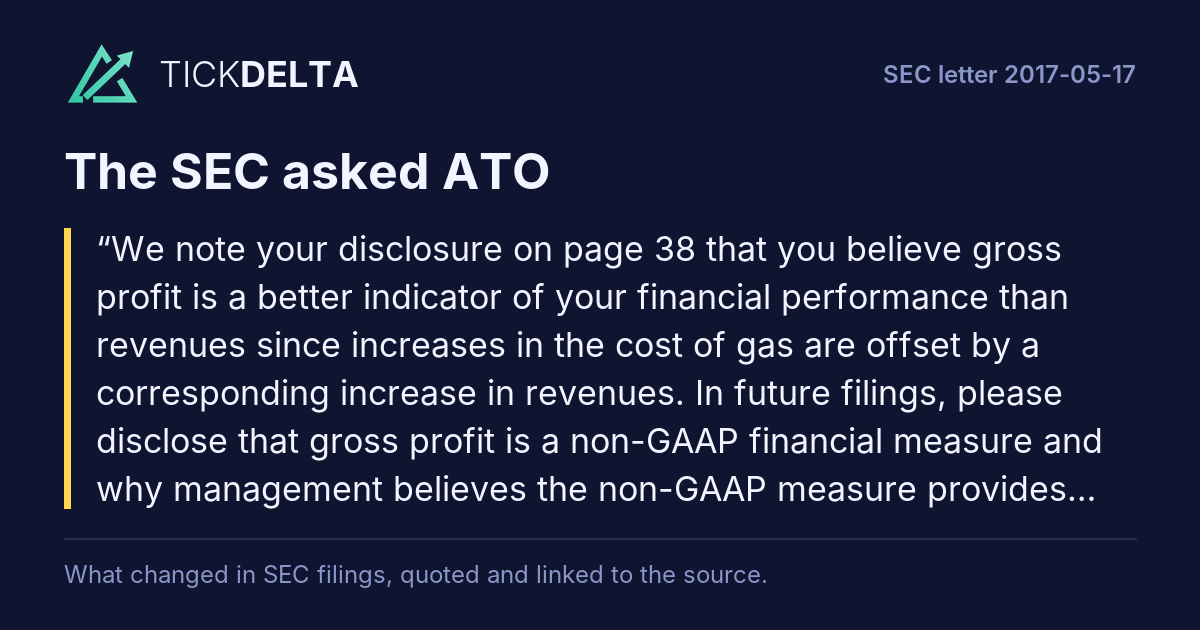
We note your disclosure on page 38 that you believe gross profit is a better indicator of your financial performance than revenues since increases in the cost of gas are offset by a corresponding increase in revenues. In future filings, please disclose that gross profit is a non-GAAP financial measure and why management believes the non-GAAP measure provides useful information to investors.
Rest of the question

Refer to Item 10(e) of Regulation S-K.

ATO answered
Beginning with our Form 10-Q for the three and nine months ended June 30, 2017, we will disclose that gross profit is a non-GAAP financial measure. We are also mindful of the additional disclosure requirements relating to the use of non-GAAP financial measures, as set forth in Item 10(e) of Regulation S-K.
Rest of the answer

The disclosures in our future filings that use any such financial measures will be prepared in accordance with such requirements, including the requirement in Item 10(e)(1)(i)(C) that a statement be included disclosing the reasons why management believes that presentation of the non-GAAP financial measure provides useful information to investors. The following statement is indicative of the disclosure that we may include regarding gross profit:

We calculate gross profit as operating revenues less purchased gas cost. This net amount is considered a non-GAAP financial measure. Management uses this financial measure because operating revenues include the cost of purchased gas, which is a tracked cost that is passed through to our customers without markup under purchased gas cost adjustment mechanisms. Accordingly, we believe that gross profit provides investors a useful and more relevant measure to analyze our financial performance than operating revenues because purchased gas cost does not impact our operating income.

To facilitate the reconciliation between gross profit and GAAP operating revenues, we will include operating revenues and purchased gas cost in the tables included in our financial highlights within Management's Discussion and Analysis in all our future Form 10-K and 10-Q filings.

Read in the reply ↗
In its next report

First report after the company's reply of 2017-05-23: 10-Q filed 2017-08-02 ↗, against the 10-Q filed 2017-05-04 ↗.

Tickdelta does not hold the text of both reports, so they are not compared here.

Other letters

Letters without questions

UPLOAD and CORRESP
2 other letters: notices that a filing will not be reviewed, requests to declare a registration effective, and the like

From the SEC's correspondence on EDGAR: staff letters (form UPLOAD) and company letters (form CORRESP), 23 letters filed since 2015-02-03. Questions and answers are matched by their numbers; topics come from words in each question. The reports are compared word for word (same form, before the first SEC letter against the first report after the company's reply). No AI.

Next in Owners and insiders Insider trades →