Aurora Innovation, Inc. AUR
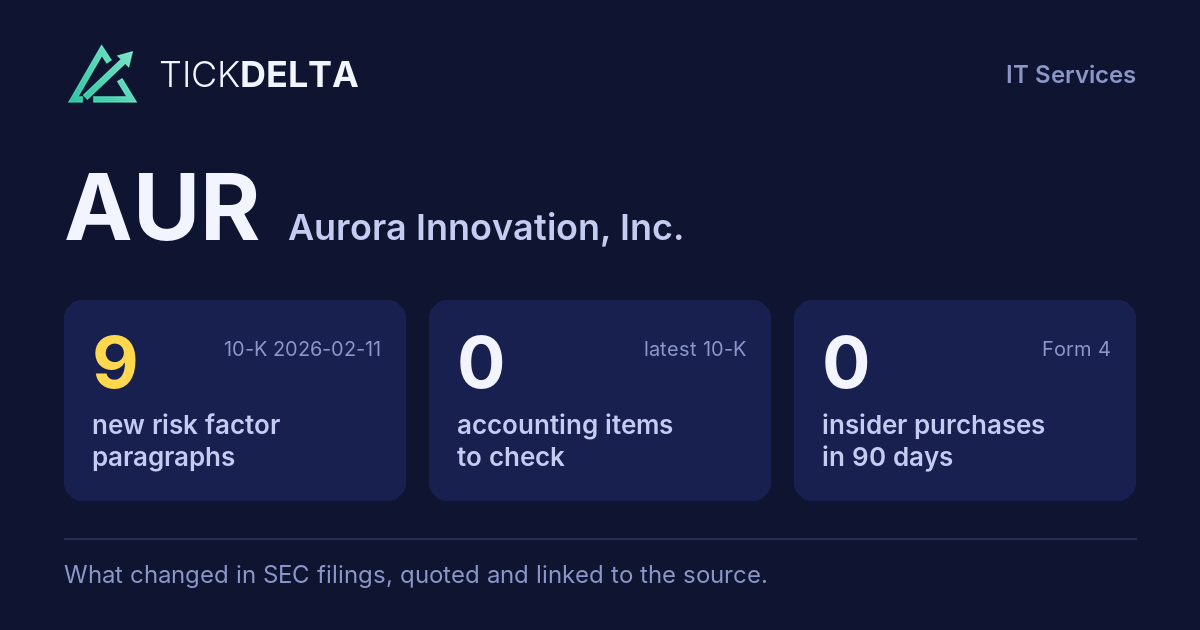
New risk paragraphs, branching off last year
Each branch is a paragraph in Risk Factors with nothing like it in the 10-K filed Feb 14, 2025. A box jumps to the paragraph as filed, below.
Paragraphs with nothing like them in last year's 10-K
9 paragraphs in Risk Factors of the 10-K filed Feb 11, 2026 with nothing like them in the 10-K filed Feb 14, 2025. Quoted exactly. Paragraphs that were only edited are under 10-K change.
•In certain cases, we plan to upfit, including by retaining third parties on our behalf, vehicles with the Aurora Driver and the necessary redundancies for driverless operations, and failures or delays in these activities could materially and adversely affect our business, financial condition, and results of operations.
Furthermore, our operations have focused exclusively on research and development of our products and self-driving system through the fiscal quarter ended March 31, 2025. Although we first recognized revenue in the fiscal quarter ended June 30, 2025, we do not expect to generate significant revenue until after we achieve commercial scale. As such, our relatively limited operating history, combined with the need to transition from a company with a research and development focus to a company capable of supporting commercial activities, has the potential to intensify the risks and difficulties that we face.
Our business plans require a significant amount of capital, and if we cannot obtain additional financing when needed on acceptable terms, or at all, our business, financial condition and results of operations could be adversely affected.
We are reliant on others for the supply of vehicles, and are also reliant on suppliers and service providers to design, develop, industrialize, manufacture, install and customize components for us, including components associated with our future generations of our Aurora Driver system. Such supply and services are subject to multiple risks, including delays in development, manufacturing, implementation and certification of components, vehicles and systems; difficulties integrating components and systems from multiple suppliers; issues meeting required quality, safety, or performance standards; supply chain disruptions; labor availability constraints; and increased costs. Our ability to maintain, expand or replace these supply, service and manufacturing arrangements is important to our business. In order for these suppliers to undertake the investment needed to produce these components, they may require us to commit to terms, pricing or purchase volumes that are not favorable to us.
In certain cases, we plan to upfit, including by retaining third parties on our behalf, vehicles with the Aurora Driver and the necessary redundancies for driverless operations, and failures or delays in these activities could materially and adversely affect our business, financial condition, and results of operations.
We rely on third-party suppliers, contractors, and service providers (some of which are single or limited sourced), in addition to our own operations, to perform the upfitting, integration, and related services to upfit vehicles with the Aurora Driver and the necessary redundancies for driverless operations. These services are subject to risks similar to those applicable to our manufacturing, OEM partner and supplier relationships described above. If we, or our third party integration service partners, fail to perform these activities at prices and volumes and on terms that we expect, or within expected timelines, our ability to scale driverless operations could be impaired, and our operational and financial condition could be materially adversely affected. In addition, any actual or perceived failures resulting from such services could expose us to increased operational, safety, product liability, warranty, recall, or regulatory risks and could harm our reputation or relationships with partners, customers, or regulators. Other potential service providers may not be available when required, in sufficient capacity, or at all. Any of these risks could materially and adversely affect our business, prospects, financial condition, and results of operations.
Show the other 3
On November 3, 2025, all lock-up restrictions on such shares have expired, and such shares are no longer subject to the contractual transfer restrictions described above, except that the shares held by the Sponsor remain subject to price-based vesting conditions. As a result, a substantial number of shares of our Class A common stock became eligible for sale in the public market. Sales of a substantial number of shares of our Class A common stock, or the perception that holders of a large number of shares intend to sell, could increase the volatility in the trading price of our Class A common stock or cause the market price of our Class A common stock to decline.
Our dual-class structure may result in volatility of our market price of our Class A common stock due to, among other things, adverse publicity or the reaction of institutional investors, governance-focused investors, or proxy advisory firms.
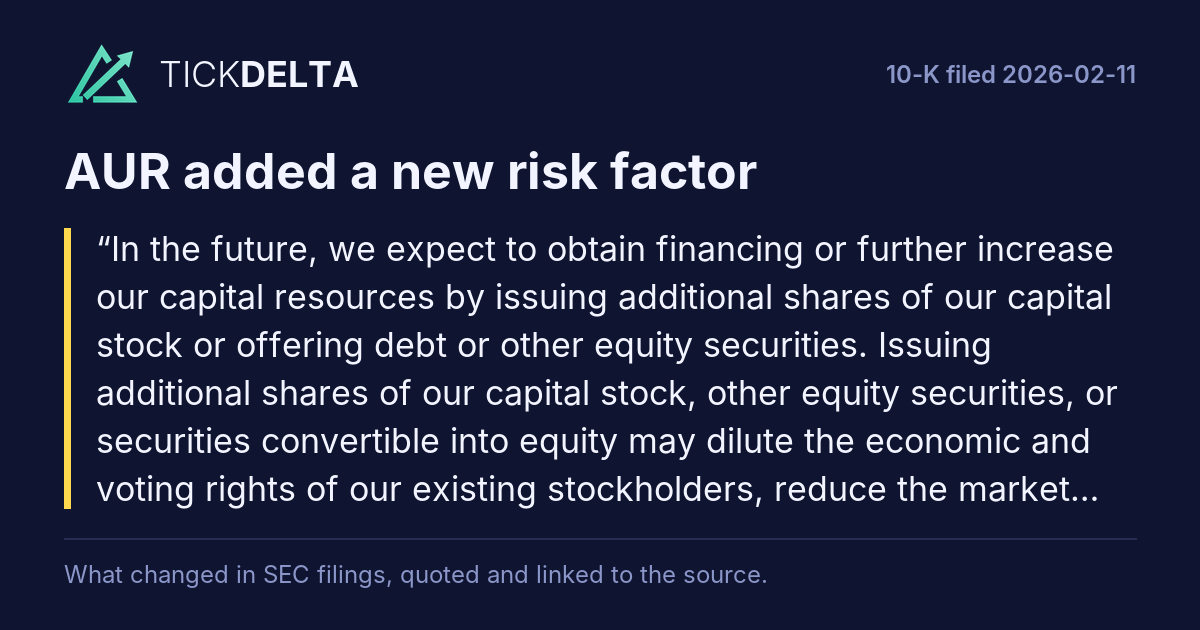
In the future, we expect to obtain financing or further increase our capital resources by issuing additional shares of our capital stock or offering debt or other equity securities. Issuing additional shares of our capital stock, other equity securities, or securities convertible into equity may dilute the economic and voting rights of our existing stockholders, reduce the market price of our Class A common stock, or both.
Paragraphs in the 10-Q filed Oct 28, 2026 that were not in the one before
New in the latest 10-Q
6 paragraphs in the 10-Q filed Oct 28, 2026 with nothing like them in the 10-Q filed Jul 29, 2026 (at least half the words must differ; new numbers alone do not count). Quoted exactly, grouped by the item heading above them. This is text that changed, not a judgement of how serious it is.
Other information
On September 30, 2026, Brittany Bagley, a member of the Company’s Board of Directors, adopted a “Rule 10b5-1 trading arrangement” providing for the sale, pursuant to the terms of the arrangement, of an aggregate of up to 50,000 shares of the Company’s Class A common stock. The plan will terminate on October 1, 2027, subject to early termination for certain specified events set forth in the plan.
Read in the 10-Q
Our outstanding public and private placement warrants will expire at 5:00 p.m., New York City time, on November 3, 2026, and any unexercised warrants will become void and be cancelled for no consideration. Trading in our public warrants (“AUROW”) on Nasdaq is expected to cease following the close of trading on November 2, 2026, and the public warrants will subsequently be delisted.
Read in the 10-Q
In connection with the ATM Offering, we filed a prospectus supplement dated February 14, 2025 (the “Original Prospectus Supplement”) to the prospectus contained in our automatically effective shelf registration statement on Form S-3ASR (Registration No. 333-284133) filed on January 3, 2025, registering the sale of up to an aggregate of $500,000,000 of our Class A common stock. The Original Prospectus Supplement was subsequently amended by amendment no. 1 dated July 30, 2025 (the “First Amendment”). As of September 30, 2026, we had offered and sold 189,522,984 shares of our Class A common stock in the ATM Offering for gross proceeds of $1,174,785,034.
Read in the 10-Q
We are filing amendment no. 2 to the Original Prospectus Supplement, as amended by the First Amendment, with the Securities and Exchange Commission, to be dated October 28, 2026 (the “Second Amendment”), to increase the aggregate dollar amount of shares of Class A common stock available for sale in the ATM Offering to $1,000,000,000, which includes $245,835,654 remaining under the Original Prospectus Supplement, as amended by the First Amendment.
Read in the 10-Q
A copy of the Amended and Restated Sales Agreement is filed as Exhibit 10.1 to this Quarterly Report. The foregoing description of the Amended and Restated Sales Agreement does not purport to be complete and is qualified in its entirety by reference to Exhibit 10.1. A copy of the opinion of Sullivan & Cromwell LLP relating to the validity of the securities issued in the ATM Offering is filed as Exhibit 5.1 to this Quarterly Report.
Read in the 10-Q
Show the other 1
Item 6
† Certain identified information has been omitted from this exhibit because it is both not material and is the type that the registrant treats as private or confidential. Information that was omitted or replaced has been identified by brackets.
Read in the 10-Q
The 10-Q's risk factors against the 10-K
Item 1A of the 10-Q filed Oct 28, 2026 against Item 1A of the 10-K filed Feb 11, 2026.
A 10-Q repeats only the risks that changed, so a 10-K paragraph that is missing from it is not counted as removed.
Added is a paragraph with nothing like it in the 10-K, Reworded a sentence that is in both with several words changed,
Quiet changes a sentence in both where one to four words changed and one is a hedge or a modal
(cut words struck through, new words highlighted).
Text on the page, not a score; each links to the filing at sec.gov.
What the 10-Q itself says about its risk factors:Our operations and financial results are subject to various risks and uncertainties, including those described in Part I, Item 1A, "Risk Factors" in our Annual Report on Form 10-K for the year ended December 31, 2025, which could adversely affect our business, financial condition, results of operations, cash flows, and the trading price of our stock. There have been no material changes from the risk factors previously disclosed in our Annual Report.
Read in the 10-Q
1 paragraph in the 10-Q's Item 1A, and none of them adds, rewords or quietly edits a paragraph of the 10-K's.
Phrases used for the first time
Two-word phrases in Risk Factors of the 10-K filed Feb 11, 2026 that are in none of the 1 earlier 10-Ks stored, back to Feb 14, 2025
Where each one is used
- necessary redundancies: •In certain cases, we plan to upfit, including by retaining third parties on our behalf, vehicles with the Aurora Driver and the necessary redundancies for driverless operations, and failures or delays in these activities could materially and adversely affect our business, financial condition, and results of operations.
- maintain profitability: •We have incurred net losses since our inception, and we expect to incur significant expenses and may not be able to achieve, or maintain profitability.
- retaining third: •In certain cases, we plan to upfit, including by retaining third parties on our behalf, vehicles with the Aurora Driver and the necessary redundancies for driverless operations, and failures or delays in these activities could materially and adversely affect our business, financial condition, and results of operations.
- behalf vehicles: •In certain cases, we plan to upfit, including by retaining third parties on our behalf, vehicles with the Aurora Driver and the necessary redundancies for driverless operations, and failures or delays in these activities could materially and adversely affect our business, financial condition, and results of operations.
- fiscal quarter: Furthermore, our operations have focused exclusively on research and development of our products and self-driving system through the fiscal quarter ended March 31, 2025. Although we first recognized revenue in the fiscal quarter ended June 30, 2025, we do not expect to generate significant revenue until after we...
- quarter ended: Furthermore, our operations have focused exclusively on research and development of our products and self-driving system through the fiscal quarter ended March 31, 2025. Although we first recognized revenue in the fiscal quarter ended June 30, 2025, we do not expect to generate significant revenue until after we...
- driver system: •We are dependent on others for the supply of vehicles, and are also dependent on our suppliers, some of which are single or limited source suppliers, for the production, provision, and/or full lifecycle support of our current and future generations of the Aurora Driver systems.
- issuing additional: In the future, we expect to obtain financing or further increase our capital resources by issuing additional shares of our capital stock or offering debt or other equity securities. Issuing additional shares of our capital stock, other equity securities, or securities convertible into equity may dilute the economic...
Used at least twice, small words left out. Counted, not picked: a phrase can be new because the company renamed something.
What was taken out
6 paragraphs of last year's Risk Factors with nothing like them now. The longest are quoted.
Sources
Item 1A of each 10-K and 10-Q on EDGAR, quoted exactly. Each paragraph links to the filing at sec.gov.
Also
10-K change: what was reworded or cut, section by section.
Work with it
Excel workbook · CSV. Google Sheet that stays up to date: paste =IMPORTDATA("https://tickdelta.com/company/AUR/export.csv") into a cell.