Added10-Q Nov 5, 2026 vs 10-K Feb 26, 2026
ITEM 2. UNREGISTERED SALES OF EQUITY SECURITIES, USE OF PROCEEDS, AND ISSUER PURCHASES OF EQUITY SECURITIES
Each branch is a paragraph in Risk Factors with nothing like it in the 10-K filed Feb 28, 2025. A box jumps to the paragraph as filed, below.
9 paragraphs in Risk Factors of the 10-K filed Feb 26, 2026 with nothing like them in the 10-K filed Feb 28, 2025. Quoted exactly. Paragraphs that were only edited are under 10-K change.
Our success depends, in part, on our technology partners. In particular, a portion of our technology works interactively with major software providers. Should any of these providers change the features of their solutions, suffer disruptions, performance issues, or cybersecurity incidents, or should we fail to retain these relationships, our customer relationships, reputation, business and results of operations could be negatively affected.
We deliver the AvePoint Confidence Platform and our related cloud services through cloud-hosted infrastructure operated by third-party hyperscaler cloud providers. Our platform services are deployed across multiple geographically distributed data centers and regions, and may be hosted in environments operated by GCP, Azure, and AWS to support customer requirements for performance, resilience, and data residency. We deploy our services across multiple data centers within key geographies and maintain additional regional capacity to support disaster recovery and business continuity.
International trade policies, including tariffs, sanctions, and trade barriers, may adversely affect our business, financial condition, results of operations, and prospects.
In recent months, markets, businesses, and consumers have reacted adversely to volatility and uncertainty in international trade policies. Among other things, significant and new tariffs, sanctions, and trade barriers have been imposed and modified, impacting a broad range of raw materials, goods and international trade. Although our current business model is not directly reliant on the import or export of physical goods, tariffs or other trade policies may indirectly adversely impact our business. For example, any future tariffs on software as a service could make our products more expensive, decrease our profitability or lessen demand for our products. Additionally, any of our customers affected by current or future tariffs may find themselves in an expense-reducing environment and not renew or reduce a contract with us upon renewal.
While we continue to monitor trade developments, the ultimate impact of these risks remains uncertain and any prolonged economic downturn, escalation in trade tensions, or deterioration in international perception of U.S.-based companies could materially and adversely affect our business, financial condition, results of operations, and prospects.
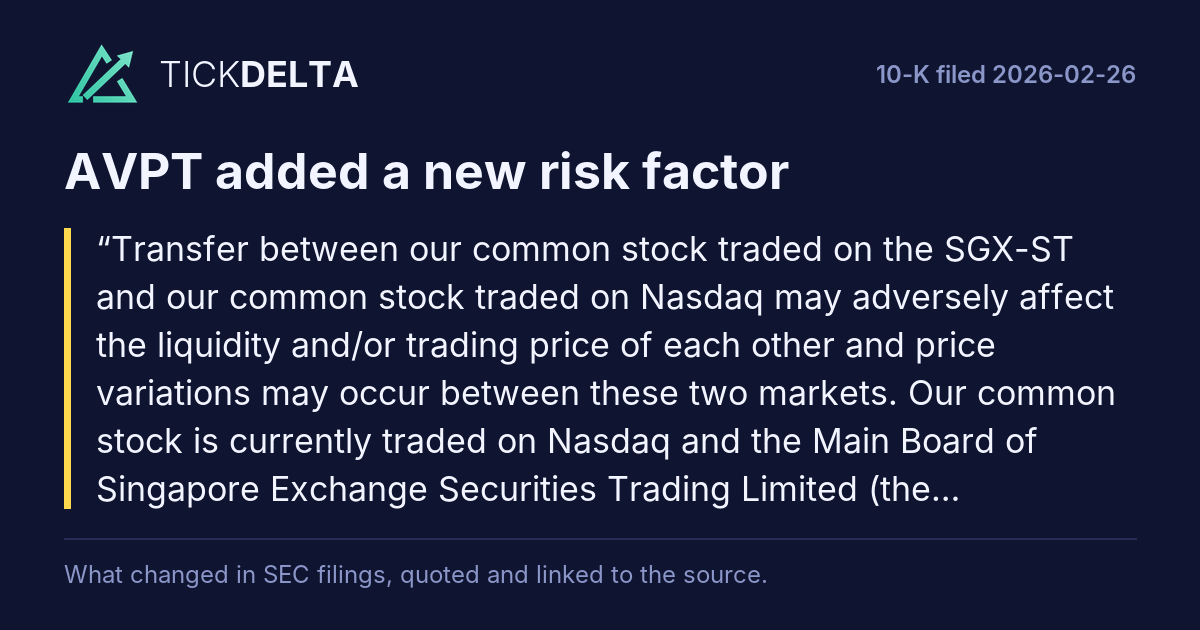
Transfer between our common stock traded on the SGX-ST and our common stock traded on Nasdaq may adversely affect the liquidity and/or trading price of each other and price variations may occur between these two markets.
Our common stock is currently traded on Nasdaq and the Main Board of Singapore Exchange Securities Trading Limited (the “SGX-ST”). Subject to compliance with U.S. securities laws and procedures of The Central Depository (Pte) Limited (“CDP”) holders of our common stock may use CDP’s procedures for cross border securities transfers via The Depository Trust Company to transfer common stock traded on the SGX-ST to Nasdaq. Any holder of common stock traded on Nasdaq may also transfer such interests for trading on the SGX-ST. In the event that a substantial number of shares of common stock are exchanged between these markets, the liquidity and trading price of our common stock on the SGX-ST and common stock on Nasdaq may be adversely affected. Additionally, trading in our common stock on these markets will be made in different currencies and take place at different times (resulting from different time zones, different trading days and different public holidays in the United States and Singapore). The trading prices of our common stock on these two markets may differ due to these and other factors. Any decrease in the price of our common stock on one of these markets could cause a decrease in the trading price of our common stock on the other market. On the other hand, investors could also seek to sell or buy our common stock to take advantage of any price differences between the markets through a practice referred to as arbitrage. Any arbitrage activity could create unexpected volatility in the trading price of our common stock.
The time required for the transfer between our common stock traded on the SGX-ST and our common stock traded on Nasdaq might be longer than expected and investors might not be able to settle or effect any sale of their securities during this period, and the transfer involves costs.
There is no direct trading or settlement between Nasdaq and the SGX-ST. CDP both acts as central depositary for the SGX-ST and is a DTC participant and facilitates settlement between the two markets via its procedures for cross border securities transfers via DTC. In addition, the time differences between Singapore and New York, unforeseen market circumstances, temporary closure of the facilities offered by CDP for cross border securities transfers via DTC, the procedures of a stockholder’s brokers in Singapore and/or the United States, or other factors may delay the transfer of common stock from trading on the SGX-ST to Nasdaq (and vice versa). Investors will be prevented from settling or effecting the sale of their securities during such periods of delay. In addition, there is no assurance that any transfer of common stock from trading on the SGX-ST to Nasdaq (and vice versa) will be completed in accordance with the timelines that stockholders may anticipate. Furthermore, CDP and other DTC participants are entitled to charge holders fees for cross border securities transfers via DTC. Brokers in Singapore and/or the United States may charge additional fees. As a result, stockholders who transfer common stock from the SGX-ST to Nasdaq (and vice versa) may not achieve the anticipated level of economic return.
New in the latest 10-Q
10 paragraphs in the 10-Q filed Nov 5, 2026 with nothing like them in the 10-Q filed Aug 6, 2026 (at least half the words must differ; new numbers alone do not count). Quoted exactly, grouped by the item heading above them. This is text that changed, not a judgement of how serious it is.
Announced Kinetic Classification and Rapid Recovery, new capabilities to the AvePoint Confidence Platform that bring continuous visibility and priority-based data restoration to AvePoint’s Trust Layer for AI;
Read in the 10-Q
Included in the 2026 Gartner® Magic Quadrant™ for AI Agent Management Platforms; and
Read in the 10-Q
Announced the AvePoint Trust Platform, which makes data AI-ready, governs every agent across its lifecycle, and keeps the business resilient when AI gets it wrong - independent of any single cloud, model, or AI provider.
Read in the 10-Q
On November 2, 2026, the Company entered into (i) that certain Credit Agreement (the “Credit Agreement”), dated as of November 2, 2026, by and among the Company, the other loan parties thereto, the lenders party thereto, and JPMorgan Chase Bank, N.A., as administrative agent (“JPM”), and (ii) that certain Pledge and Security Agreement (the “Pledge and Security Agreement”), dated as of November 2, 2026, by and between the Company and JPM.
Read in the 10-Q
Pursuant to the Pledge and Security Agreement, the Company pledged, assigned, and granted JPM a security interest in substantially all of its assets, including the equity of certain of its subsidiaries, as security for its obligations under the Credit Agreement. Further, the Credit Agreement requires that all domestic subsidiaries of the Company (other than immaterial subsidiaries and other excluded subsidiaries) guarantee the obligations under the Credit Agreement. As of the closing date, there are no subsidiary guarantors.
Read in the 10-Q
The Credit Agreement and the Pledge and Security Agreement replace (i) the Loan and Security Agreement (the “Prior Loan Agreement”), dated as of November 3, 2023, by and between the Company and HSBC Bank USA, National Association (“HBSC”), which provided a revolving line of credit of up to $30.0 million, with an additional $20.0 million accordion feature for additional capital, (ii) the related Pledge Agreement, dated as of November 3, 2023, by and between the Company and HSBC, and (iii) the related Revolving Note, dated as of November 3, 2023, by and between the Company and HSBC, which were terminated on November 2, 2026. The Company did not have any borrowings outstanding under the Prior Loan Agreement at the time of the termination.
Read in the 10-Q
JPM and the other lenders party to the Credit Agreement and their respective affiliates have various relationships with the Company and its subsidiaries involving the provision of financial services, including cash management, investment banking and trust services. Likewise, HSBC and its affiliates have various similar relationships with the Company and its subsidiaries involving financial services.
Read in the 10-Q
The descriptions of the Credit Agreement and the Pledge and Security Agreement are qualified in their entirety by the full text of such agreements, copies of which are filed as Exhibit 10.1 and 10.2 hereto and are incorporated herein by reference.
Read in the 10-Q
In Part II, Item 9B of our Annual Report on Form 10-K for the year ended December 31, 2025, we inadvertently omitted the disclosure of the following Rule 10b5-1 trading arrangement:
Read in the 10-Q
On December 16, 2025, Brian Michael Brown, our Chief Legal and Compliance Officer, and Secretary, adopted a Rule 10b5-1 trading arrangement, as defined in Item 408(a) of Regulation S-K, providing for the sale from time to time of an aggregate of up to 420,000 shares of the Company’s common stock. The trading arrangement is intended to satisfy the affirmative defense in Rule 10b5-1(c). The duration of the trading arrangement is until December 16, 2026, or earlier if all transactions under the trading arrangement are completed.
Read in the 10-Q
Item 1A of the 10-Q filed Nov 5, 2026 against Item 1A of the 10-K filed Feb 26, 2026.
A 10-Q repeats only the risks that changed, so a 10-K paragraph that is missing from it is not counted as removed.
Added is a paragraph with nothing like it in the 10-K, Reworded a sentence that is in both with several words changed,
Quiet changes a sentence in both where one to four words changed and one is a hedge or a modal
(cut words struck through, new words highlighted).
Text on the page, not a score; each links to the filing at sec.gov.
What the 10-Q itself says about its risk factors:Our operations and financial results are subject to various risks and uncertainties, including those described in Part I, Item 1A, “Risk Factors” in our Annual Report, which risks and uncertainties could affect our business, financial condition, results of operations, cash flows, and the trading price of our common stock. There have been no material changes to the risk factors previously disclosed in our Annual Report. We urge you to read the risk factors in our Annual Report.
Read in the 10-Q
Two-word phrases in Risk Factors of the 10-K filed Feb 26, 2026 that are in none of the 1 earlier 10-Ks stored, back to Feb 28, 2025
Used at least twice, small words left out. Counted, not picked: a phrase can be new because the company renamed something.
5 paragraphs of last year's Risk Factors with nothing like them now. The longest are quoted.
Item 1A of each 10-K and 10-Q on EDGAR, quoted exactly. Each paragraph links to the filing at sec.gov.
10-K change: what was reworded or cut, section by section.
Excel workbook · CSV. Google Sheet that stays up to date: paste =IMPORTDATA("https://tickdelta.com/company/AVPT/export.csv") into a cell.