Form 10-K
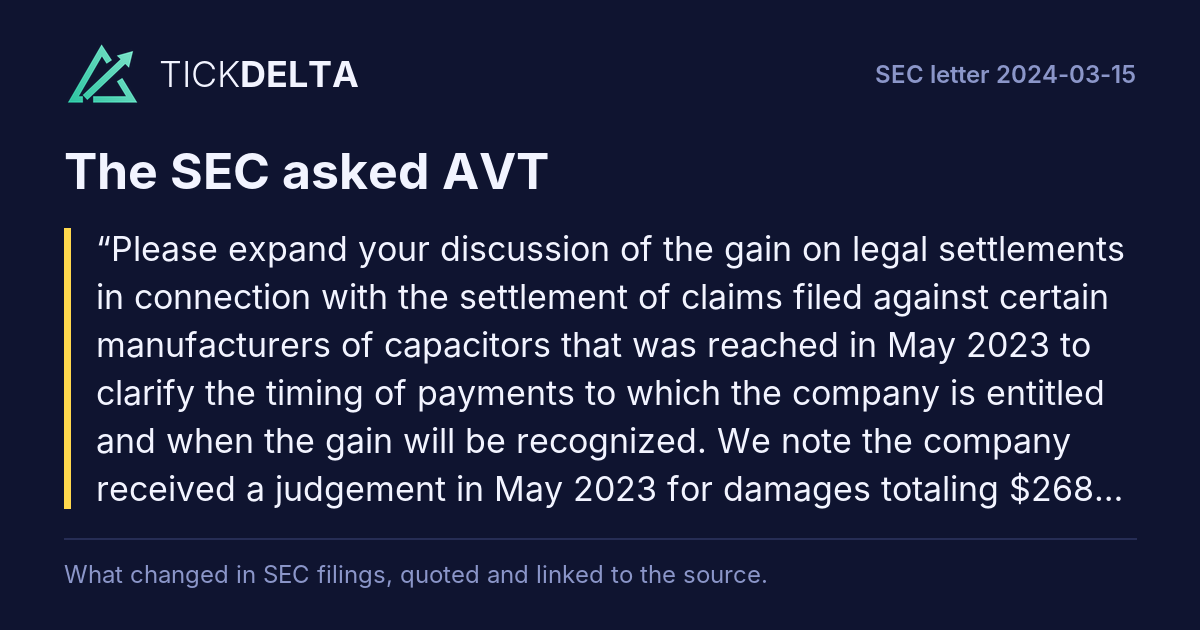
Please expand your discussion of the gain on legal settlements in connection with the settlement of claims filed against certain manufacturers of capacitors that was reached in May 2023 to clarify the timing of payments to which the company is entitled and when the gain will be recognized.Rest of the question
We note the company received a judgement in May 2023 for damages totaling $268 million from this litigation of which $74.4 was recognized as a gain during fiscal year 2023. Refer to Item 303(b) of Regulation S-K.
We hereby advise that our next periodic filing will include an expanded discussion of the legal settlement that was realized in the first quarter of fiscal 2024. As background, the Company settled claims with several capacitor manufacturers throughout fiscal year 2023, for a total of $74.4 million in realizable gains that we disclosed in our Form 10-K for fiscal year 2023 (p. 26 and p. 63, footnote 13). We realized $69.9 million of those gains in cash during fiscal year 2023.Read in the replyRest of the answer
We realized the remainder of $4.5 million in cash during the first half of fiscal year 2024.
In the fourth quarter of fiscal year 2023, we achieved a judgment against one capacitor manufacturer of $268 million. However, for several reasons, that judgement was not realizable as of July 1, 2023. To ensure a timely and successful result, we settled with the defendant for a lesser amount in the first quarter of fiscal year 2024, prior to the filing of our Form 10-K for fiscal year 2023, and disclosed that settlement as a subsequent event. The settlement was realized in cash at the end of the first quarter of fiscal year 2024.
First report after the company's reply of Apr 12, 2024: 10-Q filed May 3, 2024 ↗, against the 10-Q filed Feb 2, 2024 ↗.
Tickdelta does not hold the text of both reports, so they are not compared here.
Please explain the nature of the transactions for electronic components held for supply chain service engagements and the basis for the accounting as inventory on your balance sheet. You disclose the company is acting as an agent on behalf of an OEM or the supplier in these engagements.Rest of the question
During your second quarter earnings call on January 31, 2024 your CFO stated, "As a reminder, these service engagements are different from our traditional core EC business as the associated inventory is really the inventory of the OEM or the supplier that we hold on their behalf. The inventory is contractually restricted and the risk profile is different compared to inventories held for our core EC distribution business."
We respectfully acknowledge the Staff’s comment regarding our supply chain services engagements. In these engagements, we procure electronic components (“components”) from component manufacturers, store the components in our warehouses, and prepare the components for timely delivery for use in end products according to the customer’s instructions.Read in the replyRest of the answer
As a result, we act as the agent in these engagements, as the customer directs the use of and controls the underlying components, assumes quality and obsolescence risks associated with the components, and is responsible for setting the price of the components. In handling of warehousing the components, we bear the risks related to care and custody of the components while they are in our possession. Given that these supply chain services involve purchasing and warehousing components as part of the services, we classify the underlying components within inventories on the consolidated balance sheets. As the number and scale of these engagements has grown in recent quarters, we have enhanced our disclosures to offer financial statement users with visibility into the nature and amount of the components held for supply chain services, where control and the typical risks of inventory are not present.
First report after the company's reply of Apr 12, 2024: 10-Q filed May 3, 2024 ↗, against the 10-Q filed Feb 2, 2024 ↗.
Tickdelta does not hold the text of both reports, so they are not compared here.
Refer to the first paragraph in your executive summary. Please revise your discussion to explain how the softening demand for electronic components is expected to impact your sales and income from operations for the remainder of fiscal year 2024.Rest of the question
Your guidance furnished in your earnings release for the quarter ended December 30, 2023 reflects an anticipated sequential decline of 6% to 11% in the third quarter of fiscal year 2024. Refer to Item 303(a) of Regulation S-K.
We advise that, in our next periodic filing, we will discuss how anticipated softening (or increasing) demand may impact the Company’s sales and operating income. We anticipate our future disclosure will be similar to the following:Read in the reply
The global electronic components market has a history of cyclical downturns followed by periods of increased demand. Beginning in the second half of calendar year 2023, the industry began to experience a downturn marked by a decrease in sales due to a combination of elevated customer inventory levels and lower underlying demand for electronic components.Rest of the answer
As a result, the Company has seen elevated inventory levels and decreased sales, resulting in lower operating income. The duration of the current downturn is uncertain and the Company expects sales in the fourth quarter of fiscal 2024 to be [X% to Y% lower] than third quarter sales, which will negatively impact operating income and diluted earnings per share.
First report after the company's reply of Apr 12, 2024: 10-Q filed May 3, 2024 ↗, against the 10-Q filed Feb 2, 2024 ↗.
Tickdelta does not hold the text of both reports, so they are not compared here.
Please revise your discussion for Electronic Components (EC) sales to quantify the extent to which changes are attributable to changes in prices or to changes in the volume or amount of products or services being sold. Refer to Item 303(b)(2) of Regulation S-K.
We advise that our future periodic filings, beginning with our Form 10-Q for the third quarter of fiscal 2024, will include a discussion of changes in sales attributable to changes in prices and changes in volume. We note that for the second quarter of fiscal 2024 and for the first half of fiscal 2024, the changes in sales for EC were substantially all related to changes in the volume of products being sold.Read in the reply
Please revise your discussion and analysis of cash flows to analyze the underlying reasons for material changes, as well as on their reasonably likely impact on future cash flows and cash management decisions. Where reported amounts of cash provided and used by operations, investing activities or financing have been consistent, if the underlying sources of those cash flows have materially varied, analysis of thatRest of the question
variability should be provided. Please note that merely citing changes in results, working capital items, and noncash items reported in the statement of cash flows may not provide a sufficient basis to understand changes in operating cash between periods. Refer to section IV.B and B.1 of Release No. 33-8350 for guidance.
We advise that our future periodic filings, beginning with our Form 10-Q for the third quarter of fiscal 2024, will provide a more comprehensive analysis of the underlying reasons for material changes in cash flows and their reasonably likely impact on future cash flows and cash management decisions.Read in the reply
First report after the company's reply of Apr 12, 2024: 10-Q filed May 3, 2024 ↗, against the 10-Q filed Feb 2, 2024 ↗.
Tickdelta does not hold the text of both reports, so they are not compared here.
Please present and reconcile the most directly comparable GAAP measure for the the non- GAAP measures Adjusted Operating Margin, Adjusted EPS, Adjusted Operating Expenses, Adjusted Operating Income, and Adjusted Diluted EPS in the investor presentation. Please reconcile and revise the labeling of the non-GAAP measures Adjusted EPS and Adjusted Diluted EPS. Refer to Item 100(a)(1) and Item 100(a)(2) of Regulation G.
We advise that our future earnings presentations will present the most directly comparable GAAP financial measure for any non-GAAP financial measure that we present. We will also include non-GAAP to GAAP reconciliations in our earnings presentation, rather than cross reference to the reconciliations included in our earnings release Form 8-K. We will also update the labelling with regard to Adjusted Diluted Earnings Per Share.Read in the reply
First report after the company's reply of Apr 12, 2024: 10-Q filed May 3, 2024 ↗, against the 10-Q filed Feb 2, 2024 ↗.
Tickdelta does not hold the text of both reports, so they are not compared here.
Referencing the final measure, please revise your description of operating expenses to clearly reflect as Adjusted Operating Expenses consistent with the bar graph. In closing, we remind you that the company and its management are responsible for the accuracy and adequacy of their disclosures, notwithstanding any review, comments, action or absence of action by the staff.
We advise that, in future earnings presentations, we will consistently label non-GAAP financial measures, such as Adjusted Operating Expenses.Read in the reply
* * * * *
If any of these responses require further explanation, please do not hesitate to contact me at 480-643-7510. In addition, please feel free to contact Mike McCoy, Senior Vice President and Chief Legal Officer, at 480-643-7248. We look forward to working with you in completion of your review of the above referenced filing.
First report after the company's reply of Apr 12, 2024: 10-Q filed May 3, 2024 ↗, against the 10-Q filed Feb 2, 2024 ↗.
Tickdelta does not hold the text of both reports, so they are not compared here.
We note your response to prior comment 2. Please further explain to us your accounting for transactions for electronic components held for supply chain service engagements by providing example representative journal entries (with example dollar amounts) you record upon receipt, preparation, and delivery of such components (including the effects of such transactions on your inventory, revenue, cost of sales, and anyRest of the question
other impacted accounts).
The below assumptions and illustrative journal entries provide an example of the underlying balance sheet and statement of operations impacts from supply chain services engagements:Read in the reply
Assumptions
· Avnet purchases components from supplier, under contract between customer and supplier, at beginning of Month 1 with 30-day payment terms;
· Avnet warehouses components until Month 3 when customer needs components to place into production;
· Avnet delivers components to customer’s desired manufacturing location at the end of Month 3, with 30-day payment terms;
· Avnet charges services feesRest of the answer
comprised of warehousing fees of 4% of component value per month held and component delivery fees of 5% of component value shipped; and
· All amounts and percentages are illustrative in the example below.
Avnet, Inc.
2211 S. 47th Street, Phoenix, AZ 85034
480.643.7510
Illustrative Journal Entries
Month 1 – Purchase and Payment
Dr. Inventory (Components held for supply chain services)
$ 1,000,000
Cr. Accounts Payable
To record the purchase of components from suppliers under customer’s pricing and contract.
Dr. Accounts Payable
Cr. Cash
To record the settlement of accounts payable with supplier associated with components purchased above.
Monthly Entries for Warehousing Services (Months
1, 2 and 3 same entries are recorded)
Dr. Warehousing Services Accounts Receivable
$ 40,000
Cr. Warehousing Services Revenue
Dr. Cost of Supply Chain services expense
$ 25,000
Cr. Accrued Expenses
To record monthly warehousing services revenue and corresponding costs of providing warehousing services.
Dr. Cash
Cr. Warehousing Services Accounts Receivable
To collect customer payment for warehousing services.
Dr. Accrued Expenses
To record payment of accrued expenses related to warehousing services.
Month 3 – Shipment of Components to customer-requested manufacturing location
Dr. Accounts Receivable (billed at component cost)
Cr. Inventory (Components)
Dr. Accounts Receivable- Supply Chain Delivery Services fees
$ 50,000
Cr. Supply Chain Delivery Services Revenue
Dr. Cost of Supply Chain Delivery Services Expense
$ 30,000
To record the shipment of components held for supply chain services to the customer location and record the services revenues and related cost of delivery services.
Month 4 – Collection of cash from customer and payments for cost of services
Cr. Accounts Receivable
Cr. Accounts Receivable - Supply Chain Delivery Services fees
To record the cash receipts from customers and payments for cost of delivery services.
* * * * *
If any of these responses require further explanation, please do not hesitate to contact me at 480-643-7510. In addition, please feel free to contact Mike McCoy, Senior Vice President and Chief Legal Officer, at 480-643-7248. We look forward to working with you in completion of your review of the above referenced filing.
First report after the company's reply of May 14, 2024: 10-K filed Aug 14, 2024 ↗, against the 10-K filed Aug 18, 2023 ↗.
Tickdelta does not hold the text of both reports, so they are not compared here.
Also in this review: closing letter, 2024-06-03